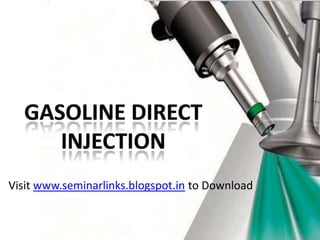
Visit www.seminarlinks.blogspot.in to Download
• Gasoline direct-injection engines generate
the air/fuel mixture in the combustion
chamber.
• During the induction stroke, only the
combustion air flows through the open intake
valve.
• The fuel is injected directly into the
combustion chamber by special fuel
injectors.
Major Objectives of the GDI engine
Ultra-low fuel consumption that betters that
of even diesel engines
Superior power to conventional MPI engines
WHY NOT CARBURETTOR?
Carburetor has following disadvantages
 Vapor lock
 Perfect air/fuel mixture cannot be obtained
 Lack of throttle response
 Low volumetric efficiency
 Icing – problem in aircraft engines
 Mechanical device
 Compromises on emission
Transition of fuel supply
Major characteristics of the GDI engine
1. Lower fuel and higher output consumption
 Optimal fuel spray for two-combustion
mode
 Ultra-lean Combustion Mode
 Superior Output Mode
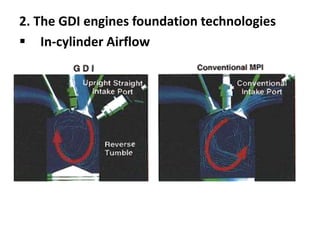
2. The GDI engines foundation technologies
 In-cylinder Airflow
Realization of lower fuel consumption
 Basic Concept
• In conventional gasoline engines, dispersion of an
air-fuel mixture with the ideal density around the
spark plug was very difficult. However, this is
possible in the GDI engine.
Furthermore, extremely low fuel consumption is
achieved because ideal stratification enables fuel
injected late in the compression stroke to
maintain an ultra-lean air-fuel mixture.
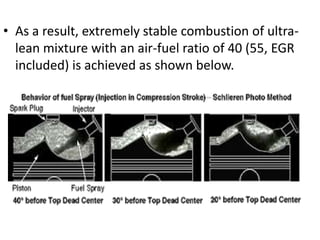
• As a result, extremely stable combustion of ultralean mixture with an air-fuel ratio of 40 (55, EGR
included) is achieved as shown below.
Combustion of Ultra-lean Mixture


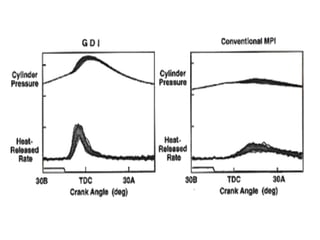
In conventional MPI engines, there were limits to
the mixtures leanness due to large changes in
combustion characteristics. However, the
stratified mixture of the GDI enabled greatly
decreasing the air-fuel ratio without leading to
poorer combustion. For example, during idling
when combustion is most inactive and
unstable, the GDI engine maintains a stable and
fast combustion even with an extremely lean
mixture of 40 to 1 air-fuel ratio (55 to 1, EGR
included)
Vehicle Fuel Consumption
Fuel Consumption during Idling
 The GDI engine maintains stable combustion
even at low idle speeds.
 Moreover, it offers greater flexibility in setting
the idle speed.
 Compared to conventional engines, its fuel
consumption during idling is 40% less.
Graph
Emission control
• However, in the case of GDI engine, 97% NOx
reduction is achieved by utilizing high-rate
EGR (Exhaust Gas Ratio) such as 30% that is
allowed by the stable combustion unique to
the GDI as well as a use of a newly developed
lean-NOx catalyst.
Realization of Superior Output
Basic concept
 To achieve power superior to conventional
MPI engines, the GDI engine has a high
compression ratio and a highly efficient air
intake system, which result in improved
volumetric efficiency.
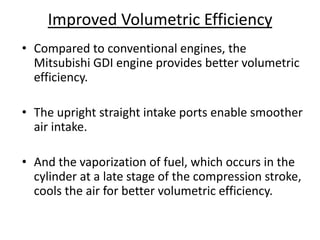
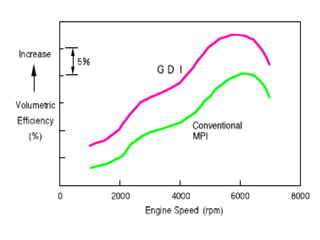
Improved Volumetric Efficiency
• Compared to conventional engines, the
Mitsubishi GDI engine provides better volumetric
efficiency.
• The upright straight intake ports enable smoother
air intake.
• And the vaporization of fuel, which occurs in the
cylinder at a late stage of the compression stroke,
cools the air for better volumetric efficiency.
Increased Compression Ratio
• The cooling of air inside the cylinder by the
vaporization of fuel has another benefit, to minimize
engine knocking. This allows a high compression
ratio of 12, and thus improved combustion efficiency
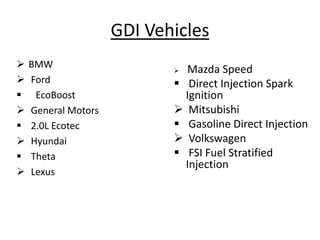
GDI Vehicles









BMW
Ford
EcoBoost
General Motors
2.0L Ecotec
Hyundai
Theta
Lexus

Mazda Speed
 Direct Injection Spark
Ignition
 Mitsubishi
 Gasoline Direct Injection
 Volkswagen
 FSI Fuel Stratified
Injection

Gasoline direct injection (GDI) engine technology
has received considerable attention
over the last few years as a way to significantly
improve fuel efficiency without making a major
shift away from conventional internal
combustion technology. In many respects, GDI
technology represents a further step in the natural
evolution of gasoline engine fueling systems.
References
• http://personales.upv.es/~jlpeidro/gdi/gdi.ht
m
• http://auto.howstuffworks.com/directinjection-engine.htm
• http://en.wikipedia.org/wiki/Gasoline_direct_
injection
• Video- Youtube.com
Gasoline Direct-Injection Engines (GDI)

Gasoline Direct-Injection Engines (GDI)

  • 1.
  • 2.
    • Gasoline direct-injectionengines generate the air/fuel mixture in the combustion chamber. • During the induction stroke, only the combustion air flows through the open intake valve. • The fuel is injected directly into the combustion chamber by special fuel injectors.
  • 3.
    Major Objectives ofthe GDI engine Ultra-low fuel consumption that betters that of even diesel engines Superior power to conventional MPI engines
  • 4.
    WHY NOT CARBURETTOR? Carburetorhas following disadvantages  Vapor lock  Perfect air/fuel mixture cannot be obtained  Lack of throttle response  Low volumetric efficiency  Icing – problem in aircraft engines  Mechanical device  Compromises on emission
  • 5.
  • 6.
    Major characteristics ofthe GDI engine 1. Lower fuel and higher output consumption  Optimal fuel spray for two-combustion mode  Ultra-lean Combustion Mode  Superior Output Mode
  • 7.
    2. The GDIengines foundation technologies  In-cylinder Airflow
  • 8.
    Realization of lowerfuel consumption  Basic Concept • In conventional gasoline engines, dispersion of an air-fuel mixture with the ideal density around the spark plug was very difficult. However, this is possible in the GDI engine. Furthermore, extremely low fuel consumption is achieved because ideal stratification enables fuel injected late in the compression stroke to maintain an ultra-lean air-fuel mixture.
  • 9.
    • As aresult, extremely stable combustion of ultralean mixture with an air-fuel ratio of 40 (55, EGR included) is achieved as shown below.
  • 10.
    Combustion of Ultra-leanMixture  In conventional MPI engines, there were limits to the mixtures leanness due to large changes in combustion characteristics. However, the stratified mixture of the GDI enabled greatly decreasing the air-fuel ratio without leading to poorer combustion. For example, during idling when combustion is most inactive and unstable, the GDI engine maintains a stable and fast combustion even with an extremely lean mixture of 40 to 1 air-fuel ratio (55 to 1, EGR included)
  • 12.
    Vehicle Fuel Consumption FuelConsumption during Idling  The GDI engine maintains stable combustion even at low idle speeds.  Moreover, it offers greater flexibility in setting the idle speed.  Compared to conventional engines, its fuel consumption during idling is 40% less.
  • 13.
  • 14.
    Emission control • However,in the case of GDI engine, 97% NOx reduction is achieved by utilizing high-rate EGR (Exhaust Gas Ratio) such as 30% that is allowed by the stable combustion unique to the GDI as well as a use of a newly developed lean-NOx catalyst.
  • 15.
    Realization of SuperiorOutput Basic concept  To achieve power superior to conventional MPI engines, the GDI engine has a high compression ratio and a highly efficient air intake system, which result in improved volumetric efficiency.
  • 16.
    Improved Volumetric Efficiency •Compared to conventional engines, the Mitsubishi GDI engine provides better volumetric efficiency. • The upright straight intake ports enable smoother air intake. • And the vaporization of fuel, which occurs in the cylinder at a late stage of the compression stroke, cools the air for better volumetric efficiency.
  • 18.
    Increased Compression Ratio •The cooling of air inside the cylinder by the vaporization of fuel has another benefit, to minimize engine knocking. This allows a high compression ratio of 12, and thus improved combustion efficiency
  • 19.
    GDI Vehicles         BMW Ford EcoBoost General Motors 2.0LEcotec Hyundai Theta Lexus Mazda Speed  Direct Injection Spark Ignition  Mitsubishi  Gasoline Direct Injection  Volkswagen  FSI Fuel Stratified Injection 
  • 21.
    Gasoline direct injection(GDI) engine technology has received considerable attention over the last few years as a way to significantly improve fuel efficiency without making a major shift away from conventional internal combustion technology. In many respects, GDI technology represents a further step in the natural evolution of gasoline engine fueling systems.
  • 22.