ME6016 ADVANCED I.C ENGINES - SYLLABUS
UNIT I SPARK IGNITION ENGINES
Mixture requirements – Fuel injection systems – Monopoint, Multipoint & Direct injection -
Stages of combustion – Normal and Abnormal combustion – Knock - Factors affecting
knock – Combustion chambers.
UNIT II COMPRESSION IGNITION ENGINES
Diesel Fuel Injection Systems - Stages of combustion – Knocking – Factors affecting knock
– Direct and Indirect injection systems – Combustion chambers – Fuel Spray behaviour –
Spray structure and spray penetration – Air motion - Introduction to Turbocharging.
OBJECTIVES:
 To understand the underlying principles of operation of different IC Engines
and components.
 To provide knowledge on pollutant formation, control, alternate fuel etc.
UNIT III POLLUTANT FORMATION AND CONTROL
Pollutant – Sources – Formation of Carbon Monoxide, Unburnt hydrocarbon,
Oxides of Nitrogen, Smoke and Particulate matter – Methods of controlling
Emissions – Catalytic converters, Selective Catalytic Reduction and Particulate Traps
– Methods of measurement – Emission norms and Driving cycles.
UNIT IV ALTERNATIVE FUELS
Alcohol, Hydrogen, Compressed Natural Gas, Liquefied Petroleum Gas and Bio
Diesel - Properties, Suitability, Merits and Demerits - Engine Modifications.
UNIT V RECENT TRENDS
Air assisted Combustion, Homogeneous charge compression ignition engines –
Variable Geometry turbochargers – Common Rail Direct Injection Systems - Hybrid
Electric Vehicles – NOx Adsorbers - Onboard Diagnostics.
ME6016 ADVANCED I.C ENGINES - SYLLABUS
OUTCOME
Upon completion of this course, the students would be able to compare the operations of
different IC Engine and components and can evaluate the pollutant formation, control,
alternate fuel
TEXT BOOKS:
1. Ramalingam. K.K., "Internal Combustion Engine undamentals", Scitech Publications, 2002.
2. Ganesan, "Internal Combustion Engines", II Edition, TMH, 2002.
*3. Rajput R. K., "Internal Combustion Engines”
*4. Gupta H N "Internal Combustion Engines”
*5. Thipse B P “Internal Combustion Engines”
REFERENCES:
1. Mathur. R.B. and R.P. Sharma, "Internal Combustion Engines"., Dhanpat Rai & Sons 2007.
2. Duffy Smith, "Auto Fuel Systems", The Good Heart Willcox Company, Inc., 1987.
3. Eric Chowenitz, "Automobile Electronics", SAE Publications, 1995
*4. Gill & Smith, “Internal Combustion Engines”
* Apart from the books prescribed in the syllabus
ME6016 ADVANCED I.C ENGINES - SYLLABUS
UNIT I
S I ENGINES
COMBUSTION IN SI ENGINES
AIR-FUEL MIXTURES
 An engine is generally operated at different loads and speeds.
 For this, proper air-fuel mixture should be supplied to the engine cylinder.
 Fuel and air are mixed to form three different types of mixtures.
 Chemically correct mixture
 Rich mixture and
 Lean mixture
 Chemically correct or stoichiometric mixture is one in which there is just enough
air for complete combustion of the fuel. For example to burn one kg of octane
(C8 H18) completely 15.12 kg of air is required.
 Hence chemically correct A/F ratio for C8 H18 is 15.12:1;usually approximated to
15:1.
 This chemically correct mixture will vary only slightly in numerical value between
different hydrocarbon fuels.
 It is always computed from the chemical equation for complete combustion for a
particular fuel.
COMBUSTION IN SI ENGINES
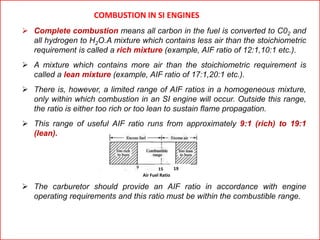
 Complete combustion means all carbon in the fuel is converted to C02 and
all hydrogen to H2O.A mixture which contains less air than the stoichiometric
requirement is called a rich mixture (example, AIF ratio of 12:1,10:1 etc.).
 A mixture which contains more air than the stoichiometric requirement is
called a lean mixture (example, AIF ratio of 17:1,20:1 etc.).
 There is, however, a limited range of AIF ratios in a homogeneous mixture,
only within which combustion in an SI engine will occur. Outside this range,
the ratio is either too rich or too lean to sustain flame propagation.
 This range of useful AIF ratio runs from approximately 9:1 (rich) to 19:1
(lean).
 The carburetor should provide an AIF ratio in accordance with engine
operating requirements and this ratio must be within the combustible range.
15 19
Air Fuel Ratio
COMBUSTION IN SI ENGINES
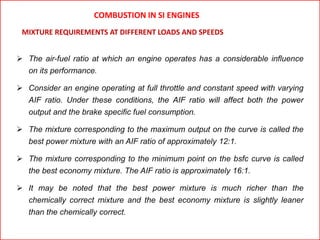
 The air-fuel ratio at which an engine operates has a considerable influence
on its performance.
 Consider an engine operating at full throttle and constant speed with varying
AIF ratio. Under these conditions, the AIF ratio will affect both the power
output and the brake specific fuel consumption.
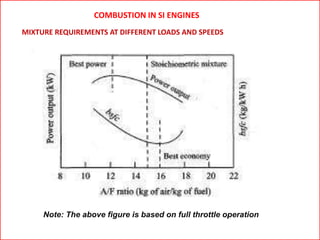
 The mixture corresponding to the maximum output on the curve is called the
best power mixture with an AIF ratio of approximately 12:1.
 The mixture corresponding to the minimum point on the bsfc curve is called
the best economy mixture. The AIF ratio is approximately 16:1.
 It may be noted that the best power mixture is much richer than the
chemically correct mixture and the best economy mixture is slightly leaner
than the chemically correct.
MIXTURE REQUIREMENTS AT DIFFERENT LOADS AND SPEEDS
COMBUSTION IN SI ENGINES
MIXTURE REQUIREMENTS AT DIFFERENT LOADS AND SPEEDS
Note: The above figure is based on full throttle operation
 The AIF ratios for the best power and best economy at part throttle are not
strictly the same as at full throttle.
 If the AIF ratios for best power and best economy are constant over the full
range of throttle operation and if the influence of other factors is
disregarded, the ideal fuel metering device would be merely a two position
carburetor.
 Such a carburetor could be set for the best power mixture when maximum
performance is desired and for the best economy mixture when the primary
consideration is the fuel economy.
 Actual engine requirements, however, again preclude the use of such a
simple and convenient arrangement. These requirements are discussed in
the succeeding section.
 Under normal conditions it is desirable to run the engine on the maximum
economy mixture, viz., around 16:1 air-fuel ratio. For quick acceleration
and for maximum power, rich mixture, viz., 12:1 air-fuel ratio is required.
MIXTURE REQUIREMENTS AT DIFFERENT LOADS AND SPEEDS
COMBUSTION IN SI ENGINES
AUTOMOTIVE ENGINE AIR-FUEL MIXTURE REQUIREMENTS
COMBUSTION IN SI ENGINES
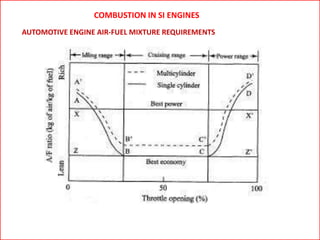
 Actual air-fuel mixture requirements in an automotive engine vary
considerably from the ideal conditions discussed in the previous section.
 For successful operation of the engine, the carburetor has to provide
mixtures which follow the general shape of the curve ABCD (single
cylinder) and A'B'C'D' (multicylinder) which represents a typical automotive
engine requirement.
 The carburetor must be suitably designed to meet the various engine
requirements.
 There are three general ranges of throttle operation.
 In each of these, the automotive engine requirements differ.
 As a result, the carburetor must be able to supply the required air-fuel ratio
to satisfy these demands. These ranges are:
 Idling (mixture must be enriched)
 Cruising (mixture must be leaned)
 High Power (mixture must be enriched)
AUTOMOTIVE ENGINE AIR-FUEL MIXTURE REQUIREMENTS
COMBUSTION IN SI ENGINES
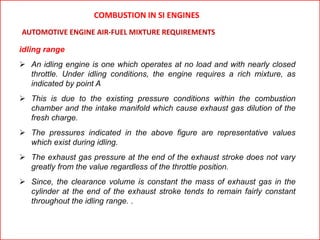
idling range
 An idling engine is one which operates at no load and with nearly closed
throttle. Under idling conditions, the engine requires a rich mixture, as
indicated by point A
 This is due to the existing pressure conditions within the combustion
chamber and the intake manifold which cause exhaust gas dilution of the
fresh charge.
 The pressures indicated in the above figure are representative values
which exist during idling.
 The exhaust gas pressure at the end of the exhaust stroke does not vary
greatly from the value regardless of the throttle position.
 Since, the clearance volume is constant the mass of exhaust gas in the
cylinder at the end of the exhaust stroke tends to remain fairly constant
throughout the idling range. .
AUTOMOTIVE ENGINE AIR-FUEL MIXTURE REQUIREMENTS
COMBUSTION IN SI ENGINES
Idling range
 The amount of fresh charge brought in. during idling, however is much
less than that during full throttle operation, due to very small opening of
the throttle. This results in a much larger proportion of exhaust gas being
mixed with the fresh charge under idling conditions.
 Further, with nearly closed throttle the pressure in the intake manifold is
considerably below atmospheric due to restriction to the air flow.
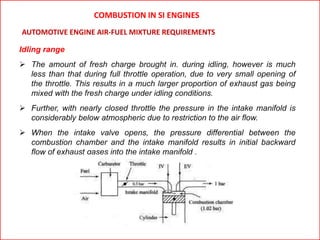
 When the intake valve opens, the pressure differential between the
combustion chamber and the intake manifold results in initial backward
flow of exhaust gases into the intake manifold .
AUTOMOTIVE ENGINE AIR-FUEL MIXTURE REQUIREMENTS
COMBUSTION IN SI ENGINES
Idling range
 As the piston proceeds down on the intake stroke, these exhaust gases
are drawn back into the cylinder along with the fresh charge.
 As a result, the final mixture of fuel and air in the combustion chamber is
diluted more by exhaust gas. The presence of this exhaust gas tends to
obstruct the contact of fuel and air particles a requirement necessary for
combustion,
 This results in poor combustion and, as a result, in loss of power. It is,
therefore, necessary to provide more fuel particles by richening the air-fuel
mixture. Thus richening increases the probability of contact between fuel
and air particles and thus improves combustion.
 As the throttle is gradually opened from A to B, the pressure differential
between the inlet manifold and the cylinder becomes smaller and the
exhaust gas dilution of the fresh charge diminishes.
 Mixture requirements then proceed along line AB to a leaner AIF ratio
required for the cruising operation.
AUTOMOTIVE ENGINE AIR-FUEL MIXTURE REQUIREMENTS
COMBUSTION IN SI ENGINES
Cruising range
 In the cruising range from B to C ,the exhaust gas dilution problem is
relatively insignificant.
 The primary interest lies in obtaining the maximum fuel economy.
 Consequently, in this range, it is desirable that the carburetor provides
the engine with the best economy mixture.
 In the cruising range, the mass of charge is smaller and the tendency to
burn the exhaust valve is not as high.
AUTOMOTIVE ENGINE AIR-FUEL MIXTURE REQUIREMENTS
COMBUSTION IN SI ENGINES
Power Range
 During peak power operation the engine requires a richer mixture, as
indicated by the line CD, for the following reasons
 (i) To provide best power:
 Since high power is desired, it is logical to transfer the economy
settings of the cruising range to that mixture which will produce the
maximum power, or a setting in the vicinity of the best power
mixture, usually in the range of 12:1.
 (ii) To prevent overheating of exhaust valve and the area near it:
 At high power, the increased mass of gas at higher temperatures
passing through the cylinder results in the necessity of transferring
greater quantities of heat away from critical areas such as those
around the exhaust valve.
 En richening the mixture reduces the flame temperature and This
reduces the cooling problem and also reduces the tendency to
damage exhaust valves at high power.
AUTOMOTIVE ENGINE AIR-FUEL MIXTURE REQUIREMENTS
COMBUSTION IN SI ENGINES
Power Range
 In an automobile engine, indication of knocking occurs in the form of an
audible sound and the operator can make the engine operating conditions
less stringent by releasing the throttle or by shifting to a lower gear.
 Furthermore, automobile engines generally operate well below full power
and a complicated and expensive system for enrichment for this purpose is
not economically feasible, although some means of richening at high power
is usually incorporated.
 For aircraft engine installations, the complication and expense is justified
because of the necessity to increase power during take off. Figure then, is
better representative of a typical engine requirements for the carburetor.
 Automobile engine requirement are similar in the idling and cruising ranges
but tend to be relatively lower or less rich, in the power range (C to D). The
portion of the curve from D to E indicates the requirements after the throttle
is wide open and the load is further increased.
AUTOMOTIVE ENGINE AIR-FUEL MIXTURE REQUIREMENTS
COMBUSTION IN SI ENGINES
Combustion of Homogeneous Mixture
 In spark-ignition engines a nearly homogeneous mixture of air and fuel is
formed in the carburettor.
 Homogeneous mixture is thus formed outside the engine cylinder and the
combustion is initiated inside the cylinder at a particular instant towards the
end of the compression stroke.
 The flame front spreads over a combustible mixture with a certain velocity. In
a homogeneous gas mixture the fuel and oxygen molecules are more or
less, uniformly distributed.
 Once the fuel vapour-air mixture is ignited, a flame front appears and rapidly
spreads through the mixture.
 The flame propagation is caused by heat transfer and diffusion of burning
fuel molecules from the combustion zone to the adjacent layers of un burnt
mixture.
 The flame front is a narrow zone separating the fresh mixture from the
combustion products.
 The velocity with which the flame front moves, with respect to the unburned
mixture in a direction normal to its surface is called the normal flame velocity
COMBUSTION IN SI ENGINES
Combustion of Homogeneous Mixture
 In a homogeneous mixture with an equivalence ratio, ¢,'(the ratio of the
actual fuel-air ratio to the stoichiometric fuel-air ratio) close to 1.0, the flame
speed is normally of the order of 40 cm/s.
 However, in a spark-ignition engine the maximum flame speed is obtained
when ¢ is between 1.1 and 1.2, i.e., when the mixture is slightly richer than
stoichiometric.
 If the equivalence ratio is outside this range the flame speed drops rapidly to
a low value.
 When the flame speed drops to a very low value, the heat loss from the
combustion zone becomes equal to the amount of heat-release due to
combustion and the flame gets extinguished.
 Therefore, it is quite preferable to operate the engine within an equivalence
ratio of 1.1 to 1.2 for proper combustion.
 However, by introducing turbulence and incorporating proper air movement,
the flame speed can be increased in mixtures outside the above range.
COMBUSTION IN SI ENGINES
Stages of Combustion in SI Engines
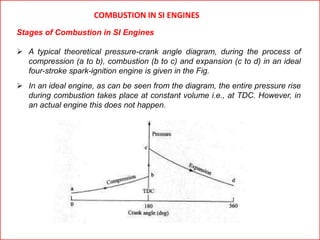
 A typical theoretical pressure-crank angle diagram, during the process of
compression (a to b), combustion (b to c) and expansion (c to d) in an ideal
four-stroke spark-ignition engine is given in the Fig.
 In an ideal engine, as can be seen from the diagram, the entire pressure rise
during combustion takes place at constant volume i.e., at TDC. However, in
an actual engine this does not happen.
COMBUSTION IN SI ENGINES
Stages of Combustion in SI Engines
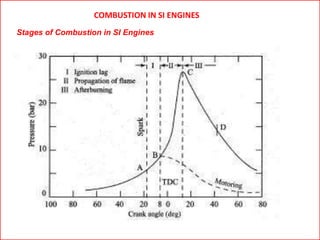
 There are three stages of combustion in SI Engines
 The point A is the passage of spark (say 20° bTDC), B is the point at
which the beginning of pressure rise can be detected (say 8° bTDC). and
C the attainment of peak pressure.
 AB represents the first stage
 BC the second stage and
 CD the third stage.
 The first stage (A-B) is referred to as the ignition lag or preparation
phase in which growth and development of a self propagating nucleus of
flame takes place.
 This is a chemical process depending upon both temperature and
pressure, the nature of the fuel and the proportion of the exhaust residual
gas.
 Further, it also depends upon the relationship between the temperature
and the rate of reaction.
COMBUSTION IN SI ENGINES
Stages of Combustion in SI Engines
 The second stage (B-C) is a physical one and it is concerned with the
spread of the flame throughout the combustion chamber.
 The starting point of the second stage is where the first measurable rise of
pressure is seen on the indicator diagram i.e., the point where the line of
combustion departs from the compression line (point B).
 This can be seen from the deviation from the motoring curve.
 During the second stage the flame propagates practically at a constant
velocity.
 Heat transfer to the cylinder wall is low, because only a small part of the
burning mixture comes in contact with the cylinder wall during this period.
 The rate of heat-release depends largely on the turbulence intensity and
also on the reaction rate which is dependent on the mixture composition.
 The rate of pressure rise is proportional to the rate of heat-release
because during this stage, the combustion chamber volume remains
practically constant (since piston is near the top dead centre).
COMBUSTION IN SI ENGINES
Stages of Combustion in SI Engines
 The starting point of the third stage is usually taken as the instant at which
the maximum pressure is reached on the indicator diagram (point C).
 The flame velocity decreases during this stage.
 The rate of combustion becomes low due to lower flame velocity and reduced
flame front surface.
 Since the expansion stroke starts before this stage of combustion, with the
piston moving away from the top dead centre, there can be no pressure rise
during this stage.
COMBUSTION IN SI ENGINES
Stages of Combustion in SI Engines
COMBUSTION IN SI ENGINES
Flame Front Propagation
 For efficient combustion, the rate of propagation of the flame front within
the cylinder is quite critical.
 The two important factors which determine the rate of movement of the
flame front across the combustion chamber are the reaction rate and the
transposition rate.
 The reaction rate is the result of a purely chemical combination process in
which the flame eats its way into the unburned charge.
 The transposition rate is due to the physical movement of the flame front
relative to the cylinder wall and is the result of the pressure differential
between the burning gases and the un-burnt gases in the combustion
chamber.
COMBUSTION IN SI ENGINES
Flame Front Propagation
COMBUSTION IN SI ENGINES
Flame Front Propagation
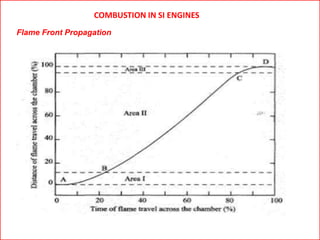
 In area I,(A-B), the flame front progresses relatively slowly due to a low
transposition rate and low turbulence.
 The transposition of the flame front is very little since there is a
comparatively small mass of charge burned at the start.
 The low reaction rate plays a dominant role resulting in a slow advance of
the flame.
 Also, since the spark plug is to be necessarily located in a quiescent layer of
gas that is close to the cylinder wall, the lack of turbulence reduces the
reaction rate and hence the flame speed.
 As the flame front leaves the quiescent zone and proceeds into more
turbulent areas (area II) where it consumes a greater mass of mixture, it
progresses more rapidly and at a constant rate (B-C)
 The volume of unburned charge is very much less towards the end of flame
travel and so the transposition rate again becomes negligible thereby
reducing the flame speed. The reaction rate is also reduced again since the
flame is entering a zone (area III) of relatively low turbulence (C-D).
COMBUSTION IN SI ENGINES
Factors affecting Flame Speed
 The study of factors which, affect the velocity of flame propagation is
important since the flame velocity influences the rate of pressure rise in the
cylinder and it is related to certain types of abnormal combustion that occur
in spark-ignition engines.
 There are several factors which affect the flame speed, to a varying degree,
the most important being the turbulence and the fuel-air ratio.
COMBUSTION IN SI ENGINES
Factors affecting Flame Speed
 Turbulence:
 The flame speed is quite low in non-turbulent mixtures and increases
with increasing turbulence.
 This is mainly due to the additional physical intermingling of the
burning and unburned particles at the flame front which expedites
reaction by increasing' the rate of contact.
 The turbulence in the incoming mixture is generated during the
admission of fuel-air mixture through comparatively narrow sections of
throttle pipe, valve openings etc., in the suction stroke.
 Turbulence which is supposed to consist of many minute swirls
appears to increase the rate of reaction and produce a higher flame
speed than that made up of larger and fewer swirls.
 A suitable design of the combustion chamber which involves the
geometry of cylinder head and piston crown increases the turbulence
during the compression stroke.
COMBUSTION IN SI ENGINES
Factors affecting Flame Speed
 Turbulence:
 Generally, turbulence increases the heat flow to the cylinder wall.
 It also accelerates the chemical reaction by intimate mixing of fuel and
oxygen so that spark advance may be reduced.
 This helps in working in lean mixtures also.
 The increase of flame speed due to turbulence reduces the combustion
duration and hence minimizes the tendency of abnormal combustion.
 However, excessive turbulence may extinguish the flame resulting in
rough and noisy operation of the engine.
COMBUSTION IN SI ENGINES
Factors affecting Flame Speed
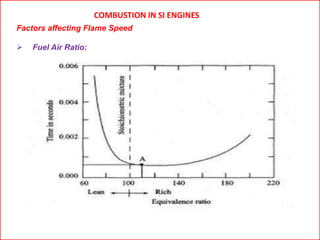
 Fuel Air Ratio:
 The fuel-air ratio has a very significant influence on the flame speed.
 The highest flame velocities (minimum time for complete combustion)
are obtained with somewhat richer mixture (point A) which shows the
effect of mixture strength on the rate of burning as indicated by the
time taken for complete burning in a given engine.
 When the mixture is made leaner or richer the flame speed decreases.
Less thermal energy is released in the case of lean mixtures resulting
in lower flame temperature.
 Very rich mixtures lead to incomplete combustion which results again
in the release of less thermal energy
COMBUSTION IN SI ENGINES
Factors affecting Flame Speed
 Fuel Air Ratio:
COMBUSTION IN SI ENGINES
Factors affecting Flame Speed
 Temperature and Pressure:
 Flame speed increases with an increase in intake temperature and
pressure.
 A higher initial pressure and temperature may help to form a better
homogeneous air-vapour mixture which helps in increasing the flame
speed.
 This is possible because of an overall increase in the density of the
charge
COMBUSTION IN SI ENGINES
Factors affecting Flame Speed
 Compression Ratio:
 A higher compression ratio increases the pressure and temperature of
the working mixture which reduce the initial preparation phase of
combustion and hence less ignition advance is needed. High pressures
and temperatures of the compressed mixture also speed up the
second phase of combustion.
 Increased compression ratio reduces the clearance volume and
therefore increases the density of the cylinder gases during burning.
This increases the peak pressure and temperature and the total
combustion duration is reduced.
 Thus engines having higher compression ratios have higher flame
speeds.
COMBUSTION IN SI ENGINES
Factors affecting Flame Speed
 Compression Ratio:
 A higher compression ratio increases the pressure and temperature of
the working mixture which reduce the initial preparation phase of
combustion and hence less ignition advance is needed. High pressures
and temperatures of the compressed mixture also speed up the
second phase of combustion.
 Increased compression ratio reduces the clearance volume and
therefore increases the density of the cylinder gases during burning.
This increases the peak pressure and temperature and the total
combustion duration is reduced.
 Thus engines having higher compression ratios have higher flame
speeds.
COMBUSTION IN SI ENGINES
Factors affecting Flame Speed
 Engine Output:
 The cycle pressure increases when the engine output is increased.
 With the increased throttle opening the cylinder gets filled to a higher
density.
 This results in increased flame speed.
 When the output is decreased by throttling, the initial and final
compression pressures decrease and the dilution of the working
mixture increases.
 The smooth development of self-propagating nucleus of flame
becomes unsteady and difficult.
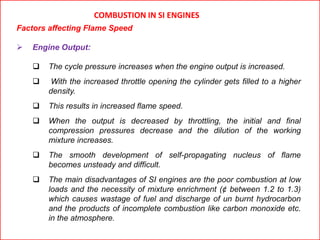
 The main disadvantages of SI engines are the poor combustion at low
loads and the necessity of mixture enrichment (¢ between 1.2 to 1.3)
which causes wastage of fuel and discharge of un burnt hydrocarbon
and the products of incomplete combustion like carbon monoxide etc.
in the atmosphere.
COMBUSTION IN SI ENGINES
Factors affecting Flame Speed
 Engine Speed:
 The flame speed increases almost linearly with engine speed since the
increase in engine speed increases the turbulence inside the cylinder.
 The time required for the flame to traverse the combustion space
would be halved, if the engine speed is doubled.
 Double the engine speed and hence half the original time would give
the same number of crank degrees for flame propagation.
 The crank angle required for the flame propagation during the entire
phase of combustion, will remain nearly constant at all speeds.
COMBUSTION IN SI ENGINES
Factors affecting Flame Speed
 Engine Size:
 The size of the engine does not have much effect on the rate of flame
propagation.
 In large engines the time required for complete combustion is more
because the flame has to travel a longer distance.
 This requires increased crank angle duration during the combustion.
This is one of the reasons why large sized engines are designed to
operate at low speeds.
COMBUSTION IN SI ENGINES
Abnormal Combustion
 In normal combustion, the flame initiated by the spark travels across
the combustion chamber in a fairly uniform manner.
 Under certain operating conditions the combustion deviates from its
normal course leading to loss of performance and possible damage to
the engine.
 This type of combustion may be termed as an abnormal combustion or
knocking combustion.
 The consequences of this abnormal combustion process are the loss
of power, recurring pre ignition and mechanical damage to the engine.
COMBUSTION IN SI ENGINES
Abnormal Combustion
The phenomenon of knock in si engines
 In a spark-ignition engine combustion which is initiated between the
spark plug electrodes spreads across the combustible mixture.
 A definite flame front which separates the fresh mixture from the
products of combustion travels from the' spark plug to the other end of
the combustion chamber.
 Heat-release due to combustion increases the temperature and
consequently the pressure, of the burned part of the mixture above
those of the unburned mixture.
 In order to effect pressure equalization the burned part of the mixture
will expand, and compress the unburned mixture adiabatically thereby
increasing its pressure and temperature.
 This process continues as the flame front advances through the
mixture and the temperature and pressure of the unburned mixture are
increased further.
COMBUSTION IN SI ENGINES
Abnormal Combustion
The phenomenon of knock in SI engines
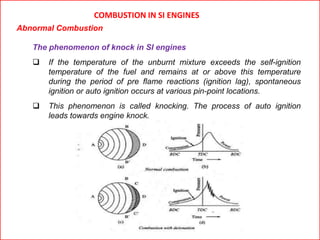
 If the temperature of the unburnt mixture exceeds the self-ignition
temperature of the fuel and remains at or above this temperature
during the period of pre flame reactions (ignition lag), spontaneous
ignition or auto ignition occurs at various pin-point locations.
 This phenomenon is called knocking. The process of auto ignition
leads towards engine knock.
COMBUSTION IN SI ENGINES
Abnormal Combustion
The phenomenon of knock in SI engines
 In the normal combustion the flame travels across the combustion
chamber from A towards D.
 The advancing flame front compresses the end charge BB'D farthest
from the spark plug, thus raising its temperature.
 The temperature is also increased due to heat transfer from the hot
advancing flame-front
 Also some preflame oxidation may take place in the end charge
leading to further increase in temperature.
 In spite of these factors if the temperature of the end charge had not
reached its self-ignition temperature, the charge would not auto ignite
and the flame will advance further and consume the charge BB'D.
COMBUSTION IN SI ENGINES
Abnormal Combustion
The phenomenon of knock in SI engines
 However, if the end charge BB'D reaches its auto ignition temperature
and remains .for some length of time equal to the time of pre flame
reactions the charge will auto ignite, leading to knocking combustion.
 It is assumed that when flame has reached the position BB" the charge
ahead of it has reached critical auto ignition temperature.
 During the pre flame reaction period if the flame front could move from
BB' to only CC’ then the charge ahead of CC’ would auto ignite.
 Because of the auto ignition, another flame front starts traveling in the
opposite direction to the main flame front.
 When the two flame fronts collide, a severe pressure pulse is
generated.
 The gas in the chamber is subjected to compression and rarefaction
along the pressure pulse until pressure equilibrium is restored.
COMBUSTION IN SI ENGINES
Abnormal Combustion
The phenomenon of knock in SI engines
 This disturbance can force the walls of the combustion chambers to
vibrate at the same frequency as the gas.
 Gas vibration frequency in automobile engines is of the order of 5000
cps.
 It is to be noted that the onset of knocking is very much dependent on
the properties of fuel.
 It is clear from the above description that if the unburned charge does
not reach its auto ignition temperature there will be no knocking.
 Further, if the initial phase i.e., ignition lag period, is longer than the
time required for the flame front to burn through the unburned charge,
there will be no knocking.
 But, if the critical temperature is reached and maintained, and the
ignition lag is shorter than the time it takes for the flame front to burn
through the unburned charge then the end charge will detonate.
COMBUSTION IN SI ENGINES
Abnormal Combustion
The phenomenon of knock in SI engines
 Hence, in order to avoid or inhibit detonation, a high auto-ignition
temperature and a long ignition lag are the desirable qualities for SI
engine fuels.
 In summary, when auto ignition occurs if two different types of vibration
may be produced.
 In one case a large-amount of mixture may auto ignite giving rise to a
very rapid increase in pressure throughout the combustion chamber and
there will be a direct blow on the engine structure.
 The human ear can detect the resulting thudding sound and consequent
noise from free vibrations of the engine parts.
 In the other case, large pressure differences may exist in the
combustion chamber and the resulting gas vibrations can force the walls
of the chamber to vibrate at the same frequency as the gas.
COMBUSTION IN SI ENGINES
Abnormal Combustion
The phenomenon of knock in SI engines
 An audible sound may be evident.
 The impact of knock on the engine components and structure can cause
engine failure and in addition the noise from engine vibration is always
objectionable.
 The pressure differences in the combustion chamber cause the gas to
vibrate and scrub the chamber walls causing increased loss of heat to
the coolant.
COMBUSTION IN SI ENGINES
Abnormal Combustion
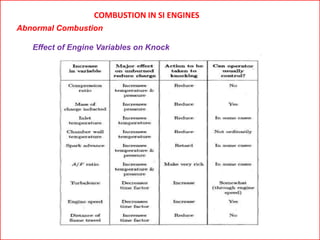
Effect of Engine Variables on Knock
 From the discussion on knock in the previous section, it may be seen
that four major factors are involved in either producing or preventing
knock.
 These are the temperature, pressure, density of the unburned charge
and the time factors.
 Since, the effect of temperature, pressure and density are closely
interrelated, these three are consolidated into one group and the time
factors into another group.
COMBUSTION IN SI ENGINES
Abnormal Combustion
Effect of Engine Variables on Knock
 Density Factors
 Any factor in the design or operation of an engine which tends to reduce
the temperature of the unburned charge should reduce the possibility of
knocking by reducing the temperature of the end charge for auto
ignition.
 Similarly, any factor which reduces the density of the charge tends to
reduce knocking by providing lower energy release.
 Further, the effect of the following parameters which are directly or
indirectly connected with temperature, pressure and density factors on
the possibility of knocking is discussed below.
COMBUSTION IN SI ENGINES
Abnormal Combustion
Effect of Engine Variables on Knock
 Density Factors
Compression Ratio:
 Compression ratio of an engine is an important factor which determines
both the pressure and temperature at the beginning of the combustion
process.
 Increase in compression ratio increases the pressure and temperature
of the gases at the end of the compression stroke.
 This decreases the ignition lag of the end gas and thereby increasing
the tendency for knocking.
 The overall increase in the density of the charge due to higher
compression ratio increases the pre flame reactions in the end charge
thereby increasing the knocking tendency of the engine,
 The increase in the knocking tendency of the engine with increasing
compression ratio is the main reason for limiting the compression ratio
to a lower value.
COMBUSTION IN SI ENGINES
Abnormal Combustion
Effect of Engine Variables on Knock
 Density Factors
Mass of Inducted Charge:
 A reduction in the mass of the inducted charge into the cylinder of an
engine by throttling or by reducing the amount of supercharging reduces
both temperature and density of the charge at the time of ignition.
 This decreases the tendency of knocking.
Inlet Temperature of the Mixture:
 Increase in the inlet temperature of the mixture makes the compression.
temperature higher thereby, increasing the tendency of knocking.
Further, volumetric efficiency will be lowered.
 Hence, a lower inlet temperature is always preferable to reduce
knocking.
 It is important that the temperature should not be so low as to cause
starting and vaporization problems in the engine.
COMBUSTION IN SI ENGINES
Abnormal Combustion
Effect of Engine Variables on Knock
 Density Factors
Temperature of the Combustion Chamber Walls:
 Temperature of the combustion chamber walls playa predominant role in
knocking.
 In order to prevent knocking the hot spots in the combustion chamber
should be avoided. '.
 Since; the spark plug and exhaust valve are two hottest parts in the
combustion chamber, the end gas should not be compressed against
them.
COMBUSTION IN SI ENGINES
Abnormal Combustion
Effect of Engine Variables on Knock
 Density Factors
Retarding the Spark Timing:
 By retarding the spark timing from the optimized timing, i.e., having the
spark closer to TDC, the peak pressures are reached farther down on
the power stroke and are thus of lower magnitude. This might reduce
the knocking.
 However, the spark timing will be different from the MBT timing. This will
affect the brake torque and power output of the engine.
Power Output of the Engine:
 A decrease in the output of the engine decreases the temperature of the
cylinder and the combustion chamber walls and also the pressure of the
charge thereby lowering mixture and end gas temperatures.
 This reduces the tendency to knock.
COMBUSTION IN SI ENGINES
Abnormal Combustion
Effect of Engine Variables on Knock
TIME FACTORS
 Increasing the flame speed or increasing the duration of the ignition
ignition lag or reducing the time of exposure of the unburned mixture to
autoignition condition will tend to reduce knocking.
 The following factors, in most cases, reduce the possibility of knocking.
Turbulence:
 Turbulence depends on the design of the combustion chamber and on
engine speed.
 Increasing turbulence increases the flame speed and reduces the time
available for the end charge to attain auto ignition conditions thereby
decreasing the tendency to knock.
COMBUSTION IN SI ENGINES
Abnormal Combustion
Effect of Engine Variables on Knock
TIME FACTORS
Engine Speed:
 An increase in engine speed increases the turbulence of the mixture
considerably resulting in increased flame speed, and reduces the time
available for preflame reactions. Hence knocking tendency is reduced at
higher speeds.
Flame Travel Distance:
 The knocking tendency is reduced by shortening the time required for
the flame front to traverse the combustion chamber.
 Engine size (combustion chamber size), and spark plug position are the
three important factors governing the flame travel distance.
COMBUSTION IN SI ENGINES
Abnormal Combustion
Effect of Engine Variables on Knock
TIME FACTORS
Engine Size:
 The flame requires a longer time to travel across the combustion
chamber of a larger engine.
 Therefore, a larger engine has a greater tendency for knocking than a
smaller engine since there is more time for the end gas to auto-ignite.
 Hence, an Sl engine is generally limited to size of about 150 mm bore.
COMBUSTION IN SI ENGINES
Abnormal Combustion
Effect of Engine Variables on Knock
TIME FACTORS
Combustion Chamber Shape:
 Generally, the more compact the combustion chamber is, the shorter is
the flame travel and the combustion time and hence better antiknock
characteristics.
 Therefore, the combustion chambers are made as spherical as possible
to minimize the length of the flame travel for a given volume.
 If the turbulence in the combustion chamber is high, the combustion rate
is high and consequently combustion time and knocking tendency are
reduced.
 Hence, the combustion chamber is shaped in such a way as to promote
turbulence.
COMBUSTION IN SI ENGINES
Abnormal Combustion
Effect of Engine Variables on Knock
TIME FACTORS
Location of Spark Plug:
 In order to have a minimum flame travel, the spark plug is centrally
located in the combustion chamber, it resulting in minimum knocking
tendency.
 The flame travel can also be reduced by using two or more spark plugs
in case of large engines.
COMPOSITION FACTORS
 Once the basic design of the engine is finalized, the fuel-air ratio and the
properties of the fuel, particularly the octane rating, plays crucial role in
controlling the knock.
COMBUSTION IN SI ENGINES
Abnormal Combustion
Effect of Engine Variables on Knock
COMPOSITION FACTORS
 Once the basic design of the engine is finalized, the fuel-air ratio and the
properties of the fuel, particularly the octane rating, plays crucial role in
controlling the knock.
COMBUSTION IN SI ENGINES
Abnormal Combustion
Effect of Engine Variables on Knock
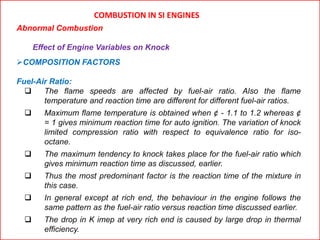
COMPOSITION FACTORS
Fuel-Air Ratio:
 The flame speeds are affected by fuel-air ratio. Also the flame
temperature and reaction time are different for different fuel-air ratios.
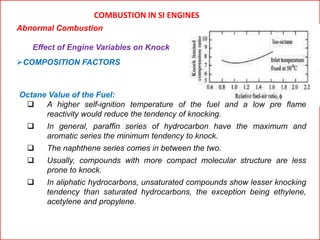
 Maximum flame temperature is obtained when ¢ - 1.1 to 1.2 whereas ¢
= 1 gives minimum reaction time for auto ignition. The variation of knock
limited compression ratio with respect to equivalence ratio for iso-
octane.
 The maximum tendency to knock takes place for the fuel-air ratio which
gives minimum reaction time as discussed, earlier.
 Thus the most predominant factor is the reaction time of the mixture in
this case.
 In general except at rich end, the behaviour in the engine follows the
same pattern as the fuel-air ratio versus reaction time discussed earlier.
 The drop in K imep at very rich end is caused by large drop in thermal
efficiency.
COMBUSTION IN SI ENGINES
Abnormal Combustion
Effect of Engine Variables on Knock
COMPOSITION FACTORS
Octane Value of the Fuel:
 A higher self-ignition temperature of the fuel and a low pre flame
reactivity would reduce the tendency of knocking.
 In general, paraffin series of hydrocarbon have the maximum and
aromatic series the minimum tendency to knock.
 The naphthene series comes in between the two.
 Usually, compounds with more compact molecular structure are less
prone to knock.
 In aliphatic hydrocarbons, unsaturated compounds show lesser knocking
tendency than saturated hydrocarbons, the exception being ethylene,
acetylene and propylene.
COMBUSTION IN SI ENGINES
Abnormal Combustion
Effect of Engine Variables on Knock
COMBUSTION IN SI ENGINES
COMBUSTION CHAMBERS FOR SI ENGINES
 The design of the combustion chamber for an SI engine has an
important chamber, influence on the engine performance and its
knocking tendencies.
 The design involves the shape of the combustion the location of spark
plug and the location of inlet and exhaust valves.
 The important requirements of an SI engine combustion chamber are to
provide high power output with minimum octane requirement, high
thermal efficiency and smooth engine operation
Reducing the Possibility of Knocking:
Reduction in the possibility of knocking in an engine can be achieved by,
 1) Reducing the distance of the flame travel by centrally locating the
spark plug and also by avoiding pockets of stagnant charge.
 2) Satisfactory cooling of the spark plug and of exhaust valve area which
are the source of hot spots in the majority of the combustion chambers.
 3) Reducing the temperature of the last portion of the charge through
application of a high surface to volume ratio in that part where the last
portion of the charge burns. Heat transfer to the combustion chamber
walls can be increased by using high surface to volume ratio thereby
 4) Power reducing the temperature.
COMBUSTION IN SI ENGINES
COMBUSTION CHAMBERS FOR SI ENGINES
High Output and Thermal Efficiency
 The main objective of the design and development of an engine is to
obtain high power as well as high thermal efficiency. This can be
achieved by considering the following factors:
 A high degree of turbulence is needed to achieve a high flame front
velocity.
 Turbulence is induced by inlet flow configuration or squish.
 Squish can be induced in spark-ignition engines by having a bowl in
piston or with a dome shaped cylinder head.
 Squish is the rapid radial movement of the gas trapped in between the
piston and the cylinder head into the bowl or the dome.
 High volumetric efficiency, i.e., more charge during the suction stroke,
results in an increased power output.
 This can be achieved by providing ample clearance around the valve
heads, large diameter valves and straight passages with minimum
pressure drop.
COMBUSTION IN SI ENGINES
COMBUSTION CHAMBERS FOR SI ENGINES
High Output and Thermal Efficiency
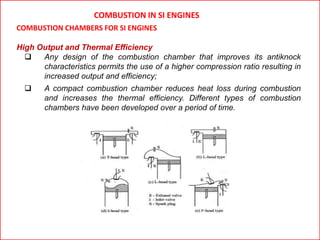
 Any design of the combustion chamber that improves its antiknock
characteristics permits the use of a higher compression ratio resulting in
increased output and efficiency;
 A compact combustion chamber reduces heat loss during combustion
and increases the thermal efficiency. Different types of combustion
chambers have been developed over a period of time.
COMBUSTION IN SI ENGINES
COMBUSTION CHAMBERS FOR SI ENGINES
High Output and Thermal Efficiency
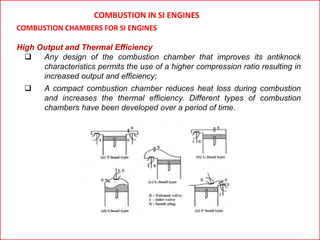
 Any design of the combustion chamber that improves its antiknock
characteristics permits the use of a higher compression ratio resulting in
increased output and efficiency;
 A compact combustion chamber reduces heat loss during combustion
and increases the thermal efficiency. Different types of combustion
chambers have been developed over a period of time.
COMBUSTION IN SI ENGINES
COMBUSTION CHAMBERS FOR SI ENGINES
High Output and Thermal Efficiency
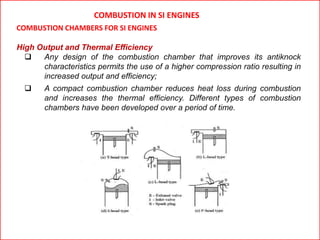
 Any design of the combustion chamber that improves its antiknock
characteristics permits the use of a higher compression ratio resulting in
increased output and efficiency;
 A compact combustion chamber reduces heat loss during combustion
and increases the thermal efficiency. Different types of combustion
chambers have been developed over a period of time.
T-Head Type:
 The T-head combustion chambers were used in the early stage of
engine development. Since the distance across the combustion
chamber is very long, knocking tendency is high in this type of engines.
 This configuration provides two valves on either side of the cylinder,
requiring two camshafts. From the manufacturing point of view,
providing two camshafts is a disadvantage.
L-Head Type:
 A modification of the T-head type of combustion chamber is the L-head
type which provides the two valves on the same side of the cylinder and
the valves are operated by a single camshaft.
 In these types, it is easy to lubricate the valve mechanism. With the
detachable head it may be noted that the cylinder head can be removed
without disturbing valve gear etc.
 The air flow has to take two right angle turns to enter the cylinder. This
causes a loss of velocity head and a loss in turbulence level resulting in
a slow combustion process.
COMBUSTION IN SI ENGINES
COMBUSTION CHAMBERS FOR SI ENGINES
 In these types, it is easy to lubricate the valve mechanism.
 With the detachable head it may be noted that the cylinder head can be removed
without disturbing valve gear etc.
 The air flow has to take two right angle turns to enter the cylinder. This causes a
loss of velocity head and a loss in turbulence level resulting in a slow combustion
process.
 The main objectives of the Ricardo's turbulent head design, are to obtain fast
flame speed and reduced knock.
 The main body of the combustion chamber is concentrated over the valves
leaving a slightly restricted passage communicating with the cylinder thereby
creating additional turbulence during the compression stroke.
 This design reduces the knocking tendency by shortening the effective flame
travel length by bringing that portion of the head which layover the farther side of
the piston into as close a contact as possible with the piston crown, forming a
quench space.
 The thin layer of gas (entrapped between the relatively cool piston and also
cooler head) loses its heat rapidly because of large enclosing surface thereby
avoiding knocking.
 By placing the spark plug in the centre of the effective combustion space slightly
towards the hot exhaust valve, the flame travel length is reduced.
COMBUSTION IN SI ENGINES
COMBUSTION CHAMBERS FOR SI ENGINES
I-Head Type or Overhead Valve:
 The I-head type is also called the overhead valve combustion chamber
in which both the valves are located on the cylinder head.
 The overhead valve engine is superior to a side valve or an L-head
engine at high compression ratios.
 Some of the important of this type of valve arrangement are
 less surface to volume ratio and therefore less heat loss
 less flame travel length and hence greater freedom from knock higher
volumetric efficiency from larger valves or valve characteristics lifts
 Confinement of thermal failures to cylinder head by keeping the hot
exhaust valve in the head instead of the cylinder block.
COMBUSTION IN SI ENGINES
COMBUSTION CHAMBERS FOR SI ENGINES
F-Head Type:
 The F-head type of valve arrangement is a compromise between L-
head and I-head types.
 Combustion chambers in which one valve is in the cylinder head and
the other in the cylinder block are known as F-head combustion
chambers
 Modern F-head engines have exhaust valve in the head and inlet
valve in the cylinder block.
 The main disadvantage of this type is that the inlet valve and the
exhaust valve are separately actuated by two cams mounted on two
camshafts driven by the crankshaft through gears.
COMBUSTION IN SI ENGINES
COMBUSTION CHAMBERS FOR SI ENGINES
COMBUSTION IN SI ENGINES
COMBUSTION CHAMBERS FOR SI ENGINES
Pre-combustion Chamber:
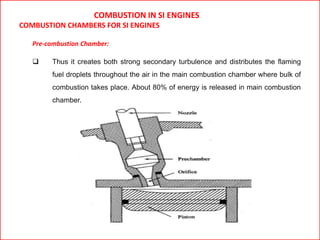
 A typical pre-combustion chamber (Fig.) consists of an anti-chamber
connected to the main chamber through a number of small holes (compared to
a relatively large passage in the swirl chamber).
 The pre-combustion chamber is located in the cylinder head and its volume
accounts for about 40% of the total combustion space. During the compression
stroke the piston forces the air into the pre-combustion chamber.
 The fuel is injected into the pre-chamber and the combustion is initiated. The
resulting pressure rise forces the flaming droplets together with some air and
their combustion products to rush out into the main cylinder at high velocity
through the small holes.
COMBUSTION IN SI ENGINES
COMBUSTION CHAMBERS FOR SI ENGINES
Pre-combustion Chamber:
 Thus it creates both strong secondary turbulence and distributes the flaming
fuel droplets throughout the air in the main combustion chamber where bulk of
combustion takes place. About 80% of energy is released in main combustion
chamber.
COMBUSTION IN SI ENGINES
COMBUSTION CHAMBERS FOR SI ENGINES
Pre-combustion Chamber:
 The rate of pressure rise and the maximum pressure is lower compared to
those of open type chamber. The initial shock of combustion is limited to pre-
combustion chamber only.
 The pre-combustion chamber has multi-fuel capability without any modification
in the injection system because of the temperature of pre-chamber. The
variation in the optimum injection timing for petrol and diesel operations is only
2° for this chamber compared to 8° to 10° in the other designs.
COMBUSTION IN SI ENGINES
COMBUSTION CHAMBERS FOR SI ENGINES
Air cell-combustion Chamber:
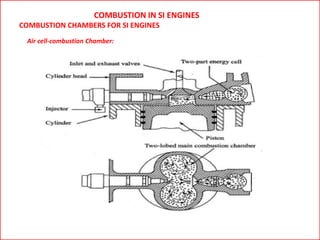
 In this-chamber (Fig.), the clearance volume is divided into two parts, one in
the main cylinder and the other called the energy cell.
 The energy cell is divided into two parts, major and minor, which are separated
from each other and from the main chamber by.narrow orifices.
 A pintle type of nozzle injects the fuel across the main combustion chamber
space towards the open neck of the air cell.
COMBUSTION IN SI ENGINES
COMBUSTION CHAMBERS FOR SI ENGINES
Air cell-combustion Chamber:
 In this-chamber (Fig.), the clearance volume is divided into two parts, one in
the main cylinder and the other called the energy cell.
 The energy cell is divided into two parts, major and minor, which are separated
from each other and from the main chamber by.narrow orifices.
 A pintle type of nozzle injects the fuel across the main combustion chamber
space towards the open neck of the air cell.
 During compression, the pressure in the main chamber is higher than that
inside the energy cell due to restricted passage area between the two.
 At the TDC, the difference in. pressure will be high and air will be forced at
high velocity through the opening into the energy cell and this moment the fuel-
injection also begins.
COMBUSTION IN SI ENGINES
COMBUSTION CHAMBERS FOR SI ENGINES
Air cell-combustion Chamber:
COMBUSTION IN SI ENGINES
COMBUSTION CHAMBERS FOR SI ENGINES
Air cell-combustion Chamber:
 Combustion starts initially in the main chamber where the temperature is
comparatively higher but the rate of burning is very slow due to absence of any
air motion.
 In the energy cell, the fuel is well mixed with air and high pressure is developed
due to heat-release and the hot burning gases blowout through the small
passage into the main chamber.
 This high velocity jet produces swirling motion in the main chamber and thereby
thoroughly mixes the fuel with air resulting in complete combustion.
 The design is not suitable for variable speed operation as the combustion
induced swirl has no relationship to the speed of the engine. The energy cell is
designed to run hot, to reduce ignition lag.
COMBUSTION IN SI ENGINES
COMBUSTION CHAMBERS FOR SI ENGINES
 The main advantages of the indirect-injection combustion chambers are:
 1) injection pressure required is low
 2) direction of spraying is not very important.
 3) These chambers have the following serious drawbacks which have
made its application limited.
 4) Poor cold starting performance requiring heater plugs.
 5) Specific fuel consumption is high because there is a loss of pressure due
to air motion through the duct and heat loss due to large heat transfer area.
COMBUSTION IN SI ENGINES
COMPARISION OF KNOCK IN CI AND SI ENGINES
 It may be interesting to note that knocking in spark-ignition engines and
compression-ignition engines is fundamentally due to the auto-ignition of the
fuel-air mixture.
 In both the cases, the knocking depends on the auto-ignition lag of the fuel-
air mixture.
 But careful examination of the knocking phenomenon in spark-ignition and
the compression-ignition engines reveals the following differences.
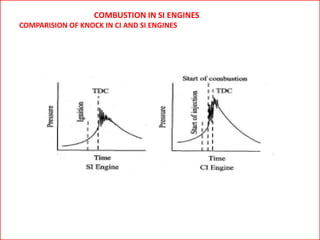
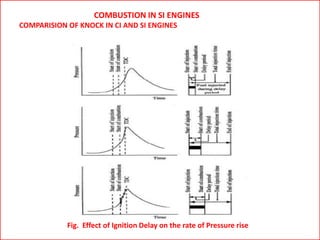
 A comparison of the knocking process in SI and CI engines is shown on the
pressure-time diagrams of Fig..
 In spark-ignition engines, the auto-ignition of the end gas away from the
spark plug, most likely near the end of the combustion causes knocking.
 But in compression-ignition engines the autoignition of the charge causing
knocking is at the start of combustion.
COMBUSTION IN SI ENGINES
COMPARISION OF KNOCK IN CI AND SI ENGINES
 It is the first charge that auto-ignites and causes knocking in the
compression-ignition engines. ‘
 This is illustrated in Fig.. It is clear from Fig.. that explosive auto- ignition is
more or less over before the peak pressure for the compression-ignition
engines.
 But for spark-ignition engines, the condition for explosive auto-ignition of the
end charge is more favourable after the peak pressure.
 In order to avoid knocking in spark-ignition engines, it is necessary to prevent
auto-ignition of the end gas to take place at all. In compression ignition
engine, the earliest possible auto-ignition is necessary to avoid knocking.
COMBUSTION IN SI ENGINES
COMPARISION OF KNOCK IN CI AND SI ENGINES
COMBUSTION IN SI ENGINES
COMPARISION OF KNOCK IN CI AND SI ENGINES
 In spark-ignition engine, the charge that auto-ignites is homogeneous and
therefore intensity of knocking or the rate of pressure rise at explosive auto-
ignition is likely to be more than that in compression-ignition engines where the
fuel and air are not homogeneously mixed even when explosive auto-ignition of
the charge occurs. Therefore, it is often called detonation in SI engines.
 In compression-ignition engines, only air is compressed during the compression
stroke and the ignition can take place only after fuel is injected just before the
top dead centre. ‘
 Thus there can be no pre-ignition in compression-ignition engines as in spark-
ignition engines.
COMBUSTION IN SI ENGINES
COMPARISION OF KNOCK IN CI AND SI ENGINES
Fig. Effect of Ignition Delay on the rate of Pressure rise
COMBUSTION IN SI ENGINES
COMPARISION OF KNOCK IN CI AND SI ENGINES
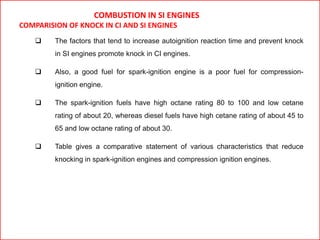
 The factors that tend to increase autoignition reaction time and prevent knock
in SI engines promote knock in CI engines.
 Also, a good fuel for spark-ignition engine is a poor fuel for compression-
ignition engine.
 The spark-ignition fuels have high octane rating 80 to 100 and low cetane
rating of about 20, whereas diesel fuels have high cetane rating of about 45 to
65 and low octane rating of about 30.
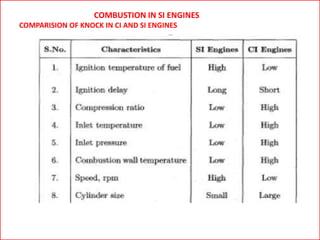
 Table gives a comparative statement of various characteristics that reduce
knocking in spark-ignition engines and compression ignition engines.
COMBUSTION IN SI ENGINES
COMPARISION OF KNOCK IN CI AND SI ENGINES
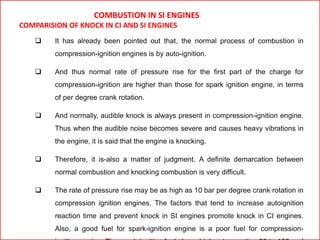
 It has already been pointed out that, the normal process of combustion in
compression-ignition engines is by auto-ignition.
 And thus normal rate of pressure rise for the first part of the charge for
compression-ignition are higher than those for spark ignition engine, in terms
of per degree crank rotation.
 And normally, audible knock is always present in compression-ignition engine.
Thus when the audible noise becomes severe and causes heavy vibrations in
the engine, it is said that the engine is knocking.
 Therefore, it is-also a matter of judgment. A definite demarcation between
normal combustion and knocking combustion is very difficult.
 The rate of pressure rise may be as high as 10 bar per degree crank rotation in
compression ignition engines. The factors that tend to increase autoignition
reaction time and prevent knock in SI engines promote knock in CI engines.
Also, a good fuel for spark-ignition engine is a poor fuel for compression-
COMBUSTION IN SI ENGINES
COMPARISION OF KNOCK IN CI AND SI ENGINES
COMBUSTION IN SI ENGINES
COMPARISION OF KNOCK IN CI AND SI ENGINES
COMBUSTION IN SI ENGINES
COMPARISION OF KNOCK IN CI AND SI ENGINES
COMBUSTION IN SI ENGINES
COMPARISION OF KNOCK IN CI AND SI ENGINES

Me6016 advanced i c engines unit i

  • 1.
    ME6016 ADVANCED I.CENGINES - SYLLABUS UNIT I SPARK IGNITION ENGINES Mixture requirements – Fuel injection systems – Monopoint, Multipoint & Direct injection - Stages of combustion – Normal and Abnormal combustion – Knock - Factors affecting knock – Combustion chambers. UNIT II COMPRESSION IGNITION ENGINES Diesel Fuel Injection Systems - Stages of combustion – Knocking – Factors affecting knock – Direct and Indirect injection systems – Combustion chambers – Fuel Spray behaviour – Spray structure and spray penetration – Air motion - Introduction to Turbocharging. OBJECTIVES:  To understand the underlying principles of operation of different IC Engines and components.  To provide knowledge on pollutant formation, control, alternate fuel etc.
  • 2.
    UNIT III POLLUTANTFORMATION AND CONTROL Pollutant – Sources – Formation of Carbon Monoxide, Unburnt hydrocarbon, Oxides of Nitrogen, Smoke and Particulate matter – Methods of controlling Emissions – Catalytic converters, Selective Catalytic Reduction and Particulate Traps – Methods of measurement – Emission norms and Driving cycles. UNIT IV ALTERNATIVE FUELS Alcohol, Hydrogen, Compressed Natural Gas, Liquefied Petroleum Gas and Bio Diesel - Properties, Suitability, Merits and Demerits - Engine Modifications. UNIT V RECENT TRENDS Air assisted Combustion, Homogeneous charge compression ignition engines – Variable Geometry turbochargers – Common Rail Direct Injection Systems - Hybrid Electric Vehicles – NOx Adsorbers - Onboard Diagnostics. ME6016 ADVANCED I.C ENGINES - SYLLABUS OUTCOME Upon completion of this course, the students would be able to compare the operations of different IC Engine and components and can evaluate the pollutant formation, control, alternate fuel
  • 3.
    TEXT BOOKS: 1. Ramalingam.K.K., "Internal Combustion Engine undamentals", Scitech Publications, 2002. 2. Ganesan, "Internal Combustion Engines", II Edition, TMH, 2002. *3. Rajput R. K., "Internal Combustion Engines” *4. Gupta H N "Internal Combustion Engines” *5. Thipse B P “Internal Combustion Engines” REFERENCES: 1. Mathur. R.B. and R.P. Sharma, "Internal Combustion Engines"., Dhanpat Rai & Sons 2007. 2. Duffy Smith, "Auto Fuel Systems", The Good Heart Willcox Company, Inc., 1987. 3. Eric Chowenitz, "Automobile Electronics", SAE Publications, 1995 *4. Gill & Smith, “Internal Combustion Engines” * Apart from the books prescribed in the syllabus ME6016 ADVANCED I.C ENGINES - SYLLABUS
  • 4.
    UNIT I S IENGINES
  • 5.
    COMBUSTION IN SIENGINES AIR-FUEL MIXTURES  An engine is generally operated at different loads and speeds.  For this, proper air-fuel mixture should be supplied to the engine cylinder.  Fuel and air are mixed to form three different types of mixtures.  Chemically correct mixture  Rich mixture and  Lean mixture  Chemically correct or stoichiometric mixture is one in which there is just enough air for complete combustion of the fuel. For example to burn one kg of octane (C8 H18) completely 15.12 kg of air is required.  Hence chemically correct A/F ratio for C8 H18 is 15.12:1;usually approximated to 15:1.  This chemically correct mixture will vary only slightly in numerical value between different hydrocarbon fuels.  It is always computed from the chemical equation for complete combustion for a particular fuel.
  • 6.
    COMBUSTION IN SIENGINES  Complete combustion means all carbon in the fuel is converted to C02 and all hydrogen to H2O.A mixture which contains less air than the stoichiometric requirement is called a rich mixture (example, AIF ratio of 12:1,10:1 etc.).  A mixture which contains more air than the stoichiometric requirement is called a lean mixture (example, AIF ratio of 17:1,20:1 etc.).  There is, however, a limited range of AIF ratios in a homogeneous mixture, only within which combustion in an SI engine will occur. Outside this range, the ratio is either too rich or too lean to sustain flame propagation.  This range of useful AIF ratio runs from approximately 9:1 (rich) to 19:1 (lean).  The carburetor should provide an AIF ratio in accordance with engine operating requirements and this ratio must be within the combustible range. 15 19 Air Fuel Ratio
  • 7.
    COMBUSTION IN SIENGINES  The air-fuel ratio at which an engine operates has a considerable influence on its performance.  Consider an engine operating at full throttle and constant speed with varying AIF ratio. Under these conditions, the AIF ratio will affect both the power output and the brake specific fuel consumption.  The mixture corresponding to the maximum output on the curve is called the best power mixture with an AIF ratio of approximately 12:1.  The mixture corresponding to the minimum point on the bsfc curve is called the best economy mixture. The AIF ratio is approximately 16:1.  It may be noted that the best power mixture is much richer than the chemically correct mixture and the best economy mixture is slightly leaner than the chemically correct. MIXTURE REQUIREMENTS AT DIFFERENT LOADS AND SPEEDS
  • 8.
    COMBUSTION IN SIENGINES MIXTURE REQUIREMENTS AT DIFFERENT LOADS AND SPEEDS Note: The above figure is based on full throttle operation
  • 9.
     The AIFratios for the best power and best economy at part throttle are not strictly the same as at full throttle.  If the AIF ratios for best power and best economy are constant over the full range of throttle operation and if the influence of other factors is disregarded, the ideal fuel metering device would be merely a two position carburetor.  Such a carburetor could be set for the best power mixture when maximum performance is desired and for the best economy mixture when the primary consideration is the fuel economy.  Actual engine requirements, however, again preclude the use of such a simple and convenient arrangement. These requirements are discussed in the succeeding section.  Under normal conditions it is desirable to run the engine on the maximum economy mixture, viz., around 16:1 air-fuel ratio. For quick acceleration and for maximum power, rich mixture, viz., 12:1 air-fuel ratio is required. MIXTURE REQUIREMENTS AT DIFFERENT LOADS AND SPEEDS COMBUSTION IN SI ENGINES
  • 10.
    AUTOMOTIVE ENGINE AIR-FUELMIXTURE REQUIREMENTS COMBUSTION IN SI ENGINES  Actual air-fuel mixture requirements in an automotive engine vary considerably from the ideal conditions discussed in the previous section.  For successful operation of the engine, the carburetor has to provide mixtures which follow the general shape of the curve ABCD (single cylinder) and A'B'C'D' (multicylinder) which represents a typical automotive engine requirement.  The carburetor must be suitably designed to meet the various engine requirements.  There are three general ranges of throttle operation.  In each of these, the automotive engine requirements differ.  As a result, the carburetor must be able to supply the required air-fuel ratio to satisfy these demands. These ranges are:  Idling (mixture must be enriched)  Cruising (mixture must be leaned)  High Power (mixture must be enriched)
  • 11.
    AUTOMOTIVE ENGINE AIR-FUELMIXTURE REQUIREMENTS COMBUSTION IN SI ENGINES
  • 12.
    idling range  Anidling engine is one which operates at no load and with nearly closed throttle. Under idling conditions, the engine requires a rich mixture, as indicated by point A  This is due to the existing pressure conditions within the combustion chamber and the intake manifold which cause exhaust gas dilution of the fresh charge.  The pressures indicated in the above figure are representative values which exist during idling.  The exhaust gas pressure at the end of the exhaust stroke does not vary greatly from the value regardless of the throttle position.  Since, the clearance volume is constant the mass of exhaust gas in the cylinder at the end of the exhaust stroke tends to remain fairly constant throughout the idling range. . AUTOMOTIVE ENGINE AIR-FUEL MIXTURE REQUIREMENTS COMBUSTION IN SI ENGINES
  • 13.
    Idling range  Theamount of fresh charge brought in. during idling, however is much less than that during full throttle operation, due to very small opening of the throttle. This results in a much larger proportion of exhaust gas being mixed with the fresh charge under idling conditions.  Further, with nearly closed throttle the pressure in the intake manifold is considerably below atmospheric due to restriction to the air flow.  When the intake valve opens, the pressure differential between the combustion chamber and the intake manifold results in initial backward flow of exhaust gases into the intake manifold . AUTOMOTIVE ENGINE AIR-FUEL MIXTURE REQUIREMENTS COMBUSTION IN SI ENGINES
  • 14.
    Idling range  Asthe piston proceeds down on the intake stroke, these exhaust gases are drawn back into the cylinder along with the fresh charge.  As a result, the final mixture of fuel and air in the combustion chamber is diluted more by exhaust gas. The presence of this exhaust gas tends to obstruct the contact of fuel and air particles a requirement necessary for combustion,  This results in poor combustion and, as a result, in loss of power. It is, therefore, necessary to provide more fuel particles by richening the air-fuel mixture. Thus richening increases the probability of contact between fuel and air particles and thus improves combustion.  As the throttle is gradually opened from A to B, the pressure differential between the inlet manifold and the cylinder becomes smaller and the exhaust gas dilution of the fresh charge diminishes.  Mixture requirements then proceed along line AB to a leaner AIF ratio required for the cruising operation. AUTOMOTIVE ENGINE AIR-FUEL MIXTURE REQUIREMENTS COMBUSTION IN SI ENGINES
  • 15.
    Cruising range  Inthe cruising range from B to C ,the exhaust gas dilution problem is relatively insignificant.  The primary interest lies in obtaining the maximum fuel economy.  Consequently, in this range, it is desirable that the carburetor provides the engine with the best economy mixture.  In the cruising range, the mass of charge is smaller and the tendency to burn the exhaust valve is not as high. AUTOMOTIVE ENGINE AIR-FUEL MIXTURE REQUIREMENTS COMBUSTION IN SI ENGINES
  • 16.
    Power Range  Duringpeak power operation the engine requires a richer mixture, as indicated by the line CD, for the following reasons  (i) To provide best power:  Since high power is desired, it is logical to transfer the economy settings of the cruising range to that mixture which will produce the maximum power, or a setting in the vicinity of the best power mixture, usually in the range of 12:1.  (ii) To prevent overheating of exhaust valve and the area near it:  At high power, the increased mass of gas at higher temperatures passing through the cylinder results in the necessity of transferring greater quantities of heat away from critical areas such as those around the exhaust valve.  En richening the mixture reduces the flame temperature and This reduces the cooling problem and also reduces the tendency to damage exhaust valves at high power. AUTOMOTIVE ENGINE AIR-FUEL MIXTURE REQUIREMENTS COMBUSTION IN SI ENGINES
  • 17.
    Power Range  Inan automobile engine, indication of knocking occurs in the form of an audible sound and the operator can make the engine operating conditions less stringent by releasing the throttle or by shifting to a lower gear.  Furthermore, automobile engines generally operate well below full power and a complicated and expensive system for enrichment for this purpose is not economically feasible, although some means of richening at high power is usually incorporated.  For aircraft engine installations, the complication and expense is justified because of the necessity to increase power during take off. Figure then, is better representative of a typical engine requirements for the carburetor.  Automobile engine requirement are similar in the idling and cruising ranges but tend to be relatively lower or less rich, in the power range (C to D). The portion of the curve from D to E indicates the requirements after the throttle is wide open and the load is further increased. AUTOMOTIVE ENGINE AIR-FUEL MIXTURE REQUIREMENTS COMBUSTION IN SI ENGINES
  • 18.
    COMBUSTION IN SIENGINES Combustion of Homogeneous Mixture  In spark-ignition engines a nearly homogeneous mixture of air and fuel is formed in the carburettor.  Homogeneous mixture is thus formed outside the engine cylinder and the combustion is initiated inside the cylinder at a particular instant towards the end of the compression stroke.  The flame front spreads over a combustible mixture with a certain velocity. In a homogeneous gas mixture the fuel and oxygen molecules are more or less, uniformly distributed.  Once the fuel vapour-air mixture is ignited, a flame front appears and rapidly spreads through the mixture.  The flame propagation is caused by heat transfer and diffusion of burning fuel molecules from the combustion zone to the adjacent layers of un burnt mixture.  The flame front is a narrow zone separating the fresh mixture from the combustion products.  The velocity with which the flame front moves, with respect to the unburned mixture in a direction normal to its surface is called the normal flame velocity
  • 19.
    COMBUSTION IN SIENGINES Combustion of Homogeneous Mixture  In a homogeneous mixture with an equivalence ratio, ¢,'(the ratio of the actual fuel-air ratio to the stoichiometric fuel-air ratio) close to 1.0, the flame speed is normally of the order of 40 cm/s.  However, in a spark-ignition engine the maximum flame speed is obtained when ¢ is between 1.1 and 1.2, i.e., when the mixture is slightly richer than stoichiometric.  If the equivalence ratio is outside this range the flame speed drops rapidly to a low value.  When the flame speed drops to a very low value, the heat loss from the combustion zone becomes equal to the amount of heat-release due to combustion and the flame gets extinguished.  Therefore, it is quite preferable to operate the engine within an equivalence ratio of 1.1 to 1.2 for proper combustion.  However, by introducing turbulence and incorporating proper air movement, the flame speed can be increased in mixtures outside the above range.
  • 20.
    COMBUSTION IN SIENGINES Stages of Combustion in SI Engines  A typical theoretical pressure-crank angle diagram, during the process of compression (a to b), combustion (b to c) and expansion (c to d) in an ideal four-stroke spark-ignition engine is given in the Fig.  In an ideal engine, as can be seen from the diagram, the entire pressure rise during combustion takes place at constant volume i.e., at TDC. However, in an actual engine this does not happen.
  • 21.
    COMBUSTION IN SIENGINES Stages of Combustion in SI Engines
  • 22.
     There arethree stages of combustion in SI Engines  The point A is the passage of spark (say 20° bTDC), B is the point at which the beginning of pressure rise can be detected (say 8° bTDC). and C the attainment of peak pressure.  AB represents the first stage  BC the second stage and  CD the third stage.  The first stage (A-B) is referred to as the ignition lag or preparation phase in which growth and development of a self propagating nucleus of flame takes place.  This is a chemical process depending upon both temperature and pressure, the nature of the fuel and the proportion of the exhaust residual gas.  Further, it also depends upon the relationship between the temperature and the rate of reaction. COMBUSTION IN SI ENGINES Stages of Combustion in SI Engines
  • 23.
     The secondstage (B-C) is a physical one and it is concerned with the spread of the flame throughout the combustion chamber.  The starting point of the second stage is where the first measurable rise of pressure is seen on the indicator diagram i.e., the point where the line of combustion departs from the compression line (point B).  This can be seen from the deviation from the motoring curve.  During the second stage the flame propagates practically at a constant velocity.  Heat transfer to the cylinder wall is low, because only a small part of the burning mixture comes in contact with the cylinder wall during this period.  The rate of heat-release depends largely on the turbulence intensity and also on the reaction rate which is dependent on the mixture composition.  The rate of pressure rise is proportional to the rate of heat-release because during this stage, the combustion chamber volume remains practically constant (since piston is near the top dead centre). COMBUSTION IN SI ENGINES Stages of Combustion in SI Engines
  • 24.
     The startingpoint of the third stage is usually taken as the instant at which the maximum pressure is reached on the indicator diagram (point C).  The flame velocity decreases during this stage.  The rate of combustion becomes low due to lower flame velocity and reduced flame front surface.  Since the expansion stroke starts before this stage of combustion, with the piston moving away from the top dead centre, there can be no pressure rise during this stage. COMBUSTION IN SI ENGINES Stages of Combustion in SI Engines
  • 25.
    COMBUSTION IN SIENGINES Flame Front Propagation  For efficient combustion, the rate of propagation of the flame front within the cylinder is quite critical.  The two important factors which determine the rate of movement of the flame front across the combustion chamber are the reaction rate and the transposition rate.  The reaction rate is the result of a purely chemical combination process in which the flame eats its way into the unburned charge.  The transposition rate is due to the physical movement of the flame front relative to the cylinder wall and is the result of the pressure differential between the burning gases and the un-burnt gases in the combustion chamber.
  • 26.
    COMBUSTION IN SIENGINES Flame Front Propagation
  • 27.
    COMBUSTION IN SIENGINES Flame Front Propagation  In area I,(A-B), the flame front progresses relatively slowly due to a low transposition rate and low turbulence.  The transposition of the flame front is very little since there is a comparatively small mass of charge burned at the start.  The low reaction rate plays a dominant role resulting in a slow advance of the flame.  Also, since the spark plug is to be necessarily located in a quiescent layer of gas that is close to the cylinder wall, the lack of turbulence reduces the reaction rate and hence the flame speed.  As the flame front leaves the quiescent zone and proceeds into more turbulent areas (area II) where it consumes a greater mass of mixture, it progresses more rapidly and at a constant rate (B-C)  The volume of unburned charge is very much less towards the end of flame travel and so the transposition rate again becomes negligible thereby reducing the flame speed. The reaction rate is also reduced again since the flame is entering a zone (area III) of relatively low turbulence (C-D).
  • 28.
    COMBUSTION IN SIENGINES Factors affecting Flame Speed  The study of factors which, affect the velocity of flame propagation is important since the flame velocity influences the rate of pressure rise in the cylinder and it is related to certain types of abnormal combustion that occur in spark-ignition engines.  There are several factors which affect the flame speed, to a varying degree, the most important being the turbulence and the fuel-air ratio.
  • 29.
    COMBUSTION IN SIENGINES Factors affecting Flame Speed  Turbulence:  The flame speed is quite low in non-turbulent mixtures and increases with increasing turbulence.  This is mainly due to the additional physical intermingling of the burning and unburned particles at the flame front which expedites reaction by increasing' the rate of contact.  The turbulence in the incoming mixture is generated during the admission of fuel-air mixture through comparatively narrow sections of throttle pipe, valve openings etc., in the suction stroke.  Turbulence which is supposed to consist of many minute swirls appears to increase the rate of reaction and produce a higher flame speed than that made up of larger and fewer swirls.  A suitable design of the combustion chamber which involves the geometry of cylinder head and piston crown increases the turbulence during the compression stroke.
  • 30.
    COMBUSTION IN SIENGINES Factors affecting Flame Speed  Turbulence:  Generally, turbulence increases the heat flow to the cylinder wall.  It also accelerates the chemical reaction by intimate mixing of fuel and oxygen so that spark advance may be reduced.  This helps in working in lean mixtures also.  The increase of flame speed due to turbulence reduces the combustion duration and hence minimizes the tendency of abnormal combustion.  However, excessive turbulence may extinguish the flame resulting in rough and noisy operation of the engine.
  • 31.
    COMBUSTION IN SIENGINES Factors affecting Flame Speed  Fuel Air Ratio:  The fuel-air ratio has a very significant influence on the flame speed.  The highest flame velocities (minimum time for complete combustion) are obtained with somewhat richer mixture (point A) which shows the effect of mixture strength on the rate of burning as indicated by the time taken for complete burning in a given engine.  When the mixture is made leaner or richer the flame speed decreases. Less thermal energy is released in the case of lean mixtures resulting in lower flame temperature.  Very rich mixtures lead to incomplete combustion which results again in the release of less thermal energy
  • 32.
    COMBUSTION IN SIENGINES Factors affecting Flame Speed  Fuel Air Ratio:
  • 33.
    COMBUSTION IN SIENGINES Factors affecting Flame Speed  Temperature and Pressure:  Flame speed increases with an increase in intake temperature and pressure.  A higher initial pressure and temperature may help to form a better homogeneous air-vapour mixture which helps in increasing the flame speed.  This is possible because of an overall increase in the density of the charge
  • 34.
    COMBUSTION IN SIENGINES Factors affecting Flame Speed  Compression Ratio:  A higher compression ratio increases the pressure and temperature of the working mixture which reduce the initial preparation phase of combustion and hence less ignition advance is needed. High pressures and temperatures of the compressed mixture also speed up the second phase of combustion.  Increased compression ratio reduces the clearance volume and therefore increases the density of the cylinder gases during burning. This increases the peak pressure and temperature and the total combustion duration is reduced.  Thus engines having higher compression ratios have higher flame speeds.
  • 35.
    COMBUSTION IN SIENGINES Factors affecting Flame Speed  Compression Ratio:  A higher compression ratio increases the pressure and temperature of the working mixture which reduce the initial preparation phase of combustion and hence less ignition advance is needed. High pressures and temperatures of the compressed mixture also speed up the second phase of combustion.  Increased compression ratio reduces the clearance volume and therefore increases the density of the cylinder gases during burning. This increases the peak pressure and temperature and the total combustion duration is reduced.  Thus engines having higher compression ratios have higher flame speeds.
  • 36.
    COMBUSTION IN SIENGINES Factors affecting Flame Speed  Engine Output:  The cycle pressure increases when the engine output is increased.  With the increased throttle opening the cylinder gets filled to a higher density.  This results in increased flame speed.  When the output is decreased by throttling, the initial and final compression pressures decrease and the dilution of the working mixture increases.  The smooth development of self-propagating nucleus of flame becomes unsteady and difficult.  The main disadvantages of SI engines are the poor combustion at low loads and the necessity of mixture enrichment (¢ between 1.2 to 1.3) which causes wastage of fuel and discharge of un burnt hydrocarbon and the products of incomplete combustion like carbon monoxide etc. in the atmosphere.
  • 37.
    COMBUSTION IN SIENGINES Factors affecting Flame Speed  Engine Speed:  The flame speed increases almost linearly with engine speed since the increase in engine speed increases the turbulence inside the cylinder.  The time required for the flame to traverse the combustion space would be halved, if the engine speed is doubled.  Double the engine speed and hence half the original time would give the same number of crank degrees for flame propagation.  The crank angle required for the flame propagation during the entire phase of combustion, will remain nearly constant at all speeds.
  • 38.
    COMBUSTION IN SIENGINES Factors affecting Flame Speed  Engine Size:  The size of the engine does not have much effect on the rate of flame propagation.  In large engines the time required for complete combustion is more because the flame has to travel a longer distance.  This requires increased crank angle duration during the combustion. This is one of the reasons why large sized engines are designed to operate at low speeds.
  • 39.
    COMBUSTION IN SIENGINES Abnormal Combustion  In normal combustion, the flame initiated by the spark travels across the combustion chamber in a fairly uniform manner.  Under certain operating conditions the combustion deviates from its normal course leading to loss of performance and possible damage to the engine.  This type of combustion may be termed as an abnormal combustion or knocking combustion.  The consequences of this abnormal combustion process are the loss of power, recurring pre ignition and mechanical damage to the engine.
  • 40.
    COMBUSTION IN SIENGINES Abnormal Combustion The phenomenon of knock in si engines  In a spark-ignition engine combustion which is initiated between the spark plug electrodes spreads across the combustible mixture.  A definite flame front which separates the fresh mixture from the products of combustion travels from the' spark plug to the other end of the combustion chamber.  Heat-release due to combustion increases the temperature and consequently the pressure, of the burned part of the mixture above those of the unburned mixture.  In order to effect pressure equalization the burned part of the mixture will expand, and compress the unburned mixture adiabatically thereby increasing its pressure and temperature.  This process continues as the flame front advances through the mixture and the temperature and pressure of the unburned mixture are increased further.
  • 41.
    COMBUSTION IN SIENGINES Abnormal Combustion The phenomenon of knock in SI engines  If the temperature of the unburnt mixture exceeds the self-ignition temperature of the fuel and remains at or above this temperature during the period of pre flame reactions (ignition lag), spontaneous ignition or auto ignition occurs at various pin-point locations.  This phenomenon is called knocking. The process of auto ignition leads towards engine knock.
  • 42.
    COMBUSTION IN SIENGINES Abnormal Combustion The phenomenon of knock in SI engines  In the normal combustion the flame travels across the combustion chamber from A towards D.  The advancing flame front compresses the end charge BB'D farthest from the spark plug, thus raising its temperature.  The temperature is also increased due to heat transfer from the hot advancing flame-front  Also some preflame oxidation may take place in the end charge leading to further increase in temperature.  In spite of these factors if the temperature of the end charge had not reached its self-ignition temperature, the charge would not auto ignite and the flame will advance further and consume the charge BB'D.
  • 43.
    COMBUSTION IN SIENGINES Abnormal Combustion The phenomenon of knock in SI engines  However, if the end charge BB'D reaches its auto ignition temperature and remains .for some length of time equal to the time of pre flame reactions the charge will auto ignite, leading to knocking combustion.  It is assumed that when flame has reached the position BB" the charge ahead of it has reached critical auto ignition temperature.  During the pre flame reaction period if the flame front could move from BB' to only CC’ then the charge ahead of CC’ would auto ignite.  Because of the auto ignition, another flame front starts traveling in the opposite direction to the main flame front.  When the two flame fronts collide, a severe pressure pulse is generated.  The gas in the chamber is subjected to compression and rarefaction along the pressure pulse until pressure equilibrium is restored.
  • 44.
    COMBUSTION IN SIENGINES Abnormal Combustion The phenomenon of knock in SI engines  This disturbance can force the walls of the combustion chambers to vibrate at the same frequency as the gas.  Gas vibration frequency in automobile engines is of the order of 5000 cps.  It is to be noted that the onset of knocking is very much dependent on the properties of fuel.  It is clear from the above description that if the unburned charge does not reach its auto ignition temperature there will be no knocking.  Further, if the initial phase i.e., ignition lag period, is longer than the time required for the flame front to burn through the unburned charge, there will be no knocking.  But, if the critical temperature is reached and maintained, and the ignition lag is shorter than the time it takes for the flame front to burn through the unburned charge then the end charge will detonate.
  • 45.
    COMBUSTION IN SIENGINES Abnormal Combustion The phenomenon of knock in SI engines  Hence, in order to avoid or inhibit detonation, a high auto-ignition temperature and a long ignition lag are the desirable qualities for SI engine fuels.  In summary, when auto ignition occurs if two different types of vibration may be produced.  In one case a large-amount of mixture may auto ignite giving rise to a very rapid increase in pressure throughout the combustion chamber and there will be a direct blow on the engine structure.  The human ear can detect the resulting thudding sound and consequent noise from free vibrations of the engine parts.  In the other case, large pressure differences may exist in the combustion chamber and the resulting gas vibrations can force the walls of the chamber to vibrate at the same frequency as the gas.
  • 46.
    COMBUSTION IN SIENGINES Abnormal Combustion The phenomenon of knock in SI engines  An audible sound may be evident.  The impact of knock on the engine components and structure can cause engine failure and in addition the noise from engine vibration is always objectionable.  The pressure differences in the combustion chamber cause the gas to vibrate and scrub the chamber walls causing increased loss of heat to the coolant.
  • 47.
    COMBUSTION IN SIENGINES Abnormal Combustion Effect of Engine Variables on Knock  From the discussion on knock in the previous section, it may be seen that four major factors are involved in either producing or preventing knock.  These are the temperature, pressure, density of the unburned charge and the time factors.  Since, the effect of temperature, pressure and density are closely interrelated, these three are consolidated into one group and the time factors into another group.
  • 48.
    COMBUSTION IN SIENGINES Abnormal Combustion Effect of Engine Variables on Knock  Density Factors  Any factor in the design or operation of an engine which tends to reduce the temperature of the unburned charge should reduce the possibility of knocking by reducing the temperature of the end charge for auto ignition.  Similarly, any factor which reduces the density of the charge tends to reduce knocking by providing lower energy release.  Further, the effect of the following parameters which are directly or indirectly connected with temperature, pressure and density factors on the possibility of knocking is discussed below.
  • 49.
    COMBUSTION IN SIENGINES Abnormal Combustion Effect of Engine Variables on Knock  Density Factors Compression Ratio:  Compression ratio of an engine is an important factor which determines both the pressure and temperature at the beginning of the combustion process.  Increase in compression ratio increases the pressure and temperature of the gases at the end of the compression stroke.  This decreases the ignition lag of the end gas and thereby increasing the tendency for knocking.  The overall increase in the density of the charge due to higher compression ratio increases the pre flame reactions in the end charge thereby increasing the knocking tendency of the engine,  The increase in the knocking tendency of the engine with increasing compression ratio is the main reason for limiting the compression ratio to a lower value.
  • 50.
    COMBUSTION IN SIENGINES Abnormal Combustion Effect of Engine Variables on Knock  Density Factors Mass of Inducted Charge:  A reduction in the mass of the inducted charge into the cylinder of an engine by throttling or by reducing the amount of supercharging reduces both temperature and density of the charge at the time of ignition.  This decreases the tendency of knocking. Inlet Temperature of the Mixture:  Increase in the inlet temperature of the mixture makes the compression. temperature higher thereby, increasing the tendency of knocking. Further, volumetric efficiency will be lowered.  Hence, a lower inlet temperature is always preferable to reduce knocking.  It is important that the temperature should not be so low as to cause starting and vaporization problems in the engine.
  • 51.
    COMBUSTION IN SIENGINES Abnormal Combustion Effect of Engine Variables on Knock  Density Factors Temperature of the Combustion Chamber Walls:  Temperature of the combustion chamber walls playa predominant role in knocking.  In order to prevent knocking the hot spots in the combustion chamber should be avoided. '.  Since; the spark plug and exhaust valve are two hottest parts in the combustion chamber, the end gas should not be compressed against them.
  • 52.
    COMBUSTION IN SIENGINES Abnormal Combustion Effect of Engine Variables on Knock  Density Factors Retarding the Spark Timing:  By retarding the spark timing from the optimized timing, i.e., having the spark closer to TDC, the peak pressures are reached farther down on the power stroke and are thus of lower magnitude. This might reduce the knocking.  However, the spark timing will be different from the MBT timing. This will affect the brake torque and power output of the engine. Power Output of the Engine:  A decrease in the output of the engine decreases the temperature of the cylinder and the combustion chamber walls and also the pressure of the charge thereby lowering mixture and end gas temperatures.  This reduces the tendency to knock.
  • 53.
    COMBUSTION IN SIENGINES Abnormal Combustion Effect of Engine Variables on Knock TIME FACTORS  Increasing the flame speed or increasing the duration of the ignition ignition lag or reducing the time of exposure of the unburned mixture to autoignition condition will tend to reduce knocking.  The following factors, in most cases, reduce the possibility of knocking. Turbulence:  Turbulence depends on the design of the combustion chamber and on engine speed.  Increasing turbulence increases the flame speed and reduces the time available for the end charge to attain auto ignition conditions thereby decreasing the tendency to knock.
  • 54.
    COMBUSTION IN SIENGINES Abnormal Combustion Effect of Engine Variables on Knock TIME FACTORS Engine Speed:  An increase in engine speed increases the turbulence of the mixture considerably resulting in increased flame speed, and reduces the time available for preflame reactions. Hence knocking tendency is reduced at higher speeds. Flame Travel Distance:  The knocking tendency is reduced by shortening the time required for the flame front to traverse the combustion chamber.  Engine size (combustion chamber size), and spark plug position are the three important factors governing the flame travel distance.
  • 55.
    COMBUSTION IN SIENGINES Abnormal Combustion Effect of Engine Variables on Knock TIME FACTORS Engine Size:  The flame requires a longer time to travel across the combustion chamber of a larger engine.  Therefore, a larger engine has a greater tendency for knocking than a smaller engine since there is more time for the end gas to auto-ignite.  Hence, an Sl engine is generally limited to size of about 150 mm bore.
  • 56.
    COMBUSTION IN SIENGINES Abnormal Combustion Effect of Engine Variables on Knock TIME FACTORS Combustion Chamber Shape:  Generally, the more compact the combustion chamber is, the shorter is the flame travel and the combustion time and hence better antiknock characteristics.  Therefore, the combustion chambers are made as spherical as possible to minimize the length of the flame travel for a given volume.  If the turbulence in the combustion chamber is high, the combustion rate is high and consequently combustion time and knocking tendency are reduced.  Hence, the combustion chamber is shaped in such a way as to promote turbulence.
  • 57.
    COMBUSTION IN SIENGINES Abnormal Combustion Effect of Engine Variables on Knock TIME FACTORS Location of Spark Plug:  In order to have a minimum flame travel, the spark plug is centrally located in the combustion chamber, it resulting in minimum knocking tendency.  The flame travel can also be reduced by using two or more spark plugs in case of large engines. COMPOSITION FACTORS  Once the basic design of the engine is finalized, the fuel-air ratio and the properties of the fuel, particularly the octane rating, plays crucial role in controlling the knock.
  • 58.
    COMBUSTION IN SIENGINES Abnormal Combustion Effect of Engine Variables on Knock COMPOSITION FACTORS  Once the basic design of the engine is finalized, the fuel-air ratio and the properties of the fuel, particularly the octane rating, plays crucial role in controlling the knock.
  • 59.
    COMBUSTION IN SIENGINES Abnormal Combustion Effect of Engine Variables on Knock COMPOSITION FACTORS Fuel-Air Ratio:  The flame speeds are affected by fuel-air ratio. Also the flame temperature and reaction time are different for different fuel-air ratios.  Maximum flame temperature is obtained when ¢ - 1.1 to 1.2 whereas ¢ = 1 gives minimum reaction time for auto ignition. The variation of knock limited compression ratio with respect to equivalence ratio for iso- octane.  The maximum tendency to knock takes place for the fuel-air ratio which gives minimum reaction time as discussed, earlier.  Thus the most predominant factor is the reaction time of the mixture in this case.  In general except at rich end, the behaviour in the engine follows the same pattern as the fuel-air ratio versus reaction time discussed earlier.  The drop in K imep at very rich end is caused by large drop in thermal efficiency.
  • 60.
    COMBUSTION IN SIENGINES Abnormal Combustion Effect of Engine Variables on Knock COMPOSITION FACTORS Octane Value of the Fuel:  A higher self-ignition temperature of the fuel and a low pre flame reactivity would reduce the tendency of knocking.  In general, paraffin series of hydrocarbon have the maximum and aromatic series the minimum tendency to knock.  The naphthene series comes in between the two.  Usually, compounds with more compact molecular structure are less prone to knock.  In aliphatic hydrocarbons, unsaturated compounds show lesser knocking tendency than saturated hydrocarbons, the exception being ethylene, acetylene and propylene.
  • 61.
    COMBUSTION IN SIENGINES Abnormal Combustion Effect of Engine Variables on Knock
  • 62.
    COMBUSTION IN SIENGINES COMBUSTION CHAMBERS FOR SI ENGINES  The design of the combustion chamber for an SI engine has an important chamber, influence on the engine performance and its knocking tendencies.  The design involves the shape of the combustion the location of spark plug and the location of inlet and exhaust valves.  The important requirements of an SI engine combustion chamber are to provide high power output with minimum octane requirement, high thermal efficiency and smooth engine operation Reducing the Possibility of Knocking: Reduction in the possibility of knocking in an engine can be achieved by,  1) Reducing the distance of the flame travel by centrally locating the spark plug and also by avoiding pockets of stagnant charge.  2) Satisfactory cooling of the spark plug and of exhaust valve area which are the source of hot spots in the majority of the combustion chambers.  3) Reducing the temperature of the last portion of the charge through application of a high surface to volume ratio in that part where the last portion of the charge burns. Heat transfer to the combustion chamber walls can be increased by using high surface to volume ratio thereby  4) Power reducing the temperature.
  • 63.
    COMBUSTION IN SIENGINES COMBUSTION CHAMBERS FOR SI ENGINES High Output and Thermal Efficiency  The main objective of the design and development of an engine is to obtain high power as well as high thermal efficiency. This can be achieved by considering the following factors:  A high degree of turbulence is needed to achieve a high flame front velocity.  Turbulence is induced by inlet flow configuration or squish.  Squish can be induced in spark-ignition engines by having a bowl in piston or with a dome shaped cylinder head.  Squish is the rapid radial movement of the gas trapped in between the piston and the cylinder head into the bowl or the dome.  High volumetric efficiency, i.e., more charge during the suction stroke, results in an increased power output.  This can be achieved by providing ample clearance around the valve heads, large diameter valves and straight passages with minimum pressure drop.
  • 64.
    COMBUSTION IN SIENGINES COMBUSTION CHAMBERS FOR SI ENGINES High Output and Thermal Efficiency  Any design of the combustion chamber that improves its antiknock characteristics permits the use of a higher compression ratio resulting in increased output and efficiency;  A compact combustion chamber reduces heat loss during combustion and increases the thermal efficiency. Different types of combustion chambers have been developed over a period of time.
  • 65.
    COMBUSTION IN SIENGINES COMBUSTION CHAMBERS FOR SI ENGINES High Output and Thermal Efficiency  Any design of the combustion chamber that improves its antiknock characteristics permits the use of a higher compression ratio resulting in increased output and efficiency;  A compact combustion chamber reduces heat loss during combustion and increases the thermal efficiency. Different types of combustion chambers have been developed over a period of time.
  • 66.
    COMBUSTION IN SIENGINES COMBUSTION CHAMBERS FOR SI ENGINES High Output and Thermal Efficiency  Any design of the combustion chamber that improves its antiknock characteristics permits the use of a higher compression ratio resulting in increased output and efficiency;  A compact combustion chamber reduces heat loss during combustion and increases the thermal efficiency. Different types of combustion chambers have been developed over a period of time.
  • 67.
    T-Head Type:  TheT-head combustion chambers were used in the early stage of engine development. Since the distance across the combustion chamber is very long, knocking tendency is high in this type of engines.  This configuration provides two valves on either side of the cylinder, requiring two camshafts. From the manufacturing point of view, providing two camshafts is a disadvantage. L-Head Type:  A modification of the T-head type of combustion chamber is the L-head type which provides the two valves on the same side of the cylinder and the valves are operated by a single camshaft.  In these types, it is easy to lubricate the valve mechanism. With the detachable head it may be noted that the cylinder head can be removed without disturbing valve gear etc.  The air flow has to take two right angle turns to enter the cylinder. This causes a loss of velocity head and a loss in turbulence level resulting in a slow combustion process. COMBUSTION IN SI ENGINES COMBUSTION CHAMBERS FOR SI ENGINES
  • 68.
     In thesetypes, it is easy to lubricate the valve mechanism.  With the detachable head it may be noted that the cylinder head can be removed without disturbing valve gear etc.  The air flow has to take two right angle turns to enter the cylinder. This causes a loss of velocity head and a loss in turbulence level resulting in a slow combustion process.  The main objectives of the Ricardo's turbulent head design, are to obtain fast flame speed and reduced knock.  The main body of the combustion chamber is concentrated over the valves leaving a slightly restricted passage communicating with the cylinder thereby creating additional turbulence during the compression stroke.  This design reduces the knocking tendency by shortening the effective flame travel length by bringing that portion of the head which layover the farther side of the piston into as close a contact as possible with the piston crown, forming a quench space.  The thin layer of gas (entrapped between the relatively cool piston and also cooler head) loses its heat rapidly because of large enclosing surface thereby avoiding knocking.  By placing the spark plug in the centre of the effective combustion space slightly towards the hot exhaust valve, the flame travel length is reduced. COMBUSTION IN SI ENGINES COMBUSTION CHAMBERS FOR SI ENGINES
  • 69.
    I-Head Type orOverhead Valve:  The I-head type is also called the overhead valve combustion chamber in which both the valves are located on the cylinder head.  The overhead valve engine is superior to a side valve or an L-head engine at high compression ratios.  Some of the important of this type of valve arrangement are  less surface to volume ratio and therefore less heat loss  less flame travel length and hence greater freedom from knock higher volumetric efficiency from larger valves or valve characteristics lifts  Confinement of thermal failures to cylinder head by keeping the hot exhaust valve in the head instead of the cylinder block. COMBUSTION IN SI ENGINES COMBUSTION CHAMBERS FOR SI ENGINES
  • 70.
    F-Head Type:  TheF-head type of valve arrangement is a compromise between L- head and I-head types.  Combustion chambers in which one valve is in the cylinder head and the other in the cylinder block are known as F-head combustion chambers  Modern F-head engines have exhaust valve in the head and inlet valve in the cylinder block.  The main disadvantage of this type is that the inlet valve and the exhaust valve are separately actuated by two cams mounted on two camshafts driven by the crankshaft through gears. COMBUSTION IN SI ENGINES COMBUSTION CHAMBERS FOR SI ENGINES
  • 73.
    COMBUSTION IN SIENGINES COMBUSTION CHAMBERS FOR SI ENGINES Pre-combustion Chamber:  A typical pre-combustion chamber (Fig.) consists of an anti-chamber connected to the main chamber through a number of small holes (compared to a relatively large passage in the swirl chamber).  The pre-combustion chamber is located in the cylinder head and its volume accounts for about 40% of the total combustion space. During the compression stroke the piston forces the air into the pre-combustion chamber.  The fuel is injected into the pre-chamber and the combustion is initiated. The resulting pressure rise forces the flaming droplets together with some air and their combustion products to rush out into the main cylinder at high velocity through the small holes.
  • 74.
    COMBUSTION IN SIENGINES COMBUSTION CHAMBERS FOR SI ENGINES Pre-combustion Chamber:  Thus it creates both strong secondary turbulence and distributes the flaming fuel droplets throughout the air in the main combustion chamber where bulk of combustion takes place. About 80% of energy is released in main combustion chamber.
  • 75.
    COMBUSTION IN SIENGINES COMBUSTION CHAMBERS FOR SI ENGINES Pre-combustion Chamber:  The rate of pressure rise and the maximum pressure is lower compared to those of open type chamber. The initial shock of combustion is limited to pre- combustion chamber only.  The pre-combustion chamber has multi-fuel capability without any modification in the injection system because of the temperature of pre-chamber. The variation in the optimum injection timing for petrol and diesel operations is only 2° for this chamber compared to 8° to 10° in the other designs.
  • 76.
    COMBUSTION IN SIENGINES COMBUSTION CHAMBERS FOR SI ENGINES Air cell-combustion Chamber:  In this-chamber (Fig.), the clearance volume is divided into two parts, one in the main cylinder and the other called the energy cell.  The energy cell is divided into two parts, major and minor, which are separated from each other and from the main chamber by.narrow orifices.  A pintle type of nozzle injects the fuel across the main combustion chamber space towards the open neck of the air cell.
  • 77.
    COMBUSTION IN SIENGINES COMBUSTION CHAMBERS FOR SI ENGINES Air cell-combustion Chamber:  In this-chamber (Fig.), the clearance volume is divided into two parts, one in the main cylinder and the other called the energy cell.  The energy cell is divided into two parts, major and minor, which are separated from each other and from the main chamber by.narrow orifices.  A pintle type of nozzle injects the fuel across the main combustion chamber space towards the open neck of the air cell.  During compression, the pressure in the main chamber is higher than that inside the energy cell due to restricted passage area between the two.  At the TDC, the difference in. pressure will be high and air will be forced at high velocity through the opening into the energy cell and this moment the fuel- injection also begins.
  • 78.
    COMBUSTION IN SIENGINES COMBUSTION CHAMBERS FOR SI ENGINES Air cell-combustion Chamber:
  • 79.
    COMBUSTION IN SIENGINES COMBUSTION CHAMBERS FOR SI ENGINES Air cell-combustion Chamber:  Combustion starts initially in the main chamber where the temperature is comparatively higher but the rate of burning is very slow due to absence of any air motion.  In the energy cell, the fuel is well mixed with air and high pressure is developed due to heat-release and the hot burning gases blowout through the small passage into the main chamber.  This high velocity jet produces swirling motion in the main chamber and thereby thoroughly mixes the fuel with air resulting in complete combustion.  The design is not suitable for variable speed operation as the combustion induced swirl has no relationship to the speed of the engine. The energy cell is designed to run hot, to reduce ignition lag.
  • 80.
    COMBUSTION IN SIENGINES COMBUSTION CHAMBERS FOR SI ENGINES  The main advantages of the indirect-injection combustion chambers are:  1) injection pressure required is low  2) direction of spraying is not very important.  3) These chambers have the following serious drawbacks which have made its application limited.  4) Poor cold starting performance requiring heater plugs.  5) Specific fuel consumption is high because there is a loss of pressure due to air motion through the duct and heat loss due to large heat transfer area.
  • 81.
    COMBUSTION IN SIENGINES COMPARISION OF KNOCK IN CI AND SI ENGINES  It may be interesting to note that knocking in spark-ignition engines and compression-ignition engines is fundamentally due to the auto-ignition of the fuel-air mixture.  In both the cases, the knocking depends on the auto-ignition lag of the fuel- air mixture.  But careful examination of the knocking phenomenon in spark-ignition and the compression-ignition engines reveals the following differences.  A comparison of the knocking process in SI and CI engines is shown on the pressure-time diagrams of Fig..  In spark-ignition engines, the auto-ignition of the end gas away from the spark plug, most likely near the end of the combustion causes knocking.  But in compression-ignition engines the autoignition of the charge causing knocking is at the start of combustion.
  • 82.
    COMBUSTION IN SIENGINES COMPARISION OF KNOCK IN CI AND SI ENGINES  It is the first charge that auto-ignites and causes knocking in the compression-ignition engines. ‘  This is illustrated in Fig.. It is clear from Fig.. that explosive auto- ignition is more or less over before the peak pressure for the compression-ignition engines.  But for spark-ignition engines, the condition for explosive auto-ignition of the end charge is more favourable after the peak pressure.  In order to avoid knocking in spark-ignition engines, it is necessary to prevent auto-ignition of the end gas to take place at all. In compression ignition engine, the earliest possible auto-ignition is necessary to avoid knocking.
  • 83.
    COMBUSTION IN SIENGINES COMPARISION OF KNOCK IN CI AND SI ENGINES
  • 84.
    COMBUSTION IN SIENGINES COMPARISION OF KNOCK IN CI AND SI ENGINES  In spark-ignition engine, the charge that auto-ignites is homogeneous and therefore intensity of knocking or the rate of pressure rise at explosive auto- ignition is likely to be more than that in compression-ignition engines where the fuel and air are not homogeneously mixed even when explosive auto-ignition of the charge occurs. Therefore, it is often called detonation in SI engines.  In compression-ignition engines, only air is compressed during the compression stroke and the ignition can take place only after fuel is injected just before the top dead centre. ‘  Thus there can be no pre-ignition in compression-ignition engines as in spark- ignition engines.
  • 85.
    COMBUSTION IN SIENGINES COMPARISION OF KNOCK IN CI AND SI ENGINES Fig. Effect of Ignition Delay on the rate of Pressure rise
  • 86.
    COMBUSTION IN SIENGINES COMPARISION OF KNOCK IN CI AND SI ENGINES  The factors that tend to increase autoignition reaction time and prevent knock in SI engines promote knock in CI engines.  Also, a good fuel for spark-ignition engine is a poor fuel for compression- ignition engine.  The spark-ignition fuels have high octane rating 80 to 100 and low cetane rating of about 20, whereas diesel fuels have high cetane rating of about 45 to 65 and low octane rating of about 30.  Table gives a comparative statement of various characteristics that reduce knocking in spark-ignition engines and compression ignition engines.
  • 87.
    COMBUSTION IN SIENGINES COMPARISION OF KNOCK IN CI AND SI ENGINES  It has already been pointed out that, the normal process of combustion in compression-ignition engines is by auto-ignition.  And thus normal rate of pressure rise for the first part of the charge for compression-ignition are higher than those for spark ignition engine, in terms of per degree crank rotation.  And normally, audible knock is always present in compression-ignition engine. Thus when the audible noise becomes severe and causes heavy vibrations in the engine, it is said that the engine is knocking.  Therefore, it is-also a matter of judgment. A definite demarcation between normal combustion and knocking combustion is very difficult.  The rate of pressure rise may be as high as 10 bar per degree crank rotation in compression ignition engines. The factors that tend to increase autoignition reaction time and prevent knock in SI engines promote knock in CI engines. Also, a good fuel for spark-ignition engine is a poor fuel for compression-
  • 88.
    COMBUSTION IN SIENGINES COMPARISION OF KNOCK IN CI AND SI ENGINES
  • 89.
    COMBUSTION IN SIENGINES COMPARISION OF KNOCK IN CI AND SI ENGINES
  • 90.
    COMBUSTION IN SIENGINES COMPARISION OF KNOCK IN CI AND SI ENGINES
  • 91.
    COMBUSTION IN SIENGINES COMPARISION OF KNOCK IN CI AND SI ENGINES