PERFORMANCE
OF
TURBOCHARGER IN ENGINES
SEMINAR
ON
JJ TECHNICAL SOLUTIONS
(www.mechieprojects.com)
 HISTORY
 INTRODUCTION
 DEFINITIONS
 TURBOCHARGER OPERATION
 TURBO CHARGER EFFICIENCY
 ADVANTAGES AND DISADVANTAGES
 DEMANDS ON FUTURE COMMERCIAL DIESEL ENGINES
 CONCLUSION
 REFERENCES
NAME YEAR ACHIEVEMENTS
Rudolph Diesel 1896 First tried to increase power of the engine by pre-
compressing intake air
Alfred Buchi 1905 Firstly invented turbocharger by Swiss engineer
HISTORY

Turbochargers were first used in production aircraft engines in
1920’s.Aircrafts such as B-17, P-47 all used turbochargers to increase high
altitude engine power.

Turbocharger’s first commercial diesel truck application came in 1938 by
“Swiss Machine Works Sauer”.

A turbocharger unit is comprised of two main components:
 Turbine and
 Compressor

Purpose is to increase the volumetric efficiency of the combustion chamber.

Compressor of the turbocharger uses - air from the ambient atmosphere and
increases its density through the rotating impeller blade passages.

Turbine of the turbocharger produces - high back pressure on the exhaust
manifold which results in the exhaust gas pressure being higher than the
atmospheric pressure.
INTRODUCTION
ENERGY AVAILABLE FOR BOOSTING

For our purposes, we will assume an engine of average thermal efficiency and
typical heat losses through exhaust and cooling water
Fuel Energy
(100%)
1/3 Useful Power to Crankshaft
1/3 Heat Loss to Cooling Water
1/3 Heat Loss through Exhaust

Turbo charging improves efficiency by using exhaust gas energy that would
otherwise be lost
 TURBOCHARGER :
A turbocharger uses the otherwise unused energy in the exhaust gases to drive a
turbine directly connected by a co-axial shaft to a rotary compressor in the air intake
system.
 BOOST:
It is the pressure to the turbocharger makes in the intake manifold.
 WASTE GATE
The waste gate is a valve that allows the exhaust gasses to bypass the turbine.
 TURBO LAG
A turbocharger uses a centrifugal compressor, which needs rpm to make boost,
and it is driven off the exhaust pressure, so it cannot make instant boost.
DEFINITION
TURBO CHARGER COMPONENTS
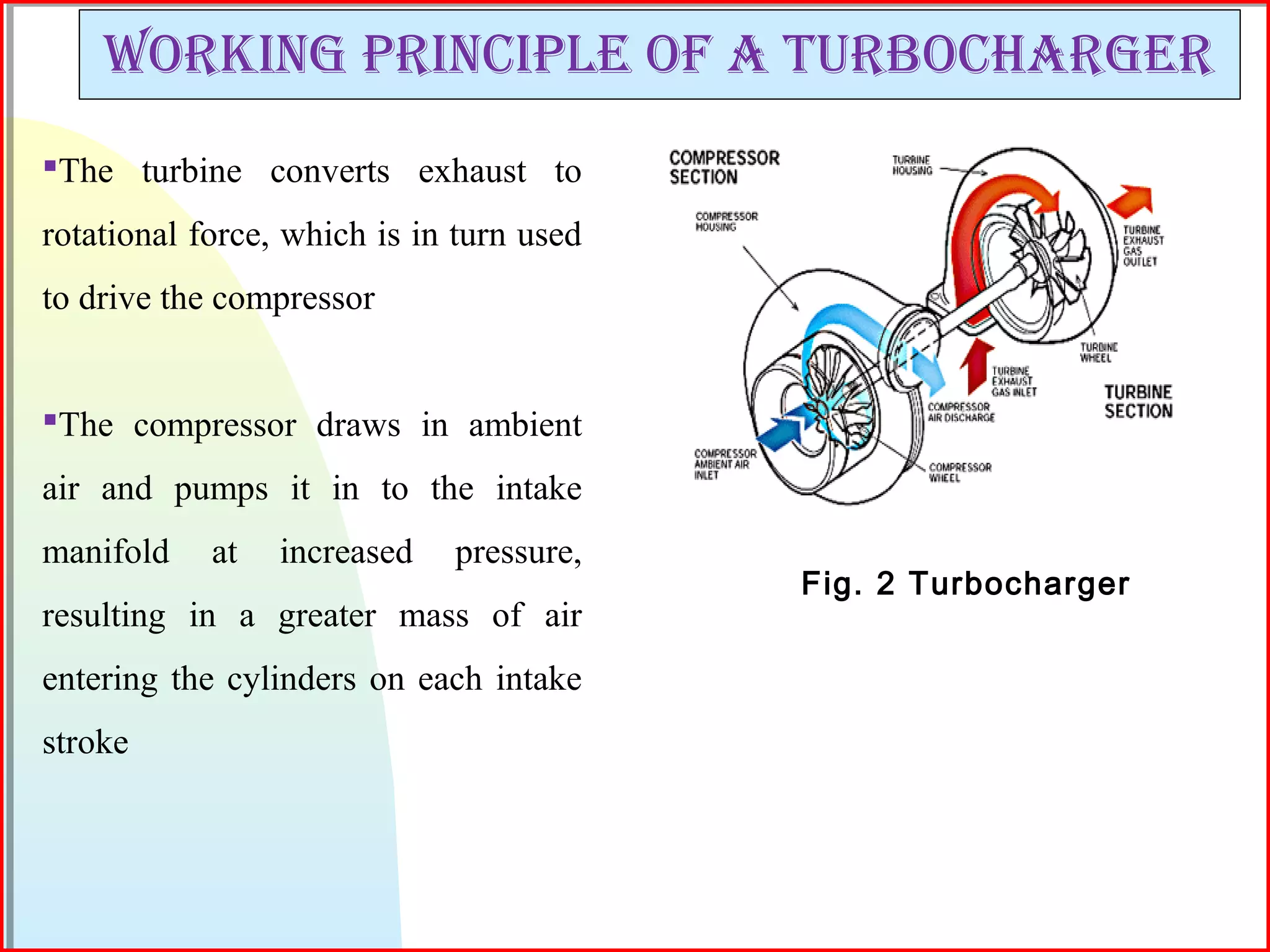
Fig. 2 Turbocharger
The turbine converts exhaust to
rotational force, which is in turn used
to drive the compressor
The compressor draws in ambient
air and pumps it in to the intake
manifold at increased pressure,
resulting in a greater mass of air
entering the cylinders on each intake
stroke
Working principle of a turbocharger
1.Exhaust waste from the engine cylinder travels
towards the turbocharger.
2.The turbocharger housing contains a turbine and
centrifugal air compressor on the same shaft.
3.The compressor forces more air into the cylinder.
4.Compressor typically increases pressure by 6-8psi,
but it can be greater.
5.The compressed air is usually cooled to allow more
air in the cylinder and to prevent knocking.
6.The increase of 6-8 psi increases horsepower by 30-
40%.
WORKING OF TURBO CHARGERWORKING OF TURBO CHARGER
COMPRESSOR
TURBINE
TURBO CHARGER
EFFICIENCY
The increase of pressure 6-8 psi increases horsepower by 30-
40%.
 More power compared to the same size naturally aspirated engine.
 Better thermal efficiency over naturally aspirated engine and supercharged
engine because the engine exhaust is being used to do the useful work
which otherwise would have been wasted.
 Better Fuel Economy by the way of more power and torque from the same
sized engine.
ADVANTAGES OF TURBO CHARGERADVANTAGES OF TURBO CHARGER

If the turbo is too big, the boost - build up slowly because more exhaust
pressure - needed to overcome the rotational inertia on the larger turbine
reducing throttle response.

Turbo is too small the turbo lag wont be as big but the peak power would be
lesser.

Non liner rise in power and torque.

Complexity: Turbocharger spins - high revolutions- proper cooling and
lubrication is essential.
DISADVANTAGES OF TURBO CHARGERDISADVANTAGES OF TURBO CHARGER
 Increase the engines rated power and/or power-to-weight ratio.
 Make available a very high maximum torque at very low engine speeds and over a
wide speed range. This allows, in connection with a suitably matched drive train,
reduced engine speeds and, as a result, lower fuel consumption and noise levels.
 Further improvement of the transient response of the engine and hence of the
launch characteristics of the vehicle.
 Simultaneously, specific fuel consumption and end user operating costs must be
reduced, while maintaining emissions and noise within the prescribed limits.
DEMANDS ON FUTURE COMMERCIALDEMANDS ON FUTURE COMMERCIAL DIESELDIESEL
ENGINESENGINES
 Global Fuel Consumption & CO2 Emission Reduction Targets Will Continue Into
The Future
 Turbo charging Plays a Huge Role in Meeting Current & Future Fuel Economy and
Performance Goals
 Driver Performance Expectations Will be Met
 Turbochargers are one of the best ways to increase power
 They’re lighter and cost less than a larger engine
 Do not place as much stress on the engine as a supercharger does
 They actually help to increase efficiency.
conclusion
1. "
HowStuffWorks "What is the difference between a turbocharger and a supercharger on a car's engine?
. Auto.howstuffworks.com. 1 April 2000. Retrieved 1 June 2012.
2. "Turbo charging Turns 100". Honeywell. 2005. Retrieved 28 September 2012.
3. "The history of turbocharging". En.turbolader.net. 27 October 1959. Retrieved1 June 2012
4. "Variable-Geometry Turbochargers". Large.stanford.edu. 24 October 2010. Retrieved 1
June 2012.
5. "Effects of Variable Geometry Turbochargers in Increasing Efficiency and Reducing Lag -
Thermal Systems". Me1065.wikidot.com. 6 December 2007.doi:10.1243/0954407991526766.
Retrieved 1 June 2012.
6. Jump up to:a
Knuteson, Randy (July 1999). "Boosting Your Knowledge of Turbocharging".
Aircraft Maintenance Technology. Retrieved 18 April 2012.
7. Parkhurst, Terry. "Turbochargers: an interview with Garrett’s Martin Verschoor". Allpar.
Retrieved 12 December 2006.
8. Macaluso, Grace (28 November 2011). "Turbo engines fuel industry's 'quiet revolution'". The
Gazette. Retrieved 28 November 2011.
9. Smith, Robert (January–February 2013). "1978 Kawasaki Z1R-TC: Turbo Power".Motorcycle
Classics 8 (3). Retrieved 7 February 2013.
REFERENCES
FOR COMPLETE PRESENTATION, MORE PROJECTS
PRESENTATIONS AND PROJECT REPORTS VISIT
WWW.MECHIEPROJECTS.COM
Email: contactus@mechieprojects.com
THANKYOU
This is purely an academic work and has no financial or other interest.
The results achieved in this should be independently verified.
We acknowledge the sources from where the photos/videos and texts have been
referred

Turbo Charger in IC Engines

  • 1.
    PERFORMANCE OF TURBOCHARGER IN ENGINES SEMINAR ON JJTECHNICAL SOLUTIONS (www.mechieprojects.com)
  • 2.
     HISTORY  INTRODUCTION DEFINITIONS  TURBOCHARGER OPERATION  TURBO CHARGER EFFICIENCY  ADVANTAGES AND DISADVANTAGES  DEMANDS ON FUTURE COMMERCIAL DIESEL ENGINES  CONCLUSION  REFERENCES
  • 3.
    NAME YEAR ACHIEVEMENTS RudolphDiesel 1896 First tried to increase power of the engine by pre- compressing intake air Alfred Buchi 1905 Firstly invented turbocharger by Swiss engineer HISTORY  Turbochargers were first used in production aircraft engines in 1920’s.Aircrafts such as B-17, P-47 all used turbochargers to increase high altitude engine power.  Turbocharger’s first commercial diesel truck application came in 1938 by “Swiss Machine Works Sauer”.
  • 4.
     A turbocharger unitis comprised of two main components:  Turbine and  Compressor  Purpose is to increase the volumetric efficiency of the combustion chamber.  Compressor of the turbocharger uses - air from the ambient atmosphere and increases its density through the rotating impeller blade passages.  Turbine of the turbocharger produces - high back pressure on the exhaust manifold which results in the exhaust gas pressure being higher than the atmospheric pressure. INTRODUCTION
  • 5.
    ENERGY AVAILABLE FORBOOSTING  For our purposes, we will assume an engine of average thermal efficiency and typical heat losses through exhaust and cooling water Fuel Energy (100%) 1/3 Useful Power to Crankshaft 1/3 Heat Loss to Cooling Water 1/3 Heat Loss through Exhaust  Turbo charging improves efficiency by using exhaust gas energy that would otherwise be lost
  • 6.
     TURBOCHARGER : Aturbocharger uses the otherwise unused energy in the exhaust gases to drive a turbine directly connected by a co-axial shaft to a rotary compressor in the air intake system.  BOOST: It is the pressure to the turbocharger makes in the intake manifold.  WASTE GATE The waste gate is a valve that allows the exhaust gasses to bypass the turbine.  TURBO LAG A turbocharger uses a centrifugal compressor, which needs rpm to make boost, and it is driven off the exhaust pressure, so it cannot make instant boost. DEFINITION
  • 7.
  • 8.
    Fig. 2 Turbocharger Theturbine converts exhaust to rotational force, which is in turn used to drive the compressor The compressor draws in ambient air and pumps it in to the intake manifold at increased pressure, resulting in a greater mass of air entering the cylinders on each intake stroke Working principle of a turbocharger
  • 9.
    1.Exhaust waste fromthe engine cylinder travels towards the turbocharger. 2.The turbocharger housing contains a turbine and centrifugal air compressor on the same shaft. 3.The compressor forces more air into the cylinder. 4.Compressor typically increases pressure by 6-8psi, but it can be greater. 5.The compressed air is usually cooled to allow more air in the cylinder and to prevent knocking. 6.The increase of 6-8 psi increases horsepower by 30- 40%. WORKING OF TURBO CHARGERWORKING OF TURBO CHARGER
  • 10.
  • 11.
  • 12.
    TURBO CHARGER EFFICIENCY The increaseof pressure 6-8 psi increases horsepower by 30- 40%.
  • 13.
     More powercompared to the same size naturally aspirated engine.  Better thermal efficiency over naturally aspirated engine and supercharged engine because the engine exhaust is being used to do the useful work which otherwise would have been wasted.  Better Fuel Economy by the way of more power and torque from the same sized engine. ADVANTAGES OF TURBO CHARGERADVANTAGES OF TURBO CHARGER
  • 14.
     If the turbois too big, the boost - build up slowly because more exhaust pressure - needed to overcome the rotational inertia on the larger turbine reducing throttle response.  Turbo is too small the turbo lag wont be as big but the peak power would be lesser.  Non liner rise in power and torque.  Complexity: Turbocharger spins - high revolutions- proper cooling and lubrication is essential. DISADVANTAGES OF TURBO CHARGERDISADVANTAGES OF TURBO CHARGER
  • 15.
     Increase theengines rated power and/or power-to-weight ratio.  Make available a very high maximum torque at very low engine speeds and over a wide speed range. This allows, in connection with a suitably matched drive train, reduced engine speeds and, as a result, lower fuel consumption and noise levels.  Further improvement of the transient response of the engine and hence of the launch characteristics of the vehicle.  Simultaneously, specific fuel consumption and end user operating costs must be reduced, while maintaining emissions and noise within the prescribed limits. DEMANDS ON FUTURE COMMERCIALDEMANDS ON FUTURE COMMERCIAL DIESELDIESEL ENGINESENGINES
  • 16.
     Global FuelConsumption & CO2 Emission Reduction Targets Will Continue Into The Future  Turbo charging Plays a Huge Role in Meeting Current & Future Fuel Economy and Performance Goals  Driver Performance Expectations Will be Met  Turbochargers are one of the best ways to increase power  They’re lighter and cost less than a larger engine  Do not place as much stress on the engine as a supercharger does  They actually help to increase efficiency. conclusion
  • 17.
    1. " HowStuffWorks "Whatis the difference between a turbocharger and a supercharger on a car's engine? . Auto.howstuffworks.com. 1 April 2000. Retrieved 1 June 2012. 2. "Turbo charging Turns 100". Honeywell. 2005. Retrieved 28 September 2012. 3. "The history of turbocharging". En.turbolader.net. 27 October 1959. Retrieved1 June 2012 4. "Variable-Geometry Turbochargers". Large.stanford.edu. 24 October 2010. Retrieved 1 June 2012. 5. "Effects of Variable Geometry Turbochargers in Increasing Efficiency and Reducing Lag - Thermal Systems". Me1065.wikidot.com. 6 December 2007.doi:10.1243/0954407991526766. Retrieved 1 June 2012. 6. Jump up to:a Knuteson, Randy (July 1999). "Boosting Your Knowledge of Turbocharging". Aircraft Maintenance Technology. Retrieved 18 April 2012. 7. Parkhurst, Terry. "Turbochargers: an interview with Garrett’s Martin Verschoor". Allpar. Retrieved 12 December 2006. 8. Macaluso, Grace (28 November 2011). "Turbo engines fuel industry's 'quiet revolution'". The Gazette. Retrieved 28 November 2011. 9. Smith, Robert (January–February 2013). "1978 Kawasaki Z1R-TC: Turbo Power".Motorcycle Classics 8 (3). Retrieved 7 February 2013. REFERENCES
  • 18.
    FOR COMPLETE PRESENTATION,MORE PROJECTS PRESENTATIONS AND PROJECT REPORTS VISIT WWW.MECHIEPROJECTS.COM Email: contactus@mechieprojects.com THANKYOU
  • 19.
    This is purelyan academic work and has no financial or other interest. The results achieved in this should be independently verified. We acknowledge the sources from where the photos/videos and texts have been referred