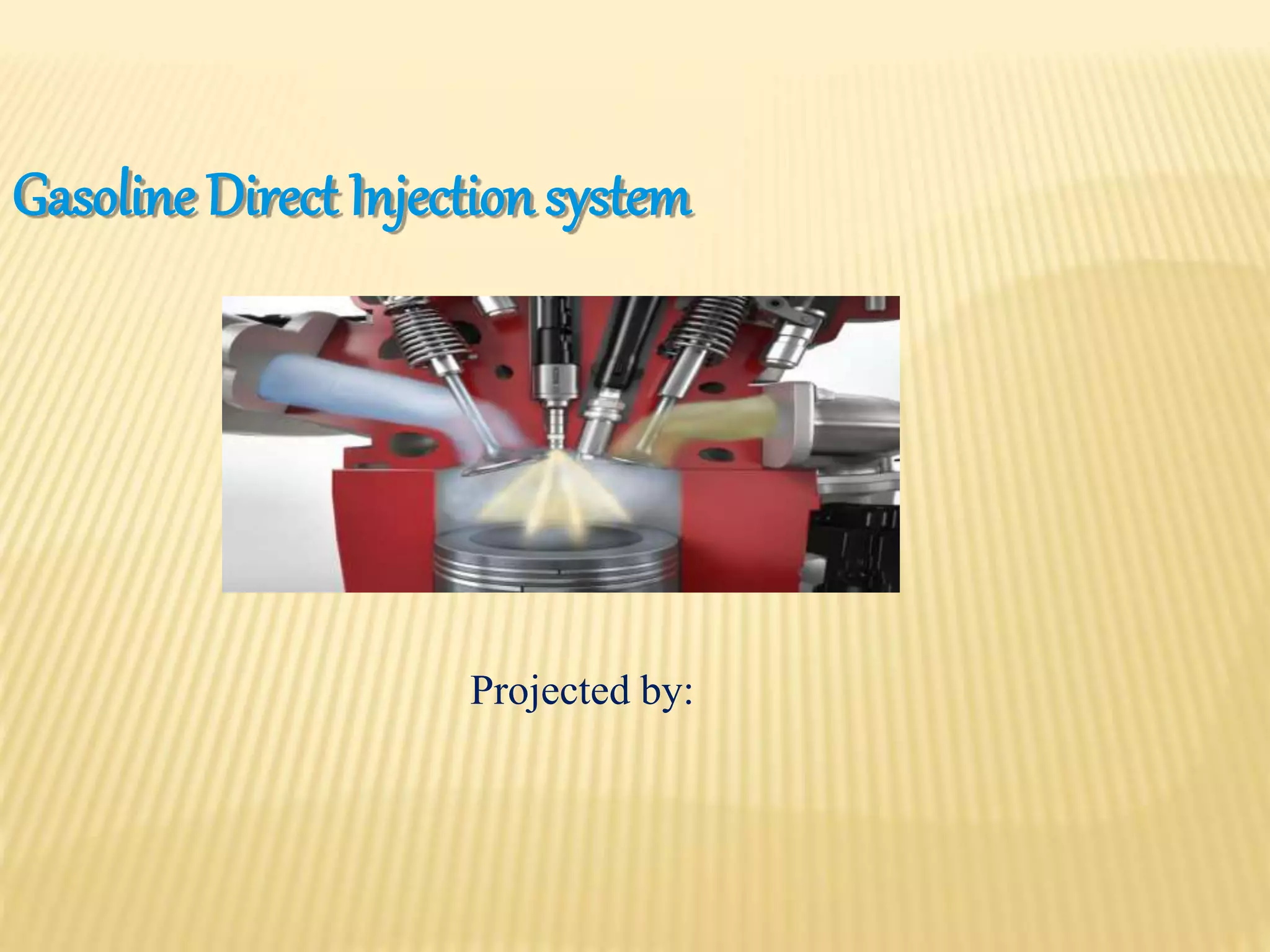
Gasoline Direct Injection system
Projected by:
INTRODUCTION:
 The direct injection system introduces the fu
el directly in the combustion chamber, which m
eans that only air enters the cylinder through th
e manifold and the mixture of air and fuel takes
place inside the combustion chamber.
 Gasoline engine works by sucking a mixture of
ga-soline and air in to cylinder.
Types Of Fuel Injection:
 The Carburetor
 Single-point or throttle body injection(TBI)
 Port or multi-point fuel injection (MPFI)
 Sequential fuel injection
 Direct injection
Major Objectives of the GDI engine:
•Ultra-low fuel consumption that betters that of even diesel engines
•Superior power to conventional MPI engines
•A Stable Combustion
Why Not Carburetor
Carburetor has following Disadvantages
Vapour lock,
Perfect air/fuel mixture cannot be obtained,
Lack of throttle response,
Low volumetric efficiency,
Icing – problem in aircraft engines,
Compromises on emission,
Gasoline Direct Injection system
MAJORCHARACTERISTICSOF THE GDI ENGINE
Lower fuel consumption and higher output
• Ultra-lean Combustion Mode
• Superior Output Mode
Recent Developments
A new 2.0 L DOHC 4-valve direct-injection (DI) gasoline engine
has been developed which features new technologies such as swirl
Intake ports pistons with a concave combustion chamber high-pressur
e fuel-injection
It has been confirmed that a vehicle with this system successfully
improves fuel economy while satisfying emission requirements.
BASIC TECHNICAL FEATURES OF GDI ENGINE
ADVANTAGES:
 Improves volumetric efficiency of the engine.
 Improves atomization and vaporization of fuel and it is ind
ependent of reduce gap spacing speed.
 Ease of cold starting and low load running.
 Specific fuel consumption is reduced i.e. it gives better veh
icle mileage.
 Variation of air fuel ratio is reduced.
 Exhaust emissions are reduced.
Disadvantages:
 Non uniform distribution of mixture in multi cylinder engine and h
ence loss of thermal efficiency
 Loss of volumetric efficiency due to restriction for the mixture flo
w and possibility of back firing.
applications:
 Toyota
 Nissan
 Mercedes-Benz GDI Combustion System
 Mazda GDI Combustion System
 Ford motor company
 Hyundai sonata
Future scope:
 The biofuels like ethanol, methanol, but and their blends with petrol
can be successfully used in direct injection engines
 With the use of biofuels in direct injection engines the pollution can
be reduced and efficiency can be increased.
 The existing two stroke engines in market can be redesigned with di
rect fuel injection system instead of existing carburetor system
CONCLUSION
 Reduction of CO2 production by nearly 20 percent.
 Provides improved torque 5-10%
 Fulfills future emissions requirements.
 97% NOx reduction is achieved.
 Improve the brake specific fuel consumption.
 Smooth transition between operation modes.
 Reduced fuel consumption 15-20%
 Up to 5% more power
 Spontaneous response behavior
THANK YOU

Gasoline direct injection

  • 1.
    Gasoline Direct Injectionsystem Projected by:
  • 2.
    INTRODUCTION:  The directinjection system introduces the fu el directly in the combustion chamber, which m eans that only air enters the cylinder through th e manifold and the mixture of air and fuel takes place inside the combustion chamber.  Gasoline engine works by sucking a mixture of ga-soline and air in to cylinder.
  • 3.
    Types Of FuelInjection:  The Carburetor  Single-point or throttle body injection(TBI)  Port or multi-point fuel injection (MPFI)  Sequential fuel injection  Direct injection
  • 4.
    Major Objectives ofthe GDI engine: •Ultra-low fuel consumption that betters that of even diesel engines •Superior power to conventional MPI engines •A Stable Combustion
  • 5.
    Why Not Carburetor Carburetorhas following Disadvantages Vapour lock, Perfect air/fuel mixture cannot be obtained, Lack of throttle response, Low volumetric efficiency, Icing – problem in aircraft engines, Compromises on emission,
  • 6.
  • 7.
    MAJORCHARACTERISTICSOF THE GDIENGINE Lower fuel consumption and higher output • Ultra-lean Combustion Mode • Superior Output Mode
  • 8.
    Recent Developments A new2.0 L DOHC 4-valve direct-injection (DI) gasoline engine has been developed which features new technologies such as swirl Intake ports pistons with a concave combustion chamber high-pressur e fuel-injection It has been confirmed that a vehicle with this system successfully improves fuel economy while satisfying emission requirements.
  • 9.
  • 10.
    ADVANTAGES:  Improves volumetricefficiency of the engine.  Improves atomization and vaporization of fuel and it is ind ependent of reduce gap spacing speed.  Ease of cold starting and low load running.  Specific fuel consumption is reduced i.e. it gives better veh icle mileage.  Variation of air fuel ratio is reduced.  Exhaust emissions are reduced.
  • 11.
    Disadvantages:  Non uniformdistribution of mixture in multi cylinder engine and h ence loss of thermal efficiency  Loss of volumetric efficiency due to restriction for the mixture flo w and possibility of back firing.
  • 12.
    applications:  Toyota  Nissan Mercedes-Benz GDI Combustion System  Mazda GDI Combustion System  Ford motor company  Hyundai sonata
  • 13.
    Future scope:  Thebiofuels like ethanol, methanol, but and their blends with petrol can be successfully used in direct injection engines  With the use of biofuels in direct injection engines the pollution can be reduced and efficiency can be increased.  The existing two stroke engines in market can be redesigned with di rect fuel injection system instead of existing carburetor system
  • 14.
    CONCLUSION  Reduction ofCO2 production by nearly 20 percent.  Provides improved torque 5-10%  Fulfills future emissions requirements.  97% NOx reduction is achieved.  Improve the brake specific fuel consumption.  Smooth transition between operation modes.  Reduced fuel consumption 15-20%  Up to 5% more power  Spontaneous response behavior
  • 15.