MALAVIYA NATIONAL INSTITUTE OF 
TECHNOLOGY , JAIPUR 
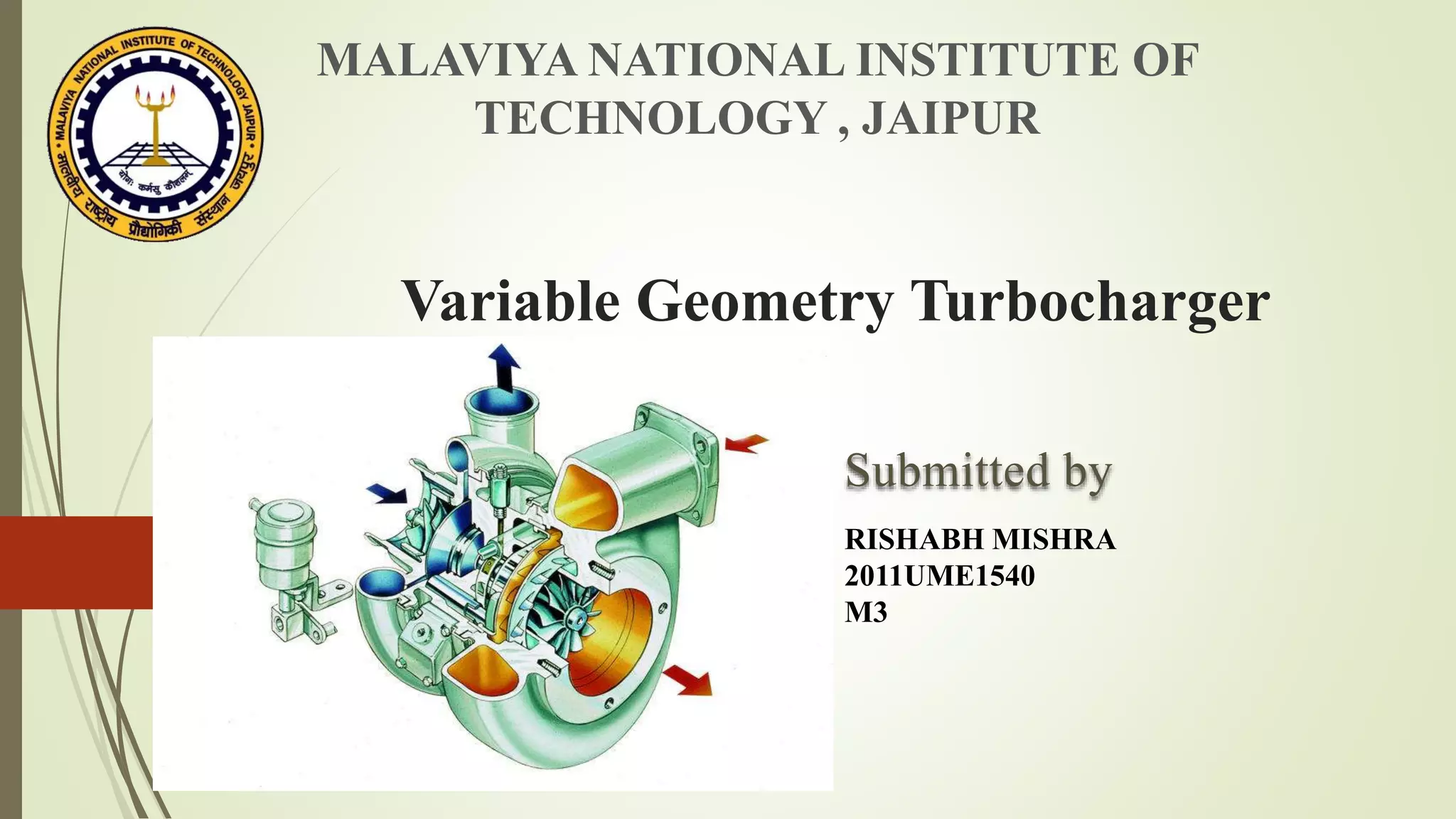
Variable Geometry Turbocharger 
Submitted by 
RISHABH MISHRA 
2011UME1540 
M3
Content 
 Introduction 
 Turbocharging 
 History 
 Problems with simple turbocharging 
Working of VGT 
 Benefits 
 Designing of VGT 
 Summary and Conclusion 
 References 
Common questions
Introduction 
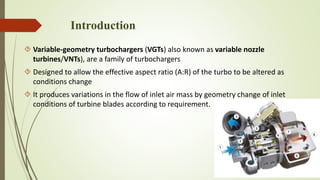
 Variable-geometry turbochargers (VGTs) also known as variable nozzle 
turbines/VNTs), are a family of turbochargers 
 Designed to allow the effective aspect ratio (A:R) of the turbo to be altered as 
conditions change 
 It produces variations in the flow of inlet air mass by geometry change of inlet 
conditions of turbine blades according to requirement.
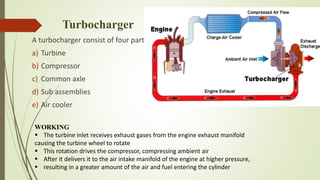
Turbocharger 
A turbocharger consist of four parts: 
a) Turbine 
b) Compressor 
c) Common axle 
d) Sub assemblies 
e) Air cooler 
WORKING 
 The turbine inlet receives exhaust gases from the engine exhaust manifold 
causing the turbine wheel to rotate 
 This rotation drives the compressor, compressing ambient air 
 After it delivers it to the air intake manifold of the engine at higher pressure, 
 resulting in a greater amount of the air and fuel entering the cylinder
History 
 1927: Swiss engineer Alfred Buchi is granted the first Patent for exhaust driven 
Turbo-Supercharging or Turbocharger. 
 1952: Garrett (Honeywell) & Schwitzer (BorgWarner) begin Turbocharger production 
for Caterpillar & Mack Truck. 
 1962: First Passenger Car Turbo application, General Motors Corvair is introduced, 
followed by 1963 Oldsmobile Jetfire Turbo-Rocket V8. 
 1979: Beginning of Downsized Turbo Era with Ford Mustang 2.3-liter, 4 cylinder engine, 
Chrysler & GM also Compete with Turbo Models. 
 1980: BorgWarner and IHI Japan form 50/50 Joint Venture, Warner-Ishi. 
MHI of Japan begins development for US. 
 1997: BorgWarner purchases majority shares of AG Kühnle, Kopp & 
Kausch from Penske Corporation. 
 1999: Kuhlman Corporation, parent of Schwitzer is purchasedby BorgWarner and 
becomes part of BorgWarner Turbo Systems. 
 2008: Bosch-Mahle & Continental Turbo Systems Begin Development.
Problems with simple Turbochargers 
 Difference in the optimum aspect ratio of nozzle at different 
running conditions 
 Low boost at slow running conditions 
 Choking at high speed 
 Variation in the inlet air mass according to engine performance 
 Starting lag
Turbocharger configuration
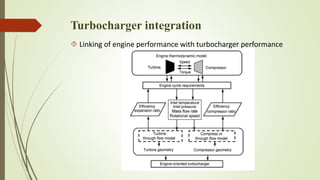
Turbocharger integration 
 Linking of engine performance with turbocharger performance
Variable geometry turbocharger 
 In variable geometry turbocharger the variation in inlet air mass is 
brought by compressor speed 
 Changes is done on the turbine 
 Nozzle angle is changed by stator vane, operated by ECU unit of 
vehicle 
 For low speed, the vane is brought in closed position so that 
boosting can be done by compressor 
 At high speed ,the vane comes at open condition allowing most of 
the exhaust to impact on the blades ,and the pressure decreases of 
exhaust gases and choking is avoided
Working of VGT 
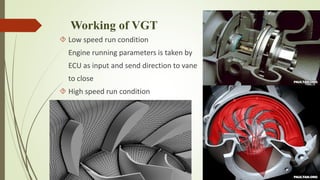
 Low speed run condition 
Engine running parameters is taken by 
ECU as input and send direction to vane 
to close 
 High speed run condition
Benefits 
 No throttling loss of the waste gate valve 
 Higher air–fuel ratio and higher peak torque at low engine speeds 
 Improved vehicle accelerations without the need to resort to turbines with high 
pumping loss at high engine speeds 
 Potential for lower engine ΔP (the difference between exhaust manifold and 
intake manifold pressures) 
 Control over engine ΔP that can be used to drive EGR flow in diesel engines with 
high pressure loop (HPL) EGR systems 
 A better ability to cover a wider region of low BSFC in the engine speed–load 
domain 
 Ability to provide engine braking 
 Ability to raise exhaust temperature for after treatment system management
Designing of the VGT 
Three parts 
a) Electronic control unit 
b) Compressor designing 
c) Turbine designing
Electronic control unit 
 The opening of the guide vanes is commanded by the electronic 
control unit (ECU) of the car 
 Aspects of engine performance that ECU consider for the varying 
the nozzle angle 
1) the instant and quantity of injected fuel 
2) the opening and closing of the intake and exhaust valves 
3) pressures, temperatures, flow rates 
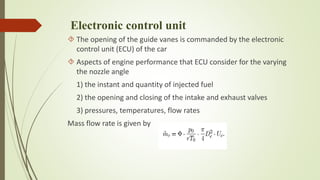
Mass flow rate is given by
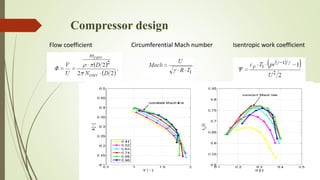
Compressor design 
Flow coefficient Circumferential Mach number Isentropic work coefficient
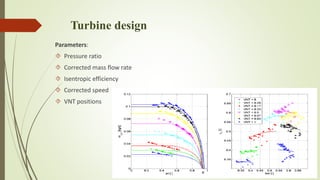
Turbine design 
Parameters: 
 Pressure ratio 
 Corrected mass flow rate 
 Isentropic efficiency 
 Corrected speed 
 VNT positions
Conclusion 
 An VGT is designed to position the nozzle to attain the optimum air mass flow inside 
the engine and improving the break specific fuel consumption. 
 An VGT, under low running speed, provides closing of vane blades to allow more 
impact of exhaust gases on it improving intake air mass.. 
 Designing of the compressor and turbine include the study of there design parameter 
on the maps which allow us to decide standards for the components. 
 Pumping losses , pressure energy loss, engine noise and heat energy loss is recovered 
by VGT. These problems commonly occur on vehicle with conventional turbocharging 
system or in case of no turbocharging. 
 If there occurs VGT failure, the system will revert to normal turbocharging operation. 
Normally the ECU unit will turn on the light in case of any fault.
References 
 K. Segawa, A. Iwakami, S. Yamaguchi, H. Tange, K. Kimachi, Improvement of turbine 
performance for small size variable geometry system Turbo charger, IHI Corporation, 
Japan,2010. 
 Rabih Omran, Rafic Younes, and Jean-Claude Champoussin, Optimal Control of a Variable 
Geometry Turbocharged Diesel Engine Using Neural Networks: Applications on the ETC 
Test Cycle, Lebanese University. Nov. 27, 2008. 
 Daniel Cristian Dinescu, Mohand Tazerout, mean value modelling of a variable nozzle 
turbocharger (VNT), U.P.B. Sci. Bull., 2010. 
 Zhang Yang Jun, Chen Tao, Zhuge Weil, Zhang Shu Yong & XU Jian Zhong, An integrated 
turbocharger design approach to improve engine Performance, Technological Sciences, 
January 2010 
 Tao Chen, Weilin Zhuge, Xinqian Zheng, Yangjun Zhang, turbocharger design for a 1.8 litre 
turbocharged gasoline Engine using an integrated method, ASME, June 2009
variable geometry turbocharger

variable geometry turbocharger

  • 1.
    MALAVIYA NATIONAL INSTITUTEOF TECHNOLOGY , JAIPUR Variable Geometry Turbocharger Submitted by RISHABH MISHRA 2011UME1540 M3
  • 2.
    Content  Introduction  Turbocharging  History  Problems with simple turbocharging Working of VGT  Benefits  Designing of VGT  Summary and Conclusion  References Common questions
  • 3.
    Introduction  Variable-geometryturbochargers (VGTs) also known as variable nozzle turbines/VNTs), are a family of turbochargers  Designed to allow the effective aspect ratio (A:R) of the turbo to be altered as conditions change  It produces variations in the flow of inlet air mass by geometry change of inlet conditions of turbine blades according to requirement.
  • 4.
    Turbocharger A turbochargerconsist of four parts: a) Turbine b) Compressor c) Common axle d) Sub assemblies e) Air cooler WORKING  The turbine inlet receives exhaust gases from the engine exhaust manifold causing the turbine wheel to rotate  This rotation drives the compressor, compressing ambient air  After it delivers it to the air intake manifold of the engine at higher pressure,  resulting in a greater amount of the air and fuel entering the cylinder
  • 5.
    History  1927:Swiss engineer Alfred Buchi is granted the first Patent for exhaust driven Turbo-Supercharging or Turbocharger.  1952: Garrett (Honeywell) & Schwitzer (BorgWarner) begin Turbocharger production for Caterpillar & Mack Truck.  1962: First Passenger Car Turbo application, General Motors Corvair is introduced, followed by 1963 Oldsmobile Jetfire Turbo-Rocket V8.  1979: Beginning of Downsized Turbo Era with Ford Mustang 2.3-liter, 4 cylinder engine, Chrysler & GM also Compete with Turbo Models.  1980: BorgWarner and IHI Japan form 50/50 Joint Venture, Warner-Ishi. MHI of Japan begins development for US.  1997: BorgWarner purchases majority shares of AG Kühnle, Kopp & Kausch from Penske Corporation.  1999: Kuhlman Corporation, parent of Schwitzer is purchasedby BorgWarner and becomes part of BorgWarner Turbo Systems.  2008: Bosch-Mahle & Continental Turbo Systems Begin Development.
  • 6.
    Problems with simpleTurbochargers  Difference in the optimum aspect ratio of nozzle at different running conditions  Low boost at slow running conditions  Choking at high speed  Variation in the inlet air mass according to engine performance  Starting lag
  • 7.
  • 8.
    Turbocharger integration Linking of engine performance with turbocharger performance
  • 9.
    Variable geometry turbocharger  In variable geometry turbocharger the variation in inlet air mass is brought by compressor speed  Changes is done on the turbine  Nozzle angle is changed by stator vane, operated by ECU unit of vehicle  For low speed, the vane is brought in closed position so that boosting can be done by compressor  At high speed ,the vane comes at open condition allowing most of the exhaust to impact on the blades ,and the pressure decreases of exhaust gases and choking is avoided
  • 10.
    Working of VGT  Low speed run condition Engine running parameters is taken by ECU as input and send direction to vane to close  High speed run condition
  • 12.
    Benefits  Nothrottling loss of the waste gate valve  Higher air–fuel ratio and higher peak torque at low engine speeds  Improved vehicle accelerations without the need to resort to turbines with high pumping loss at high engine speeds  Potential for lower engine ΔP (the difference between exhaust manifold and intake manifold pressures)  Control over engine ΔP that can be used to drive EGR flow in diesel engines with high pressure loop (HPL) EGR systems  A better ability to cover a wider region of low BSFC in the engine speed–load domain  Ability to provide engine braking  Ability to raise exhaust temperature for after treatment system management
  • 13.
    Designing of theVGT Three parts a) Electronic control unit b) Compressor designing c) Turbine designing
  • 14.
    Electronic control unit  The opening of the guide vanes is commanded by the electronic control unit (ECU) of the car  Aspects of engine performance that ECU consider for the varying the nozzle angle 1) the instant and quantity of injected fuel 2) the opening and closing of the intake and exhaust valves 3) pressures, temperatures, flow rates Mass flow rate is given by
  • 15.
    Compressor design Flowcoefficient Circumferential Mach number Isentropic work coefficient
  • 16.
    Turbine design Parameters:  Pressure ratio  Corrected mass flow rate  Isentropic efficiency  Corrected speed  VNT positions
  • 17.
    Conclusion  AnVGT is designed to position the nozzle to attain the optimum air mass flow inside the engine and improving the break specific fuel consumption.  An VGT, under low running speed, provides closing of vane blades to allow more impact of exhaust gases on it improving intake air mass..  Designing of the compressor and turbine include the study of there design parameter on the maps which allow us to decide standards for the components.  Pumping losses , pressure energy loss, engine noise and heat energy loss is recovered by VGT. These problems commonly occur on vehicle with conventional turbocharging system or in case of no turbocharging.  If there occurs VGT failure, the system will revert to normal turbocharging operation. Normally the ECU unit will turn on the light in case of any fault.
  • 18.
    References  K.Segawa, A. Iwakami, S. Yamaguchi, H. Tange, K. Kimachi, Improvement of turbine performance for small size variable geometry system Turbo charger, IHI Corporation, Japan,2010.  Rabih Omran, Rafic Younes, and Jean-Claude Champoussin, Optimal Control of a Variable Geometry Turbocharged Diesel Engine Using Neural Networks: Applications on the ETC Test Cycle, Lebanese University. Nov. 27, 2008.  Daniel Cristian Dinescu, Mohand Tazerout, mean value modelling of a variable nozzle turbocharger (VNT), U.P.B. Sci. Bull., 2010.  Zhang Yang Jun, Chen Tao, Zhuge Weil, Zhang Shu Yong & XU Jian Zhong, An integrated turbocharger design approach to improve engine Performance, Technological Sciences, January 2010  Tao Chen, Weilin Zhuge, Xinqian Zheng, Yangjun Zhang, turbocharger design for a 1.8 litre turbocharged gasoline Engine using an integrated method, ASME, June 2009

Editor's Notes

  • #7 Do internet search and add more
  • #15 Add diagrams and notes about ecu