Chapter Twenty-Eight

Electronic Fuel Injection
Objectives

• Explain the difference between throttle
  body and port injection systems.
• Describe the difference between a
  sequential fuel injection (SFI) system and a
  multi-port fuel injection (MFI) system.
• Explain the design, purpose, and operation
  of major EFI components.
Objectives (Cont’d)

• Describe the inputs used by the computer to
  control the idle air control and idle air
  control by-pass air motors.
• Describe how the computer supplies the
  correct air/fuel ratio on a throttle body
  injection (TBI) system.
Objectives (Cont’d)

• Explain how the clear flood mode operates
  on a TBI system.
• Explain why manifold vacuum is connected
  to the pressure regulator in an MFI system.
• Describe the operation of the pressure
  regulator in a returnless EFI system.
Objectives (Cont’d)

• Describe the operation of the central
  injector and poppet nozzles in a central port
  injection (CPI) system.
• Describe the operation of direct gasoline
  injection systems.
Types of Fuel Injection Systems

•   Throttle body injection (TBI)
•   Central port injection (CPI)
•   Port fuel injection (PFI)
•   Gasoline direct injection (GDI)
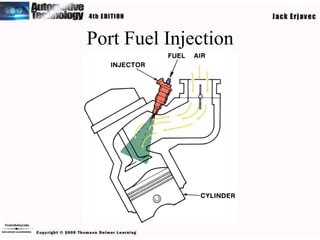
Port Fuel Injection
Basic Fuel Injection System
• Input sensors
   – Give engine operating condition information to the
     computer.
• Control module
   – Determines how much fuel the engine needs and
     controls the fuel injectors.
• Fuel injectors
   – Meter and atomize the fuel entering the intake manifold
     or intake port.
Operating Modes

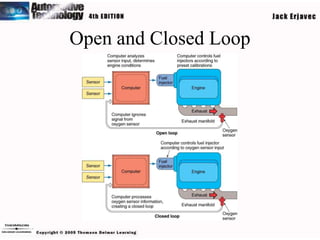
• Open loop mode
  – The computer uses pre-programmed values and
    basic sensor information to determine injector
    pulse length.
• Closed loop mode
  – In addition to the other input sensors, the
    computer uses signals from the exhaust oxygen
    sensor to determine injector pulse length.
Operating Modes (Cont’d)

• Clear flood mode
  – The computer cuts off the fuel injectors when
    throttle position is high (wide open) and RPM
    is low (cranking speed).
• Acceleration enrichment mode
  – The computer adds extra fuel during rapid
    changes in throttle position and manifold
    vacuum or air flow.
Open and Closed Loop
Port Firing Control

• Multi-port injection (MPI)
  – The injectors are arranged and fired together in
    groups or pairs.
• Sequential injection (SFI)
  – Each injector is fired individually just before
    the intake valve for that cylinder opens.
Gasoline Direct Injection (GDI)
            Features
• Gasoline direction injection (GDI)
  – Allows for very lean air/fuel mixtures.
  – Increases volumetric efficiency.
  – Uses very high fuel pressures (typically
    between 400 and 1500 psi).
  – System operates similarly to diesel injection
    systems.
A Typical GDI System
Common Input Sensors

•   Mass airflow (MAF) sensor
•   Intake air temperature (IAT) sensor
•   Manifold absolute pressure (MAP) sensor
•   Coolant temperature (ECT) sensor
•   Throttle position (TP) sensor
•   Crankshaft speed (CKP) sensor
•   Oxygen (HO2S) sensor
A Mass Airflow Sensor
A MAP Sensor
Summary

• There are three types of electronic fuel
  injection systems: throttle body, port, and
  central multi-port.
• Port injection systems use one of four firing
  systems: grounded single fire, grouped
  double fire, simultaneous double fire, or
  sequential fire.
Summary (Cont’d)

• The airflow sensor determines the amount
  of air entering the engine.
• The heart of the fuel injection system is the
  electronic control unit.
• Two types of fuel injectors are currently in
  use: top feed and bottom feed.
Summary (Cont’d)

• In a speed-density EFI system, the computer
  uses manifold pressure and engine rpm inputs
  to calculate the amount of air entering the
  engine.
• In an EFI system, the computer supplies the
  proper air/fuel ratio by controlling injector
  pulse width.
Summary (Cont’d)

• In an SFI system, each injector is controlled
  individually by the computer.
• The pressure regulator maintains the
  specified fuel system pressure and returns
  excess fuel to the fuel tank.
Summary (Cont’d)

• In a returnless fuel system, the pressure
  regulator and filter assembly is mounted
  with the fuel pump and gauge sending unit
  assembly in the fuel tank.
• A central multi-port injection system has
  one central injector and a poppet nozzle in
  each intake port.
Summary (Cont’d)

• GDI systems inject gasoline directly into
  the combustion chamber and allow for very
  lean operation.
• EFI systems rely on inputs from various
  sensors; these include airflow, air
  temperature, mass airflow, manifold
  absolute pressure, oxygen, coolant
  temperature, and throttle position sensors.

Ch28 electronic fuel injection

  • 1.
  • 2.
    Objectives • Explain thedifference between throttle body and port injection systems. • Describe the difference between a sequential fuel injection (SFI) system and a multi-port fuel injection (MFI) system. • Explain the design, purpose, and operation of major EFI components.
  • 3.
    Objectives (Cont’d) • Describethe inputs used by the computer to control the idle air control and idle air control by-pass air motors. • Describe how the computer supplies the correct air/fuel ratio on a throttle body injection (TBI) system.
  • 4.
    Objectives (Cont’d) • Explainhow the clear flood mode operates on a TBI system. • Explain why manifold vacuum is connected to the pressure regulator in an MFI system. • Describe the operation of the pressure regulator in a returnless EFI system.
  • 5.
    Objectives (Cont’d) • Describethe operation of the central injector and poppet nozzles in a central port injection (CPI) system. • Describe the operation of direct gasoline injection systems.
  • 6.
    Types of FuelInjection Systems • Throttle body injection (TBI) • Central port injection (CPI) • Port fuel injection (PFI) • Gasoline direct injection (GDI)
  • 7.
  • 8.
    Basic Fuel InjectionSystem • Input sensors – Give engine operating condition information to the computer. • Control module – Determines how much fuel the engine needs and controls the fuel injectors. • Fuel injectors – Meter and atomize the fuel entering the intake manifold or intake port.
  • 9.
    Operating Modes • Openloop mode – The computer uses pre-programmed values and basic sensor information to determine injector pulse length. • Closed loop mode – In addition to the other input sensors, the computer uses signals from the exhaust oxygen sensor to determine injector pulse length.
  • 10.
    Operating Modes (Cont’d) •Clear flood mode – The computer cuts off the fuel injectors when throttle position is high (wide open) and RPM is low (cranking speed). • Acceleration enrichment mode – The computer adds extra fuel during rapid changes in throttle position and manifold vacuum or air flow.
  • 11.
  • 12.
    Port Firing Control •Multi-port injection (MPI) – The injectors are arranged and fired together in groups or pairs. • Sequential injection (SFI) – Each injector is fired individually just before the intake valve for that cylinder opens.
  • 13.
    Gasoline Direct Injection(GDI) Features • Gasoline direction injection (GDI) – Allows for very lean air/fuel mixtures. – Increases volumetric efficiency. – Uses very high fuel pressures (typically between 400 and 1500 psi). – System operates similarly to diesel injection systems.
  • 14.
  • 15.
    Common Input Sensors • Mass airflow (MAF) sensor • Intake air temperature (IAT) sensor • Manifold absolute pressure (MAP) sensor • Coolant temperature (ECT) sensor • Throttle position (TP) sensor • Crankshaft speed (CKP) sensor • Oxygen (HO2S) sensor
  • 16.
  • 17.
  • 18.
    Summary • There arethree types of electronic fuel injection systems: throttle body, port, and central multi-port. • Port injection systems use one of four firing systems: grounded single fire, grouped double fire, simultaneous double fire, or sequential fire.
  • 19.
    Summary (Cont’d) • Theairflow sensor determines the amount of air entering the engine. • The heart of the fuel injection system is the electronic control unit. • Two types of fuel injectors are currently in use: top feed and bottom feed.
  • 20.
    Summary (Cont’d) • Ina speed-density EFI system, the computer uses manifold pressure and engine rpm inputs to calculate the amount of air entering the engine. • In an EFI system, the computer supplies the proper air/fuel ratio by controlling injector pulse width.
  • 21.
    Summary (Cont’d) • Inan SFI system, each injector is controlled individually by the computer. • The pressure regulator maintains the specified fuel system pressure and returns excess fuel to the fuel tank.
  • 22.
    Summary (Cont’d) • Ina returnless fuel system, the pressure regulator and filter assembly is mounted with the fuel pump and gauge sending unit assembly in the fuel tank. • A central multi-port injection system has one central injector and a poppet nozzle in each intake port.
  • 23.
    Summary (Cont’d) • GDIsystems inject gasoline directly into the combustion chamber and allow for very lean operation. • EFI systems rely on inputs from various sensors; these include airflow, air temperature, mass airflow, manifold absolute pressure, oxygen, coolant temperature, and throttle position sensors.