A.I. in Schools
PROS and CONS
What is AI ?
“Artificial intelligence (AI) refers to the simulation
of human intelligence in machines that are
programmed to think like humans and mimic their
actions.
The term may also be applied to any machine that
exhibits traits associated with a human mind such
as learning and problem-solving.”
- Investopedia
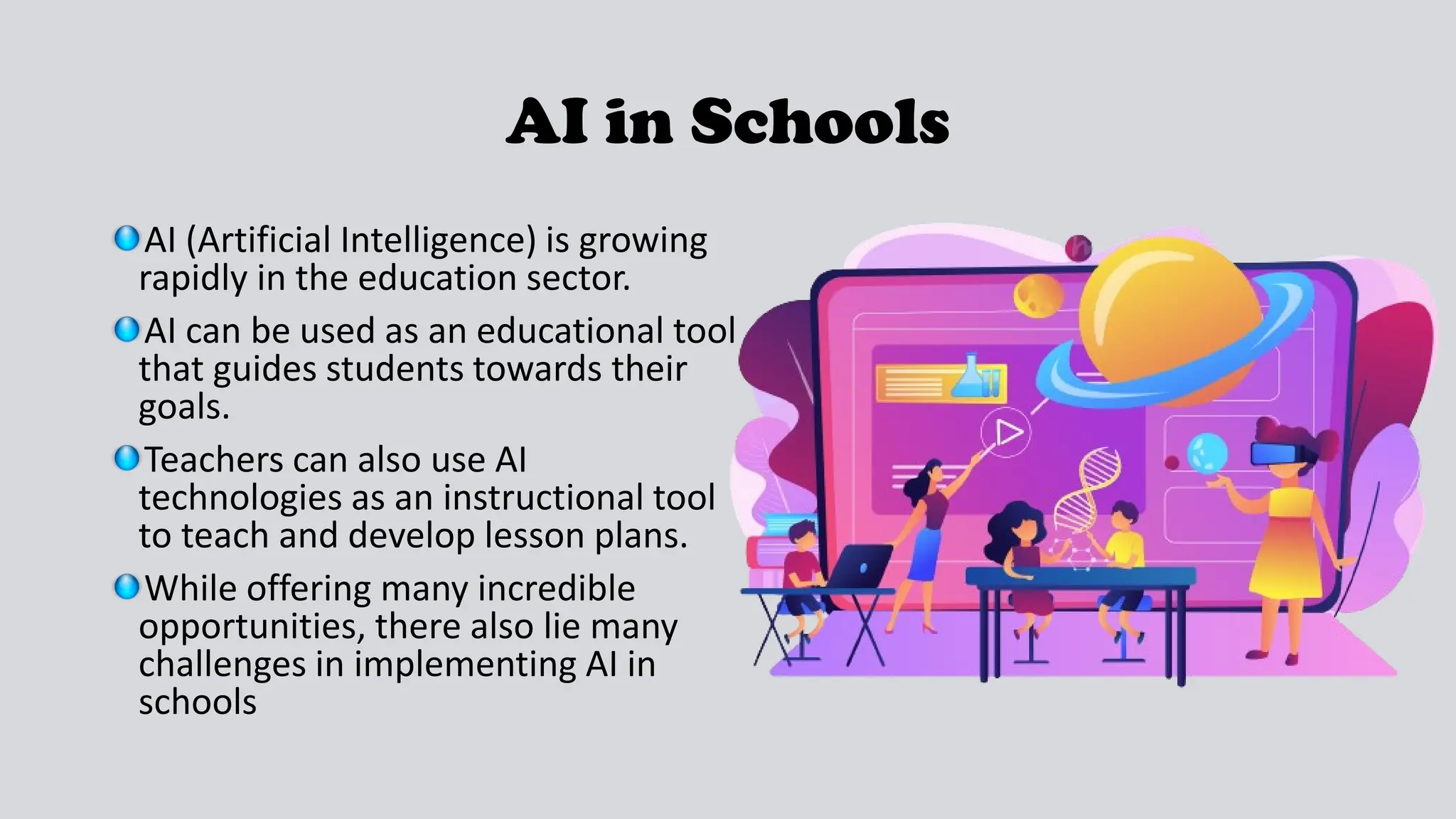
AI in Schools
AI (Artificial Intelligence) is growing
rapidly in the education sector.
AI can be used as an educational tool
that guides students towards their
goals.
Teachers can also use AI
technologies as an instructional tool
to teach and develop lesson plans.
While offering many incredible
opportunities, there also lie many
challenges in implementing AI in
schools
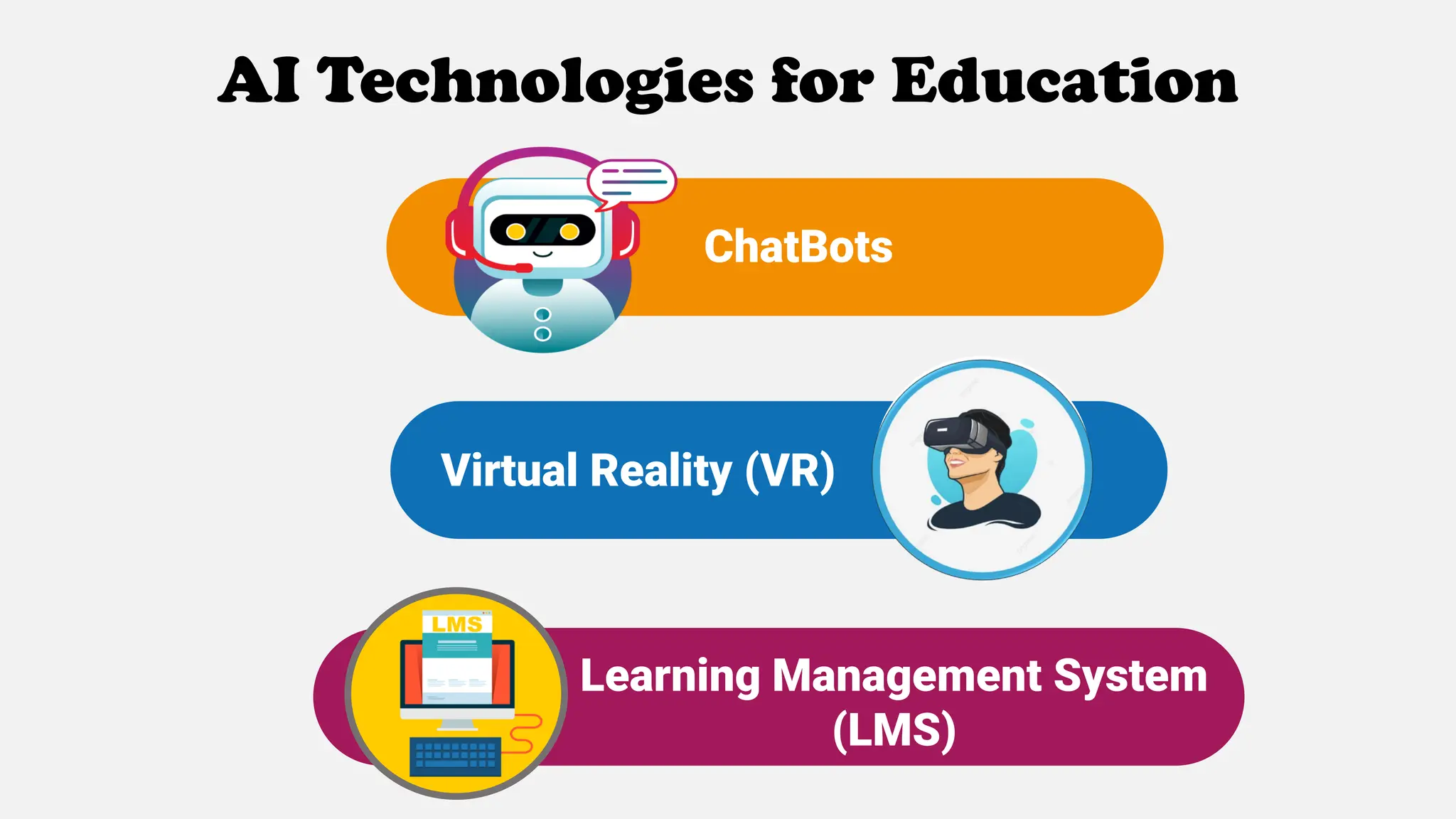
AI Technologies for Education
ChatBots
Virtual Reality (VR)
Learning Management System
(LMS)
Pros of using A.I. in Schools
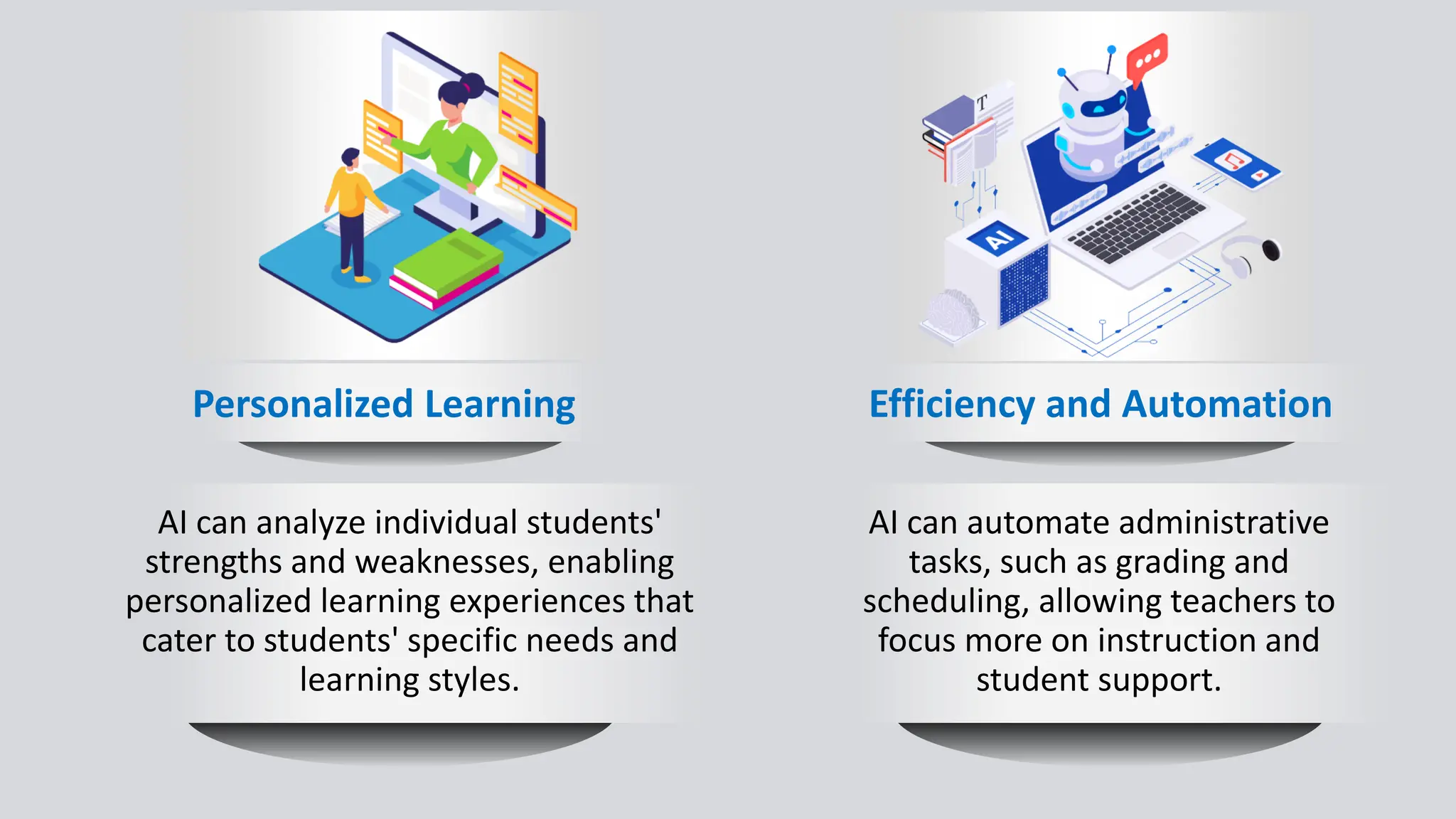
Efficiency and Automation
Personalized Learning
AI can automate administrative
tasks, such as grading and
scheduling, allowing teachers to
focus more on instruction and
student support.​
AI can analyze individual students'
strengths and weaknesses, enabling
personalized learning experiences that
cater to students' specific needs and
learning styles.​
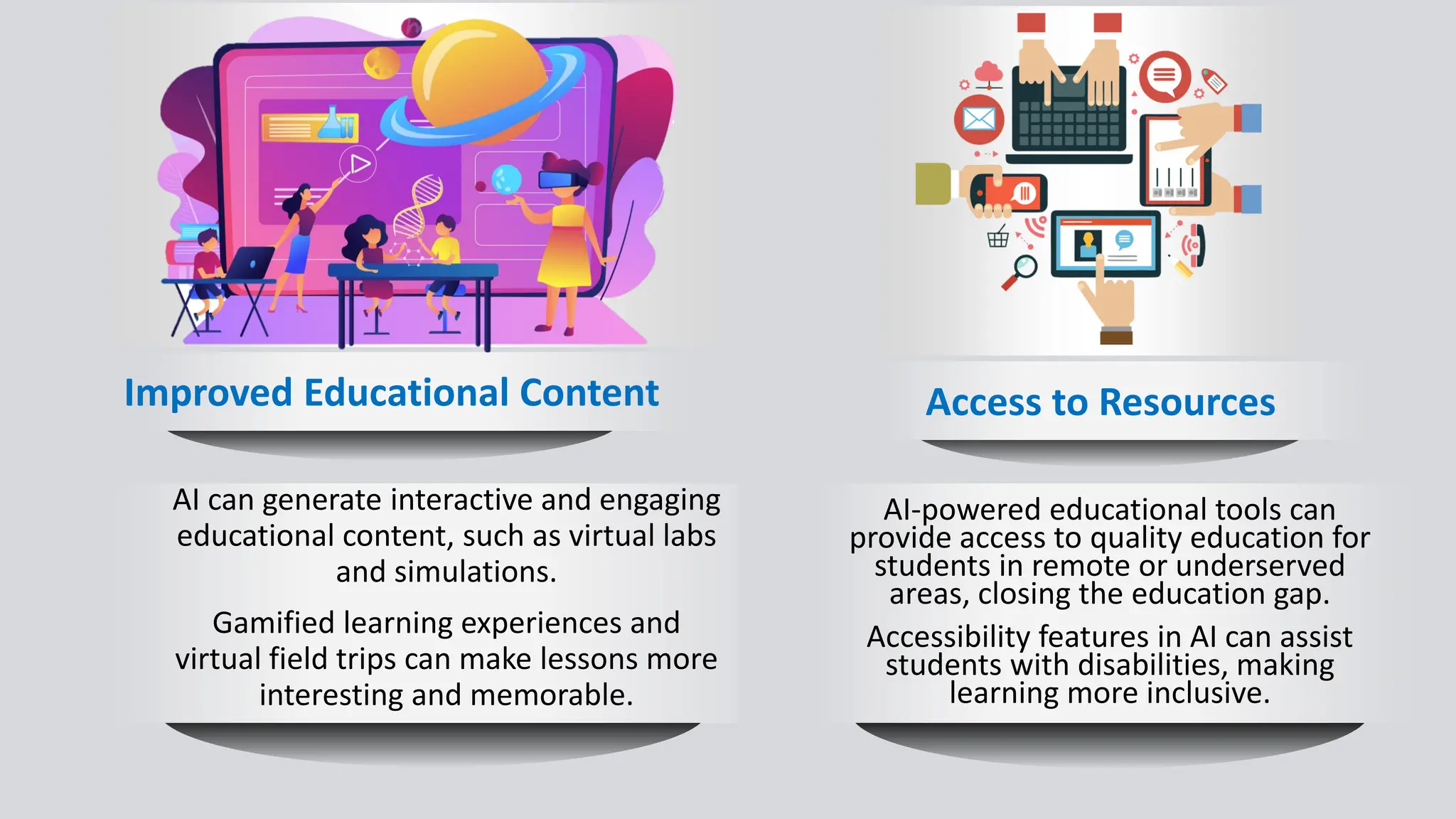
AI can generate interactive and engaging
educational content, such as virtual labs
and simulations.
Gamified learning experiences and
virtual field trips can make lessons more
interesting and memorable.
Access to Resources
AI-powered educational tools can
provide access to quality education for
students in remote or underserved
areas, closing the education gap.
Accessibility features in AI can assist
students with disabilities, making
learning more inclusive.
Improved Educational Content
Language Learning
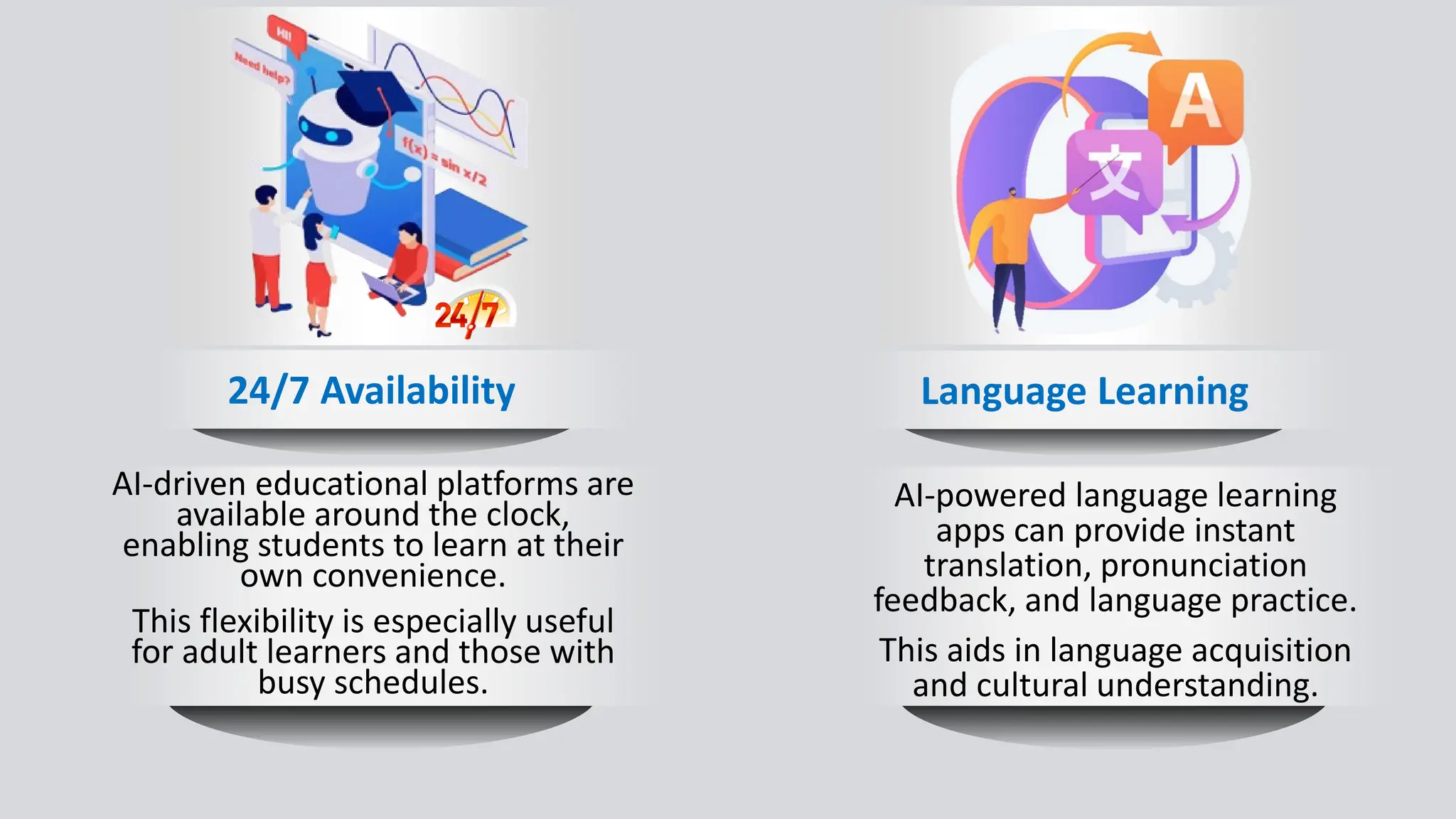
24/7 Availability
AI-driven educational platforms are
available around the clock,
enabling students to learn at their
own convenience.
This flexibility is especially useful
for adult learners and those with
busy schedules.
AI-powered language learning
apps can provide instant
translation, pronunciation
feedback, and language practice.
This aids in language acquisition
and cultural understanding.
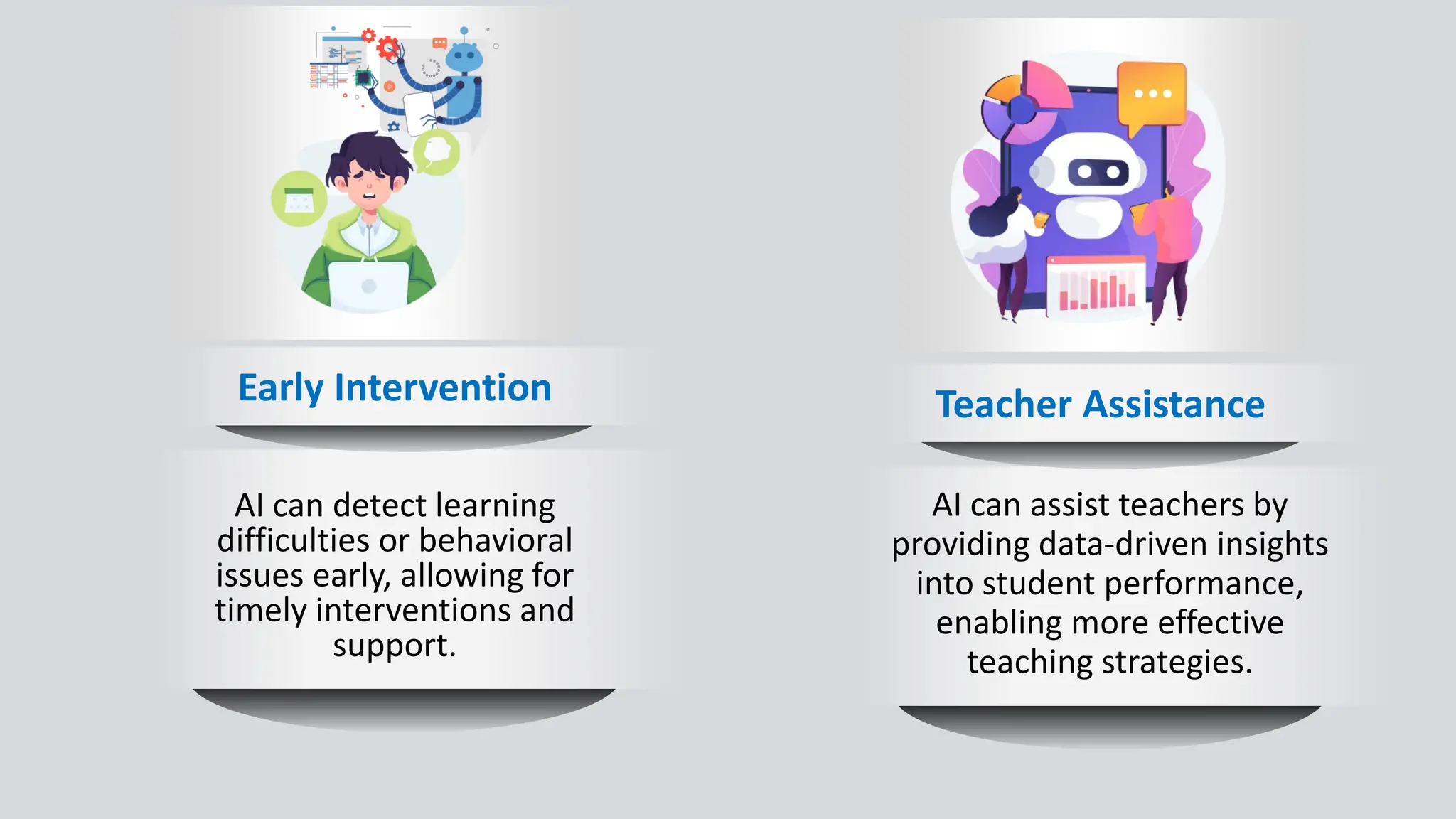
Teacher Assistance
Early Intervention
AI can detect learning
difficulties or behavioral
issues early, allowing for
timely interventions and
support.
AI can assist teachers by
providing data-driven insights
into student performance,
enabling more effective
teaching strategies.
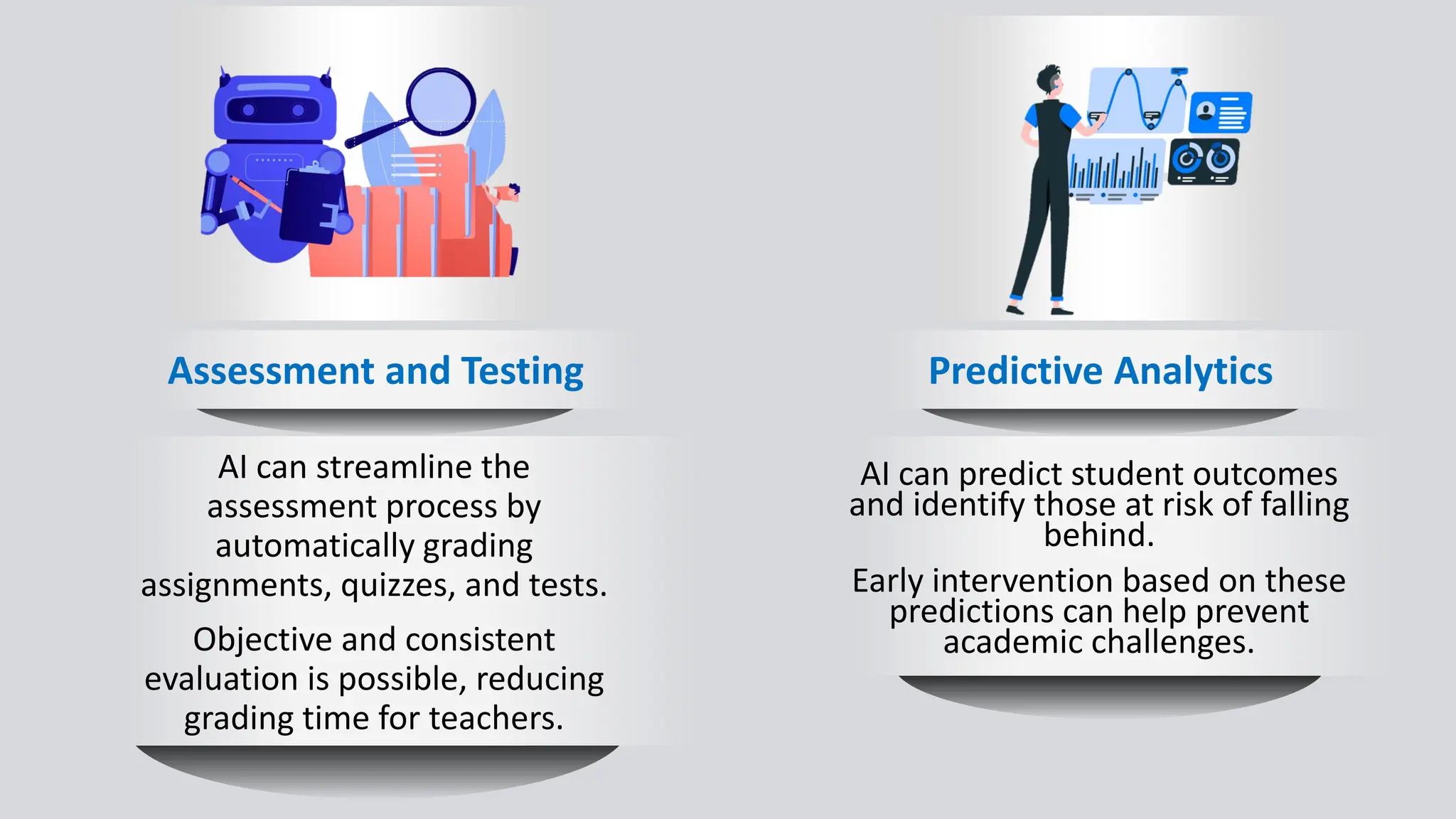
Predictive Analytics
Assessment and Testing
AI can streamline the
assessment process by
automatically grading
assignments, quizzes, and tests.
Objective and consistent
evaluation is possible, reducing
grading time for teachers.
AI can predict student outcomes
and identify those at risk of falling
behind.
Early intervention based on these
predictions can help prevent
academic challenges.
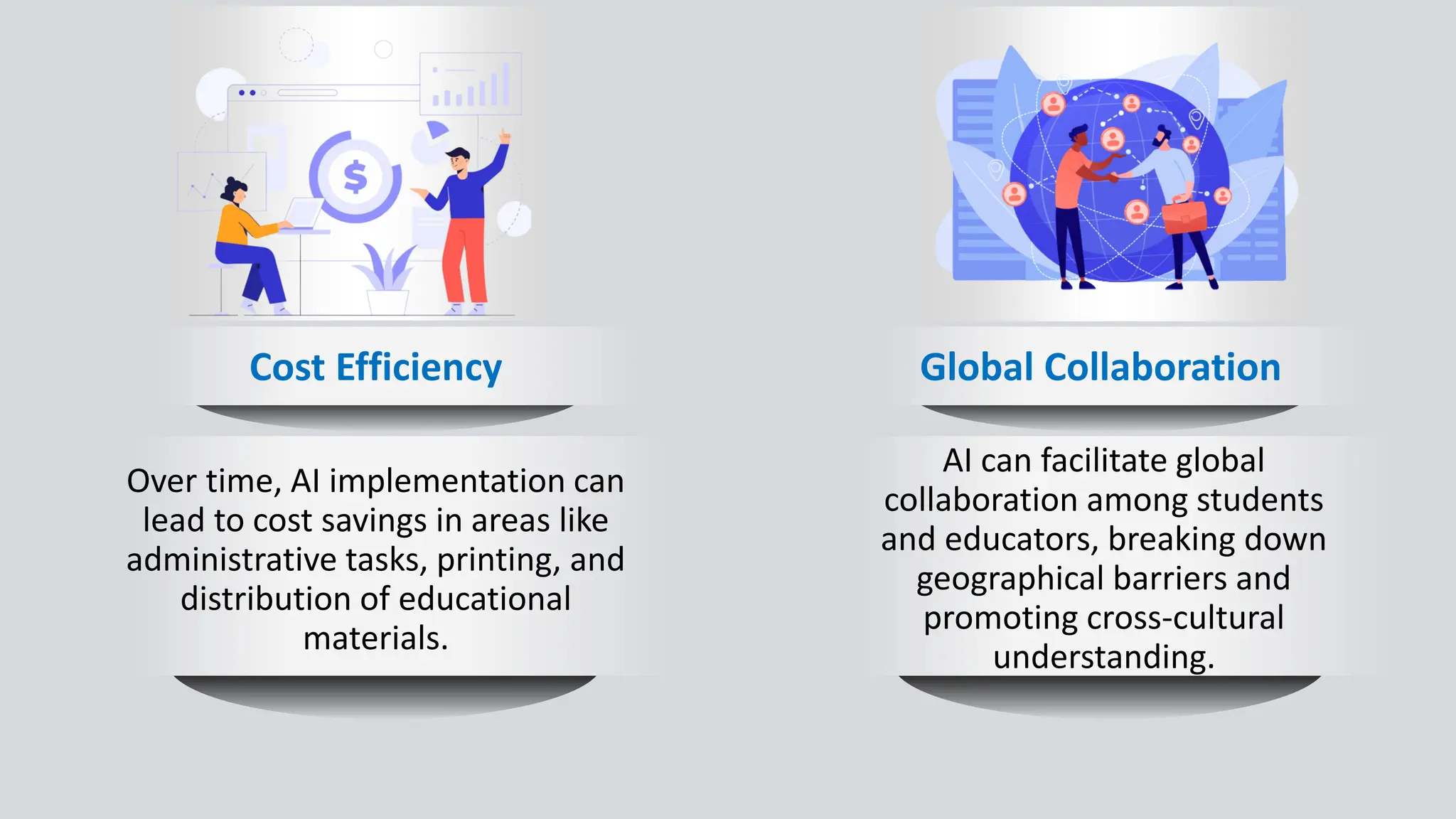
Global Collaboration
Cost Efficiency
Over time, AI implementation can
lead to cost savings in areas like
administrative tasks, printing, and
distribution of educational
materials.
AI can facilitate global
collaboration among students
and educators, breaking down
geographical barriers and
promoting cross-cultural
understanding.
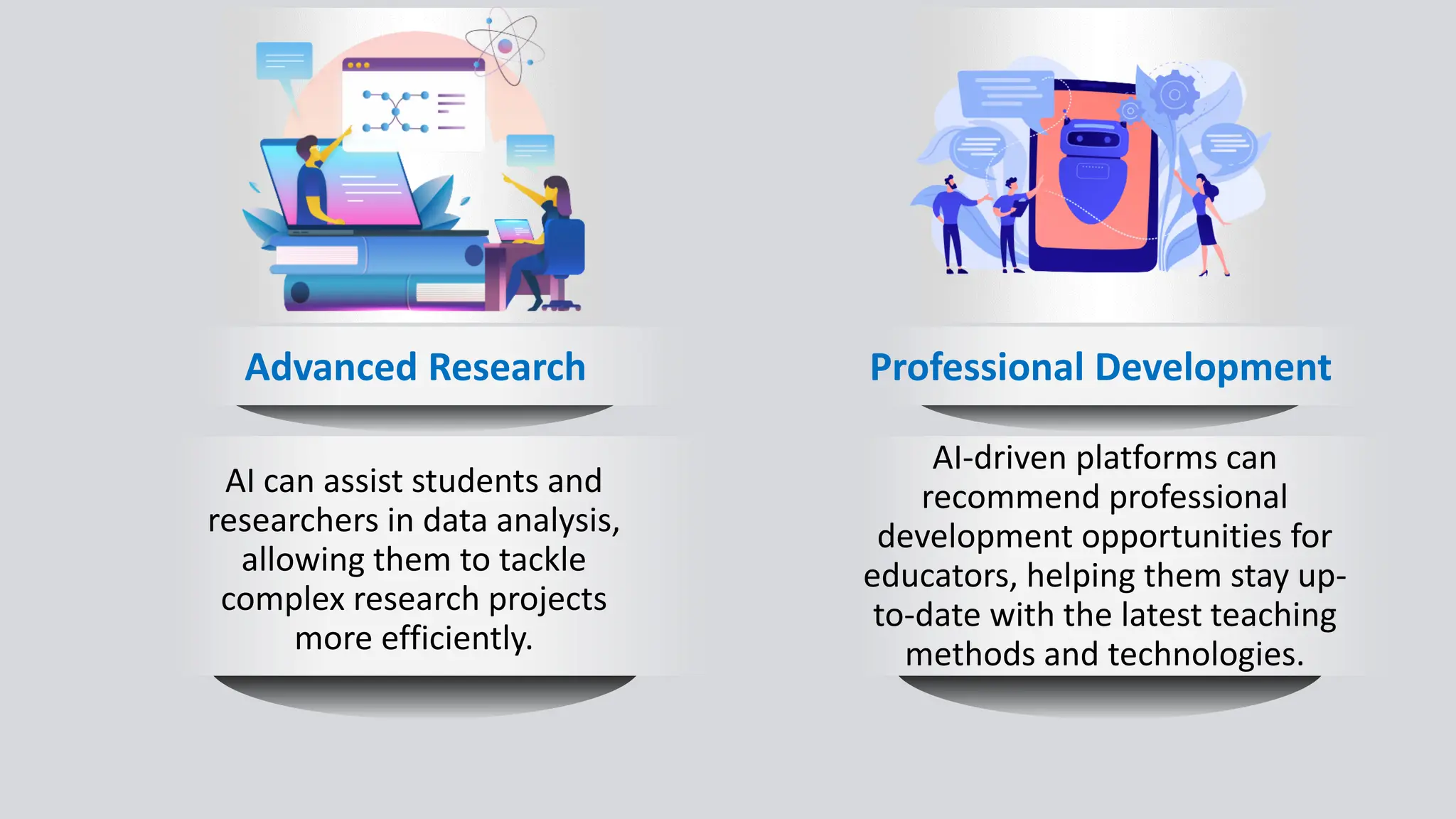
Professional Development
Advanced Research
AI can assist students and
researchers in data analysis,
allowing them to tackle
complex research projects
more efficiently.
AI-driven platforms can
recommend professional
development opportunities for
educators, helping them stay up-
to-date with the latest teaching
methods and technologies.
SUMMARY
AI can revolutionize education in schools.
Personalized learning experiences can be offered through AI.
Efficiency can be improved with AI.
Valuable data-driven insights can be provided by AI.
Potential challenges and ethical considerations need to be addressed.
Pros of using AI in education are significant and can lead to more
effective and inclusive learning environments.
Cons of
using A.I. in
Schools
Cons of using A.I. in Schools
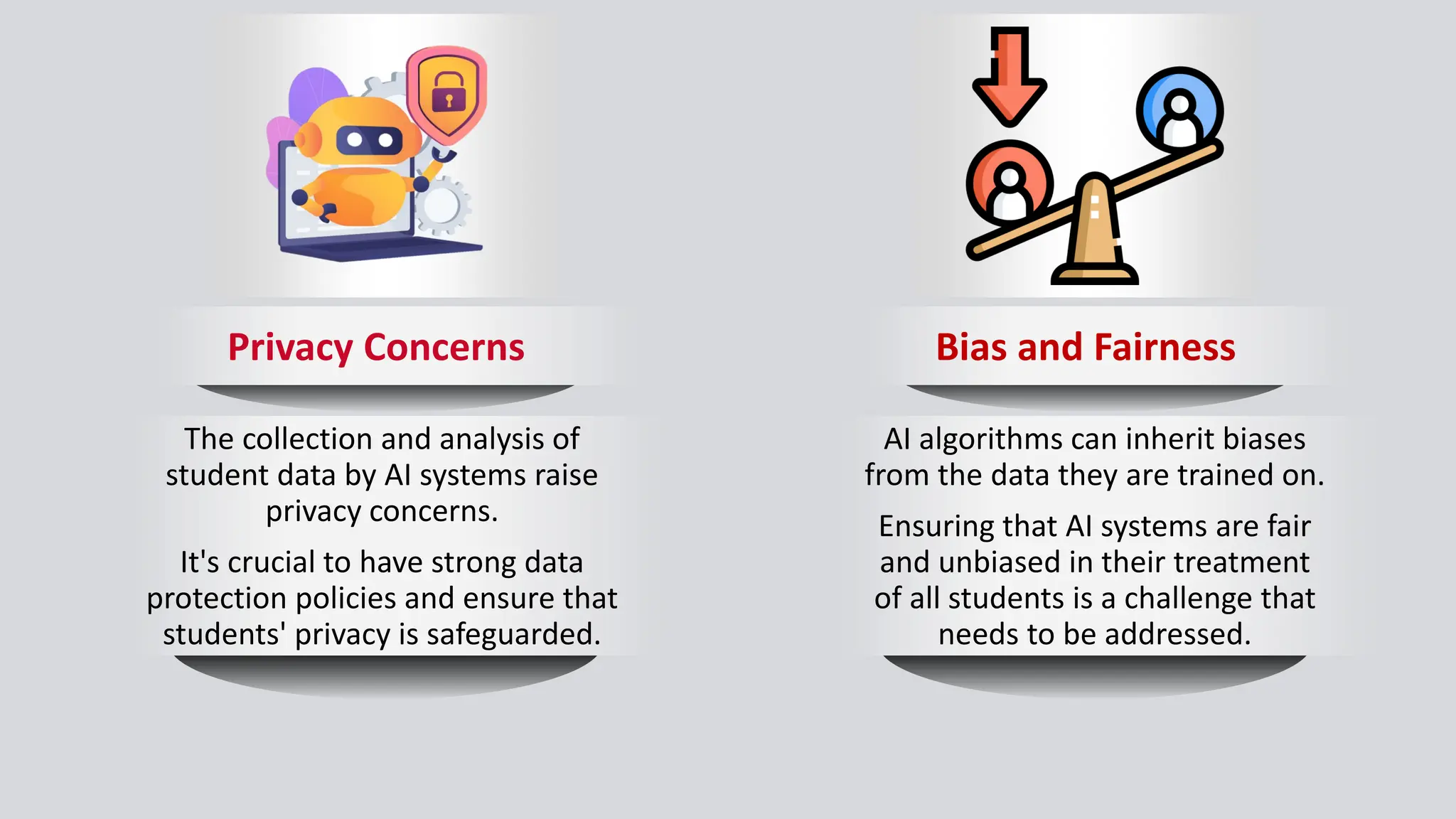
Bias and Fairness
Privacy Concerns
The collection and analysis of
student data by AI systems raise
privacy concerns.
It's crucial to have strong data
protection policies and ensure that
students' privacy is safeguarded.
AI algorithms can inherit biases
from the data they are trained on.
Ensuring that AI systems are fair
and unbiased in their treatment
of all students is a challenge that
needs to be addressed.
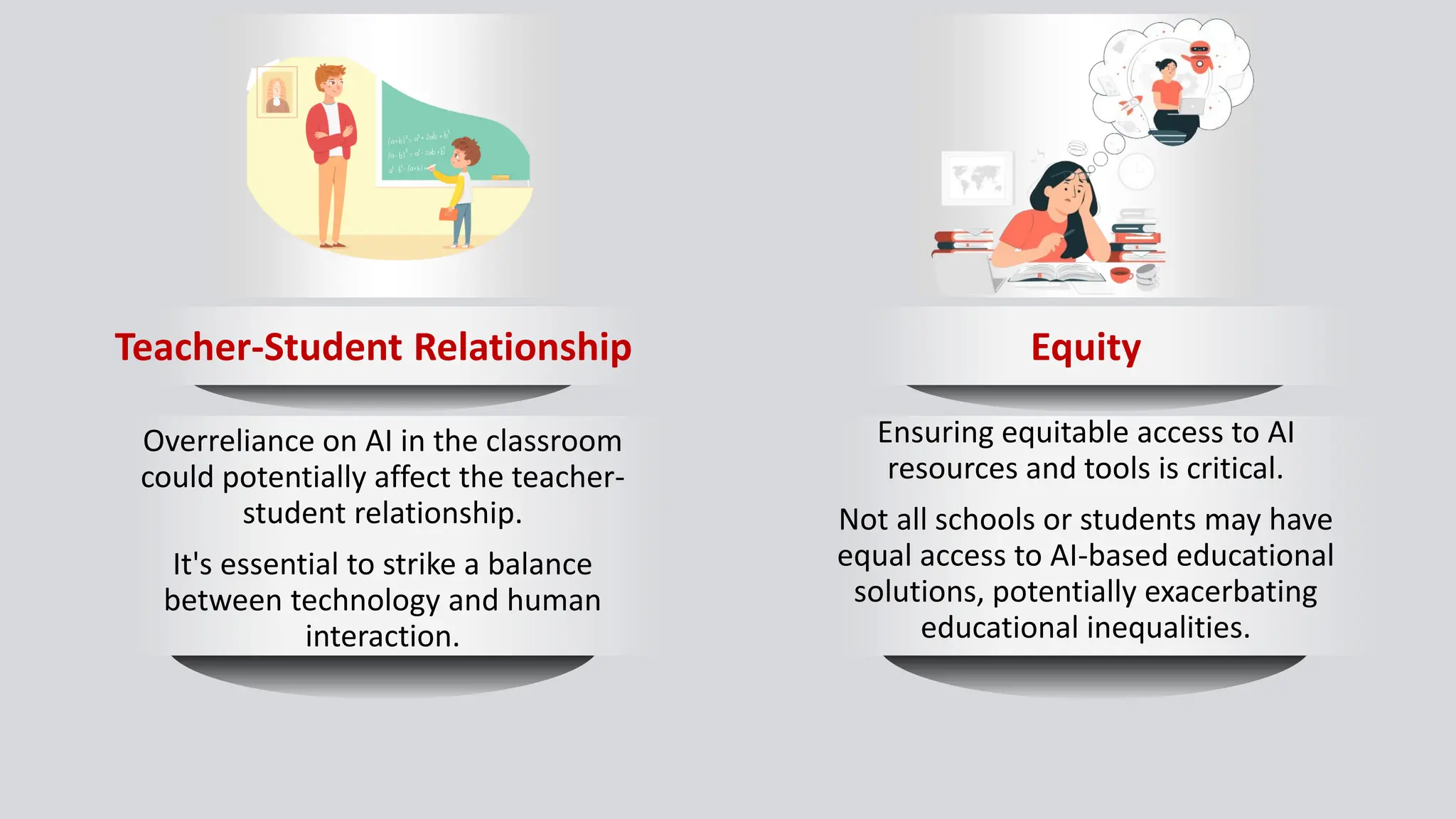
Equity
Teacher-Student Relationship
Overreliance on AI in the classroom
could potentially affect the teacher-
student relationship.
It's essential to strike a balance
between technology and human
interaction.
Ensuring equitable access to AI
resources and tools is critical.
Not all schools or students may have
equal access to AI-based educational
solutions, potentially exacerbating
educational inequalities.
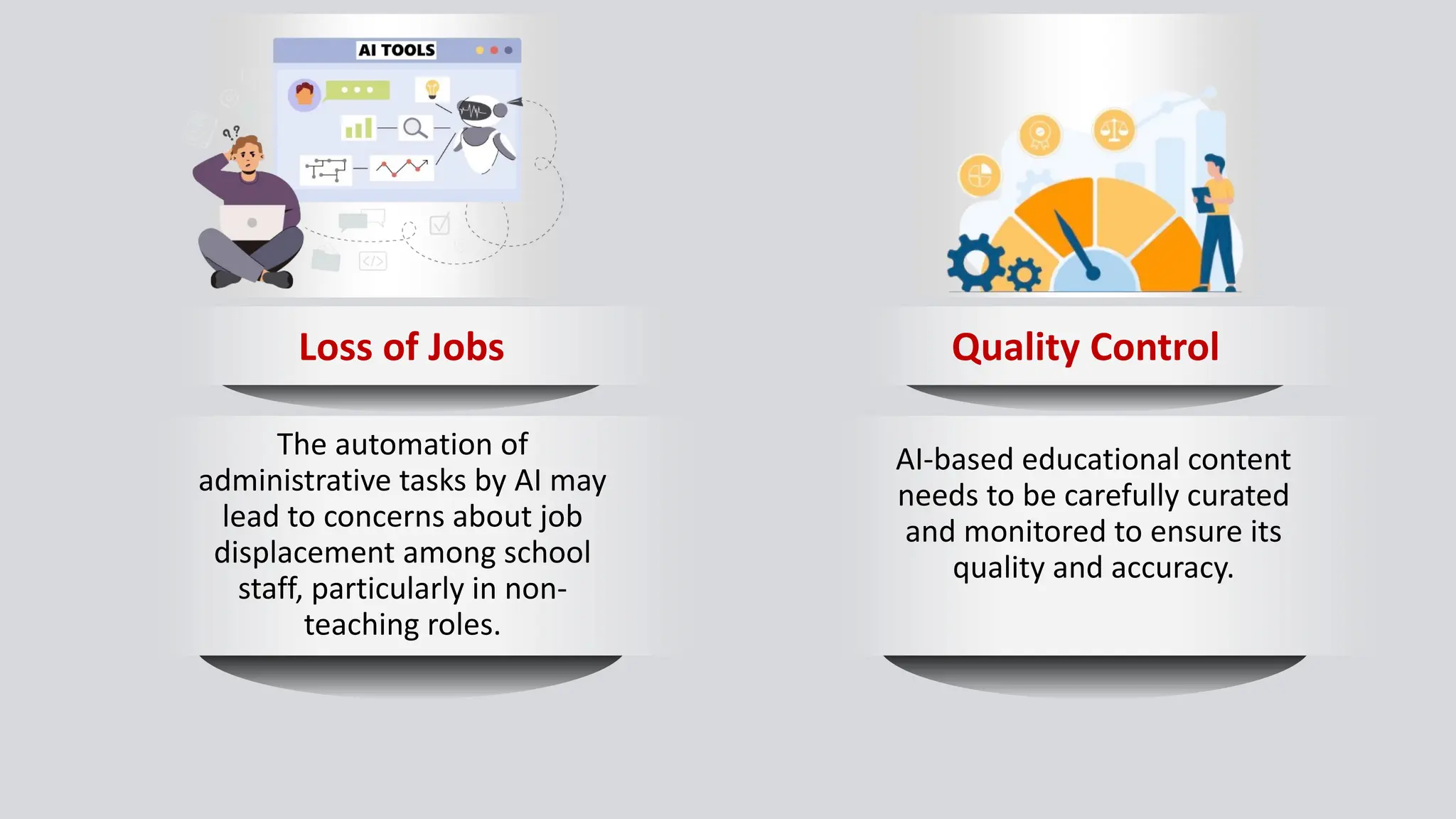
Quality Control
Loss of Jobs
The automation of
administrative tasks by AI may
lead to concerns about job
displacement among school
staff, particularly in non-
teaching roles.
AI-based educational content
needs to be carefully curated
and monitored to ensure its
quality and accuracy.​
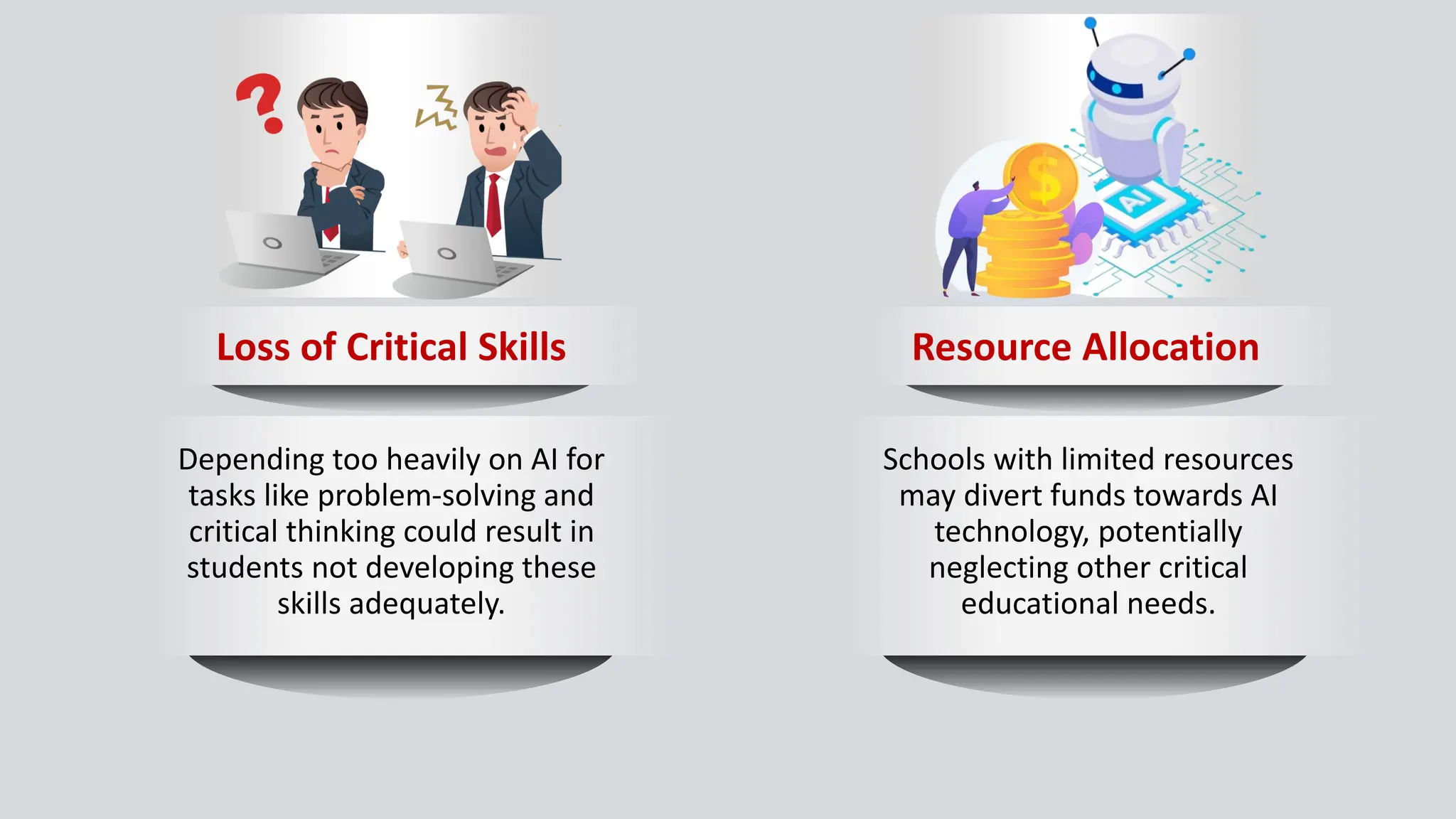
Resource Allocation
Loss of Critical Skills
Depending too heavily on AI for
tasks like problem-solving and
critical thinking could result in
students not developing these
skills adequately.
Schools with limited resources
may divert funds towards AI
technology, potentially
neglecting other critical
educational needs.
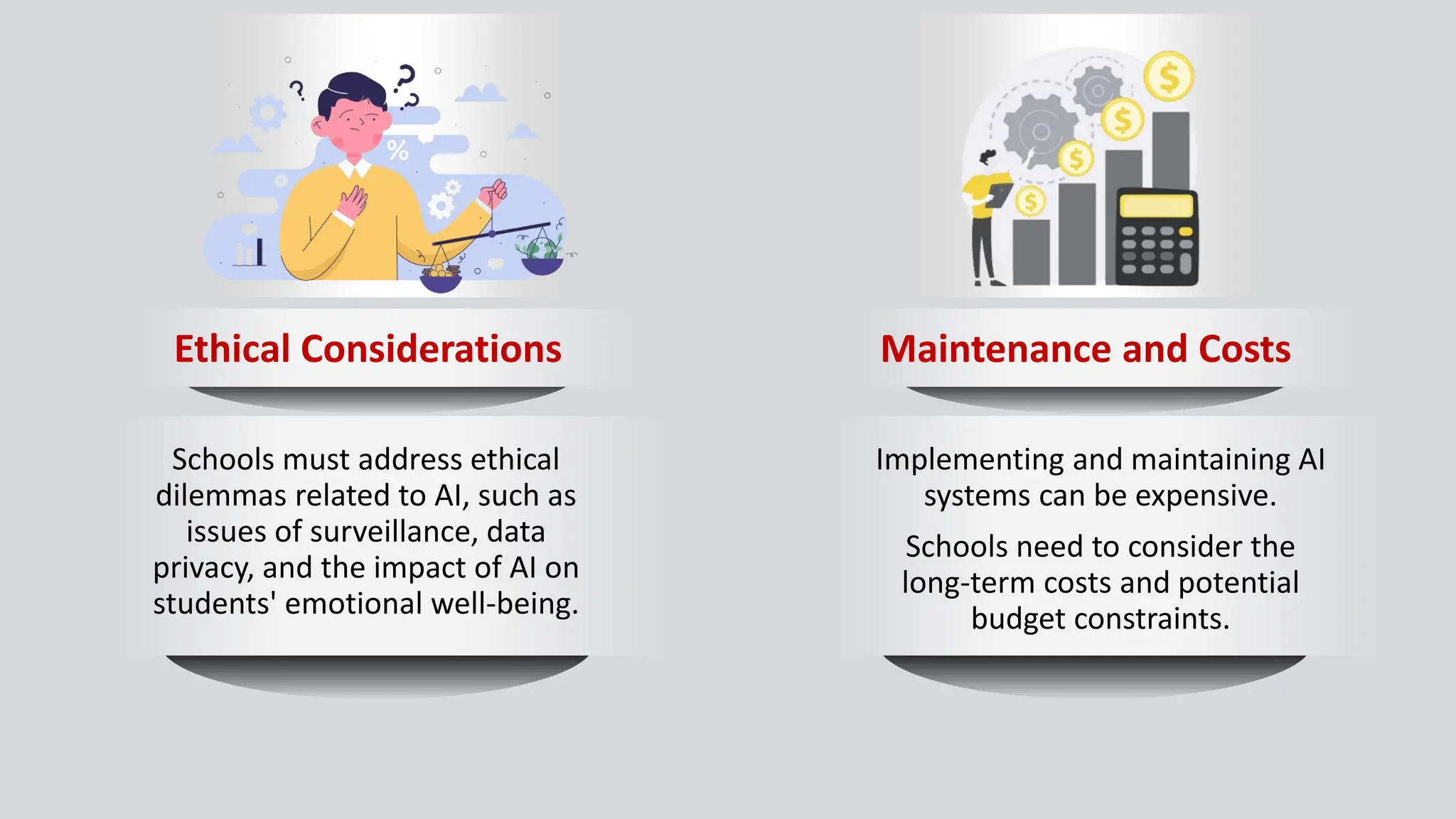
Maintenance and Costs
Ethical Considerations
Schools must address ethical
dilemmas related to AI, such as
issues of surveillance, data
privacy, and the impact of AI on
students' emotional well-being.
Implementing and maintaining AI
systems can be expensive.
Schools need to consider the
long-term costs and potential
budget constraints.
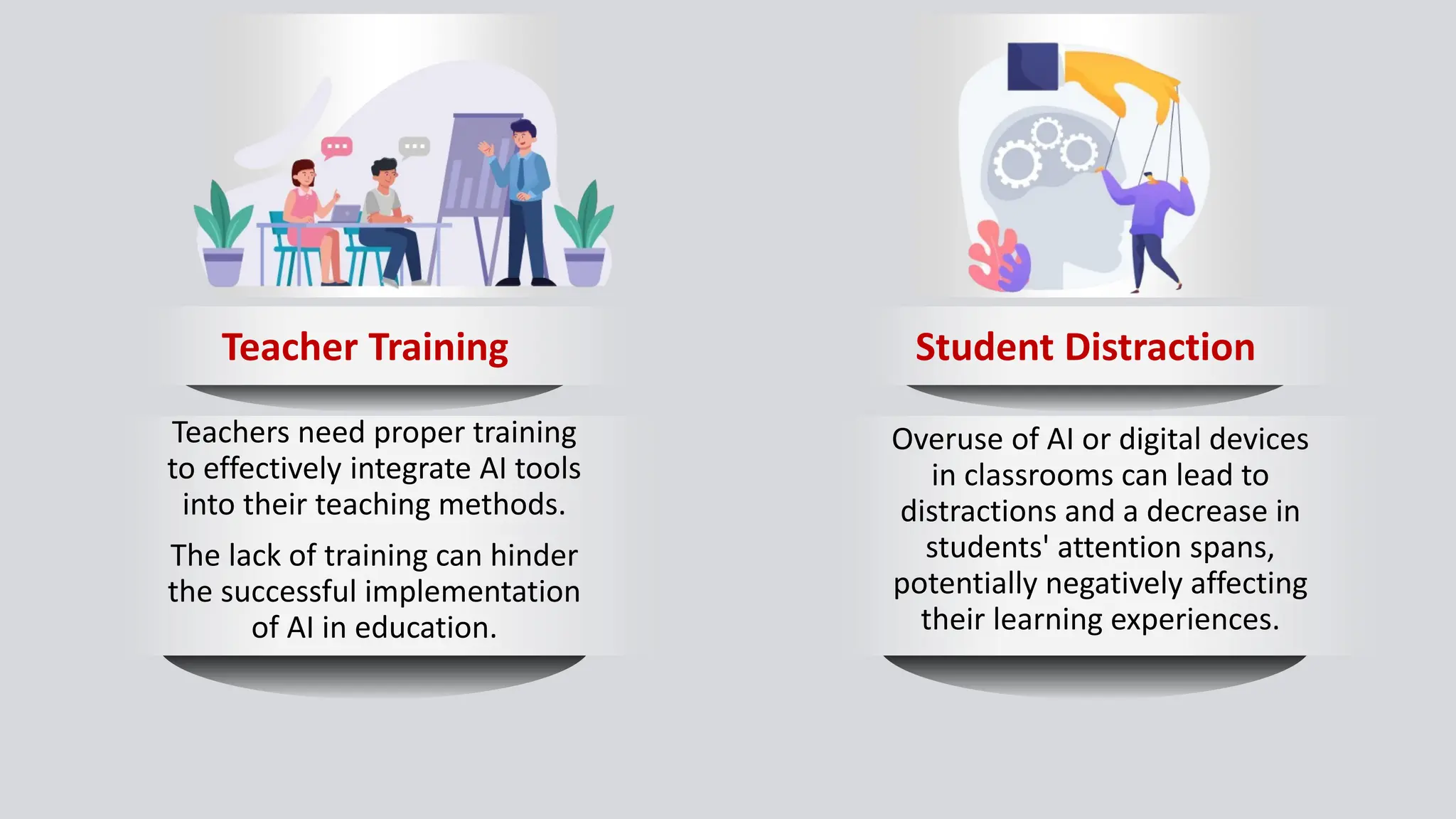
Student Distraction
Teacher Training
Teachers need proper training
to effectively integrate AI tools
into their teaching methods.
The lack of training can hinder
the successful implementation
of AI in education.
Overuse of AI or digital devices
in classrooms can lead to
distractions and a decrease in
students' attention spans,
potentially negatively affecting
their learning experiences.
AI can bring significant benefits to education.
Addressing the cons and considerations is vital for successful
implementation in schools.
Schools and policymakers must take a proactive approach to ensure
responsible and ethical use of AI technologies.
AI should enhance, rather than hinder, the educational experience
for all students.
SUMMARY
Conclusion
Conclusion
AI can bring significant improvements to schools.
It is essential to address potential challenges and
ethical considerations. Identifying the right tools
and use cases is important for integrating AI
effectively in schools.

Artificial Intelligence (A.I.) in Schools (PPT)

  • 1.
  • 2.
    What is AI? “Artificial intelligence (AI) refers to the simulation of human intelligence in machines that are programmed to think like humans and mimic their actions. The term may also be applied to any machine that exhibits traits associated with a human mind such as learning and problem-solving.” - Investopedia
  • 3.
    AI in Schools AI(Artificial Intelligence) is growing rapidly in the education sector. AI can be used as an educational tool that guides students towards their goals. Teachers can also use AI technologies as an instructional tool to teach and develop lesson plans. While offering many incredible opportunities, there also lie many challenges in implementing AI in schools
  • 4.
    AI Technologies forEducation ChatBots Virtual Reality (VR) Learning Management System (LMS)
  • 5.
    Pros of usingA.I. in Schools
  • 6.
    Efficiency and Automation PersonalizedLearning AI can automate administrative tasks, such as grading and scheduling, allowing teachers to focus more on instruction and student support.​ AI can analyze individual students' strengths and weaknesses, enabling personalized learning experiences that cater to students' specific needs and learning styles.​
  • 7.
    AI can generateinteractive and engaging educational content, such as virtual labs and simulations. Gamified learning experiences and virtual field trips can make lessons more interesting and memorable. Access to Resources AI-powered educational tools can provide access to quality education for students in remote or underserved areas, closing the education gap. Accessibility features in AI can assist students with disabilities, making learning more inclusive. Improved Educational Content
  • 8.
    Language Learning 24/7 Availability AI-driveneducational platforms are available around the clock, enabling students to learn at their own convenience. This flexibility is especially useful for adult learners and those with busy schedules. AI-powered language learning apps can provide instant translation, pronunciation feedback, and language practice. This aids in language acquisition and cultural understanding.
  • 9.
    Teacher Assistance Early Intervention AIcan detect learning difficulties or behavioral issues early, allowing for timely interventions and support. AI can assist teachers by providing data-driven insights into student performance, enabling more effective teaching strategies.
  • 10.
    Predictive Analytics Assessment andTesting AI can streamline the assessment process by automatically grading assignments, quizzes, and tests. Objective and consistent evaluation is possible, reducing grading time for teachers. AI can predict student outcomes and identify those at risk of falling behind. Early intervention based on these predictions can help prevent academic challenges.
  • 11.
    Global Collaboration Cost Efficiency Overtime, AI implementation can lead to cost savings in areas like administrative tasks, printing, and distribution of educational materials. AI can facilitate global collaboration among students and educators, breaking down geographical barriers and promoting cross-cultural understanding.
  • 12.
    Professional Development Advanced Research AIcan assist students and researchers in data analysis, allowing them to tackle complex research projects more efficiently. AI-driven platforms can recommend professional development opportunities for educators, helping them stay up- to-date with the latest teaching methods and technologies.
  • 13.
    SUMMARY AI can revolutionizeeducation in schools. Personalized learning experiences can be offered through AI. Efficiency can be improved with AI. Valuable data-driven insights can be provided by AI. Potential challenges and ethical considerations need to be addressed. Pros of using AI in education are significant and can lead to more effective and inclusive learning environments.
  • 14.
    Cons of using A.I.in Schools Cons of using A.I. in Schools
  • 15.
    Bias and Fairness PrivacyConcerns The collection and analysis of student data by AI systems raise privacy concerns. It's crucial to have strong data protection policies and ensure that students' privacy is safeguarded. AI algorithms can inherit biases from the data they are trained on. Ensuring that AI systems are fair and unbiased in their treatment of all students is a challenge that needs to be addressed.
  • 16.
    Equity Teacher-Student Relationship Overreliance onAI in the classroom could potentially affect the teacher- student relationship. It's essential to strike a balance between technology and human interaction. Ensuring equitable access to AI resources and tools is critical. Not all schools or students may have equal access to AI-based educational solutions, potentially exacerbating educational inequalities.
  • 17.
    Quality Control Loss ofJobs The automation of administrative tasks by AI may lead to concerns about job displacement among school staff, particularly in non- teaching roles. AI-based educational content needs to be carefully curated and monitored to ensure its quality and accuracy.​
  • 18.
    Resource Allocation Loss ofCritical Skills Depending too heavily on AI for tasks like problem-solving and critical thinking could result in students not developing these skills adequately. Schools with limited resources may divert funds towards AI technology, potentially neglecting other critical educational needs.
  • 19.
    Maintenance and Costs EthicalConsiderations Schools must address ethical dilemmas related to AI, such as issues of surveillance, data privacy, and the impact of AI on students' emotional well-being. Implementing and maintaining AI systems can be expensive. Schools need to consider the long-term costs and potential budget constraints.
  • 20.
    Student Distraction Teacher Training Teachersneed proper training to effectively integrate AI tools into their teaching methods. The lack of training can hinder the successful implementation of AI in education. Overuse of AI or digital devices in classrooms can lead to distractions and a decrease in students' attention spans, potentially negatively affecting their learning experiences.
  • 21.
    AI can bringsignificant benefits to education. Addressing the cons and considerations is vital for successful implementation in schools. Schools and policymakers must take a proactive approach to ensure responsible and ethical use of AI technologies. AI should enhance, rather than hinder, the educational experience for all students. SUMMARY
  • 22.
    Conclusion Conclusion AI can bringsignificant improvements to schools. It is essential to address potential challenges and ethical considerations. Identifying the right tools and use cases is important for integrating AI effectively in schools.