SEMINAR ON GASOLINE
DIRECT INJECTION
SARAN S NAIR
S7 MECHANICAL
11434033
STIST
PREPARED BY,
CONTENTS
 INTRODUCTION
 TYPES OF FUEL INJECTION
 WHY NOT CARBURETOR?
 WHY THE GDI?
 MAJOR OBJECTIVES OF GDI
 TIMELINE OF FUEL SUPPLY SYSTEM
 ACHIEVEMENTS
 MAIN COMPONENTS OF GDI
 WORKING OF GDI
 ADVANTAGES
 DISDVANTAGES
 GDI VEHICLES
 CONCLUSION
 REFERENCES

 INTRODUCTION
 TYPES OF FUEL INJECTION
 WHY NOT CARBURETOR?
 WHY THE GDI?
 MAJOR OBJECTIVES OF GDI
 TIMELINE OF FUEL SUPPLY SYSTEM
 ACHIEVEMENTS
 MAIN COMPONENTS OF GDI
 WORKING OF GDI
 ADVANTAGES
 DISDVANTAGES
 GDI VEHICLES
 CONCLUSION
 REFERENCES

INTRODUCTION
 Fuel injection is a system for admitting fuel into an IC
engine. It has become the primary fuel delivery system
used in engines, having replaced carburetors during the
1980s and 1990s.
 FUEL INJECTION atomizes the fuel by forcibly
pumping it through a small nozzle under high pressure
 while a CARBURETOR relies on suction created by
intake air accelerated through a ventury tube to draw the
fuel into the airstream.
 Fuel injection is a system for admitting fuel into an IC
engine. It has become the primary fuel delivery system
used in engines, having replaced carburetors during the
1980s and 1990s.
 FUEL INJECTION atomizes the fuel by forcibly
pumping it through a small nozzle under high pressure
 while a CARBURETOR relies on suction created by
intake air accelerated through a ventury tube to draw the
fuel into the airstream.
TYPES OF FUEL SUPPLY
• The Carburetor
• Single-point or throttle body injection (TBI)
• Port or multi point fuel injection (MPFI)
• Sequential fuel injection (SFI)
• Direct injection
• The Carburetor
• Single-point or throttle body injection (TBI)
• Port or multi point fuel injection (MPFI)
• Sequential fuel injection (SFI)
• Direct injection
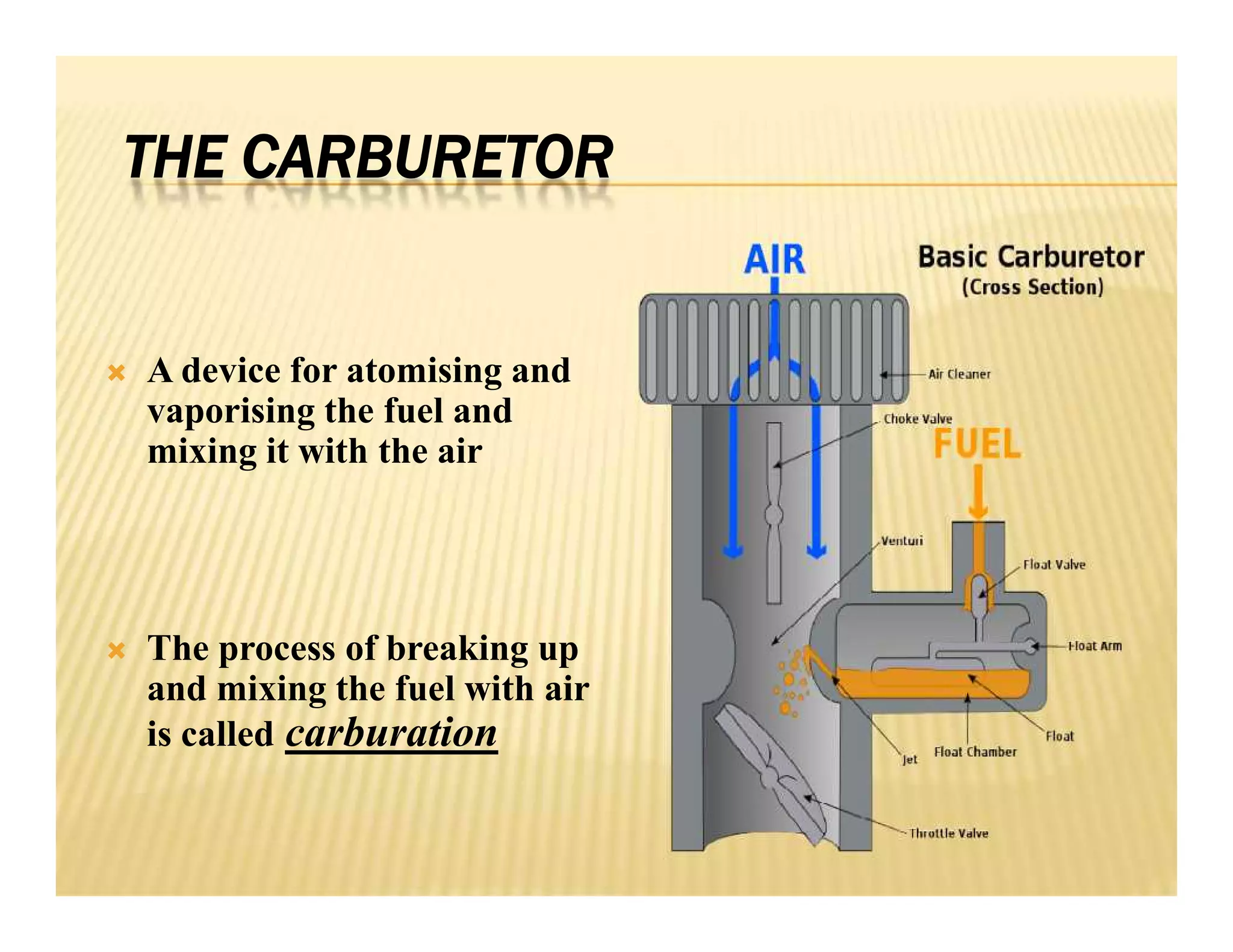
THE CARBURETOR
 A device for atomising and
vaporising the fuel and
mixing it with the air
 The process of breaking up
and mixing the fuel with air
is called carburation
 A device for atomising and
vaporising the fuel and
mixing it with the air
 The process of breaking up
and mixing the fuel with air
is called carburation
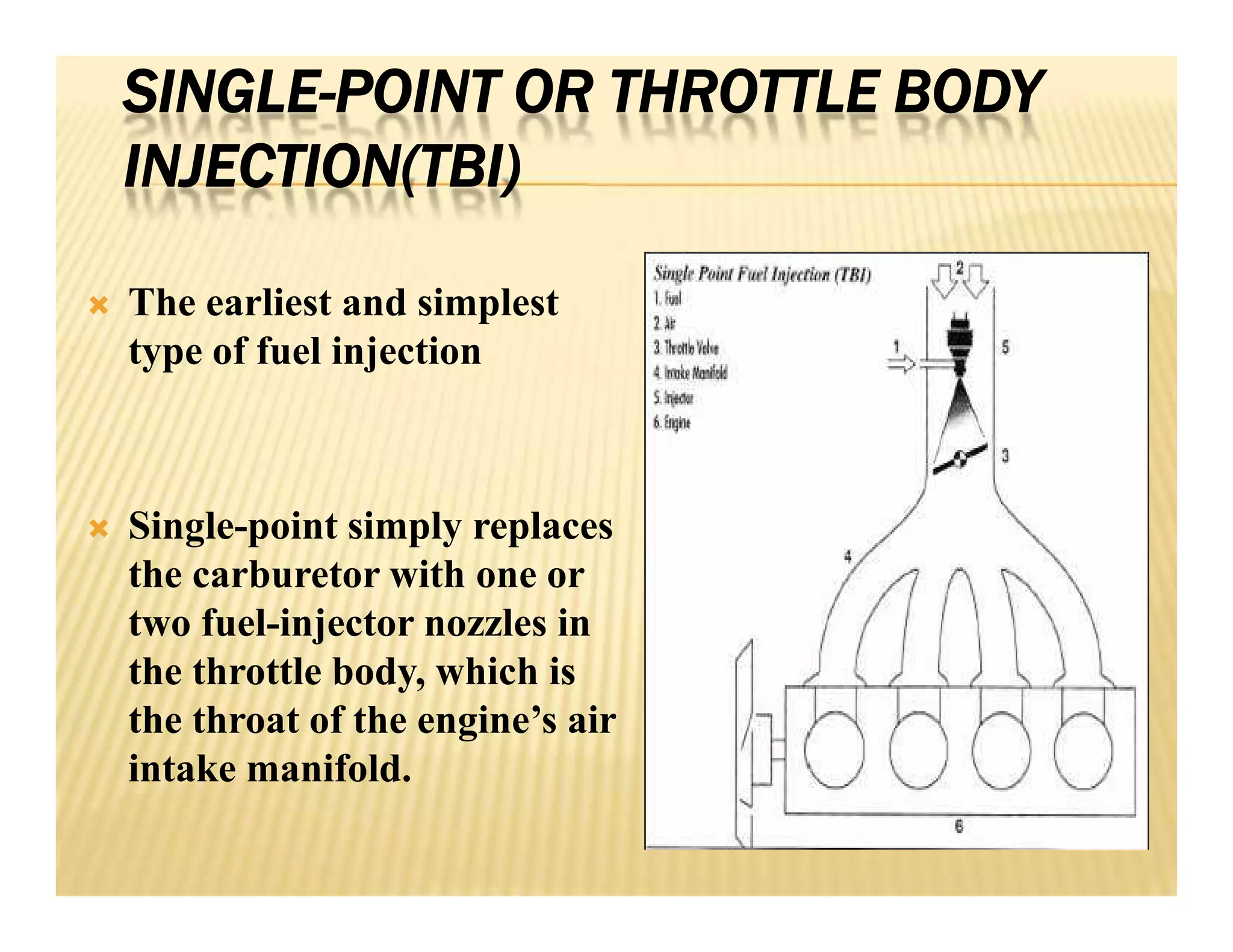
SINGLE-POINT OR THROTTLE BODY
INJECTION(TBI)
 The earliest and simplest
type of fuel injection
 Single-point simply replaces
the carburetor with one or
two fuel-injector nozzles in
the throttle body, which is
the throat of the engine’s air
intake manifold.
 The earliest and simplest
type of fuel injection
 Single-point simply replaces
the carburetor with one or
two fuel-injector nozzles in
the throttle body, which is
the throat of the engine’s air
intake manifold.
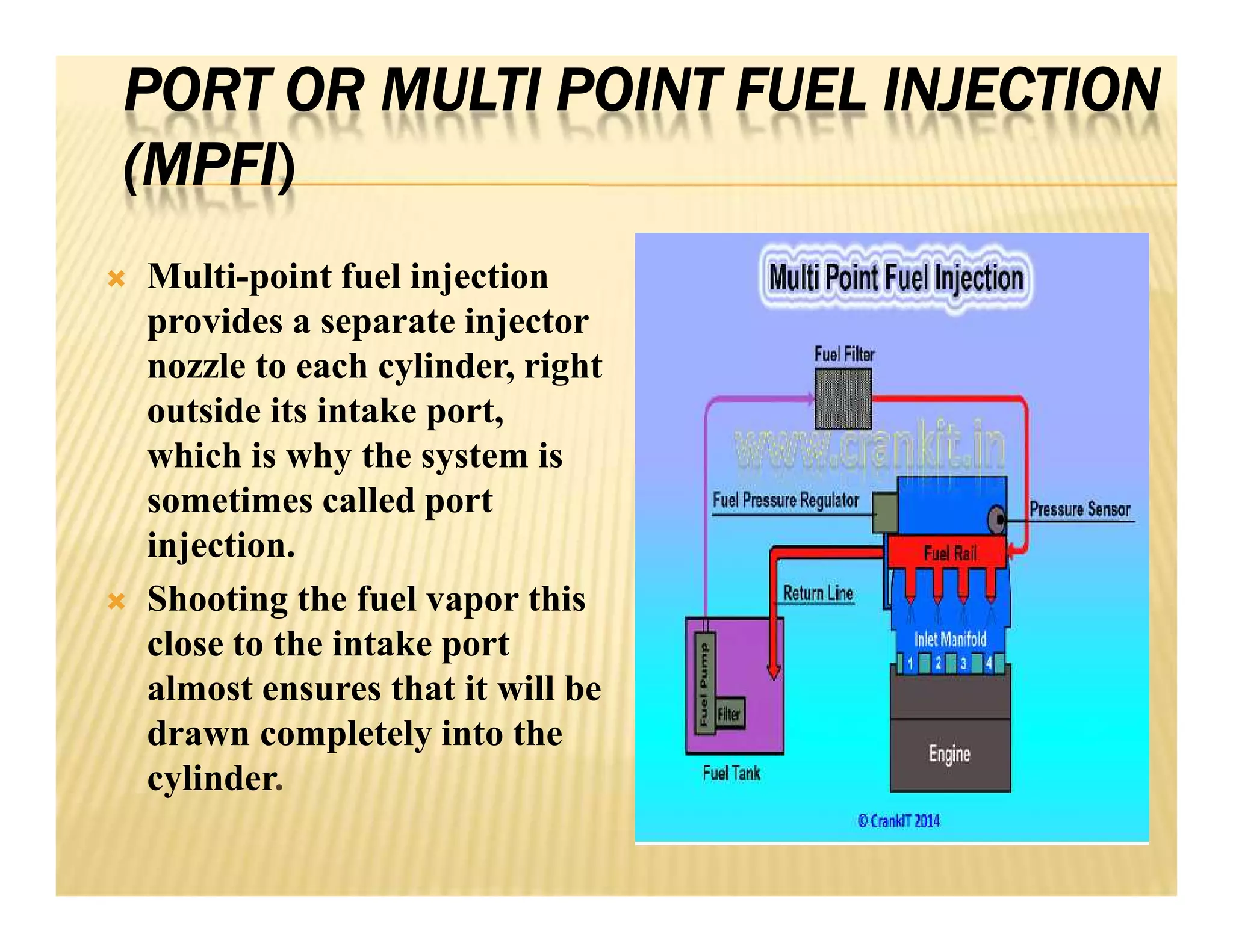
PORT OR MULTI POINT FUEL INJECTION
(MPFI)
 Multi-point fuel injection
provides a separate injector
nozzle to each cylinder, right
outside its intake port,
which is why the system is
sometimes called port
injection.
 Shooting the fuel vapor this
close to the intake port
almost ensures that it will be
drawn completely into the
cylinder.
 Multi-point fuel injection
provides a separate injector
nozzle to each cylinder, right
outside its intake port,
which is why the system is
sometimes called port
injection.
 Shooting the fuel vapor this
close to the intake port
almost ensures that it will be
drawn completely into the
cylinder.
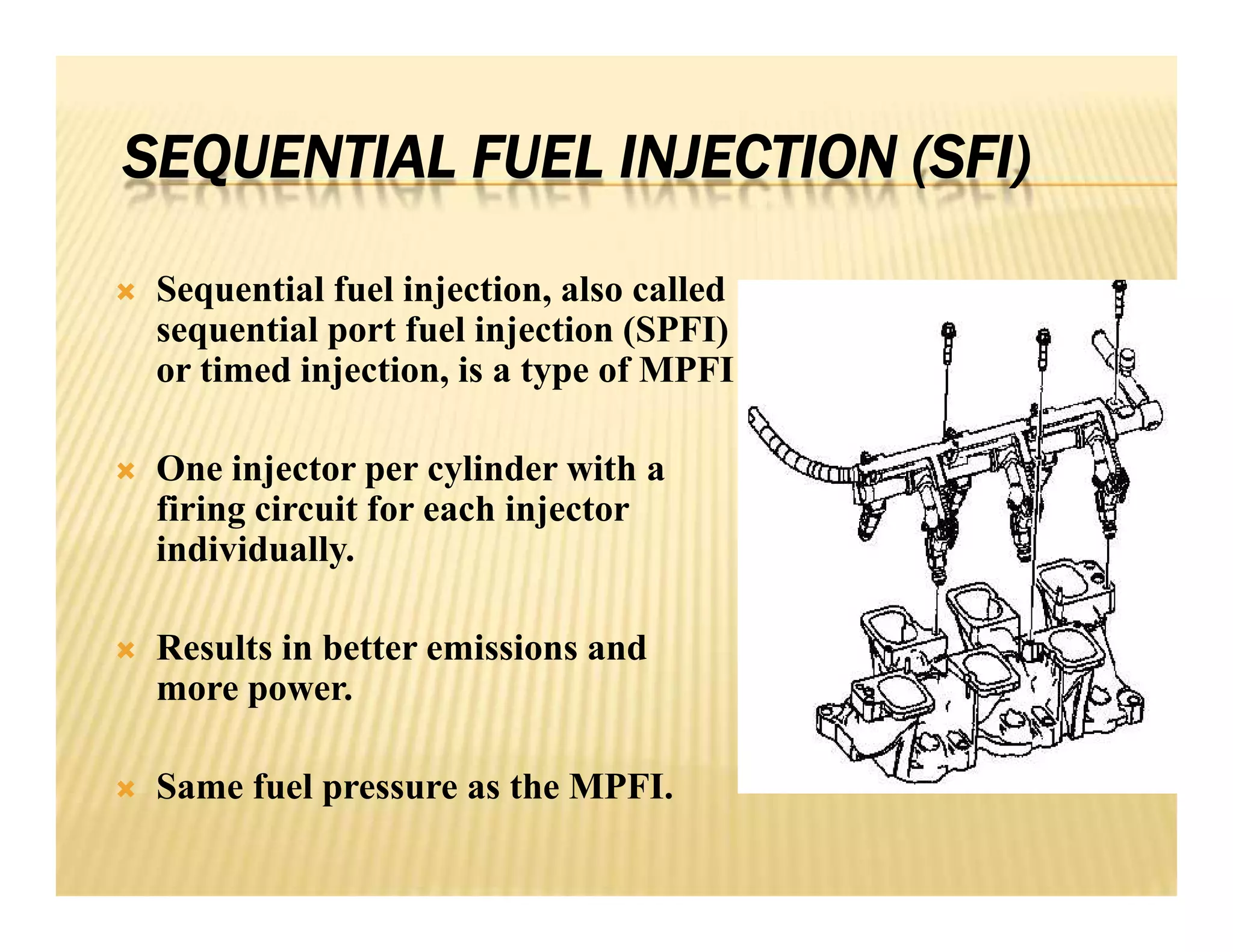
SEQUENTIAL FUEL INJECTION (SFI)
 Sequential fuel injection, also called
sequential port fuel injection (SPFI)
or timed injection, is a type of MPFI
 One injector per cylinder with a
firing circuit for each injector
individually.
 Results in better emissions and
more power.
 Same fuel pressure as the MPFI.
 Sequential fuel injection, also called
sequential port fuel injection (SPFI)
or timed injection, is a type of MPFI
 One injector per cylinder with a
firing circuit for each injector
individually.
 Results in better emissions and
more power.
 Same fuel pressure as the MPFI.
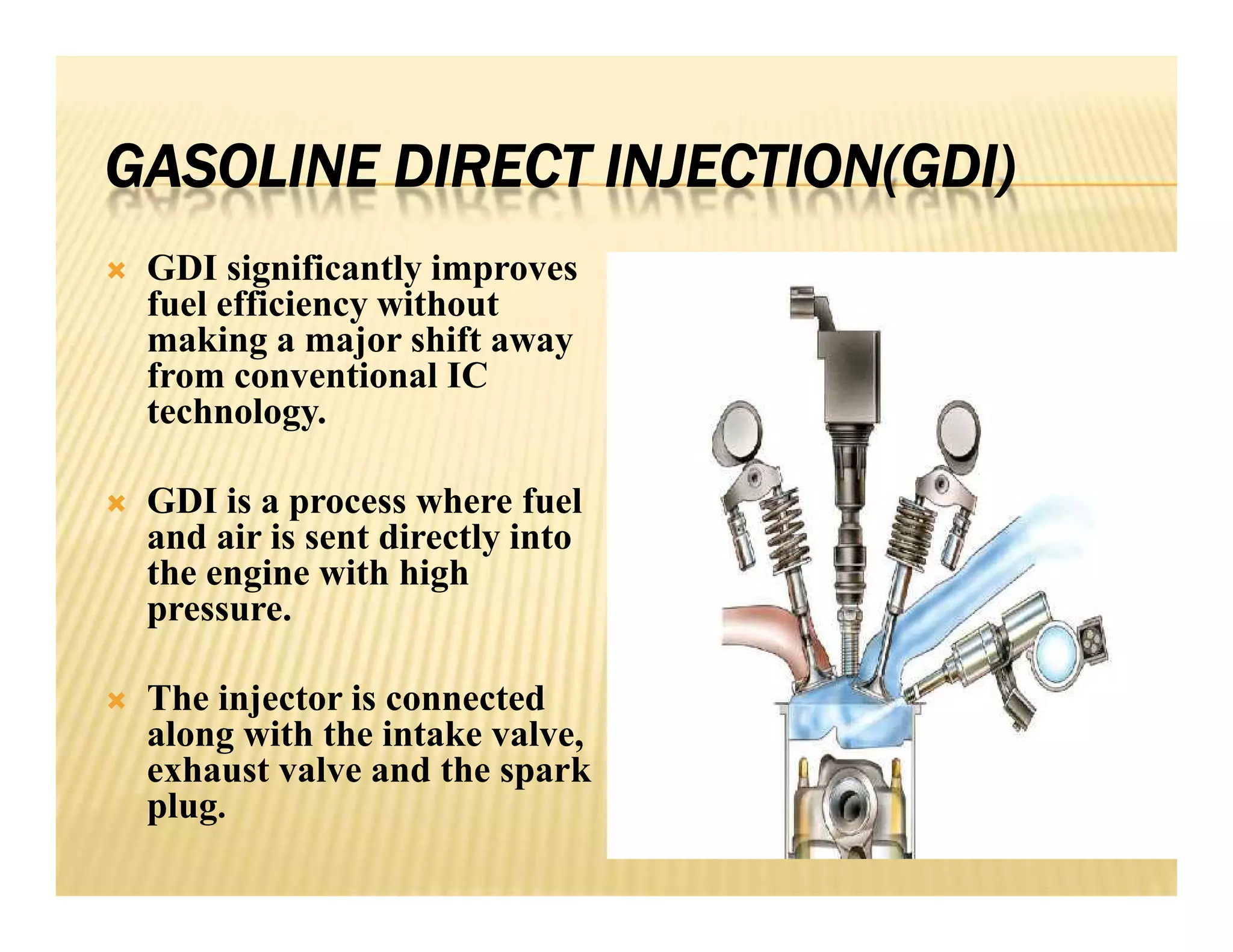
GASOLINE DIRECT INJECTION(GDI)
 GDI significantly improves
fuel efficiency without
making a major shift away
from conventional IC
technology.
 GDI is a process where fuel
and air is sent directly into
the engine with high
pressure.
 The injector is connected
along with the intake valve,
exhaust valve and the spark
plug.
 GDI significantly improves
fuel efficiency without
making a major shift away
from conventional IC
technology.
 GDI is a process where fuel
and air is sent directly into
the engine with high
pressure.
 The injector is connected
along with the intake valve,
exhaust valve and the spark
plug.
GASOLINE DIRECT INJECTION
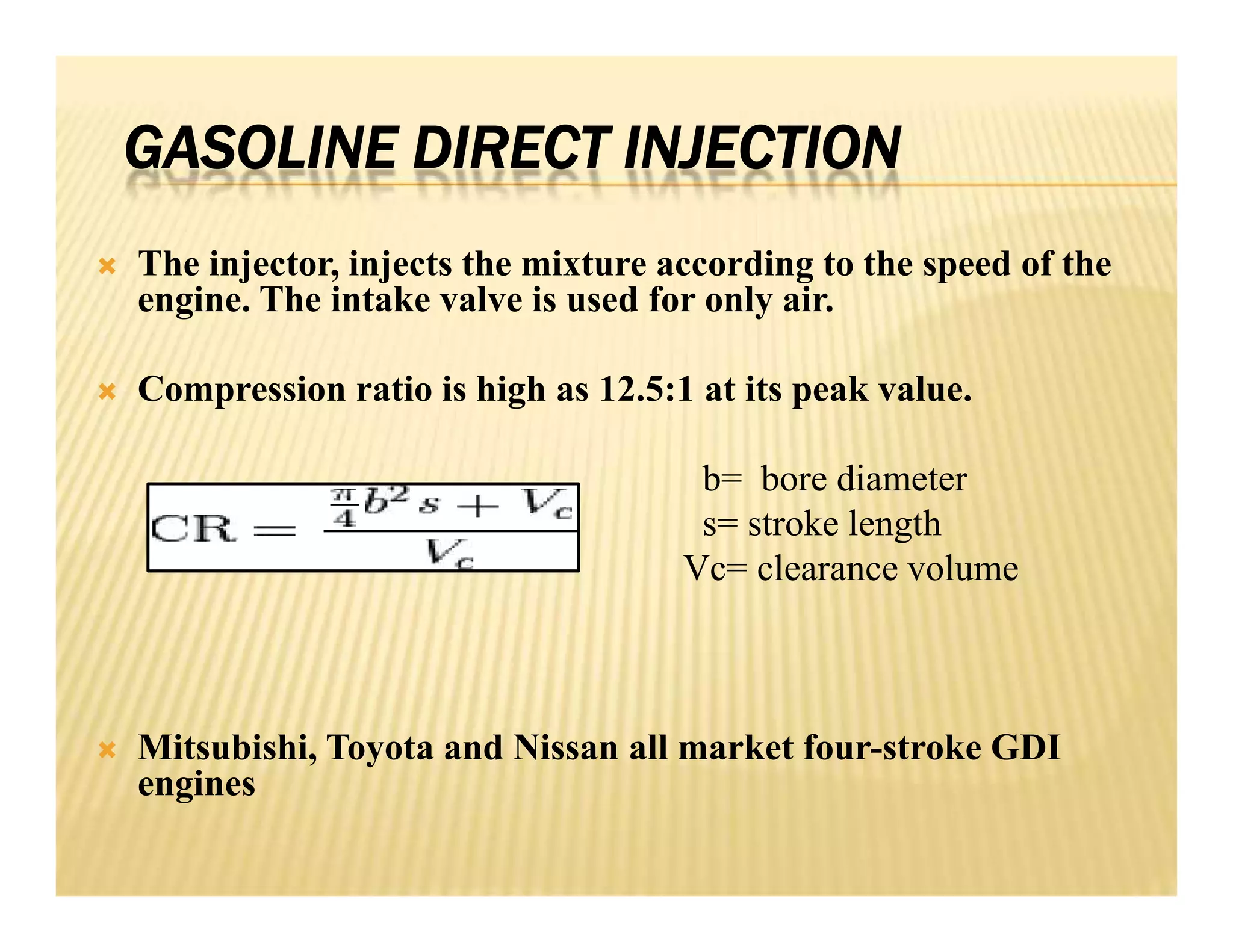
 The injector, injects the mixture according to the speed of the
engine. The intake valve is used for only air.
 Compression ratio is high as 12.5:1 at its peak value.
b= bore diameter
s= stroke length
Vc= clearance volume
 Mitsubishi, Toyota and Nissan all market four-stroke GDI
engines
 The injector, injects the mixture according to the speed of the
engine. The intake valve is used for only air.
 Compression ratio is high as 12.5:1 at its peak value.
b= bore diameter
s= stroke length
Vc= clearance volume
 Mitsubishi, Toyota and Nissan all market four-stroke GDI
engines
WHY NOT CARBURETOR ??
Carburetor has following Disadvantages:
 Vapour lock,
 Perfect air/fuel mixture cannot be obtained,
 Lack of throttle response,
 Low volumetric efficiency,
 Icing – problem in aircraft engines,
Carburetor has following Disadvantages:
 Vapour lock,
 Perfect air/fuel mixture cannot be obtained,
 Lack of throttle response,
 Low volumetric efficiency,
 Icing – problem in aircraft engines,
WHY THE GDI ??
• Lower Fuel Consumption and More Output
• Better than the current MPI Style of Fuel Injection
• Ultra-precise computer management
• The location of the injector
• Less pollution from each drop of gasoline.
• The World needs a better Environment
• Lower Fuel Consumption and More Output
• Better than the current MPI Style of Fuel Injection
• Ultra-precise computer management
• The location of the injector
• Less pollution from each drop of gasoline.
• The World needs a better Environment
MAJOR OBJECTIVES OF THE GDI
ENGINE
• Ultra-low fuel consumption that betters that of even
diesel engines
• Superior power to conventional MPFI engines
• A Stable Combustion
• Ultra-low fuel consumption that betters that of even
diesel engines
• Superior power to conventional MPFI engines
• A Stable Combustion
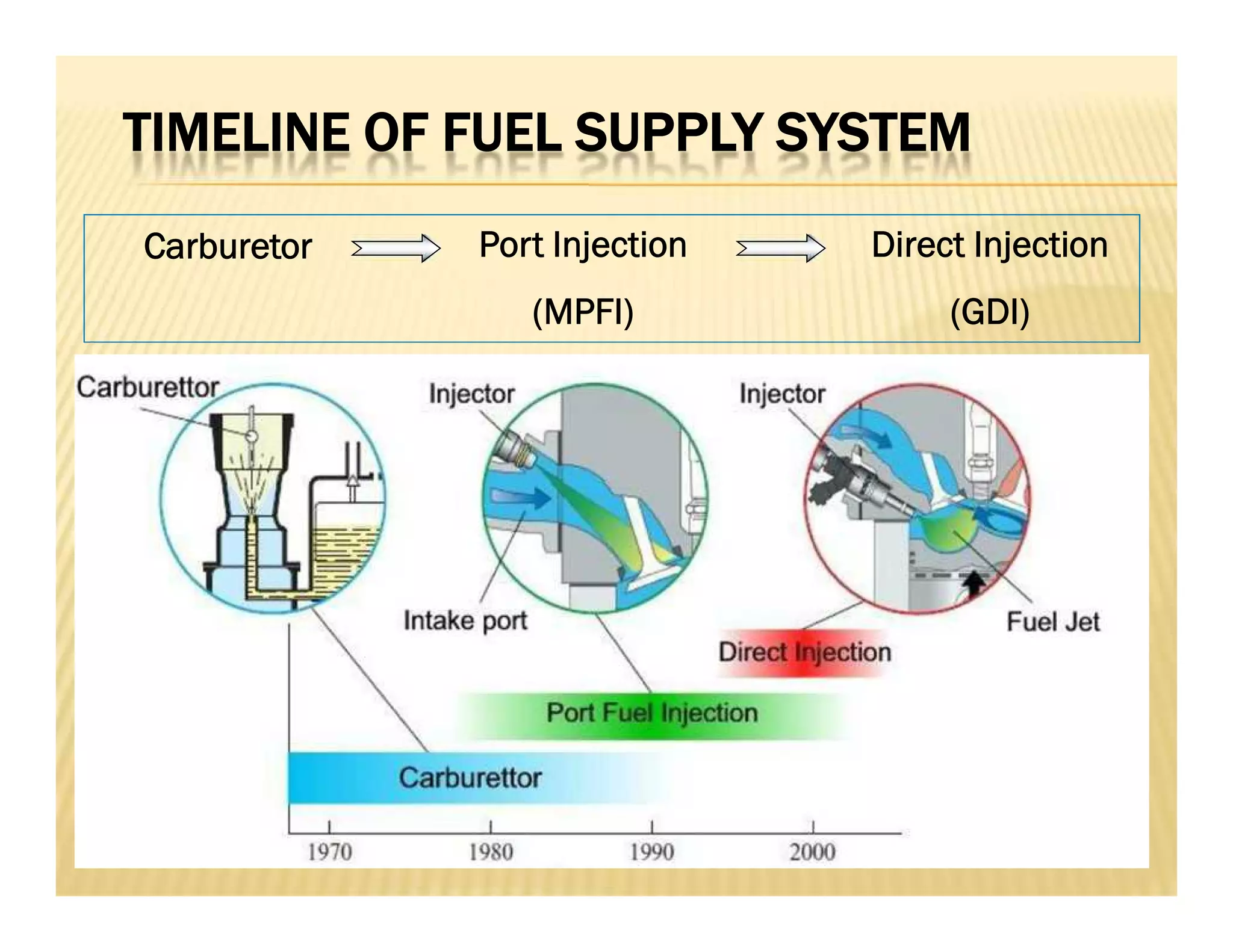
TIMELINE OF FUEL SUPPLY SYSTEM
Carburetor Port Injection
(MPFI)
Direct Injection
(GDI)
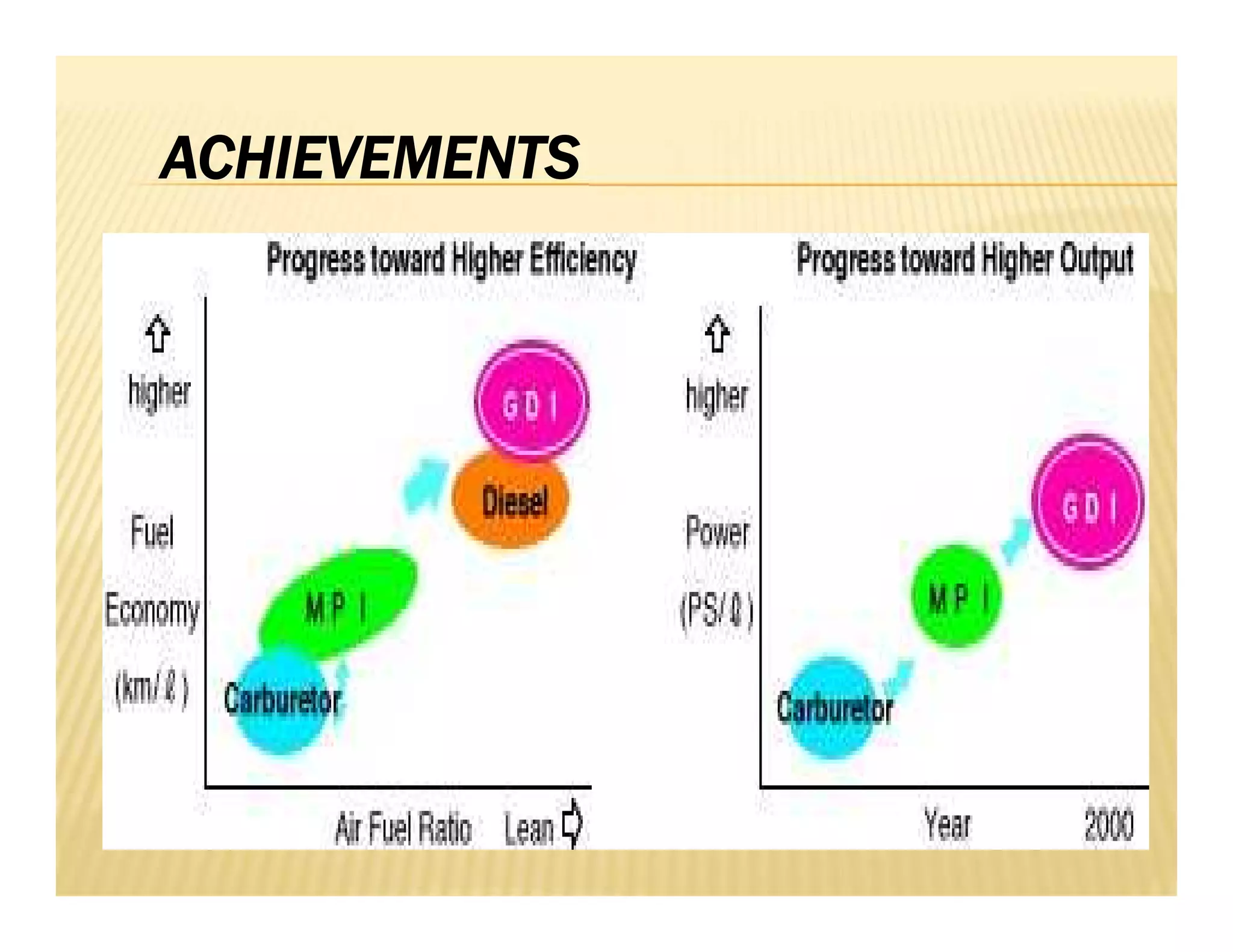
ACHIEVEMENTS
MAIN COMPONENTS OF GDI
1. Engine Control Unit
2. Sensors
3. High pressure Fuel Pump
4. Fuel Injector
1. Engine Control Unit
2. Sensors
3. High pressure Fuel Pump
4. Fuel Injector
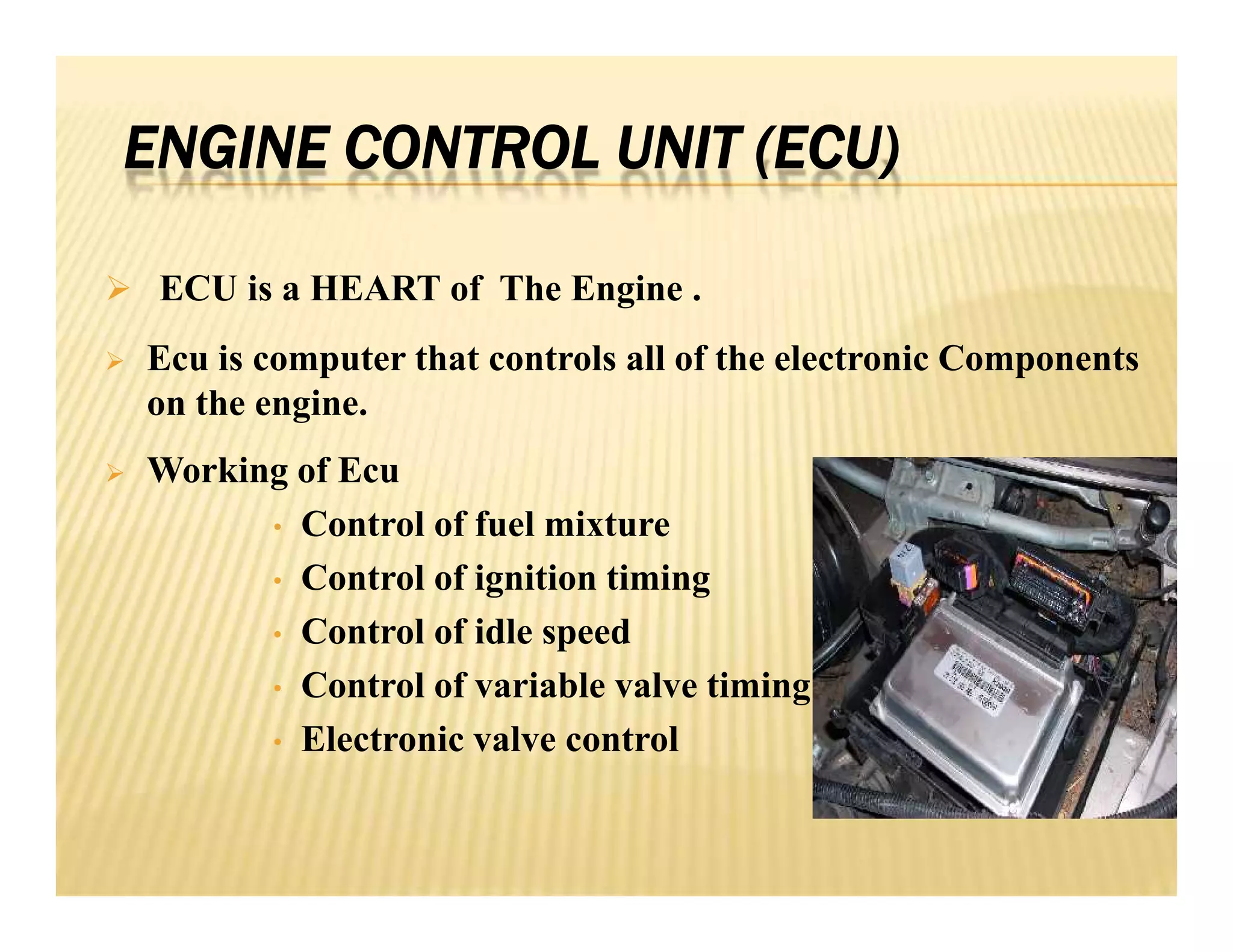
ENGINE CONTROL UNIT (ECU)
 ECU is a HEART of The Engine .
 Ecu is computer that controls all of the electronic Components
on the engine.
 Working of Ecu
• Control of fuel mixture
• Control of ignition timing
• Control of idle speed
• Control of variable valve timing
• Electronic valve control
 ECU is a HEART of The Engine .
 Ecu is computer that controls all of the electronic Components
on the engine.
 Working of Ecu
• Control of fuel mixture
• Control of ignition timing
• Control of idle speed
• Control of variable valve timing
• Electronic valve control
SENSORS
In order to provide the correct amount of fuel for every
operating condition, the ECU has to monitor a huge number
of input sensors.
Eg : Acceleration pedal sensor
Air flow sensor
Hi pressure pump sensor
Crank Angle sensor
In order to provide the correct amount of fuel for every
operating condition, the ECU has to monitor a huge number
of input sensors.
Eg : Acceleration pedal sensor
Air flow sensor
Hi pressure pump sensor
Crank Angle sensor
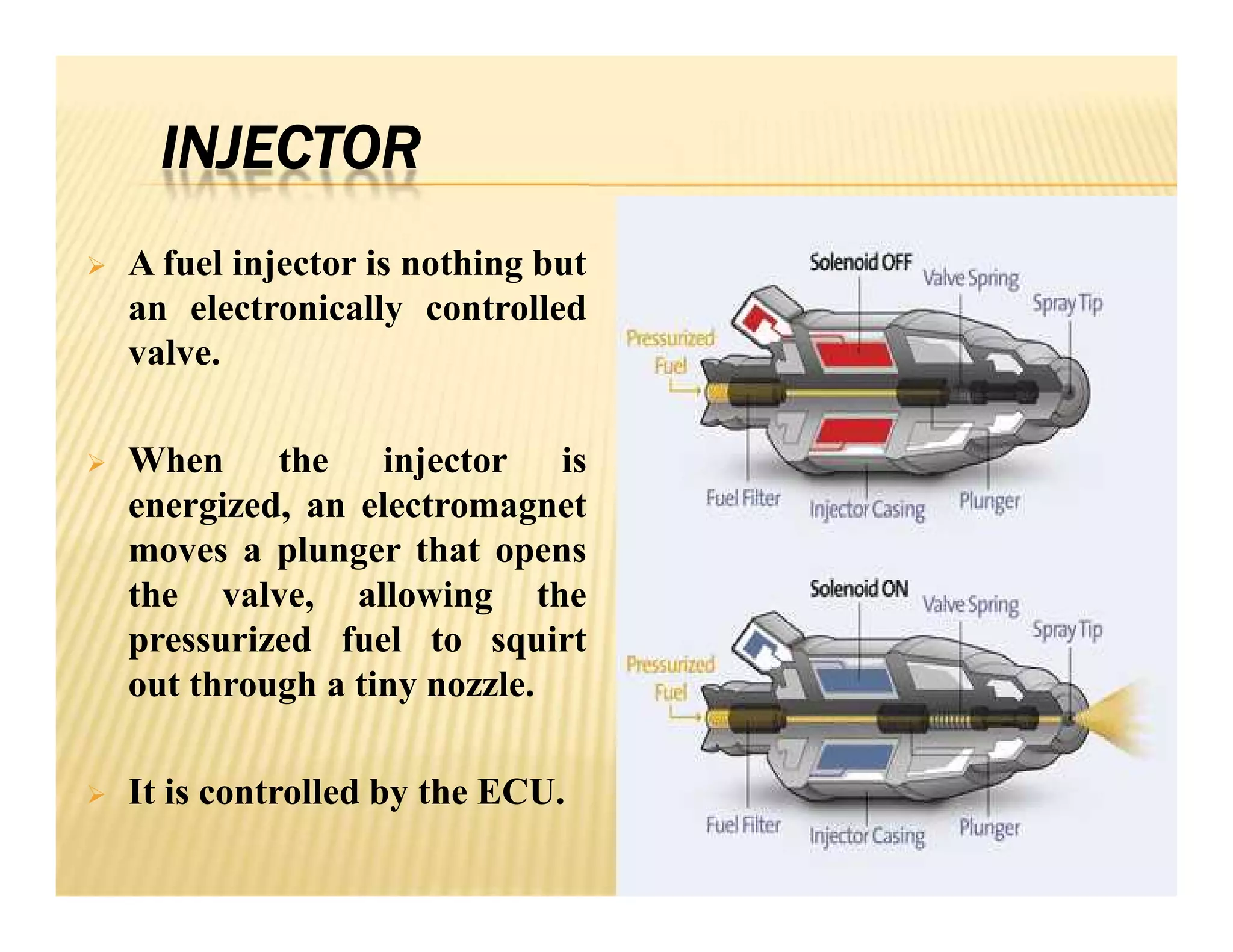
INJECTOR
 A fuel injector is nothing but
an electronically controlled
valve.
 When the injector is
energized, an electromagnet
moves a plunger that opens
the valve, allowing the
pressurized fuel to squirt
out through a tiny nozzle.
 It is controlled by the ECU.
 A fuel injector is nothing but
an electronically controlled
valve.
 When the injector is
energized, an electromagnet
moves a plunger that opens
the valve, allowing the
pressurized fuel to squirt
out through a tiny nozzle.
 It is controlled by the ECU.
WORKING OF GDI
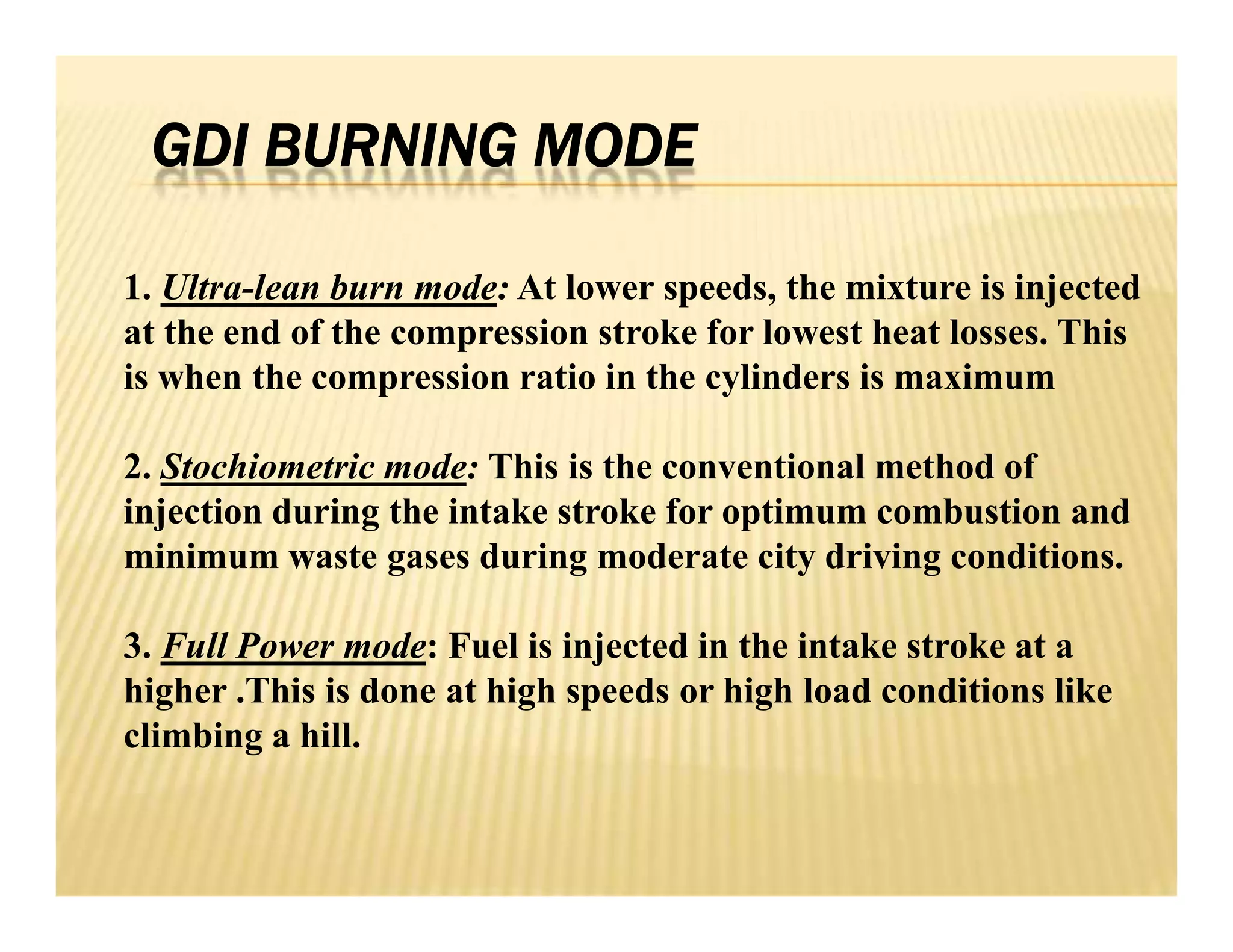
GDI BURNING MODE
1. Ultra-lean burn mode: At lower speeds, the mixture is injected
at the end of the compression stroke for lowest heat losses. This
is when the compression ratio in the cylinders is maximum
2. Stochiometric mode: This is the conventional method of
injection during the intake stroke for optimum combustion and
minimum waste gases during moderate city driving conditions.
3. Full Power mode: Fuel is injected in the intake stroke at a
higher .This is done at high speeds or high load conditions like
climbing a hill.
1. Ultra-lean burn mode: At lower speeds, the mixture is injected
at the end of the compression stroke for lowest heat losses. This
is when the compression ratio in the cylinders is maximum
2. Stochiometric mode: This is the conventional method of
injection during the intake stroke for optimum combustion and
minimum waste gases during moderate city driving conditions.
3. Full Power mode: Fuel is injected in the intake stroke at a
higher .This is done at high speeds or high load conditions like
climbing a hill.
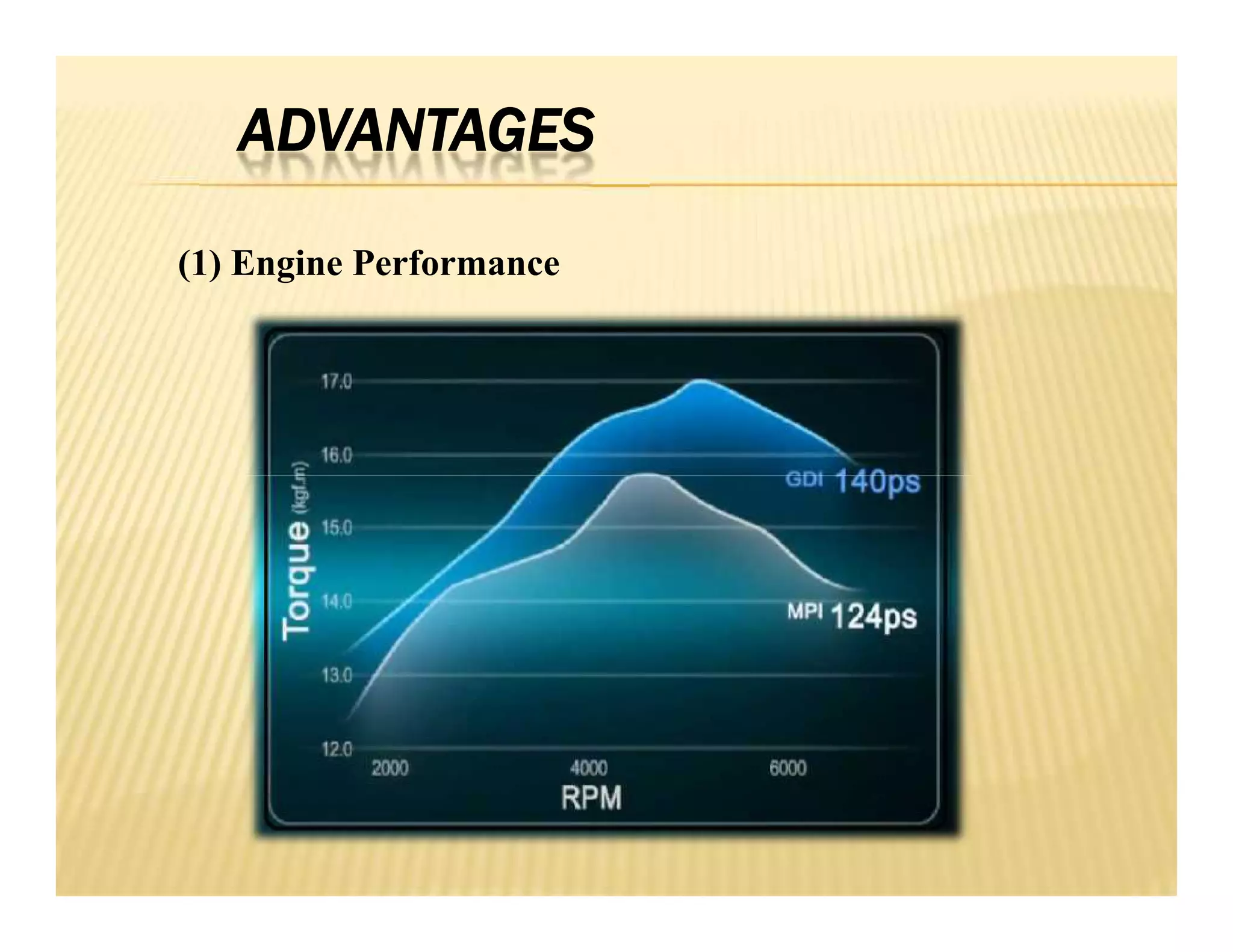
(1) Engine Performance
ADVANTAGES
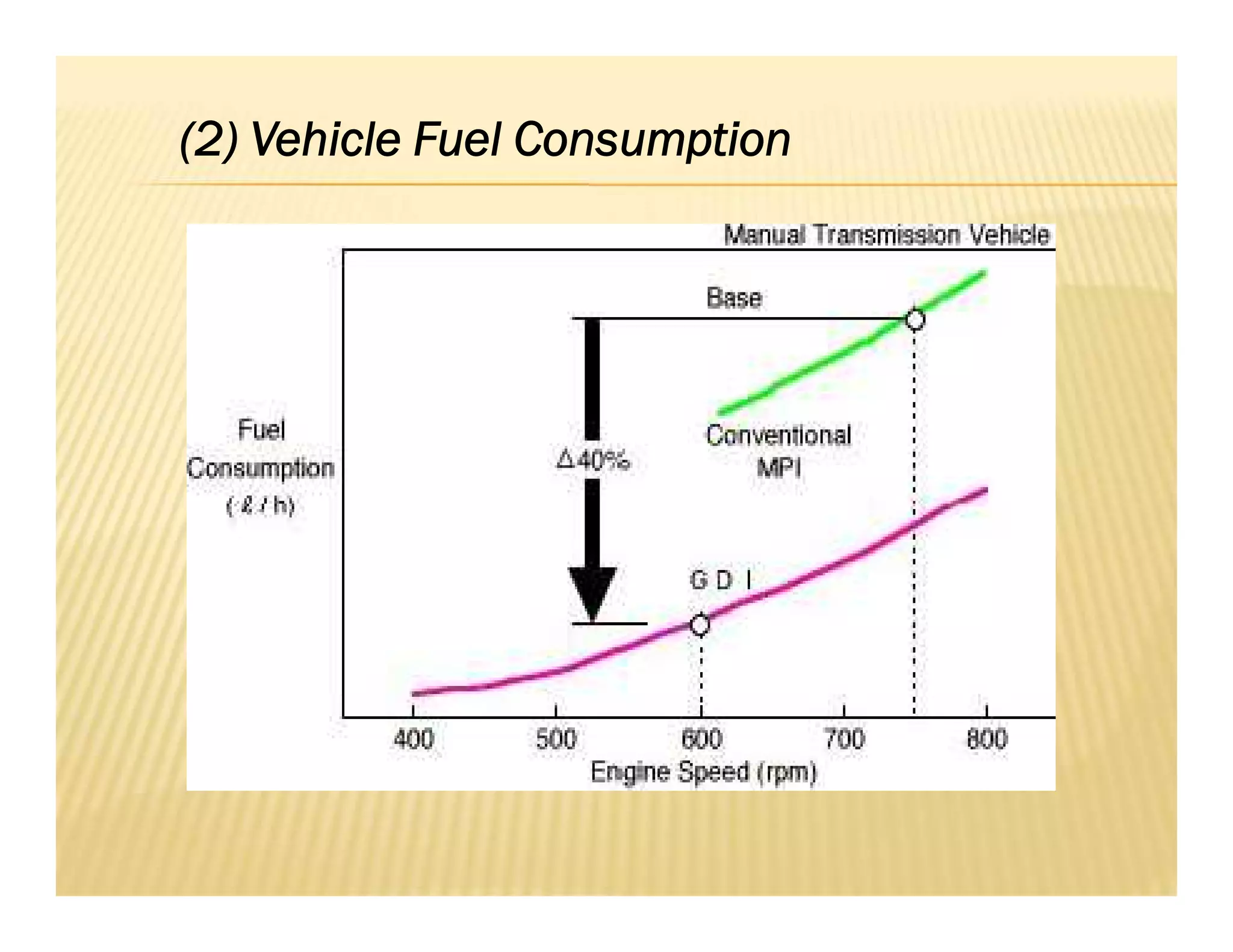
(2) Vehicle Fuel Consumption
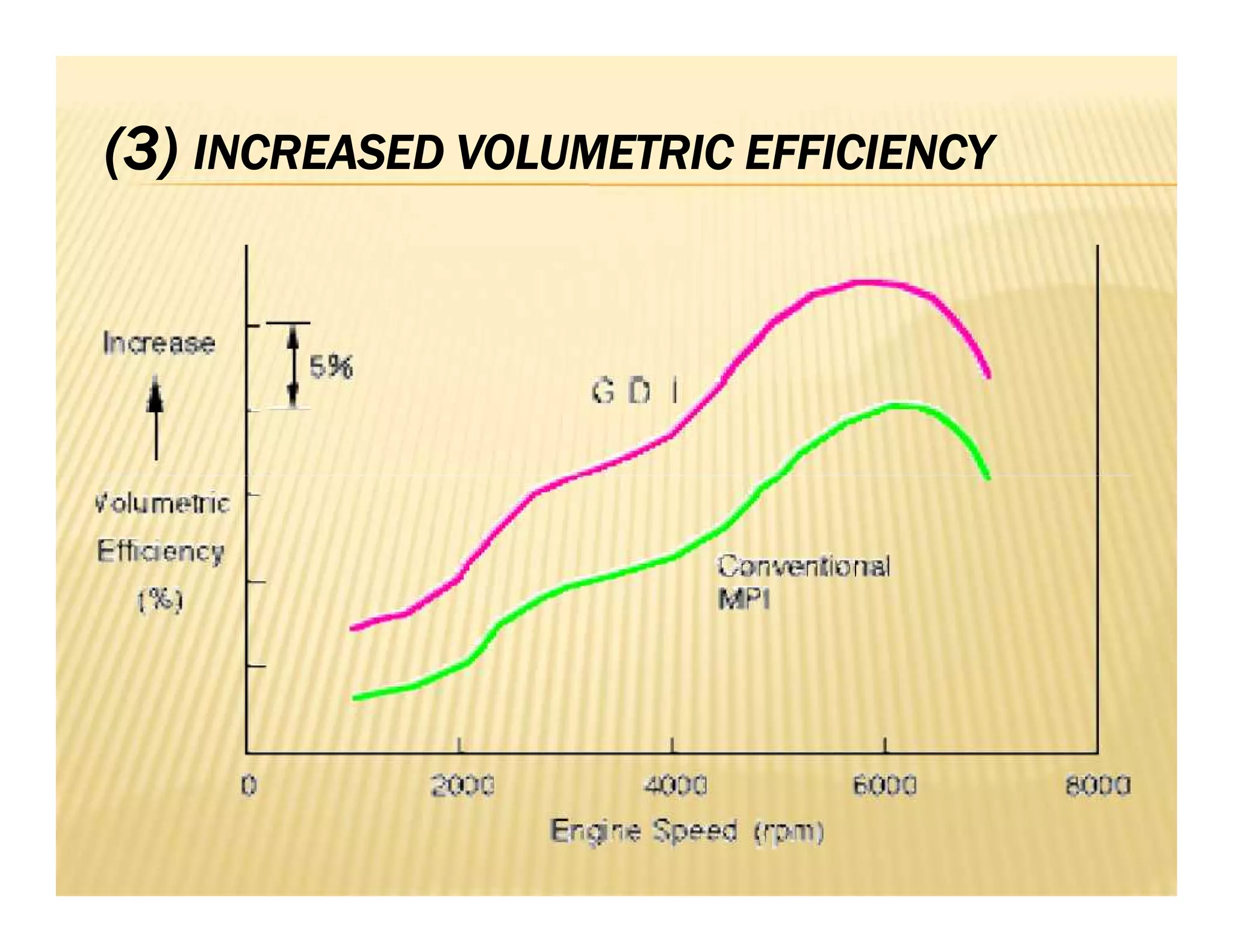
(3) INCREASED VOLUMETRIC EFFICIENCY
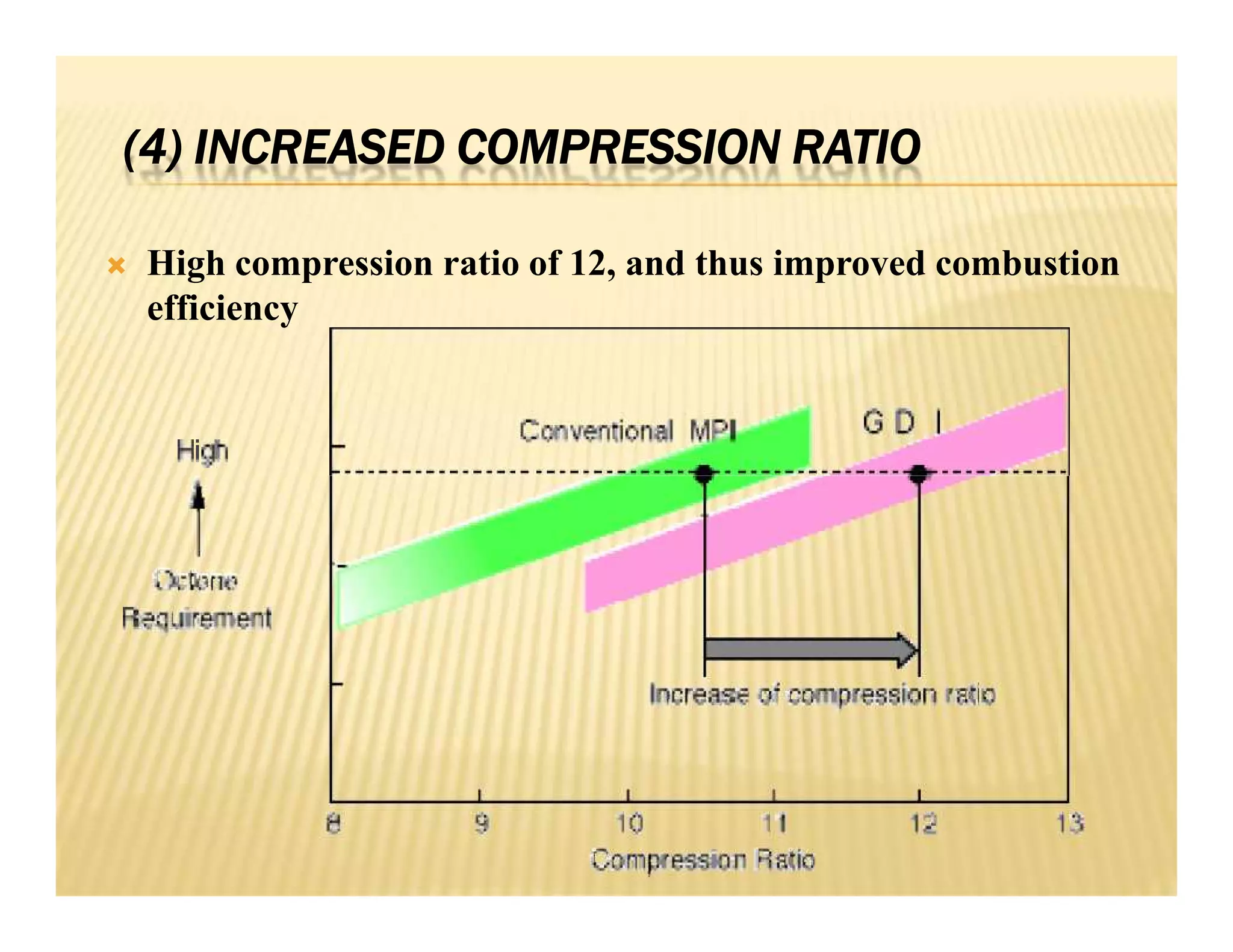
(4) INCREASED COMPRESSION RATIO
 High compression ratio of 12, and thus improved combustion
efficiency
DISADVANTAGES
 Complexity
 High cost
 Harder Deposits
 Undetected Knocking
 Complexity
 High cost
 Harder Deposits
 Undetected Knocking
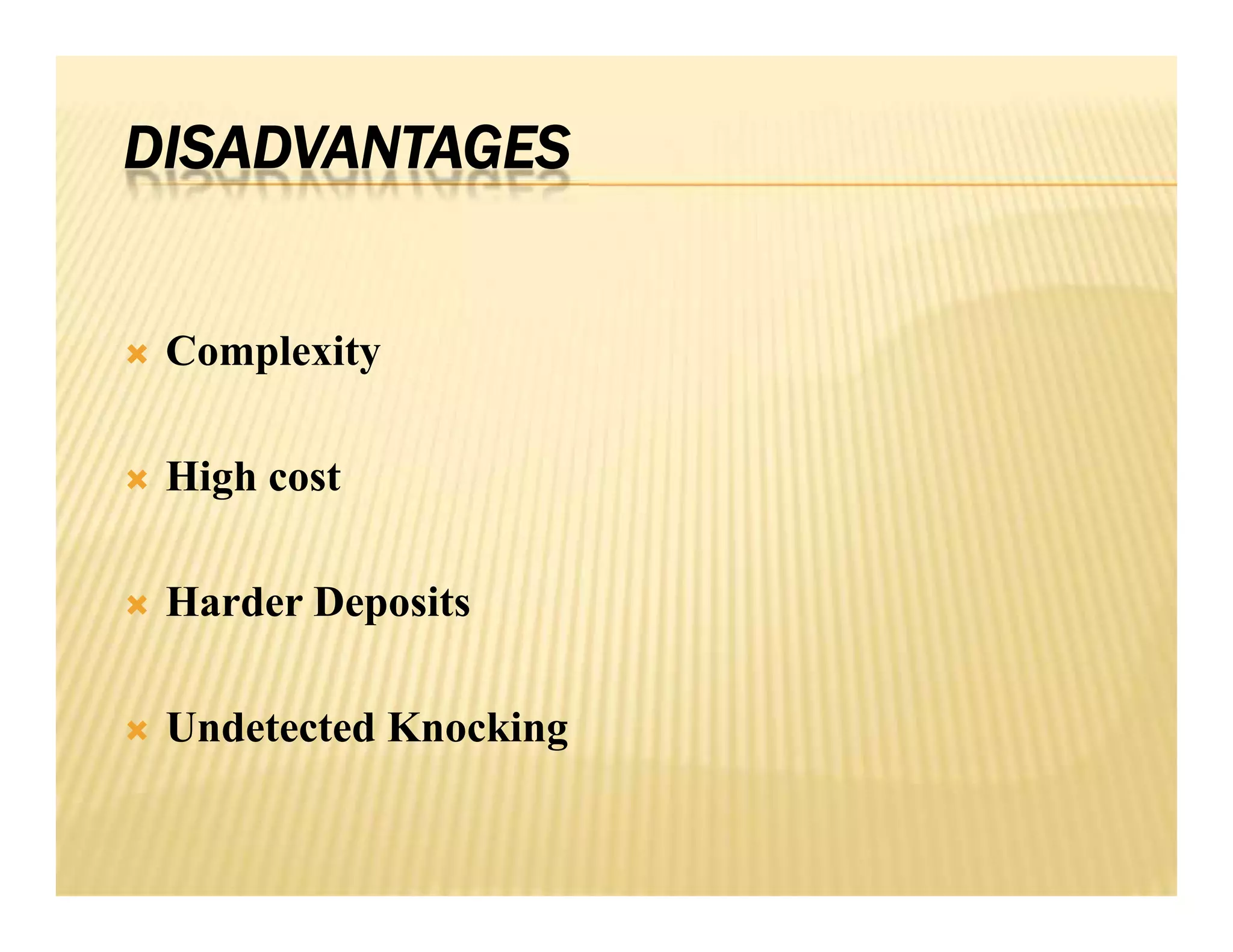
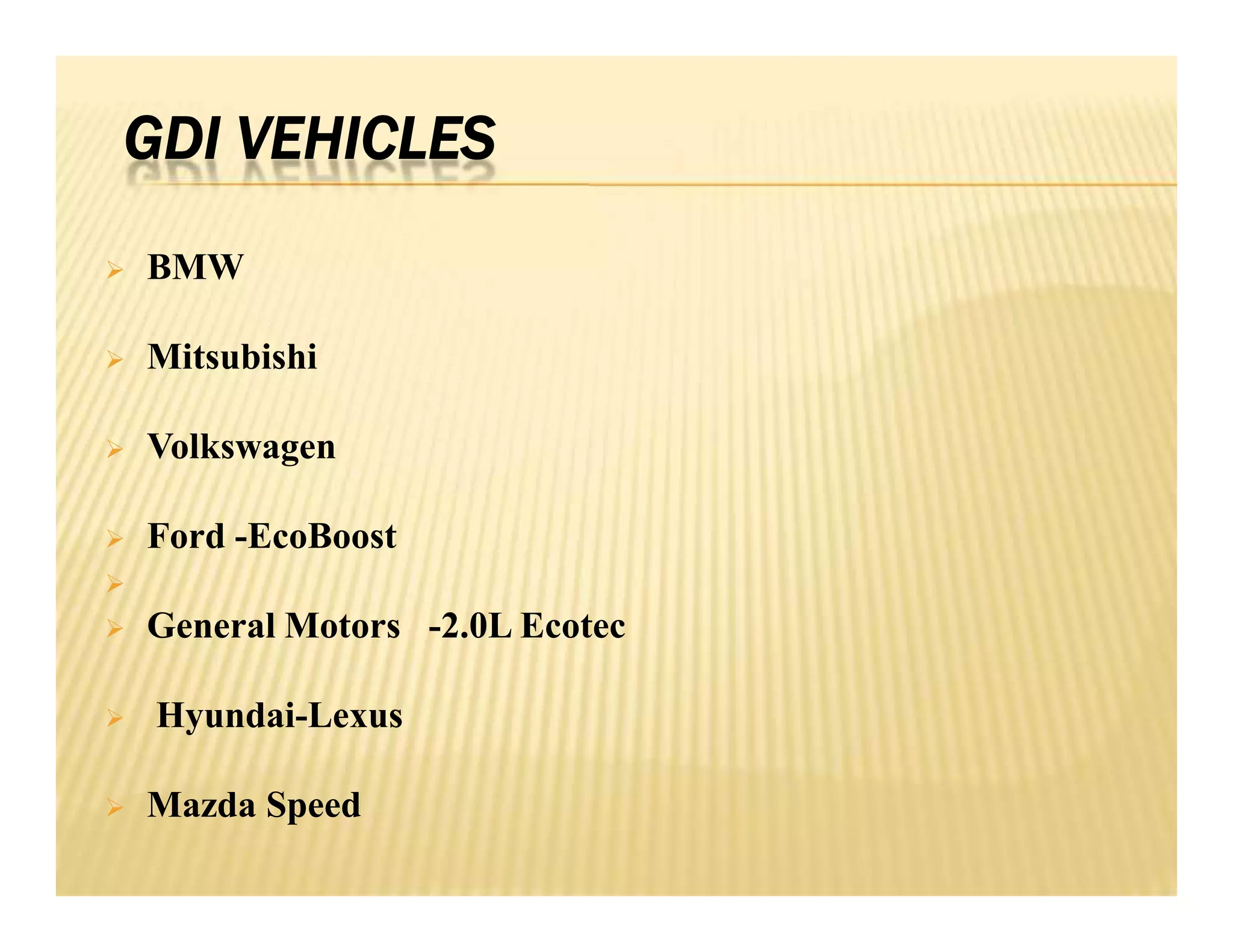
GDI VEHICLES
 BMW
 Mitsubishi
 Volkswagen
 Ford -EcoBoost

 General Motors -2.0L Ecotec
 Hyundai-Lexus
 Mazda Speed
 BMW
 Mitsubishi
 Volkswagen
 Ford -EcoBoost

 General Motors -2.0L Ecotec
 Hyundai-Lexus
 Mazda Speed
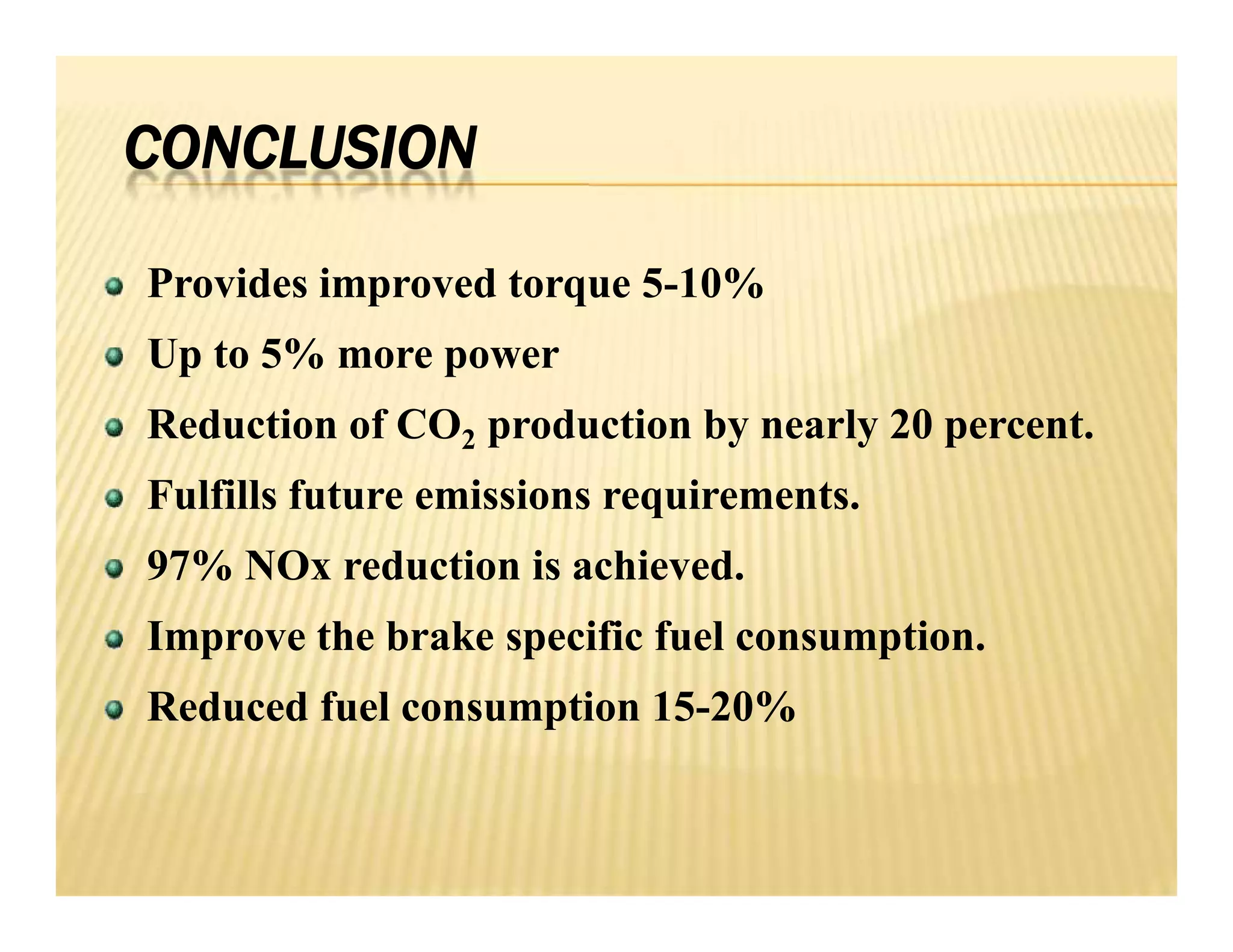
CONCLUSION
Provides improved torque 5-10%
Up to 5% more power
Reduction of CO2 production by nearly 20 percent.
Fulfills future emissions requirements.
97% NOx reduction is achieved.
Improve the brake specific fuel consumption.
Reduced fuel consumption 15-20%
Provides improved torque 5-10%
Up to 5% more power
Reduction of CO2 production by nearly 20 percent.
Fulfills future emissions requirements.
97% NOx reduction is achieved.
Improve the brake specific fuel consumption.
Reduced fuel consumption 15-20%
REFERENCES
 http://auto.howstuffworks.com/direct-injection-
engine.htm
 http://en.wikipedia.org/wiki/Gasoline_direct_injectio
n
 Video- Youtube.com
 Textbook of Thermal engineering, by R.S.
KHURUMI
 http://auto.howstuffworks.com/direct-injection-
engine.htm
 http://en.wikipedia.org/wiki/Gasoline_direct_injectio
n
 Video- Youtube.com
 Textbook of Thermal engineering, by R.S.
KHURUMI
THANK YOUTHANK YOU

Seminar on gasoline direct injection...

  • 1.
    SEMINAR ON GASOLINE DIRECTINJECTION SARAN S NAIR S7 MECHANICAL 11434033 STIST PREPARED BY,
  • 2.
    CONTENTS  INTRODUCTION  TYPESOF FUEL INJECTION  WHY NOT CARBURETOR?  WHY THE GDI?  MAJOR OBJECTIVES OF GDI  TIMELINE OF FUEL SUPPLY SYSTEM  ACHIEVEMENTS  MAIN COMPONENTS OF GDI  WORKING OF GDI  ADVANTAGES  DISDVANTAGES  GDI VEHICLES  CONCLUSION  REFERENCES   INTRODUCTION  TYPES OF FUEL INJECTION  WHY NOT CARBURETOR?  WHY THE GDI?  MAJOR OBJECTIVES OF GDI  TIMELINE OF FUEL SUPPLY SYSTEM  ACHIEVEMENTS  MAIN COMPONENTS OF GDI  WORKING OF GDI  ADVANTAGES  DISDVANTAGES  GDI VEHICLES  CONCLUSION  REFERENCES 
  • 3.
    INTRODUCTION  Fuel injectionis a system for admitting fuel into an IC engine. It has become the primary fuel delivery system used in engines, having replaced carburetors during the 1980s and 1990s.  FUEL INJECTION atomizes the fuel by forcibly pumping it through a small nozzle under high pressure  while a CARBURETOR relies on suction created by intake air accelerated through a ventury tube to draw the fuel into the airstream.  Fuel injection is a system for admitting fuel into an IC engine. It has become the primary fuel delivery system used in engines, having replaced carburetors during the 1980s and 1990s.  FUEL INJECTION atomizes the fuel by forcibly pumping it through a small nozzle under high pressure  while a CARBURETOR relies on suction created by intake air accelerated through a ventury tube to draw the fuel into the airstream.
  • 4.
    TYPES OF FUELSUPPLY • The Carburetor • Single-point or throttle body injection (TBI) • Port or multi point fuel injection (MPFI) • Sequential fuel injection (SFI) • Direct injection • The Carburetor • Single-point or throttle body injection (TBI) • Port or multi point fuel injection (MPFI) • Sequential fuel injection (SFI) • Direct injection
  • 5.
    THE CARBURETOR  Adevice for atomising and vaporising the fuel and mixing it with the air  The process of breaking up and mixing the fuel with air is called carburation  A device for atomising and vaporising the fuel and mixing it with the air  The process of breaking up and mixing the fuel with air is called carburation
  • 6.
    SINGLE-POINT OR THROTTLEBODY INJECTION(TBI)  The earliest and simplest type of fuel injection  Single-point simply replaces the carburetor with one or two fuel-injector nozzles in the throttle body, which is the throat of the engine’s air intake manifold.  The earliest and simplest type of fuel injection  Single-point simply replaces the carburetor with one or two fuel-injector nozzles in the throttle body, which is the throat of the engine’s air intake manifold.
  • 7.
    PORT OR MULTIPOINT FUEL INJECTION (MPFI)  Multi-point fuel injection provides a separate injector nozzle to each cylinder, right outside its intake port, which is why the system is sometimes called port injection.  Shooting the fuel vapor this close to the intake port almost ensures that it will be drawn completely into the cylinder.  Multi-point fuel injection provides a separate injector nozzle to each cylinder, right outside its intake port, which is why the system is sometimes called port injection.  Shooting the fuel vapor this close to the intake port almost ensures that it will be drawn completely into the cylinder.
  • 8.
    SEQUENTIAL FUEL INJECTION(SFI)  Sequential fuel injection, also called sequential port fuel injection (SPFI) or timed injection, is a type of MPFI  One injector per cylinder with a firing circuit for each injector individually.  Results in better emissions and more power.  Same fuel pressure as the MPFI.  Sequential fuel injection, also called sequential port fuel injection (SPFI) or timed injection, is a type of MPFI  One injector per cylinder with a firing circuit for each injector individually.  Results in better emissions and more power.  Same fuel pressure as the MPFI.
  • 9.
    GASOLINE DIRECT INJECTION(GDI) GDI significantly improves fuel efficiency without making a major shift away from conventional IC technology.  GDI is a process where fuel and air is sent directly into the engine with high pressure.  The injector is connected along with the intake valve, exhaust valve and the spark plug.  GDI significantly improves fuel efficiency without making a major shift away from conventional IC technology.  GDI is a process where fuel and air is sent directly into the engine with high pressure.  The injector is connected along with the intake valve, exhaust valve and the spark plug.
  • 10.
    GASOLINE DIRECT INJECTION The injector, injects the mixture according to the speed of the engine. The intake valve is used for only air.  Compression ratio is high as 12.5:1 at its peak value. b= bore diameter s= stroke length Vc= clearance volume  Mitsubishi, Toyota and Nissan all market four-stroke GDI engines  The injector, injects the mixture according to the speed of the engine. The intake valve is used for only air.  Compression ratio is high as 12.5:1 at its peak value. b= bore diameter s= stroke length Vc= clearance volume  Mitsubishi, Toyota and Nissan all market four-stroke GDI engines
  • 11.
    WHY NOT CARBURETOR?? Carburetor has following Disadvantages:  Vapour lock,  Perfect air/fuel mixture cannot be obtained,  Lack of throttle response,  Low volumetric efficiency,  Icing – problem in aircraft engines, Carburetor has following Disadvantages:  Vapour lock,  Perfect air/fuel mixture cannot be obtained,  Lack of throttle response,  Low volumetric efficiency,  Icing – problem in aircraft engines,
  • 12.
    WHY THE GDI?? • Lower Fuel Consumption and More Output • Better than the current MPI Style of Fuel Injection • Ultra-precise computer management • The location of the injector • Less pollution from each drop of gasoline. • The World needs a better Environment • Lower Fuel Consumption and More Output • Better than the current MPI Style of Fuel Injection • Ultra-precise computer management • The location of the injector • Less pollution from each drop of gasoline. • The World needs a better Environment
  • 13.
    MAJOR OBJECTIVES OFTHE GDI ENGINE • Ultra-low fuel consumption that betters that of even diesel engines • Superior power to conventional MPFI engines • A Stable Combustion • Ultra-low fuel consumption that betters that of even diesel engines • Superior power to conventional MPFI engines • A Stable Combustion
  • 14.
    TIMELINE OF FUELSUPPLY SYSTEM Carburetor Port Injection (MPFI) Direct Injection (GDI)
  • 15.
  • 16.
    MAIN COMPONENTS OFGDI 1. Engine Control Unit 2. Sensors 3. High pressure Fuel Pump 4. Fuel Injector 1. Engine Control Unit 2. Sensors 3. High pressure Fuel Pump 4. Fuel Injector
  • 17.
    ENGINE CONTROL UNIT(ECU)  ECU is a HEART of The Engine .  Ecu is computer that controls all of the electronic Components on the engine.  Working of Ecu • Control of fuel mixture • Control of ignition timing • Control of idle speed • Control of variable valve timing • Electronic valve control  ECU is a HEART of The Engine .  Ecu is computer that controls all of the electronic Components on the engine.  Working of Ecu • Control of fuel mixture • Control of ignition timing • Control of idle speed • Control of variable valve timing • Electronic valve control
  • 18.
    SENSORS In order toprovide the correct amount of fuel for every operating condition, the ECU has to monitor a huge number of input sensors. Eg : Acceleration pedal sensor Air flow sensor Hi pressure pump sensor Crank Angle sensor In order to provide the correct amount of fuel for every operating condition, the ECU has to monitor a huge number of input sensors. Eg : Acceleration pedal sensor Air flow sensor Hi pressure pump sensor Crank Angle sensor
  • 19.
    INJECTOR  A fuelinjector is nothing but an electronically controlled valve.  When the injector is energized, an electromagnet moves a plunger that opens the valve, allowing the pressurized fuel to squirt out through a tiny nozzle.  It is controlled by the ECU.  A fuel injector is nothing but an electronically controlled valve.  When the injector is energized, an electromagnet moves a plunger that opens the valve, allowing the pressurized fuel to squirt out through a tiny nozzle.  It is controlled by the ECU.
  • 20.
  • 21.
    GDI BURNING MODE 1.Ultra-lean burn mode: At lower speeds, the mixture is injected at the end of the compression stroke for lowest heat losses. This is when the compression ratio in the cylinders is maximum 2. Stochiometric mode: This is the conventional method of injection during the intake stroke for optimum combustion and minimum waste gases during moderate city driving conditions. 3. Full Power mode: Fuel is injected in the intake stroke at a higher .This is done at high speeds or high load conditions like climbing a hill. 1. Ultra-lean burn mode: At lower speeds, the mixture is injected at the end of the compression stroke for lowest heat losses. This is when the compression ratio in the cylinders is maximum 2. Stochiometric mode: This is the conventional method of injection during the intake stroke for optimum combustion and minimum waste gases during moderate city driving conditions. 3. Full Power mode: Fuel is injected in the intake stroke at a higher .This is done at high speeds or high load conditions like climbing a hill.
  • 22.
  • 23.
    (2) Vehicle FuelConsumption
  • 24.
  • 25.
    (4) INCREASED COMPRESSIONRATIO  High compression ratio of 12, and thus improved combustion efficiency
  • 26.
    DISADVANTAGES  Complexity  Highcost  Harder Deposits  Undetected Knocking  Complexity  High cost  Harder Deposits  Undetected Knocking
  • 27.
    GDI VEHICLES  BMW Mitsubishi  Volkswagen  Ford -EcoBoost   General Motors -2.0L Ecotec  Hyundai-Lexus  Mazda Speed  BMW  Mitsubishi  Volkswagen  Ford -EcoBoost   General Motors -2.0L Ecotec  Hyundai-Lexus  Mazda Speed
  • 28.
    CONCLUSION Provides improved torque5-10% Up to 5% more power Reduction of CO2 production by nearly 20 percent. Fulfills future emissions requirements. 97% NOx reduction is achieved. Improve the brake specific fuel consumption. Reduced fuel consumption 15-20% Provides improved torque 5-10% Up to 5% more power Reduction of CO2 production by nearly 20 percent. Fulfills future emissions requirements. 97% NOx reduction is achieved. Improve the brake specific fuel consumption. Reduced fuel consumption 15-20%
  • 29.
    REFERENCES  http://auto.howstuffworks.com/direct-injection- engine.htm  http://en.wikipedia.org/wiki/Gasoline_direct_injectio n Video- Youtube.com  Textbook of Thermal engineering, by R.S. KHURUMI  http://auto.howstuffworks.com/direct-injection- engine.htm  http://en.wikipedia.org/wiki/Gasoline_direct_injectio n  Video- Youtube.com  Textbook of Thermal engineering, by R.S. KHURUMI
  • 30.