Pedagogical Approaches
sheryl.pacheco@deped.gov.ph
PEDAGOGICAL APPROACHES
Section 5 (e) RA 10533
“The curriculum shall use pedagogical
approaches such as constructivism, inquiry-
based, reflective, collaborative, and
integrative.”
• The aim of AP 10 is not only to answer the
question: “Who are we?”.
• More importantly, AP 10 aims to immerse
ourselves (you and your students) in the
process of finding out who we are and
what we want to become based on shared
experiences of contemporary issues.
Experiential learning (praxis) as the core
pedagogical approach
Why? Because political knowledge is best
acquired, retained and deepened when it
impacts people’s personal and communal
lives – often leading to involvement in public
affairs.
Constructivism
• We construct meaning based on prior
knowledge and experience
• Meaning-making
• Learning is social
• Learning as active
In a constructivist approach, it is important
that we know where our students are
coming from but NOT to judge them, but to
be able to provide the most suitable learning
environment for them to discover what
needed to be learned and un-learned.
CONSTRUCTIVIST APPROACH
• ANECDOTAL RECORDS
• CELEBRATION OF LEARNING
• EXIT CARD
• GRAPHIC ORGANIZER
• JOURNAL
• ORAL PRESENTATION
• PEER ASSESSMENT
• PORTFOLIOS
• RUBRICS
• SIMULATION
• PROJECT BASED LEARNING
ASSESSMENT IN A CONSTRUCTIVIST CLASSROOM
Approaches that promote constructivism in the
AP 10 classroom
• Integrative teaching – cutting across disciplinal
lines (interdisciplinary) and learning styles
• Reflective – stepping back and analyze their
experience to improve future learning
• Collaborative – not only among students but more
importantly between students, teachers, and their
respective community
• Inquiry-based – raising questions, posing problems
or scenarios and let student discover the answer
CONTEN
T-BASED
INSTRUC
TION
INQUIRY
THEMATIC
TEACHING
GENERIC
COMPETE
NCY
MODEL
IT AIMS TO CONNECT WHAT
IS LEARNED IN SCHOOL TO
REAL LIFE SITUATIONS, THUS
IT IS MORE ON DEVELOPING
PROBLEM SOLVING AND
DISCUSSIONS OF ISSUES IN
THE REAL WORLD.
Make connections of learning across curricula;
focuses on connections rather than isolated facts.
Integrative Approach
Integrative Teaching
•THEMATIC TEACHING- THEME HELPS STUDENTS SEE THE
MEANINGFUL CONNECTIONS ACROSS DISCIPLINES OR LEARNING
AREAS
REFLECTIVE APPROACH
-TEACHERS ANALYZE THEIR
OWN PRACTICE AND
UNDERLYING BASIS TO
CONSIDER ALTERNATIVE
MEANS FOR ACHIEVING
THEIR ENDS.
Strategies- Reflective Approach
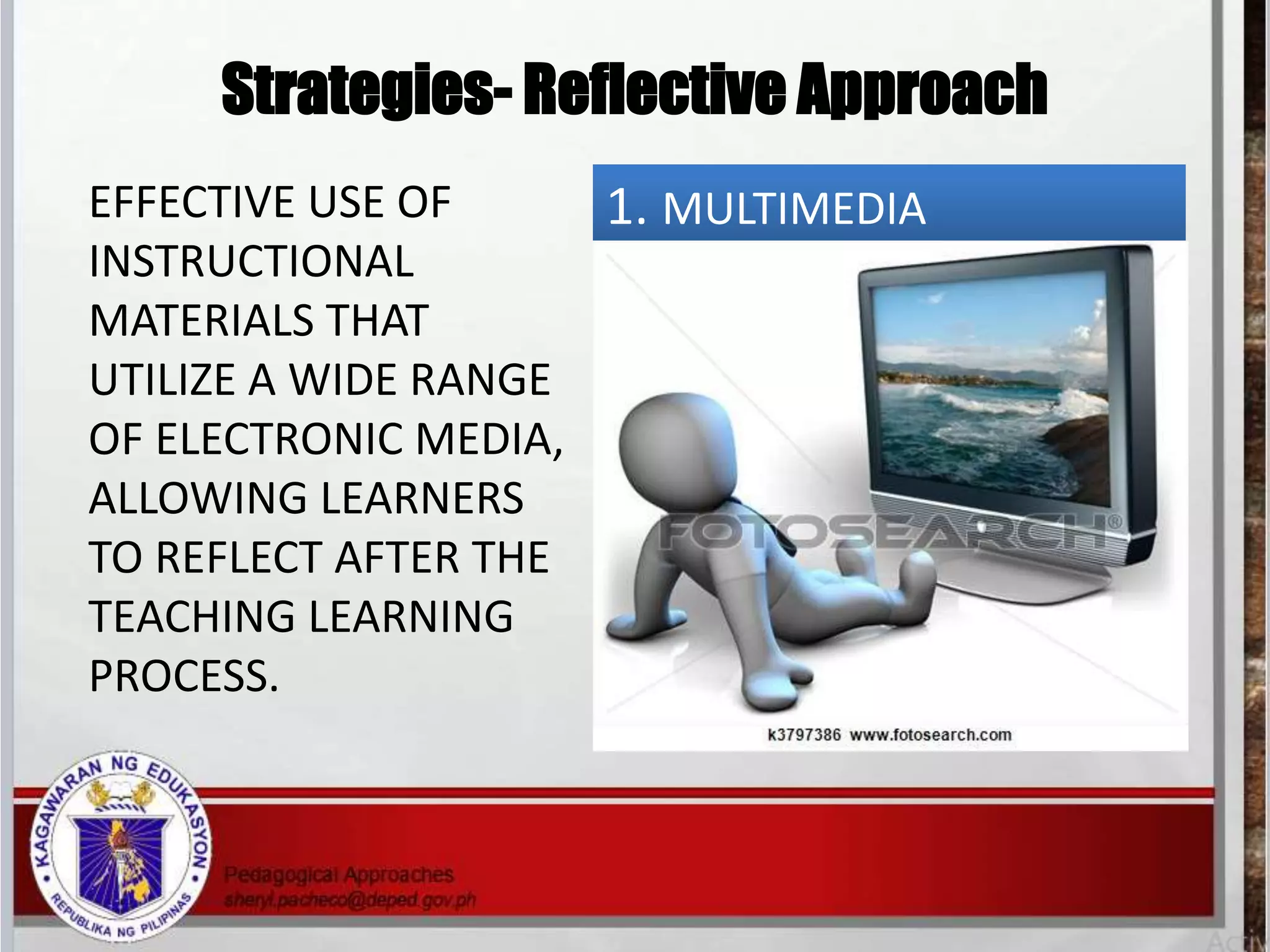
1. MULTIMEDIA
PRESENTATION
EFFECTIVE USE OF
INSTRUCTIONAL
MATERIALS THAT
UTILIZE A WIDE RANGE
OF ELECTRONIC MEDIA,
ALLOWING LEARNERS
TO REFLECT AFTER THE
TEACHING LEARNING
PROCESS.
2. Drill and Practice
Strategies-Reflective Approach
GIVES EMPHASIS
ON REPETITION
AFTER THE
LEARNERS
REFLECT ON THEIR
SKILL OR
LEARNING.
collective
learning, learning
communities,
peer teaching,
peer learning or
team learning
LEARNERS WORK
TOGETHER
TOWARDS A
COMMON GOAL
• TEACHERS MUST FULLY UNDERSTAND LEARNERS PREFERRED LEARNING
STYLES.
Collaborative Approach
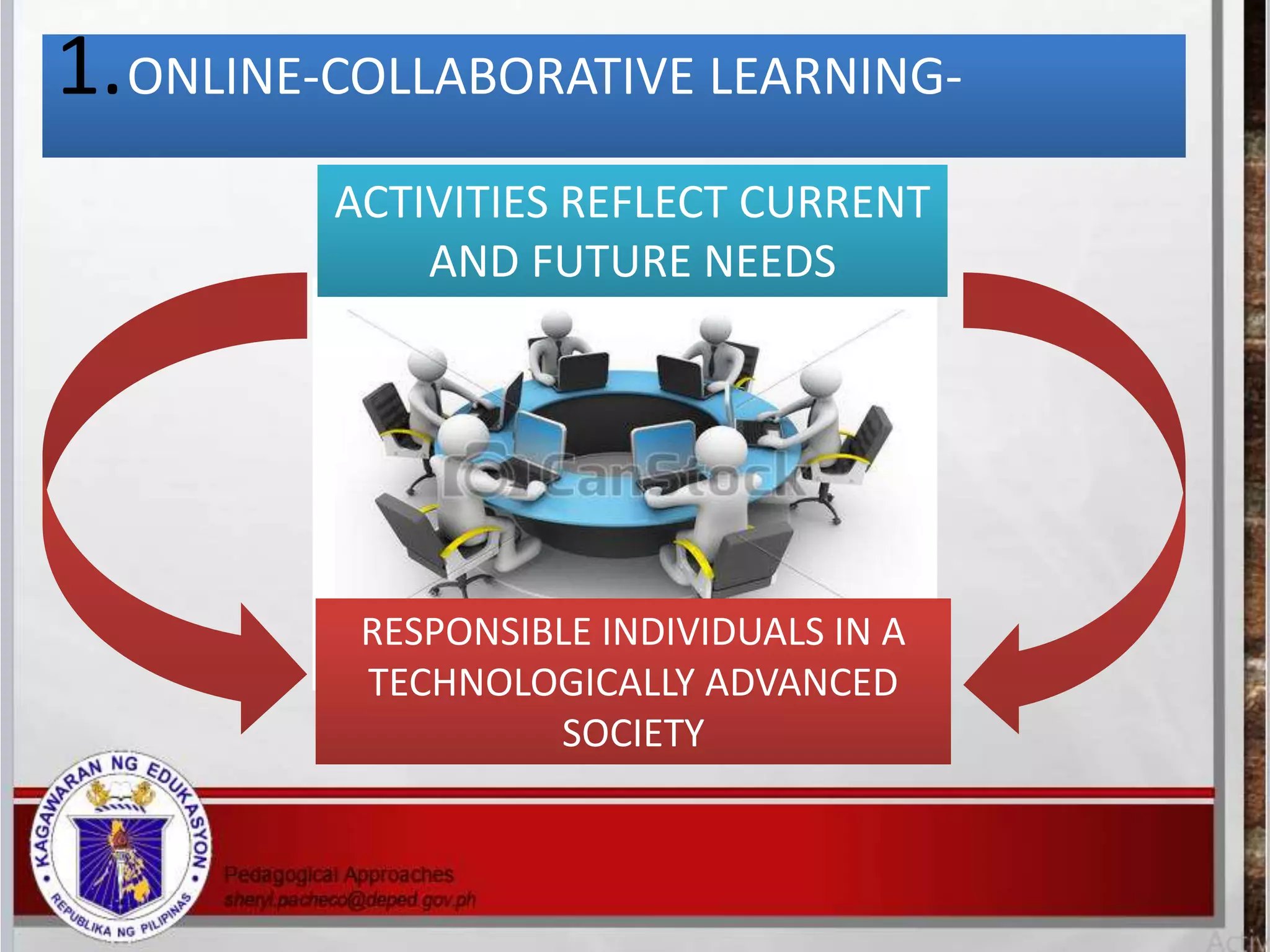
1.ONLINE-COLLABORATIVE LEARNING-
ACTIVITIES REFLECT CURRENT
AND FUTURE NEEDS
RESPONSIBLE INDIVIDUALS IN A
TECHNOLOGICALLY ADVANCED
SOCIETY
2. JIGSAW METHOD
LEARNERS
WORK IN A
SMALL
GROUP
ALLOWS INTERACTION
WORK INDEPENDENTLY
DEVELOP LISTENING , ENGAGEMENT
AND EMPATHY SKILLS
EFFICIENT WAY TO LEARN CONTENT
Strategies- Collaborative Approach
3. THINK-PAIR-SHARE
COOPERATIVE DISCUSSION
STRATEGY WITH 3 STAGES OF
ACTION
THINK •PONDERS
PAIR • GETS A
PAIR
SHARE
•PARTAKES
KNOWLEDGE
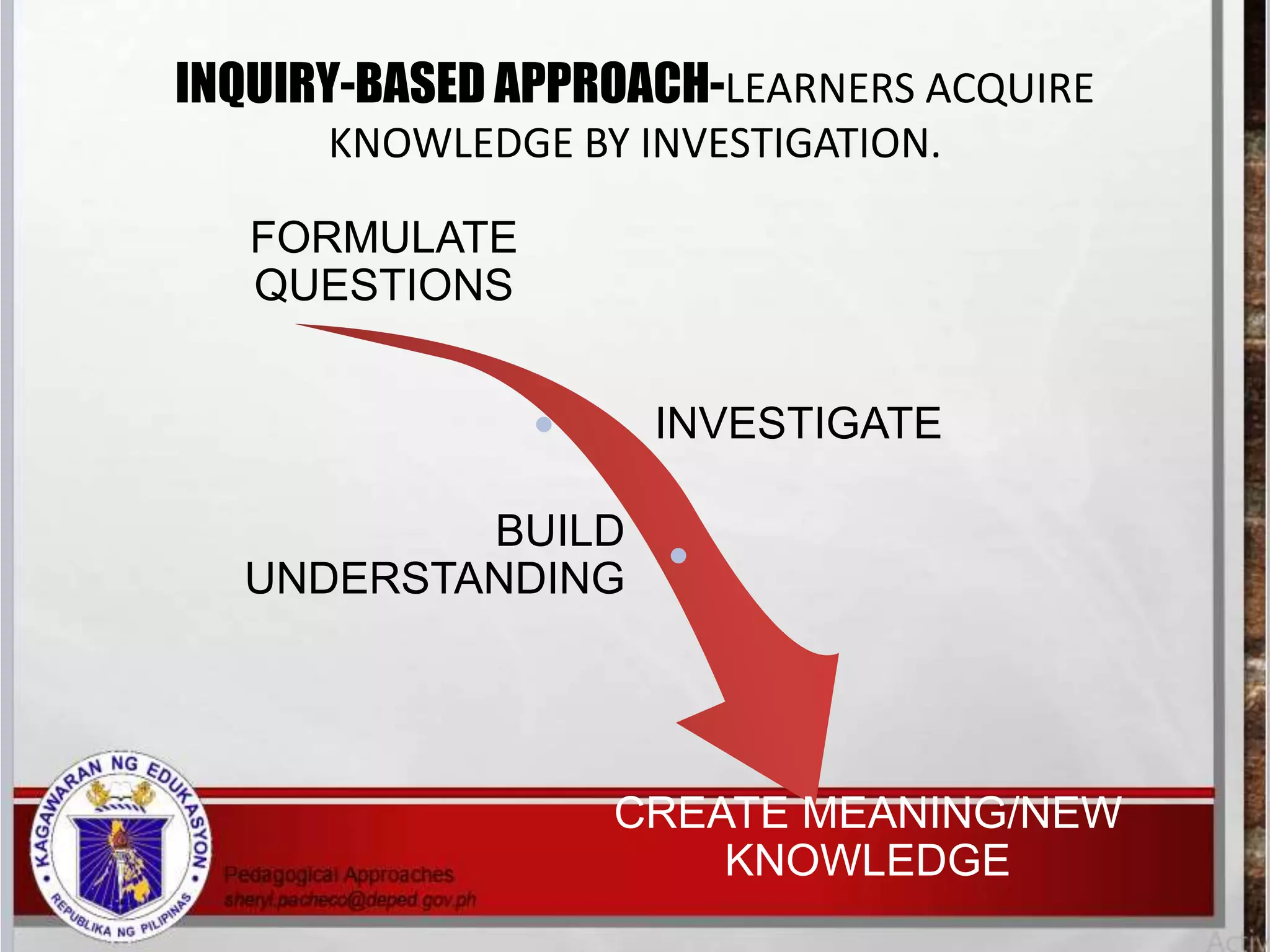
INQUIRY-BASED APPROACH-LEARNERS ACQUIRE
KNOWLEDGE BY INVESTIGATION.
FORMULATE
QUESTIONS
INVESTIGATE
BUILD
UNDERSTANDING
CREATE MEANING/NEW
KNOWLEDGE
• PLACED IN
A
SITUATION
• INTERACT
SIMULATION
ROLE
PLAYS
 GAMES
MODE
Strategies
Strategies- Inquiry-based Approach
DEMONSTRATION
•LESSENS TEACHERS’ ACTIVE ROLE
•ALLOW LEARNERS TO RESPECT
DIVERSITY
•PROVIDES A CONCRETE/VISUAL
WAY OF EXPLAINING THE TOPIC
Where do we start?
Techniques in probing student’s understanding:
1. Predict-observe-explain
2. Graphic organizer, KWLH Chart
3. Mind Mapping and Concept Mapping
4. Concept Cartoons
Each module in the LM should have at least
one or two of these activities. Can you find
them?
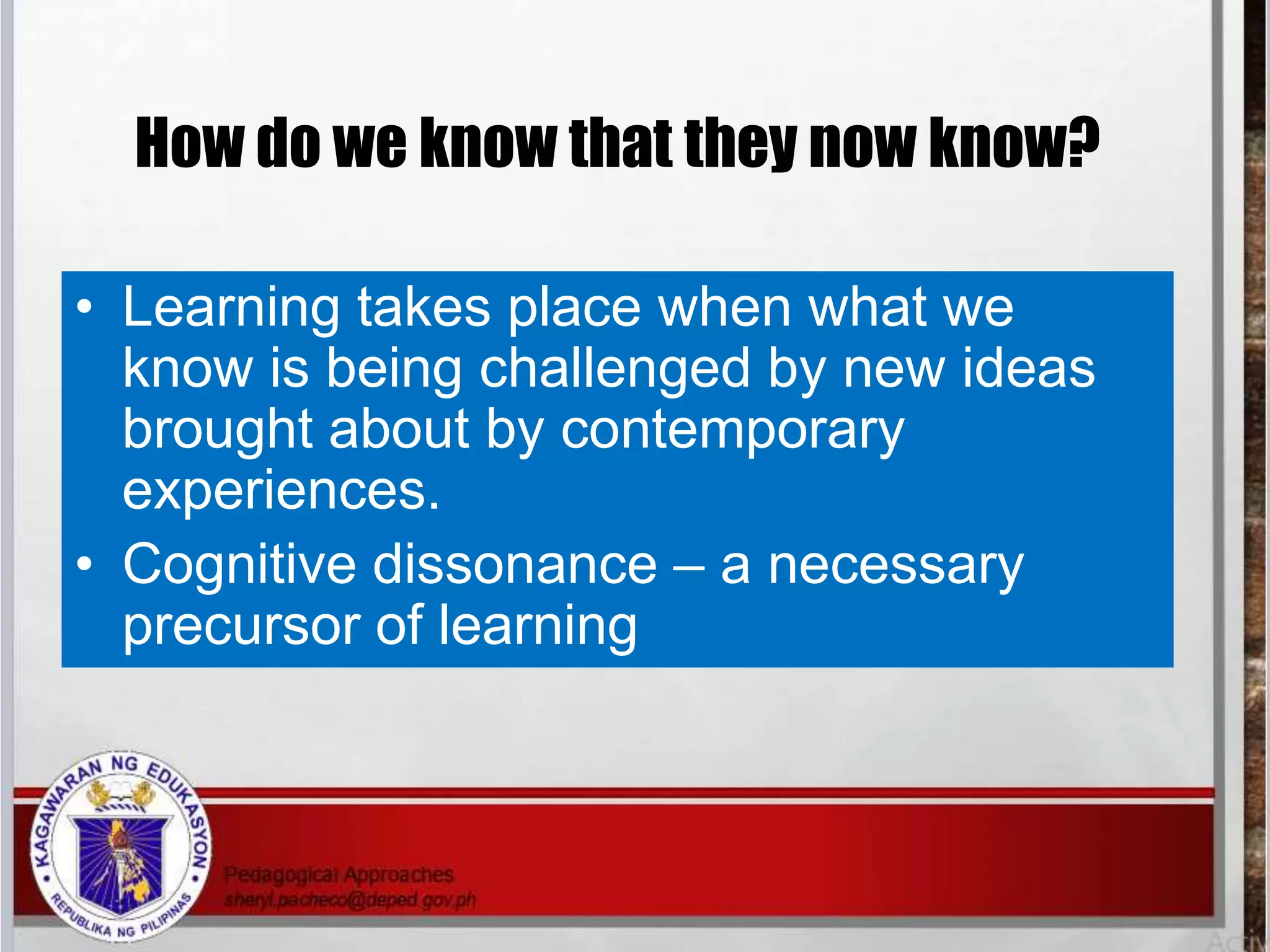
How do we know that they now know?
• Learning takes place when what we
know is being challenged by new ideas
brought about by contemporary
experiences.
• Cognitive dissonance – a necessary
precursor of learning
Why are we doing this?
• meaningful lesson vs meaningful classroom
A lesson is meaningful if it provides learners
with facts and empirical data and explain how
these relate with each other.
But if the learner does not find any relevance in
learning for learning’s sake, then the classroom
is not a meaningful one.
Therefore, a lesson is meaningful in so far
as it effectively provides conceptual
knowledge.
A classroom is a meaningful when learners
see its value beyond what the lessons
provide.
We must offer the AP 10 learners the
experience of a meaningful classroom – that
coming to class is not pointless but a value in
itself.
This means that we have to convert our
classroom from a theoretical to a more practical
one.
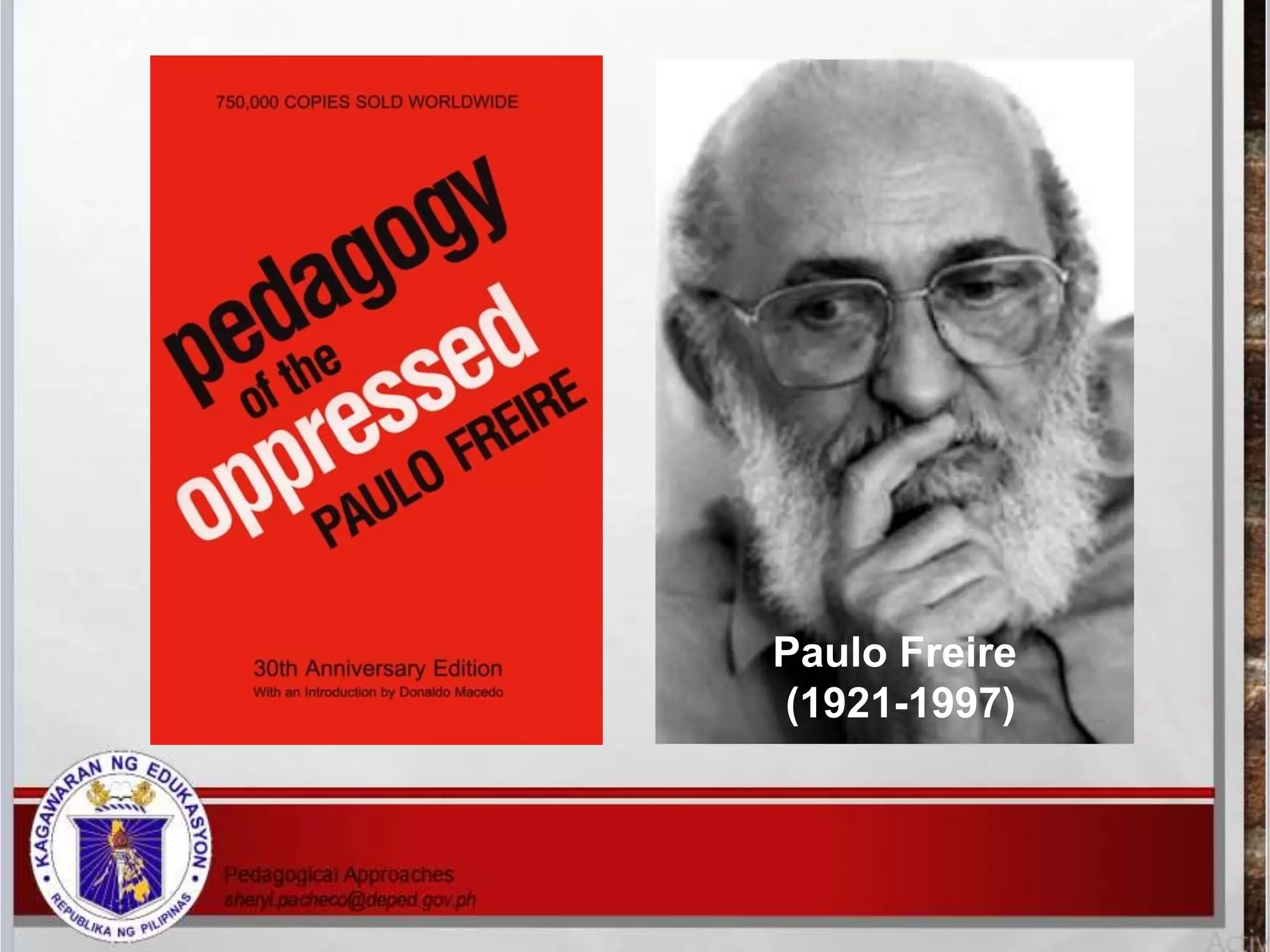
Paulo Freire
(1921-1997)
The educational system is one of the major
instruments for the maintenance of the
culture of silence (education as a practice
of domination).
Therefore, the education process CANNOT be
neutral.
It either functions as an instrument to facilitate the
integration of younger generation into the logic of the
present system and bring about conformity to it.
or
It becomes the practice of freedom, the means by which
men & women deal critically and creatively with reality &
discover how to participate in the transformation of the
world.
AP 10 provides a safe and
inclusive space where
critical and honest
conversations can happen.
AP 10 uses relevant
experiences that can excite
our students to find
meaning inside the
classroom and eventually
ignite them to engage in the
political outside.
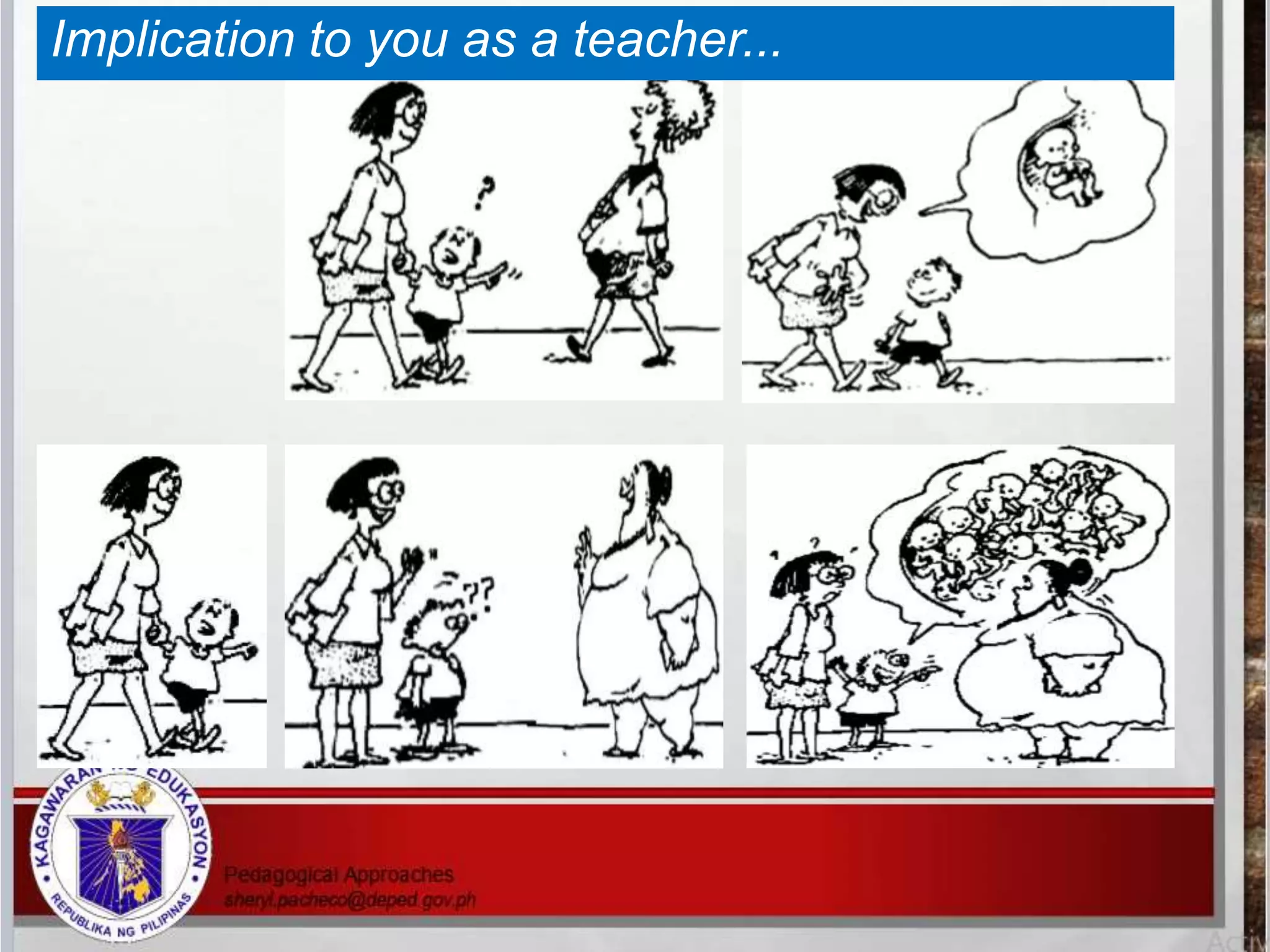
Implication to you as a teacher...
“It is what teachers think, what teachers do, and
what teachers are at the level of the classroom that
ultimately shapes the kind of learning that young
people get.”
- Andy Hargreaves and Michael Fullan-
Pedagogical Approaches
sheryl.pacheco@deped.gov.ph

Pedagogical Approaches

  • 1.
  • 2.
    Section 5 (e)RA 10533 “The curriculum shall use pedagogical approaches such as constructivism, inquiry- based, reflective, collaborative, and integrative.”
  • 3.
    • The aimof AP 10 is not only to answer the question: “Who are we?”. • More importantly, AP 10 aims to immerse ourselves (you and your students) in the process of finding out who we are and what we want to become based on shared experiences of contemporary issues.
  • 4.
    Experiential learning (praxis)as the core pedagogical approach Why? Because political knowledge is best acquired, retained and deepened when it impacts people’s personal and communal lives – often leading to involvement in public affairs.
  • 5.
    Constructivism • We constructmeaning based on prior knowledge and experience • Meaning-making • Learning is social • Learning as active
  • 6.
    In a constructivistapproach, it is important that we know where our students are coming from but NOT to judge them, but to be able to provide the most suitable learning environment for them to discover what needed to be learned and un-learned.
  • 7.
    CONSTRUCTIVIST APPROACH • ANECDOTALRECORDS • CELEBRATION OF LEARNING • EXIT CARD • GRAPHIC ORGANIZER • JOURNAL • ORAL PRESENTATION • PEER ASSESSMENT • PORTFOLIOS • RUBRICS • SIMULATION • PROJECT BASED LEARNING ASSESSMENT IN A CONSTRUCTIVIST CLASSROOM
  • 8.
    Approaches that promoteconstructivism in the AP 10 classroom • Integrative teaching – cutting across disciplinal lines (interdisciplinary) and learning styles • Reflective – stepping back and analyze their experience to improve future learning • Collaborative – not only among students but more importantly between students, teachers, and their respective community • Inquiry-based – raising questions, posing problems or scenarios and let student discover the answer
  • 9.
    CONTEN T-BASED INSTRUC TION INQUIRY THEMATIC TEACHING GENERIC COMPETE NCY MODEL IT AIMS TOCONNECT WHAT IS LEARNED IN SCHOOL TO REAL LIFE SITUATIONS, THUS IT IS MORE ON DEVELOPING PROBLEM SOLVING AND DISCUSSIONS OF ISSUES IN THE REAL WORLD. Make connections of learning across curricula; focuses on connections rather than isolated facts. Integrative Approach
  • 10.
    Integrative Teaching •THEMATIC TEACHING-THEME HELPS STUDENTS SEE THE MEANINGFUL CONNECTIONS ACROSS DISCIPLINES OR LEARNING AREAS
  • 11.
    REFLECTIVE APPROACH -TEACHERS ANALYZETHEIR OWN PRACTICE AND UNDERLYING BASIS TO CONSIDER ALTERNATIVE MEANS FOR ACHIEVING THEIR ENDS.
  • 12.
    Strategies- Reflective Approach 1.MULTIMEDIA PRESENTATION EFFECTIVE USE OF INSTRUCTIONAL MATERIALS THAT UTILIZE A WIDE RANGE OF ELECTRONIC MEDIA, ALLOWING LEARNERS TO REFLECT AFTER THE TEACHING LEARNING PROCESS.
  • 13.
    2. Drill andPractice Strategies-Reflective Approach GIVES EMPHASIS ON REPETITION AFTER THE LEARNERS REFLECT ON THEIR SKILL OR LEARNING.
  • 14.
    collective learning, learning communities, peer teaching, peerlearning or team learning LEARNERS WORK TOGETHER TOWARDS A COMMON GOAL • TEACHERS MUST FULLY UNDERSTAND LEARNERS PREFERRED LEARNING STYLES. Collaborative Approach
  • 15.
    1.ONLINE-COLLABORATIVE LEARNING- ACTIVITIES REFLECTCURRENT AND FUTURE NEEDS RESPONSIBLE INDIVIDUALS IN A TECHNOLOGICALLY ADVANCED SOCIETY
  • 16.
    2. JIGSAW METHOD LEARNERS WORKIN A SMALL GROUP ALLOWS INTERACTION WORK INDEPENDENTLY DEVELOP LISTENING , ENGAGEMENT AND EMPATHY SKILLS EFFICIENT WAY TO LEARN CONTENT Strategies- Collaborative Approach
  • 17.
    Strategies- Collaborative Approach 3.THINK-PAIR-SHARE COOPERATIVE DISCUSSION STRATEGY WITH 3 STAGES OF ACTION THINK •PONDERS PAIR • GETS A PAIR SHARE •PARTAKES KNOWLEDGE
  • 18.
    INQUIRY-BASED APPROACH-LEARNERS ACQUIRE KNOWLEDGEBY INVESTIGATION. FORMULATE QUESTIONS INVESTIGATE BUILD UNDERSTANDING CREATE MEANING/NEW KNOWLEDGE
  • 19.
    • PLACED IN A SITUATION •INTERACT SIMULATION ROLE PLAYS  GAMES MODE Strategies
  • 20.
    Strategies- Inquiry-based Approach DEMONSTRATION •LESSENSTEACHERS’ ACTIVE ROLE •ALLOW LEARNERS TO RESPECT DIVERSITY •PROVIDES A CONCRETE/VISUAL WAY OF EXPLAINING THE TOPIC
  • 21.
    Where do westart? Techniques in probing student’s understanding: 1. Predict-observe-explain 2. Graphic organizer, KWLH Chart 3. Mind Mapping and Concept Mapping 4. Concept Cartoons Each module in the LM should have at least one or two of these activities. Can you find them?
  • 22.
    How do weknow that they now know? • Learning takes place when what we know is being challenged by new ideas brought about by contemporary experiences. • Cognitive dissonance – a necessary precursor of learning
  • 23.
    Why are wedoing this? • meaningful lesson vs meaningful classroom A lesson is meaningful if it provides learners with facts and empirical data and explain how these relate with each other. But if the learner does not find any relevance in learning for learning’s sake, then the classroom is not a meaningful one.
  • 24.
    Therefore, a lessonis meaningful in so far as it effectively provides conceptual knowledge. A classroom is a meaningful when learners see its value beyond what the lessons provide.
  • 25.
    We must offerthe AP 10 learners the experience of a meaningful classroom – that coming to class is not pointless but a value in itself. This means that we have to convert our classroom from a theoretical to a more practical one.
  • 26.
  • 27.
    The educational systemis one of the major instruments for the maintenance of the culture of silence (education as a practice of domination).
  • 28.
    Therefore, the educationprocess CANNOT be neutral. It either functions as an instrument to facilitate the integration of younger generation into the logic of the present system and bring about conformity to it. or It becomes the practice of freedom, the means by which men & women deal critically and creatively with reality & discover how to participate in the transformation of the world.
  • 29.
    AP 10 providesa safe and inclusive space where critical and honest conversations can happen. AP 10 uses relevant experiences that can excite our students to find meaning inside the classroom and eventually ignite them to engage in the political outside.
  • 30.
    Implication to youas a teacher...
  • 31.
    “It is whatteachers think, what teachers do, and what teachers are at the level of the classroom that ultimately shapes the kind of learning that young people get.” - Andy Hargreaves and Michael Fullan- Pedagogical Approaches sheryl.pacheco@deped.gov.ph

Editor's Notes

  • #5 People generally remember only 10% of what they read and 20% of what they hear. 90% of the time they learn from what they do.
  • #6 We understand the world through experiencing things and reflecting on those experience Meaning-making: we generate new knowledge by making sense of our world Learning is social – it is not detached from one’s environment and culture, it does not happen in a vacuum, we learn from each other We are therefore active participants in the learning process Paiget, Bruner, Vygotsky, Dewey
  • #7 In a constructivist approach, it is important that we know where our students are coming from NOT to judge them, but to be able to provide the most suitable learning environment for them to discover what needed to be learned.
  • #8 In a constructivist approach, it is important that we know where our students are coming from NOT to judge them, but to be able to provide the most suitable learning environment for them to discover what needed to be learned.
  • #9 If you notice, AP 10 is divided into themes rather than topics – a topic is more narrow and the approach to teaching and learning is theoretical; a theme is broader and invites both students and teachers to identify and explore the interconnectedness between topics, theories and experiences This necessitates reflection or the stepping --- Collaborative learning is also useful in a constructivist classroom. But here I place emphasis on collaborative work between you, your students, and your respective communities Inquiry-based
  • #10 If you notice, AP 10 is divided into themes rather than topics – a topic is more narrow and the approach to teaching and learning is theoretical; a theme is broader and invites both students and teachers to identify and explore the interconnectedness between topics, theories and experiences This necessitates reflection or the stepping --- Collaborative learning is also useful in a constructivist classroom. But here I place emphasis on collaborative work between you, your students, and your respective communities Inquiry-based
  • #11 If you notice, AP 10 is divided into themes rather than topics – a topic is more narrow and the approach to teaching and learning is theoretical; a theme is broader and invites both students and teachers to identify and explore the interconnectedness between topics, theories and experiences This necessitates reflection or the stepping --- Collaborative learning is also useful in a constructivist classroom. But here I place emphasis on collaborative work between you, your students, and your respective communities Inquiry-based
  • #12 If you notice, AP 10 is divided into themes rather than topics – a topic is more narrow and the approach to teaching and learning is theoretical; a theme is broader and invites both students and teachers to identify and explore the interconnectedness between topics, theories and experiences This necessitates reflection or the stepping --- Collaborative learning is also useful in a constructivist classroom. But here I place emphasis on collaborative work between you, your students, and your respective communities Inquiry-based
  • #13 If you notice, AP 10 is divided into themes rather than topics – a topic is more narrow and the approach to teaching and learning is theoretical; a theme is broader and invites both students and teachers to identify and explore the interconnectedness between topics, theories and experiences This necessitates reflection or the stepping --- Collaborative learning is also useful in a constructivist classroom. But here I place emphasis on collaborative work between you, your students, and your respective communities Inquiry-based
  • #14 If you notice, AP 10 is divided into themes rather than topics – a topic is more narrow and the approach to teaching and learning is theoretical; a theme is broader and invites both students and teachers to identify and explore the interconnectedness between topics, theories and experiences This necessitates reflection or the stepping --- Collaborative learning is also useful in a constructivist classroom. But here I place emphasis on collaborative work between you, your students, and your respective communities Inquiry-based
  • #15 If you notice, AP 10 is divided into themes rather than topics – a topic is more narrow and the approach to teaching and learning is theoretical; a theme is broader and invites both students and teachers to identify and explore the interconnectedness between topics, theories and experiences This necessitates reflection or the stepping --- Collaborative learning is also useful in a constructivist classroom. But here I place emphasis on collaborative work between you, your students, and your respective communities Inquiry-based
  • #16 If you notice, AP 10 is divided into themes rather than topics – a topic is more narrow and the approach to teaching and learning is theoretical; a theme is broader and invites both students and teachers to identify and explore the interconnectedness between topics, theories and experiences This necessitates reflection or the stepping --- Collaborative learning is also useful in a constructivist classroom. But here I place emphasis on collaborative work between you, your students, and your respective communities Inquiry-based
  • #22 Give the participants 2 minutes to browse through the LM.
  • #23 Piaget – cognitive disequilibrium When critical questions are raised by your students, or if they made comments that were unexpected, or when an unplanned lively debate ensues in the classroom – these are manifestations that the window of opportunity for learning is wide open. As a teacher, when I experience this in the classroom, what I do is SHUT MY MOUTH and let THEM TALK. At the end of the day, students will find these exchanges more meaningful than a boring lecture.
  • #24 \
  • #26 We must offer the AP 10 learners the experience of a meaningful classroom – that coming to class is not pointless but a value in itself. This means that we have to convert our classroom from a theoretical to a more practical one – a classroom that helps them understand their vulnerabilities and manage risks during times of disasters, a classroom that allows them to address concretely various forms of discrimination (gender and work), a classroom that enables them to reflect on the impact of globalization on local values, traditions, and practices, a classroom that encourages them to speak up because as citizens in a democratic society, it is their right to do so.
  • #27 Brazilian educator He fell behind in school when he was young. Took up law & philosophy Worked as a teacher in secondary schools teaching Portuguese. In 1962, he taught 300 sugarcane workers how to read and write in just 45 days, (Literacy was a requirement for voting in presidential elections.) which led to the creation of “cultural circles” all over Brazil. Exiled in Bolivia and then Chile, where he wrote Pedagogy of the Oppressed in 1968.
  • #28 “banking” concept of education as an instrument of oppression
  • #30 AP 10 as a “lived” curriculum.
  • #31 AP 10 as a “lived” curriculum.
  • #32 AP 10 as a “lived” curriculum.