By:
Gyneranette M. Trinidad
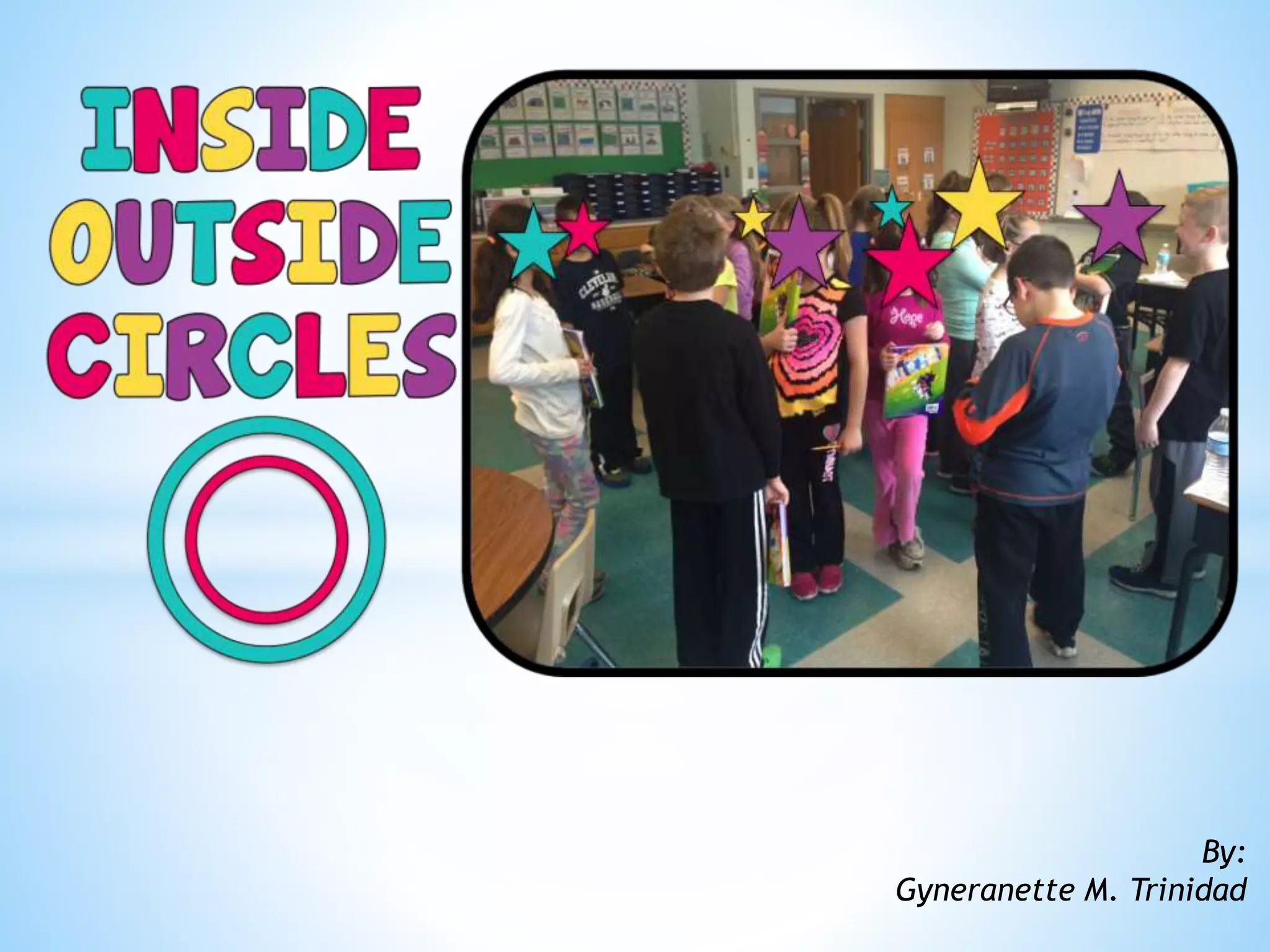
 It is a kinesthetic activity that involves all
students in the class and that facilitates short
exchanges between students.
Description:
 a cooperative grouping strategy that allows
movement and is an excellent way to have
the students summarize and review
information or extend thinking.
*When To Use:
Use Inside/Outside Circle at any point in the lesson to
structure meaningful conversation:
 Before introducing new material to begin a
discussion or highlight key issues in the
presentation to come
 During a lesson to process important concepts
before applying them in group or
independent work
 After a reading to discuss key concepts
 Before an assessment to review information
*Benefits:
 engages all students simultaneously;
 pairs students briefly with classmates with
whom they may rarely work;
 allows the teacher to spontaneously increase
or decrease the number of different student
pairings that occur
 No specific materials are needed for the
strategy, so it can be easily incorporated into
lessons.
*Method:
1. Students pair up, then the class forms two
concentric circles with Partner A on the inside
and Partner B on the outside. Partners face each
other.
2. Pose a question and Partner A shares his/her
answer with Partner B. Then Partner B shares
his/her answer.
3. Direct either the inside circle or the outside
circle to rotate either clockwise or counter
clockwise.
4. Once the students have rotated they have a new
partner and steps 2-3 are repeated.
Sources:
http://www.theteachertoolkit.com
Bennett, B. and C. Rolheiser. Beyond Monet: The Artful Science of Instructional Integration.
Toronto, Ontario: Bookation, 2001
Kagan Structures

Inside outside circle- strategy

  • 1.
  • 2.
     It isa kinesthetic activity that involves all students in the class and that facilitates short exchanges between students. Description:  a cooperative grouping strategy that allows movement and is an excellent way to have the students summarize and review information or extend thinking.
  • 3.
    *When To Use: UseInside/Outside Circle at any point in the lesson to structure meaningful conversation:  Before introducing new material to begin a discussion or highlight key issues in the presentation to come  During a lesson to process important concepts before applying them in group or independent work  After a reading to discuss key concepts  Before an assessment to review information
  • 4.
    *Benefits:  engages allstudents simultaneously;  pairs students briefly with classmates with whom they may rarely work;  allows the teacher to spontaneously increase or decrease the number of different student pairings that occur  No specific materials are needed for the strategy, so it can be easily incorporated into lessons.
  • 5.
    *Method: 1. Students pairup, then the class forms two concentric circles with Partner A on the inside and Partner B on the outside. Partners face each other. 2. Pose a question and Partner A shares his/her answer with Partner B. Then Partner B shares his/her answer. 3. Direct either the inside circle or the outside circle to rotate either clockwise or counter clockwise. 4. Once the students have rotated they have a new partner and steps 2-3 are repeated.
  • 6.
    Sources: http://www.theteachertoolkit.com Bennett, B. andC. Rolheiser. Beyond Monet: The Artful Science of Instructional Integration. Toronto, Ontario: Bookation, 2001 Kagan Structures