Thursday, October 9, 2014 1
Refers to methods and techniques 
used for describing, organizing, 
analyzing, and interpreting 
numerical data.
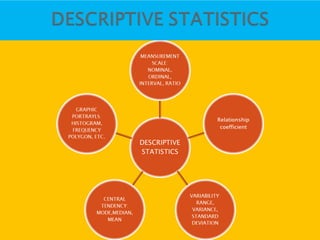
 The field of statistics is often divided into two 
broad categories : descriptive statistics and 
inferential statistics. 
 Descriptive statistics transform a set of numbers 
or observations into indices that describe or 
characterize the data.
 Thus, descriptive statistics are used to classify, 
organize, and summarize numerical data about a 
particular group of observations. 
 There is no attempt to generalize these statistics, 
which describe only one group, to other samples 
or population.
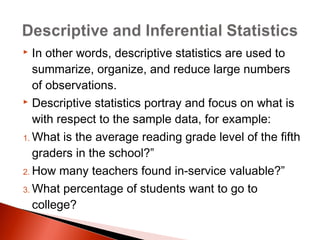
 In other words, descriptive statistics are used to 
summarize, organize, and reduce large numbers 
of observations. 
 Descriptive statistics portray and focus on what is 
with respect to the sample data, for example: 
1. What is the average reading grade level of the fifth 
graders in the school?” 
2. How many teachers found in-service valuable?” 
3. What percentage of students want to go to 
college?
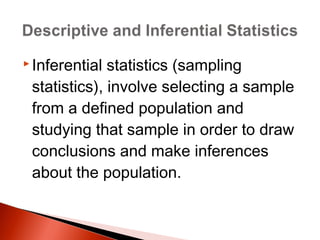
Inferential statistics (sampling 
statistics), involve selecting a sample 
from a defined population and 
studying that sample in order to draw 
conclusions and make inferences 
about the population.
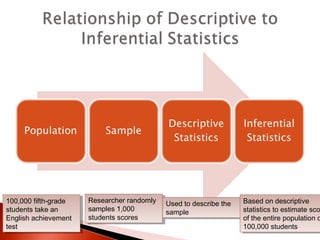
100,000 fifth-grade 
students take an 
English achievement 
test 
100,000 fifth-grade 
students take an 
English achievement 
test 
Researcher randomly 
samples 1,000 
students scores 
Researcher randomly 
samples 1,000 
students scores 
Used to describe the 
sample 
Used to describe the 
sample 
Based on descriptive 
statistics to estimate scores 
of the entire population of 
100,000 students 
Based on descriptive 
statistics to estimate scores 
of the entire population of 
100,000 students
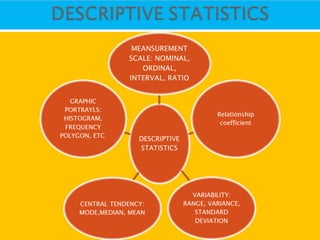
Focuses on ways to organize 
numerical data and present them 
visually with the use of graphs. 
One way to organize your data is to 
create a frequency distribution. 
 Various software programs, such as 
Excel, can easily produce graphs for 
you.
Allows researchers and educators to 
describe, summarize, and report their 
data. 
By organizing data, they can compare 
distributions and observe patterns.
In most cases, the original data we 
collect is not ordered or summarized. 
 Therefore, after collecting data, we 
may want to create a frequency 
distribution by ordering and tallying 
the scores.
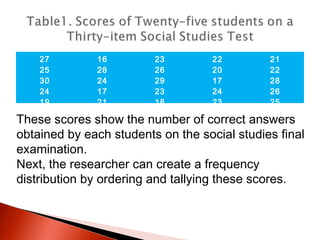
A seventh-grade social studies teacher wants to assign 
end-of term letter grades to the twenty-five students in 
her class. 
After administering a thirty-item final examination, the 
teacher records the students’ test scores.
27 
25 
30 
24 
19 
16 
28 
24 
17 
21 
23 
26 
29 
23 
18 
22 
20 
17 
24 
23 
21 
22 
28 
26 
25 
These scores show the number of correct answers 
obtained by each students on the social studies final 
examination. 
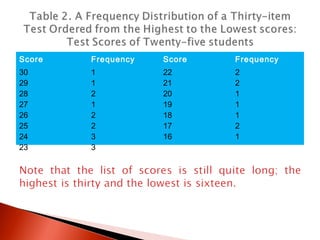
Next, the researcher can create a frequency 
distribution by ordering and tallying these scores.
Score Frequency Score Frequency 
30 
29 
28 
27 
26 
25 
24 
23 
11212233 
22 
21 
20 
19 
18 
17 
16 
2211121
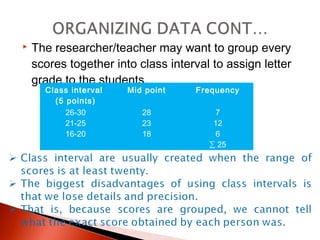
 The researcher/teacher may want to group every 
scores together into class interval to assign letter 
grade to the students. 
Class interval 
(5 points) 
Mid point Frequency 
26-30 
21-25 
16-20 
28 
23 
18 
7 
12 
6 
Σ 25
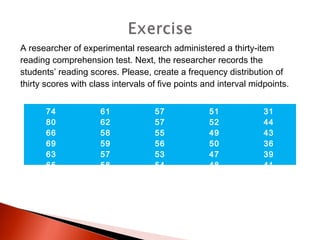
A researcher of experimental research administered a thirty-item 
reading comprehension test. Next, the researcher records the 
students’ reading scores. Please, create a frequency distribution of 
thirty scores with class intervals of five points and interval midpoints. 
74 
80 
66 
69 
63 
65 
61 
62 
58 
59 
57 
58 
57 
57 
55 
56 
53 
54 
51 
52 
49 
50 
47 
48 
31 
44 
43 
36 
39 
41
Graphs are usually to communicate 
information by transforming numerical 
data into a visual form. 
Graphs allow us to see relationships not 
easily apparent by looking at the 
numerical data. 
There are various forms of graphs, each 
are appropriate for a different type of data.
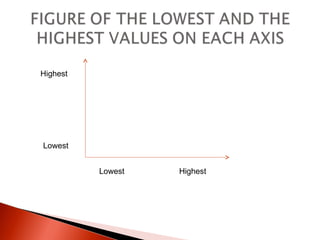
In drawing histogram and frequency 
polygon, the vertical axis always 
represents frequencies, and the 
horizontal axis always represents scores 
or Class interval (Mid point). 
The lower values of both vertical and 
horizontal axes are recorded at the 
intersection of the axes (at the bottom left 
side).
Lowest Highest 
Highest 
Lowest
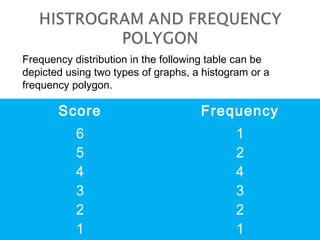
Frequency distribution in the following table can be 
depicted using two types of graphs, a histogram or a 
frequency polygon. 
Score Frequency 
654321 
124321
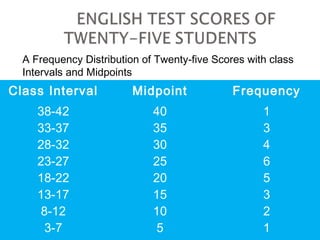
A Frequency Distribution of Twenty-five Scores with class 
Intervals and Midpoints 
Class Interval Midpoint Frequency 
38-42 
33-37 
28-32 
23-27 
18-22 
13-17 
8-12 
3-7 
40 
35 
30 
25 
20 
15 
10 
5 
13465321
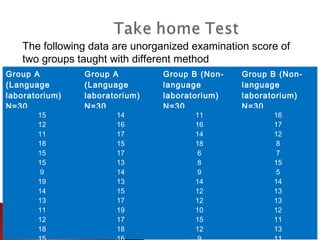
The following data are unorganized examination score of 
two groups taught with different method 
Group A 
(Language 
laboratorium) 
N=30 
Group A 
(Language 
laboratorium) 
N=30 
Group B (Non-language 
laboratorium) 
N=30 
Group B (Non-language 
laboratorium) 
N=30 
15 
12 
11 
18 
15 
15 
9 
19 
14 
13 
11 
12 
18 
15 
14 
16 
17 
15 
17 
13 
14 
13 
15 
17 
19 
17 
18 
16 
11 
16 
14 
18 
689 
14 
12 
12 
10 
15 
12 
9 
16 
17 
12 
87 
15 
5 
14 
13 
13 
12 
11 
13 
11
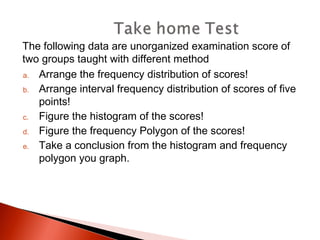
The following data are unorganized examination score of 
two groups taught with different method 
a. Arrange the frequency distribution of scores! 
b. Arrange interval frequency distribution of scores of five 
points! 
c. Figure the histogram of the scores! 
d. Figure the frequency Polygon of the scores! 
e. Take a conclusion from the histogram and frequency 
polygon you graph.
They are descriptive statistics that measure the 
central location or value of sets of scores. 
A measure of central tendency is a summary 
score that is used to represent a distribution of 
scores. 
It is a summary score that represents a set of 
scores. 
They are used widely to summarize and 
simplify large quantities of data.
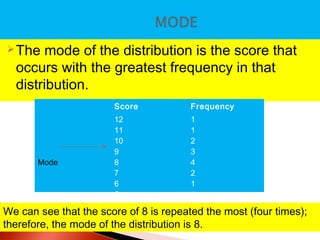
The mode of the distribution is the score that 
occurs with the greatest frequency in that 
distribution. 
Score Frequency 
Mode 
12 
11 
10 
98765 11234211 
We can see that the score of 8 is repeated the most (four times); 
therefore, the mode of the distribution is 8.
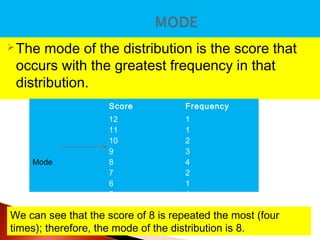
The mode of the distribution is the score that 
occurs with the greatest frequency in that 
distribution. 
Score Frequency 
Mode 
12 
11 
10 
98765 
11234211 
We can see that the score of 8 is repeated the most (four 
times); therefore, the mode of the distribution is 8.
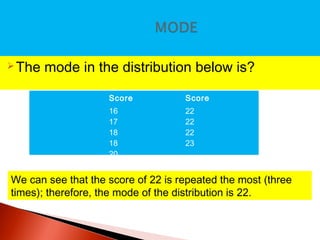
The mode in the distribution below is? 
Score Score 
16 
22 
17 
22 
18 
22 
18 
23 
20 
We can see that the score of 22 is repeated the most (three 
times); therefore, the mode of the distribution is 22.
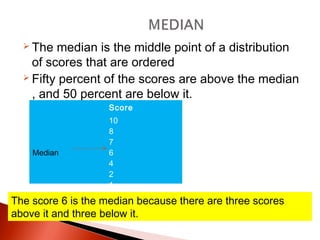
 The median is the middle point of a distribution 
of scores that are ordered 
 Fifty percent of the scores are above the median 
, and 50 percent are below it. 
Score 
Median 
10 
876421 
The score 6 is the median because there are three scores 
above it and three below it.
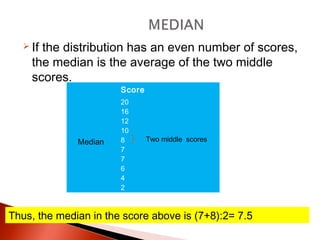
 If the distribution has an even number of scores, 
the median is the average of the two middle 
scores. 
Score 
20 
16 
12 
10 
Median Two middle scores 
877642 
Thus, the median in the score above is (7+8):2= 7.5
 It is the “arithmetic average” of a set of scores. 
 It is obtained by adding up the scores and 
dividing that sum by the number of scores. 
 The statistical symbol for the mean of a sample 
is χ (pronounced “ex bar”). 
 A raw score is represented in statistics by the 
letter X. 
 A raw score is score as it was obtained on a test 
or any other measure, without converting it to 
any other scale.
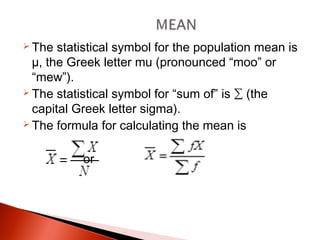
 The statistical symbol for the population mean is 
μ, the Greek letter mu (pronounced “moo” or 
“mew”). 
 The statistical symbol for “sum of” is Σ (the 
capital Greek letter sigma). 
 The formula for calculating the mean is 
or
 The statistical symbol for the population mean is 
μ, the Greek letter mu (pronounced “moo” or 
“mew”). 
 The statistical symbol for “sum of” is Σ (the 
capital Greek letter sigma).
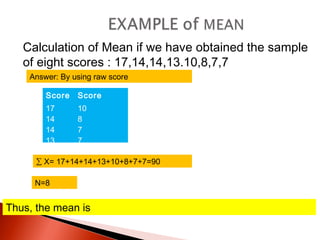
Calculation of Mean if we have obtained the sample 
of eight scores : 17,14,14,13.10,8,7,7 
Answer: By using raw score 
Score Score 
17 
10 
14 
14 
13 
877 Σ X= 17+14+14+13+10+8+7+7=90 
N=8 
Thus, the mean is
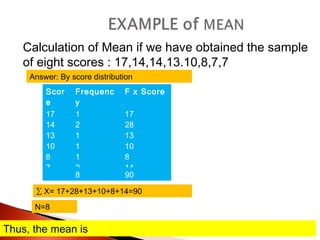
Calculation of Mean if we have obtained the sample 
of eight scores : 17,14,14,13.10,8,7,7 
Answer: By score distribution 
Scor 
e 
Frequenc 
y 
F x Score 
17 
14 
13 
10 
87 
121112 
17 
28 
13 
10 
8 
14 
8 90 
Σ X= 17+28+13+10+8+14=90 
N=8 
Thus, the mean is
Are used to show the differences among 
the scores in a distribution. 
We use the term variability or dispersion 
because the statistics provide an 
indication of how different, or dispersed, 
the scores are from one another.
The range is the simplest; but also least 
useful, measure of variability. 
It is defined as the distance between the 
smallest and the largest scores. 
It is calculated by simply subtracting the 
bottom, or lowest, score from the top, or 
highest score. 
Range = XH- XL 
XH = the highest score 
XL = the lowest score
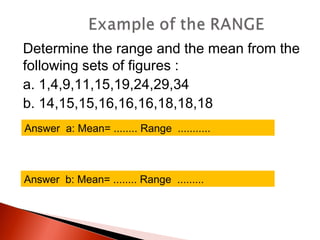
Determine the range and the mean from the 
following sets of figures : 
a. 1,4,9,11,15,19,24,29,34 
b. 14,15,15,16,16,16,18,18,18 
Answer a: Mean= ........ Range ........... 
Answer b: Mean= ........ Range .........
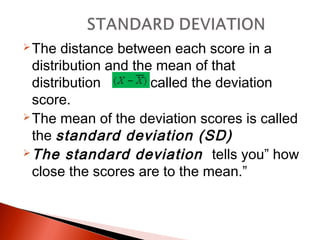
The distance between each score in a 
distribution and the mean of that 
distribution is called the deviation 
score. 
The mean of the deviation scores is called 
the standard deviation (SD) 
The standard deviation tells you” how 
close the scores are to the mean.”
The SD describes the mean distance of 
the scores around the distribution mean. 
Squaring the SD give us another index of 
variability, called the VARIANCE. 
The Variance is needed in order to 
calculate the SD (Standard Deviation).
If the standard deviation is a small 
numbers, this tells you that the scores are 
“bunched together” close to the mean. 
 If the standard deviation is a large 
number, this tells you that the scores are 
“spread out” a greater distance from the 
mean.
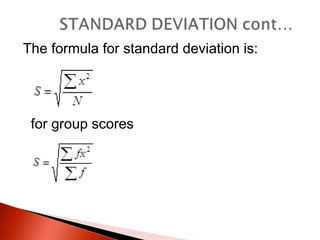
The formula for standard deviation is: 
for group scores
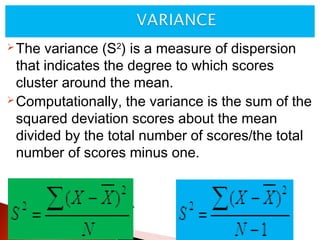
The variance (S2) is a measure of dispersion 
that indicates the degree to which scores 
cluster around the mean. 
Computationally, the variance is the sum of the 
squared deviation scores about the mean 
divided by the total number of scores/the total 
number of scores minus one. 
or
or 
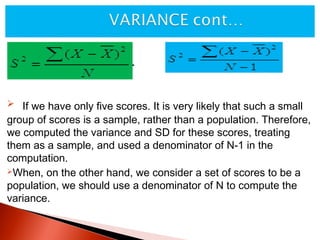
 If we have only five scores. It is very likely that such a small 
group of scores is a sample, rather than a population. Therefore, 
we computed the variance and SD for these scores, treating 
them as a sample, and used a denominator of N-1 in the 
computation. 
When, on the other hand, we consider a set of scores to be a 
population, we should use a denominator of N to compute the 
variance.
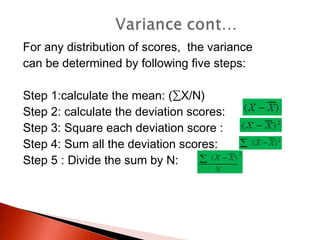
For any distribution of scores, the variance 
can be determined by following five steps: 
Step 1:calculate the mean: (ΣX/N) 
Step 2: calculate the deviation scores: 
Step 3: Square each deviation score : 
Step 4: Sum all the deviation scores: 
Step 5 : Divide the sum by N:
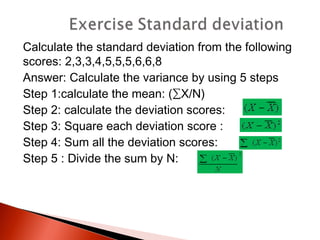
Calculate the standard deviation from the following 
scores: 2,3,3,4,5,5,5,6,6,8 
Answer: Calculate the variance by using 5 steps 
Step 1:calculate the mean: (ΣX/N) 
Step 2: calculate the deviation scores: 
Step 3: Square each deviation score : 
Step 4: Sum all the deviation scores: 
Step 5 : Divide the sum by N:
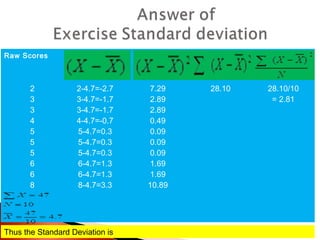
Raw Scores 
2334555668 
2-4.7=-2.7 
3-4.7=-1.7 
3-4.7=-1.7 
4-4.7=-0.7 
5-4.7=0.3 
5-4.7=0.3 
5-4.7=0.3 
6-4.7=1.3 
6-4.7=1.3 
8-4.7=3.3 
7.29 
2.89 
2.89 
0.49 
0.09 
0.09 
0.09 
1.69 
1.69 
10.89 
28.10 28.10/10 
= 2.81 
Thus the Standard Deviation is
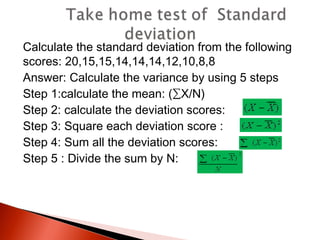
Calculate the standard deviation from the following 
scores: 20,15,15,14,14,14,12,10,8,8 
Answer: Calculate the variance by using 5 steps 
Step 1:calculate the mean: (ΣX/N) 
Step 2: calculate the deviation scores: 
Step 3: Square each deviation score : 
Step 4: Sum all the deviation scores: 
Step 5 : Divide the sum by N:

Day 3 descriptive statistics

  • 1.
  • 2.
    Refers to methodsand techniques used for describing, organizing, analyzing, and interpreting numerical data.
  • 3.
     The fieldof statistics is often divided into two broad categories : descriptive statistics and inferential statistics.  Descriptive statistics transform a set of numbers or observations into indices that describe or characterize the data.
  • 4.
     Thus, descriptivestatistics are used to classify, organize, and summarize numerical data about a particular group of observations.  There is no attempt to generalize these statistics, which describe only one group, to other samples or population.
  • 5.
     In otherwords, descriptive statistics are used to summarize, organize, and reduce large numbers of observations.  Descriptive statistics portray and focus on what is with respect to the sample data, for example: 1. What is the average reading grade level of the fifth graders in the school?” 2. How many teachers found in-service valuable?” 3. What percentage of students want to go to college?
  • 6.
    Inferential statistics (sampling statistics), involve selecting a sample from a defined population and studying that sample in order to draw conclusions and make inferences about the population.
  • 7.
    100,000 fifth-grade studentstake an English achievement test 100,000 fifth-grade students take an English achievement test Researcher randomly samples 1,000 students scores Researcher randomly samples 1,000 students scores Used to describe the sample Used to describe the sample Based on descriptive statistics to estimate scores of the entire population of 100,000 students Based on descriptive statistics to estimate scores of the entire population of 100,000 students
  • 9.
    Focuses on waysto organize numerical data and present them visually with the use of graphs. One way to organize your data is to create a frequency distribution.  Various software programs, such as Excel, can easily produce graphs for you.
  • 10.
    Allows researchers andeducators to describe, summarize, and report their data. By organizing data, they can compare distributions and observe patterns.
  • 11.
    In most cases,the original data we collect is not ordered or summarized.  Therefore, after collecting data, we may want to create a frequency distribution by ordering and tallying the scores.
  • 12.
    A seventh-grade socialstudies teacher wants to assign end-of term letter grades to the twenty-five students in her class. After administering a thirty-item final examination, the teacher records the students’ test scores.
  • 13.
    27 25 30 24 19 16 28 24 17 21 23 26 29 23 18 22 20 17 24 23 21 22 28 26 25 These scores show the number of correct answers obtained by each students on the social studies final examination. Next, the researcher can create a frequency distribution by ordering and tallying these scores.
  • 14.
    Score Frequency ScoreFrequency 30 29 28 27 26 25 24 23 11212233 22 21 20 19 18 17 16 2211121
  • 15.
     The researcher/teachermay want to group every scores together into class interval to assign letter grade to the students. Class interval (5 points) Mid point Frequency 26-30 21-25 16-20 28 23 18 7 12 6 Σ 25
  • 16.
    A researcher ofexperimental research administered a thirty-item reading comprehension test. Next, the researcher records the students’ reading scores. Please, create a frequency distribution of thirty scores with class intervals of five points and interval midpoints. 74 80 66 69 63 65 61 62 58 59 57 58 57 57 55 56 53 54 51 52 49 50 47 48 31 44 43 36 39 41
  • 17.
    Graphs are usuallyto communicate information by transforming numerical data into a visual form. Graphs allow us to see relationships not easily apparent by looking at the numerical data. There are various forms of graphs, each are appropriate for a different type of data.
  • 18.
    In drawing histogramand frequency polygon, the vertical axis always represents frequencies, and the horizontal axis always represents scores or Class interval (Mid point). The lower values of both vertical and horizontal axes are recorded at the intersection of the axes (at the bottom left side).
  • 19.
  • 20.
    Frequency distribution inthe following table can be depicted using two types of graphs, a histogram or a frequency polygon. Score Frequency 654321 124321
  • 21.
    A Frequency Distributionof Twenty-five Scores with class Intervals and Midpoints Class Interval Midpoint Frequency 38-42 33-37 28-32 23-27 18-22 13-17 8-12 3-7 40 35 30 25 20 15 10 5 13465321
  • 22.
    The following dataare unorganized examination score of two groups taught with different method Group A (Language laboratorium) N=30 Group A (Language laboratorium) N=30 Group B (Non-language laboratorium) N=30 Group B (Non-language laboratorium) N=30 15 12 11 18 15 15 9 19 14 13 11 12 18 15 14 16 17 15 17 13 14 13 15 17 19 17 18 16 11 16 14 18 689 14 12 12 10 15 12 9 16 17 12 87 15 5 14 13 13 12 11 13 11
  • 23.
    The following dataare unorganized examination score of two groups taught with different method a. Arrange the frequency distribution of scores! b. Arrange interval frequency distribution of scores of five points! c. Figure the histogram of the scores! d. Figure the frequency Polygon of the scores! e. Take a conclusion from the histogram and frequency polygon you graph.
  • 26.
    They are descriptivestatistics that measure the central location or value of sets of scores. A measure of central tendency is a summary score that is used to represent a distribution of scores. It is a summary score that represents a set of scores. They are used widely to summarize and simplify large quantities of data.
  • 27.
    The mode ofthe distribution is the score that occurs with the greatest frequency in that distribution. Score Frequency Mode 12 11 10 98765 11234211 We can see that the score of 8 is repeated the most (four times); therefore, the mode of the distribution is 8.
  • 28.
    The mode ofthe distribution is the score that occurs with the greatest frequency in that distribution. Score Frequency Mode 12 11 10 98765 11234211 We can see that the score of 8 is repeated the most (four times); therefore, the mode of the distribution is 8.
  • 29.
    The mode inthe distribution below is? Score Score 16 22 17 22 18 22 18 23 20 We can see that the score of 22 is repeated the most (three times); therefore, the mode of the distribution is 22.
  • 30.
     The medianis the middle point of a distribution of scores that are ordered  Fifty percent of the scores are above the median , and 50 percent are below it. Score Median 10 876421 The score 6 is the median because there are three scores above it and three below it.
  • 31.
     If thedistribution has an even number of scores, the median is the average of the two middle scores. Score 20 16 12 10 Median Two middle scores 877642 Thus, the median in the score above is (7+8):2= 7.5
  • 32.
     It isthe “arithmetic average” of a set of scores.  It is obtained by adding up the scores and dividing that sum by the number of scores.  The statistical symbol for the mean of a sample is χ (pronounced “ex bar”).  A raw score is represented in statistics by the letter X.  A raw score is score as it was obtained on a test or any other measure, without converting it to any other scale.
  • 33.
     The statisticalsymbol for the population mean is μ, the Greek letter mu (pronounced “moo” or “mew”).  The statistical symbol for “sum of” is Σ (the capital Greek letter sigma).  The formula for calculating the mean is or
  • 34.
     The statisticalsymbol for the population mean is μ, the Greek letter mu (pronounced “moo” or “mew”).  The statistical symbol for “sum of” is Σ (the capital Greek letter sigma).
  • 35.
    Calculation of Meanif we have obtained the sample of eight scores : 17,14,14,13.10,8,7,7 Answer: By using raw score Score Score 17 10 14 14 13 877 Σ X= 17+14+14+13+10+8+7+7=90 N=8 Thus, the mean is
  • 36.
    Calculation of Meanif we have obtained the sample of eight scores : 17,14,14,13.10,8,7,7 Answer: By score distribution Scor e Frequenc y F x Score 17 14 13 10 87 121112 17 28 13 10 8 14 8 90 Σ X= 17+28+13+10+8+14=90 N=8 Thus, the mean is
  • 38.
    Are used toshow the differences among the scores in a distribution. We use the term variability or dispersion because the statistics provide an indication of how different, or dispersed, the scores are from one another.
  • 39.
    The range isthe simplest; but also least useful, measure of variability. It is defined as the distance between the smallest and the largest scores. It is calculated by simply subtracting the bottom, or lowest, score from the top, or highest score. Range = XH- XL XH = the highest score XL = the lowest score
  • 40.
    Determine the rangeand the mean from the following sets of figures : a. 1,4,9,11,15,19,24,29,34 b. 14,15,15,16,16,16,18,18,18 Answer a: Mean= ........ Range ........... Answer b: Mean= ........ Range .........
  • 41.
    The distance betweeneach score in a distribution and the mean of that distribution is called the deviation score. The mean of the deviation scores is called the standard deviation (SD) The standard deviation tells you” how close the scores are to the mean.”
  • 42.
    The SD describesthe mean distance of the scores around the distribution mean. Squaring the SD give us another index of variability, called the VARIANCE. The Variance is needed in order to calculate the SD (Standard Deviation).
  • 43.
    If the standarddeviation is a small numbers, this tells you that the scores are “bunched together” close to the mean.  If the standard deviation is a large number, this tells you that the scores are “spread out” a greater distance from the mean.
  • 44.
    The formula forstandard deviation is: for group scores
  • 45.
    The variance (S2)is a measure of dispersion that indicates the degree to which scores cluster around the mean. Computationally, the variance is the sum of the squared deviation scores about the mean divided by the total number of scores/the total number of scores minus one. or
  • 46.
    or  Ifwe have only five scores. It is very likely that such a small group of scores is a sample, rather than a population. Therefore, we computed the variance and SD for these scores, treating them as a sample, and used a denominator of N-1 in the computation. When, on the other hand, we consider a set of scores to be a population, we should use a denominator of N to compute the variance.
  • 47.
    For any distributionof scores, the variance can be determined by following five steps: Step 1:calculate the mean: (ΣX/N) Step 2: calculate the deviation scores: Step 3: Square each deviation score : Step 4: Sum all the deviation scores: Step 5 : Divide the sum by N:
  • 48.
    Calculate the standarddeviation from the following scores: 2,3,3,4,5,5,5,6,6,8 Answer: Calculate the variance by using 5 steps Step 1:calculate the mean: (ΣX/N) Step 2: calculate the deviation scores: Step 3: Square each deviation score : Step 4: Sum all the deviation scores: Step 5 : Divide the sum by N:
  • 49.
    Raw Scores 2334555668 2-4.7=-2.7 3-4.7=-1.7 3-4.7=-1.7 4-4.7=-0.7 5-4.7=0.3 5-4.7=0.3 5-4.7=0.3 6-4.7=1.3 6-4.7=1.3 8-4.7=3.3 7.29 2.89 2.89 0.49 0.09 0.09 0.09 1.69 1.69 10.89 28.10 28.10/10 = 2.81 Thus the Standard Deviation is
  • 50.
    Calculate the standarddeviation from the following scores: 20,15,15,14,14,14,12,10,8,8 Answer: Calculate the variance by using 5 steps Step 1:calculate the mean: (ΣX/N) Step 2: calculate the deviation scores: Step 3: Square each deviation score : Step 4: Sum all the deviation scores: Step 5 : Divide the sum by N: