Understanding Box Plots
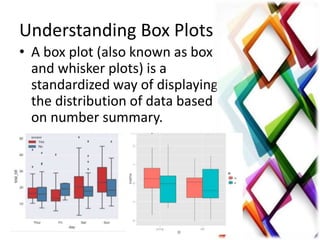
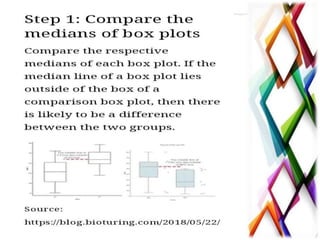
• A box plot (also known as box
and whisker plots) is a
standardized way of displaying
the distribution of data based
on number summary.
Understanding Box Plots
It can tell you about the
outliers and what their values
are.
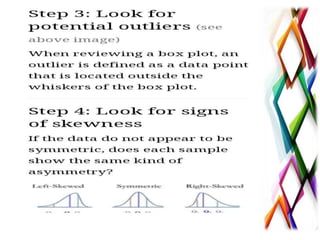
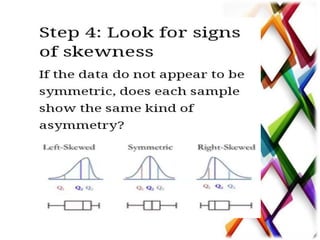
It can also tell you if your data
is symmetrical, how tightly your
data is grouped, and if and how
your data is skewed.
• In origin, a grouped box plot can be created
from either indexed data or raw data.
• The indexed data is arranged as one data
column and one or more group columns,
while the raw data is arranged as multiple
data columns grouped according to the
column label row (s).
A box plot is constructed
from five values:
• the minimum value
• the first value
• the first quartile
• the maximum value
We use these values to
compare how close other data
values are to them.
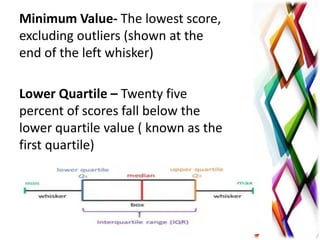
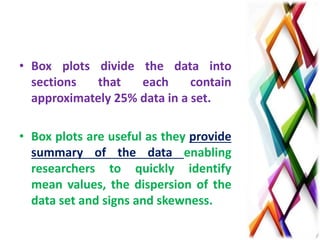
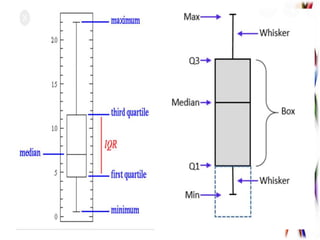
Minimum Value- The lowest score,
excluding outliers (shown at the
end of the left whisker)
Lower Quartile – Twenty five
percent of scores fall below the
lower quartile value ( known as the
first quartile)
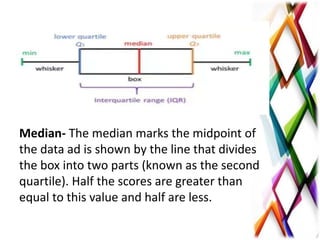
Median- The median marks the midpoint of
the data ad is shown by the line that divides
the box into two parts (known as the second
quartile). Half the scores are greater than
equal to this value and half are less.
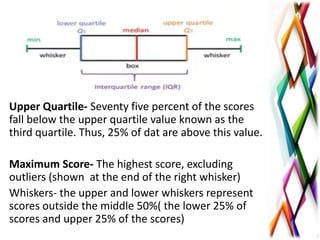
Upper Quartile- Seventy five percent of the scores
fall below the upper quartile value known as the
third quartile. Thus, 25% of dat are above this value.
Maximum Score- The highest score, excluding
outliers (shown at the end of the right whisker)
Whiskers- the upper and lower whiskers represent
scores outside the middle 50%( the lower 25% of
scores and upper 25% of the scores)
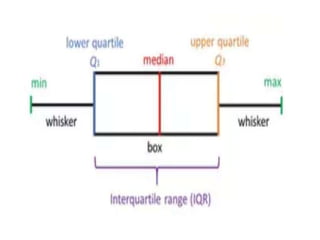
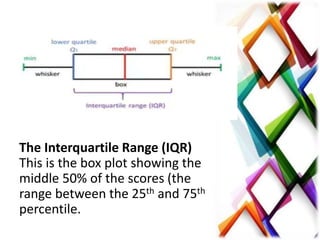
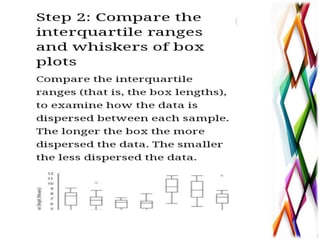
The Interquartile Range (IQR)
This is the box plot showing the
middle 50% of the scores (the
range between the 25th and 75th
percentile.
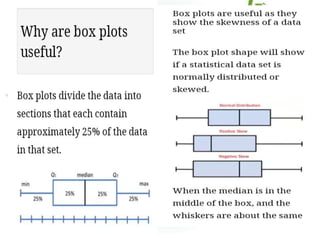
• Box plots divide the data into
sections that each contain
approximately 25% data in a set.
• Box plots are useful as they provide
summary of the data enabling
researchers to quickly identify
mean values, the dispersion of the
data set and signs and skewness.
Why use Grouped Box Plots?
Answer:
When you want to compare several
groups on the same quantitative
outcomes, you have to use the
grouped box plot.
DEMONSTRATION
By
Ms. Jowe Ann

Boxplot

  • 2.
    Understanding Box Plots •A box plot (also known as box and whisker plots) is a standardized way of displaying the distribution of data based on number summary.
  • 3.
    Understanding Box Plots Itcan tell you about the outliers and what their values are. It can also tell you if your data is symmetrical, how tightly your data is grouped, and if and how your data is skewed.
  • 4.
    • In origin,a grouped box plot can be created from either indexed data or raw data. • The indexed data is arranged as one data column and one or more group columns, while the raw data is arranged as multiple data columns grouped according to the column label row (s).
  • 5.
    A box plotis constructed from five values: • the minimum value • the first value • the first quartile • the maximum value We use these values to compare how close other data values are to them.
  • 7.
    Minimum Value- Thelowest score, excluding outliers (shown at the end of the left whisker) Lower Quartile – Twenty five percent of scores fall below the lower quartile value ( known as the first quartile)
  • 8.
    Median- The medianmarks the midpoint of the data ad is shown by the line that divides the box into two parts (known as the second quartile). Half the scores are greater than equal to this value and half are less.
  • 9.
    Upper Quartile- Seventyfive percent of the scores fall below the upper quartile value known as the third quartile. Thus, 25% of dat are above this value. Maximum Score- The highest score, excluding outliers (shown at the end of the right whisker) Whiskers- the upper and lower whiskers represent scores outside the middle 50%( the lower 25% of scores and upper 25% of the scores)
  • 10.
    The Interquartile Range(IQR) This is the box plot showing the middle 50% of the scores (the range between the 25th and 75th percentile.
  • 11.
    • Box plotsdivide the data into sections that each contain approximately 25% data in a set. • Box plots are useful as they provide summary of the data enabling researchers to quickly identify mean values, the dispersion of the data set and signs and skewness.
  • 18.
    Why use GroupedBox Plots? Answer: When you want to compare several groups on the same quantitative outcomes, you have to use the grouped box plot.
  • 19.