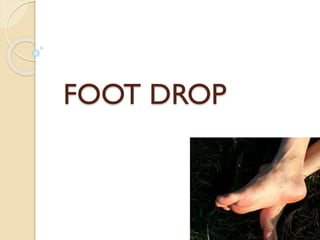
FOOT DROP
 DROPING OF FOREFOOT DUE TO
WEAKNESS
 DAMAGE TO COMMON PERONEAL
NERVE
 PARALYSIS 0F MUSCLES IN ANTERIOR
PORTION OF LOWER LEG
 INABILITY TO DORSIFLEX ANKLE AND TOES
 UNILATERAL OR BILATERAL
 TEMPORARY OR PERMANENT
ANATOMY
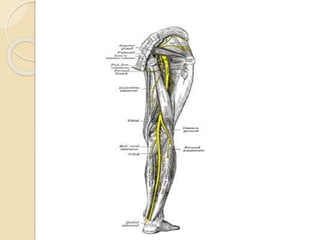
 SCIATIC NERVE BIFURCATES INTO TIBIAL
AND PERONEAL NERVE
 PERONEAL NERVE CROSSES LATERALLY
OVER FIBULAR NECK
 DIVIDES INTO SUPERFICIAL AND DEEP
BRANCHES
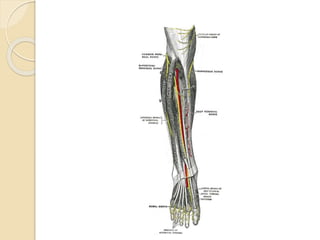
 SUPERFICIAL BRANCH TRAVELS BETWEEN
TWO HEADS OF PERONEI AND SUPPLIES
LATERAL COMPARTMENT
 DEEP BRANCH SUPPLIES ANTERIOR
COMPARTMENT
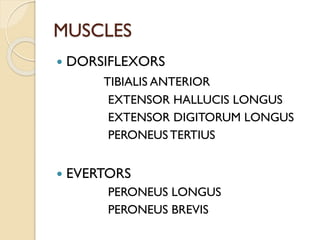
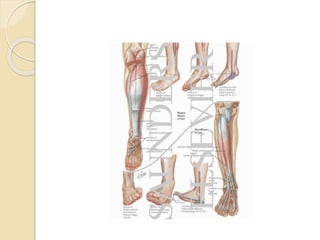
MUSCLES
 DORSIFLEXORS
TIBIALIS ANTERIOR
EXTENSOR HALLUCIS LONGUS
EXTENSOR DIGITORUM LONGUS
PERONEUS TERTIUS
 EVERTORS
PERONEUS LONGUS
PERONEUS BREVIS
MOREVULNERABLE TO INJURY
 Funiculi of the peroneal nerve - larger and less
connective tissue
 Fewer autonomic fibers, so in any injury,
motor and sensory fibers bear the brunt of the
trauma.
 More superficial course, especially at the
fibular neck
 Adheres closely to the periosteum of the
proximal fibula
CAUSES
 NEUROLOGICAL
NM DISEASE
PERONEAL NERVE INJURY
SCIATIC NERVE INJURY
LUMBAR SACRAL PLEXUS INJURY
SPINAL CORD LESIONS
CAUDA EQUINA SYNDROME
BRAIN – STROKE,TIA
GENETIC
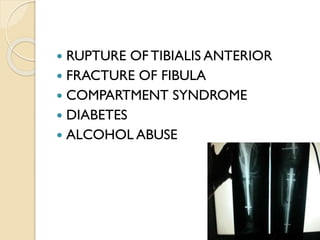
 RUPTURE OF TIBIALIS ANTERIOR
 FRACTURE OF FIBULA
 COMPARTMENT SYNDROME
 DIABETES
 ALCOHOL ABUSE
SYMPTOMS
 Difficulty in lifting the foot.
 Dragging the foot on the floor as one walks.
 Slapping the foot down with each step.
 Raising thigh while walking(stepping gait)
 Pain , weakness or numbness in the foot.
GAIT CYCLE
 Swing phase (SW):The period of time when
the foot is not in contact with the ground. In
those cases where the foot never leaves the
ground (foot drag) - phase when all
portions of the foot are in forward motion.
 Initial contact (IC): when the foot initially
makes contact with the ground; represents
beginning of the stance phase - foot strike.
 Terminal contact (TC): when the foot leaves
the ground - end of the stance phase or
beginning of the swing phase - foot off. .
FOOT DROP
 Drop foot SW: Greater flexion at the knee
to accommodate the inability to dorsiflex -
stair climbing movement.
 Drop foot IC: Instead of normal heel-toe foot
strike, foot may either slap the ground or the
entire foot may be planted on the ground all at
once.
 Drop footTC: Terminal contact is quite
different - inability to support their body weight
– walker can be used
DIAGNOSIS
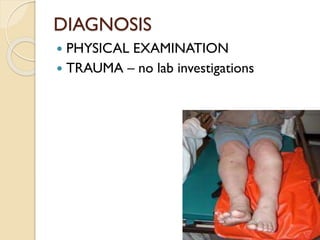
 PHYSICAL EXAMINATION
 TRAUMA – no lab investigations
INVESTIGATIONS
FBS
ESR
CRP
B.UREA
S CREATININE
ELECTROPHORESIS.
IMAGING
 Plain films
posttraumatic - tibia/fibula and ankle-any bony
injury.
anatomic dysfunction (eg, Charcot joint)
 Ultrasonography
If bleeding is suspected in a patient with a hip or
knee prosthesis
 Magnetic Resonance Neurography
tumor or a compressive mass lesion to the
peroneal nerve
Electromyelogram
◦ This study can confirm the type of
neuropathy, establish the site of the lesion,
estimate extent of injury, and provide a
prognosis.
◦ Sequential studies are useful to monitor
recovery of acute lesions.
TRAETMENT
 Depends on the underlying cause.
 If cause is successfully treated foot drop
may improve or even disappear.
 Medical treatment - painful paresthesia
sympathetic block
amitriptyline
nortriptyline
pregabalin
Laproscopic synovectomy
SPECIFIC TREATMENT
 Braces or splint-a brace on the ankle and
foot or splint that fits into the shoe can
help to hold the foot in the normal
position
Physical therapy
 exercises that strengthen the leg
muscles
 maintain the range of motion in knee and
ankle
 improve gait problems associated with
foot drop.
 Nerve stimulation
stimulating the nerve (peroneal nerve)
improves foot drop especially if it caused
by a stroke.
SURGICAL REPAIR
 Foot drop due to direct trauma to the
dorsiflexors generally requires surgical
repair.
 When nerve insult is the cause - restore
the nerve continuity - nerve grafting or
repair.
 If there is no significant neuronal recovery
at one year - tendon transfer maybe
considered.
 Bridal procedure
 Neurotendinous transpositon
BRIDALS PROCEDURE
 Tendon to bone attachment - posterior
tibial tendon is attatched to the second
cuneiform bone.
 Tendon to tendon attachment
Neurotendinoustransposition
 Lateral head of gastronemius is transposed to
the tendons of the anterior muscle group with
simultaneous transposition of the proximal end
of deep peroneal nerve.
 The nerve is sutured to the motor nerve of the
gartronemius
 Active voluntary dorsiflexion of foot
 AFTER TENDON TRANSFER
CAST AND NON WEIGHT BEARING
AMBULATION FOR SIX WEEKS
 PHYSIOTHERAPY
TO CORRECT GAIT ABNORMALITIES
 CHRONIC AND CONTRACTURE CASES
ACHILLES TENDON LENGTHENING
 In patients whom foot drop is due to
neurologic and anatomic factors (polio,
charcot joint ) - arthodesis
 Subtalar stabilising procedure or triple
arthodesis can be done.
COMPLICATIONS
 Surgical procedure- wound infection may
occur.
 Nerve graft failure
 In tendon transfer procedures- recurrent
deformity
 In arthrodeses or fusion procedures-
 pseudoarthrosis, delayed
union, or nonunion.
THANKYOU

Foot drop

  • 1.
  • 2.
     DROPING OFFOREFOOT DUE TO WEAKNESS  DAMAGE TO COMMON PERONEAL NERVE  PARALYSIS 0F MUSCLES IN ANTERIOR PORTION OF LOWER LEG  INABILITY TO DORSIFLEX ANKLE AND TOES  UNILATERAL OR BILATERAL  TEMPORARY OR PERMANENT
  • 3.
    ANATOMY  SCIATIC NERVEBIFURCATES INTO TIBIAL AND PERONEAL NERVE  PERONEAL NERVE CROSSES LATERALLY OVER FIBULAR NECK  DIVIDES INTO SUPERFICIAL AND DEEP BRANCHES
  • 5.
     SUPERFICIAL BRANCHTRAVELS BETWEEN TWO HEADS OF PERONEI AND SUPPLIES LATERAL COMPARTMENT  DEEP BRANCH SUPPLIES ANTERIOR COMPARTMENT
  • 7.
    MUSCLES  DORSIFLEXORS TIBIALIS ANTERIOR EXTENSORHALLUCIS LONGUS EXTENSOR DIGITORUM LONGUS PERONEUS TERTIUS  EVERTORS PERONEUS LONGUS PERONEUS BREVIS
  • 9.
    MOREVULNERABLE TO INJURY Funiculi of the peroneal nerve - larger and less connective tissue  Fewer autonomic fibers, so in any injury, motor and sensory fibers bear the brunt of the trauma.  More superficial course, especially at the fibular neck  Adheres closely to the periosteum of the proximal fibula
  • 10.
    CAUSES  NEUROLOGICAL NM DISEASE PERONEALNERVE INJURY SCIATIC NERVE INJURY LUMBAR SACRAL PLEXUS INJURY SPINAL CORD LESIONS CAUDA EQUINA SYNDROME BRAIN – STROKE,TIA GENETIC
  • 11.
     RUPTURE OFTIBIALIS ANTERIOR  FRACTURE OF FIBULA  COMPARTMENT SYNDROME  DIABETES  ALCOHOL ABUSE
  • 12.
    SYMPTOMS  Difficulty inlifting the foot.  Dragging the foot on the floor as one walks.  Slapping the foot down with each step.  Raising thigh while walking(stepping gait)  Pain , weakness or numbness in the foot.
  • 13.
    GAIT CYCLE  Swingphase (SW):The period of time when the foot is not in contact with the ground. In those cases where the foot never leaves the ground (foot drag) - phase when all portions of the foot are in forward motion.  Initial contact (IC): when the foot initially makes contact with the ground; represents beginning of the stance phase - foot strike.  Terminal contact (TC): when the foot leaves the ground - end of the stance phase or beginning of the swing phase - foot off. .
  • 14.
    FOOT DROP  Dropfoot SW: Greater flexion at the knee to accommodate the inability to dorsiflex - stair climbing movement.  Drop foot IC: Instead of normal heel-toe foot strike, foot may either slap the ground or the entire foot may be planted on the ground all at once.  Drop footTC: Terminal contact is quite different - inability to support their body weight – walker can be used
  • 15.
    DIAGNOSIS  PHYSICAL EXAMINATION TRAUMA – no lab investigations
  • 16.
  • 17.
    IMAGING  Plain films posttraumatic- tibia/fibula and ankle-any bony injury. anatomic dysfunction (eg, Charcot joint)  Ultrasonography If bleeding is suspected in a patient with a hip or knee prosthesis  Magnetic Resonance Neurography tumor or a compressive mass lesion to the peroneal nerve
  • 18.
    Electromyelogram ◦ This studycan confirm the type of neuropathy, establish the site of the lesion, estimate extent of injury, and provide a prognosis. ◦ Sequential studies are useful to monitor recovery of acute lesions.
  • 19.
    TRAETMENT  Depends onthe underlying cause.  If cause is successfully treated foot drop may improve or even disappear.  Medical treatment - painful paresthesia sympathetic block amitriptyline nortriptyline pregabalin Laproscopic synovectomy
  • 20.
    SPECIFIC TREATMENT  Bracesor splint-a brace on the ankle and foot or splint that fits into the shoe can help to hold the foot in the normal position
  • 21.
    Physical therapy  exercisesthat strengthen the leg muscles  maintain the range of motion in knee and ankle  improve gait problems associated with foot drop.
  • 22.
     Nerve stimulation stimulatingthe nerve (peroneal nerve) improves foot drop especially if it caused by a stroke.
  • 23.
    SURGICAL REPAIR  Footdrop due to direct trauma to the dorsiflexors generally requires surgical repair.  When nerve insult is the cause - restore the nerve continuity - nerve grafting or repair.
  • 24.
     If thereis no significant neuronal recovery at one year - tendon transfer maybe considered.  Bridal procedure  Neurotendinous transpositon
  • 25.
    BRIDALS PROCEDURE  Tendonto bone attachment - posterior tibial tendon is attatched to the second cuneiform bone.  Tendon to tendon attachment
  • 26.
    Neurotendinoustransposition  Lateral headof gastronemius is transposed to the tendons of the anterior muscle group with simultaneous transposition of the proximal end of deep peroneal nerve.  The nerve is sutured to the motor nerve of the gartronemius  Active voluntary dorsiflexion of foot
  • 27.
     AFTER TENDONTRANSFER CAST AND NON WEIGHT BEARING AMBULATION FOR SIX WEEKS  PHYSIOTHERAPY TO CORRECT GAIT ABNORMALITIES  CHRONIC AND CONTRACTURE CASES ACHILLES TENDON LENGTHENING
  • 28.
     In patientswhom foot drop is due to neurologic and anatomic factors (polio, charcot joint ) - arthodesis  Subtalar stabilising procedure or triple arthodesis can be done.
  • 29.
    COMPLICATIONS  Surgical procedure-wound infection may occur.  Nerve graft failure  In tendon transfer procedures- recurrent deformity  In arthrodeses or fusion procedures-  pseudoarthrosis, delayed union, or nonunion.
  • 30.