
Peripheral Nerve Injury
(Lower Limb)
Dr Sandip Biswas
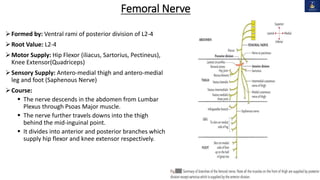
Femoral Nerve
Formed by: Ventral rami of posterior division of L2-4
Root Value: L2-4
Motor Supply: Hip Flexor (iliacus, Sartorius, Pectineus),
Knee Extensor(Quadriceps)
Sensory Supply: Antero-medial thigh and antero-medial
leg and foot (Saphenous Nerve)
Course:
 The nerve descends in the abdomen from Lumbar
Plexus through Psoas Major muscle.
 The nerve further travels downs into the thigh
behind the mid-inguinal point.
 It divides into anterior and posterior branches which
supply hip flexor and knee extensor respectively.
 Injury can happen in – direct trauma, anterior hip dislocation, iatrogenic
 Problems after injury-
 Loss of Knee extension
 Mild loss of hip flexion
 Motor function test of femoral nerve
 Quadriceps: Knee Extension
 Sensory Test:
 Anteromedial aspect of thigh
 Anteromedial aspect of leg via Saphenous nerve
Note:
Meralgia Paresthetica- compression of lateral cutaneous nerve of thigh below ASIS under the inguinal
ligament. It causes paraesthesia over lateral aspect of thigh
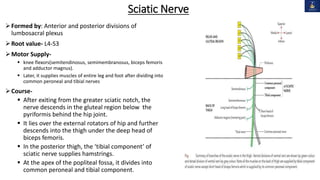
Sciatic Nerve
Formed by: Anterior and posterior divisions of
lumbosacral plexus
Root value- L4-S3
Motor Supply-
 knee flexors(semitendinosus, semimembranosus, biceps femoris
and adductor magnus).
 Later, it supplies muscles of entire leg and foot after dividing into
common peroneal and tibial nerves
Course-
 After exiting from the greater sciatic notch, the
nerve descends in the gluteal region below the
pyriformis behind the hip joint.
 It lies over the external rotators of hip and further
descends into the thigh under the deep head of
biceps femoris.
 In the posterior thigh, the ‘tibial component’ of
sciatic nerve supplies hamstrings.
 At the apex of the popliteal fossa, it divides into
common peroneal and tibial component.
 Injury can happen in- Posterior dislocation of hip, posterior surgical approaches to hip, direct trauma,
injection into the gluteal region
 Problems after the injury :
 Loss of knee flexion
 Loss of all motor activity at ankle and foot (flail foot)
 Motor Function Test of sciatic nerve:
 Hamstrings: Knee Flexion
 Test for all ankle and foot muscles
 Sensory test
 Test the sensory function of Tibial and Common Peroneal Nerve
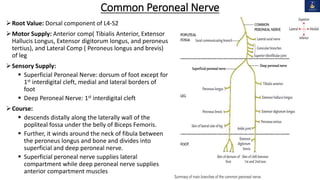
Common Peroneal Nerve
Root Value: Dorsal component of L4-S2
Motor Supply: Anterior comp( Tibialis Anterior, Extensor
Hallucis Longus, Extensor digitorum longus, and peroneus
tertius), and Lateral Comp ( Peroneus longus and brevis)
of leg
Sensory Supply:
 Superficial Peroneal Nerve: dorsum of foot except for
1st interdigital cleft, medial and lateral borders of
foot
 Deep Peroneal Nerve: 1st interdigital cleft
Course:
 descends distally along the laterally wall of the
popliteal fossa under the belly of Biceps Femoris.
 Further, it winds around the neck of fibula between
the peroneus longus and bone and divides into
superficial and deep peroneal nerve.
 Superficial peroneal nerve supplies lateral
compartment while deep peroneal nerve supplies
anterior compartment muscles
 Injury to CPN nerve can happen in – Fibular Neck Fracture, Knee Dislocation
 Problems after injury to CPN: “FOOT DROP”
 Loss of ankle dorsiflexion(tibialis anterior) and eversion (peroneal longus and brevis)
 Loss of great and lesser toe extension (EHL and EDL)
 High stepping Gait
 Motor function test :
 Tibialis anterior: dorsiflexion in inversion
 EHL,EDL: Extension of great toe and other digits
 Peroneus Longus and brevis: Eversion at subtalar joint
 Sensory Test
 Dorsum of 1st web space: deep peroneal nerve
 Rest of the dorsum: superficial peroneal nerve
Tibial Nerve
Root Value- Ventral component of L4-S3
Motor Supply: All muscles of the posterior
compartment of leg and plantar aspect of foot
Sensory Supply- Plantar aspect of foot via medial
and lateral plantar nerves
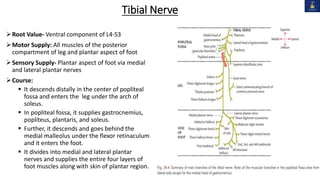
Course:
 It descends distally in the center of popliteal
fossa and enters the leg under the arch of
soleus.
 In popliteal fossa, it supplies gastrocnemius,
popliteus, plantaris, and soleus.
 Further, it descends and goes behind the
medial malleolus under the flexor retinaculum
and it enters the foot.
 It divides into medial and lateral plantar
nerves and supplies the entire four layers of
foot muscles along with skin of plantar region.
 Injury to tibial nerve can happen in- knee dislocation, proximal tibia fractures, compartment syndrome,
compressive neuropathy under the flexor retinaculum
 Problems after the injury :
 Loss of ankle plantar flexion (gastrosoleus)
 Weak inversion (tibialis posterior)
 Loss of plantar flexion of toes
 Claw toes: occurs after injury to the posterior tibial nerve near ankle leading to palsy of all foot intrinsic
muscles
 High stepping gait
 Motor Function test :
 Tendoachilles: ankle plantar flexion while standing on tip toe
 Tibialis posterior: inversion in plantar flexion
 Great toe flexor hallucis longus(FHL) and lesser toe Flexor Digitorum Longus (FDL) plantar flexion
 Sensory Test
 Sensory over the plantar aspect of foot
 Note: Tarsal Tunnel Syndrome- Compression of tibial nerve under the flexor retinaculum behind the ankle
Peripheral Nerve Injury (Lower Limb)

Peripheral Nerve Injury (Lower Limb)

  • 1.
    Peripheral Nerve Injury (LowerLimb) Dr Sandip Biswas
  • 2.
    Femoral Nerve Formed by:Ventral rami of posterior division of L2-4 Root Value: L2-4 Motor Supply: Hip Flexor (iliacus, Sartorius, Pectineus), Knee Extensor(Quadriceps) Sensory Supply: Antero-medial thigh and antero-medial leg and foot (Saphenous Nerve) Course:  The nerve descends in the abdomen from Lumbar Plexus through Psoas Major muscle.  The nerve further travels downs into the thigh behind the mid-inguinal point.  It divides into anterior and posterior branches which supply hip flexor and knee extensor respectively.
  • 3.
     Injury canhappen in – direct trauma, anterior hip dislocation, iatrogenic  Problems after injury-  Loss of Knee extension  Mild loss of hip flexion  Motor function test of femoral nerve  Quadriceps: Knee Extension  Sensory Test:  Anteromedial aspect of thigh  Anteromedial aspect of leg via Saphenous nerve Note: Meralgia Paresthetica- compression of lateral cutaneous nerve of thigh below ASIS under the inguinal ligament. It causes paraesthesia over lateral aspect of thigh
  • 4.
    Sciatic Nerve Formed by:Anterior and posterior divisions of lumbosacral plexus Root value- L4-S3 Motor Supply-  knee flexors(semitendinosus, semimembranosus, biceps femoris and adductor magnus).  Later, it supplies muscles of entire leg and foot after dividing into common peroneal and tibial nerves Course-  After exiting from the greater sciatic notch, the nerve descends in the gluteal region below the pyriformis behind the hip joint.  It lies over the external rotators of hip and further descends into the thigh under the deep head of biceps femoris.  In the posterior thigh, the ‘tibial component’ of sciatic nerve supplies hamstrings.  At the apex of the popliteal fossa, it divides into common peroneal and tibial component.
  • 5.
     Injury canhappen in- Posterior dislocation of hip, posterior surgical approaches to hip, direct trauma, injection into the gluteal region  Problems after the injury :  Loss of knee flexion  Loss of all motor activity at ankle and foot (flail foot)  Motor Function Test of sciatic nerve:  Hamstrings: Knee Flexion  Test for all ankle and foot muscles  Sensory test  Test the sensory function of Tibial and Common Peroneal Nerve
  • 6.
    Common Peroneal Nerve RootValue: Dorsal component of L4-S2 Motor Supply: Anterior comp( Tibialis Anterior, Extensor Hallucis Longus, Extensor digitorum longus, and peroneus tertius), and Lateral Comp ( Peroneus longus and brevis) of leg Sensory Supply:  Superficial Peroneal Nerve: dorsum of foot except for 1st interdigital cleft, medial and lateral borders of foot  Deep Peroneal Nerve: 1st interdigital cleft Course:  descends distally along the laterally wall of the popliteal fossa under the belly of Biceps Femoris.  Further, it winds around the neck of fibula between the peroneus longus and bone and divides into superficial and deep peroneal nerve.  Superficial peroneal nerve supplies lateral compartment while deep peroneal nerve supplies anterior compartment muscles
  • 7.
     Injury toCPN nerve can happen in – Fibular Neck Fracture, Knee Dislocation  Problems after injury to CPN: “FOOT DROP”  Loss of ankle dorsiflexion(tibialis anterior) and eversion (peroneal longus and brevis)  Loss of great and lesser toe extension (EHL and EDL)  High stepping Gait  Motor function test :  Tibialis anterior: dorsiflexion in inversion  EHL,EDL: Extension of great toe and other digits  Peroneus Longus and brevis: Eversion at subtalar joint  Sensory Test  Dorsum of 1st web space: deep peroneal nerve  Rest of the dorsum: superficial peroneal nerve
  • 8.
    Tibial Nerve Root Value-Ventral component of L4-S3 Motor Supply: All muscles of the posterior compartment of leg and plantar aspect of foot Sensory Supply- Plantar aspect of foot via medial and lateral plantar nerves Course:  It descends distally in the center of popliteal fossa and enters the leg under the arch of soleus.  In popliteal fossa, it supplies gastrocnemius, popliteus, plantaris, and soleus.  Further, it descends and goes behind the medial malleolus under the flexor retinaculum and it enters the foot.  It divides into medial and lateral plantar nerves and supplies the entire four layers of foot muscles along with skin of plantar region.
  • 9.
     Injury totibial nerve can happen in- knee dislocation, proximal tibia fractures, compartment syndrome, compressive neuropathy under the flexor retinaculum  Problems after the injury :  Loss of ankle plantar flexion (gastrosoleus)  Weak inversion (tibialis posterior)  Loss of plantar flexion of toes  Claw toes: occurs after injury to the posterior tibial nerve near ankle leading to palsy of all foot intrinsic muscles  High stepping gait  Motor Function test :  Tendoachilles: ankle plantar flexion while standing on tip toe  Tibialis posterior: inversion in plantar flexion  Great toe flexor hallucis longus(FHL) and lesser toe Flexor Digitorum Longus (FDL) plantar flexion  Sensory Test  Sensory over the plantar aspect of foot  Note: Tarsal Tunnel Syndrome- Compression of tibial nerve under the flexor retinaculum behind the ankle