FOOT DROP AskTheNeurologist.Com Author Anon
The Case of Mr. A. 40 year old man Self-employed systems administrator Divorced  Lives with girlfriend R handed Presented with a 2 week history of back pain and difficulty walking
HPC 2 weeks prior to admission Lower back pain ( more on R) Started tripping and falling ( no injury) Urinary incontinence “ dripping” Presented to ER , on examination weakness of R ankle dorsiflexion found CT: mild discopathy L3 - S1 without suspicion of root compression Discharged with recommendation to continue investigation as out-patient
HPC II Following discharge Continued to fall ( x4) with no injury Urinary problems resolved spontaneously 10 days later Loss of anal sphincter control Unaware of passing stool except for smell No change in state of leg Presented to ER 3 days later with no change
HPCIII Patient denies Urinary problems Erectile dysfunction Sensory disturbances Arm or left leg weakness Definable psychological trauma in previous year
PMH I Age 9 Hospitalised for 1 year According to patient unable to move legs with total anaesthesia below waist Possibly associated with sphincter disturbance “  no diagnosis found” Spontaneously recovered under interesting  circumstances !
PMH II Similar episodes recurred at least 3 times: Aged 11 years Aged 14 years Aged 17 years Each episode would last a few hours and was usually hospitalised and discharged without a diagnosis
PMH III Aged 32 Following mother’s death had episode of feeling legs “ frozen” below knees Resolved spontaneously after arriving in ER
PMH IV Aged 35 Hospitalised with DVT + SVT left leg Treated with heparin and then warfarin “ Borderline” homocysteine ( according to pt) 14 nmol / ml ( 0-15)
PMH IV 4 months prior to admission Admitted to Neurology ward Left leg superficial thrombophlebitis Global weakness right arm ( 4/5) Distal > Proximal weakness Left leg Reflexes ++ symmetrical No pyramidal sings Sensory loss “ stocking” on left NCV + LP normal Weakness improved spontaneously
Social History Smokes 1 pack / day Divorced 2 years ago following marriage of 8 months ( infidelity of partner) Currently lives with girlfriend of 3 months No children Self- employed, business going well
Examination in ER CN’s intact Tone intact Power  Preserved in arms and L Leg Weakness R leg  DF INV EV PF preserved ? Decreased right achilles reflex No pyramidal signs
Examination in ER II Sensory examination Inconsistent sensory level T8 Decreased vibration sense R leg only No cerebellar signs Gait Antalgic / paretic ( R Leg) Anal sphincter tone intact with normal perianal sensation
During hospitalisation No nursing observations regarding sphincter disturbances One episode of fever > 38.0 Request to receive heparin injections for a DVT he suspects he has developed Episodes of sudden loss of power in both legs associated with “ knees giving way” Inconsistencies between examiners No real change in right leg function
Examination follow-up CN’s intact Tone intact Power  Preserved in arms and L Leg Weakness R leg  TA, EHL, EDB Proximal strength preserved including Glutei Hamstrings INV, EV, PF preserved Reflexes symmetrical No pyramidal signs
Examination follow-up II Sensory examination normal No cerebellar signs Gait variable “ foot drop” on R Preserved perianal sensation and anal reflexes
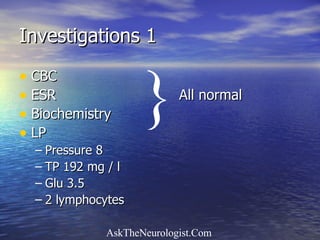
Investigations 1 CBC ESR All normal Biochemistry LP Pressure 8 TP 192 mg / l Glu 3.5 2 lymphocytes }
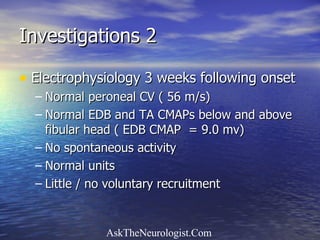
Investigations 2 Electrophysiology 3 weeks following onset Normal peroneal CV ( 56 m/s) Normal EDB and TA CMAPs below and above fibular head ( EDB CMAP  = 9.0 mv) No spontaneous activity Normal units Little / no voluntary recruitment
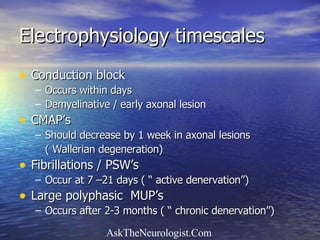
Electrophysiology timescales Conduction block Occurs within days Demyelinative / early axonal lesion CMAP’s Should decrease by 1 week in axonal lesions  ( Wallerian degeneration) Fibrillations / PSW’s Occur at 7 –21 days ( “ active denervation”) Large polyphasic  MUP’s Occurs after 2-3 months ( “ chronic denervation”)
Investigations 3  Brain CT : normal  ( 2 ½ weeks following onset) MRI lumbosacral region
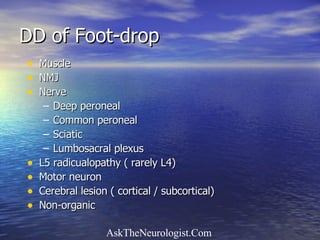
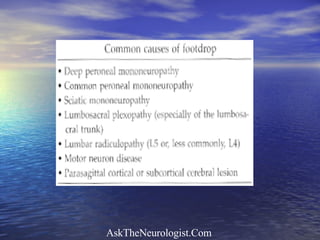
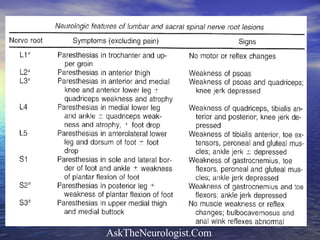
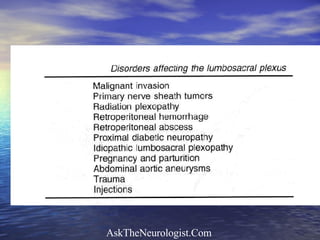
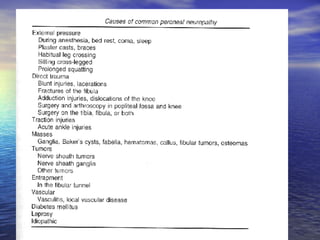
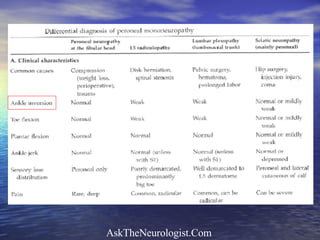
DD of Foot-drop Muscle NMJ Nerve Deep peroneal Common peroneal  Sciatic Lumbosacral plexus L5 radicualopathy ( rarely L4) Motor neuron Cerebral lesion ( cortical / subcortical) Non-organic
 
 
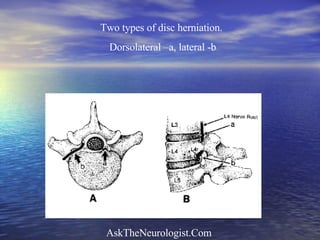
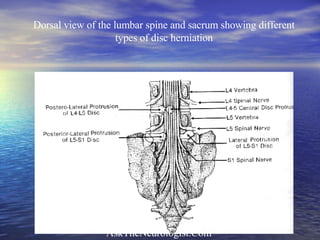
Two types of disc herniation.  Dorsolateral –a, lateral -b
Dorsal view of the lumbar spine and sacrum showing different types of disc herniation


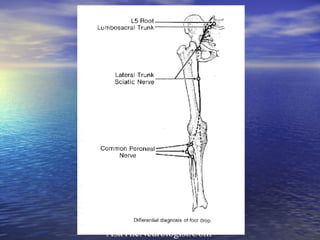
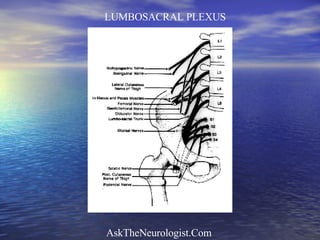
LUMBOSACRAL PLEXUS
 
 
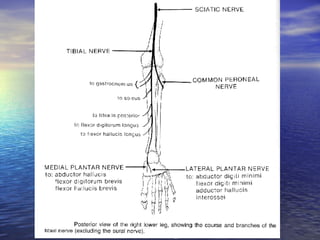
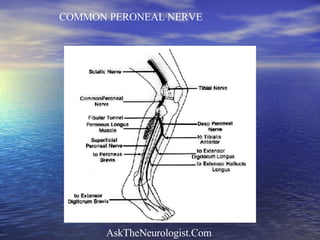
COMMON PERONEAL NERVE
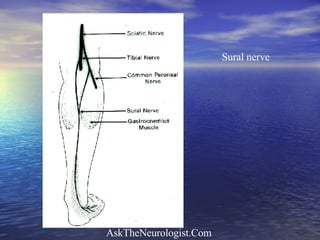
Sural nerve
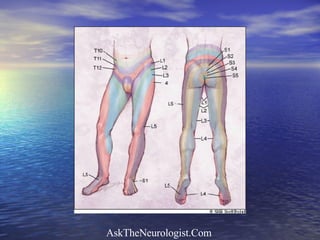
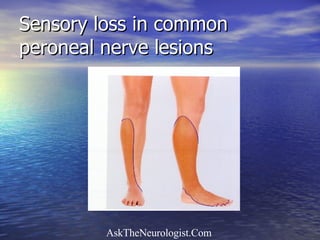
Sensory loss in common peroneal nerve lesions
Sensory loss in deep peroneal nerve lesions
Weight loss predisposes }
 
 
DD of Foot-drop Muscle NMJ Nerve Deep peroneal Common peroneal  Sciatic Lumbosacral plexus L5 radicualopathy ( rarely L4) Motor neuron Cerebral lesion ( cortical / subcortical) Non-organic
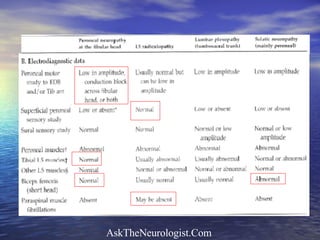
DD of Foot-drop Muscle Sudden onset, unilateral, restricted, rarely  causes foot-drop as major feature NMJ Focal, no fluctuations, rarely causes foot-drop  as major feature Nerve Deep peroneal Common peroneal  Sciatic Lumbosacral plexus L5 radiculopathy ( rarely L4) Motor neuron normal EMG Cerebral lesion  Rare cause of foot-drop, no other UMN  signs, normal Head CT Non-organic Explanation of documented DVT? Absence of motor and sensory involvement expected to be associated with various syndromes Normal NCV / EMG with profound weakness ( at 3 weeks)

Deep Venous Thrombosis: Risk Factor Assessment and Diagnosis Emergency Medicine Review 1996 “ Be alert for psychiatric patients or prisoners who may tie a tourniquet around their thigh to produce  factitious DVT .”
Non-Organic disorders Somatoform disorders  Patient believes they have a real disorder Somatisation disorder ( IBS, palpitations etc) Over-interpretation of real physiological phenomena Often reflect an affective disorder Conversion disorder ( hysterical blindness etc) Loss of physical functioning Usually follows acute stress Hypochondriasis More disease-centered than somatisation disorder Factitious disorder ( Munchausen) Intentional production / reporting of clinical features in order to enter sick-role…Motives unknown to patient Malingering Intentional production / reporting of clinical features for a conscious concrete gain
Munchausen Syndrome Baron Munchausen Served in German Army against Turkey (1700’s) Told “ wild and wonderful stories” of life as an adventurer and soldier Most stories untrue Stories were not medically directed
Munchausen syndrome II 3 Major presentations Haemorrhagic Abdominal Neurological Triad Dramatic presentation Falsely elaborating symptoms Travel to a number of medical institutions
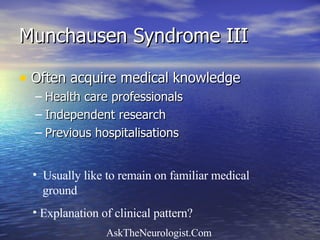
Munchausen Syndrome III Often acquire medical knowledge Health care professionals Independent research Previous hospitalisations Usually like to remain on familiar medical  ground Explanation of clinical pattern?
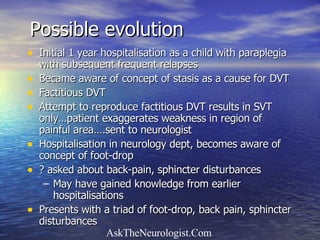
Possible evolution Initial 1 year hospitalisation as a child with paraplegia with subsequent frequent relapses Became aware of concept of stasis as a cause for DVT Factitious DVT Attempt to reproduce factitious DVT results in SVT only…patient exaggerates weakness in region of painful area….sent to neurologist Hospitalisation in neurology dept, becomes aware of concept of foot-drop ? asked about back-pain, sphincter disturbances  May have gained knowledge from earlier hospitalisations  Presents with a triad of foot-drop, back pain, sphincter disturbances
Thank you! AskTheNeurologist.Com Author Anon

Foot Drop

  • 1.
  • 2.
    The Case ofMr. A. 40 year old man Self-employed systems administrator Divorced Lives with girlfriend R handed Presented with a 2 week history of back pain and difficulty walking
  • 3.
    HPC 2 weeksprior to admission Lower back pain ( more on R) Started tripping and falling ( no injury) Urinary incontinence “ dripping” Presented to ER , on examination weakness of R ankle dorsiflexion found CT: mild discopathy L3 - S1 without suspicion of root compression Discharged with recommendation to continue investigation as out-patient
  • 4.
    HPC II Followingdischarge Continued to fall ( x4) with no injury Urinary problems resolved spontaneously 10 days later Loss of anal sphincter control Unaware of passing stool except for smell No change in state of leg Presented to ER 3 days later with no change
  • 5.
    HPCIII Patient deniesUrinary problems Erectile dysfunction Sensory disturbances Arm or left leg weakness Definable psychological trauma in previous year
  • 6.
    PMH I Age9 Hospitalised for 1 year According to patient unable to move legs with total anaesthesia below waist Possibly associated with sphincter disturbance “ no diagnosis found” Spontaneously recovered under interesting circumstances !
  • 7.
    PMH II Similarepisodes recurred at least 3 times: Aged 11 years Aged 14 years Aged 17 years Each episode would last a few hours and was usually hospitalised and discharged without a diagnosis
  • 8.
    PMH III Aged32 Following mother’s death had episode of feeling legs “ frozen” below knees Resolved spontaneously after arriving in ER
  • 9.
    PMH IV Aged35 Hospitalised with DVT + SVT left leg Treated with heparin and then warfarin “ Borderline” homocysteine ( according to pt) 14 nmol / ml ( 0-15)
  • 10.
    PMH IV 4months prior to admission Admitted to Neurology ward Left leg superficial thrombophlebitis Global weakness right arm ( 4/5) Distal > Proximal weakness Left leg Reflexes ++ symmetrical No pyramidal sings Sensory loss “ stocking” on left NCV + LP normal Weakness improved spontaneously
  • 11.
    Social History Smokes1 pack / day Divorced 2 years ago following marriage of 8 months ( infidelity of partner) Currently lives with girlfriend of 3 months No children Self- employed, business going well
  • 12.
    Examination in ERCN’s intact Tone intact Power Preserved in arms and L Leg Weakness R leg DF INV EV PF preserved ? Decreased right achilles reflex No pyramidal signs
  • 13.
    Examination in ERII Sensory examination Inconsistent sensory level T8 Decreased vibration sense R leg only No cerebellar signs Gait Antalgic / paretic ( R Leg) Anal sphincter tone intact with normal perianal sensation
  • 14.
    During hospitalisation Nonursing observations regarding sphincter disturbances One episode of fever > 38.0 Request to receive heparin injections for a DVT he suspects he has developed Episodes of sudden loss of power in both legs associated with “ knees giving way” Inconsistencies between examiners No real change in right leg function
  • 15.
    Examination follow-up CN’sintact Tone intact Power Preserved in arms and L Leg Weakness R leg TA, EHL, EDB Proximal strength preserved including Glutei Hamstrings INV, EV, PF preserved Reflexes symmetrical No pyramidal signs
  • 16.
    Examination follow-up IISensory examination normal No cerebellar signs Gait variable “ foot drop” on R Preserved perianal sensation and anal reflexes
  • 17.
    Investigations 1 CBCESR All normal Biochemistry LP Pressure 8 TP 192 mg / l Glu 3.5 2 lymphocytes }
  • 18.
    Investigations 2 Electrophysiology3 weeks following onset Normal peroneal CV ( 56 m/s) Normal EDB and TA CMAPs below and above fibular head ( EDB CMAP = 9.0 mv) No spontaneous activity Normal units Little / no voluntary recruitment
  • 19.
    Electrophysiology timescales Conductionblock Occurs within days Demyelinative / early axonal lesion CMAP’s Should decrease by 1 week in axonal lesions ( Wallerian degeneration) Fibrillations / PSW’s Occur at 7 –21 days ( “ active denervation”) Large polyphasic MUP’s Occurs after 2-3 months ( “ chronic denervation”)
  • 20.
    Investigations 3 Brain CT : normal ( 2 ½ weeks following onset) MRI lumbosacral region
  • 21.
    DD of Foot-dropMuscle NMJ Nerve Deep peroneal Common peroneal Sciatic Lumbosacral plexus L5 radicualopathy ( rarely L4) Motor neuron Cerebral lesion ( cortical / subcortical) Non-organic
  • 22.
  • 23.
  • 24.
    Two types ofdisc herniation. Dorsolateral –a, lateral -b
  • 25.
    Dorsal view ofthe lumbar spine and sacrum showing different types of disc herniation
  • 26.
  • 27.
  • 28.
  • 29.
  • 30.
  • 31.
  • 32.
  • 33.
  • 34.
  • 35.
    Sensory loss incommon peroneal nerve lesions
  • 36.
    Sensory loss indeep peroneal nerve lesions
  • 37.
  • 38.
  • 39.
  • 40.
    DD of Foot-dropMuscle NMJ Nerve Deep peroneal Common peroneal Sciatic Lumbosacral plexus L5 radicualopathy ( rarely L4) Motor neuron Cerebral lesion ( cortical / subcortical) Non-organic
  • 41.
    DD of Foot-dropMuscle Sudden onset, unilateral, restricted, rarely causes foot-drop as major feature NMJ Focal, no fluctuations, rarely causes foot-drop as major feature Nerve Deep peroneal Common peroneal Sciatic Lumbosacral plexus L5 radiculopathy ( rarely L4) Motor neuron normal EMG Cerebral lesion Rare cause of foot-drop, no other UMN signs, normal Head CT Non-organic Explanation of documented DVT? Absence of motor and sensory involvement expected to be associated with various syndromes Normal NCV / EMG with profound weakness ( at 3 weeks)
  • 42.
    Deep Venous Thrombosis:Risk Factor Assessment and Diagnosis Emergency Medicine Review 1996 “ Be alert for psychiatric patients or prisoners who may tie a tourniquet around their thigh to produce factitious DVT .”
  • 43.
    Non-Organic disorders Somatoformdisorders Patient believes they have a real disorder Somatisation disorder ( IBS, palpitations etc) Over-interpretation of real physiological phenomena Often reflect an affective disorder Conversion disorder ( hysterical blindness etc) Loss of physical functioning Usually follows acute stress Hypochondriasis More disease-centered than somatisation disorder Factitious disorder ( Munchausen) Intentional production / reporting of clinical features in order to enter sick-role…Motives unknown to patient Malingering Intentional production / reporting of clinical features for a conscious concrete gain
  • 44.
    Munchausen Syndrome BaronMunchausen Served in German Army against Turkey (1700’s) Told “ wild and wonderful stories” of life as an adventurer and soldier Most stories untrue Stories were not medically directed
  • 45.
    Munchausen syndrome II3 Major presentations Haemorrhagic Abdominal Neurological Triad Dramatic presentation Falsely elaborating symptoms Travel to a number of medical institutions
  • 46.
    Munchausen Syndrome IIIOften acquire medical knowledge Health care professionals Independent research Previous hospitalisations Usually like to remain on familiar medical ground Explanation of clinical pattern?
  • 47.
    Possible evolution Initial1 year hospitalisation as a child with paraplegia with subsequent frequent relapses Became aware of concept of stasis as a cause for DVT Factitious DVT Attempt to reproduce factitious DVT results in SVT only…patient exaggerates weakness in region of painful area….sent to neurologist Hospitalisation in neurology dept, becomes aware of concept of foot-drop ? asked about back-pain, sphincter disturbances May have gained knowledge from earlier hospitalisations Presents with a triad of foot-drop, back pain, sphincter disturbances
  • 48.