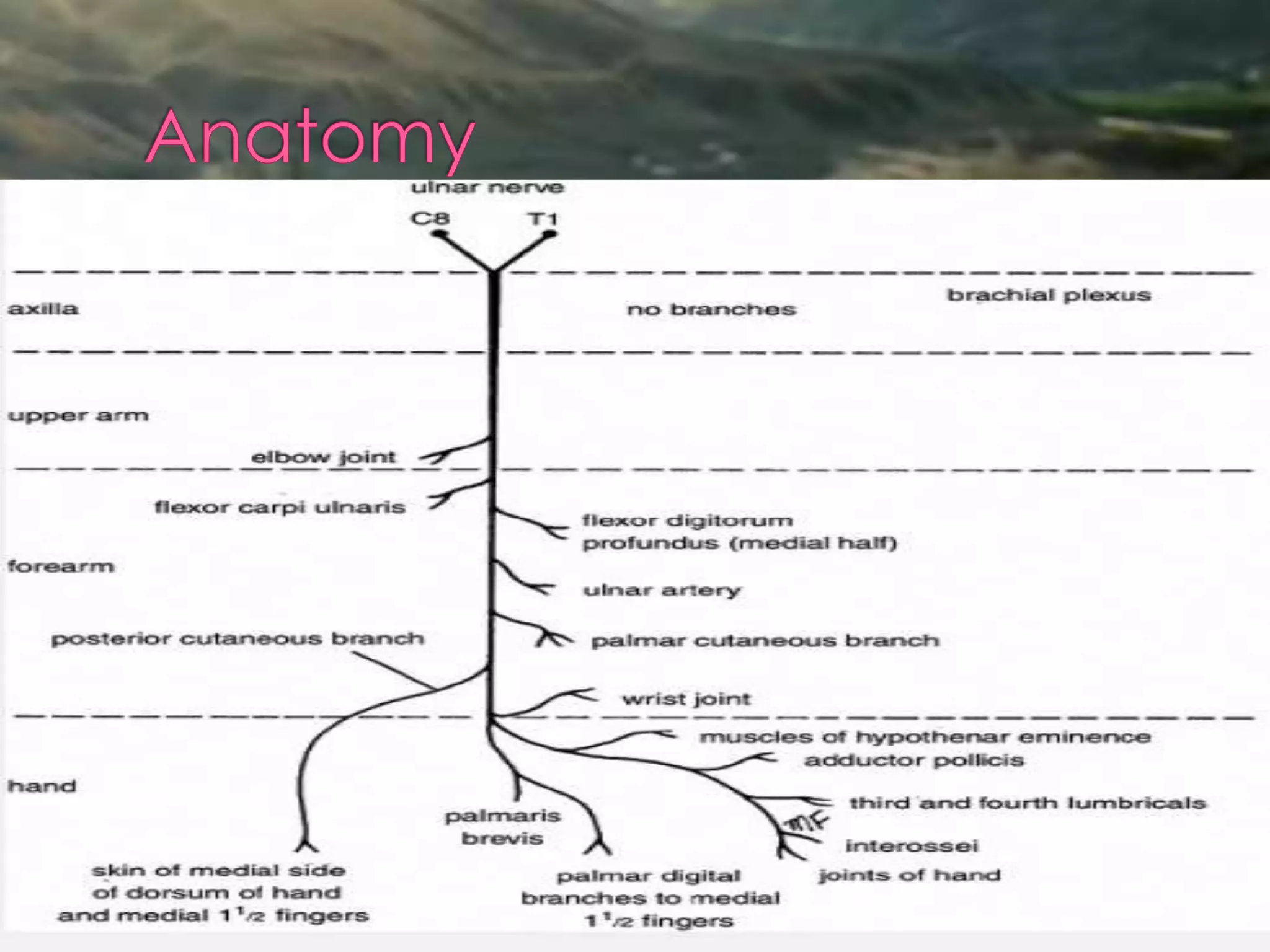
 The ulnar nerve arises from the medial
cord of the brachial plexus (C8 and T1),
 Gives off no cutaneous or motor
branches in the axilla or in the arm.
 It enters the forearm from behind the
medial epicondyle
 In the distal third of the forearm, it gives
off its palmar and posterior cutaneous
branches.
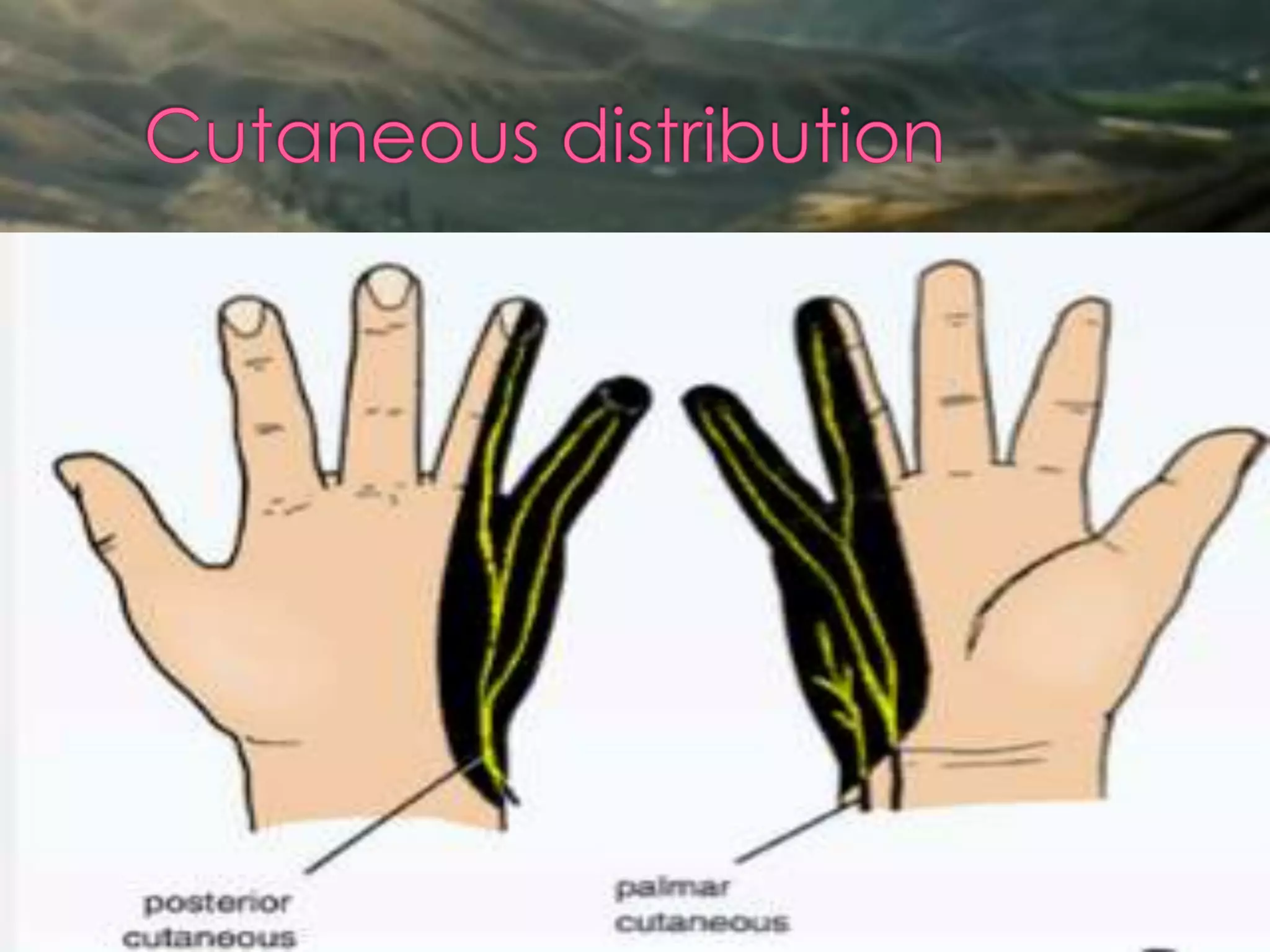
 The palmar cutaneous branch supplies
the skin over the hypothenar eminence
 The posterior branch supplies the skin
over the medial third of the dorsum of
the hand and the medial one and a half
fingers.
 Not uncommonly, the posterior branch
supplies two and a half instead of one
and a half fingers.
 NB: It does not supply the skin over the
distal part of the dorsum of these fingers.
 Entering the palm by passing in front of
the flexor retinaculum,
 The superficial branch of the ulnar nerve
supplies the skin of the palmar surface of
the medial one and a half fingers
, including their nail beds
Muscles supplied:
 Flexor carpi ulnaris
 Flexor digitorum profundus(medial half)
 Muscles of the hypothenar eminence
 Adductor policis
 Third and fourth lumbricals
 Interossei
 Palmaris brevis
 Mainly the type of nerve trauma
depends on the mechanism of injury:
 Neuropraxia
 Axonotemesis
 Neurotemesis
 The ulnar nerve is most commonly injured at
the elbow, where it lies behind the medial
epicondyle,
 The injuries at the elbow are usually
associated with fractures of the medial
epicondyle.
 At the wrist, where it lies with the ulnar artery
in front of the flexor retinaculum.
 The superficial position of the nerve at the
wrist makes it vulnerable to damage from
cuts and stab wounds
Injuries of the ulnar nerve at elbow:
Motor:
 The flexor carpi ulnaris and the medial half of the
flexor digitorum profundus muscles are paralyzed.
 The paralysis of the flexor carpi ulnaris can be
observed by asking the patient to make a tightly
clenched fist.
 Normally, the synergistic action of the flexor carpi
ulnaris tendon can be observed as it passes to the
pisiform bone;
 the tightening of the tendon will be absent if the
muscle is paralyzed.
 The profundus tendons to the ring and little fingers will
be functionless,
 The terminal phalanges of these fingers are therefore
not capable of being markedly flexed.
 Flexion of the wrist joint will result in abduction, owing
to paralysis of the flexor carpi ulnaris.
 The medial border of the front of the forearm will
show flattening owing to the wasting of the
underlying ulnaris and profundus muscles.
 The small muscles of the hand will be paralyzed,
except the muscles of the thenar eminence and the
first two lumbricals, which are supplied by the median
nerve.
 The patient is unable to adduct and abduct the fingers
and consequently is unable to grip a piece of paper
placed between the fingers.
 It is impossible to adduct the thumb because the
adductor pollicis muscle is paralyzed.
 If the patient is asked to grip a piece of paper between
the thumb and the index finger, he or she does so by
strongly contracting the flexor pollicis longus and flexing
the terminal phalanx (Froment's sign).
 The metacarpophalangeal joints become hyperextended
because of the paralysis of the lumbrical and interosseous
muscles, which normally flex these joints.
 The interphalangeal joints are flexed, owing again to the
paralysis of the lumbrical and interosseous muscles, which
normally extend these joints through the extensor
expansion.
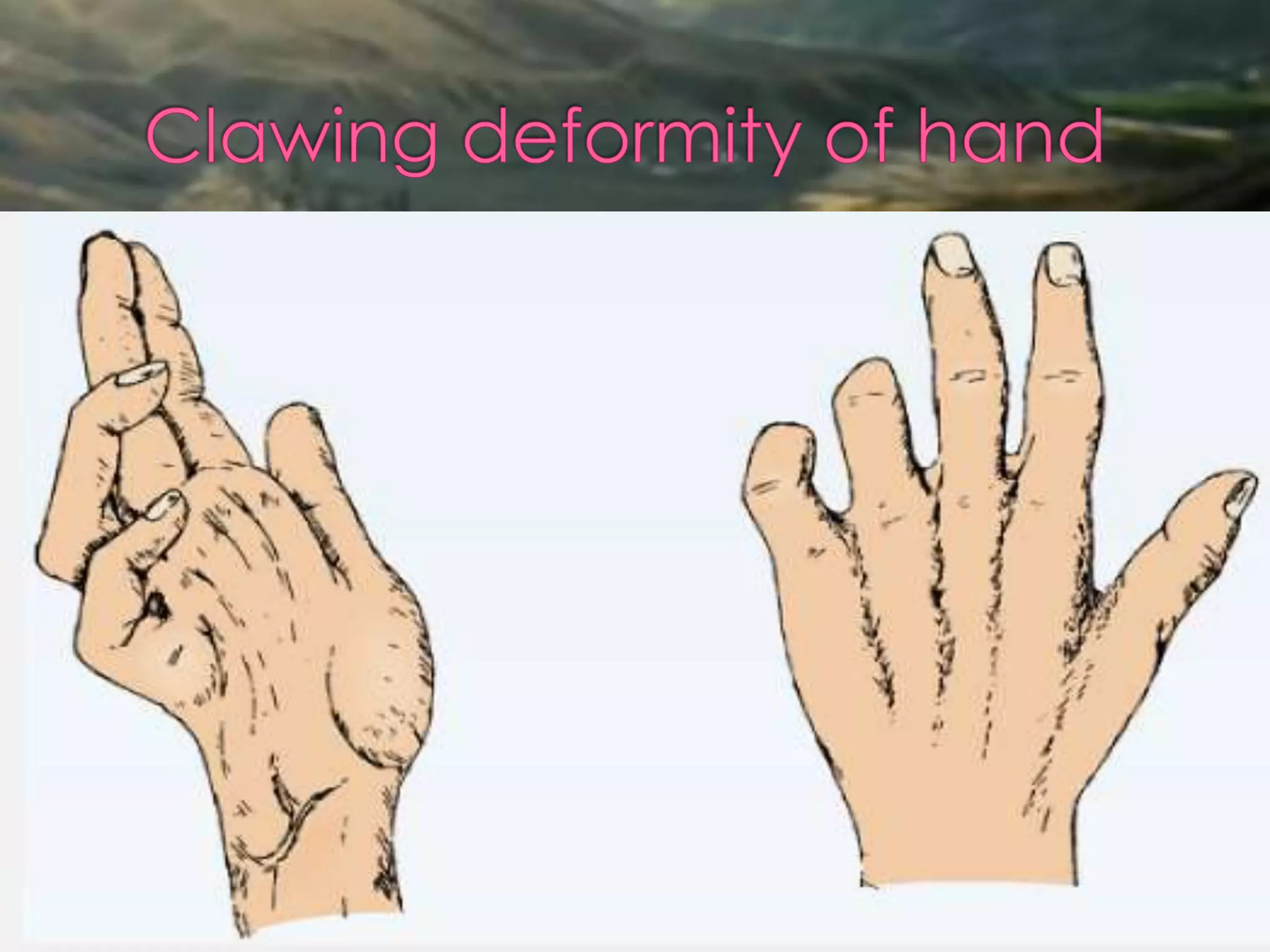
 The flexion deformity at the interphalangeal joints of
the fourth and fifth fingers is obvious because the first
and second lumbrical muscles of the index and
middle fingers are not paralyzed.
 In long-standing cases the hand assumes the
characteristic claw deformity (main en griffe).
 Wasting of the paralyzed muscles results in flattening
of the hypothenar eminence and loss of the convex
curve to the medial border of the hand.
 Examination of the dorsum of the hand will show
hollowing between the metacarpal bones caused by
wasting of the dorsal interosseous muscles.
Sensory:
 Loss of skin sensation will be observed
over the anterior and posterior surfaces
of the medial third of the hand and the
medial one and a half fingers.
Vasomotor Changes
 The skin areas involved in sensory loss are
warmer and drier than normal because
of the arteriolar dilatation and absence
of sweating resulting from loss of
sympathetic control
Injury of ulnar nerve at wrist:
Motor:
 The small muscles of the hand will be
paralyzed and show wasting, except for the
muscles of the thenar eminence and the
first two lumbricals.
 The clawhand is much more obvious in
wrist lesions because the flexor digitorum
profundus muscle is not paralyzed, and
marked flexion of the terminal phalanges
occurs.
Sensory:
 The main ulnar nerve and its palmar cutaneous
branch are usually severed
 The posterior cutaneous branch, which arises
from the ulnar nerve trunk about 2.5 in. (6.25
cm) above the pisiform bone, is usually
unaffected.
 The sensory loss will therefore be confined to
the palmar surface of the medial third of the
hand and the medial one and a half fingers
and to the dorsal aspects of the middle and
distal phalanges of the same fingers.
Vasomotor and trophic changes:
 These are the same as those described
for injuries at the elbow. It is important to
remember that with ulnar nerve
injuries, the higher the lesion, the less
obvious the clawing deformity of the
hand.
Surgical management & Medical mx:
 Exploration and suture of the divided nerve
 Anterior transposition of nerve at the elbow
joint
 Metacarpophalengeal flexion can be
improved by extensor carpi radialis longus to
intrinsic tendon transferes or
 Looping a slip of flexor digitorum supeficialis
around the opening of the flexor
sheath(Zancolli procedure)
 Admistration of analgesics if nerve lesion is
associated with fracture
 Index abduction can be improved by
transfering extensor policis brevis or
extensor indicis to interosseous insertion
on the radial side of the finger.
 faradism
 Ift
 Passive movements, can be auto
assisted
 Hydrotherapy
 Electro diagnosis
 Tens
 If there is no recovery after nerve
division,hand function is significantly
impaired
 Grip strength is lost because the primary
metacarpophalangial flexors are lost
 Pinch is poor because thumb adduction
and index finger abduction is weakened.
 Apley’s othopaedic textbook
 Snell’ clinical anatomy
 www.physiopedia.com
 Cleveland clinic journal of medicine
 www.pubmed.com
 Essential physical medicine and
rehabilitation.

Ulnar nerve injuries

  • 2.
     The ulnarnerve arises from the medial cord of the brachial plexus (C8 and T1),  Gives off no cutaneous or motor branches in the axilla or in the arm.  It enters the forearm from behind the medial epicondyle
  • 3.
     In thedistal third of the forearm, it gives off its palmar and posterior cutaneous branches.  The palmar cutaneous branch supplies the skin over the hypothenar eminence  The posterior branch supplies the skin over the medial third of the dorsum of the hand and the medial one and a half fingers.
  • 4.
     Not uncommonly,the posterior branch supplies two and a half instead of one and a half fingers.  NB: It does not supply the skin over the distal part of the dorsum of these fingers.
  • 5.
     Entering thepalm by passing in front of the flexor retinaculum,  The superficial branch of the ulnar nerve supplies the skin of the palmar surface of the medial one and a half fingers , including their nail beds
  • 7.
    Muscles supplied:  Flexorcarpi ulnaris  Flexor digitorum profundus(medial half)  Muscles of the hypothenar eminence  Adductor policis  Third and fourth lumbricals  Interossei  Palmaris brevis
  • 9.
     Mainly thetype of nerve trauma depends on the mechanism of injury:  Neuropraxia  Axonotemesis  Neurotemesis
  • 10.
     The ulnarnerve is most commonly injured at the elbow, where it lies behind the medial epicondyle,  The injuries at the elbow are usually associated with fractures of the medial epicondyle.  At the wrist, where it lies with the ulnar artery in front of the flexor retinaculum.  The superficial position of the nerve at the wrist makes it vulnerable to damage from cuts and stab wounds
  • 11.
    Injuries of theulnar nerve at elbow: Motor:  The flexor carpi ulnaris and the medial half of the flexor digitorum profundus muscles are paralyzed.  The paralysis of the flexor carpi ulnaris can be observed by asking the patient to make a tightly clenched fist.  Normally, the synergistic action of the flexor carpi ulnaris tendon can be observed as it passes to the pisiform bone;  the tightening of the tendon will be absent if the muscle is paralyzed.
  • 12.
     The profundustendons to the ring and little fingers will be functionless,  The terminal phalanges of these fingers are therefore not capable of being markedly flexed.  Flexion of the wrist joint will result in abduction, owing to paralysis of the flexor carpi ulnaris.  The medial border of the front of the forearm will show flattening owing to the wasting of the underlying ulnaris and profundus muscles.  The small muscles of the hand will be paralyzed, except the muscles of the thenar eminence and the first two lumbricals, which are supplied by the median nerve.
  • 13.
     The patientis unable to adduct and abduct the fingers and consequently is unable to grip a piece of paper placed between the fingers.  It is impossible to adduct the thumb because the adductor pollicis muscle is paralyzed.  If the patient is asked to grip a piece of paper between the thumb and the index finger, he or she does so by strongly contracting the flexor pollicis longus and flexing the terminal phalanx (Froment's sign).  The metacarpophalangeal joints become hyperextended because of the paralysis of the lumbrical and interosseous muscles, which normally flex these joints.  The interphalangeal joints are flexed, owing again to the paralysis of the lumbrical and interosseous muscles, which normally extend these joints through the extensor expansion.
  • 14.
     The flexiondeformity at the interphalangeal joints of the fourth and fifth fingers is obvious because the first and second lumbrical muscles of the index and middle fingers are not paralyzed.  In long-standing cases the hand assumes the characteristic claw deformity (main en griffe).  Wasting of the paralyzed muscles results in flattening of the hypothenar eminence and loss of the convex curve to the medial border of the hand.  Examination of the dorsum of the hand will show hollowing between the metacarpal bones caused by wasting of the dorsal interosseous muscles.
  • 15.
    Sensory:  Loss ofskin sensation will be observed over the anterior and posterior surfaces of the medial third of the hand and the medial one and a half fingers.
  • 16.
    Vasomotor Changes  Theskin areas involved in sensory loss are warmer and drier than normal because of the arteriolar dilatation and absence of sweating resulting from loss of sympathetic control
  • 17.
    Injury of ulnarnerve at wrist: Motor:  The small muscles of the hand will be paralyzed and show wasting, except for the muscles of the thenar eminence and the first two lumbricals.  The clawhand is much more obvious in wrist lesions because the flexor digitorum profundus muscle is not paralyzed, and marked flexion of the terminal phalanges occurs.
  • 18.
    Sensory:  The mainulnar nerve and its palmar cutaneous branch are usually severed  The posterior cutaneous branch, which arises from the ulnar nerve trunk about 2.5 in. (6.25 cm) above the pisiform bone, is usually unaffected.  The sensory loss will therefore be confined to the palmar surface of the medial third of the hand and the medial one and a half fingers and to the dorsal aspects of the middle and distal phalanges of the same fingers.
  • 19.
    Vasomotor and trophicchanges:  These are the same as those described for injuries at the elbow. It is important to remember that with ulnar nerve injuries, the higher the lesion, the less obvious the clawing deformity of the hand.
  • 21.
    Surgical management &Medical mx:  Exploration and suture of the divided nerve  Anterior transposition of nerve at the elbow joint  Metacarpophalengeal flexion can be improved by extensor carpi radialis longus to intrinsic tendon transferes or  Looping a slip of flexor digitorum supeficialis around the opening of the flexor sheath(Zancolli procedure)  Admistration of analgesics if nerve lesion is associated with fracture
  • 22.
     Index abductioncan be improved by transfering extensor policis brevis or extensor indicis to interosseous insertion on the radial side of the finger.
  • 23.
     faradism  Ift Passive movements, can be auto assisted  Hydrotherapy  Electro diagnosis  Tens
  • 24.
     If thereis no recovery after nerve division,hand function is significantly impaired  Grip strength is lost because the primary metacarpophalangial flexors are lost  Pinch is poor because thumb adduction and index finger abduction is weakened.
  • 25.
     Apley’s othopaedictextbook  Snell’ clinical anatomy  www.physiopedia.com  Cleveland clinic journal of medicine  www.pubmed.com  Essential physical medicine and rehabilitation.