Peripheral
                        Nerve
                        Injuries

Dr.Prateek Singh
intern
Dept. of Orthopaedics
BPKIHS
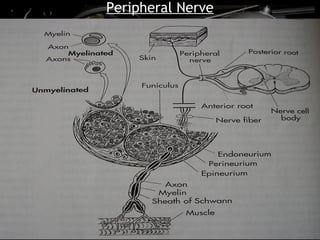
Peripheral Nerve
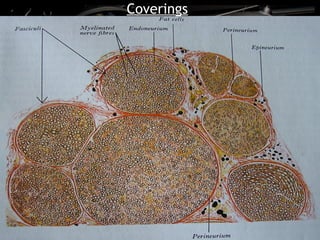
Coverings
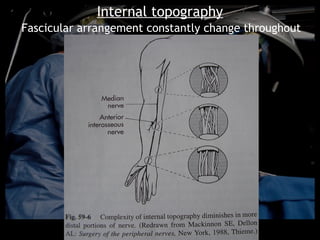
Internal topography
Fascicular arrangement constantly change throughout
                     the course
Etiology of peripheral nerve injuries

1.   Metabolic or collagen disease
2.   Malignancy
3.   Endo or exo-toxins
4.   Ischaemia
5.   Radiation            * infection:leprosy
6.   Trauma
      Thermal
      Chemical
      Mechanical
Primary injury
 – Results from same trauma that injures a bone or
   joint
 – Radial nerve is the most commonly injured. Of
   humeral shaft fractures, 14 % is complicated by
   radial nerve injuries
       – Displaced osseous fragments
       – Stretching
       – Manipulation


 Secondary injury
 – Results from involvement of nerve by infection, scar,
   callous or vascular complications which may be
   hematoma, AV fistula, Ischemia or aneurysm
Classification of nerve injuries
Seddon Classification
     1.Neuropraxia:
      1.Minor contusion or compression with preservation of axis –
        cylinder of myelin sheath.
      2.Impulse transmission physiologically interrupted.
      3.Complete recovery in a few days to weeks
     2.Axonotemesis :
      1.More significant injury
      2.Breakdown of axon and distal Wallerian degeneration but with
        preservation of schwann cell & endoneurial tubes
      3.Spontaneous regeneration with good functional recovery can be
        expected
3.      Neurotmesis
      1.More severe injury
      2.Complete anatomical severance, avulsion or crushing of nerve
      3.Axon, Schwann cell & endoneurial tubes are completely
        disrupted
      4.Spontaneous recovery cannot be expected unless surgically
        intervened
Sunderland Classification
   Each degree of injury suggesting a greater anatomical
    disruption with its correspondingly altered prognosis
   Anatomically various degrees (1st – 5th) represent injury
    to
         Myelin
         Axon
         Endoneurial tube & it’s content
         Perineurium
         Entire nerve trunk
   Sixth degree (Mackinson) or mixed injuries occur in
    which a nerve trunk is partially severed and
    remaining part of trunk sustains 1st to 4th degree
    injury.
   Mixed recovery pattern depending on degree of
    injury to each portion of nerve.
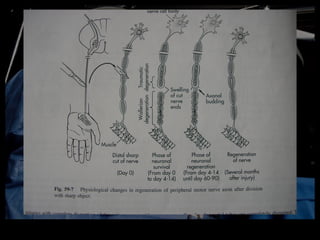
Neuronal degeneration and regeneration
• Any part of neuron detached from its
  nucleus, degenerates & is destroyed by
  phagocytosis.
     • Distal   – Secondary / Wallerian Degeneration
     • Proximal - Primary / Traumatic / Retrograde
                   Degeneration
•   Time required for degeneration varies between
    sensory and motor fibers and is also related to size
    & myelination of fibers
•   Advancing Tinel sign and presence of motor march
    phenomena are signs of regeneration
Diagnosis of Peripheral nerve
                 injuries
• History
  –   Which nerve ?
  –   What level ?
  –   What is the cause ?
  –   What degree of injury ?
  –   Old or fresh injury ?
Diagnosis of Peripheral nerve
                 injuries

1. Motor:
  –    All muscles distal to the injury – paralyzed
       & atonic
  –    Atrophy : 50 -70 % in 1st two months
  –    Striations & motor end plate configurations
       retained for 12 – 18 months (critical limit
       of delay)
2.   Sensory :

• Sensory loss usually follows a definite
  anatomical pattern, although factor of
  overlap from adjacent nerves may be
  present
• Autonomous zone
• Weber 2 point discrimination test
• Tinel’s sign
(3) Reflex


• Abolishes all reflexes transmitted by that
  nerve, either afferent or efferent arc.
• Complete & incomplete lesion. So , not a
  reliable guide to injury severity.
(4)   Autonomic :
• Loss of sweating
• Loss of pilomotor response and
• Vasomotor paralysis in autonomous zone
(5)   Others:

 • Trophic Changes
          • Esp. hand and feet
          • Skin – thin, glistening, breaks easily to form
            ulcers that heal slowly
 • Fingernails
          • Ridged, distorted and brittle
 • Osteoporosis          (Reflex sympathetic dystrophy)
Test for peripheral nerves of upper limb
• Radial nerve injury
  – very high / high / low injury
  – Wrist drop / finger drop / thumb drop
  – Test for triceps/ /Brachioradialis/ wrist extensors /
    extensor digitorum / EPL
• Median nerve
  – High / low injury
  – Test for FPL / FDS / FDP (lat. half) / FCR / Abd.
    Pollicis brevis ( pen test) / Oppenens pollicis
  – See for pointing index / complete claw hand
• Ulnar nerve
  – High / low palsy –ulnar paradox
  – Test for FCU / Abd. digiti minimi / Interossei (dorsal -
    Egawa’s test ; palmar – card test ) / lumbricals /Add.
    Pollicis (Froment’s sign / book test )
  – Ulnar claw hand
Electrodiagnostic studies
• Electromyography
• Nerve conduction velocity
• Strength duration curve
Time of Surgery
• Primary repair : First 6 – 8 hours

• Delayed primary repair : First 7 – 18 days

• Secondary repair : > 3 weeks
Indications for surgery
1. When a sharp injury has obviously divided a
   nerve.
2. When abrading, avulsing or blast wounds have
   rendered the condition of nerve unknown
3. When a nerve deficit follows a blunt or closed
   trauma & no clinical or electrical evidence of
   regeneration has occurred after an appropriate
   time
4. When a nerve deficit follows a penetrating wound
   as stab or low velocity gunshot wound, part
   observed for evidence of nerve regeneration for
   appropriate time.
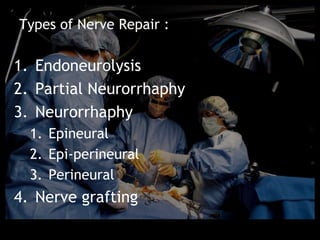
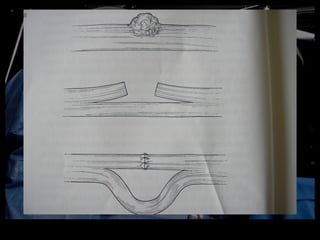
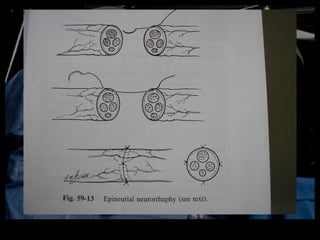
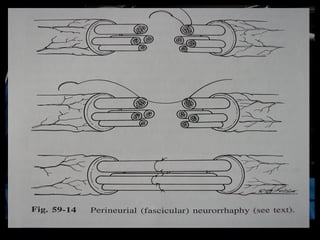
Types of Nerve Repair :

1. Endoneurolysis
2. Partial Neurorrhaphy
3. Neurorrhaphy
  1. Epineural
  2. Epi-perineural
  3. Perineural
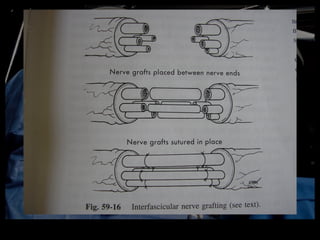
4. Nerve grafting
Method of closing gap between nerve ends
1. Mobilization ( critical nerve gap distance – value
   of Grantham)
2. Positioning of extremity
        – Flex knee and elbow < 90°
        – Flex wrist < 40°
1. Transposition
2. Bone resection
3. Nerve stretching & bulb sutures
4. Nerve grafting
5. Nerve crossing ( pedicle grafting )
Factors that influence regeneration after
neurorrhaphy

 1.   Age of patient
 2.   Gap between nerve ends
 3.   Delay between time of injury and repair
 4.   Level of injury
 5.   Condition of nerve ends
 6.   Experience & technique of surgeon
Options
•   Orthoses
•   Tendon transfers
•   Bony blocks
•   Arthrodesis
Thank You

Peripheral nerve injury

  • 1.
    Peripheral Nerve Injuries Dr.Prateek Singh intern Dept. of Orthopaedics BPKIHS
  • 2.
  • 3.
  • 4.
    Internal topography Fascicular arrangementconstantly change throughout the course
  • 5.
    Etiology of peripheralnerve injuries 1. Metabolic or collagen disease 2. Malignancy 3. Endo or exo-toxins 4. Ischaemia 5. Radiation * infection:leprosy 6. Trauma  Thermal  Chemical  Mechanical
  • 6.
    Primary injury –Results from same trauma that injures a bone or joint – Radial nerve is the most commonly injured. Of humeral shaft fractures, 14 % is complicated by radial nerve injuries – Displaced osseous fragments – Stretching – Manipulation Secondary injury – Results from involvement of nerve by infection, scar, callous or vascular complications which may be hematoma, AV fistula, Ischemia or aneurysm
  • 7.
    Classification of nerveinjuries Seddon Classification 1.Neuropraxia: 1.Minor contusion or compression with preservation of axis – cylinder of myelin sheath. 2.Impulse transmission physiologically interrupted. 3.Complete recovery in a few days to weeks 2.Axonotemesis : 1.More significant injury 2.Breakdown of axon and distal Wallerian degeneration but with preservation of schwann cell & endoneurial tubes 3.Spontaneous regeneration with good functional recovery can be expected 3. Neurotmesis 1.More severe injury 2.Complete anatomical severance, avulsion or crushing of nerve 3.Axon, Schwann cell & endoneurial tubes are completely disrupted 4.Spontaneous recovery cannot be expected unless surgically intervened
  • 8.
    Sunderland Classification  Each degree of injury suggesting a greater anatomical disruption with its correspondingly altered prognosis  Anatomically various degrees (1st – 5th) represent injury to  Myelin  Axon  Endoneurial tube & it’s content  Perineurium  Entire nerve trunk  Sixth degree (Mackinson) or mixed injuries occur in which a nerve trunk is partially severed and remaining part of trunk sustains 1st to 4th degree injury.  Mixed recovery pattern depending on degree of injury to each portion of nerve.
  • 9.
    Neuronal degeneration andregeneration • Any part of neuron detached from its nucleus, degenerates & is destroyed by phagocytosis. • Distal – Secondary / Wallerian Degeneration • Proximal - Primary / Traumatic / Retrograde Degeneration • Time required for degeneration varies between sensory and motor fibers and is also related to size & myelination of fibers • Advancing Tinel sign and presence of motor march phenomena are signs of regeneration
  • 11.
    Diagnosis of Peripheralnerve injuries • History – Which nerve ? – What level ? – What is the cause ? – What degree of injury ? – Old or fresh injury ?
  • 12.
    Diagnosis of Peripheralnerve injuries 1. Motor: – All muscles distal to the injury – paralyzed & atonic – Atrophy : 50 -70 % in 1st two months – Striations & motor end plate configurations retained for 12 – 18 months (critical limit of delay)
  • 13.
    2. Sensory : • Sensory loss usually follows a definite anatomical pattern, although factor of overlap from adjacent nerves may be present • Autonomous zone • Weber 2 point discrimination test • Tinel’s sign
  • 14.
    (3) Reflex • Abolishesall reflexes transmitted by that nerve, either afferent or efferent arc. • Complete & incomplete lesion. So , not a reliable guide to injury severity. (4) Autonomic : • Loss of sweating • Loss of pilomotor response and • Vasomotor paralysis in autonomous zone
  • 15.
    (5) Others: • Trophic Changes • Esp. hand and feet • Skin – thin, glistening, breaks easily to form ulcers that heal slowly • Fingernails • Ridged, distorted and brittle • Osteoporosis (Reflex sympathetic dystrophy)
  • 16.
    Test for peripheralnerves of upper limb • Radial nerve injury – very high / high / low injury – Wrist drop / finger drop / thumb drop – Test for triceps/ /Brachioradialis/ wrist extensors / extensor digitorum / EPL • Median nerve – High / low injury – Test for FPL / FDS / FDP (lat. half) / FCR / Abd. Pollicis brevis ( pen test) / Oppenens pollicis – See for pointing index / complete claw hand
  • 17.
    • Ulnar nerve – High / low palsy –ulnar paradox – Test for FCU / Abd. digiti minimi / Interossei (dorsal - Egawa’s test ; palmar – card test ) / lumbricals /Add. Pollicis (Froment’s sign / book test ) – Ulnar claw hand
  • 18.
    Electrodiagnostic studies • Electromyography •Nerve conduction velocity • Strength duration curve
  • 19.
    Time of Surgery •Primary repair : First 6 – 8 hours • Delayed primary repair : First 7 – 18 days • Secondary repair : > 3 weeks
  • 20.
    Indications for surgery 1.When a sharp injury has obviously divided a nerve. 2. When abrading, avulsing or blast wounds have rendered the condition of nerve unknown 3. When a nerve deficit follows a blunt or closed trauma & no clinical or electrical evidence of regeneration has occurred after an appropriate time 4. When a nerve deficit follows a penetrating wound as stab or low velocity gunshot wound, part observed for evidence of nerve regeneration for appropriate time.
  • 21.
    Types of NerveRepair : 1. Endoneurolysis 2. Partial Neurorrhaphy 3. Neurorrhaphy 1. Epineural 2. Epi-perineural 3. Perineural 4. Nerve grafting
  • 26.
    Method of closinggap between nerve ends 1. Mobilization ( critical nerve gap distance – value of Grantham) 2. Positioning of extremity – Flex knee and elbow < 90° – Flex wrist < 40° 1. Transposition 2. Bone resection 3. Nerve stretching & bulb sutures 4. Nerve grafting 5. Nerve crossing ( pedicle grafting )
  • 27.
    Factors that influenceregeneration after neurorrhaphy 1. Age of patient 2. Gap between nerve ends 3. Delay between time of injury and repair 4. Level of injury 5. Condition of nerve ends 6. Experience & technique of surgeon
  • 28.
    Options • Orthoses • Tendon transfers • Bony blocks • Arthrodesis
  • 29.