Chapter 1 Properties of Fluids Definition of fluid Properties of fluids Calculations
What is hydrostatics? Definition of Fluid All matter can be divided into 2 major classes 1) Solid 2) Fluids The difference between a solid and fluid can be defined by 1) The stress-strain relationship 2) The elasticity
What is hydrostatics? The Stress-Strain Relationship Solid requires external forces to cause it to deform. Fluid will deform without the application of external  forces. will take on the shape of the container in which  they are held.  -Ex. water, oil, gas   etc.
What is hydrostatics? The Elasticity Relationship Solid -When external forces stress and deform solids, the  solid will regain their original shape  when these external forces are removed  [Elasticity]. Fluid - Fluid will continue to change shape in time  even after the removal of the external forces causing the deformation.
What is hydrostatics? Ideal Fluid Ideal fluid is a substance that is  unable to resist internal shear and tensile forces .
What is hydrostatics? Liquid and Gases Fluids can be classified into 2 forms of matter 1) Liquids 2) Gases The difference between a liquid and gas can be defined by 1) The compressibility 2) The continuity
What is hydrostatics? Compressibility :to compress something into a small space. Liquids Liquids are considered to be  incompressible . Liquids only change in volume even when  subjected to very high pressure. Gases Gases are very  compressible .  Their volume can increase/decrease when  subjected to slight variation in pressure.
What is hydrostatics? Continuity : is the state of being continuous. Liquids When a liquid is held in a container, its  entire  mass will arrange itself  so as to be in contact  with the bottom and the sides of that container,  and  a well-defined surface of the liquid will form . Gases A  gas held in a closed container will not form a  well-defined surface  and will tend to fill the  entire container.
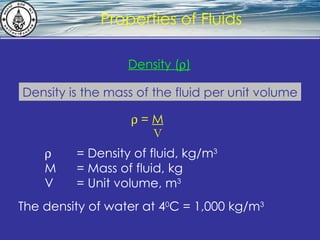
What is hydrostatics? Properties of Fluids Density is the mass of the fluid per unit volume   Density (  )    = Density of fluid, kg/m 3 M  = Mass of fluid, kg V = Unit volume, m 3    =  M V The density of water at 4 0 C = 1,000 kg/m 3
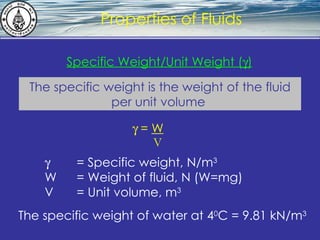
What is hydrostatics? Properties of Fluids The specific weight is the weight of the fluid per unit volume      = Specific weight, N/m 3 W  = Weight of fluid, N (W=mg) V = Unit volume, m 3    =  W V The specific weight of water at 4 0 C = 9.81 kN/m 3 Specific Weight/Unit Weight (  )
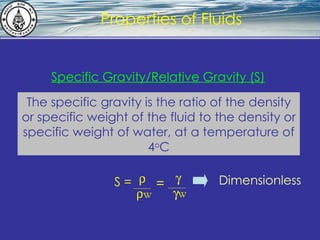
What is hydrostatics? Properties of Fluids The specific gravity is the ratio of the density or specific weight of the fluid to the density or specific weight of water, at a temperature of 4 o C Specific Gravity/Relative Gravity (S) S =  w  =  w  Dimensionless
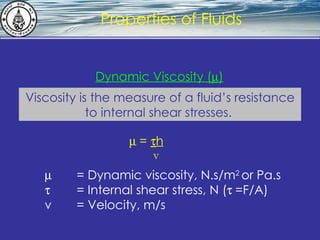
What is hydrostatics? Properties of Fluids Viscosity is the measure of a fluid’s resistance to internal shear stresses.   Dynamic Viscosity (  )    = Dynamic viscosity, N.s/m 2  or Pa.s    = Internal shear stress, N (    =F/A) v = Velocity, m/s    =   h v
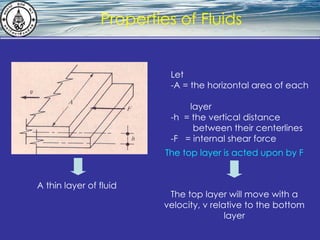
What is hydrostatics? Properties of Fluids Let  -A = the horizontal area of each  layer -h  = the vertical distance  between their centerlines -F  = internal shear force A thin layer of fluid The top layer is acted upon by F The top layer will move with a velocity, v relative to the bottom layer
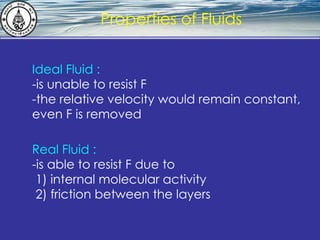
What is hydrostatics? Properties of Fluids Ideal Fluid : -is unable to resist F -the relative velocity would remain constant, even F is removed Real Fluid : -is able to resist F due to  1) internal molecular activity 2) friction between the layers
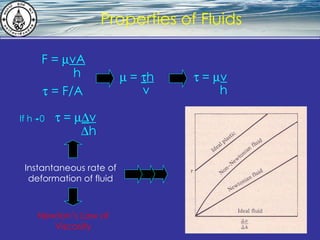
What is hydrostatics? Properties of Fluids    =   h v F =   vA h    = F/A    =   v h If h  0    =    v  h Instantaneous rate of deformation of fluid Newton’s Law of Viscosity
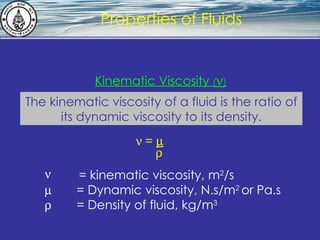
What is hydrostatics? Properties of Fluids The kinematic viscosity of a fluid is the ratio of its dynamic viscosity to its density. Kinematic Viscosity  (  ) = kinematic viscosity, m 2 /s    = Dynamic viscosity, N.s/m 2  or Pa.s    = Density of fluid, kg/m 3    =   
What is hydrostatics? Properties of Fluids The capacity of liquids to resist tensile stresses at their surface is called surface tensile. Surface Tension  (  )
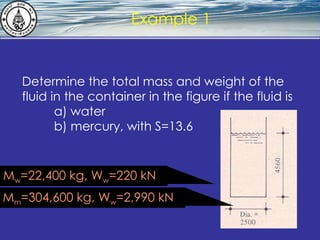
What is hydrostatics? Example 1 Determine the total mass and weight of the fluid in the container in the figure if the fluid is  a) water b) mercury, with S=13.6 M w =22,400 kg, W w =220 kN M m =304,600 kg, W w =2,990 kN
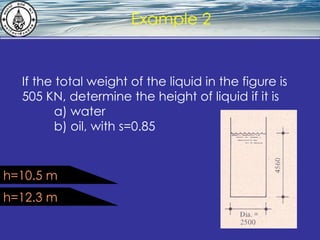
What is hydrostatics? Example 2 If the total weight of the liquid in the figure   is 505 KN, determine the height of liquid if it is a) water b) oil, with s=0.85 h=10.5 m h=12.3 m
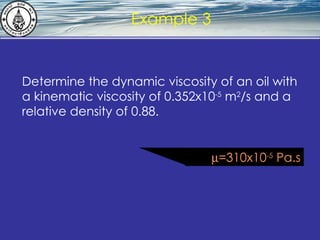
What is hydrostatics? Example 3 Determine the dynamic viscosity of an oil with a kinematic viscosity of 0.352x10 -5  m 2 /s and a relative density of 0.88.  =310x10 -5  Pa.s
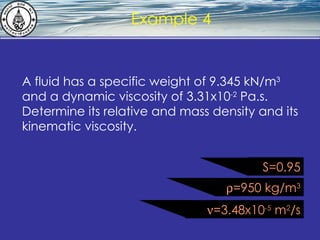
What is hydrostatics? Example 4 A fluid has a specific weight of 9.345 kN/m 3  and a dynamic viscosity of 3.31x10 -2  Pa.s. Determine its relative and mass density and its kinematic viscosity.  =950 kg/m 3  =3.48x10 -5  m 2 /s S=0.95
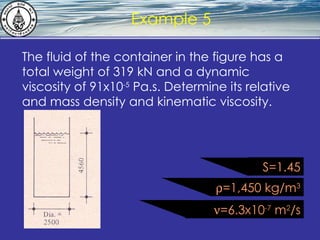
What is hydrostatics? Example 5 The fluid of the container in the figure has a total weight of 319 kN and a dynamic viscosity of 91x10 -5  Pa.s. Determine its relative and mass density and kinematic viscosity.  =1,450 kg/m 3  =6.3x10 -7  m 2 /s S=1.45

Fluid Mechanics Properties

  • 1.
    Chapter 1 Propertiesof Fluids Definition of fluid Properties of fluids Calculations
  • 2.
    What is hydrostatics?Definition of Fluid All matter can be divided into 2 major classes 1) Solid 2) Fluids The difference between a solid and fluid can be defined by 1) The stress-strain relationship 2) The elasticity
  • 3.
    What is hydrostatics?The Stress-Strain Relationship Solid requires external forces to cause it to deform. Fluid will deform without the application of external forces. will take on the shape of the container in which they are held. -Ex. water, oil, gas etc.
  • 4.
    What is hydrostatics?The Elasticity Relationship Solid -When external forces stress and deform solids, the solid will regain their original shape when these external forces are removed [Elasticity]. Fluid - Fluid will continue to change shape in time even after the removal of the external forces causing the deformation.
  • 5.
    What is hydrostatics?Ideal Fluid Ideal fluid is a substance that is unable to resist internal shear and tensile forces .
  • 6.
    What is hydrostatics?Liquid and Gases Fluids can be classified into 2 forms of matter 1) Liquids 2) Gases The difference between a liquid and gas can be defined by 1) The compressibility 2) The continuity
  • 7.
    What is hydrostatics?Compressibility :to compress something into a small space. Liquids Liquids are considered to be incompressible . Liquids only change in volume even when subjected to very high pressure. Gases Gases are very compressible . Their volume can increase/decrease when subjected to slight variation in pressure.
  • 8.
    What is hydrostatics?Continuity : is the state of being continuous. Liquids When a liquid is held in a container, its entire mass will arrange itself so as to be in contact with the bottom and the sides of that container, and a well-defined surface of the liquid will form . Gases A gas held in a closed container will not form a well-defined surface and will tend to fill the entire container.
  • 9.
    What is hydrostatics?Properties of Fluids Density is the mass of the fluid per unit volume Density (  )  = Density of fluid, kg/m 3 M = Mass of fluid, kg V = Unit volume, m 3  = M V The density of water at 4 0 C = 1,000 kg/m 3
  • 10.
    What is hydrostatics?Properties of Fluids The specific weight is the weight of the fluid per unit volume  = Specific weight, N/m 3 W = Weight of fluid, N (W=mg) V = Unit volume, m 3  = W V The specific weight of water at 4 0 C = 9.81 kN/m 3 Specific Weight/Unit Weight (  )
  • 11.
    What is hydrostatics?Properties of Fluids The specific gravity is the ratio of the density or specific weight of the fluid to the density or specific weight of water, at a temperature of 4 o C Specific Gravity/Relative Gravity (S) S =  w  =  w  Dimensionless
  • 12.
    What is hydrostatics?Properties of Fluids Viscosity is the measure of a fluid’s resistance to internal shear stresses. Dynamic Viscosity (  )  = Dynamic viscosity, N.s/m 2 or Pa.s  = Internal shear stress, N (  =F/A) v = Velocity, m/s  =  h v
  • 13.
    What is hydrostatics?Properties of Fluids Let -A = the horizontal area of each layer -h = the vertical distance between their centerlines -F = internal shear force A thin layer of fluid The top layer is acted upon by F The top layer will move with a velocity, v relative to the bottom layer
  • 14.
    What is hydrostatics?Properties of Fluids Ideal Fluid : -is unable to resist F -the relative velocity would remain constant, even F is removed Real Fluid : -is able to resist F due to 1) internal molecular activity 2) friction between the layers
  • 15.
    What is hydrostatics?Properties of Fluids  =  h v F =  vA h  = F/A  =  v h If h 0  =   v  h Instantaneous rate of deformation of fluid Newton’s Law of Viscosity
  • 16.
    What is hydrostatics?Properties of Fluids The kinematic viscosity of a fluid is the ratio of its dynamic viscosity to its density. Kinematic Viscosity (  ) = kinematic viscosity, m 2 /s  = Dynamic viscosity, N.s/m 2 or Pa.s  = Density of fluid, kg/m 3  =  
  • 17.
    What is hydrostatics?Properties of Fluids The capacity of liquids to resist tensile stresses at their surface is called surface tensile. Surface Tension (  )
  • 18.
    What is hydrostatics?Example 1 Determine the total mass and weight of the fluid in the container in the figure if the fluid is a) water b) mercury, with S=13.6 M w =22,400 kg, W w =220 kN M m =304,600 kg, W w =2,990 kN
  • 19.
    What is hydrostatics?Example 2 If the total weight of the liquid in the figure is 505 KN, determine the height of liquid if it is a) water b) oil, with s=0.85 h=10.5 m h=12.3 m
  • 20.
    What is hydrostatics?Example 3 Determine the dynamic viscosity of an oil with a kinematic viscosity of 0.352x10 -5 m 2 /s and a relative density of 0.88.  =310x10 -5 Pa.s
  • 21.
    What is hydrostatics?Example 4 A fluid has a specific weight of 9.345 kN/m 3 and a dynamic viscosity of 3.31x10 -2 Pa.s. Determine its relative and mass density and its kinematic viscosity.  =950 kg/m 3  =3.48x10 -5 m 2 /s S=0.95
  • 22.
    What is hydrostatics?Example 5 The fluid of the container in the figure has a total weight of 319 kN and a dynamic viscosity of 91x10 -5 Pa.s. Determine its relative and mass density and kinematic viscosity.  =1,450 kg/m 3  =6.3x10 -7 m 2 /s S=1.45