1
Topic:
Quasi Steady and Unsteady flow
2
What are FLUIDS
 a substance that has no fixed shape
and yields easily to external pressure;
a gas or (especially) a liquid
 Particles can move past each other
3
Types of Fluid:
 Ideal Fluid
 Real Fluid
 Newtonian fluids
 Non- Newtonian fluids
 Ideal plastic fluids
4
Ideal Fluids:
 A fluid ;
a) Is incompressible
b) Have zero viscosity
c) An imaginary fluid
d) No surface tension
5
Real Fluid:
 A fluid
a) Have viscosity
b) Compressible
c) Have surface tension
d) For example; water
6
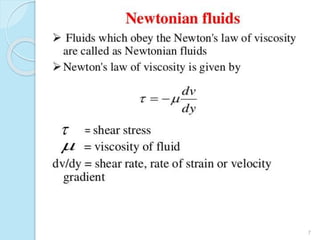
Newtonian fluid
7
Non-Newtonian fluid:
 The real fluid, in which the shear stress is
not directly proportional to the rate of
shear strain is know as non Newtonian
fluids.
 For example:
ketchup, custard, toothpaste, starch,
blood, and shampoo are non Newtonian
fluids.
8
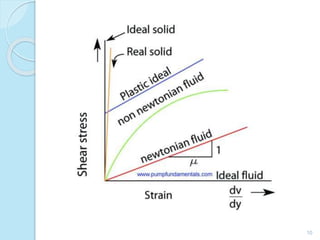
Ideal Plastic fluid:
 A fluid in which the shear stress is
more than the yield value and the
shear stress is directly proportional to
the rate of shear strain that is it should
follow Newton's law of viscosity.
 It behaves as a rigid body at low
stresses but flows as a viscous fluid at
high stress .
 Eg : tooth paste can be considered as
ideal plastic fluid
9
10
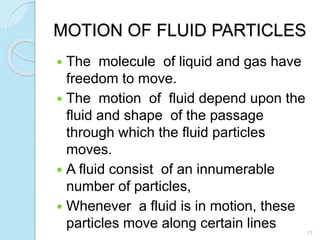
MOTION OF FLUID PARTICLES
 The molecule of liquid and gas have
freedom to move.
 The motion of fluid depend upon the
fluid and shape of the passage
through which the fluid particles
moves.
 A fluid consist of an innumerable
number of particles,
 Whenever a fluid is in motion, these
particles move along certain lines 11
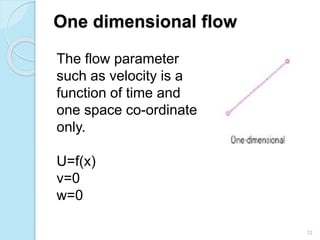
One dimensional flow
12
The flow parameter
such as velocity is a
function of time and
one space co-ordinate
only.
U=f(x)
v=0
w=0
Two dimensional flow
13
The velocity is a
function of time and two
rectangular space co-
ordinates.
U=f(x,y) v=f(x,y)
w=0
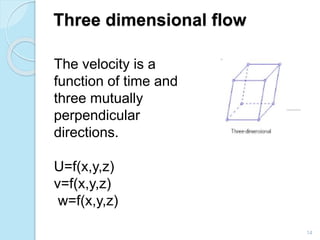
Three dimensional flow
14
The velocity is a
function of time and
three mutually
perpendicular
directions.
U=f(x,y,z)
v=f(x,y,z)
w=f(x,y,z)
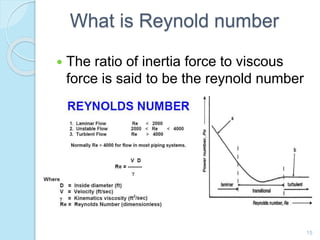
What is Reynold number
15
 The ratio of inertia force to viscous
force is said to be the reynold number
.
Reynolds number
16
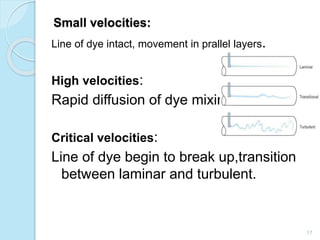
Small velocities:
Line of dye intact, movement in prallel layers.
High velocities:
Rapid diffusion of dye mixing. .
Critical velocities:
Line of dye begin to break up,transition
between laminar and turbulent.
17
Types of fluid flow:
 Steady & Unsteady Flows.
 Uniform & Non-uniform Flows.
 Laminar & Turbulent Flows.
Compressible & Incompressible Flows.
Rotational & Irrotational Flows.
18
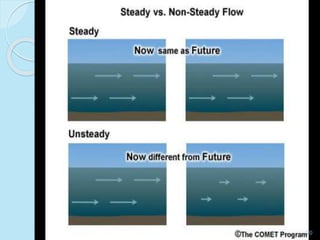
Steady & Unsteady Flow:
 The steady flow In which the fluid
Characteristics like velocity, pressure,
density at a Point do not change with
respect to time.
The unsteady flow in which the fluid
characteristics velocity , pressure or
density at a point changes with respect to
time.
19
20
Uniform & Non-uniform Flow:
The uniform flow is defined as the type
of fluid in which the flow parameters like,
pressure , velocity and density etc, at a
given time do not change with respect to
space.
The non-uniform flow is defines as the
type of fluid in which the flow parameters
like pressure , velocity, density etc, at a
given time change with respect to space.
21
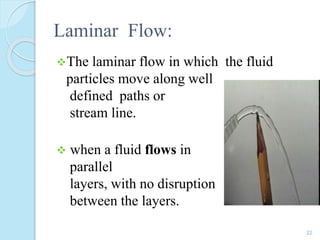
Laminar Flow:
The laminar flow in which the fluid
particles move along well
defined paths or
stream line.
 when a fluid flows in
parallel
layers, with no disruption
between the layers.
22
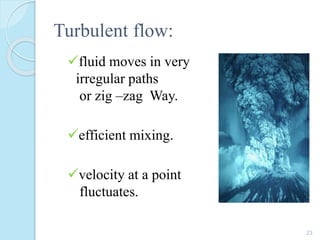
Turbulent flow:
fluid moves in very
irregular paths
or zig –zag Way.
efficient mixing.
velocity at a point
fluctuates.
23
Compressible & Incompressible
flows:
Compressible flow is the branch of fluid
mechanics that deals with flows having
significant changes in fluid density.
Gases, but not liquids, display such
behaviour.
Incompressible flow is the branch of
fluid mechanics which refers the flow in
which the density is constant within a
fluid that moves with a velocity.
24
Rotational&Irrotational Flow
Rotational flow:
In which the fluid particles while flowing
along stream lines, Also rotate about their
own axis.
25
Irrotational flow:
In which the fluid particles while flowing
along stream lines, do not rotate about
their own axis.
26
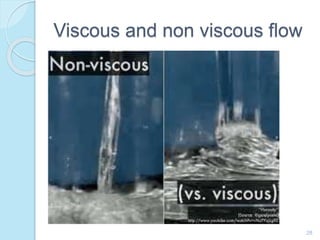
Viscous and non viscous flow
 A viscous fluid ,such as honey ,does not flow
readily and is said to have a large viscosity.
 In contrast, water is less viscous and flows more
readily;water has a smaller viscosity than honey.
 The flow of viscous fluid is an energy dissipating
process.
 A fluid with zero velocity flows in an unhindered
manner with no dissipation of energy .
 Although no real fluid has zero viscosity at normal
temperatures ,some fluids have negligibly small
velocities.
 An incompressible, non viscous fluid is called an
ideal fluid.
27
Viscous and non viscous flow
28
29

Quasi steady and unsteady flow

  • 1.
  • 2.
    Topic: Quasi Steady andUnsteady flow 2
  • 3.
    What are FLUIDS a substance that has no fixed shape and yields easily to external pressure; a gas or (especially) a liquid  Particles can move past each other 3
  • 4.
    Types of Fluid: Ideal Fluid  Real Fluid  Newtonian fluids  Non- Newtonian fluids  Ideal plastic fluids 4
  • 5.
    Ideal Fluids:  Afluid ; a) Is incompressible b) Have zero viscosity c) An imaginary fluid d) No surface tension 5
  • 6.
    Real Fluid:  Afluid a) Have viscosity b) Compressible c) Have surface tension d) For example; water 6
  • 7.
  • 8.
    Non-Newtonian fluid:  Thereal fluid, in which the shear stress is not directly proportional to the rate of shear strain is know as non Newtonian fluids.  For example: ketchup, custard, toothpaste, starch, blood, and shampoo are non Newtonian fluids. 8
  • 9.
    Ideal Plastic fluid: A fluid in which the shear stress is more than the yield value and the shear stress is directly proportional to the rate of shear strain that is it should follow Newton's law of viscosity.  It behaves as a rigid body at low stresses but flows as a viscous fluid at high stress .  Eg : tooth paste can be considered as ideal plastic fluid 9
  • 10.
  • 11.
    MOTION OF FLUIDPARTICLES  The molecule of liquid and gas have freedom to move.  The motion of fluid depend upon the fluid and shape of the passage through which the fluid particles moves.  A fluid consist of an innumerable number of particles,  Whenever a fluid is in motion, these particles move along certain lines 11
  • 12.
    One dimensional flow 12 Theflow parameter such as velocity is a function of time and one space co-ordinate only. U=f(x) v=0 w=0
  • 13.
    Two dimensional flow 13 Thevelocity is a function of time and two rectangular space co- ordinates. U=f(x,y) v=f(x,y) w=0
  • 14.
    Three dimensional flow 14 Thevelocity is a function of time and three mutually perpendicular directions. U=f(x,y,z) v=f(x,y,z) w=f(x,y,z)
  • 15.
    What is Reynoldnumber 15  The ratio of inertia force to viscous force is said to be the reynold number .
  • 16.
  • 17.
    Small velocities: Line ofdye intact, movement in prallel layers. High velocities: Rapid diffusion of dye mixing. . Critical velocities: Line of dye begin to break up,transition between laminar and turbulent. 17
  • 18.
    Types of fluidflow:  Steady & Unsteady Flows.  Uniform & Non-uniform Flows.  Laminar & Turbulent Flows. Compressible & Incompressible Flows. Rotational & Irrotational Flows. 18
  • 19.
    Steady & UnsteadyFlow:  The steady flow In which the fluid Characteristics like velocity, pressure, density at a Point do not change with respect to time. The unsteady flow in which the fluid characteristics velocity , pressure or density at a point changes with respect to time. 19
  • 20.
  • 21.
    Uniform & Non-uniformFlow: The uniform flow is defined as the type of fluid in which the flow parameters like, pressure , velocity and density etc, at a given time do not change with respect to space. The non-uniform flow is defines as the type of fluid in which the flow parameters like pressure , velocity, density etc, at a given time change with respect to space. 21
  • 22.
    Laminar Flow: The laminarflow in which the fluid particles move along well defined paths or stream line.  when a fluid flows in parallel layers, with no disruption between the layers. 22
  • 23.
    Turbulent flow: fluid movesin very irregular paths or zig –zag Way. efficient mixing. velocity at a point fluctuates. 23
  • 24.
    Compressible & Incompressible flows: Compressibleflow is the branch of fluid mechanics that deals with flows having significant changes in fluid density. Gases, but not liquids, display such behaviour. Incompressible flow is the branch of fluid mechanics which refers the flow in which the density is constant within a fluid that moves with a velocity. 24
  • 25.
    Rotational&Irrotational Flow Rotational flow: Inwhich the fluid particles while flowing along stream lines, Also rotate about their own axis. 25
  • 26.
    Irrotational flow: In whichthe fluid particles while flowing along stream lines, do not rotate about their own axis. 26
  • 27.
    Viscous and nonviscous flow  A viscous fluid ,such as honey ,does not flow readily and is said to have a large viscosity.  In contrast, water is less viscous and flows more readily;water has a smaller viscosity than honey.  The flow of viscous fluid is an energy dissipating process.  A fluid with zero velocity flows in an unhindered manner with no dissipation of energy .  Although no real fluid has zero viscosity at normal temperatures ,some fluids have negligibly small velocities.  An incompressible, non viscous fluid is called an ideal fluid. 27
  • 28.
    Viscous and nonviscous flow 28
  • 29.