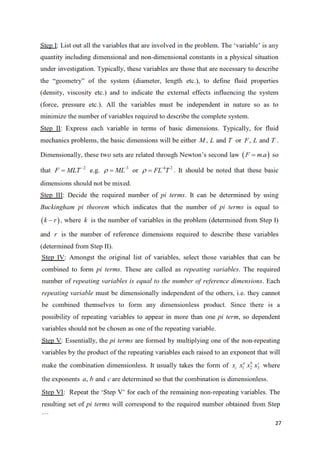
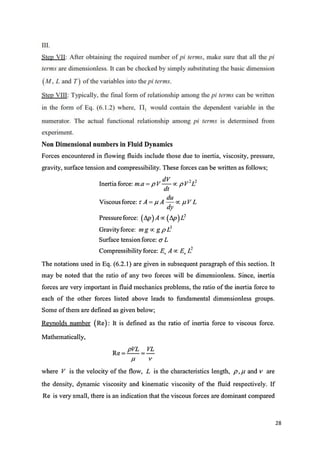
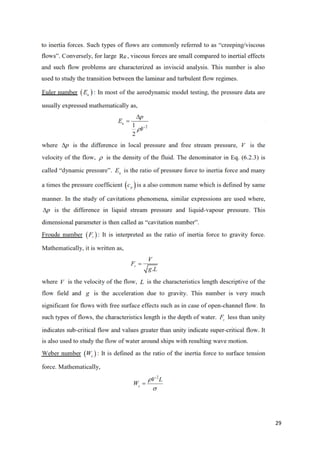
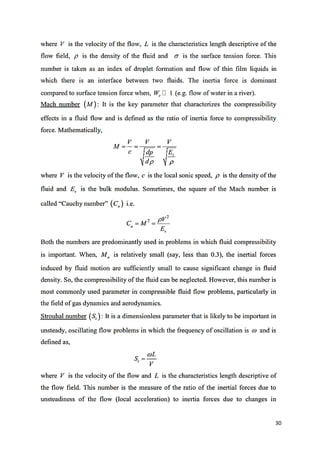
SCHOOL OF MECHANICAL ENGINEERING
DEPARTMENT OF MECHANICAL ENGINEERING
UNIT – I – Fluid Mechanics and Machinery – SMEA1303
UNIT 1 FLUID PROPERTIES
Fluids: Substances capable of flowing are known as fluids. Flow is the continuous deformation of
substances under the action of shear stresses.
Fluids have no definite shape of their own, but confirm to the shape of the containing vessel. Fluids
include liquids and gases.
Fluid Mechanics:
Fluid mechanics is the branch of science that deals with the behavior of fluids at rest as well as in
motion. Thus,it deals with the static, kinematics and dynamic aspects of fluids.
The study of fluids at rest is called fluid statics. The study of fluids in motion, where pressure
forces are not considered, is called fluid kinematics and if the pressure forces are also considered for
the fluids in motion, that branch of science is called fluid dynamics.
Fluid Properties:
1.Density (or )Mass Density:
Density or mass density of a fluid is defined as the ratio of the mass of the fluid to its volume.
Thus, Mass per unit volume of a fluid is called density.
Mass density,  
Mass of fluid
Volume of fluid
3
S.I unit of density is kg/m .
3
The value of density for water is 1000 kg/m .
2.Specific weight (or) Weight Density (w ):
Specific weight or weight density of a fluid is the ratio between the weight of a fluid to its
volume.
The weight per unit volume of a fluid is called specific weight or weight density.
 Weight of fluid
Weight density
Volume of fluid
 Mass of fluid X g
w
Volume of fluid
w  g
3
S.I unit of specific weight is N/m .
3
The value of specific weight or weight density of water is 9810N/m
3. Specific Volume (ʋ):
or 9.81 kN/m³.
Specific volume of a fluid is defined as the volume of a fluid occupied by unit mass.
Volume per unit mass of a fluid is called Specific volume.
Page | 1
;
Specific volume 
Volume of a fluid

1
Mass of fluid 
Thus specific volume is the reciprocal of mass density. S.I unit: m3
/kg.
4. Specific Gravity (s):
Specific gravity is defined as the ratio of the specific weight of a fluid to the specific weight of
a standard fluid.
Specific gravity 
Specific weight of liquid
Specific weight of water
Specific gravity is also equal to Relative density. Relative density =
5. Viscosity:
Viscosity is defined as the property of a fluid which offers resistance to the movement of one
layer of fluid over adjacent layer of the fluid.
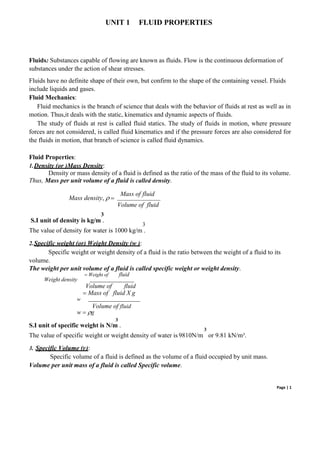
When two layers of a fluid, at distance ‘dy’ apart, move one
over the other at different velocities, say u and u+du as shown in
figure. The viscosity together with relative velocity causes a shear
stress acting between the fluid layers.
The top layer causes a shear stress on the adjacent lower layer
while the lower layer causes a shear stress on the adjacent top
layer.
This shear stress is proportional to the rate of change of
velocity with respect to y.
 du
dy
or    du dy
Fig.1. Velocity distribution curve
Thus the viscosity is also defined as the shear stress required to produce unit rate of shear
strain.
S.I unit: Ns/m². It is still expressed in poise (P) as well as centipoises (cP).
Kinematic Viscosity (ν): It is defined as the ratio between the dynamic viscosity and density of fluid. It is
denoted by the nu.
V = Viscosity/Density = µ/ρ
In MKS and SI unit of kinematic viscosity is metre2
/sec or m2
/sec while CGs units it is written as cm2/s.
In CGS units kinematic viscosity is also known as stoke.
One stoke = cm2
/s = (1/100)2
m2
/s = 10-4
m2
/s and centistokes means = 1/100 stoke
Page | 2
Newton's Law of Viscosity:
It states that the shear stress (τ) on a fluid element layer is directly proportional to the rate of shear
strain. The constant of proportionality is called the co-efficient of viscosity.
   du
dy
6.Compressibility:
Compressibility is the reciprocal of the bulk modulus of elasticity, K, which is defined as the
ratio of compressive stress to volumetric strain.
Compression of fluids gives rise to pressure with the decrease in volume.
If dv is the decrease in volume and dp is the increase in pressure, Volumetric Strain =
(- ve sign indicate the volume decreases with increase of pressure)
Bulk modulus, K =
Increase of pressure
Volumetric Strain
dp
=
 dV
V
Compressibility =
1
K
 dV
V
7.Surface tension:
Surface tension is defined as the tensile force acting on the surface of a liquid in contact with a
gas or on the surface between two immiscible liquids such that the contact surface behaves like a
membrane under tension.
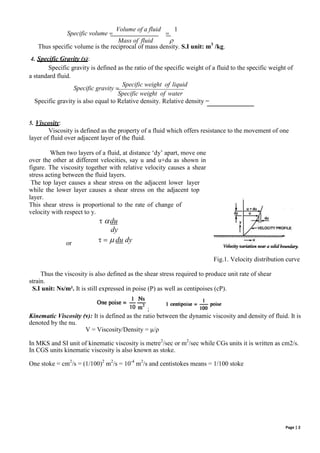
Fig.2. Forces on droplet
Surface Tension on Liquid Droplet:
Consider a small spherical droplet of a liquid of diameter ‘d’. On the entire surface of the droplet,
the tensile force due to surface tension will be acting.
Let σ = Surface tension of the liquid
p = Pressure intensity inside the droplet (in excess of the outside pressure
intensity) d = Dia. of droplet.
Let the droplet is cut into two halves. The forces acting on one half will be
i) Tensile force (FT)due to surface tension acting around the circumference of the cut portion
as shown in fig. and this is equal to = σ x Circumference = σ x π d
Pressure force (Fp) on the area C= p x (π/4) d2
as shown in the figure.
These two forces are equal under equilibrium conditions. i.e.,
Page | 3
p x (π/4) d2
= σ x π d
P = (σ x π d)/( σ x π d) = 4 σ /d
Surface Tension on a Hollow Bubble:
A hollow bubble like a soap bubble in air has two surfaces in contact with air, one inside and other
outside. Thus two surfaces arc subjected to surface tension. In that case,
2
p (π/4) d2
= 2(σ x π d)
P = (2σ π d)/ (π/4) d2
= 8 σ /d
8. Capillarity:
Capillarity is defined as a phenomenon of rise or fall of a liquid surface in a small tube relative to the
adjacent general level of liquid when the tube is held vertically in the liquid.
The rise of liquid surface is known as capillary rise while the fall of the liquid surface is known as
capillary depression. It is expressed in terms of cm or mm of liquid. Its value depends upon the
specific weight of the liquid, diameter of the tube and surface tension of the liquid.
Expression for Capillary Rise:
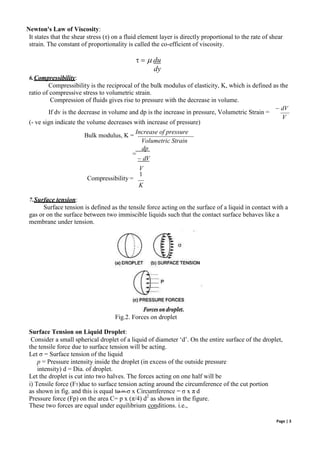
Consider a glass tube of small diameter ‘d' opened at both ends and is inserted in a liquid. The liquid
will rise in the lube above the level of the liquid.
Let, h = height of the liquid in the tube. Under
a state of equilibrium,
the weight of liquid of height h is balanced by
the force at the surface of
the liquid in the tube. But the force at
the surface of the liquid in the tube is
due to surface tension.
Let, σ = Surface tension of liquid
θ= Angle of contact between liquid and
glass lube.
Fig.3. Capillary Rise
The weight of liquid of height ‘h’ in the tube = (Area of tube x h) x ρ x g
where, ρ = density of liquid
Vertical component of the surface tensile force
= σ x Circumference x cos θ
= σ x πd x cos θ
Weight of liquid of height ‘h’ in the tube = Vertical component of the surface tensile force
9.Vapour pressure:
Vapour pressure is the pressure of the vapor over a liquid which is confined in a closed vessel at
equilibrium. Vapour pressure increases with temperature. All liquids exhibit this phenomenon.
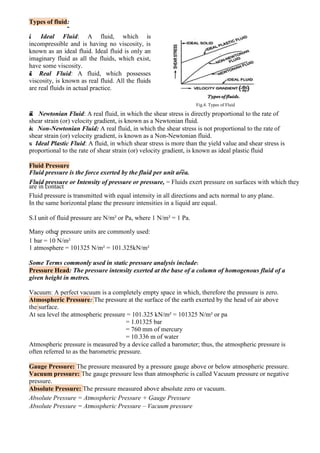
Types of fluid:
i. Ideal Fluid: A fluid, which is
incompressible and is having no viscosity, is
known as an ideal fluid. Ideal fluid is only an
imaginary fluid as all the fluids, which exist,
have some viscosity.
ii. Real Fluid: A fluid, which possesses
viscosity, is known as real fluid. All the fluids
are real fluids in actual practice.
Fig.4. Types of Fluid
iii. Newtonian Fluid: A real fluid, in which the shear stress is directly proportional to the rate of
shear strain (or) velocity gradient, is known as a Newtonian fluid.
iv. Non-Newtonian Fluid: A real fluid, in which the shear stress is not proportional to the rate of
shear strain (or) velocity gradient, is known as a Non-Newtonian fluid.
v. Ideal Plastic Fluid: A fluid, in which shear stress is more than the yield value and shear stress is
proportional to the rate of shear strain (or) velocity gradient, is known as ideal plastic fluid
Fluid Pressure
Fluid pressure is the force exerted by the fluid per unit area.
Fluid pressure or Intensity of pressure or pressure, = Fluids exert pressure on surfaces with which they
are in contact.
Fluid pressure is transmitted with equal intensity in all directions and acts normal to any plane.
In the same horizontal plane the pressure intensities in a liquid are equal.
S.I unit of fluid pressure are N/m² or Pa, where 1 N/m² = 1 Pa.
Many other pressure units are commonly used:
5
1 bar = 10 N/m²
1 atmosphere = 101325 N/m² = 101.325kN/m²
Some Terms commonly used in static pressure analysis include:
Pressure Head: The pressure intensity exerted at the base of a column of homogenous fluid of a
given height in metres.
Vacuum: A perfect vacuum is a completely empty space in which, therefore the pressure is zero.
Atmospheric Pressure: The pressure at the surface of the earth exerted by the head of air above
the surface.
At sea level the atmospheric pressure = 101.325 kN/m² = 101325 N/m² or pa
= 1.01325 bar
= 760 mm of mercury
= 10.336 m of water
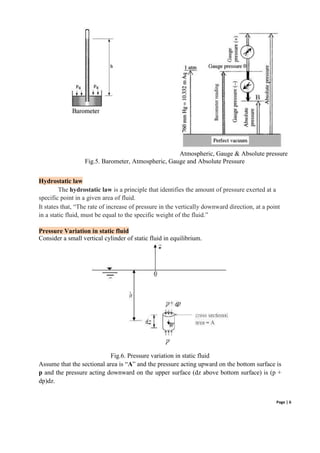
Atmospheric pressure is measured by a device called a barometer; thus, the atmospheric pressure is
often referred to as the barometric pressure.
Gauge Pressure: The pressure measured by a pressure gauge above or below atmospheric pressure.
Vacuum pressure: The gauge pressure less than atmospheric is called Vacuum pressure or negative
pressure.
Absolute Pressure: The pressure measured above absolute zero or vacuum.
Absolute Pressure = Atmospheric Pressure + Gauge Pressure
Absolute Pressure = Atmospheric Pressure – Vacuum pressure
Atmospheric, Gauge & Absolute pressure
Fig.5. Barometer, Atmospheric, Gauge and Absolute Pressure
Hydrostatic law
The hydrostatic law is a principle that identifies the amount of pressure exerted at a
specific point in a given area of fluid.
It states that, “The rate of increase of pressure in the vertically downward direction, at a point
in a static fluid, must be equal to the specific weight of the fluid.”
Pressure Variation in static fluid
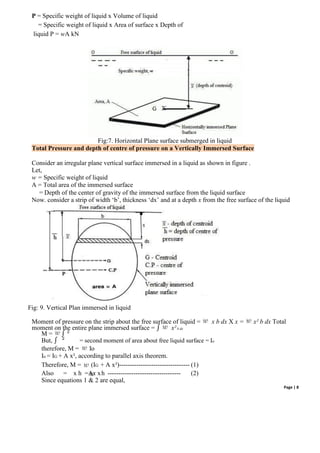
Consider a small vertical cylinder of static fluid in equilibrium.
Fig.6. Pressure variation in static fluid
Assume that the sectional area is “A” and the pressure acting upward on the bottom surface is
p and the pressure acting downward on the upper surface (dz above bottom surface) is (p +
dp)dz.
Page | 6
Let the free surface of the fluid be the origin, i.e., Z = 0. Then the pressure variation at a
depth Z = - h below the free surface is governed by
(p + dp) A + W = pA
dpA + ρgAdz = 0 [W= w x volume = ρg Adz] dp = -ρgdz
= - ρg = - w
Therefore, the hydrostatic pressure increases linearly with depth at the rate of the specific
weight, w = ρg of the fluid.
If fluid is homogeneous, ρ is constant.
By simply integrating the above equation,
ʃdp = - ʃρg dz => p = - ρg Z + C
Where C is constant of integration.
When z = 0 (on the free surface), p = C = po = the atmospheric pressure.
Hence, p = - ρgZ + po
Pressure given by this equation is called ABSOLUTE PRESSURE, i.e., measured above
perfect vacuum.
However, it is more convenient to measure the pressure as gauge pressure by setting
atmospheric pressure as datum pressure. By setting po = 0,
p = -ρgz+0 = -ρgz = ρgh
p = wh
The equation derived above shows that when the density is constant, the pressure in a liquid at
rest increases linearly with depth from the free surface.
Here, h is known as pressure head or simply head of fluid.
In fluid mechanics, fluid pressure is usually expressed in height of fluids or head of fluids.
Hydrostatic force
Hydrostatic pressure is the force exerted by a static fluid on a plane surface, when the static
fluid comes in contact with the surface. This force will act normal to the surface. It is also known as
Total Pressure.
The point of application of the hydrostatic or total pressure on the surface is known as Centre of
pressure.
The vertical distance between the free surface of fluid and the centre of pressure is called depth of
centre of pressure or location of hydrostatic force.
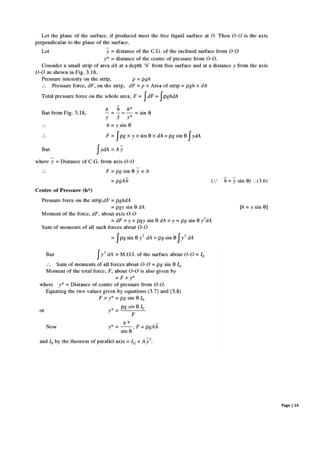
Total Pressure on a Horizontally Immersed Surface
Consider a plane horizontal surface immersed in a liquid as shown in figure.
Let, w = Specific weight of the liquid, kN/m³
A = Area of the immersed surface in m²
= Depth of the horizontal surface from the liquid level in
m We know that,
Total pressure on the surface, P = Weight of the liquid above the immersed surface
Page | 7
Page | 8
P = Specific weight of liquid x Volume of liquid
= Specific weight of liquid x Area of surface x Depth of
liquid P = wA kN
Fig:7. Horizontal Plane surface submerged in liquid
Total Pressure and depth of centre of pressure on a Vertically Immersed Surface
Consider an irregular plane vertical surface immersed in a liquid as shown in figure .
Let,
w = Specific weight of liquid
A = Total area of the immersed surface
= Depth of the center of gravity of the immersed surface from the liquid surface
Now. consider a strip of width ‘b’, thickness ‘dx’ and at a depth x from the free surface of the liquid
Fig: 9. Vertical Plan immersed in liquid
Moment of pressure on the strip about the free surface of liquid = x b dx X x = x² b dx Total
moment on the entire plane immersed surface = ∫ x²b dx
M = ∫ ²
But, ∫ ² = second moment of area about free liquid surface = Io
therefore, M = Io
Io = IG + A x², according to parallel axis theorem.
Therefore, M = (IG + A x²)--------------------------------- (1)
Also = x h =Ax xh ---------------------------------- (2)
Since equations 1 & 2 are equal,
Page | 9
A x h = (IG + A x
²)
epth of centre of pressure, h
= (IG + A x²) / A
h* = [ (IG + Ah2
)/Ah] + h
Total Pressure and depth of Centre of Pressure on an Inclined Immersed Surface
Consider a plane inclined surface, immersed in a liquid as shown in figure. Let,
w = Specific weight of the liquid
A = Total area of the immersed surface
x = Depth of the centroid of the immersed plane surface from the free surface of liquid.
θ = Angle at which the immersed surface is inclined with the liquid
surface h
= depth of centre of pressure from the liquid surface
b = width of the considered thin
strip dx = thickness of the strip
O = the reference point obtained by projecting the plane surface with the free surface of liquid
x = distance of the strip from O
Fig: 10. Inclined Immersed Plain
Page | 14
Page | 14
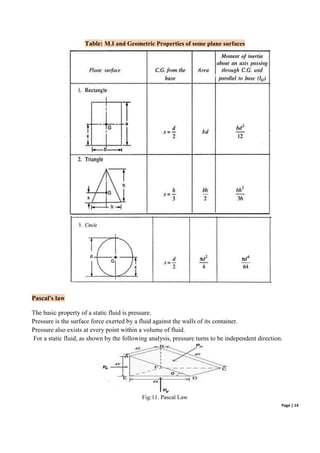
Table: M.I and Geometric Properties of some plane surfaces
Pascal's law
The basic property of a static fluid is pressure.
Pressure is the surface force exerted by a fluid against the walls of its container.
Pressure also exists at every point within a volume of fluid.
For a static fluid, as shown by the following analysis, pressure turns to be independent direction.
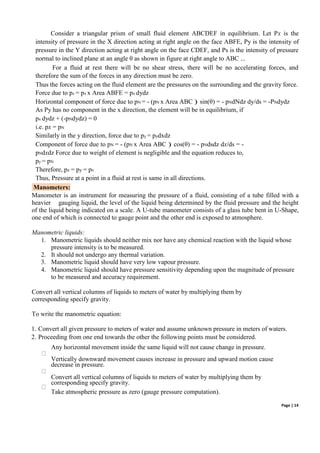
Fig:11. Pascal Law
Page | 14
Consider a triangular prism of small fluid element ABCDEF in equilibrium. Let Px is the
intensity of pressure in the X direction acting at right angle on the face ABFE, Py is the intensity of
pressure in the Y direction acting at right angle on the face CDEF, and Ps is the intensity of pressure
normal to inclined plane at an angle θ as shown in figure at right angle to ABC ..
For a fluid at rest there will be no shear stress, there will be no accelerating forces, and
therefore the sum of the forces in any direction must be zero.
Thus the forces acting on the fluid element are the pressures on the surrounding and the gravity force.
Force due to px = px x Area ABFE = px dydz
Horizontal component of force due to pN = - (pN x Area ABC ) sin(θ) = - pNdNdz dy/ds = -PNdydz
As Py has no component in the x direction, the element will be in equilibrium, if
px dydz + (-pNdydz) = 0
i.e. px = pN
Similarly in the y direction, force due to py = pydxdz
Component of force due to pN = - (pN x Area ABC ) cos(θ) = - pNdsdz dx/ds = -
pNdxdz Force due to weight of element is negligible and the equation reduces to,
py = pN
Therefore, px = py = pN
Thus, Pressure at a point in a fluid at rest is same in all directions.
Manometers:
Manometer is an instrument for measuring the pressure of a fluid, consisting of a tube filled with a
heavier gauging liquid, the level of the liquid being determined by the fluid pressure and the height
of the liquid being indicated on a scale. A U-tube manometer consists of a glass tube bent in U-Shape,
one end of which is connected to gauge point and the other end is exposed to atmosphere.
Manometric liquids:
1. Manometric liquids should neither mix nor have any chemical reaction with the liquid whose
pressure intensity is to be measured.
2. It should not undergo any thermal variation.
3. Manometric liquid should have very low vapour pressure.
4. Manometric liquid should have pressure sensitivity depending upon the magnitude of pressure
to be measured and accuracy requirement.
Convert all vertical columns of liquids to meters of water by multiplying them by
corresponding specify gravity.
To write the manometric equation:
1. Convert all given pressure to meters of water and assume unknown pressure in meters of waters.
2. Proceeding from one end towards the other the following points must be considered.

Any horizontal movement inside the same liquid will not cause change in pressure.
Vertically downward movement causes increase in pressure and upward motion cause
decrease in pressure.
Convert all vertical columns of liquids to meters of water by multiplying them by
corresponding specify gravity.
Take atmospheric pressure as zero (gauge pressure computation).
Page | 14
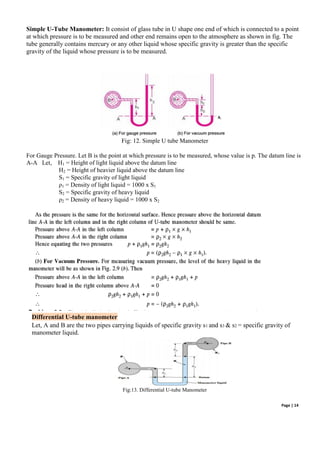
Simple U-Tube Manometer: It consist of glass tube in U shape one end of which is connected to a point
at which pressure is to be measured and other end remains open to the atmosphere as shown in fig. The
tube generally contains mercury or any other liquid whose specific gravity is greater than the specific
gravity of the liquid whose pressure is to be measured.
Fig: 12. Simple U tube Manometer
For Gauge Pressure. Let B is the point at which pressure is to be measured, whose value is p. The datum line is
A-A Let, H1 = Height of light liquid above the datum line
H2 = Height of heavier liquid above the datum line
S1 = Specific gravity of light liquid
ρ1 = Density of light liquid = 1000 x S1
S2 = Specific gravity of heavy liquid
ρ2 = Density of heavy liquid = 1000 x S2
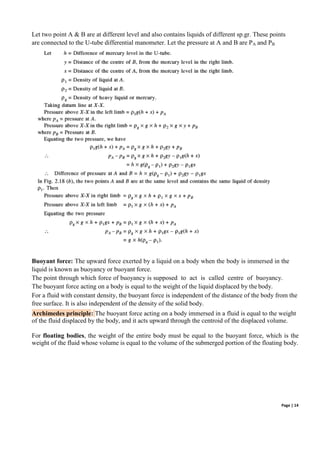
Differential U-tube manometer
Let, A and B are the two pipes carrying liquids of specific gravity s1 and s3 & s2 = specific gravity of
manometer liquid.
Fig:13. Differential U-tube Manometer
=
Page | 14
Let two point A & B are at different level and also contains liquids of different sp.gr. These points
are connected to the U-tube differential manometer. Let the pressure at A and B are PA and PB
Buoyant force: The upward force exerted by a liquid on a body when the body is immersed in the
liquid is known as buoyancy or buoyant force.
The point through which force of buoyancy is supposed to act is called centre of buoyancy.
The buoyant force acting on a body is equal to the weight of the liquid displaced by the body.
For a fluid with constant density, the buoyant force is independent of the distance of the body from the
free surface. It is also independent of the density of the solid body.
Archimedes principle: The buoyant force acting on a body immersed in a fluid is equal to the weight
of the fluid displaced by the body, and it acts upward through the centroid of the displaced volume.
For floating bodies, the weight of the entire body must be equal to the buoyant force, which is the
weight of the fluid whose volume is equal to the volume of the submerged portion of the floating body.
Page | 14
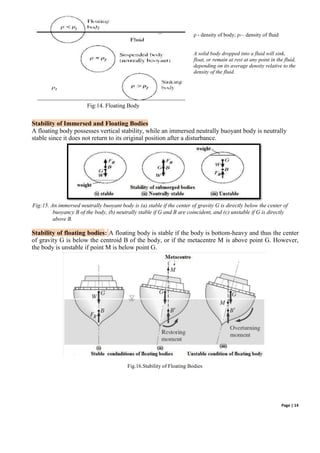
ρ - density of body; ρf – density of fluid
A solid body dropped into a fluid will sink,
float, or remain at rest at any point in the fluid,
depending on its average density relative to the
density of the fluid.
Fig:14. Floating Body
Stability of Immersed and Floating Bodies
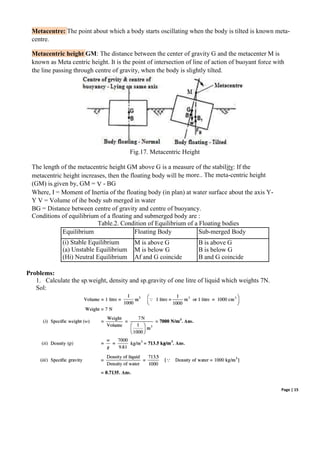
A floating body possesses vertical stability, while an immersed neutrally buoyant body is neutrally
stable since it does not return to its original position after a disturbance.
Fig:15. An immersed neutrally buoyant body is (a) stable if the center of gravity G is directly below the center of
buoyancy B of the body, (b) neutrally stable if G and B are coincident, and (c) unstable if G is directly
above B.
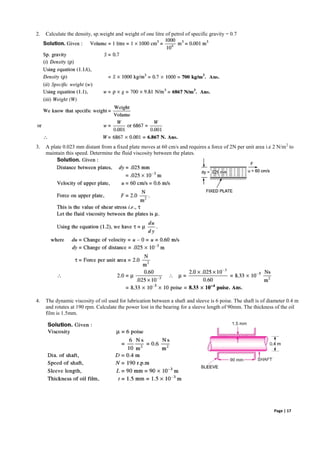
Stability of floating bodies: A floating body is stable if the body is bottom-heavy and thus the center
of gravity G is below the centroid B of the body, or if the metacentre M is above point G. However,
the body is unstable if point M is below point G.
Fig.16.Stability of Floating Bodies
Page | 15
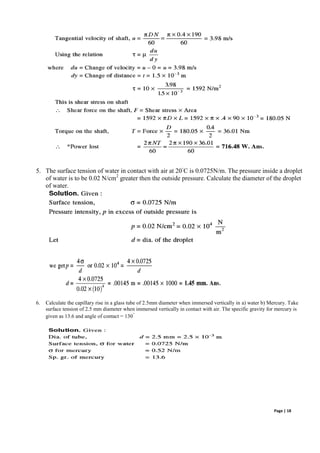
Metacentre: The point about which a body starts oscillating when the body is tilted is known meta-
centre.
Metacentric height GM: The distance between the center of gravity G and the metacenter M is
known as Meta centric height. It is the point of intersection of line of action of buoyant force with
the line passing through centre of gravity, when the body is slightly tilted.
Fig.17. Metacentric Height
The length of the metacentric height GM above G is a measure of the stability: If the
metacentric height increases, then the floating body will be more.. The meta-centric height
(GM) is.given by, GM = V - BG
Where, I = Moment of Inertia of the floating body (in plan) at water surface about the axis Y-
Y V = Volume of ihe body sub merged in water
BG = Distance between centre of gravity and centre of buoyancy.
Conditions of equilibrium of a floating and submerged body are :
Table.2. Condition of Equilibrium of a Floating bodies
Problems:
1. Calculate the sp.weight, density and sp.gravity of one litre of liquid which weights 7N.
Sol:
Equilibrium Floating Body Sub-merged Body
(i) Stable Equilibrium
(a) Unstable Equilibrium
(Hi) Neutral Equilibrium
M is above G
M is below G
Af and G coincide
B is above G
B is below G
B and G coincide
Page | 17
2. Calculate the density, sp.weight and weight of one litre of petrol of specific gravity = 0.7
3. A plate 0.023 mm distant from a fixed plate moves at 60 cm/s and requires a force of 2N per unit area i.e 2 N/m2
to
maintain this speed. Determine the fluid viscosity between the plates.
4. The dynamic viscosity of oil used for lubrication between a shaft and sleeve is 6 poise. The shaft is of diameter 0.4 m
and rotates at 190 rpm. Calculate the power lost in the bearing for a sleeve length of 90mm. The thickness of the oil
film is 1.5mm.
Page | 18
5. The surface tension of water in contact with air at 20◦
C is 0.0725N/m. The pressure inside a droplet
of water is to be 0.02 N/cm2
greater then the outside pressure. Calculate the diameter of the droplet
of water.
6. Calculate the capillary rise in a glass tube of 2.5mm diameter when immersed vertically in a) water b) Mercury. Take
surface tension of 2.5 mm diameter when immersed vertically in contact with air. The specific gravity for mercury is
given as 13.6 and angle of contact = 130
◦
Page | 19
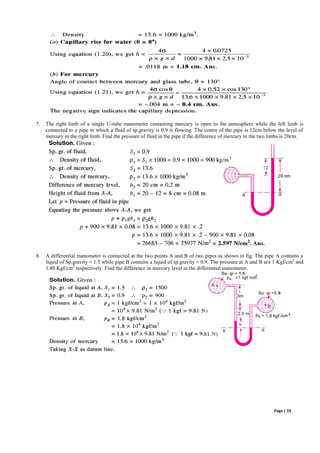
7. The right limb of a single U-tube manometer containing mercury is open to the atmosphere while the left limb is
connected to a pipe in which a fluid of sp.gravity is 0.9 is flowing. The centre of the pipe is 12cm below the level of
mercury in the right limb. Find the pressure of fluid in the pipe if the difference of mercury in the two limbs is 20cm.
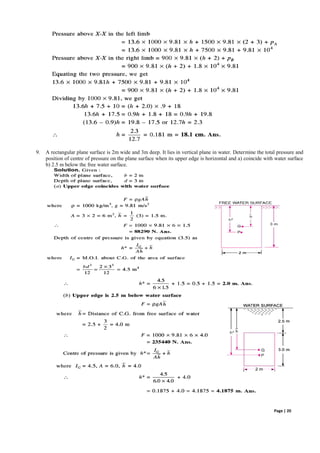
8. A differential manometer is connected at the two points A and B of two pipes as shown in fig. The pipe A contains a
liquid of Sp.gravity = 1.5 while pipe B contains a liquid of sp.gravity = 0.9. The pressure at A and B are 1 Kgf/cm2
and
1.80 Kgf/cm2
respectively. Find the difference in mercury level in the differential manometer.
Page | 20
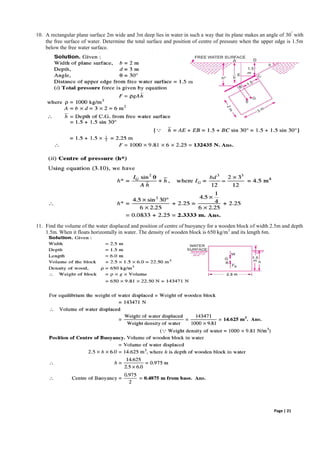
9. A rectangular plane surface is 2m wide and 3m deep. It lies in vertical plane in water. Determine the total pressure and
position of centre of pressure on the plane surface when its upper edge is horizontal and a) coincide with water surface
b) 2.5 m below the free water surface.
Page | 21
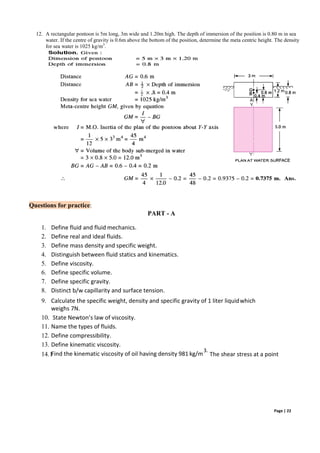
10. A rectangular plane surface 2m wide and 3m deep lies in water in such a way that its plane makes an angle of 30
◦
with
the free surface of water. Determine the total surface and position of centre of pressure when the upper edge is 1.5m
below the free water surface.
11. Find the volume of the water displaced and position of centre of buoyancy for a wooden block of width 2.5m and depth
1.5m. When it floats horizontally in water. The density of wooden block is 650 kg/m3
and its length 6m.
Page | 22
12. A rectangular pontoon is 5m long, 3m wide and 1.20m high. The depth of immersion of the position is 0.80 m in sea
water. If the centre of gravity is 0.6m above the bottom of the position, determine the meta centric height. The density
for sea water is 1025 kg/m3
.
Questions for practice:
1. Define fluid and fluid mechanics.
2. Define real and ideal fluids.
PART - A
3. Define mass density and specific weight.
4. Distinguish between fluid statics and kinematics.
5. Define viscosity.
6. Define specific volume.
7. Define specific gravity.
8. Distinct b/w capillarity and surface tension.
9. Calculate the specific weight, density and specific gravity of 1 liter liquidwhich
weighs 7N.
10. State Newton’s law of viscosity.
11. Name the types of fluids.
12. Define compressibility.
13. Define kinematic viscosity.
14.1
Find the kinematic viscosity of oil having density 981 kg/m
3.
The shear stress at a point
Page | 25
in oil is 0.2452N/m and velocity gradient at that point is 0.2/sec.
15. Determine the specific gravity of a fluid having 0.05 poise and kinematic viscosity0.035
stokes.
16. Find out the minimum size of glass tube that can be used to measure water level if the
capillary rise is restricted to 2 mm. Consider surface tension of water in contact withair
as 0.073575 N/m.
17. Write down the expression for capillary fall.
18. Explain vapour pressure .
19. Two horizontal plates are placed 1.25 cm apart. The space between them is being
filled with oil of viscosity 14 poises. Calculate the shear stress in oil if upper plateis
moved with a velocity of 2.5 m/s.
20. State Pascal’s law.
21. What is mean by absolute and gauge pressure and vacuum pressure?
22. Define Manometer and list out its types.
23. Define centre of pressure and total pressure.
24. Define buoyancy and centre of buoyancy.
25. Define Meta centre.
26. Define Hydro static Pressure.
27. What is stable equilibrium of floating bodies?
28. What is stable equilibrium of submerged bodies?
PART – B
1. Calculate the capillary effect in a glass tube of 4.5 mm diameter, when immersed in (a) water
o
(a) mercury. The temperature of the liquid is 20
o
C and the values of the surface tension of
water and mercury at 20 C in contact with air are 0.073575 N/m and 0.51 N/m respectively.
o
The angle of contact for water is zero that for mercury 130
3
. Take specific weight of water as
9800 N/m .
2. If the velocity profile of a liquid over a plate is a parabolic with the vertex 202
cm from the plate, where the velocity is 120 cm/sec. calculate the velocity
gradients and shear stress at a distance of 0, 10 and 20 cm from the plate, if the
viscosity of the fluid is 8.5 poise.
3. The dynamic viscosity of oil, used for lubrication between a shaft and sleeve is 6
poise. The shaft is of diameter 0.4 m and rotates at 190 rpm. Calculate the power lost
in the bearing for a sleeve length of 90mm. the thickness of the oil film is 1.5 mm.
2
4. If the velocity distribution over a plate is given by u=2/3 y – y in which u is the
velocity in
m/s at a distance y meter above the plate, determine the shear stress at y = 0 and y
= 0.15 m.
5. The velocity distribution of flow is given by u = ly² + my+c with vertex 30 cm
from the plate, where velocity is 1.8 m/s. If µ = 0.9 Ns/m², find the velocity
gradients and shear stresses at y = 0, 15 and 30 cm from the plate.
6. Derive Pascal’s law.
7. Derive expression for capillary rise and fall.
8. Two large plane surfaces are 2.4 cm apart. The space between the gap is filled
with glycerin. What force is required to drag a thin plate of size 0.5 m between
two large plane surfaces at a speed of 0.6 m/sec. if the thin plate is (i) in the
middle gap (ii) thin plate is 0.8 cm from one of the plane surfaces? Take
dynamic viscosity of fluid is 8.1 poise.
9. Calculate the capillary rise in a glass tube of 2.5 mm diameter when immersed vertically in
(a)water
(b) mercury. Take surface tension = 0.0725 N/m for water and = 0.52 N/m for
mercury in contact with air. The specific gravity for mercury is given as 13.6 and
angle of contact of mercury with glass =
130 degree.
10. A U - Tube manometer is used to measure the pressure of water in a pipe line,
which is in excess of atmospheric pressure. The right limb of the manometer
contains water and mercury is in the left limb. Determine the pressure of
water in the main line, if the difference in level of mercury in the limbs of U
tube is 10 cm and the free surface of mercury is in level withover
the centre of the pipe. If the pressure of water in pipe line is reduced to 9810 N/m2
,
Calculate the new difference in the level of mercury. Sketch the arrangement in
both cases.
11. Calculate the total hydrostatic force and location of centre of pressure for a
circular plate of 2.5 m diameter when immersed vertically in an oil of specific gravity 0.8
with its top edge 1.5 m below the oil.
13. A rectangular plate 2.5m x 3.5 m is submerged in water and makes an angle
of 60° with the horizontal, the 2.5m sides being horizontal. Calculate the total
force on the plate and the location of the point of application of the force,
when the top edge of the plate is 1.6m below the water surface.
14. A rectangular plate 1.5 m x 3 m is immersed in an oil of specific gravity 0.82
such that its upper and lower edge is at depths 1.5 m and 3 m respectively.
Determine the total pressure acting on the plate and its location.
15. In an open container water is filled to a height of 2.5m and above that an oil
of Specific gravity 0.85 is filled for a depth of 1.4 m. Find the intensity of
pressure at the interface of two liquids and at the bottom of the tank.
16. The pressure Intensity at a point is 40kPa. Find corresponding pressure
head in (a) water(b) Mercury (c) oil of specific gravity 0.9.
1
SCHOOL OF MECHANICAL ENGINEERING
DEPARTMENT OF MECHANICAL ENGINEERING
UNIT – 2- Fluid Mechanics and Machinery – SMEA1303
2
UNIT – 2 Equations of Motion
Fluid flow is described by two methods: Lagrangian method & Eulerian method In the
Lagrangian method a single particle is followed over the flow field with the co ordinate
system following the particle. The flow description is particle based and not space based.
A moving coordinate system has to be used. In the Eulerian method, the description of
flow is based on fixed coordinate system and the description of the velocity is with
reference to location and time. Hence, Eulerian approach is easily adoptable to describe
fluid motion mathematically.
Control Volume:
A fixed volume in space whose size and shape is entirely arbitrary, through which a
fluid is continuously flowing is known as control volume. The boundary of a control
volume is termed as the control surface. The size and shape is arbitrary and normally
chosen such that it encloses part of the flow of particular interest.
Types of Fluid Flow:
1)Steady flow: The flow in which the fluid characteristics like velocity, pressure,
density etc. at a point do not change with time is defined as steady flow.
Mathematically, for steady flow,
Unsteady Flow: The flow, in which the velocity, pressure and density at a point changes
with respect to time is defined as unsteady flow.
Mathematically, for unsteady flow
2. Uniform flows: The flow in which the velocity at any given time does not change
with respect to distance is defined as Uniform flow.
Mathematically, for uniform flow
Non-uniform flow: The flow in which the velocity at any given time changes with
respect to distance is defined as non uniform flow.
Mathematically, for non-uniform flow,
3. Laminar flow: The flow in which the fluid particles move along well-defined paths
which are straight and parallel is defined as laminar flow. Thus the particles move in
layers and do not cross each other.
Turbulent flow: The flow in which the fluid particles do not move in a zig-zag way
and the adjacent layers cross each other is defined as turbulent flow.
Fig.1. Laminar & Turbulent Flow
4. Compressible flow: The flow in which the density of fluid changes from point to
point ie., ρ is not constant for the fluid, is defined as compressible flow.
Mathematically, for compressible flow, ρ ≠ constant.
3
Incompressible flow: The flow in which the density of fluid is constant is defined as
incompressible flow.
Liquids are generally incompressible while gases are compressible.
Mathematically, for incompressible flow,   Constant
5.Rotational flow: The flow in which the fluid particles while flowing along stream-
lines, also rotate about their own axes, that type of flow is known as rotational flow.
Irrotational flow: The flow in which the fluid particles while flowing along
stream-lines, do not rotate about their own axes, that type of flow is called
irrotational flow.
6. One Dimensional Flow:
One dimensional flow is that type of flow in which the fluid velocity is a
function of one- space-co-ordinate only. The variation of velocities in other two
mutually perpendicular directions is assumed negligible.
Mathematically, for one-dimensional flow
u  f x, v = 0 and w = 0
where u, v and w are velocity components in x, y and z directions respectively.
Two-dimensional flow:
It is that type of flow in which the velocity is a function of two space co-
ordinates only. Thus, mathematically for two dimensional flow
u  f1 x, y, v  f 2 x, y and w = 0
Three-dimensional flow:
It is the type of flow in which the velocity is a function of three space co-
ordinates (x, y and z). Mathematically for three dimensional flow,
u  f1 x, y, z, v  f 2 x, y, z , w  f 3 x, y, z.
Path Line:
A path line is the trajectory of an individual element of fluid.
Streamline:
A streamline is an imaginary continuous line within a moving fluid such that the
tangent at each point is the direction of the flow velocity vector at that point.
Stream Tube:
An imaginary tube (need not be circular) formed by collection of neighboring
streamlines through which the fluid flows is known as stream tube.
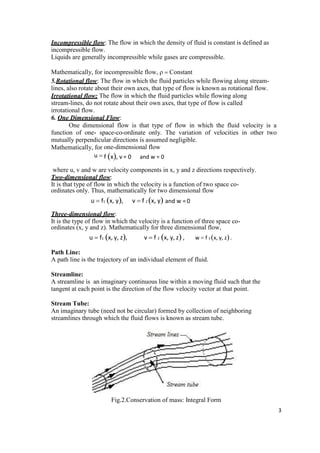
Fig.2.Conservation of mass: Integral Form
4
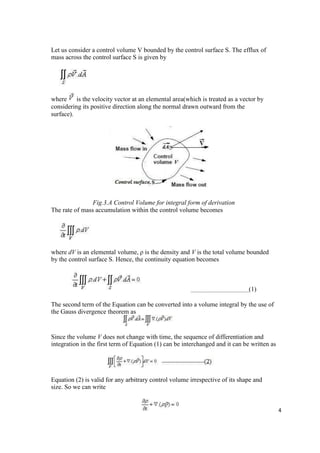
Let us consider a control volume V bounded by the control surface S. The efflux of
mass across the control surface S is given by
where is the velocity vector at an elemental area(which is treated as a vector by
considering its positive direction along the normal drawn outward from the
surface).
Fig.3.A Control Volume for integral form of derivation
The rate of mass accumulation within the control volume becomes
where dV is an elemental volume, ρ is the density and V is the total volume bounded
by the control surface S. Hence, the continuity equation becomes
(1)
The second term of the Equation can be converted into a volume integral by the use of
the Gauss divergence theorem as
Since the volume V does not change with time, the sequence of differentiation and
integration in the first term of Equation (1) can be interchanged and it can be written as
Equation (2) is valid for any arbitrary control volume irrespective of its shape and
size. So we can write
5
Conservation of Energy:
The law of conservation of energy says “energy cannot be created or be destroyed; One
form of energy can be changed into another form only”.
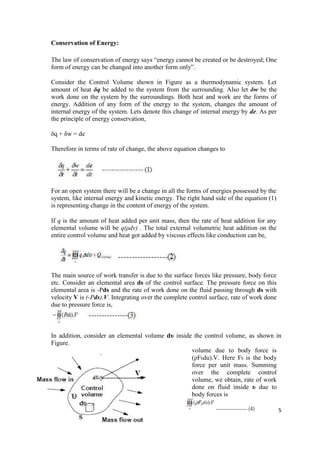
Consider the Control Volume shown in Figure as a thermodynamic system. Let
amount of heat δq be added to the system from the surrounding. Also let δw be the
work done on the system by the surroundings. Both heat and work are the forms of
energy. Addition of any form of the energy to the system, changes the amount of
internal energy of the system. Lets denote this change of internal energy by de. As per
the principle of energy conservation,
δq + δw = de
Therefore in terms of rate of change, the above equation changes to
For an open system there will be a change in all the forms of energies possessed by the
system, like internal energy and kinetic energy. The right hand side of the equation (1)
is representing change in the content of energy of the system.
If q is the amount of heat added per unit mass, then the rate of heat addition for any
elemental volume will be q(ρdv) . The total external volumetric heat addition on the
entire control volume and heat got added by viscous effects like conduction can be,
The main source of work transfer is due to the surface forces like pressure, body force
etc. Consider an elemental area ds of the control surface. The pressure force on this
elemental area is -Pds and the rate of work done on the fluid passing through ds with
velocity V is (-Pds).V. Integrating over the complete control surface, rate of work done
due to pressure force is,
In addition, consider an elemental volume dυ inside the control volume, as shown in
Figure.
volume due to body force is
(ρFbdu).V. Here Fb is the body
force per unit mass. Summing
over the complete control
volume, we obtain, rate of work
done on fluid inside υ due to
body forces is
6
The rate of work done on the elemental
If the flow is viscous, the shear stress on the control surface will also do work on the
fluid as it passes across the surface. Let Wviscous denote the work done due to the
shear stress. Therefore, the total work done on the fluid inside the control volume is
the sum of terms given by (3) and (4) and Wviscous, that is
For the open system considered, the changes in internal energy as well as kinetic
energy need to be accounted. Therefore, right hand side of equation (1) should deal
with total energy (sum of internal and kinetic energies) of the system. Let, e be the
internal energy per unit mass of the system and kinetic energy per unit mass due to
local velocity V be V²/2.
Total energy in the control volume might also change due to influx and outflux of the
fluid. The elemental mass flow across ds is (ρV.ds). Therefore the elemental flow of
total energy across the ds is (ρV.ds)(e+V²/2).
Hence the net energy change of the control volume is,
) -------------------(6)
Thus, substituting Equations (2), (5) and (6) in equation (1), we have
This is the energy equation in the integral form. It is essentially the first law
thermodynamics applied to fluid flow or open system.
One dimensional form of Conservation of Energy
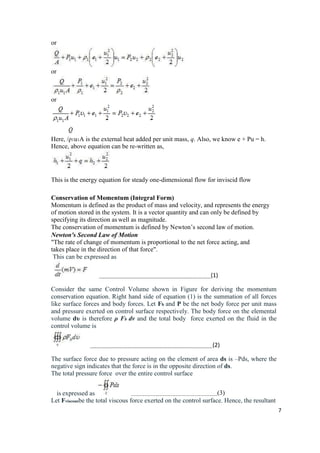
Consider the control volume shown in Figure for steady inviscid flow without
body force, Then the equation (9) reduces to,
Let us denote the first term on left hand side of above equation by to represent
the total external heat addition in the system. Thus, above equation becomes
2
− ∯ = ∯ [ + ]
2
Evaluating the surface integrals over the control volume in Figure, we obtain
7
or
or
or
Here, /ρ1u1A is the external heat added per unit mass, q. Also, we know e + Pu = h.
Hence, above equation can be re-written as,
This is the energy equation for steady one-dimensional flow for inviscid flow
Conservation of Momentum (Integral Form)
Momentum is defined as the product of mass and velocity, and represents the energy
of motion stored in the system. It is a vector quantity and can only be defined by
specifying its direction as well as magnitude.
The conservation of momentum is defined by Newton’s second law of motion.
Newton's Second Law of Motion
"The rate of change of momentum is proportional to the net force acting, and
takes place in the direction of that force".
This can be expressed as
(1)
Consider the same Control Volume shown in Figure for deriving the momentum
conservation equation. Right hand side of equation (1) is the summation of all forces
like surface forces and body forces. Let Fb and P be the net body force per unit mass
and pressure exerted on control surface respectively. The body force on the elemental
volume dυ is therefore ρ Fb dv and the total body force exerted on the fluid in the
control volume is
(2)
The surface force due to pressure acting on the element of area ds is –Pds, where the
negative sign indicates that the force is in the opposite direction of ds.
The total pressure force over the entire control surface
is expressed as (3)
Let Fviscousbe the total viscous force exerted on the control surface. Hence, the resultant
8
force
experienced by the fluid is given by
(4)
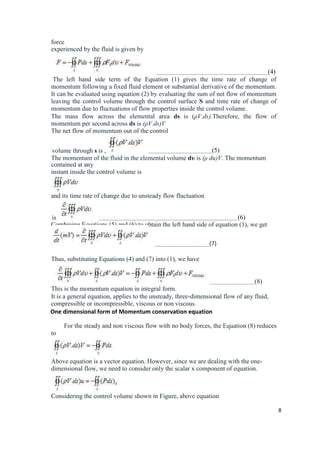
The left hand side term of the Equation (1) gives the time rate of change of
momentum following a fixed fluid element or substantial derivative of the momentum.
It can be evaluated using equation (2) by evaluating the sum of net flow of momentum
leaving the control volume through the control surface S and time rate of change of
momentum due to fluctuations of flow properties inside the control volume.
The mass flow across the elemental area ds is (ρV.ds).Therefore, the flow of
momentum per second across ds is (ρV.ds)V
The net flow of momentum out of the control
volume through s is , (5)
The momentum of the fluid in the elemental volume dυ is (ρ du)V. The momentum
contained at any
instant inside the control volume is
and its time rate of change due to unsteady flow fluctuation
is (6)
Combining Equations (5) and (6) to obtain the left hand side of equation (1), we get
(7)
Thus, substituting Equations (4) and (7) into (1), we have
(8)
This is the momentum equation in integral form.
It is a general equation, applies to the unsteady, three-dimensional flow of any fluid,
compressible or incompressible, viscous or non viscous.
One dimensional form of Momentum conservation equation
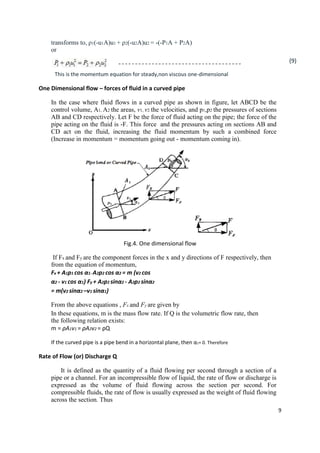
For the steady and non viscous flow with no body forces, the Equation (8) reduces
to
Above equation is a vector equation. However, since we are dealing with the one-
dimensional flow, we need to consider only the scalar x component of equation.
Considering the control volume shown in Figure, above equation
9
transforms to, ρ1(-u1A)u1 + ρ2(-u2A)u2 = -(-P1A + P2A)
or
(9)
This is the momentum equation for steady,non viscous one-dimensional
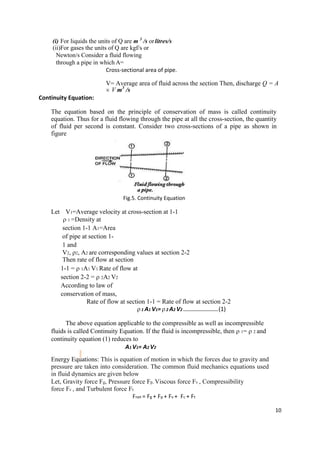
One Dimensional flow – forces of fluid in a curved pipe
In the case where fluid flows in a curved pipe as shown in figure, let ABCD be the
control volume, A1, A2 the areas, v1, v2 the velocities, and p1,p2 the pressures of sections
AB and CD respectively. Let F be the force of fluid acting on the pipe; the force of the
pipe acting on the fluid is -F. This force and the pressures acting on sections AB and
CD act on the fluid, increasing the fluid momentum by such a combined force
(Increase in momentum = momentum going out - momentum coming in).
Fig.4. One dimensional flow
If Fx and Fy are the component forces in the x and y directions of F respectively, then
from the equation of momentum,
Fx + A1p1 cos α1- A2p2 cos α2 = m (v2 cos
α2 - v1 cos α1) Fy + A2p2 sinα2 - A2p2 sinα2
= m(v2 sinα2 –v1 sinα1)
From the above equations , Fx and Fy are given by
In these equations, m is the mass flow rate. If Q is the volumetric flow rate, then
the following relation exists:
m = ρA1v1 = ρA2v2 = ρQ
If the curved pipe is a pipe bend in a horizontal plane, then α1= 0. Therefore
Rate of Flow (or) Discharge Q
It is defined as the quantity of a fluid flowing per second through a section of a
pipe or a channel. For an incompressible flow of liquid, the rate of flow or discharge is
expressed as the volume of fluid flowing across the section per second. For
compressible fluids, the rate of flow is usually expressed as the weight of fluid flowing
across the section. Thus
10
(i) For liquids the units of Q are m 3
/s orlitres/s
(ii)For gases the units of Q are kgf/s or
Newton/s Consider a fluid flowing
through a pipe in which A=
Cross-sectional area of pipe.
V= Average area of fluid across the section Then, discharge Q = A
V m3
/s
Continuity Equation:
The equation based on the principle of conservation of mass is called continuity
equation. Thus for a fluid flowing through the pipe at all the cross-section, the quantity
of fluid per second is constant. Consider two cross-sections of a pipe as shown in
figure
Fig.5. Continuity Equation
Let V1=Average velocity at cross-section at 1-1
 1 =Density at
section 1-1 A1=Area
of pipe at section 1-
1 and
V2, ρ2, A2 are corresponding values at section 2-2
Then rate of flow at section
1-1 =  1A1 V1 Rate of flow at
section 2-2 =  2A2 V2
According to law of
conservation of mass,
Rate of flow at section 1-1 = Rate of flow at section 2-2
1 A1 V1= 2 A2 V2 ................................(1)
The above equation applicable to the compressible as well as incompressible
fluids is called Continuity Equation. If the fluid is incompressible, then  1=  2 and
continuity equation (1) reduces to
A1 V1= A2 V2
Energy Equations: This is equation of motion in which the forces due to gravity and
pressure are taken into consideration. The common fluid mechanics equations used
in fluid dynamics are given below
Let, Gravity force Fg, Pressure force Fp, Viscous force Fv , Compressibility
force Fc , and Turbulent force Ft.
Fnet = Fg + Fp + Fv + Fc + Ft
11
1. If fluid is incompressible, then Fc = 0
This is known as Reynolds equation of motion.
2. If fluid is incompressible and turbulence is negligible, then
This equation is called as Navier-Stokes equation.
3. If fluid flow is considered ideal then, viscous effect will also be negligible. Then
Fnet = Fg + Fp
This equation is known as Euler’s equation.
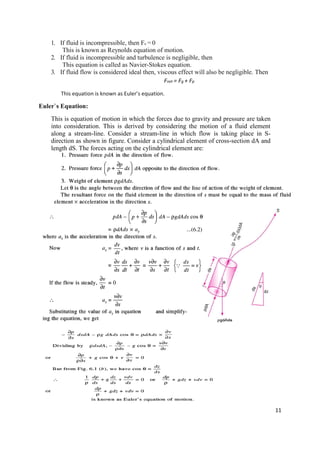
Euler`s Equation:
This is equation of motion in which the forces due to gravity and pressure are taken
into consideration. This is derived by considering the motion of a fluid element
along a stream-line. Consider a stream-line in which flow is taking place in S-
direction as shown in figure. Consider a cylindrical element of cross-section dA and
length dS. The forces acting on the cylindrical element are:
12
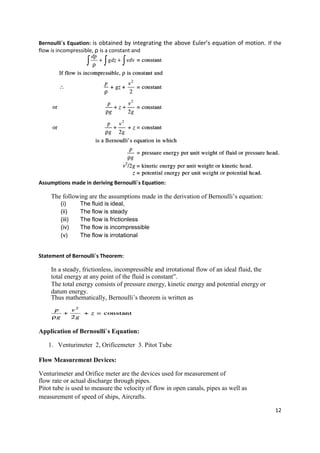
Bernoulli`s Equation: is obtained by integrating the above Euler’s equation of motion. If the
flow is incompressible, ρ is a constant and
Assumptions made in deriving Bernoulli`s Equation:
The following are the assumptions made in the derivation of Bernoulli’s equation:
(i) The fluid is ideal,
(ii) The flow is steady
(iii) The flow is frictionless
(iv) The flow is incompressible
(v) The flow is irrotational
Statement of Bernoulli`s Theorem:
In a steady, frictionless, incompressible and irrotational flow of an ideal fluid, the
total energy at any point of the fluid is constant”.
The total energy consists of pressure energy, kinetic energy and potential energy or
datum energy.
Thus mathematically, Bernoulli’s theorem is written as
Application of Bernoulli`s Equation:
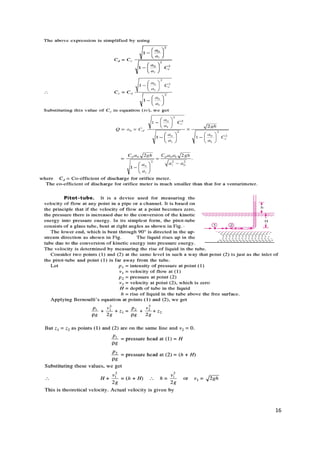
1. Venturimeter 2, Orificemeter 3. Pitot Tube
Flow Measurement Devices:
Venturimeter and Orifice meter are the devices used for measurement of
flow rate or actual discharge through pipes.
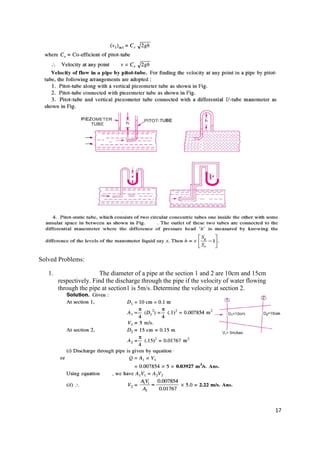
Pitot tube is used to measure the velocity of flow in open canals, pipes as well as
measurement of speed of ships, Aircrafts.
13
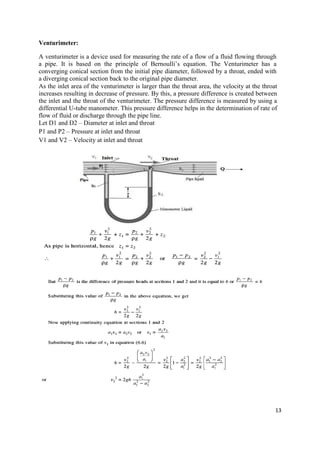
Venturimeter:
A venturimeter is a device used for measuring the rate of a flow of a fluid flowing through
a pipe. It is based on the principle of Bernoulli’s equation. The Venturimeter has a
converging conical section from the initial pipe diameter, followed by a throat, ended with
a diverging conical section back to the original pipe diameter.
As the inlet area of the venturimeter is larger than the throat area, the velocity at the throat
increases resulting in decrease of pressure. By this, a pressure difference is created between
the inlet and the throat of the venturimeter. The pressure difference is measured by using a
differential U-tube manometer. This pressure difference helps in the determination of rate of
flow of fluid or discharge through the pipe line.
Let D1 and D2 – Diameter at inlet and throat
P1 and P2 – Pressure at inlet and throat
V1 and V2 – Velocity at inlet and throat
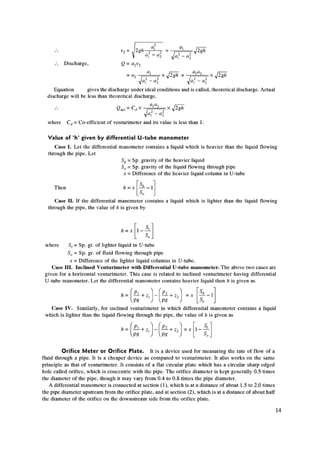
14
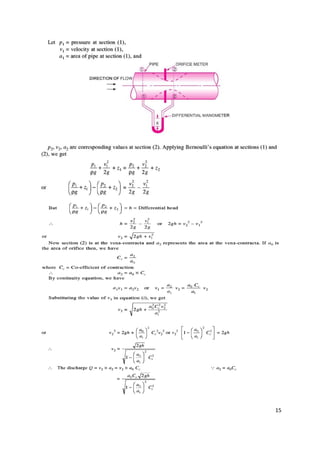
15
16
17
Solved Problems:
1. The diameter of a pipe at the section 1 and 2 are 10cm and 15cm
respectively. Find the discharge through the pipe if the velocity of water flowing
through the pipe at section1 is 5m/s. Determine the velocity at section 2.
18
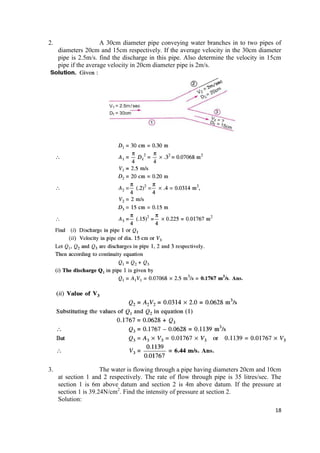
2. A 30cm diameter pipe conveying water branches in to two pipes of
diameters 20cm and 15cm respectively. If the average velocity in the 30cm diameter
pipe is 2.5m/s. find the discharge in this pipe. Also determine the velocity in 15cm
pipe if the average velocity in 20cm diameter pipe is 2m/s.
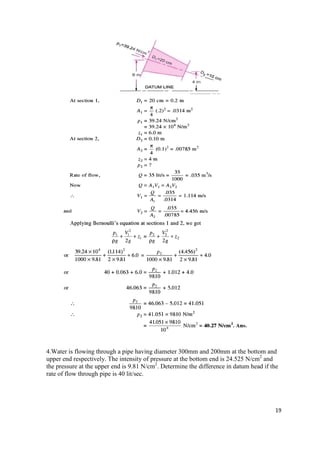
3. The water is flowing through a pipe having diameters 20cm and 10cm
at section 1 and 2 respectively. The rate of flow through pipe is 35 litres/sec. The
section 1 is 6m above datum and section 2 is 4m above datum. If the pressure at
section 1 is 39.24N/cm2
. Find the intensity of pressure at section 2.
Solution:
19
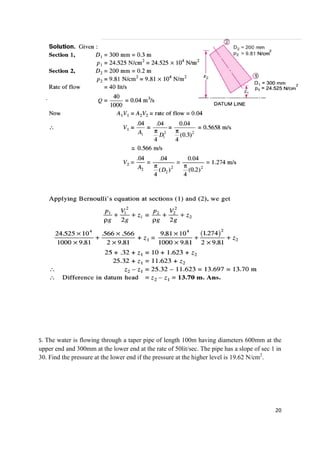
4.Water is flowing through a pipe having diameter 300mm and 200mm at the bottom and
upper end respectively. The intensity of pressure at the bottom end is 24.525 N/cm2
and
the pressure at the upper end is 9.81 N/cm2
. Determine the difference in datum head if the
rate of flow through pipe is 40 lit/sec.
20
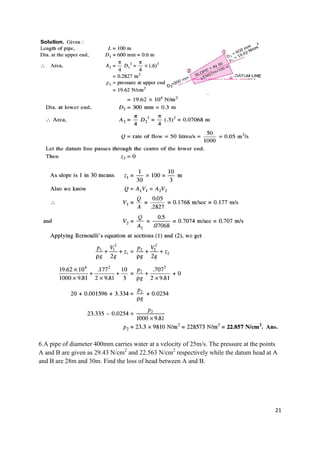
5. The water is flowing through a taper pipe of length 100m having diameters 600mm at the
upper end and 300mm at the lower end at the rate of 50lit/sec. The pipe has a slope of sec 1 in
30. Find the pressure at the lower end if the pressure at the higher level is 19.62 N/cm2
.
21
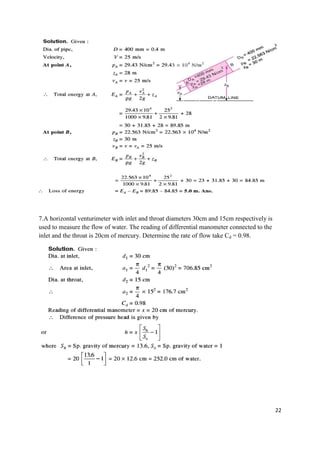
6.A pipe of diameter 400mm carries water at a velocity of 25m/s. The pressure at the points
A and B are given as 29.43 N/cm2
and 22.563 N/cm2
respectively while the datum head at A
and B are 28m and 30m. Find the loss of head between A and B.
22
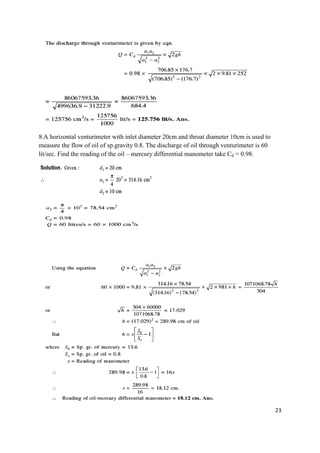
7.A horizontal venturimeter with inlet and throat diameters 30cm and 15cm respectively is
used to measure the flow of water. The reading of differential manometer connected to the
inlet and the throat is 20cm of mercury. Determine the rate of flow take Cd = 0.98.
23
8.A horizontal venturimeter with inlet diameter 20cm and throat diameter 10cm is used to
measure the flow of oil of sp.gravity 0.8. The discharge of oil through venturimeter is 60
lit/sec. Find the reading of the oil – mercury differential manometer take Cd = 0.98.
24
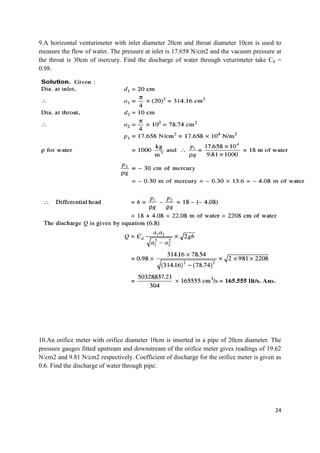
9.A horizontal venturimeter with inlet diameter 20cm and throat diameter 10cm is used to
measure the flow of water. The pressure at inlet is 17.658 N/cm2 and the vacuum pressure at
the throat is 30cm of mercury. Find the discharge of water through veturimeter take Cd =
0.98.
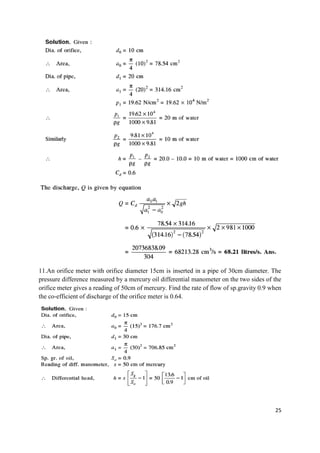
10.An orifice meter with orifice diameter 10cm is inserted in a pipe of 20cm diameter. The
pressure gauges fitted upstream and downstream of the orifice meter gives readings of 19.62
N/cm2 and 9.81 N/cm2 respectively. Coefficient of discharge for the orifice meter is given as
0.6. Find the discharge of water through pipe.
25
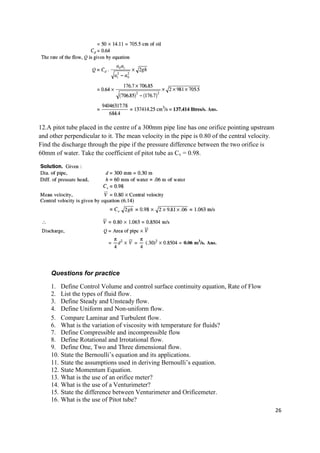
11.An orifice meter with orifice diameter 15cm is inserted in a pipe of 30cm diameter. The
pressure difference measured by a mercury oil differential manometer on the two sides of the
orifice meter gives a reading of 50cm of mercury. Find the rate of flow of sp.gravity 0.9 when
the co-efficient of discharge of the orifice meter is 0.64.
26
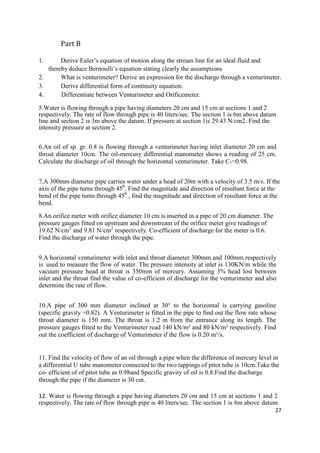
12.A pitot tube placed in the centre of a 300mm pipe line has one orifice pointing upstream
and other perpendicular to it. The mean velocity in the pipe is 0.80 of the central velocity.
Find the discharge through the pipe if the pressure difference between the two orifice is
60mm of water. Take the coefficient of pitot tube as Cv = 0.98.
Questions for practice
1. Define Control Volume and control surface continuity equation, Rate of Flow
2. List the types of fluid flow.
3. Define Steady and Unsteady flow.
4. Define Uniform and Non-uniform flow.
5. Compare Laminar and Turbulent flow.
6. What is the variation of viscosity with temperature for fluids?
7. Define Compressible and incompressible flow
8. Define Rotational and Irrotational flow.
9. Define One, Two and Three dimensional flow.
10. State the Bernoulli’s equation and its applications.
11. State the assumptions used in deriving Bernoulli’s equation.
12. State Momentum Equation.
13. What is the use of an orifice meter?
14. What is the use of a Venturimeter?
15. State the difference between Venturimeter and Orificemeter.
16. What is the use of Pitot tube?
27
Part B
1. Derive Euler’s equation of motion along the stream line for an ideal fluid and
thereby deduce Bernoulli’s equation stating clearly the assumptions
2. What is venturimeter? Derive an expression for the discharge through a venturimeter.
3. Derive differential form of continuity equation.
4. Differentiate between Venturimeter and Orificemeter.
5.Water is flowing through a pipe having diameters 20 cm and 15 cm at sections 1 and 2
respectively. The rate of flow through pipe is 40 liters/sec. The section 1 is 6m above datum
line and section 2 is 3m above the datum. If pressure at section 1is 29.43 N/cm2. Find the
intensity pressure at section 2.
6.An oil of sp. gr. 0.8 is flowing through a venturimeter having inlet diameter 20 cm and
throat diameter 10cm. The oil-mercury differential manometer shows a reading of 25 cm.
Calculate the discharge of oil through the horizontal venturimeter. Take Cv=0.98.
7.A 300mm diameter pipe carries water under a head of 20m with a velocity of 3.5 m/s. If the
axis of the pipe turns through 450
. Find the magnitude and direction of resultant force at the
bend of the pipe turns through 450
, find the magnitude and direction of resultant force at the
bend.
8.An orifice meter with orifice diameter 10 cm is inserted in a pipe of 20 cm diameter. The
pressure gauges fitted on upstream and downstream of the orifice meter give readings of
19.62 N/cm2
and 9.81 N/cm2
respectively. Co-efficient of discharge for the meter is 0.6.
Find the discharge of water through the pipe.
9.A horizontal venturimeter with inlet and throat diameter 300mm and 100mm respectively
is used to measure the flow of water. The pressure intensity at inlet is 130KN/m while the
vacuum pressure head at throat is 350mm of mercury. Assuming 3% head lost between
inlet and the throat find the value of co-efficient of discharge for the venturimeter and also
determine the rate of flow.
10.A pipe of 300 mm diameter inclined at 30° to the horizontal is carrying gasoline
(specific gravity =0.82). A Venturimeter is fitted in the pipe to find out the flow rate whose
throat diameter is 150 mm. The throat is 1.2 m from the entrance along its length. The
pressure gauges fitted to the Venturimeter read 140 kN/m² and 80 kN/m² respectively. Find
out the coefficient of discharge of Venturimeter if the flow is 0.20 m³/s.
11. Find the velocity of flow of an oil through a pipe when the difference of mercury level in
a differential U tube manometer connected to the two tappings of pitot tube is 10cm.Take the
co- efficient of of pitot tube as 0.98and Specific gravity of oil is 0.8.Find the discharge
through the pipe if the diameter is 30 cm.
12. Water is flowing through a pipe having diameters 20 cm and 15 cm at sections 1 and 2
respectively. The rate of flow through pipe is 40 liters/sec. The section 1 is 6m above datum
28
line and section2 is 3m above the datum. If pressure at section 2 is 3m above the datum. If
pressure at section 1 is 29.43 N/cm2
. Find the intensity of pressure at section 2.
13.Water flows upwards in a vertical pipe line of gradually varying section from point 1 to
point 2, which is 1.5m above point 1, at the rate of 0.9 m³/s. At section 1 the pipe dia is 0.5m
and pressure is 300 kPa. If pressure at section 2 is 600 kPa, determine the pipe diameter at
that location. Neglect losses.
14.Water flows up a conical pipe 450 mm diameter at the lower end and 250 mm diameter
at 2.3 m above the lower end. If the pressure and velocity at the lower end are 63 kN/m² (gauge) and
4.1 m/s, assuming a head loss in the pipe to be 10% of the pressure head at the lower end, calculate
the discharge through the pipe. Also calculate the pressure and velocity at the upper end.
15.Water is flowing through a tapering pipe of length 200 m having diameters 500 mm at
the upper end and 250 mm at the lower end, the pipe has a slope of 1 in 40. The rate of flow
through the pipe is 250 lit/ sec. the pressure at the lower end and the upper end are 20 N/cm²
and 10 N/cm² respectively. Find the loss of head and direction of flow.
16.Water at 36 m above sea level has a velocity of 18 m/s and a pressure of 350 kN/m².
Determine the potential, kinetic and pressure energy of the water in metres of head.Also
determine the total head.
17.A liquid with specific gravity 0.8 flows at the rate of 3 l/s through a venturimeter of
diameters 6 cm and 4 cm. If the manometer fluid is mercury, determine the valueof
manometer reading.
1
SCHOOL OF MECHANICAL ENGINEERING
DEPARTMENT OF MECHANICAL ENGINEERING
UNIT – 3 – Fluid Mechanics and Machinery– SMEA1303
2
UNIT 3 Flow through Orifice, Notches and Weir and Pipes
Orifice
Orifice is a small opening on the side or at the bottom of a tank, through which a fluid
is flowing. The orifices are classified according to the size, shape, nature of discharge
and shape of the edge.
1. According to the size of orifice and head of liquid from the centre of the orifice:
Small orifice and Large orifice.
Small Orifice: If the head of liquid from the centre of orifice is more than five times
the depth of orifice, the orifice is called small orifice.
Large Orifice: If the head of liquid is less than five times the depth of orifice, it is known
as large orifice.
2. According to shape of orifice: (i) Circular orifice, (ii) Triangular orifice,( iii)
Rectangularorifice and (iv) Square orifice
3. According to their cross-sectional area or edge: (i) Sharp-edged orifice and (ii)
Bell mouthed orifice
According to the discharge condition: (i) Free discharging orifices (ii) Fully drowned or submerged
orifices and (iii) Partially submerged orifices.
Flow through a Small Orifice
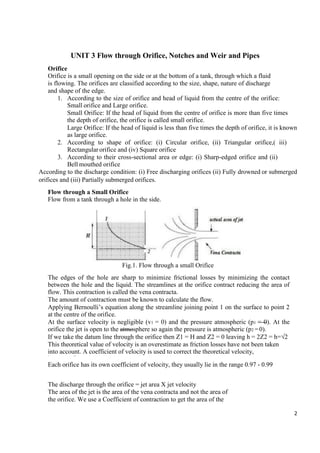
Flow from a tank through a hole in the side.
Fig.1. Flow through a small Orifice
The edges of the hole are sharp to minimize frictional losses by minimizing the contact
between the hole and the liquid. The streamlines at the orifice contract reducing the area of
flow. This contraction is called the vena contracta.
The amount of contraction must be known to calculate the flow.
Applying Bernoulli’s equation along the streamline joining point 1 on the surface to point 2
at the centre of the orifice.
At the surface velocity is negligible (v1 = 0) and the pressure atmospheric (p1 = 0). At the
orifice the jet is open to the atmosphere so again the pressure is atmospheric (p2 =0).
If we take the datum line through the orifice then Z1 = H and Z2 = 0 leaving h = 2Z2 = h=√2
This theoretical value of velocity is an overestimate as friction losses have not been taken
into account. A coefficient of velocity is used to correct the theoretical velocity,
= × ℎ
Each orifice has its own coefficient of velocity, they usually lie in the range 0.97 - 0.99
The discharge through the orifice = jet area X jet velocity
The area of the jet is the area of the vena contracta and not the area of
the orifice. We use a Coefficient of contraction to get the area of the
3
jet,Aa.
Aa = Cc x area of orifice
Discharge through the Orifice Q = Area x Velocity
Actual Discharge Qa = Cd x Qth
Qth = Area of Orifice x Vth
Hydraulic Coefficient
The following three coefficients are known as hydraulic coefficients or orifice coefficient
Coefficient of Contraction
Coefficient of Velocity
Coefficient of Discharge
Coefficient of Contraction:
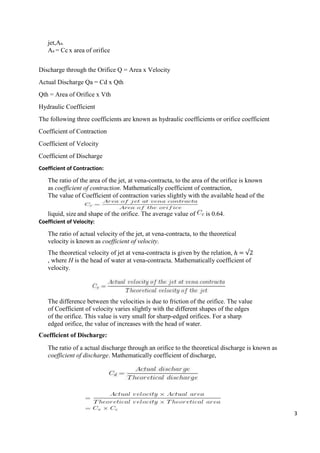
The ratio of the area of the jet, at vena-contracta, to the area of the orifice is known
as coefficient of contraction. Mathematically coefficient of contraction,
The value of Coefficient of contraction varies slightly with the available head of the
liquid, size and shape of the orifice. The average value of is 0.64.
Coefficient of Velocity:
The ratio of actual velocity of the jet, at vena-contracta, to the theoretical
velocity is known as coefficient of velocity.
The theoretical velocity of jet at vena-contracta is given by the relation, ℎ = √2
, where H is the head of water at vena-contracta. Mathematically coefficient of
velocity.
The difference between the velocities is due to friction of the orifice. The value
of Coefficient of velocity varies slightly with the different shapes of the edges
of the orifice. This value is very small for sharp-edged orifices. For a sharp
edged orifice, the value of increases with the head of water.
Coefficient of Discharge:
The ratio of a actual discharge through an orifice to the theoretical discharge is known as
coefficient of discharge. Mathematically coefficient of discharge,
4
Thus the value of coefficient of discharge varies with the values of and . An average
of coefficient of discharge varies from 0.60 to 0.64.
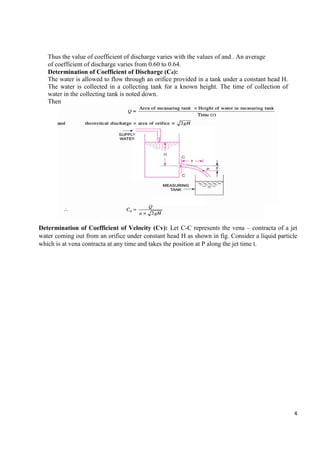
Determination of Coefficient of Discharge (Cd):
The water is allowed to flow through an orifice provided in a tank under a constant head H.
The water is collected in a collecting tank for a known height. The time of collection of
water in the collecting tank is noted down.
Then
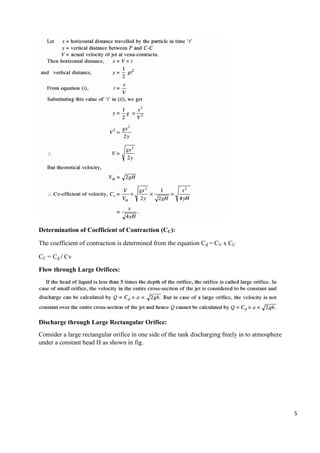
Determination of Coefficient of Velocity (Cv): Let C-C represents the vena – contracta of a jet
water coming out from an orifice under constant head H as shown in fig. Consider a liquid particle
which is at vena contracta at any time and takes the position at P along the jet time t.
5
Determination of Coefficient of Contraction (CC):
The coefficient of contraction is determined from the equation Cd = CV x CC
CC = Cd / Cv
Flow through Large Orifices:
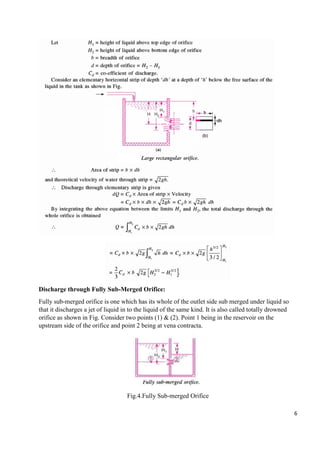
Discharge through Large Rectangular Orifice:
Consider a large rectangular orifice in one side of the tank discharging freely in to atmosphere
under a constant head H as shown in fig.
6
Discharge through Fully Sub-Merged Orifice:
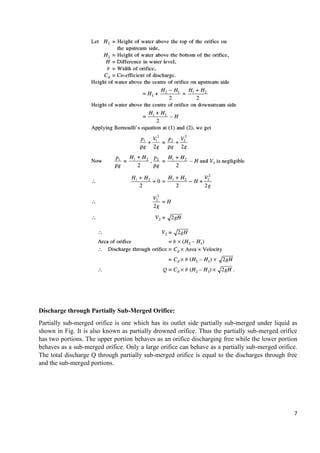
Fully sub-merged orifice is one which has its whole of the outlet side sub merged under liquid so
that it discharges a jet of liquid in to the liquid of the same kind. It is also called totally drowned
orifice as shown in Fig. Consider two points (1) & (2). Point 1 being in the reservoir on the
upstream side of the orifice and point 2 being at vena contracta.
Fig.4.Fully Sub-merged Orifice
7
Discharge through Partially Sub-Merged Orifice:
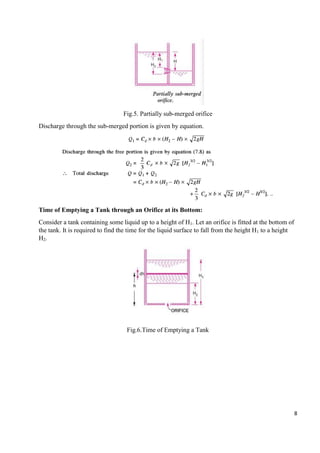
Partially sub-merged orifice is one which has its outlet side partially sub-merged under liquid as
shown in Fig. It is also known as partially drowned orifice. Thus the partially sub-merged orifice
has two portions. The upper portion behaves as an orifice discharging free while the lower portion
behaves as a sub-merged orifice. Only a large orifice can behave as a partially sub-merged orifice.
The total discharge Q through partially sub-merged orifice is equal to the discharges through free
and the sub-merged portions.
8
Fig.5. Partially sub-merged orifice
Discharge through the sub-merged portion is given by equation.
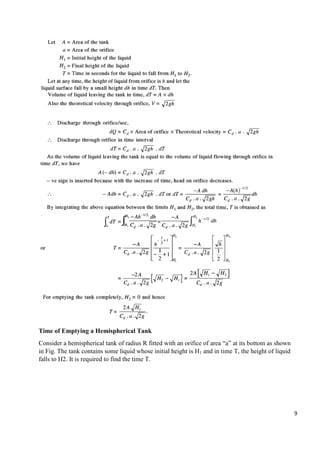
Time of Emptying a Tank through an Orifice at its Bottom:
Consider a tank containing some liquid up to a height of H1. Let an orifice is fitted at the bottom of
the tank. It is required to find the time for the liquid surface to fall from the height H1 to a height
H2.
Fig.6.Time of Emptying a Tank
9
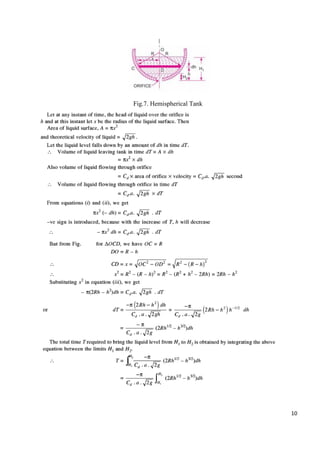
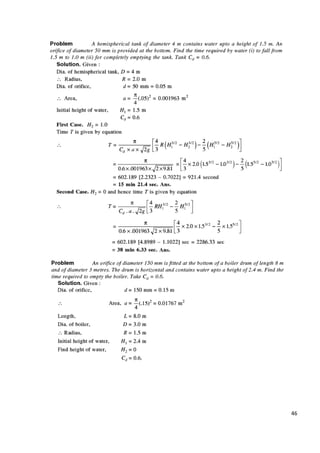
Time of Emptying a Hemispherical Tank
Consider a hemispherical tank of radius R fitted with an orifice of area “a” at its bottom as shown
in Fig. The tank contains some liquid whose initial height is H1 and in time T, the height of liquid
falls to H2. It is required to find the time T.
10
Fig.7. Hemispherical Tank
11
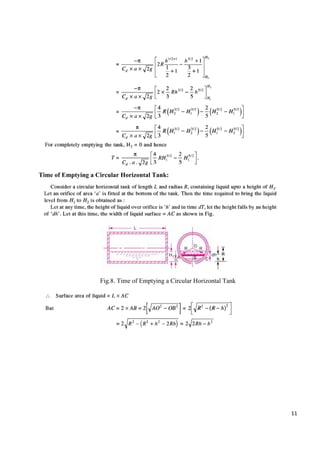
Time of Emptying a Circular Horizontal Tank:
Fig.8. Time of Emptying a Circular Horizontal Tank
12
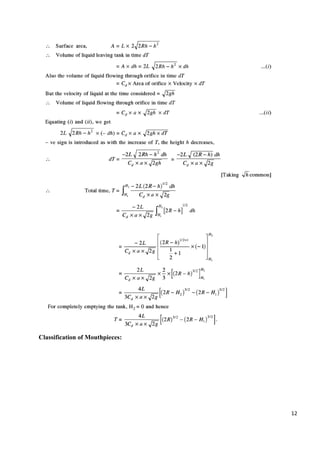
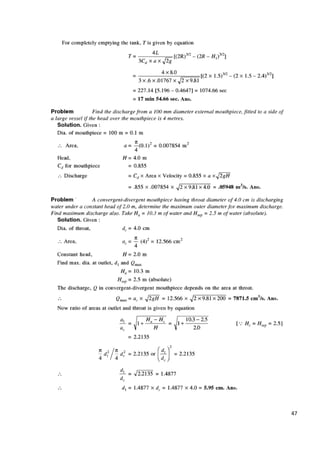
Classification of Mouthpieces:
13
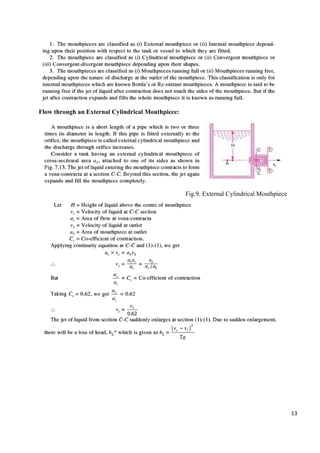
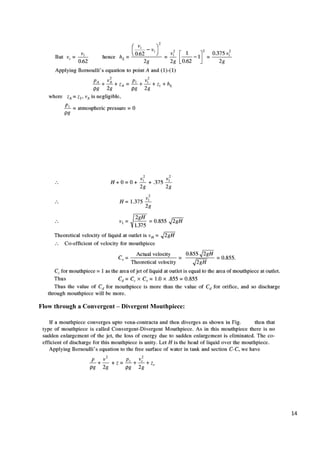
Flow through an External Cylindrical Mouthpiece:
Fig.9. External Cylindrical Mouthpiece
14
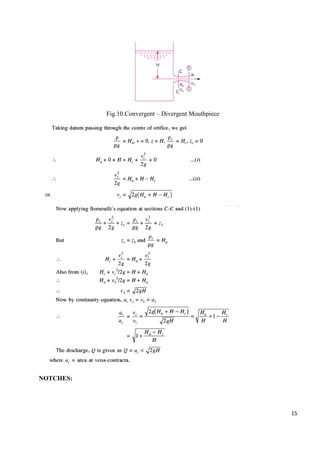
Flow through a Convergent – Divergent Mouthpiece:
15
Fig.10.Convergent – Divergent Mouthpiece
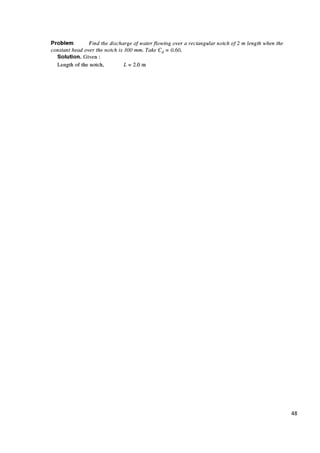
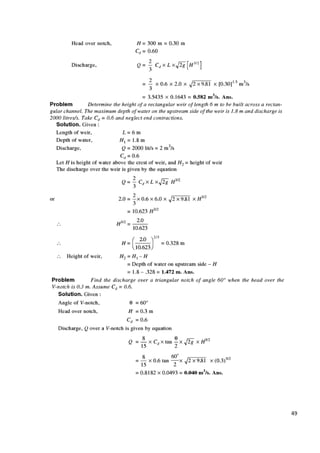
NOTCHES:
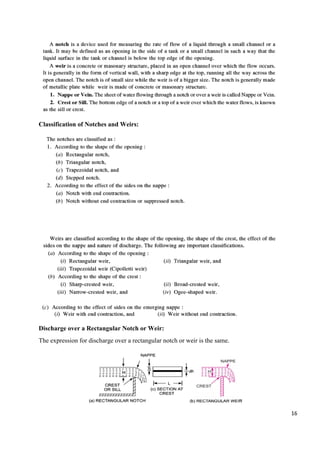
16
Classification of Notches and Weirs:
Discharge over a Rectangular Notch or Weir:
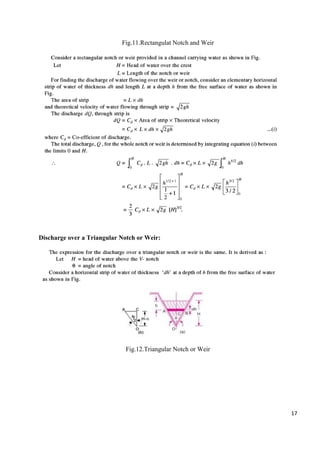
The expression for discharge over a rectangular notch or weir is the same.
17
Fig.11.Rectangulat Notch and Weir
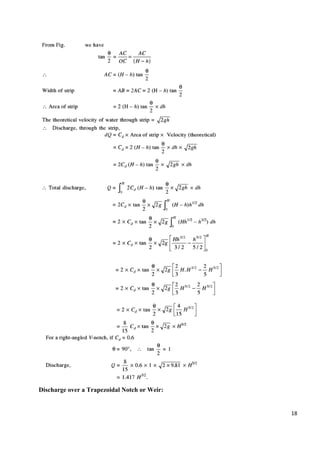
Discharge over a Triangular Notch or Weir:
Fig.12.Triangular Notch or Weir
18
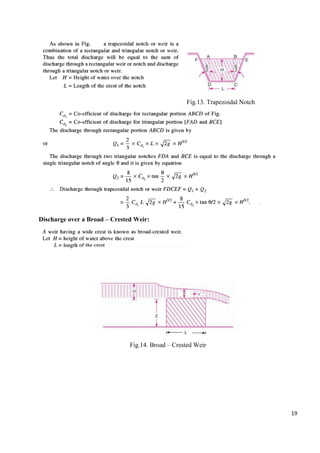
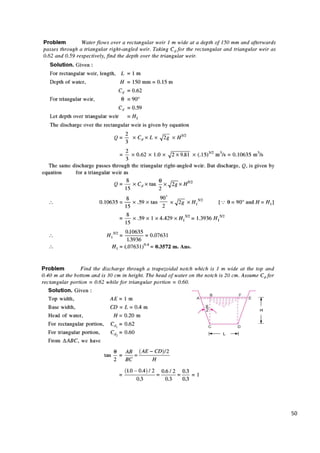
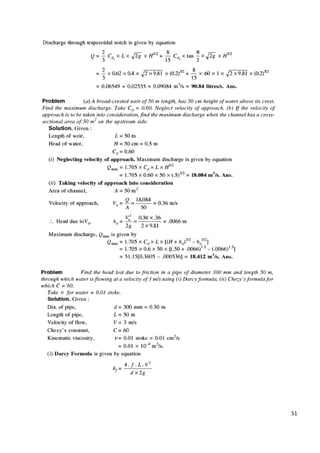
Discharge over a Trapezoidal Notch or Weir:
19
Fig.13. Trapezoidal Notch
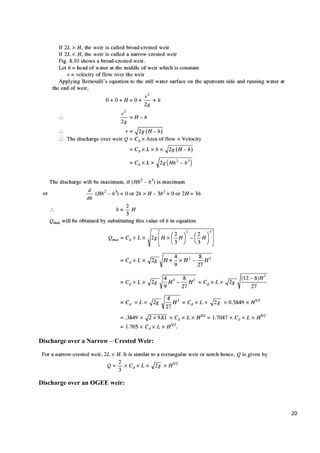
Discharge over a Broad – Crested Weir:
Fig.14. Broad – Crested Weir
20
Discharge over a Narrow – Crested Weir:
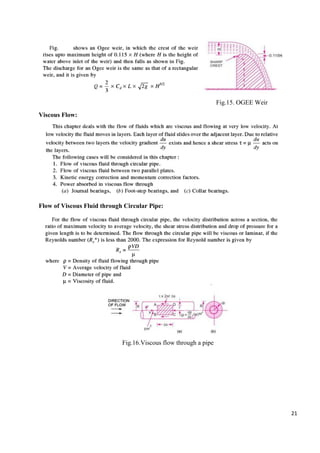
Discharge over an OGEE weir:
21
Fig.15. OGEE Weir
Viscous Flow:
Flow of Viscous Fluid through Circular Pipe:
Fig.16.Viscous flow through a pipe
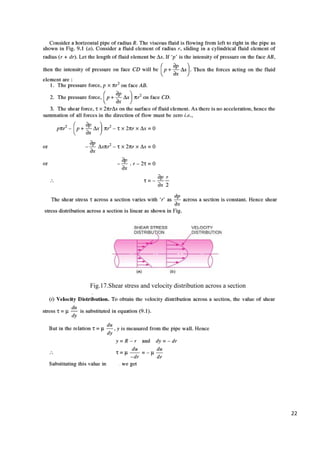
22
Fig.17.Shear stress and velocity distribution across a section
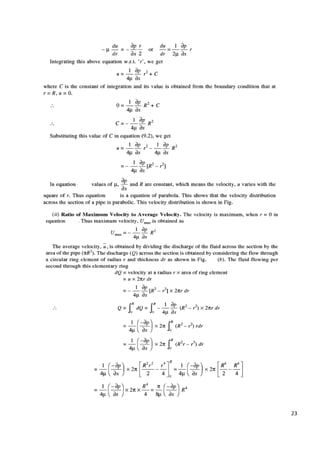
23
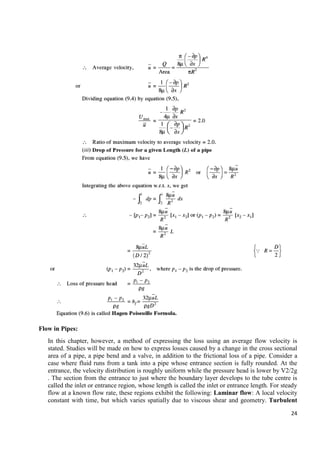
24
Flow in Pipes:
In this chapter, however, a method of expressing the loss using an average flow velocity is
stated. Studies will be made on how to express losses caused by a change in the cross sectional
area of a pipe, a pipe bend and a valve, in addition to the frictional loss of a pipe. Consider a
case where fluid runs from a tank into a pipe whose entrance section is fully rounded. At the
entrance, the velocity distribution is roughly uniform while the pressure head is lower by V2/2g
. The section from the entrance to just where the boundary layer develops to the tube centre is
called the inlet or entrance region, whose length is called the inlet or entrance length. For steady
flow at a known flow rate, these regions exhibit the following: Laminar flow: A local velocity
constant with time, but which varies spatially due to viscous shear and geometry. Turbulent
25
flow: A local velocity which has a constant mean value but also has a statistically random
fluctuating component due to turbulence in the flow. Typical plots of velocity time histories for
laminar flow, turbulent flow, and the region of transition between the two are shown below.
Principal parameter used to specify the type of flow regime is the Reynolds number :
V- Flow velocity
D – Flow dimension
µ - Dynamic Viscosity
Ʋ – Kinematic Viscosity
Frictional Loss in Pipe flow
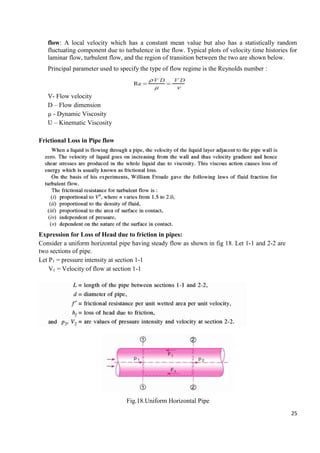
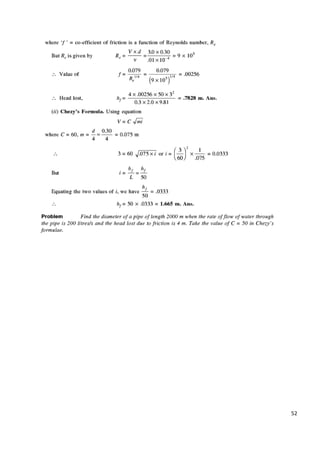
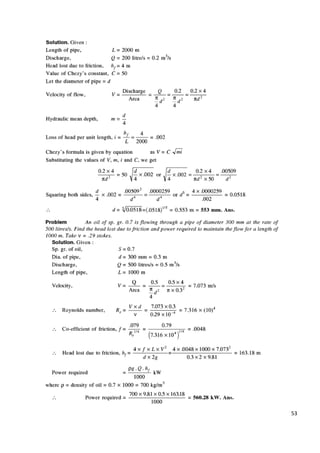
Expression for Loss of Head due to friction in pipes:
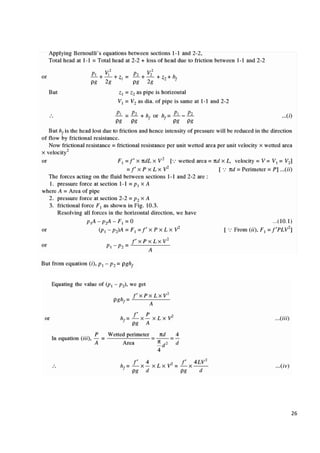
Consider a uniform horizontal pipe having steady flow as shown in fig 18. Let 1-1 and 2-2 are
two sections of pipe.
Let P1 = pressure intensity at section 1-1
V1 = Velocity of flow at section 1-1
Fig.18.Uniform Horizontal Pipe
26
27
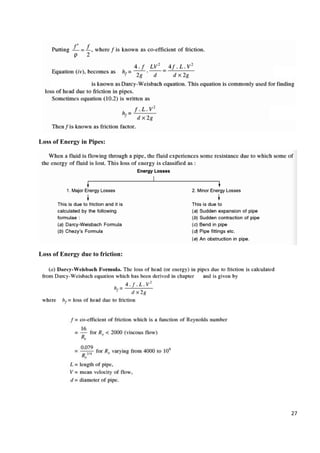
Loss of Energy in Pipes:
Loss of Energy due to friction:
28
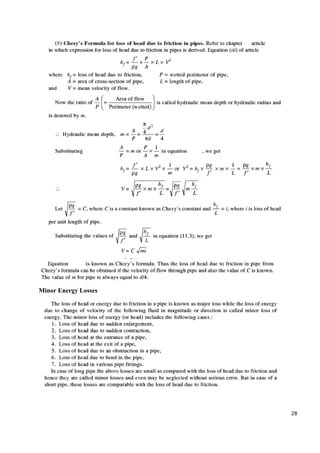
Minor Energy Losses
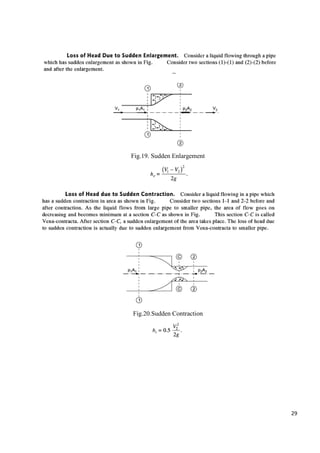
29
Fig.19. Sudden Enlargement
Fig.20.Sudden Contraction
30
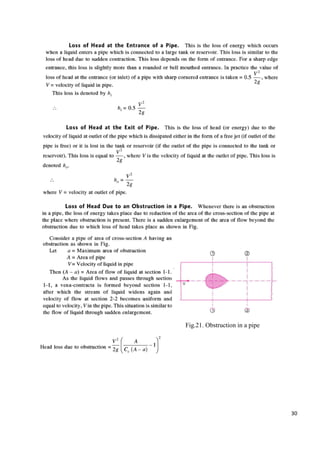
Fig.21. Obstruction in a pipe
31
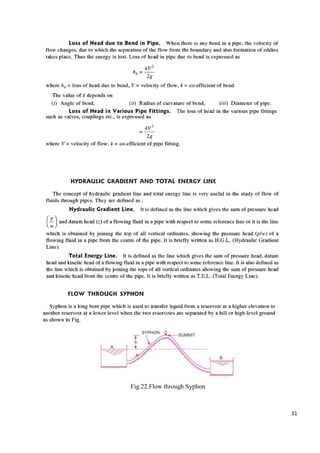
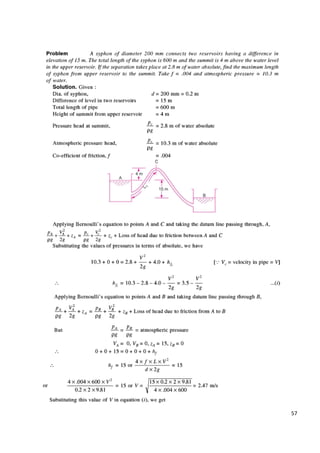
Fig.22.Flow through Syphon
32
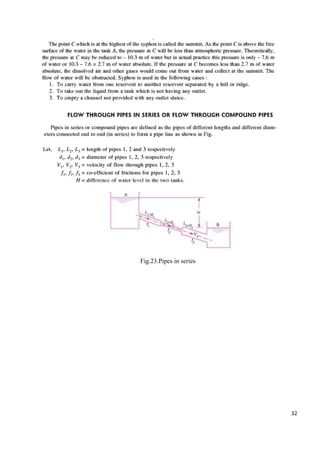
Fig.23.Pipes in series
33
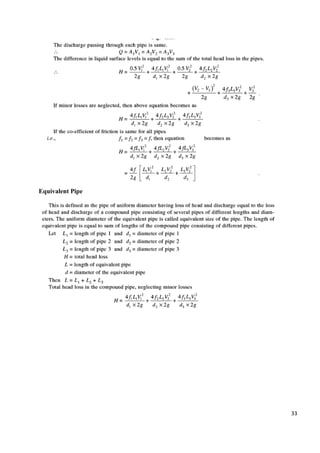
Equivalent Pipe
34
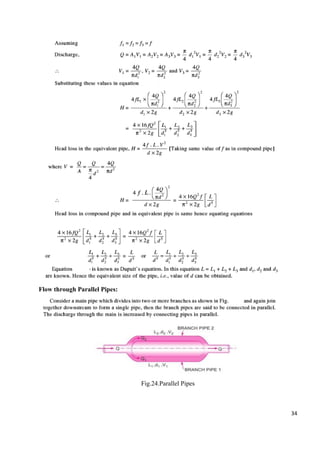
Flow through Parallel Pipes:
Fig.24.Parallel Pipes
35
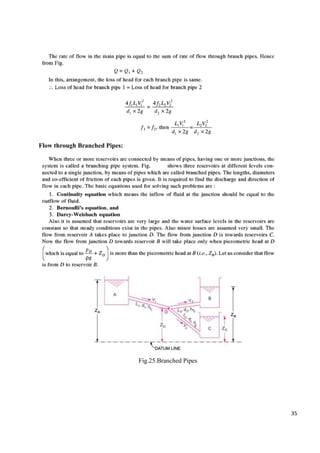
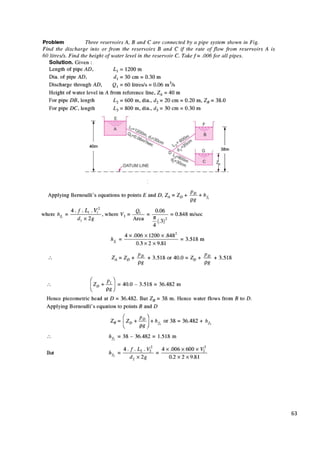
Flow through Branched Pipes:
Fig.25.Branched Pipes
36
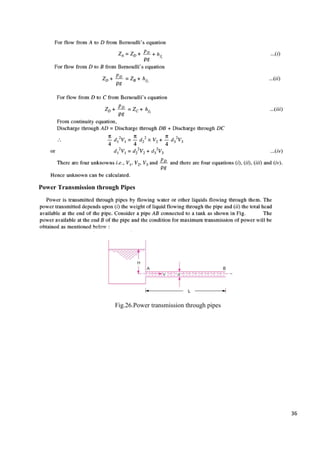
Power Transmission through Pipes
Fig.26.Power transmission through pipes
37
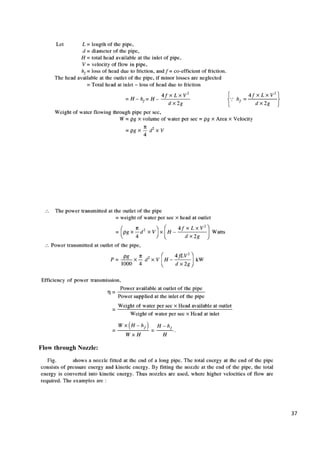
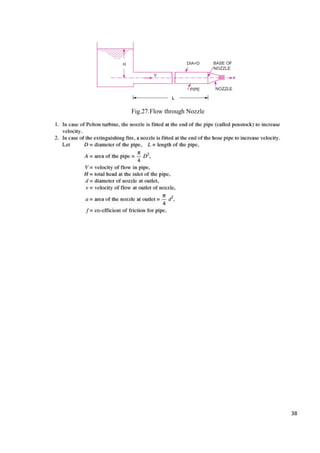
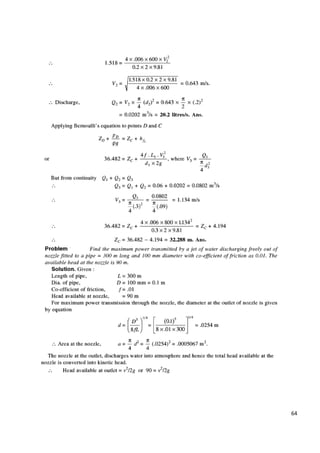
Flow through Nozzle:
38
Fig.27.Flow through Nozzle
39
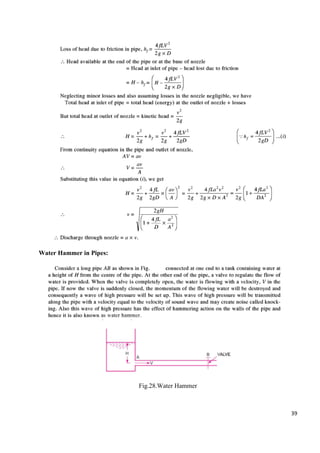
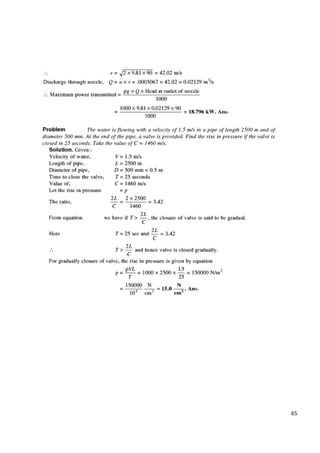
Water Hammer in Pipes:
Fig.28.Water Hammer
40
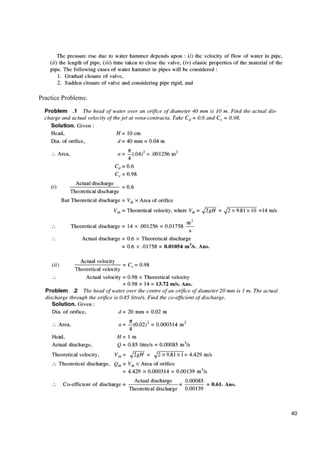
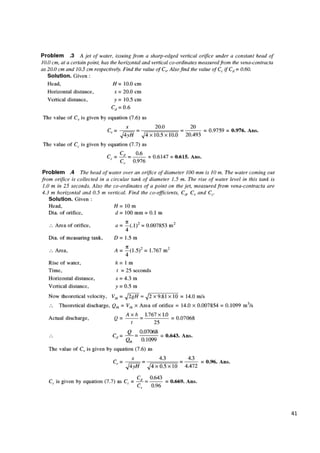
Practice Problems:
41
42
43
44
45
46
47
48
49
50
51
52
53
54
55
56
57
58
59
60
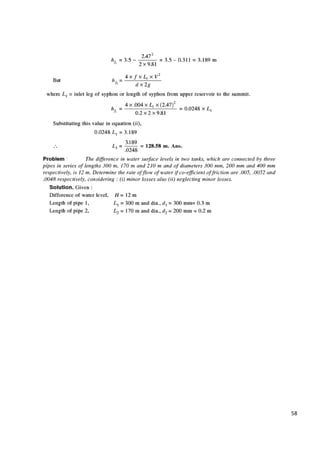
61
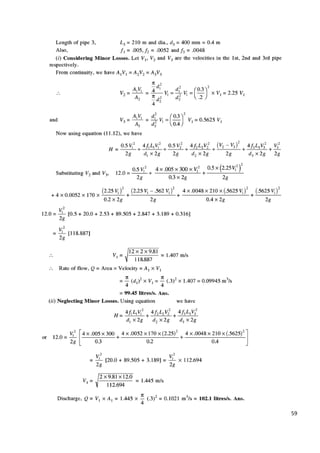
62
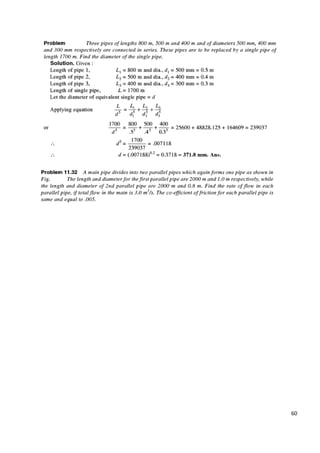
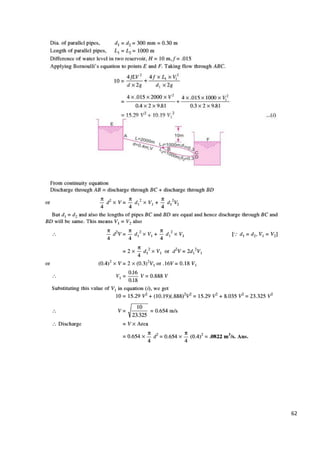
63
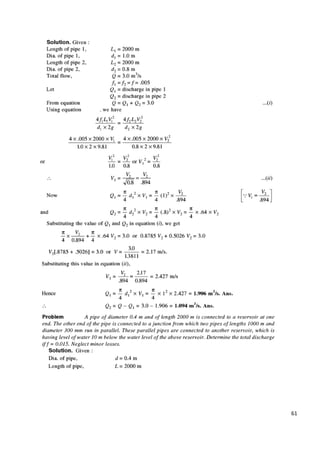
64
65
1
SCHOOL OF MECHANICAL ENGINEERING
DEPARTMENT OF MECHANICAL ENGINEERING
UNIT – 4 – Fluid Mechanics and Fluid Machinery – SMEA1303
2
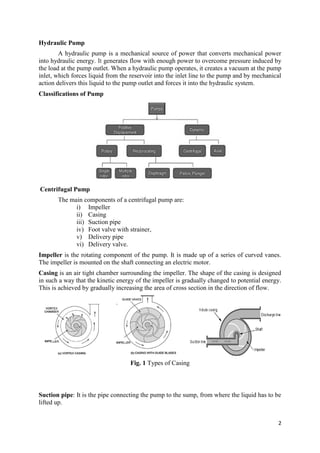
Hydraulic Pump
A hydraulic pump is a mechanical source of power that converts mechanical power
into hydraulic energy. It generates flow with enough power to overcome pressure induced by
the load at the pump outlet. When a hydraulic pump operates, it creates a vacuum at the pump
inlet, which forces liquid from the reservoir into the inlet line to the pump and by mechanical
action delivers this liquid to the pump outlet and forces it into the hydraulic system.
Classifications of Pump
Centrifugal Pump
The main components of a centrifugal pump are:
i) Impeller
ii) Casing
iii) Suction pipe
iv) Foot valve with strainer,
v) Delivery pipe
vi) Delivery valve.
Impeller is the rotating component of the pump. It is made up of a series of curved vanes.
The impeller is mounted on the shaft connecting an electric motor.
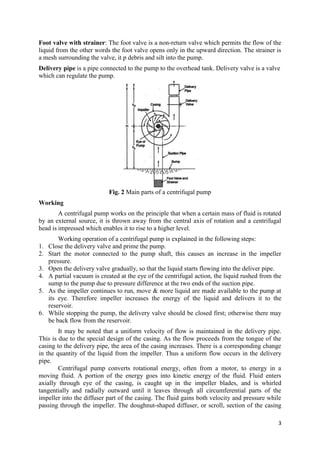
Casing is an air tight chamber surrounding the impeller. The shape of the casing is designed
in such a way that the kinetic energy of the impeller is gradually changed to potential energy.
This is achieved by gradually increasing the area of cross section in the direction of flow.
Fig. 1 Types of Casing
Suction pipe: It is the pipe connecting the pump to the sump, from where the liquid has to be
lifted up.
3
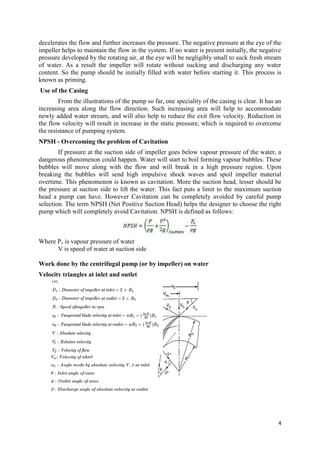
Foot valve with strainer: The foot valve is a non-return valve which permits the flow of the
liquid from the other words the foot valve opens only in the upward direction. The strainer is
a mesh surrounding the valve, it p debris and silt into the pump.
Delivery pipe is a pipe connected to the pump to the overhead tank. Delivery valve is a valve
which can regulate the pump.
Fig. 2 Main parts of a centrifugal pump
Working
A centrifugal pump works on the principle that when a certain mass of fluid is rotated
by an external source, it is thrown away from the central axis of rotation and a centrifugal
head is impressed which enables it to rise to a higher level.
Working operation of a centrifugal pump is explained in the following steps:
1. Close the delivery valve and prime the pump.
2. Start the motor connected to the pump shaft, this causes an increase in the impeller
pressure.
3. Open the delivery valve gradually, so that the liquid starts flowing into the deliver pipe.
4. A partial vacuum is created at the eye of the centrifugal action, the liquid rushed from the
sump to the pump due to pressure difference at the two ends of the suction pipe.
5. As the impeller continues to run, move & more liquid are made available to the pump at
its eye. Therefore impeller increases the energy of the liquid and delivers it to the
reservoir.
6. While stopping the pump, the delivery valve should be closed first; otherwise there may
be back flow from the reservoir.
It may be noted that a uniform velocity of flow is maintained in the delivery pipe.
This is due to the special design of the casing. As the flow proceeds from the tongue of the
casing to the delivery pipe, the area of the casing increases. There is a corresponding change
in the quantity of the liquid from the impeller. Thus a uniform flow occurs in the delivery
pipe.
Centrifugal pump converts rotational energy, often from a motor, to energy in a
moving fluid. A portion of the energy goes into kinetic energy of the fluid. Fluid enters
axially through eye of the casing, is caught up in the impeller blades, and is whirled
tangentially and radially outward until it leaves through all circumferential parts of the
impeller into the diffuser part of the casing. The fluid gains both velocity and pressure while
passing through the impeller. The doughnut-shaped diffuser, or scroll, section of the casing
4
decelerates the flow and further increases the pressure. The negative pressure at the eye of the
impeller helps to maintain the flow in the system. If no water is present initially, the negative
pressure developed by the rotating air, at the eye will be negligibly small to suck fresh stream
of water. As a result the impeller will rotate without sucking and discharging any water
content. So the pump should be initially filled with water before starting it. This process is
known as priming.
Use of the Casing
From the illustrations of the pump so far, one speciality of the casing is clear. It has an
increasing area along the flow direction. Such increasing area will help to accommodate
newly added water stream, and will also help to reduce the exit flow velocity. Reduction in
the flow velocity will result in increase in the static pressure, which is required to overcome
the resistance of pumping system.
NPSH - Overcoming the problem of Cavitation
If pressure at the suction side of impeller goes below vapour pressure of the water, a
dangerous phenomenon could happen. Water will start to boil forming vapour bubbles. These
bubbles will move along with the flow and will break in a high pressure region. Upon
breaking the bubbles will send high impulsive shock waves and spoil impeller material
overtime. This phenomenon is known as cavitation. More the suction head, lesser should be
the pressure at suction side to lift the water. This fact puts a limit to the maximum suction
head a pump can have. However Cavitation can be completely avoided by careful pump
selection. The term NPSH (Net Positive Suction Head) helps the designer to choose the right
pump which will completely avoid Cavitation. NPSH is defined as follows:
Where Pv is vapour pressure of water
V is speed of water at suction side
Work done by the centrifugal pump (or by impeller) on water
Velocity triangles at inlet and outlet
5
Definitions of Heads and Efficiencies of a centrifugal pump
6
7
8
Example The internal and external diameters of the impeller of a centrifugal pump are
200 and 400 mm respectively. The pump is running at 1200 rpm. The vane angles of the
impeller at inlet and outlet are 20 and 30 respectively. The water enters the impeller
radially and velocity of flow is constant. Determine the work done by the impeller per unit
weight of water.
Given:
Example A centrifugal pump is to discharge 0.118 m3
/s at a speed of 1450 rpm against a
head of 25m. the impeller diameter is 250 mm, its width at outlet is 50 mm and
manometric efficiency is 75%. Determine the vane angle at the outer periphery of the
impeller.
Given:
9
Example A centrifugal pump delivers water against a net head of 14.5 m and a design
speed of 1000 rpm. The vanes are curved back at an angle of 30° with the periphery. The
impeller diameter is 300 mm and outlet width is 50 mm. determine the discharge of the
pump if manometric efficiency is 95%.
Given:
10
Example A centrifugal pump having outer diameter equal to two times the inner diameter
and running at 1000 rpm works against a total head of 40 m. the velocity of flow through
the impeller is constant and equal to 2.5 m/s. the vanes are set back at an angle of 40° at
outlet. If the outer diameter of the impeller is 500 mm and width at the outlet is 50 mm,
determine: i) Vane angle at inlet, ii) work done by impeller on water per second
iii) manometric efficiency
Given:
11
Example The outer diameter of an impeller of a centrifugal pump is 400 mm and outlet
width is 50 mm. the pump is running at 800 rpm and is working against a total head of 15
m. the vanes angle at outlet is 40° and manometric efficiency is 75%. Determine:
i) Velocity of flow at outlet, ii) velocity of water leaving the vane, iii) angle made by the
absolute velocity at outlet with the direction of motion at outlet and iv) discharge
Given:
12
Example The internal diameter and external diameter of an impeller of a centrifugal
pump which is running at 1000 rpm are 200 and 40 mm respectively. The discharge
through pump is 0.04 m3/s and velocity of flow is constant and equal to 2.0 m/s. the
diameter of the suction and delivery pipes are 150 and 100 mm respectively and suction
and delivery heads are 6 m (abs.) and 30 m (abs.) of water respectively. If the outlet vane
angle is 45° and power required to drive the pump is 16.168 kW, determine: i) Vane angle
of the impeller at inlet, ii) the overall efficiency of the pump and iii) manometric efficiency
of the pump
Given:
13
14
15
16
17
RECIPROCATING PUMP
If the mechanical energy is converted into hydraulic energy by sucking the liquid into
a cylinder in which a piston is reciprocating, which exerts the thrust on the liquid and
increases its hydraulic energy is known as reciprocating pump. A reciprocating pump is a
positive displacement pump. It is often used where relatively small quantity of liquid is to be
handled and where delivery pressure is quite large.
Reciprocating pump consists of following parts.
1. A cylinder with a piston 5. suction pipe
2. piston rod 6. delivery pipe
3. connecting rod 7. suction valve
4. crank 8. delivery valve
WORKING OF A SINGLE-ACTING RECIPROCATING PUMP
Single acting reciprocating pump:-
A single acting reciprocating pump, which consists of a piston which moves forwards
and backwards in a close fitting cylinder. The movement of the piston is obtained by
connecting the piston rod to crank by means of a connecting rod. The crank is rotated by
means of an electric motor. Suction and delivery pipes with suction valve and delivery valve
are connected to the cylinder. The suction and delivery valves are one way valves or non-
return valves, which allow the water to flow in one direction only. Suction valve allows water
from suction pipe to the cylinder which delivery valve allows water from cylinder to delivery
pipe.
The rotation of the crank brings about an outward and inward movement of the piston
in the cylinder. During the suction stroke the piston is moving towards right in the cylinder,
this movement of piston causes vacuum in the cylinder. The pressure of the atmosphere
acting on the sump water surface forces the water up in the suction pipe. The forced water
opens the suction valve and the water enters the cylinder. The piston from its extreme right
position starts moving towards left in the cylinder. The movement of the piston towards left
increases the pressure of the liquid inside the cylinder more than atmospheric pressure. Hence
suction valve closes and delivery valve opens. The liquid is forced into the delivery pipe and
is raised to a required height.
For one revolution of the crank, the quantity of water raised up in the delivery pipe is
equal to the stroke volume in the cylinder in the single acting pump and twice this volume in
the double acting pump. Discharge through a single acting reciprocating pump.
D = diameter of the cylinder
A = cross section are of the piston or cylinder
r = radius of crank
N = r.p.m of the crank
L = Length of the stroke = 2 x r
hs = Suction head or height of axis of the cylinder from water surface in sump.
hd = Delivery head or height of the delivery outlet above the cylinder axis.
Discharge of water in one revolution = Area x Length of stroke
= A x L
Number of revolution per second = N/60
Discharge of the pump per second
Q = Discharge in one revolution x No.of revolution per second
18
.
Fig.3
Double acting reciprocating pump
Fig.4
19
20
Fig.5
21
The actual discharge of the pump is always less than theoretical discharge. The
difference between theoretical discharge and actual discharge is known as Slip of the
reciprocating pump
Example A single acting reciprocating pump, running at 50 rpm, delivers 0.01m3/s of
water. The diameter of the piston is 200 mm and stroke length 400 m. Determine:
i) theoretical discharge of the pump ii) Co – efficient of discharge and iii) Slip and the
percentage of slip of the pump.
Given:
22
Example
6
23
SEPARATION OF LIQUID
If the pressure in the cylinder is below the vapour pressure, dissolved gasses will be
liberated from the liquid and cavitation will takes place. The continuous flow of liquid will
not exist which means separation of liquid takes place. The pressure at which separation takes
place is called separation pressure and head corresponding to the separation pressure is called
separation pressure head.
The ways to avoid cavitation in reciprocating pumps:
1. Design: Ensure that there are no sharp corners or curvatures of flow in the system while
designing the pump.
2. Material: Cavitation resistant materials like Bronze or Nickel can be used.
3. Model Testing: Before manufacturing, a scaled down model should be tested.
4. Admission of air: High pressure air can be injected into the low pressure zones of
flowing liquid to prevent bubble formation.
Fig.7
friction in suction and delivery pipes
24
TEXT / REFERENCE BOOKS
1. Bansal.R.K, Fluid Mechanics & Hydraulics Machines, 9th Edition, Laxmi
Publications, 2015.
2. Modi P.N., Seth S.M., Hydraulics and Fluid Mechanics Including Hydraulic
Machines, 21st Edition, Standard Book House, 2017.
3. Goyal, Manish Kumar, Fluid Mechanics and Hydraulic Machines, PHI Learning Pvt.
Ltd., 2015.
4. Kumar K.L., Engineering Fluid Mechanics, 8thEdition, Eurasia Publication House (P)
Ltd, 2014.
5. R. K. Rajput, Fluid Mechanics & Hydraulics Machines, 4th Edition, S. Chand
Limited, 2008.
6. NPTEL
1
SCHOOL OF MECHANICAL ENGINEERING
DEPARTMENT OF MECHANICAL ENGINEERING
UNIT – 5 – Fluid Mechanics and Machinery– SMEA1303
2
TURBINES
Hydraulic machines are defined as those machines which convert either hydraulic energy
(energy possessed by water) into mechanical energy (which is further converted into
electrical energy) or mechanical energy into hydraulic energy. The hydraulic machines,
which convert the hydraulic energy into mechanical energy, are called turbines while the
hydraulic machines which convert the mechanical energy into hydraulic energy. The study of
hydraulic machines consists of turbines and pumps.
Turbines are defined as the hydraulic machines which convert hydraulic energy into
mechanical energy. This, mechanical energy is used in running an electric generator which is
directly coupled to the shaft of the turbine. Thus the mechanical energy is converted into
electrical energy. The electric power which is obtained from the hydraulic energy (energy of
water) is known as Hydroelectric power. At present the generation of hydroelectric power is
the cheapest as compared by the power generated by other sources such as oil, coal etc.
General Layout of a Hydroelectric Power Plant
1. A dam constructed across a river to store water.
2. Pipes of large diameters called penstocks, which carry water under pressure from the
storage reservoir to the turbines. These pipes are made of steel or reinforced concrete.
3. Turbines having different types of vanes fitted to the wheels.
4. Tail race, which is a channel which carries water away from the turbines after the water
has worked on the turbines. The surface of water in the tail race channel is also known as
tail race.
Fig. Layout of hydroelectric power plant
Definitions of Heads and Efficiencies of a Turbine
1. Gross Head. The difference between the head race level and tail race level when no water
is flowing is known as Gross Head. It is denoted by 'Hg".
2. Net Head. It is also called effective head and is defined as the head available at the inlet
of the turbine, when water is flowing from head race to the turbine, a loss of head due to
friction between water and penstock occurs. Though there are other losses also such as
loss due to bend, Pipes, fittings, loss at the entrance of penstock etc., yet they are having
small magnitude as compared to head loss due to friction. In ‘hf’ is the head loss due to
friction between penstocks and water then net heat on turbine is given by
H = Hg - hf
3
4
5
Main parts of Pelton Wheel
6
7
8
Example
9
10
Example
11
Example
12
Example
13
FRANCIS TURBINE
The Francis turbine is a mixed flow reaction turbine. This turbine is used for medium
heads with medium discharge. Water enters the runner and flows towards the center of the
wheel in the radial direction and leaves parallel to the axis of the turbine.
Turbines are subdivided into impulse and reaction machines. In the impulse turbines,
the total head available is converted into the kinetic energy. In the reaction turbines, only
some part of the available total head of the fluid is converted into kinetic energy so that the
fluid entering the runner has pressure energy as well as kinetic energy. The pressure energy is
then converted into kinetic energy in the runner.
The Francis turbine is a type of reaction turbine that was developed by James B.
Francis. Francis turbines are the most common water turbine in use today. They operate in a
water head from 40 to 600 m and are primarily used for electrical power production. The
electric generators which most often use this type of turbine have a power output which
generally ranges just a few kilowatts up to 800 MW.
Main components of Francis turbine
1. Spiral Casing
The water flowing from the reservoir or dam is made to pass through this pipe with
high pressure. The blades of the turbines are circularly placed, which means the water
striking the blades of the turbine should flow in the circular axis for efficient striking. So, the
spiral casing is used, but due to the circular movement of the water, it loses its pressure.
To maintain the same pressure, the diameter of the casing is gradually reduced, to
maintain the pressure uniformly, thus uniform momentum or velocity striking the runner
blades.
14
2. Stay Vanes
This guides the water to the runner blades. Stay vanes remain stationary at their
position and reduces the swirling of water due to radial flow and as it enters the runner
blades. Hence, makes the turbine more efficient.
3. Guide Vanes
Guide vanes are also known as wicket gates. The main function or usages of the guide
vanes are to guide the water towards the runner and it also regulates the quantity of water
supplied to runner. It also guides the water to flow at an angle and that is appropriate for the
design.
4. Runner Blades:
Absorbs the energy from the water and converts it to rotational motion of the main
shaft. The runner blades design decides how effectively a turbine is going to perform. The
runner blades are divided into two parts. The lower half is made in the shape of a small
bucket so that it uses the impulse action of water to rotate the turbine.
The upper part of the blades uses the reaction force of water flowing through it. These
two forces together make the runner rotate.
Draft Tube
The draft tube is an expanding tube which is used to discharge the water through the
runner and next to the tailrace. The main function of the draft tube is to reduce the water
velocity at the time of discharge. Its cross-section area increases along its length, as the water
coming out of runner blades, is at considerably low pressure, so its expanding cross-section
area helps it to recover the pressure as it flows towards the tailrace.
15
Working principles of Francis turbine
 The water is admitted to the runner through guide vanes or wicket gates. The opening
between the vanes can be adjusted to vary the quantity of water admitted to the turbine.
This is done to suit the load conditions.
 The water enters the runner with a low velocity but with a considerable pressure. As the
water flows over the vanes the pressure head is gradually converted into velocity head.
 This kinetic energy is utilized in rotating the wheel Thus the hydraulic energy is
converted into mechanical energy.
 The outgoing water enters the tailrace after passing through the draft tube. The draft tube
enlarges gradually and the enlarged end is submerged deeply in the tailrace water.
 Due to this arrangement a suction head is created at the exit of the runner.
Velocity Triangle
16
Example
17
18
Example
19
20
Main components of Kaplan turbine
21
Example
22
Example
23
24
Example
25
Dimensional analysis
Dimensional analysis is a method of dimensions. It is a mathematical technique used
in research work for design and for conducting model tests. It deals with the dimensions of
the physical quantities involved in the phenomenon. All physical quantities are measured by
comparison, which is made with respect to an arbitrarily fixed value. Length L, mass M and
time T are three fixed dimensions which are of importance in Fluid Mechanics. If in any
problem of fluid mechanics, heat is involved then temperature is also taken as fixed
dimension. These fixed dimensions are called fundamental dimensions or fundamental
quantity.
Secondary or derived quantities are those quantities which possess more than one
fundamental dimension. For example, velocity is denoted by distance per unit time (L/T),
density by mass per unit volume| (M/L3
) and acceleration distance per second Square (L/T2
).
Then velocity, density, deceleration become as secondary or derived quantities. The
expressions (L/T), (M/L3
) and (L/T2
) are called the dimensions of velocity, density and
acceleration respectively. The dimensions of mostly used physical quantities in Fluid
Mechanics.
Dimensional Homogeneity
If an equation truly expresses a proper relationship among variables in a physical
process, then it will be dimensionally homogeneous. The equations are correct for any system
of units and consequently each group of terms in the equation must have the same
dimensional representation. This is also known as the law of dimensional homogeneity.
Dimensional variables
These are the quantities, which actually vary during a given case and can be plotted
against each other. Dimensional constants: These are normally held constant during a given
run. But, they may vary from case to case.
Pure constants
They have no dimensions, but, while performing the mathematical manipulation, they
can arise.
26
It should be ensured that the dimensions of the variables on the left side of the
equation are equal to the dimensions of any term on the right side of equation. Now, it is
possible to rearrange the above equation into a set of dimensionless products (pi terms), so
that
27
28
29
30
31
Flow Similarity
In order to achieve similarity between model and prototype behavior, all the
corresponding pi terms must be equated to satisfy the following conditions.
Geometric similarity
A model and prototype are geometric similar if and only if all body dimensions in all
three coordinates have the same linear-scale ratio. In order to have geometric similarity
between the model and prototype, the model and the prototype should be of the same shape,
all the linear dimensions of the model can be related to corresponding dimensions of the
prototype by a constant scale factor. Usually, one or more of these pi terms will involve ratios
of important lengths, which are purely geometrical in nature.
32
Kinematic similarity
The motions of two systems are kinematically similar if homogeneous particles lie at
same points at same times. In a specific sense, the velocities at corresponding points are in
the same direction (i.e. same streamline patterns) and are related in magnitude by a constant
scale factor.
Dynamic similarity
When two flows have force distributions such that identical types of forces are
parallel and are related in magnitude by a constant scale factor at all corresponding points,
then the flows are dynamic similar. For a model and prototype, the dynamic similarity exists,
when both of them have same length-scale ratio, timescale ratio and force-scale (or mass-
scale ratio).
In order to have complete similarity between the model and prototype, all the
similarity flow conditions must be maintained. This will automatically follow if all the
important variables are included in the dimensional analysis and if all the similarity
requirements based on the resulting pi terms are satisfied. For example, in compressible
flows, the model and prototype should have same Reynolds number, Mach number and
specific heat ratio etc. If the flow is incompressible (without free surface), then same
Reynolds numbers for model and prototype can satisfy the complete similarity.
TEXT / REFERENCE BOOKS
1. Bansal.R.K, Fluid Mechanics & Hydraulics Machines, 9th Edition, Laxmi
Publications, 2015.
2. Modi P.N., Seth S.M., Hydraulics and Fluid Mechanics Including Hydraulic
Machines, 21st Edition, Standard Book House, 2017.
3. Goyal, Manish Kumar, Fluid Mechanics and Hydraulic Machines, PHI Learning Pvt.
Ltd., 2015.
4. Kumar K.L., Engineering Fluid Mechanics, 8thEdition, Eurasia Publication House (P)
Ltd, 2014.
5. R. K. Rajput, Fluid Mechanics & Hydraulics Machines, 4th Edition, S. Chand
Limited, 2008.
6. NPTEL

fmm notes.pdf

  • 1.
    SCHOOL OF MECHANICALENGINEERING DEPARTMENT OF MECHANICAL ENGINEERING UNIT – I – Fluid Mechanics and Machinery – SMEA1303
  • 2.
    UNIT 1 FLUIDPROPERTIES Fluids: Substances capable of flowing are known as fluids. Flow is the continuous deformation of substances under the action of shear stresses. Fluids have no definite shape of their own, but confirm to the shape of the containing vessel. Fluids include liquids and gases. Fluid Mechanics: Fluid mechanics is the branch of science that deals with the behavior of fluids at rest as well as in motion. Thus,it deals with the static, kinematics and dynamic aspects of fluids. The study of fluids at rest is called fluid statics. The study of fluids in motion, where pressure forces are not considered, is called fluid kinematics and if the pressure forces are also considered for the fluids in motion, that branch of science is called fluid dynamics. Fluid Properties: 1.Density (or )Mass Density: Density or mass density of a fluid is defined as the ratio of the mass of the fluid to its volume. Thus, Mass per unit volume of a fluid is called density. Mass density,   Mass of fluid Volume of fluid 3 S.I unit of density is kg/m . 3 The value of density for water is 1000 kg/m . 2.Specific weight (or) Weight Density (w ): Specific weight or weight density of a fluid is the ratio between the weight of a fluid to its volume. The weight per unit volume of a fluid is called specific weight or weight density.  Weight of fluid Weight density Volume of fluid  Mass of fluid X g w Volume of fluid w  g 3 S.I unit of specific weight is N/m . 3 The value of specific weight or weight density of water is 9810N/m 3. Specific Volume (ʋ): or 9.81 kN/m³. Specific volume of a fluid is defined as the volume of a fluid occupied by unit mass. Volume per unit mass of a fluid is called Specific volume. Page | 1
  • 3.
    ; Specific volume  Volumeof a fluid  1 Mass of fluid  Thus specific volume is the reciprocal of mass density. S.I unit: m3 /kg. 4. Specific Gravity (s): Specific gravity is defined as the ratio of the specific weight of a fluid to the specific weight of a standard fluid. Specific gravity  Specific weight of liquid Specific weight of water Specific gravity is also equal to Relative density. Relative density = 5. Viscosity: Viscosity is defined as the property of a fluid which offers resistance to the movement of one layer of fluid over adjacent layer of the fluid. When two layers of a fluid, at distance ‘dy’ apart, move one over the other at different velocities, say u and u+du as shown in figure. The viscosity together with relative velocity causes a shear stress acting between the fluid layers. The top layer causes a shear stress on the adjacent lower layer while the lower layer causes a shear stress on the adjacent top layer. This shear stress is proportional to the rate of change of velocity with respect to y.  du dy or    du dy Fig.1. Velocity distribution curve Thus the viscosity is also defined as the shear stress required to produce unit rate of shear strain. S.I unit: Ns/m². It is still expressed in poise (P) as well as centipoises (cP). Kinematic Viscosity (ν): It is defined as the ratio between the dynamic viscosity and density of fluid. It is denoted by the nu. V = Viscosity/Density = µ/ρ In MKS and SI unit of kinematic viscosity is metre2 /sec or m2 /sec while CGs units it is written as cm2/s. In CGS units kinematic viscosity is also known as stoke. One stoke = cm2 /s = (1/100)2 m2 /s = 10-4 m2 /s and centistokes means = 1/100 stoke Page | 2
  • 4.
    Newton's Law ofViscosity: It states that the shear stress (τ) on a fluid element layer is directly proportional to the rate of shear strain. The constant of proportionality is called the co-efficient of viscosity.    du dy 6.Compressibility: Compressibility is the reciprocal of the bulk modulus of elasticity, K, which is defined as the ratio of compressive stress to volumetric strain. Compression of fluids gives rise to pressure with the decrease in volume. If dv is the decrease in volume and dp is the increase in pressure, Volumetric Strain = (- ve sign indicate the volume decreases with increase of pressure) Bulk modulus, K = Increase of pressure Volumetric Strain dp =  dV V Compressibility = 1 K  dV V 7.Surface tension: Surface tension is defined as the tensile force acting on the surface of a liquid in contact with a gas or on the surface between two immiscible liquids such that the contact surface behaves like a membrane under tension. Fig.2. Forces on droplet Surface Tension on Liquid Droplet: Consider a small spherical droplet of a liquid of diameter ‘d’. On the entire surface of the droplet, the tensile force due to surface tension will be acting. Let σ = Surface tension of the liquid p = Pressure intensity inside the droplet (in excess of the outside pressure intensity) d = Dia. of droplet. Let the droplet is cut into two halves. The forces acting on one half will be i) Tensile force (FT)due to surface tension acting around the circumference of the cut portion as shown in fig. and this is equal to = σ x Circumference = σ x π d Pressure force (Fp) on the area C= p x (π/4) d2 as shown in the figure. These two forces are equal under equilibrium conditions. i.e., Page | 3
  • 5.
    p x (π/4)d2 = σ x π d P = (σ x π d)/( σ x π d) = 4 σ /d Surface Tension on a Hollow Bubble: A hollow bubble like a soap bubble in air has two surfaces in contact with air, one inside and other outside. Thus two surfaces arc subjected to surface tension. In that case, 2 p (π/4) d2 = 2(σ x π d) P = (2σ π d)/ (π/4) d2 = 8 σ /d 8. Capillarity: Capillarity is defined as a phenomenon of rise or fall of a liquid surface in a small tube relative to the adjacent general level of liquid when the tube is held vertically in the liquid. The rise of liquid surface is known as capillary rise while the fall of the liquid surface is known as capillary depression. It is expressed in terms of cm or mm of liquid. Its value depends upon the specific weight of the liquid, diameter of the tube and surface tension of the liquid. Expression for Capillary Rise: Consider a glass tube of small diameter ‘d' opened at both ends and is inserted in a liquid. The liquid will rise in the lube above the level of the liquid. Let, h = height of the liquid in the tube. Under a state of equilibrium, the weight of liquid of height h is balanced by the force at the surface of the liquid in the tube. But the force at the surface of the liquid in the tube is due to surface tension. Let, σ = Surface tension of liquid θ= Angle of contact between liquid and glass lube. Fig.3. Capillary Rise The weight of liquid of height ‘h’ in the tube = (Area of tube x h) x ρ x g where, ρ = density of liquid Vertical component of the surface tensile force = σ x Circumference x cos θ = σ x πd x cos θ Weight of liquid of height ‘h’ in the tube = Vertical component of the surface tensile force 9.Vapour pressure: Vapour pressure is the pressure of the vapor over a liquid which is confined in a closed vessel at equilibrium. Vapour pressure increases with temperature. All liquids exhibit this phenomenon.
  • 6.
    Types of fluid: i.Ideal Fluid: A fluid, which is incompressible and is having no viscosity, is known as an ideal fluid. Ideal fluid is only an imaginary fluid as all the fluids, which exist, have some viscosity. ii. Real Fluid: A fluid, which possesses viscosity, is known as real fluid. All the fluids are real fluids in actual practice. Fig.4. Types of Fluid iii. Newtonian Fluid: A real fluid, in which the shear stress is directly proportional to the rate of shear strain (or) velocity gradient, is known as a Newtonian fluid. iv. Non-Newtonian Fluid: A real fluid, in which the shear stress is not proportional to the rate of shear strain (or) velocity gradient, is known as a Non-Newtonian fluid. v. Ideal Plastic Fluid: A fluid, in which shear stress is more than the yield value and shear stress is proportional to the rate of shear strain (or) velocity gradient, is known as ideal plastic fluid Fluid Pressure Fluid pressure is the force exerted by the fluid per unit area. Fluid pressure or Intensity of pressure or pressure, = Fluids exert pressure on surfaces with which they are in contact. Fluid pressure is transmitted with equal intensity in all directions and acts normal to any plane. In the same horizontal plane the pressure intensities in a liquid are equal. S.I unit of fluid pressure are N/m² or Pa, where 1 N/m² = 1 Pa. Many other pressure units are commonly used: 5 1 bar = 10 N/m² 1 atmosphere = 101325 N/m² = 101.325kN/m² Some Terms commonly used in static pressure analysis include: Pressure Head: The pressure intensity exerted at the base of a column of homogenous fluid of a given height in metres. Vacuum: A perfect vacuum is a completely empty space in which, therefore the pressure is zero. Atmospheric Pressure: The pressure at the surface of the earth exerted by the head of air above the surface. At sea level the atmospheric pressure = 101.325 kN/m² = 101325 N/m² or pa = 1.01325 bar = 760 mm of mercury = 10.336 m of water Atmospheric pressure is measured by a device called a barometer; thus, the atmospheric pressure is often referred to as the barometric pressure. Gauge Pressure: The pressure measured by a pressure gauge above or below atmospheric pressure. Vacuum pressure: The gauge pressure less than atmospheric is called Vacuum pressure or negative pressure. Absolute Pressure: The pressure measured above absolute zero or vacuum. Absolute Pressure = Atmospheric Pressure + Gauge Pressure Absolute Pressure = Atmospheric Pressure – Vacuum pressure
  • 7.
    Atmospheric, Gauge &Absolute pressure Fig.5. Barometer, Atmospheric, Gauge and Absolute Pressure Hydrostatic law The hydrostatic law is a principle that identifies the amount of pressure exerted at a specific point in a given area of fluid. It states that, “The rate of increase of pressure in the vertically downward direction, at a point in a static fluid, must be equal to the specific weight of the fluid.” Pressure Variation in static fluid Consider a small vertical cylinder of static fluid in equilibrium. Fig.6. Pressure variation in static fluid Assume that the sectional area is “A” and the pressure acting upward on the bottom surface is p and the pressure acting downward on the upper surface (dz above bottom surface) is (p + dp)dz. Page | 6
  • 8.
    Let the freesurface of the fluid be the origin, i.e., Z = 0. Then the pressure variation at a depth Z = - h below the free surface is governed by (p + dp) A + W = pA dpA + ρgAdz = 0 [W= w x volume = ρg Adz] dp = -ρgdz = - ρg = - w Therefore, the hydrostatic pressure increases linearly with depth at the rate of the specific weight, w = ρg of the fluid. If fluid is homogeneous, ρ is constant. By simply integrating the above equation, ʃdp = - ʃρg dz => p = - ρg Z + C Where C is constant of integration. When z = 0 (on the free surface), p = C = po = the atmospheric pressure. Hence, p = - ρgZ + po Pressure given by this equation is called ABSOLUTE PRESSURE, i.e., measured above perfect vacuum. However, it is more convenient to measure the pressure as gauge pressure by setting atmospheric pressure as datum pressure. By setting po = 0, p = -ρgz+0 = -ρgz = ρgh p = wh The equation derived above shows that when the density is constant, the pressure in a liquid at rest increases linearly with depth from the free surface. Here, h is known as pressure head or simply head of fluid. In fluid mechanics, fluid pressure is usually expressed in height of fluids or head of fluids. Hydrostatic force Hydrostatic pressure is the force exerted by a static fluid on a plane surface, when the static fluid comes in contact with the surface. This force will act normal to the surface. It is also known as Total Pressure. The point of application of the hydrostatic or total pressure on the surface is known as Centre of pressure. The vertical distance between the free surface of fluid and the centre of pressure is called depth of centre of pressure or location of hydrostatic force. Total Pressure on a Horizontally Immersed Surface Consider a plane horizontal surface immersed in a liquid as shown in figure. Let, w = Specific weight of the liquid, kN/m³ A = Area of the immersed surface in m² = Depth of the horizontal surface from the liquid level in m We know that, Total pressure on the surface, P = Weight of the liquid above the immersed surface Page | 7
  • 9.
    Page | 8 P= Specific weight of liquid x Volume of liquid = Specific weight of liquid x Area of surface x Depth of liquid P = wA kN Fig:7. Horizontal Plane surface submerged in liquid Total Pressure and depth of centre of pressure on a Vertically Immersed Surface Consider an irregular plane vertical surface immersed in a liquid as shown in figure . Let, w = Specific weight of liquid A = Total area of the immersed surface = Depth of the center of gravity of the immersed surface from the liquid surface Now. consider a strip of width ‘b’, thickness ‘dx’ and at a depth x from the free surface of the liquid Fig: 9. Vertical Plan immersed in liquid Moment of pressure on the strip about the free surface of liquid = x b dx X x = x² b dx Total moment on the entire plane immersed surface = ∫ x²b dx M = ∫ ² But, ∫ ² = second moment of area about free liquid surface = Io therefore, M = Io Io = IG + A x², according to parallel axis theorem. Therefore, M = (IG + A x²)--------------------------------- (1) Also = x h =Ax xh ---------------------------------- (2) Since equations 1 & 2 are equal,
  • 10.
    Page | 9 Ax h = (IG + A x ²) epth of centre of pressure, h = (IG + A x²) / A h* = [ (IG + Ah2 )/Ah] + h Total Pressure and depth of Centre of Pressure on an Inclined Immersed Surface Consider a plane inclined surface, immersed in a liquid as shown in figure. Let, w = Specific weight of the liquid A = Total area of the immersed surface x = Depth of the centroid of the immersed plane surface from the free surface of liquid. θ = Angle at which the immersed surface is inclined with the liquid surface h = depth of centre of pressure from the liquid surface b = width of the considered thin strip dx = thickness of the strip O = the reference point obtained by projecting the plane surface with the free surface of liquid x = distance of the strip from O Fig: 10. Inclined Immersed Plain
  • 11.
  • 12.
    Page | 14 Table:M.I and Geometric Properties of some plane surfaces Pascal's law The basic property of a static fluid is pressure. Pressure is the surface force exerted by a fluid against the walls of its container. Pressure also exists at every point within a volume of fluid. For a static fluid, as shown by the following analysis, pressure turns to be independent direction. Fig:11. Pascal Law
  • 13.
    Page | 14 Considera triangular prism of small fluid element ABCDEF in equilibrium. Let Px is the intensity of pressure in the X direction acting at right angle on the face ABFE, Py is the intensity of pressure in the Y direction acting at right angle on the face CDEF, and Ps is the intensity of pressure normal to inclined plane at an angle θ as shown in figure at right angle to ABC .. For a fluid at rest there will be no shear stress, there will be no accelerating forces, and therefore the sum of the forces in any direction must be zero. Thus the forces acting on the fluid element are the pressures on the surrounding and the gravity force. Force due to px = px x Area ABFE = px dydz Horizontal component of force due to pN = - (pN x Area ABC ) sin(θ) = - pNdNdz dy/ds = -PNdydz As Py has no component in the x direction, the element will be in equilibrium, if px dydz + (-pNdydz) = 0 i.e. px = pN Similarly in the y direction, force due to py = pydxdz Component of force due to pN = - (pN x Area ABC ) cos(θ) = - pNdsdz dx/ds = - pNdxdz Force due to weight of element is negligible and the equation reduces to, py = pN Therefore, px = py = pN Thus, Pressure at a point in a fluid at rest is same in all directions. Manometers: Manometer is an instrument for measuring the pressure of a fluid, consisting of a tube filled with a heavier gauging liquid, the level of the liquid being determined by the fluid pressure and the height of the liquid being indicated on a scale. A U-tube manometer consists of a glass tube bent in U-Shape, one end of which is connected to gauge point and the other end is exposed to atmosphere. Manometric liquids: 1. Manometric liquids should neither mix nor have any chemical reaction with the liquid whose pressure intensity is to be measured. 2. It should not undergo any thermal variation. 3. Manometric liquid should have very low vapour pressure. 4. Manometric liquid should have pressure sensitivity depending upon the magnitude of pressure to be measured and accuracy requirement. Convert all vertical columns of liquids to meters of water by multiplying them by corresponding specify gravity. To write the manometric equation: 1. Convert all given pressure to meters of water and assume unknown pressure in meters of waters. 2. Proceeding from one end towards the other the following points must be considered.  Any horizontal movement inside the same liquid will not cause change in pressure. Vertically downward movement causes increase in pressure and upward motion cause decrease in pressure. Convert all vertical columns of liquids to meters of water by multiplying them by corresponding specify gravity. Take atmospheric pressure as zero (gauge pressure computation).
  • 14.
    Page | 14 SimpleU-Tube Manometer: It consist of glass tube in U shape one end of which is connected to a point at which pressure is to be measured and other end remains open to the atmosphere as shown in fig. The tube generally contains mercury or any other liquid whose specific gravity is greater than the specific gravity of the liquid whose pressure is to be measured. Fig: 12. Simple U tube Manometer For Gauge Pressure. Let B is the point at which pressure is to be measured, whose value is p. The datum line is A-A Let, H1 = Height of light liquid above the datum line H2 = Height of heavier liquid above the datum line S1 = Specific gravity of light liquid ρ1 = Density of light liquid = 1000 x S1 S2 = Specific gravity of heavy liquid ρ2 = Density of heavy liquid = 1000 x S2 Differential U-tube manometer Let, A and B are the two pipes carrying liquids of specific gravity s1 and s3 & s2 = specific gravity of manometer liquid. Fig:13. Differential U-tube Manometer =
  • 15.
    Page | 14 Lettwo point A & B are at different level and also contains liquids of different sp.gr. These points are connected to the U-tube differential manometer. Let the pressure at A and B are PA and PB Buoyant force: The upward force exerted by a liquid on a body when the body is immersed in the liquid is known as buoyancy or buoyant force. The point through which force of buoyancy is supposed to act is called centre of buoyancy. The buoyant force acting on a body is equal to the weight of the liquid displaced by the body. For a fluid with constant density, the buoyant force is independent of the distance of the body from the free surface. It is also independent of the density of the solid body. Archimedes principle: The buoyant force acting on a body immersed in a fluid is equal to the weight of the fluid displaced by the body, and it acts upward through the centroid of the displaced volume. For floating bodies, the weight of the entire body must be equal to the buoyant force, which is the weight of the fluid whose volume is equal to the volume of the submerged portion of the floating body.
  • 16.
    Page | 14 ρ- density of body; ρf – density of fluid A solid body dropped into a fluid will sink, float, or remain at rest at any point in the fluid, depending on its average density relative to the density of the fluid. Fig:14. Floating Body Stability of Immersed and Floating Bodies A floating body possesses vertical stability, while an immersed neutrally buoyant body is neutrally stable since it does not return to its original position after a disturbance. Fig:15. An immersed neutrally buoyant body is (a) stable if the center of gravity G is directly below the center of buoyancy B of the body, (b) neutrally stable if G and B are coincident, and (c) unstable if G is directly above B. Stability of floating bodies: A floating body is stable if the body is bottom-heavy and thus the center of gravity G is below the centroid B of the body, or if the metacentre M is above point G. However, the body is unstable if point M is below point G. Fig.16.Stability of Floating Bodies
  • 17.
    Page | 15 Metacentre:The point about which a body starts oscillating when the body is tilted is known meta- centre. Metacentric height GM: The distance between the center of gravity G and the metacenter M is known as Meta centric height. It is the point of intersection of line of action of buoyant force with the line passing through centre of gravity, when the body is slightly tilted. Fig.17. Metacentric Height The length of the metacentric height GM above G is a measure of the stability: If the metacentric height increases, then the floating body will be more.. The meta-centric height (GM) is.given by, GM = V - BG Where, I = Moment of Inertia of the floating body (in plan) at water surface about the axis Y- Y V = Volume of ihe body sub merged in water BG = Distance between centre of gravity and centre of buoyancy. Conditions of equilibrium of a floating and submerged body are : Table.2. Condition of Equilibrium of a Floating bodies Problems: 1. Calculate the sp.weight, density and sp.gravity of one litre of liquid which weights 7N. Sol: Equilibrium Floating Body Sub-merged Body (i) Stable Equilibrium (a) Unstable Equilibrium (Hi) Neutral Equilibrium M is above G M is below G Af and G coincide B is above G B is below G B and G coincide
  • 18.
    Page | 17 2.Calculate the density, sp.weight and weight of one litre of petrol of specific gravity = 0.7 3. A plate 0.023 mm distant from a fixed plate moves at 60 cm/s and requires a force of 2N per unit area i.e 2 N/m2 to maintain this speed. Determine the fluid viscosity between the plates. 4. The dynamic viscosity of oil used for lubrication between a shaft and sleeve is 6 poise. The shaft is of diameter 0.4 m and rotates at 190 rpm. Calculate the power lost in the bearing for a sleeve length of 90mm. The thickness of the oil film is 1.5mm.
  • 19.
    Page | 18 5.The surface tension of water in contact with air at 20◦ C is 0.0725N/m. The pressure inside a droplet of water is to be 0.02 N/cm2 greater then the outside pressure. Calculate the diameter of the droplet of water. 6. Calculate the capillary rise in a glass tube of 2.5mm diameter when immersed vertically in a) water b) Mercury. Take surface tension of 2.5 mm diameter when immersed vertically in contact with air. The specific gravity for mercury is given as 13.6 and angle of contact = 130 ◦
  • 20.
    Page | 19 7.The right limb of a single U-tube manometer containing mercury is open to the atmosphere while the left limb is connected to a pipe in which a fluid of sp.gravity is 0.9 is flowing. The centre of the pipe is 12cm below the level of mercury in the right limb. Find the pressure of fluid in the pipe if the difference of mercury in the two limbs is 20cm. 8. A differential manometer is connected at the two points A and B of two pipes as shown in fig. The pipe A contains a liquid of Sp.gravity = 1.5 while pipe B contains a liquid of sp.gravity = 0.9. The pressure at A and B are 1 Kgf/cm2 and 1.80 Kgf/cm2 respectively. Find the difference in mercury level in the differential manometer.
  • 21.
    Page | 20 9.A rectangular plane surface is 2m wide and 3m deep. It lies in vertical plane in water. Determine the total pressure and position of centre of pressure on the plane surface when its upper edge is horizontal and a) coincide with water surface b) 2.5 m below the free water surface.
  • 22.
    Page | 21 10.A rectangular plane surface 2m wide and 3m deep lies in water in such a way that its plane makes an angle of 30 ◦ with the free surface of water. Determine the total surface and position of centre of pressure when the upper edge is 1.5m below the free water surface. 11. Find the volume of the water displaced and position of centre of buoyancy for a wooden block of width 2.5m and depth 1.5m. When it floats horizontally in water. The density of wooden block is 650 kg/m3 and its length 6m.
  • 23.
    Page | 22 12.A rectangular pontoon is 5m long, 3m wide and 1.20m high. The depth of immersion of the position is 0.80 m in sea water. If the centre of gravity is 0.6m above the bottom of the position, determine the meta centric height. The density for sea water is 1025 kg/m3 . Questions for practice: 1. Define fluid and fluid mechanics. 2. Define real and ideal fluids. PART - A 3. Define mass density and specific weight. 4. Distinguish between fluid statics and kinematics. 5. Define viscosity. 6. Define specific volume. 7. Define specific gravity. 8. Distinct b/w capillarity and surface tension. 9. Calculate the specific weight, density and specific gravity of 1 liter liquidwhich weighs 7N. 10. State Newton’s law of viscosity. 11. Name the types of fluids. 12. Define compressibility. 13. Define kinematic viscosity. 14.1 Find the kinematic viscosity of oil having density 981 kg/m 3. The shear stress at a point
  • 24.
    Page | 25 inoil is 0.2452N/m and velocity gradient at that point is 0.2/sec. 15. Determine the specific gravity of a fluid having 0.05 poise and kinematic viscosity0.035 stokes. 16. Find out the minimum size of glass tube that can be used to measure water level if the capillary rise is restricted to 2 mm. Consider surface tension of water in contact withair as 0.073575 N/m. 17. Write down the expression for capillary fall. 18. Explain vapour pressure . 19. Two horizontal plates are placed 1.25 cm apart. The space between them is being filled with oil of viscosity 14 poises. Calculate the shear stress in oil if upper plateis moved with a velocity of 2.5 m/s. 20. State Pascal’s law. 21. What is mean by absolute and gauge pressure and vacuum pressure? 22. Define Manometer and list out its types. 23. Define centre of pressure and total pressure. 24. Define buoyancy and centre of buoyancy. 25. Define Meta centre. 26. Define Hydro static Pressure. 27. What is stable equilibrium of floating bodies? 28. What is stable equilibrium of submerged bodies? PART – B 1. Calculate the capillary effect in a glass tube of 4.5 mm diameter, when immersed in (a) water o (a) mercury. The temperature of the liquid is 20 o C and the values of the surface tension of water and mercury at 20 C in contact with air are 0.073575 N/m and 0.51 N/m respectively. o The angle of contact for water is zero that for mercury 130 3 . Take specific weight of water as
  • 25.
    9800 N/m . 2.If the velocity profile of a liquid over a plate is a parabolic with the vertex 202 cm from the plate, where the velocity is 120 cm/sec. calculate the velocity gradients and shear stress at a distance of 0, 10 and 20 cm from the plate, if the viscosity of the fluid is 8.5 poise. 3. The dynamic viscosity of oil, used for lubrication between a shaft and sleeve is 6 poise. The shaft is of diameter 0.4 m and rotates at 190 rpm. Calculate the power lost in the bearing for a sleeve length of 90mm. the thickness of the oil film is 1.5 mm. 2 4. If the velocity distribution over a plate is given by u=2/3 y – y in which u is the velocity in m/s at a distance y meter above the plate, determine the shear stress at y = 0 and y = 0.15 m. 5. The velocity distribution of flow is given by u = ly² + my+c with vertex 30 cm from the plate, where velocity is 1.8 m/s. If µ = 0.9 Ns/m², find the velocity gradients and shear stresses at y = 0, 15 and 30 cm from the plate. 6. Derive Pascal’s law. 7. Derive expression for capillary rise and fall. 8. Two large plane surfaces are 2.4 cm apart. The space between the gap is filled with glycerin. What force is required to drag a thin plate of size 0.5 m between two large plane surfaces at a speed of 0.6 m/sec. if the thin plate is (i) in the middle gap (ii) thin plate is 0.8 cm from one of the plane surfaces? Take dynamic viscosity of fluid is 8.1 poise. 9. Calculate the capillary rise in a glass tube of 2.5 mm diameter when immersed vertically in (a)water (b) mercury. Take surface tension = 0.0725 N/m for water and = 0.52 N/m for mercury in contact with air. The specific gravity for mercury is given as 13.6 and angle of contact of mercury with glass = 130 degree. 10. A U - Tube manometer is used to measure the pressure of water in a pipe line, which is in excess of atmospheric pressure. The right limb of the manometer contains water and mercury is in the left limb. Determine the pressure of water in the main line, if the difference in level of mercury in the limbs of U tube is 10 cm and the free surface of mercury is in level withover the centre of the pipe. If the pressure of water in pipe line is reduced to 9810 N/m2 , Calculate the new difference in the level of mercury. Sketch the arrangement in both cases. 11. Calculate the total hydrostatic force and location of centre of pressure for a circular plate of 2.5 m diameter when immersed vertically in an oil of specific gravity 0.8 with its top edge 1.5 m below the oil. 13. A rectangular plate 2.5m x 3.5 m is submerged in water and makes an angle of 60° with the horizontal, the 2.5m sides being horizontal. Calculate the total force on the plate and the location of the point of application of the force, when the top edge of the plate is 1.6m below the water surface.
  • 26.
    14. A rectangularplate 1.5 m x 3 m is immersed in an oil of specific gravity 0.82 such that its upper and lower edge is at depths 1.5 m and 3 m respectively. Determine the total pressure acting on the plate and its location. 15. In an open container water is filled to a height of 2.5m and above that an oil of Specific gravity 0.85 is filled for a depth of 1.4 m. Find the intensity of pressure at the interface of two liquids and at the bottom of the tank. 16. The pressure Intensity at a point is 40kPa. Find corresponding pressure head in (a) water(b) Mercury (c) oil of specific gravity 0.9.
  • 27.
    1 SCHOOL OF MECHANICALENGINEERING DEPARTMENT OF MECHANICAL ENGINEERING UNIT – 2- Fluid Mechanics and Machinery – SMEA1303
  • 28.
    2 UNIT – 2Equations of Motion Fluid flow is described by two methods: Lagrangian method & Eulerian method In the Lagrangian method a single particle is followed over the flow field with the co ordinate system following the particle. The flow description is particle based and not space based. A moving coordinate system has to be used. In the Eulerian method, the description of flow is based on fixed coordinate system and the description of the velocity is with reference to location and time. Hence, Eulerian approach is easily adoptable to describe fluid motion mathematically. Control Volume: A fixed volume in space whose size and shape is entirely arbitrary, through which a fluid is continuously flowing is known as control volume. The boundary of a control volume is termed as the control surface. The size and shape is arbitrary and normally chosen such that it encloses part of the flow of particular interest. Types of Fluid Flow: 1)Steady flow: The flow in which the fluid characteristics like velocity, pressure, density etc. at a point do not change with time is defined as steady flow. Mathematically, for steady flow, Unsteady Flow: The flow, in which the velocity, pressure and density at a point changes with respect to time is defined as unsteady flow. Mathematically, for unsteady flow 2. Uniform flows: The flow in which the velocity at any given time does not change with respect to distance is defined as Uniform flow. Mathematically, for uniform flow Non-uniform flow: The flow in which the velocity at any given time changes with respect to distance is defined as non uniform flow. Mathematically, for non-uniform flow, 3. Laminar flow: The flow in which the fluid particles move along well-defined paths which are straight and parallel is defined as laminar flow. Thus the particles move in layers and do not cross each other. Turbulent flow: The flow in which the fluid particles do not move in a zig-zag way and the adjacent layers cross each other is defined as turbulent flow. Fig.1. Laminar & Turbulent Flow 4. Compressible flow: The flow in which the density of fluid changes from point to point ie., ρ is not constant for the fluid, is defined as compressible flow. Mathematically, for compressible flow, ρ ≠ constant.
  • 29.
    3 Incompressible flow: Theflow in which the density of fluid is constant is defined as incompressible flow. Liquids are generally incompressible while gases are compressible. Mathematically, for incompressible flow,   Constant 5.Rotational flow: The flow in which the fluid particles while flowing along stream- lines, also rotate about their own axes, that type of flow is known as rotational flow. Irrotational flow: The flow in which the fluid particles while flowing along stream-lines, do not rotate about their own axes, that type of flow is called irrotational flow. 6. One Dimensional Flow: One dimensional flow is that type of flow in which the fluid velocity is a function of one- space-co-ordinate only. The variation of velocities in other two mutually perpendicular directions is assumed negligible. Mathematically, for one-dimensional flow u  f x, v = 0 and w = 0 where u, v and w are velocity components in x, y and z directions respectively. Two-dimensional flow: It is that type of flow in which the velocity is a function of two space co- ordinates only. Thus, mathematically for two dimensional flow u  f1 x, y, v  f 2 x, y and w = 0 Three-dimensional flow: It is the type of flow in which the velocity is a function of three space co- ordinates (x, y and z). Mathematically for three dimensional flow, u  f1 x, y, z, v  f 2 x, y, z , w  f 3 x, y, z. Path Line: A path line is the trajectory of an individual element of fluid. Streamline: A streamline is an imaginary continuous line within a moving fluid such that the tangent at each point is the direction of the flow velocity vector at that point. Stream Tube: An imaginary tube (need not be circular) formed by collection of neighboring streamlines through which the fluid flows is known as stream tube. Fig.2.Conservation of mass: Integral Form
  • 30.
    4 Let us considera control volume V bounded by the control surface S. The efflux of mass across the control surface S is given by where is the velocity vector at an elemental area(which is treated as a vector by considering its positive direction along the normal drawn outward from the surface). Fig.3.A Control Volume for integral form of derivation The rate of mass accumulation within the control volume becomes where dV is an elemental volume, ρ is the density and V is the total volume bounded by the control surface S. Hence, the continuity equation becomes (1) The second term of the Equation can be converted into a volume integral by the use of the Gauss divergence theorem as Since the volume V does not change with time, the sequence of differentiation and integration in the first term of Equation (1) can be interchanged and it can be written as Equation (2) is valid for any arbitrary control volume irrespective of its shape and size. So we can write
  • 31.
    5 Conservation of Energy: Thelaw of conservation of energy says “energy cannot be created or be destroyed; One form of energy can be changed into another form only”. Consider the Control Volume shown in Figure as a thermodynamic system. Let amount of heat δq be added to the system from the surrounding. Also let δw be the work done on the system by the surroundings. Both heat and work are the forms of energy. Addition of any form of the energy to the system, changes the amount of internal energy of the system. Lets denote this change of internal energy by de. As per the principle of energy conservation, δq + δw = de Therefore in terms of rate of change, the above equation changes to For an open system there will be a change in all the forms of energies possessed by the system, like internal energy and kinetic energy. The right hand side of the equation (1) is representing change in the content of energy of the system. If q is the amount of heat added per unit mass, then the rate of heat addition for any elemental volume will be q(ρdv) . The total external volumetric heat addition on the entire control volume and heat got added by viscous effects like conduction can be, The main source of work transfer is due to the surface forces like pressure, body force etc. Consider an elemental area ds of the control surface. The pressure force on this elemental area is -Pds and the rate of work done on the fluid passing through ds with velocity V is (-Pds).V. Integrating over the complete control surface, rate of work done due to pressure force is, In addition, consider an elemental volume dυ inside the control volume, as shown in Figure. volume due to body force is (ρFbdu).V. Here Fb is the body force per unit mass. Summing over the complete control volume, we obtain, rate of work done on fluid inside υ due to body forces is
  • 32.
    6 The rate ofwork done on the elemental If the flow is viscous, the shear stress on the control surface will also do work on the fluid as it passes across the surface. Let Wviscous denote the work done due to the shear stress. Therefore, the total work done on the fluid inside the control volume is the sum of terms given by (3) and (4) and Wviscous, that is For the open system considered, the changes in internal energy as well as kinetic energy need to be accounted. Therefore, right hand side of equation (1) should deal with total energy (sum of internal and kinetic energies) of the system. Let, e be the internal energy per unit mass of the system and kinetic energy per unit mass due to local velocity V be V²/2. Total energy in the control volume might also change due to influx and outflux of the fluid. The elemental mass flow across ds is (ρV.ds). Therefore the elemental flow of total energy across the ds is (ρV.ds)(e+V²/2). Hence the net energy change of the control volume is, ) -------------------(6) Thus, substituting Equations (2), (5) and (6) in equation (1), we have This is the energy equation in the integral form. It is essentially the first law thermodynamics applied to fluid flow or open system. One dimensional form of Conservation of Energy Consider the control volume shown in Figure for steady inviscid flow without body force, Then the equation (9) reduces to, Let us denote the first term on left hand side of above equation by to represent the total external heat addition in the system. Thus, above equation becomes 2 − ∯ = ∯ [ + ] 2 Evaluating the surface integrals over the control volume in Figure, we obtain
  • 33.
    7 or or or Here, /ρ1u1A isthe external heat added per unit mass, q. Also, we know e + Pu = h. Hence, above equation can be re-written as, This is the energy equation for steady one-dimensional flow for inviscid flow Conservation of Momentum (Integral Form) Momentum is defined as the product of mass and velocity, and represents the energy of motion stored in the system. It is a vector quantity and can only be defined by specifying its direction as well as magnitude. The conservation of momentum is defined by Newton’s second law of motion. Newton's Second Law of Motion "The rate of change of momentum is proportional to the net force acting, and takes place in the direction of that force". This can be expressed as (1) Consider the same Control Volume shown in Figure for deriving the momentum conservation equation. Right hand side of equation (1) is the summation of all forces like surface forces and body forces. Let Fb and P be the net body force per unit mass and pressure exerted on control surface respectively. The body force on the elemental volume dυ is therefore ρ Fb dv and the total body force exerted on the fluid in the control volume is (2) The surface force due to pressure acting on the element of area ds is –Pds, where the negative sign indicates that the force is in the opposite direction of ds. The total pressure force over the entire control surface is expressed as (3) Let Fviscousbe the total viscous force exerted on the control surface. Hence, the resultant
  • 34.
    8 force experienced by thefluid is given by (4) The left hand side term of the Equation (1) gives the time rate of change of momentum following a fixed fluid element or substantial derivative of the momentum. It can be evaluated using equation (2) by evaluating the sum of net flow of momentum leaving the control volume through the control surface S and time rate of change of momentum due to fluctuations of flow properties inside the control volume. The mass flow across the elemental area ds is (ρV.ds).Therefore, the flow of momentum per second across ds is (ρV.ds)V The net flow of momentum out of the control volume through s is , (5) The momentum of the fluid in the elemental volume dυ is (ρ du)V. The momentum contained at any instant inside the control volume is and its time rate of change due to unsteady flow fluctuation is (6) Combining Equations (5) and (6) to obtain the left hand side of equation (1), we get (7) Thus, substituting Equations (4) and (7) into (1), we have (8) This is the momentum equation in integral form. It is a general equation, applies to the unsteady, three-dimensional flow of any fluid, compressible or incompressible, viscous or non viscous. One dimensional form of Momentum conservation equation For the steady and non viscous flow with no body forces, the Equation (8) reduces to Above equation is a vector equation. However, since we are dealing with the one- dimensional flow, we need to consider only the scalar x component of equation. Considering the control volume shown in Figure, above equation
  • 35.
    9 transforms to, ρ1(-u1A)u1+ ρ2(-u2A)u2 = -(-P1A + P2A) or (9) This is the momentum equation for steady,non viscous one-dimensional One Dimensional flow – forces of fluid in a curved pipe In the case where fluid flows in a curved pipe as shown in figure, let ABCD be the control volume, A1, A2 the areas, v1, v2 the velocities, and p1,p2 the pressures of sections AB and CD respectively. Let F be the force of fluid acting on the pipe; the force of the pipe acting on the fluid is -F. This force and the pressures acting on sections AB and CD act on the fluid, increasing the fluid momentum by such a combined force (Increase in momentum = momentum going out - momentum coming in). Fig.4. One dimensional flow If Fx and Fy are the component forces in the x and y directions of F respectively, then from the equation of momentum, Fx + A1p1 cos α1- A2p2 cos α2 = m (v2 cos α2 - v1 cos α1) Fy + A2p2 sinα2 - A2p2 sinα2 = m(v2 sinα2 –v1 sinα1) From the above equations , Fx and Fy are given by In these equations, m is the mass flow rate. If Q is the volumetric flow rate, then the following relation exists: m = ρA1v1 = ρA2v2 = ρQ If the curved pipe is a pipe bend in a horizontal plane, then α1= 0. Therefore Rate of Flow (or) Discharge Q It is defined as the quantity of a fluid flowing per second through a section of a pipe or a channel. For an incompressible flow of liquid, the rate of flow or discharge is expressed as the volume of fluid flowing across the section per second. For compressible fluids, the rate of flow is usually expressed as the weight of fluid flowing across the section. Thus
  • 36.
    10 (i) For liquidsthe units of Q are m 3 /s orlitres/s (ii)For gases the units of Q are kgf/s or Newton/s Consider a fluid flowing through a pipe in which A= Cross-sectional area of pipe. V= Average area of fluid across the section Then, discharge Q = A V m3 /s Continuity Equation: The equation based on the principle of conservation of mass is called continuity equation. Thus for a fluid flowing through the pipe at all the cross-section, the quantity of fluid per second is constant. Consider two cross-sections of a pipe as shown in figure Fig.5. Continuity Equation Let V1=Average velocity at cross-section at 1-1  1 =Density at section 1-1 A1=Area of pipe at section 1- 1 and V2, ρ2, A2 are corresponding values at section 2-2 Then rate of flow at section 1-1 =  1A1 V1 Rate of flow at section 2-2 =  2A2 V2 According to law of conservation of mass, Rate of flow at section 1-1 = Rate of flow at section 2-2 1 A1 V1= 2 A2 V2 ................................(1) The above equation applicable to the compressible as well as incompressible fluids is called Continuity Equation. If the fluid is incompressible, then  1=  2 and continuity equation (1) reduces to A1 V1= A2 V2 Energy Equations: This is equation of motion in which the forces due to gravity and pressure are taken into consideration. The common fluid mechanics equations used in fluid dynamics are given below Let, Gravity force Fg, Pressure force Fp, Viscous force Fv , Compressibility force Fc , and Turbulent force Ft. Fnet = Fg + Fp + Fv + Fc + Ft
  • 37.
    11 1. If fluidis incompressible, then Fc = 0 This is known as Reynolds equation of motion. 2. If fluid is incompressible and turbulence is negligible, then This equation is called as Navier-Stokes equation. 3. If fluid flow is considered ideal then, viscous effect will also be negligible. Then Fnet = Fg + Fp This equation is known as Euler’s equation. Euler`s Equation: This is equation of motion in which the forces due to gravity and pressure are taken into consideration. This is derived by considering the motion of a fluid element along a stream-line. Consider a stream-line in which flow is taking place in S- direction as shown in figure. Consider a cylindrical element of cross-section dA and length dS. The forces acting on the cylindrical element are:
  • 38.
    12 Bernoulli`s Equation: isobtained by integrating the above Euler’s equation of motion. If the flow is incompressible, ρ is a constant and Assumptions made in deriving Bernoulli`s Equation: The following are the assumptions made in the derivation of Bernoulli’s equation: (i) The fluid is ideal, (ii) The flow is steady (iii) The flow is frictionless (iv) The flow is incompressible (v) The flow is irrotational Statement of Bernoulli`s Theorem: In a steady, frictionless, incompressible and irrotational flow of an ideal fluid, the total energy at any point of the fluid is constant”. The total energy consists of pressure energy, kinetic energy and potential energy or datum energy. Thus mathematically, Bernoulli’s theorem is written as Application of Bernoulli`s Equation: 1. Venturimeter 2, Orificemeter 3. Pitot Tube Flow Measurement Devices: Venturimeter and Orifice meter are the devices used for measurement of flow rate or actual discharge through pipes. Pitot tube is used to measure the velocity of flow in open canals, pipes as well as measurement of speed of ships, Aircrafts.
  • 39.
    13 Venturimeter: A venturimeter isa device used for measuring the rate of a flow of a fluid flowing through a pipe. It is based on the principle of Bernoulli’s equation. The Venturimeter has a converging conical section from the initial pipe diameter, followed by a throat, ended with a diverging conical section back to the original pipe diameter. As the inlet area of the venturimeter is larger than the throat area, the velocity at the throat increases resulting in decrease of pressure. By this, a pressure difference is created between the inlet and the throat of the venturimeter. The pressure difference is measured by using a differential U-tube manometer. This pressure difference helps in the determination of rate of flow of fluid or discharge through the pipe line. Let D1 and D2 – Diameter at inlet and throat P1 and P2 – Pressure at inlet and throat V1 and V2 – Velocity at inlet and throat
  • 40.
  • 41.
  • 42.
  • 43.
    17 Solved Problems: 1. Thediameter of a pipe at the section 1 and 2 are 10cm and 15cm respectively. Find the discharge through the pipe if the velocity of water flowing through the pipe at section1 is 5m/s. Determine the velocity at section 2.
  • 44.
    18 2. A 30cmdiameter pipe conveying water branches in to two pipes of diameters 20cm and 15cm respectively. If the average velocity in the 30cm diameter pipe is 2.5m/s. find the discharge in this pipe. Also determine the velocity in 15cm pipe if the average velocity in 20cm diameter pipe is 2m/s. 3. The water is flowing through a pipe having diameters 20cm and 10cm at section 1 and 2 respectively. The rate of flow through pipe is 35 litres/sec. The section 1 is 6m above datum and section 2 is 4m above datum. If the pressure at section 1 is 39.24N/cm2 . Find the intensity of pressure at section 2. Solution:
  • 45.
    19 4.Water is flowingthrough a pipe having diameter 300mm and 200mm at the bottom and upper end respectively. The intensity of pressure at the bottom end is 24.525 N/cm2 and the pressure at the upper end is 9.81 N/cm2 . Determine the difference in datum head if the rate of flow through pipe is 40 lit/sec.
  • 46.
    20 5. The wateris flowing through a taper pipe of length 100m having diameters 600mm at the upper end and 300mm at the lower end at the rate of 50lit/sec. The pipe has a slope of sec 1 in 30. Find the pressure at the lower end if the pressure at the higher level is 19.62 N/cm2 .
  • 47.
    21 6.A pipe ofdiameter 400mm carries water at a velocity of 25m/s. The pressure at the points A and B are given as 29.43 N/cm2 and 22.563 N/cm2 respectively while the datum head at A and B are 28m and 30m. Find the loss of head between A and B.
  • 48.
    22 7.A horizontal venturimeterwith inlet and throat diameters 30cm and 15cm respectively is used to measure the flow of water. The reading of differential manometer connected to the inlet and the throat is 20cm of mercury. Determine the rate of flow take Cd = 0.98.
  • 49.
    23 8.A horizontal venturimeterwith inlet diameter 20cm and throat diameter 10cm is used to measure the flow of oil of sp.gravity 0.8. The discharge of oil through venturimeter is 60 lit/sec. Find the reading of the oil – mercury differential manometer take Cd = 0.98.
  • 50.
    24 9.A horizontal venturimeterwith inlet diameter 20cm and throat diameter 10cm is used to measure the flow of water. The pressure at inlet is 17.658 N/cm2 and the vacuum pressure at the throat is 30cm of mercury. Find the discharge of water through veturimeter take Cd = 0.98. 10.An orifice meter with orifice diameter 10cm is inserted in a pipe of 20cm diameter. The pressure gauges fitted upstream and downstream of the orifice meter gives readings of 19.62 N/cm2 and 9.81 N/cm2 respectively. Coefficient of discharge for the orifice meter is given as 0.6. Find the discharge of water through pipe.
  • 51.
    25 11.An orifice meterwith orifice diameter 15cm is inserted in a pipe of 30cm diameter. The pressure difference measured by a mercury oil differential manometer on the two sides of the orifice meter gives a reading of 50cm of mercury. Find the rate of flow of sp.gravity 0.9 when the co-efficient of discharge of the orifice meter is 0.64.
  • 52.
    26 12.A pitot tubeplaced in the centre of a 300mm pipe line has one orifice pointing upstream and other perpendicular to it. The mean velocity in the pipe is 0.80 of the central velocity. Find the discharge through the pipe if the pressure difference between the two orifice is 60mm of water. Take the coefficient of pitot tube as Cv = 0.98. Questions for practice 1. Define Control Volume and control surface continuity equation, Rate of Flow 2. List the types of fluid flow. 3. Define Steady and Unsteady flow. 4. Define Uniform and Non-uniform flow. 5. Compare Laminar and Turbulent flow. 6. What is the variation of viscosity with temperature for fluids? 7. Define Compressible and incompressible flow 8. Define Rotational and Irrotational flow. 9. Define One, Two and Three dimensional flow. 10. State the Bernoulli’s equation and its applications. 11. State the assumptions used in deriving Bernoulli’s equation. 12. State Momentum Equation. 13. What is the use of an orifice meter? 14. What is the use of a Venturimeter? 15. State the difference between Venturimeter and Orificemeter. 16. What is the use of Pitot tube?
  • 53.
    27 Part B 1. DeriveEuler’s equation of motion along the stream line for an ideal fluid and thereby deduce Bernoulli’s equation stating clearly the assumptions 2. What is venturimeter? Derive an expression for the discharge through a venturimeter. 3. Derive differential form of continuity equation. 4. Differentiate between Venturimeter and Orificemeter. 5.Water is flowing through a pipe having diameters 20 cm and 15 cm at sections 1 and 2 respectively. The rate of flow through pipe is 40 liters/sec. The section 1 is 6m above datum line and section 2 is 3m above the datum. If pressure at section 1is 29.43 N/cm2. Find the intensity pressure at section 2. 6.An oil of sp. gr. 0.8 is flowing through a venturimeter having inlet diameter 20 cm and throat diameter 10cm. The oil-mercury differential manometer shows a reading of 25 cm. Calculate the discharge of oil through the horizontal venturimeter. Take Cv=0.98. 7.A 300mm diameter pipe carries water under a head of 20m with a velocity of 3.5 m/s. If the axis of the pipe turns through 450 . Find the magnitude and direction of resultant force at the bend of the pipe turns through 450 , find the magnitude and direction of resultant force at the bend. 8.An orifice meter with orifice diameter 10 cm is inserted in a pipe of 20 cm diameter. The pressure gauges fitted on upstream and downstream of the orifice meter give readings of 19.62 N/cm2 and 9.81 N/cm2 respectively. Co-efficient of discharge for the meter is 0.6. Find the discharge of water through the pipe. 9.A horizontal venturimeter with inlet and throat diameter 300mm and 100mm respectively is used to measure the flow of water. The pressure intensity at inlet is 130KN/m while the vacuum pressure head at throat is 350mm of mercury. Assuming 3% head lost between inlet and the throat find the value of co-efficient of discharge for the venturimeter and also determine the rate of flow. 10.A pipe of 300 mm diameter inclined at 30° to the horizontal is carrying gasoline (specific gravity =0.82). A Venturimeter is fitted in the pipe to find out the flow rate whose throat diameter is 150 mm. The throat is 1.2 m from the entrance along its length. The pressure gauges fitted to the Venturimeter read 140 kN/m² and 80 kN/m² respectively. Find out the coefficient of discharge of Venturimeter if the flow is 0.20 m³/s. 11. Find the velocity of flow of an oil through a pipe when the difference of mercury level in a differential U tube manometer connected to the two tappings of pitot tube is 10cm.Take the co- efficient of of pitot tube as 0.98and Specific gravity of oil is 0.8.Find the discharge through the pipe if the diameter is 30 cm. 12. Water is flowing through a pipe having diameters 20 cm and 15 cm at sections 1 and 2 respectively. The rate of flow through pipe is 40 liters/sec. The section 1 is 6m above datum
  • 54.
    28 line and section2is 3m above the datum. If pressure at section 2 is 3m above the datum. If pressure at section 1 is 29.43 N/cm2 . Find the intensity of pressure at section 2. 13.Water flows upwards in a vertical pipe line of gradually varying section from point 1 to point 2, which is 1.5m above point 1, at the rate of 0.9 m³/s. At section 1 the pipe dia is 0.5m and pressure is 300 kPa. If pressure at section 2 is 600 kPa, determine the pipe diameter at that location. Neglect losses. 14.Water flows up a conical pipe 450 mm diameter at the lower end and 250 mm diameter at 2.3 m above the lower end. If the pressure and velocity at the lower end are 63 kN/m² (gauge) and 4.1 m/s, assuming a head loss in the pipe to be 10% of the pressure head at the lower end, calculate the discharge through the pipe. Also calculate the pressure and velocity at the upper end. 15.Water is flowing through a tapering pipe of length 200 m having diameters 500 mm at the upper end and 250 mm at the lower end, the pipe has a slope of 1 in 40. The rate of flow through the pipe is 250 lit/ sec. the pressure at the lower end and the upper end are 20 N/cm² and 10 N/cm² respectively. Find the loss of head and direction of flow. 16.Water at 36 m above sea level has a velocity of 18 m/s and a pressure of 350 kN/m². Determine the potential, kinetic and pressure energy of the water in metres of head.Also determine the total head. 17.A liquid with specific gravity 0.8 flows at the rate of 3 l/s through a venturimeter of diameters 6 cm and 4 cm. If the manometer fluid is mercury, determine the valueof manometer reading.
  • 55.
    1 SCHOOL OF MECHANICALENGINEERING DEPARTMENT OF MECHANICAL ENGINEERING UNIT – 3 – Fluid Mechanics and Machinery– SMEA1303
  • 56.
    2 UNIT 3 Flowthrough Orifice, Notches and Weir and Pipes Orifice Orifice is a small opening on the side or at the bottom of a tank, through which a fluid is flowing. The orifices are classified according to the size, shape, nature of discharge and shape of the edge. 1. According to the size of orifice and head of liquid from the centre of the orifice: Small orifice and Large orifice. Small Orifice: If the head of liquid from the centre of orifice is more than five times the depth of orifice, the orifice is called small orifice. Large Orifice: If the head of liquid is less than five times the depth of orifice, it is known as large orifice. 2. According to shape of orifice: (i) Circular orifice, (ii) Triangular orifice,( iii) Rectangularorifice and (iv) Square orifice 3. According to their cross-sectional area or edge: (i) Sharp-edged orifice and (ii) Bell mouthed orifice According to the discharge condition: (i) Free discharging orifices (ii) Fully drowned or submerged orifices and (iii) Partially submerged orifices. Flow through a Small Orifice Flow from a tank through a hole in the side. Fig.1. Flow through a small Orifice The edges of the hole are sharp to minimize frictional losses by minimizing the contact between the hole and the liquid. The streamlines at the orifice contract reducing the area of flow. This contraction is called the vena contracta. The amount of contraction must be known to calculate the flow. Applying Bernoulli’s equation along the streamline joining point 1 on the surface to point 2 at the centre of the orifice. At the surface velocity is negligible (v1 = 0) and the pressure atmospheric (p1 = 0). At the orifice the jet is open to the atmosphere so again the pressure is atmospheric (p2 =0). If we take the datum line through the orifice then Z1 = H and Z2 = 0 leaving h = 2Z2 = h=√2 This theoretical value of velocity is an overestimate as friction losses have not been taken into account. A coefficient of velocity is used to correct the theoretical velocity, = × ℎ Each orifice has its own coefficient of velocity, they usually lie in the range 0.97 - 0.99 The discharge through the orifice = jet area X jet velocity The area of the jet is the area of the vena contracta and not the area of the orifice. We use a Coefficient of contraction to get the area of the
  • 57.
    3 jet,Aa. Aa = Ccx area of orifice Discharge through the Orifice Q = Area x Velocity Actual Discharge Qa = Cd x Qth Qth = Area of Orifice x Vth Hydraulic Coefficient The following three coefficients are known as hydraulic coefficients or orifice coefficient Coefficient of Contraction Coefficient of Velocity Coefficient of Discharge Coefficient of Contraction: The ratio of the area of the jet, at vena-contracta, to the area of the orifice is known as coefficient of contraction. Mathematically coefficient of contraction, The value of Coefficient of contraction varies slightly with the available head of the liquid, size and shape of the orifice. The average value of is 0.64. Coefficient of Velocity: The ratio of actual velocity of the jet, at vena-contracta, to the theoretical velocity is known as coefficient of velocity. The theoretical velocity of jet at vena-contracta is given by the relation, ℎ = √2 , where H is the head of water at vena-contracta. Mathematically coefficient of velocity. The difference between the velocities is due to friction of the orifice. The value of Coefficient of velocity varies slightly with the different shapes of the edges of the orifice. This value is very small for sharp-edged orifices. For a sharp edged orifice, the value of increases with the head of water. Coefficient of Discharge: The ratio of a actual discharge through an orifice to the theoretical discharge is known as coefficient of discharge. Mathematically coefficient of discharge,
  • 58.
    4 Thus the valueof coefficient of discharge varies with the values of and . An average of coefficient of discharge varies from 0.60 to 0.64. Determination of Coefficient of Discharge (Cd): The water is allowed to flow through an orifice provided in a tank under a constant head H. The water is collected in a collecting tank for a known height. The time of collection of water in the collecting tank is noted down. Then Determination of Coefficient of Velocity (Cv): Let C-C represents the vena – contracta of a jet water coming out from an orifice under constant head H as shown in fig. Consider a liquid particle which is at vena contracta at any time and takes the position at P along the jet time t.
  • 59.
    5 Determination of Coefficientof Contraction (CC): The coefficient of contraction is determined from the equation Cd = CV x CC CC = Cd / Cv Flow through Large Orifices: Discharge through Large Rectangular Orifice: Consider a large rectangular orifice in one side of the tank discharging freely in to atmosphere under a constant head H as shown in fig.
  • 60.
    6 Discharge through FullySub-Merged Orifice: Fully sub-merged orifice is one which has its whole of the outlet side sub merged under liquid so that it discharges a jet of liquid in to the liquid of the same kind. It is also called totally drowned orifice as shown in Fig. Consider two points (1) & (2). Point 1 being in the reservoir on the upstream side of the orifice and point 2 being at vena contracta. Fig.4.Fully Sub-merged Orifice
  • 61.
    7 Discharge through PartiallySub-Merged Orifice: Partially sub-merged orifice is one which has its outlet side partially sub-merged under liquid as shown in Fig. It is also known as partially drowned orifice. Thus the partially sub-merged orifice has two portions. The upper portion behaves as an orifice discharging free while the lower portion behaves as a sub-merged orifice. Only a large orifice can behave as a partially sub-merged orifice. The total discharge Q through partially sub-merged orifice is equal to the discharges through free and the sub-merged portions.
  • 62.
    8 Fig.5. Partially sub-mergedorifice Discharge through the sub-merged portion is given by equation. Time of Emptying a Tank through an Orifice at its Bottom: Consider a tank containing some liquid up to a height of H1. Let an orifice is fitted at the bottom of the tank. It is required to find the time for the liquid surface to fall from the height H1 to a height H2. Fig.6.Time of Emptying a Tank
  • 63.
    9 Time of Emptyinga Hemispherical Tank Consider a hemispherical tank of radius R fitted with an orifice of area “a” at its bottom as shown in Fig. The tank contains some liquid whose initial height is H1 and in time T, the height of liquid falls to H2. It is required to find the time T.
  • 64.
  • 65.
    11 Time of Emptyinga Circular Horizontal Tank: Fig.8. Time of Emptying a Circular Horizontal Tank
  • 66.
  • 67.
    13 Flow through anExternal Cylindrical Mouthpiece: Fig.9. External Cylindrical Mouthpiece
  • 68.
    14 Flow through aConvergent – Divergent Mouthpiece:
  • 69.
  • 70.
    16 Classification of Notchesand Weirs: Discharge over a Rectangular Notch or Weir: The expression for discharge over a rectangular notch or weir is the same.
  • 71.
    17 Fig.11.Rectangulat Notch andWeir Discharge over a Triangular Notch or Weir: Fig.12.Triangular Notch or Weir
  • 72.
    18 Discharge over aTrapezoidal Notch or Weir:
  • 73.
    19 Fig.13. Trapezoidal Notch Dischargeover a Broad – Crested Weir: Fig.14. Broad – Crested Weir
  • 74.
    20 Discharge over aNarrow – Crested Weir: Discharge over an OGEE weir:
  • 75.
    21 Fig.15. OGEE Weir ViscousFlow: Flow of Viscous Fluid through Circular Pipe: Fig.16.Viscous flow through a pipe
  • 76.
    22 Fig.17.Shear stress andvelocity distribution across a section
  • 77.
  • 78.
    24 Flow in Pipes: Inthis chapter, however, a method of expressing the loss using an average flow velocity is stated. Studies will be made on how to express losses caused by a change in the cross sectional area of a pipe, a pipe bend and a valve, in addition to the frictional loss of a pipe. Consider a case where fluid runs from a tank into a pipe whose entrance section is fully rounded. At the entrance, the velocity distribution is roughly uniform while the pressure head is lower by V2/2g . The section from the entrance to just where the boundary layer develops to the tube centre is called the inlet or entrance region, whose length is called the inlet or entrance length. For steady flow at a known flow rate, these regions exhibit the following: Laminar flow: A local velocity constant with time, but which varies spatially due to viscous shear and geometry. Turbulent
  • 79.
    25 flow: A localvelocity which has a constant mean value but also has a statistically random fluctuating component due to turbulence in the flow. Typical plots of velocity time histories for laminar flow, turbulent flow, and the region of transition between the two are shown below. Principal parameter used to specify the type of flow regime is the Reynolds number : V- Flow velocity D – Flow dimension µ - Dynamic Viscosity Ʋ – Kinematic Viscosity Frictional Loss in Pipe flow Expression for Loss of Head due to friction in pipes: Consider a uniform horizontal pipe having steady flow as shown in fig 18. Let 1-1 and 2-2 are two sections of pipe. Let P1 = pressure intensity at section 1-1 V1 = Velocity of flow at section 1-1 Fig.18.Uniform Horizontal Pipe
  • 80.
  • 81.
    27 Loss of Energyin Pipes: Loss of Energy due to friction:
  • 82.
  • 83.
  • 84.
  • 85.
  • 86.
  • 87.
  • 88.
    34 Flow through ParallelPipes: Fig.24.Parallel Pipes
  • 89.
    35 Flow through BranchedPipes: Fig.25.Branched Pipes
  • 90.
    36 Power Transmission throughPipes Fig.26.Power transmission through pipes
  • 91.
  • 92.
  • 93.
    39 Water Hammer inPipes: Fig.28.Water Hammer
  • 94.
  • 95.
  • 96.
  • 97.
  • 98.
  • 99.
  • 100.
  • 101.
  • 102.
  • 103.
  • 104.
  • 105.
  • 106.
  • 107.
  • 108.
  • 109.
  • 110.
  • 111.
  • 112.
  • 113.
  • 114.
  • 115.
  • 116.
  • 117.
  • 118.
  • 119.
  • 120.
    1 SCHOOL OF MECHANICALENGINEERING DEPARTMENT OF MECHANICAL ENGINEERING UNIT – 4 – Fluid Mechanics and Fluid Machinery – SMEA1303
  • 121.
    2 Hydraulic Pump A hydraulicpump is a mechanical source of power that converts mechanical power into hydraulic energy. It generates flow with enough power to overcome pressure induced by the load at the pump outlet. When a hydraulic pump operates, it creates a vacuum at the pump inlet, which forces liquid from the reservoir into the inlet line to the pump and by mechanical action delivers this liquid to the pump outlet and forces it into the hydraulic system. Classifications of Pump Centrifugal Pump The main components of a centrifugal pump are: i) Impeller ii) Casing iii) Suction pipe iv) Foot valve with strainer, v) Delivery pipe vi) Delivery valve. Impeller is the rotating component of the pump. It is made up of a series of curved vanes. The impeller is mounted on the shaft connecting an electric motor. Casing is an air tight chamber surrounding the impeller. The shape of the casing is designed in such a way that the kinetic energy of the impeller is gradually changed to potential energy. This is achieved by gradually increasing the area of cross section in the direction of flow. Fig. 1 Types of Casing Suction pipe: It is the pipe connecting the pump to the sump, from where the liquid has to be lifted up.
  • 122.
    3 Foot valve withstrainer: The foot valve is a non-return valve which permits the flow of the liquid from the other words the foot valve opens only in the upward direction. The strainer is a mesh surrounding the valve, it p debris and silt into the pump. Delivery pipe is a pipe connected to the pump to the overhead tank. Delivery valve is a valve which can regulate the pump. Fig. 2 Main parts of a centrifugal pump Working A centrifugal pump works on the principle that when a certain mass of fluid is rotated by an external source, it is thrown away from the central axis of rotation and a centrifugal head is impressed which enables it to rise to a higher level. Working operation of a centrifugal pump is explained in the following steps: 1. Close the delivery valve and prime the pump. 2. Start the motor connected to the pump shaft, this causes an increase in the impeller pressure. 3. Open the delivery valve gradually, so that the liquid starts flowing into the deliver pipe. 4. A partial vacuum is created at the eye of the centrifugal action, the liquid rushed from the sump to the pump due to pressure difference at the two ends of the suction pipe. 5. As the impeller continues to run, move & more liquid are made available to the pump at its eye. Therefore impeller increases the energy of the liquid and delivers it to the reservoir. 6. While stopping the pump, the delivery valve should be closed first; otherwise there may be back flow from the reservoir. It may be noted that a uniform velocity of flow is maintained in the delivery pipe. This is due to the special design of the casing. As the flow proceeds from the tongue of the casing to the delivery pipe, the area of the casing increases. There is a corresponding change in the quantity of the liquid from the impeller. Thus a uniform flow occurs in the delivery pipe. Centrifugal pump converts rotational energy, often from a motor, to energy in a moving fluid. A portion of the energy goes into kinetic energy of the fluid. Fluid enters axially through eye of the casing, is caught up in the impeller blades, and is whirled tangentially and radially outward until it leaves through all circumferential parts of the impeller into the diffuser part of the casing. The fluid gains both velocity and pressure while passing through the impeller. The doughnut-shaped diffuser, or scroll, section of the casing
  • 123.
    4 decelerates the flowand further increases the pressure. The negative pressure at the eye of the impeller helps to maintain the flow in the system. If no water is present initially, the negative pressure developed by the rotating air, at the eye will be negligibly small to suck fresh stream of water. As a result the impeller will rotate without sucking and discharging any water content. So the pump should be initially filled with water before starting it. This process is known as priming. Use of the Casing From the illustrations of the pump so far, one speciality of the casing is clear. It has an increasing area along the flow direction. Such increasing area will help to accommodate newly added water stream, and will also help to reduce the exit flow velocity. Reduction in the flow velocity will result in increase in the static pressure, which is required to overcome the resistance of pumping system. NPSH - Overcoming the problem of Cavitation If pressure at the suction side of impeller goes below vapour pressure of the water, a dangerous phenomenon could happen. Water will start to boil forming vapour bubbles. These bubbles will move along with the flow and will break in a high pressure region. Upon breaking the bubbles will send high impulsive shock waves and spoil impeller material overtime. This phenomenon is known as cavitation. More the suction head, lesser should be the pressure at suction side to lift the water. This fact puts a limit to the maximum suction head a pump can have. However Cavitation can be completely avoided by careful pump selection. The term NPSH (Net Positive Suction Head) helps the designer to choose the right pump which will completely avoid Cavitation. NPSH is defined as follows: Where Pv is vapour pressure of water V is speed of water at suction side Work done by the centrifugal pump (or by impeller) on water Velocity triangles at inlet and outlet
  • 124.
    5 Definitions of Headsand Efficiencies of a centrifugal pump
  • 125.
  • 126.
  • 127.
    8 Example The internaland external diameters of the impeller of a centrifugal pump are 200 and 400 mm respectively. The pump is running at 1200 rpm. The vane angles of the impeller at inlet and outlet are 20 and 30 respectively. The water enters the impeller radially and velocity of flow is constant. Determine the work done by the impeller per unit weight of water. Given: Example A centrifugal pump is to discharge 0.118 m3 /s at a speed of 1450 rpm against a head of 25m. the impeller diameter is 250 mm, its width at outlet is 50 mm and manometric efficiency is 75%. Determine the vane angle at the outer periphery of the impeller. Given:
  • 128.
    9 Example A centrifugalpump delivers water against a net head of 14.5 m and a design speed of 1000 rpm. The vanes are curved back at an angle of 30° with the periphery. The impeller diameter is 300 mm and outlet width is 50 mm. determine the discharge of the pump if manometric efficiency is 95%. Given:
  • 129.
    10 Example A centrifugalpump having outer diameter equal to two times the inner diameter and running at 1000 rpm works against a total head of 40 m. the velocity of flow through the impeller is constant and equal to 2.5 m/s. the vanes are set back at an angle of 40° at outlet. If the outer diameter of the impeller is 500 mm and width at the outlet is 50 mm, determine: i) Vane angle at inlet, ii) work done by impeller on water per second iii) manometric efficiency Given:
  • 130.
    11 Example The outerdiameter of an impeller of a centrifugal pump is 400 mm and outlet width is 50 mm. the pump is running at 800 rpm and is working against a total head of 15 m. the vanes angle at outlet is 40° and manometric efficiency is 75%. Determine: i) Velocity of flow at outlet, ii) velocity of water leaving the vane, iii) angle made by the absolute velocity at outlet with the direction of motion at outlet and iv) discharge Given:
  • 131.
    12 Example The internaldiameter and external diameter of an impeller of a centrifugal pump which is running at 1000 rpm are 200 and 40 mm respectively. The discharge through pump is 0.04 m3/s and velocity of flow is constant and equal to 2.0 m/s. the diameter of the suction and delivery pipes are 150 and 100 mm respectively and suction and delivery heads are 6 m (abs.) and 30 m (abs.) of water respectively. If the outlet vane angle is 45° and power required to drive the pump is 16.168 kW, determine: i) Vane angle of the impeller at inlet, ii) the overall efficiency of the pump and iii) manometric efficiency of the pump Given:
  • 132.
  • 133.
  • 134.
  • 135.
  • 136.
    17 RECIPROCATING PUMP If themechanical energy is converted into hydraulic energy by sucking the liquid into a cylinder in which a piston is reciprocating, which exerts the thrust on the liquid and increases its hydraulic energy is known as reciprocating pump. A reciprocating pump is a positive displacement pump. It is often used where relatively small quantity of liquid is to be handled and where delivery pressure is quite large. Reciprocating pump consists of following parts. 1. A cylinder with a piston 5. suction pipe 2. piston rod 6. delivery pipe 3. connecting rod 7. suction valve 4. crank 8. delivery valve WORKING OF A SINGLE-ACTING RECIPROCATING PUMP Single acting reciprocating pump:- A single acting reciprocating pump, which consists of a piston which moves forwards and backwards in a close fitting cylinder. The movement of the piston is obtained by connecting the piston rod to crank by means of a connecting rod. The crank is rotated by means of an electric motor. Suction and delivery pipes with suction valve and delivery valve are connected to the cylinder. The suction and delivery valves are one way valves or non- return valves, which allow the water to flow in one direction only. Suction valve allows water from suction pipe to the cylinder which delivery valve allows water from cylinder to delivery pipe. The rotation of the crank brings about an outward and inward movement of the piston in the cylinder. During the suction stroke the piston is moving towards right in the cylinder, this movement of piston causes vacuum in the cylinder. The pressure of the atmosphere acting on the sump water surface forces the water up in the suction pipe. The forced water opens the suction valve and the water enters the cylinder. The piston from its extreme right position starts moving towards left in the cylinder. The movement of the piston towards left increases the pressure of the liquid inside the cylinder more than atmospheric pressure. Hence suction valve closes and delivery valve opens. The liquid is forced into the delivery pipe and is raised to a required height. For one revolution of the crank, the quantity of water raised up in the delivery pipe is equal to the stroke volume in the cylinder in the single acting pump and twice this volume in the double acting pump. Discharge through a single acting reciprocating pump. D = diameter of the cylinder A = cross section are of the piston or cylinder r = radius of crank N = r.p.m of the crank L = Length of the stroke = 2 x r hs = Suction head or height of axis of the cylinder from water surface in sump. hd = Delivery head or height of the delivery outlet above the cylinder axis. Discharge of water in one revolution = Area x Length of stroke = A x L Number of revolution per second = N/60 Discharge of the pump per second Q = Discharge in one revolution x No.of revolution per second
  • 137.
  • 138.
  • 139.
  • 140.
    21 The actual dischargeof the pump is always less than theoretical discharge. The difference between theoretical discharge and actual discharge is known as Slip of the reciprocating pump Example A single acting reciprocating pump, running at 50 rpm, delivers 0.01m3/s of water. The diameter of the piston is 200 mm and stroke length 400 m. Determine: i) theoretical discharge of the pump ii) Co – efficient of discharge and iii) Slip and the percentage of slip of the pump. Given:
  • 141.
  • 142.
    23 SEPARATION OF LIQUID Ifthe pressure in the cylinder is below the vapour pressure, dissolved gasses will be liberated from the liquid and cavitation will takes place. The continuous flow of liquid will not exist which means separation of liquid takes place. The pressure at which separation takes place is called separation pressure and head corresponding to the separation pressure is called separation pressure head. The ways to avoid cavitation in reciprocating pumps: 1. Design: Ensure that there are no sharp corners or curvatures of flow in the system while designing the pump. 2. Material: Cavitation resistant materials like Bronze or Nickel can be used. 3. Model Testing: Before manufacturing, a scaled down model should be tested. 4. Admission of air: High pressure air can be injected into the low pressure zones of flowing liquid to prevent bubble formation. Fig.7 friction in suction and delivery pipes
  • 143.
    24 TEXT / REFERENCEBOOKS 1. Bansal.R.K, Fluid Mechanics & Hydraulics Machines, 9th Edition, Laxmi Publications, 2015. 2. Modi P.N., Seth S.M., Hydraulics and Fluid Mechanics Including Hydraulic Machines, 21st Edition, Standard Book House, 2017. 3. Goyal, Manish Kumar, Fluid Mechanics and Hydraulic Machines, PHI Learning Pvt. Ltd., 2015. 4. Kumar K.L., Engineering Fluid Mechanics, 8thEdition, Eurasia Publication House (P) Ltd, 2014. 5. R. K. Rajput, Fluid Mechanics & Hydraulics Machines, 4th Edition, S. Chand Limited, 2008. 6. NPTEL
  • 144.
    1 SCHOOL OF MECHANICALENGINEERING DEPARTMENT OF MECHANICAL ENGINEERING UNIT – 5 – Fluid Mechanics and Machinery– SMEA1303
  • 145.
    2 TURBINES Hydraulic machines aredefined as those machines which convert either hydraulic energy (energy possessed by water) into mechanical energy (which is further converted into electrical energy) or mechanical energy into hydraulic energy. The hydraulic machines, which convert the hydraulic energy into mechanical energy, are called turbines while the hydraulic machines which convert the mechanical energy into hydraulic energy. The study of hydraulic machines consists of turbines and pumps. Turbines are defined as the hydraulic machines which convert hydraulic energy into mechanical energy. This, mechanical energy is used in running an electric generator which is directly coupled to the shaft of the turbine. Thus the mechanical energy is converted into electrical energy. The electric power which is obtained from the hydraulic energy (energy of water) is known as Hydroelectric power. At present the generation of hydroelectric power is the cheapest as compared by the power generated by other sources such as oil, coal etc. General Layout of a Hydroelectric Power Plant 1. A dam constructed across a river to store water. 2. Pipes of large diameters called penstocks, which carry water under pressure from the storage reservoir to the turbines. These pipes are made of steel or reinforced concrete. 3. Turbines having different types of vanes fitted to the wheels. 4. Tail race, which is a channel which carries water away from the turbines after the water has worked on the turbines. The surface of water in the tail race channel is also known as tail race. Fig. Layout of hydroelectric power plant Definitions of Heads and Efficiencies of a Turbine 1. Gross Head. The difference between the head race level and tail race level when no water is flowing is known as Gross Head. It is denoted by 'Hg". 2. Net Head. It is also called effective head and is defined as the head available at the inlet of the turbine, when water is flowing from head race to the turbine, a loss of head due to friction between water and penstock occurs. Though there are other losses also such as loss due to bend, Pipes, fittings, loss at the entrance of penstock etc., yet they are having small magnitude as compared to head loss due to friction. In ‘hf’ is the head loss due to friction between penstocks and water then net heat on turbine is given by H = Hg - hf
  • 146.
  • 147.
  • 148.
    5 Main parts ofPelton Wheel
  • 149.
  • 150.
  • 151.
  • 152.
  • 153.
  • 154.
  • 155.
  • 156.
    13 FRANCIS TURBINE The Francisturbine is a mixed flow reaction turbine. This turbine is used for medium heads with medium discharge. Water enters the runner and flows towards the center of the wheel in the radial direction and leaves parallel to the axis of the turbine. Turbines are subdivided into impulse and reaction machines. In the impulse turbines, the total head available is converted into the kinetic energy. In the reaction turbines, only some part of the available total head of the fluid is converted into kinetic energy so that the fluid entering the runner has pressure energy as well as kinetic energy. The pressure energy is then converted into kinetic energy in the runner. The Francis turbine is a type of reaction turbine that was developed by James B. Francis. Francis turbines are the most common water turbine in use today. They operate in a water head from 40 to 600 m and are primarily used for electrical power production. The electric generators which most often use this type of turbine have a power output which generally ranges just a few kilowatts up to 800 MW. Main components of Francis turbine 1. Spiral Casing The water flowing from the reservoir or dam is made to pass through this pipe with high pressure. The blades of the turbines are circularly placed, which means the water striking the blades of the turbine should flow in the circular axis for efficient striking. So, the spiral casing is used, but due to the circular movement of the water, it loses its pressure. To maintain the same pressure, the diameter of the casing is gradually reduced, to maintain the pressure uniformly, thus uniform momentum or velocity striking the runner blades.
  • 157.
    14 2. Stay Vanes Thisguides the water to the runner blades. Stay vanes remain stationary at their position and reduces the swirling of water due to radial flow and as it enters the runner blades. Hence, makes the turbine more efficient. 3. Guide Vanes Guide vanes are also known as wicket gates. The main function or usages of the guide vanes are to guide the water towards the runner and it also regulates the quantity of water supplied to runner. It also guides the water to flow at an angle and that is appropriate for the design. 4. Runner Blades: Absorbs the energy from the water and converts it to rotational motion of the main shaft. The runner blades design decides how effectively a turbine is going to perform. The runner blades are divided into two parts. The lower half is made in the shape of a small bucket so that it uses the impulse action of water to rotate the turbine. The upper part of the blades uses the reaction force of water flowing through it. These two forces together make the runner rotate. Draft Tube The draft tube is an expanding tube which is used to discharge the water through the runner and next to the tailrace. The main function of the draft tube is to reduce the water velocity at the time of discharge. Its cross-section area increases along its length, as the water coming out of runner blades, is at considerably low pressure, so its expanding cross-section area helps it to recover the pressure as it flows towards the tailrace.
  • 158.
    15 Working principles ofFrancis turbine  The water is admitted to the runner through guide vanes or wicket gates. The opening between the vanes can be adjusted to vary the quantity of water admitted to the turbine. This is done to suit the load conditions.  The water enters the runner with a low velocity but with a considerable pressure. As the water flows over the vanes the pressure head is gradually converted into velocity head.  This kinetic energy is utilized in rotating the wheel Thus the hydraulic energy is converted into mechanical energy.  The outgoing water enters the tailrace after passing through the draft tube. The draft tube enlarges gradually and the enlarged end is submerged deeply in the tailrace water.  Due to this arrangement a suction head is created at the exit of the runner. Velocity Triangle
  • 159.
  • 160.
  • 161.
  • 162.
  • 163.
    20 Main components ofKaplan turbine
  • 164.
  • 165.
  • 166.
  • 167.
  • 168.
    25 Dimensional analysis Dimensional analysisis a method of dimensions. It is a mathematical technique used in research work for design and for conducting model tests. It deals with the dimensions of the physical quantities involved in the phenomenon. All physical quantities are measured by comparison, which is made with respect to an arbitrarily fixed value. Length L, mass M and time T are three fixed dimensions which are of importance in Fluid Mechanics. If in any problem of fluid mechanics, heat is involved then temperature is also taken as fixed dimension. These fixed dimensions are called fundamental dimensions or fundamental quantity. Secondary or derived quantities are those quantities which possess more than one fundamental dimension. For example, velocity is denoted by distance per unit time (L/T), density by mass per unit volume| (M/L3 ) and acceleration distance per second Square (L/T2 ). Then velocity, density, deceleration become as secondary or derived quantities. The expressions (L/T), (M/L3 ) and (L/T2 ) are called the dimensions of velocity, density and acceleration respectively. The dimensions of mostly used physical quantities in Fluid Mechanics. Dimensional Homogeneity If an equation truly expresses a proper relationship among variables in a physical process, then it will be dimensionally homogeneous. The equations are correct for any system of units and consequently each group of terms in the equation must have the same dimensional representation. This is also known as the law of dimensional homogeneity. Dimensional variables These are the quantities, which actually vary during a given case and can be plotted against each other. Dimensional constants: These are normally held constant during a given run. But, they may vary from case to case. Pure constants They have no dimensions, but, while performing the mathematical manipulation, they can arise.
  • 169.
    26 It should beensured that the dimensions of the variables on the left side of the equation are equal to the dimensions of any term on the right side of equation. Now, it is possible to rearrange the above equation into a set of dimensionless products (pi terms), so that
  • 170.
  • 171.
  • 172.
  • 173.
  • 174.
    31 Flow Similarity In orderto achieve similarity between model and prototype behavior, all the corresponding pi terms must be equated to satisfy the following conditions. Geometric similarity A model and prototype are geometric similar if and only if all body dimensions in all three coordinates have the same linear-scale ratio. In order to have geometric similarity between the model and prototype, the model and the prototype should be of the same shape, all the linear dimensions of the model can be related to corresponding dimensions of the prototype by a constant scale factor. Usually, one or more of these pi terms will involve ratios of important lengths, which are purely geometrical in nature.
  • 175.
    32 Kinematic similarity The motionsof two systems are kinematically similar if homogeneous particles lie at same points at same times. In a specific sense, the velocities at corresponding points are in the same direction (i.e. same streamline patterns) and are related in magnitude by a constant scale factor. Dynamic similarity When two flows have force distributions such that identical types of forces are parallel and are related in magnitude by a constant scale factor at all corresponding points, then the flows are dynamic similar. For a model and prototype, the dynamic similarity exists, when both of them have same length-scale ratio, timescale ratio and force-scale (or mass- scale ratio). In order to have complete similarity between the model and prototype, all the similarity flow conditions must be maintained. This will automatically follow if all the important variables are included in the dimensional analysis and if all the similarity requirements based on the resulting pi terms are satisfied. For example, in compressible flows, the model and prototype should have same Reynolds number, Mach number and specific heat ratio etc. If the flow is incompressible (without free surface), then same Reynolds numbers for model and prototype can satisfy the complete similarity. TEXT / REFERENCE BOOKS 1. Bansal.R.K, Fluid Mechanics & Hydraulics Machines, 9th Edition, Laxmi Publications, 2015. 2. Modi P.N., Seth S.M., Hydraulics and Fluid Mechanics Including Hydraulic Machines, 21st Edition, Standard Book House, 2017. 3. Goyal, Manish Kumar, Fluid Mechanics and Hydraulic Machines, PHI Learning Pvt. Ltd., 2015. 4. Kumar K.L., Engineering Fluid Mechanics, 8thEdition, Eurasia Publication House (P) Ltd, 2014. 5. R. K. Rajput, Fluid Mechanics & Hydraulics Machines, 4th Edition, S. Chand Limited, 2008. 6. NPTEL