P.221 nuclear energy
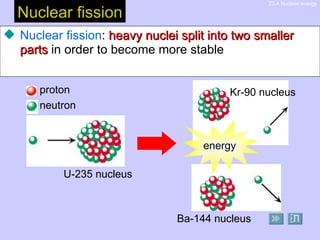
Nuclear fission Nuclear fission :  heavy nuclei split into two smaller parts  in order to become more stable energy proton neutron U-235 nucleus Kr-90 nucleus Ba-144 nucleus
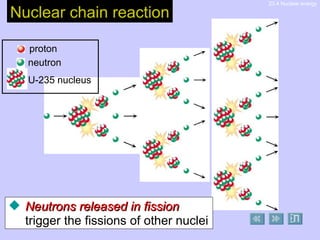
Nuclear chain reaction Neutrons released in fission  trigger the fissions of other nuclei proton neutron U-235 nucleus
The chain reaction is not slowed down Uncontrolled nuclear reaction a huge amount of energy is released very quickly the rate of fission increases rapidly Nuclear bomb
Nuclear reactors Nuclear power plant : rate of fission is controlled by artificial means to generate electricity  the Daya Bay Nuclear Power Station Simulation: Nuclear power plant
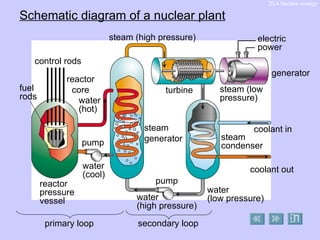
Schematic diagram of a nuclear plant control rods fuel rods reactor pressure vessel water (cool) water (hot) water  (high pressure) water  (low pressure) coolant out coolant in steam condenser steam (low pressure) turbine electric power steam generator steam (high pressure) pump primary loop secondary loop generator reactor core pump
control rods reactor pressure vessel water (cool) water (hot) water  (high pressure) water  (low pressure) coolant out coolant in steam condenser steam (low pressure) turbine electric power steam generator steam (high pressure) pump primary loop secondary loop fuel rods They contain the nuclear fuel:  uranium (U-235) They are surrounded by a  moderator (water or graphite)  to  slow down the neutrons released.
control rods reactor pressure vessel water (cool) water (hot) water  (high pressure) water  (low pressure) coolant out coolant in steam condenser steam (low pressure) turbine electric power steam generator steam (high pressure) pump primary loop secondary loop fuel rods They control the rate of reaction by moving in and out of the reactor. Move in: rate of reaction   Move out: rate of reaction   All are moved in: the reactor is shut down They are made of  boron  硼  or  cadmium  鎘  that can  absorb neutrons.
control rods reactor pressure vessel water  (high pressure) water  (low pressure) coolant out coolant in steam condenser steam (low pressure) turbine electric power pump primary loop secondary loop fuel rods The energy released in fissions heats up the water around the reactor. The water in the secondary loop is boiled to steam . water (hot) water (cool) steam generator steam (high pressure)
steam generator control rods reactor pressure vessel water  (high pressure) water  (low pressure) coolant out coolant in steam condenser steam (high pressure) pump primary loop secondary loop fuel rods The steam drives a turbine, which turns the generator. Electricity is produced by the generator. water (hot) water (cool) steam (low pressure) turbine electric power generator
control rods fuel rods reactor pressure vessel water (cool) water (hot) water  (high pressure) water  (low pressure) coolant out coolant in steam condenser steam (low pressure) turbine electric power steam generator steam (high pressure) pump primary loop secondary loop Two separate water systems  are used to avoid radioactive substances to reach the turbine.
Nuclear waste  核廢料 They are highly radioactive Many of them have very long half-lives.    Radioactive waste  must be stored carefully.
Low level radioactive waste cooling water pipes, radiation suits , etc. stored in storage facilities radioactivity will fall to a safe level after  10 to 50 years .
used nuclear fuel highly radioactive embedded in concrete and stored  deep underground  for  several thousand years High level radioactive waste  高危險性核廢料
Nuclear fusion Nuclear fusion : light nuclei fuse together to form a heavier nucleus H-2 + H-3    He-4 + n + energy proton neutron helium nucleus neutron energy deuterium nucleus tritium nucleus
They must have  enough kinetic energy to overcome the electrical repulsion . Very high temperature  (about 10 7  K)   is   required to start a nuclear fusion. Atomic nuclei are  positively charged  and repelled each other. How can two nuclei fuse together ?
The temperatures  inside the Sun  and the stars reach such  high temperature . Inside the Sun,  657 million tons of hydrogen undergo fusion to form helium each second.
Man-made uncontrolled fusion  was first achieved in 1952, during the explosion of the first  hydrogen bomb. Controlled fusion is still under investigated by scientists.  No one has succeeded in yielding a net surplus of energy from fusion reactors.
Unlimited supply of fuel  for fusion reactors. We can get  hydrogen from water . Little problem on disposal of radioactive waste . The  end products of fusion are generally stable and not radioactive. What are the advantages of fusion power?

Nuclear Fission

  • 1.
  • 2.
    Nuclear fission Nuclearfission : heavy nuclei split into two smaller parts in order to become more stable energy proton neutron U-235 nucleus Kr-90 nucleus Ba-144 nucleus
  • 3.
    Nuclear chain reactionNeutrons released in fission trigger the fissions of other nuclei proton neutron U-235 nucleus
  • 4.
    The chain reactionis not slowed down Uncontrolled nuclear reaction a huge amount of energy is released very quickly the rate of fission increases rapidly Nuclear bomb
  • 5.
    Nuclear reactors Nuclearpower plant : rate of fission is controlled by artificial means to generate electricity the Daya Bay Nuclear Power Station Simulation: Nuclear power plant
  • 6.
    Schematic diagram ofa nuclear plant control rods fuel rods reactor pressure vessel water (cool) water (hot) water (high pressure) water (low pressure) coolant out coolant in steam condenser steam (low pressure) turbine electric power steam generator steam (high pressure) pump primary loop secondary loop generator reactor core pump
  • 7.
    control rods reactorpressure vessel water (cool) water (hot) water (high pressure) water (low pressure) coolant out coolant in steam condenser steam (low pressure) turbine electric power steam generator steam (high pressure) pump primary loop secondary loop fuel rods They contain the nuclear fuel: uranium (U-235) They are surrounded by a moderator (water or graphite) to slow down the neutrons released.
  • 8.
    control rods reactorpressure vessel water (cool) water (hot) water (high pressure) water (low pressure) coolant out coolant in steam condenser steam (low pressure) turbine electric power steam generator steam (high pressure) pump primary loop secondary loop fuel rods They control the rate of reaction by moving in and out of the reactor. Move in: rate of reaction  Move out: rate of reaction  All are moved in: the reactor is shut down They are made of boron 硼 or cadmium 鎘 that can absorb neutrons.
  • 9.
    control rods reactorpressure vessel water (high pressure) water (low pressure) coolant out coolant in steam condenser steam (low pressure) turbine electric power pump primary loop secondary loop fuel rods The energy released in fissions heats up the water around the reactor. The water in the secondary loop is boiled to steam . water (hot) water (cool) steam generator steam (high pressure)
  • 10.
    steam generator controlrods reactor pressure vessel water (high pressure) water (low pressure) coolant out coolant in steam condenser steam (high pressure) pump primary loop secondary loop fuel rods The steam drives a turbine, which turns the generator. Electricity is produced by the generator. water (hot) water (cool) steam (low pressure) turbine electric power generator
  • 11.
    control rods fuelrods reactor pressure vessel water (cool) water (hot) water (high pressure) water (low pressure) coolant out coolant in steam condenser steam (low pressure) turbine electric power steam generator steam (high pressure) pump primary loop secondary loop Two separate water systems are used to avoid radioactive substances to reach the turbine.
  • 12.
    Nuclear waste 核廢料 They are highly radioactive Many of them have very long half-lives.  Radioactive waste must be stored carefully.
  • 13.
    Low level radioactivewaste cooling water pipes, radiation suits , etc. stored in storage facilities radioactivity will fall to a safe level after 10 to 50 years .
  • 14.
    used nuclear fuelhighly radioactive embedded in concrete and stored deep underground for several thousand years High level radioactive waste 高危險性核廢料
  • 15.
    Nuclear fusion Nuclearfusion : light nuclei fuse together to form a heavier nucleus H-2 + H-3  He-4 + n + energy proton neutron helium nucleus neutron energy deuterium nucleus tritium nucleus
  • 16.
    They must have enough kinetic energy to overcome the electrical repulsion . Very high temperature (about 10 7 K) is required to start a nuclear fusion. Atomic nuclei are positively charged and repelled each other. How can two nuclei fuse together ?
  • 17.
    The temperatures inside the Sun and the stars reach such high temperature . Inside the Sun, 657 million tons of hydrogen undergo fusion to form helium each second.
  • 18.
    Man-made uncontrolled fusion was first achieved in 1952, during the explosion of the first hydrogen bomb. Controlled fusion is still under investigated by scientists. No one has succeeded in yielding a net surplus of energy from fusion reactors.
  • 19.
    Unlimited supply offuel for fusion reactors. We can get hydrogen from water . Little problem on disposal of radioactive waste . The end products of fusion are generally stable and not radioactive. What are the advantages of fusion power?