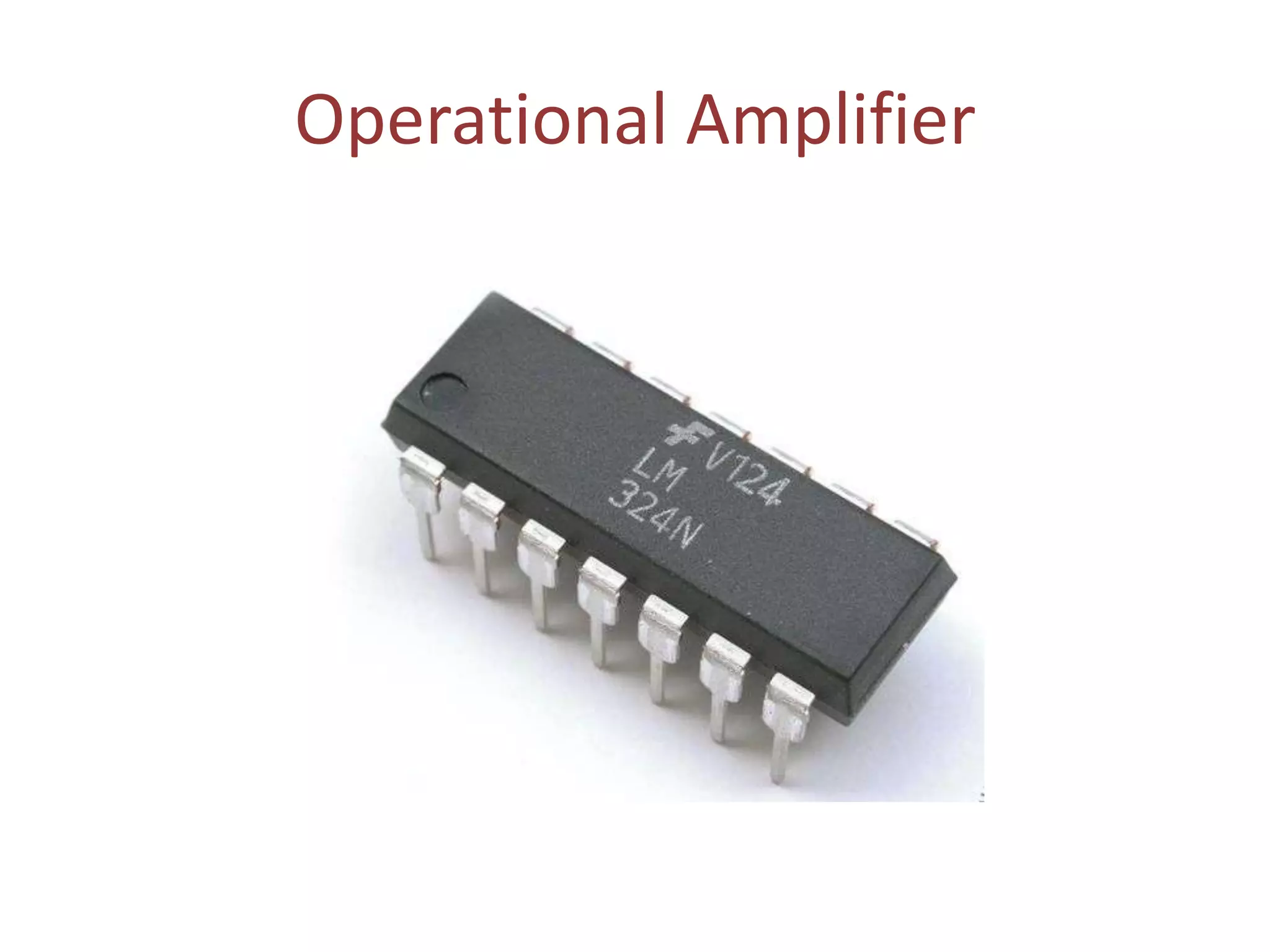
Operational Amplifier
What is an Operational Amplifier?Differential amplifier - amplifies difference between two signals.Can amplify very small voltage signals to a useful level.3) Typically an 8 lead IC.4) Op Amps can require one power supply (single supply) or a positive and a negative power supply (dual supply)
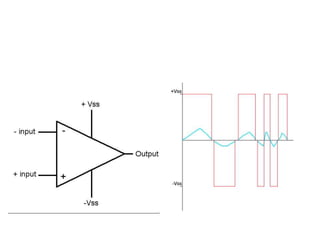
Basic Op Amp Function1) If (inverting input) > (non-inverting input) output saturates towards -Vss2) If (inverting input) < (non-inverting input) output saturates towards +Vss3) Without feedback maximum saturation occurs with the slightest difference between inputs.4) Ideal op-amp has infinite impedance on the inputs, infinite gain, and zero resistance on output.
Contnd….5) In real life gain is limited to voltage present at +Vss/-Vss6) For practical purposes there is no current flow from the inputs to the outputs. The input voltage serves only as a reference to control the output.
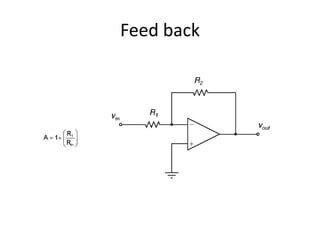
Feedback1) Degree of amplification can be controlled using feedback.2) Feedback can be applied to the inverting or non-inverting input.3) Feedback applied to the inverting input is more common and is called negative feedback. 4) Gain (A) = 1 + (Rf/Rin)
Feed back
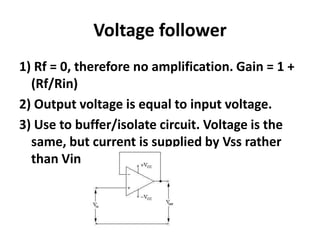
Voltage follower1) Rf = 0, therefore no amplification. Gain = 1 + (Rf/Rin)2) Output voltage is equal to input voltage. 3) Use to buffer/isolate circuit. Voltage is the same, but current is supplied by Vss rather than Vin
Amplifies small difference between two signals.Output voltage will "switch" whenever the input voltage (at the inverting input) reaches the reference voltage Vref (at the non-inverting input)3) Very useful for comparing signals and working with sensorsComparator
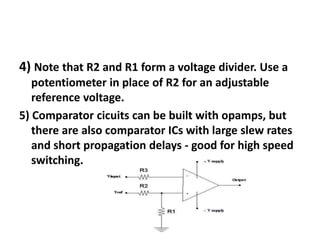
4) Note that R2 and R1 form a voltage divider. Use a potentiometer in place of R2 for an adjustable reference voltage.5) Comparator cicuits can be built with opamps, but there are also comparator ICs with large slew rates and short propagation delays - good for high speed switching.  
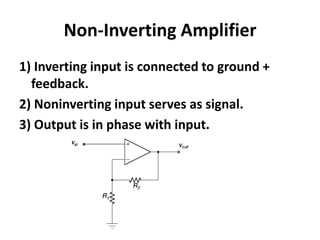
Non-Inverting Amplifier1) Inverting input is connected to ground + feedback.2) Noninverting input serves as signal.3) Output is in phase with input.
Negative power supply1) Some opamps need a dual power supply.2) If we're only interested in getting positive output from opamp, -Vss can be connected to ground.3) Dual power supply options include building a dual power supply, using two batteries, or purchasing a dual polarity power supply.
Slew Rate1) Slew rate defines how fast the opamp can react to changes at the inputs. Different opamps have different slew rates.2) If voltage chages faster than opamp's slew rate, signal will be attentuated.3) The higher the gain, the more deliterious effect from slow slew rate.4) This is only an issue with high frequencey signals.
Construction tips1) Don't reverse the power leads. This will kill the opamp. A diode can be placed in series with -Vss to avoid this.2) +Vss and -Vss must be greater than the noninverting and inverting inputs.3) Couple signals and output to ground with caps (1.0uf - 0.1uf) if needed to filter noise and prevent oscillation. 4) Keep leads from power supply to +/- Vss short and direct.
Thanking You!

Operational Amplifier

  • 1.
  • 2.
    What is anOperational Amplifier?Differential amplifier - amplifies difference between two signals.Can amplify very small voltage signals to a useful level.3) Typically an 8 lead IC.4) Op Amps can require one power supply (single supply) or a positive and a negative power supply (dual supply)
  • 3.
    Basic Op AmpFunction1) If (inverting input) > (non-inverting input) output saturates towards -Vss2) If (inverting input) < (non-inverting input) output saturates towards +Vss3) Without feedback maximum saturation occurs with the slightest difference between inputs.4) Ideal op-amp has infinite impedance on the inputs, infinite gain, and zero resistance on output.
  • 4.
    Contnd….5) In reallife gain is limited to voltage present at +Vss/-Vss6) For practical purposes there is no current flow from the inputs to the outputs. The input voltage serves only as a reference to control the output.
  • 6.
    Feedback1) Degree ofamplification can be controlled using feedback.2) Feedback can be applied to the inverting or non-inverting input.3) Feedback applied to the inverting input is more common and is called negative feedback. 4) Gain (A) = 1 + (Rf/Rin)
  • 7.
  • 8.
    Voltage follower1) Rf= 0, therefore no amplification. Gain = 1 + (Rf/Rin)2) Output voltage is equal to input voltage. 3) Use to buffer/isolate circuit. Voltage is the same, but current is supplied by Vss rather than Vin
  • 9.
    Amplifies small differencebetween two signals.Output voltage will "switch" whenever the input voltage (at the inverting input) reaches the reference voltage Vref (at the non-inverting input)3) Very useful for comparing signals and working with sensorsComparator
  • 10.
    4) Note thatR2 and R1 form a voltage divider. Use a potentiometer in place of R2 for an adjustable reference voltage.5) Comparator cicuits can be built with opamps, but there are also comparator ICs with large slew rates and short propagation delays - good for high speed switching.  
  • 11.
    Non-Inverting Amplifier1) Invertinginput is connected to ground + feedback.2) Noninverting input serves as signal.3) Output is in phase with input.
  • 12.
    Negative power supply1)Some opamps need a dual power supply.2) If we're only interested in getting positive output from opamp, -Vss can be connected to ground.3) Dual power supply options include building a dual power supply, using two batteries, or purchasing a dual polarity power supply.
  • 13.
    Slew Rate1) Slewrate defines how fast the opamp can react to changes at the inputs. Different opamps have different slew rates.2) If voltage chages faster than opamp's slew rate, signal will be attentuated.3) The higher the gain, the more deliterious effect from slow slew rate.4) This is only an issue with high frequencey signals.
  • 14.
    Construction tips1) Don'treverse the power leads. This will kill the opamp. A diode can be placed in series with -Vss to avoid this.2) +Vss and -Vss must be greater than the noninverting and inverting inputs.3) Couple signals and output to ground with caps (1.0uf - 0.1uf) if needed to filter noise and prevent oscillation. 4) Keep leads from power supply to +/- Vss short and direct.
  • 15.