Name: (1) Kamal Akhtar F.(120450119156) 
Branch: Mechanical-4C(1) 
Collage: S.V.M.I.T.
Introduction… 
O Iteration method:- 
O Why iteration method is need? 
O When the system of algebraic equation consist of large 
number of equation then the direct method becomes 
cumbersome and time consuming. 
O In this case Iteration method provide easy to 
solve the system. 
O In Iteration method we start from initial approximation to the 
actual solution and obtain better and better approximation 
after repeating iteration. 
O Iteration method gives the value to the desired accuracy.
Iteration method:- 
O(1) Jacobi's method 
O(2) Gauss-Seidel method
Jacobi's method 
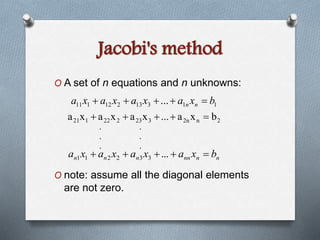
O A set of n equations and n unknowns: 
11 1 12 2 13 3 1 1 a x a x a x ... a x b n n      
21 1 22 2 23 3 2n n 2 a x  a x  a x ... a x  b 
. . 
. . 
. . 
n n n nn n n a x  a x  a x ...  a x  b 1 1 2 2 3 3 
O note: assume all the diagonal elements 
are not zero.
Jacobi's method 
O If diagonal elements are zero then we 
Rewrite the question as… 
O 푥1 = 
[푏1− 푎11푥2+푎13푥3+⋯+푎1푛푥푛 ] 
푎11 
O 푥2 = 
[푏2− 푎21푥2+푎23푥3+⋯+푎2푛푥푛 ] 
푎22 
O 푥푛 = 
[푏푛− 푎푛1푥2+푎푛2푥2+⋯+푎푛(푛−1)푥푛−1 ] 
푎푛푛
Jacobi's method 
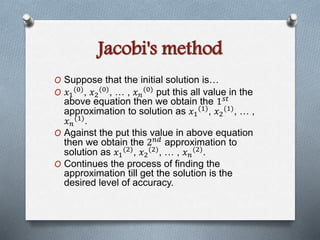
O Suppose that the initial solution is… 
O 푥(1 
0), 푥(2 
0), … , 푥푛 
(0) put this all value in the 
above equation then we obtain the 1푠푡 
approximation to solution as 푥(1 
1), 푥2 
(1), … , 
푥푛 
(1). 
O Against the put this value in above equation 
then we obtain the 2푛푑 approximation to 
solution as 푥(((1 
2), 푥2 
2), … , 푥푛 
2). 
O Continues the process of finding the 
approximation till get the solution is the 
desired level of accuracy.
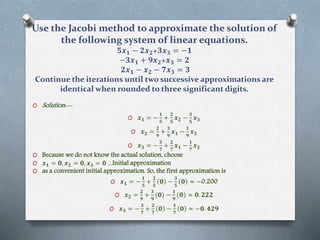
Use the Jacobi method to approximate the solution of 
the following system of linear equations. 
ퟓ풙ퟏ − ퟐ풙ퟐ+ퟑ풙ퟑ = −ퟏ 
−ퟑ풙ퟏ + ퟗ풙ퟐ+풙ퟑ = ퟐ 
ퟐ풙ퟏ − 풙ퟐ − ퟕ풙ퟑ = ퟑ 
Continue the iterations until two successive approximations are 
identical when rounded to three significant digits. 
O Solution:-- 
O 풙ퟏ = − 
ퟏ 
ퟓ 
+ 
ퟐ 
ퟓ 
풙ퟐ − 
ퟑ 
ퟓ 
풙ퟑ 
O 풙ퟐ = 
ퟐ 
ퟗ 
+ 
ퟑ 
ퟗ 
풙ퟏ − 
ퟏ 
ퟗ 
풙ퟑ 
O 풙ퟑ = − 
ퟑ 
ퟕ 
+ 
ퟐ 
ퟕ 
풙ퟏ − 
ퟏ 
ퟕ 
풙ퟐ 
O Because we do not know the actual solution, choose 
O 풙ퟏ = ퟎ, 풙ퟐ = ퟎ, 풙ퟑ = ퟎ …Initial approximation 
O as a convenient initial approximation. So, the first approximation is 
O 풙ퟏ = − 
ퟏ 
ퟓ 
+ 
ퟐ 
ퟓ 
ퟎ − 
ퟑ 
ퟓ 
ퟎ ≈ −0.200 
O 풙ퟐ = 
ퟐ 
ퟗ 
+ 
ퟑ 
ퟗ 
(ퟎ) − 
ퟏ 
ퟗ 
(ퟎ) ≈ ퟎ. ퟐퟐퟐ 
O 풙ퟑ = − 
ퟑ 
ퟕ 
+ 
ퟐ 
ퟕ 
ퟎ − 
ퟏ 
ퟕ 
ퟎ ≈ −ퟎ. ퟒퟐퟗ
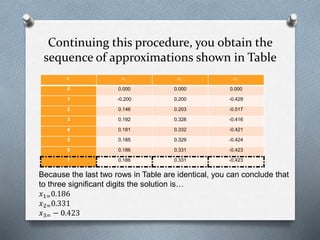
Continuing this procedure, you obtain the 
sequence of approximations shown in Table 
푛 푥1 푥2 푥3 
0 0.000 0.000 0.000 
1 -0.200 0.200 -0.429 
2 0.146 0.203 -0.517 
3 0.192 0.328 -0.416 
4 0.181 0.332 -0.421 
5 0.185 0.329 -0.424 
6 0.186 0.331 -0.423 
7 0.186 0.331 -0.423 
Because the last two rows in Table are identical, you can conclude that 
to three significant digits the solution is… 
푥1=0.186 
푥2=0.331 
푥3= − 0.423
The Gauss-Seidel Method 
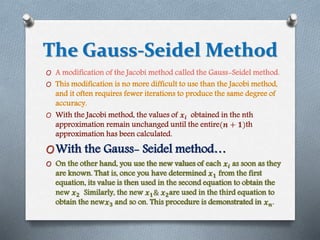
O A modification of the Jacobi method called the Gauss-Seidel method. 
O This modification is no more difficult to use than the Jacobi method, 
and it often requires fewer iterations to produce the same degree of 
accuracy. 
O With the Jacobi method, the values of 풙풊 obtained in the nth 
approximation remain unchanged until the entire(풏 + ퟏ)th 
approximation has been calculated. 
OWith the Gauss- Seidel method… 
O On the other hand, you use the new values of each 풙풊 as soon as they 
are known. That is, once you have determined 풙ퟏ from the first 
equation, its value is then used in the second equation to obtain the 
new 풙ퟐ Similarly, the new 풙ퟏ& 풙ퟐare used in the third equation to 
obtain the new풙ퟑ and so on. This procedure is demonstrated in 풙풏.
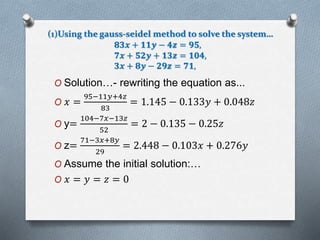
(1)Using the gauss-seidel method to solve the system… 
ퟖퟑ풙 + ퟏퟏ풚 − ퟒ풛 = ퟗퟓ, 
ퟕ풙 + ퟓퟐ풚 + ퟏퟑ풛 = ퟏퟎퟒ, 
ퟑ풙 + ퟖ풚 − ퟐퟗ풛 = ퟕퟏ, 
O Solution…- rewriting the equation as... 
95−11푦+4푧 
O 푥 = 
83 
= 1.145 − 0.133푦 + 0.048푧 
O y= 
104−7푥−13푧 
52 
= 2 − 0.135 − 0.25푧 
O z= 
71−3푥+8푦 
29 
= 2.448 − 0.103푥 + 0.276푦 
O Assume the initial solution:… 
O 푥 = 푦 = 푧 = 0
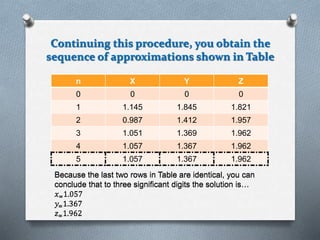
Continuing this procedure, you obtain the 
sequence of approximations shown in Table 
n X Y Z 
0 0 0 0 
1 1.145 1.845 1.821 
2 0.987 1.412 1.957 
3 1.051 1.369 1.962 
4 1.057 1.367 1.962 
5 1.057 1.367 1.962 
Because the last two rows in Table are identical, you can 
conclude that to three significant digits the solution is… 
푥=1.057 
푦=1.367 
푧=1.962
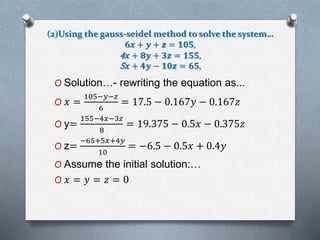
(2)Using the gauss-seidel method to solve the system… 
6풙 + 풚 + 풛 = ퟏퟎퟓ, 
4풙 + ퟖ풚 + ퟑ풛 = ퟏퟓퟓ, 
5풙 + ퟒ풚 − ퟏퟎ풛 = ퟔퟓ, 
O Solution…- rewriting the equation as... 
105−푦−푧 
O 푥 = 
6 
= 17.5 − 0.167푦 − 0.167푧 
O y= 
155−4푥−3푧 
8 
= 19.375 − 0.5푥 − 0.375푧 
O z= 
−65+5푥+4푦 
10 
= −6.5 − 0.5푥 + 0.4푦 
O Assume the initial solution:… 
O 푥 = 푦 = 푧 = 0
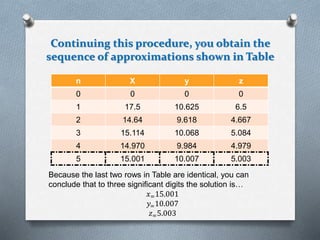
Continuing this procedure, you obtain the 
sequence of approximations shown in Table 
n X y z 
0 0 0 0 
1 17.5 10.625 6.5 
2 14.64 9.618 4.667 
3 15.114 10.068 5.084 
4 14.970 9.984 4.979 
5 15.001 10.007 5.003 
Because the last two rows in Table are identical, you can 
conclude that to three significant digits the solution is… 
푥=15.001 
푦=10.007 
푧=5.003
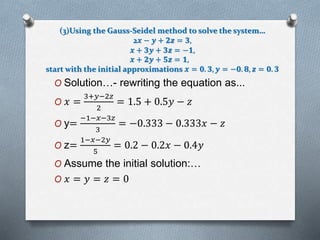
(3)Using the Gauss-Seidel method to solve the system… 
2풙 − 풚 + ퟐ풛 = ퟑ, 
풙 + ퟑ풚 + ퟑ풛 = −ퟏ, 
풙 + ퟐ풚 + ퟓ풛 = ퟏ, 
start with the initial approximations 풙 = ퟎ. ퟑ, 풚 = −ퟎ. ퟖ, 풛 = ퟎ. ퟑ 
O Solution…- rewriting the equation as... 
3+푦−2푧 
O 푥 = 
2 
= 1.5 + 0.5푦 − 푧 
O y= 
−1−푥−3푧 
3 
= −0.333 − 0.333푥 − 푧 
O z= 
1−푥−2푦 
5 
= 0.2 − 0.2푥 − 0.4푦 
O Assume the initial solution:… 
O 푥 = 푦 = 푧 = 0
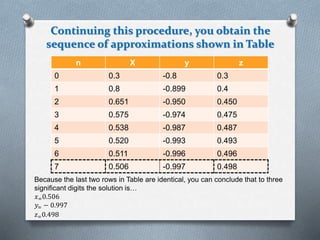
Continuing this procedure, you obtain the 
sequence of approximations shown in Table 
n X y z 
0 0.3 -0.8 0.3 
1 0.8 -0.899 0.4 
2 0.651 -0.950 0.450 
3 0.575 -0.974 0.475 
4 0.538 -0.987 0.487 
5 0.520 -0.993 0.493 
6 0.511 -0.996 0.496 
7 0.506 -0.997 0.498 
Because the last two rows in Table are identical, you can conclude that to three 
significant digits the solution is… 
푥=0.506 
푦= − 0.997 
푧=0.498
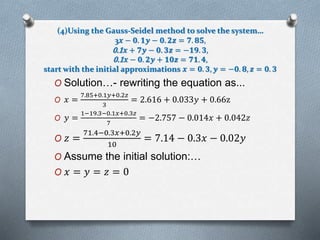
(4)Using the Gauss-Seidel method to solve the system… 
3풙 − ퟎ. ퟏ풚 − ퟎ. ퟐ풛 = ퟕ. ퟖퟓ, 
0.1풙 + ퟕ풚 − ퟎ. ퟑ풛 = −ퟏퟗ. ퟑ, 
0.1풙 − ퟎ. ퟐ풚 + ퟏퟎ풛 = ퟕퟏ. ퟒ, 
start with the initial approximations 풙 = ퟎ. ퟑ, 풚 = −ퟎ. ퟖ, 풛 = ퟎ. ퟑ 
O Solution…- rewriting the equation as... 
7.85+0.1푦+0.2푧 
O 푥 = 
3 
= 2.616 + 0.033푦 + 0.66z 
O 푦 = 
1−19.3−0.1푥+0.3푧 
7 
= −2.757 − 0.014푥 + 0.042푧 
O 푧 = 
71.4−0.3푥+0.2푦 
10 
= 7.14 − 0.3푥 − 0.02푦 
O Assume the initial solution:… 
O 푥 = 푦 = 푧 = 0
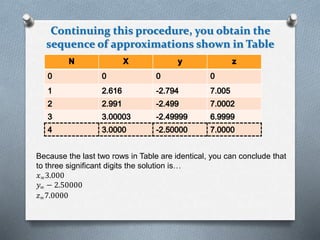
Continuing this procedure, you obtain the 
sequence of approximations shown in Table 
Because the last two rows in Table are identical, you can conclude that 
to three significant digits the solution is… 
푥=3.000 
푦= − 2.50000 
푧=7.0000
system of algebraic equation by Iteration method

system of algebraic equation by Iteration method

  • 1.
    Name: (1) KamalAkhtar F.(120450119156) Branch: Mechanical-4C(1) Collage: S.V.M.I.T.
  • 2.
    Introduction… O Iterationmethod:- O Why iteration method is need? O When the system of algebraic equation consist of large number of equation then the direct method becomes cumbersome and time consuming. O In this case Iteration method provide easy to solve the system. O In Iteration method we start from initial approximation to the actual solution and obtain better and better approximation after repeating iteration. O Iteration method gives the value to the desired accuracy.
  • 3.
    Iteration method:- O(1)Jacobi's method O(2) Gauss-Seidel method
  • 4.
    Jacobi's method OA set of n equations and n unknowns: 11 1 12 2 13 3 1 1 a x a x a x ... a x b n n      21 1 22 2 23 3 2n n 2 a x  a x  a x ... a x  b . . . . . . n n n nn n n a x  a x  a x ...  a x  b 1 1 2 2 3 3 O note: assume all the diagonal elements are not zero.
  • 5.
    Jacobi's method OIf diagonal elements are zero then we Rewrite the question as… O 푥1 = [푏1− 푎11푥2+푎13푥3+⋯+푎1푛푥푛 ] 푎11 O 푥2 = [푏2− 푎21푥2+푎23푥3+⋯+푎2푛푥푛 ] 푎22 O 푥푛 = [푏푛− 푎푛1푥2+푎푛2푥2+⋯+푎푛(푛−1)푥푛−1 ] 푎푛푛
  • 6.
    Jacobi's method OSuppose that the initial solution is… O 푥(1 0), 푥(2 0), … , 푥푛 (0) put this all value in the above equation then we obtain the 1푠푡 approximation to solution as 푥(1 1), 푥2 (1), … , 푥푛 (1). O Against the put this value in above equation then we obtain the 2푛푑 approximation to solution as 푥(((1 2), 푥2 2), … , 푥푛 2). O Continues the process of finding the approximation till get the solution is the desired level of accuracy.
  • 7.
    Use the Jacobimethod to approximate the solution of the following system of linear equations. ퟓ풙ퟏ − ퟐ풙ퟐ+ퟑ풙ퟑ = −ퟏ −ퟑ풙ퟏ + ퟗ풙ퟐ+풙ퟑ = ퟐ ퟐ풙ퟏ − 풙ퟐ − ퟕ풙ퟑ = ퟑ Continue the iterations until two successive approximations are identical when rounded to three significant digits. O Solution:-- O 풙ퟏ = − ퟏ ퟓ + ퟐ ퟓ 풙ퟐ − ퟑ ퟓ 풙ퟑ O 풙ퟐ = ퟐ ퟗ + ퟑ ퟗ 풙ퟏ − ퟏ ퟗ 풙ퟑ O 풙ퟑ = − ퟑ ퟕ + ퟐ ퟕ 풙ퟏ − ퟏ ퟕ 풙ퟐ O Because we do not know the actual solution, choose O 풙ퟏ = ퟎ, 풙ퟐ = ퟎ, 풙ퟑ = ퟎ …Initial approximation O as a convenient initial approximation. So, the first approximation is O 풙ퟏ = − ퟏ ퟓ + ퟐ ퟓ ퟎ − ퟑ ퟓ ퟎ ≈ −0.200 O 풙ퟐ = ퟐ ퟗ + ퟑ ퟗ (ퟎ) − ퟏ ퟗ (ퟎ) ≈ ퟎ. ퟐퟐퟐ O 풙ퟑ = − ퟑ ퟕ + ퟐ ퟕ ퟎ − ퟏ ퟕ ퟎ ≈ −ퟎ. ퟒퟐퟗ
  • 8.
    Continuing this procedure,you obtain the sequence of approximations shown in Table 푛 푥1 푥2 푥3 0 0.000 0.000 0.000 1 -0.200 0.200 -0.429 2 0.146 0.203 -0.517 3 0.192 0.328 -0.416 4 0.181 0.332 -0.421 5 0.185 0.329 -0.424 6 0.186 0.331 -0.423 7 0.186 0.331 -0.423 Because the last two rows in Table are identical, you can conclude that to three significant digits the solution is… 푥1=0.186 푥2=0.331 푥3= − 0.423
  • 9.
    The Gauss-Seidel Method O A modification of the Jacobi method called the Gauss-Seidel method. O This modification is no more difficult to use than the Jacobi method, and it often requires fewer iterations to produce the same degree of accuracy. O With the Jacobi method, the values of 풙풊 obtained in the nth approximation remain unchanged until the entire(풏 + ퟏ)th approximation has been calculated. OWith the Gauss- Seidel method… O On the other hand, you use the new values of each 풙풊 as soon as they are known. That is, once you have determined 풙ퟏ from the first equation, its value is then used in the second equation to obtain the new 풙ퟐ Similarly, the new 풙ퟏ& 풙ퟐare used in the third equation to obtain the new풙ퟑ and so on. This procedure is demonstrated in 풙풏.
  • 10.
    (1)Using the gauss-seidelmethod to solve the system… ퟖퟑ풙 + ퟏퟏ풚 − ퟒ풛 = ퟗퟓ, ퟕ풙 + ퟓퟐ풚 + ퟏퟑ풛 = ퟏퟎퟒ, ퟑ풙 + ퟖ풚 − ퟐퟗ풛 = ퟕퟏ, O Solution…- rewriting the equation as... 95−11푦+4푧 O 푥 = 83 = 1.145 − 0.133푦 + 0.048푧 O y= 104−7푥−13푧 52 = 2 − 0.135 − 0.25푧 O z= 71−3푥+8푦 29 = 2.448 − 0.103푥 + 0.276푦 O Assume the initial solution:… O 푥 = 푦 = 푧 = 0
  • 11.
    Continuing this procedure,you obtain the sequence of approximations shown in Table n X Y Z 0 0 0 0 1 1.145 1.845 1.821 2 0.987 1.412 1.957 3 1.051 1.369 1.962 4 1.057 1.367 1.962 5 1.057 1.367 1.962 Because the last two rows in Table are identical, you can conclude that to three significant digits the solution is… 푥=1.057 푦=1.367 푧=1.962
  • 12.
    (2)Using the gauss-seidelmethod to solve the system… 6풙 + 풚 + 풛 = ퟏퟎퟓ, 4풙 + ퟖ풚 + ퟑ풛 = ퟏퟓퟓ, 5풙 + ퟒ풚 − ퟏퟎ풛 = ퟔퟓ, O Solution…- rewriting the equation as... 105−푦−푧 O 푥 = 6 = 17.5 − 0.167푦 − 0.167푧 O y= 155−4푥−3푧 8 = 19.375 − 0.5푥 − 0.375푧 O z= −65+5푥+4푦 10 = −6.5 − 0.5푥 + 0.4푦 O Assume the initial solution:… O 푥 = 푦 = 푧 = 0
  • 13.
    Continuing this procedure,you obtain the sequence of approximations shown in Table n X y z 0 0 0 0 1 17.5 10.625 6.5 2 14.64 9.618 4.667 3 15.114 10.068 5.084 4 14.970 9.984 4.979 5 15.001 10.007 5.003 Because the last two rows in Table are identical, you can conclude that to three significant digits the solution is… 푥=15.001 푦=10.007 푧=5.003
  • 14.
    (3)Using the Gauss-Seidelmethod to solve the system… 2풙 − 풚 + ퟐ풛 = ퟑ, 풙 + ퟑ풚 + ퟑ풛 = −ퟏ, 풙 + ퟐ풚 + ퟓ풛 = ퟏ, start with the initial approximations 풙 = ퟎ. ퟑ, 풚 = −ퟎ. ퟖ, 풛 = ퟎ. ퟑ O Solution…- rewriting the equation as... 3+푦−2푧 O 푥 = 2 = 1.5 + 0.5푦 − 푧 O y= −1−푥−3푧 3 = −0.333 − 0.333푥 − 푧 O z= 1−푥−2푦 5 = 0.2 − 0.2푥 − 0.4푦 O Assume the initial solution:… O 푥 = 푦 = 푧 = 0
  • 15.
    Continuing this procedure,you obtain the sequence of approximations shown in Table n X y z 0 0.3 -0.8 0.3 1 0.8 -0.899 0.4 2 0.651 -0.950 0.450 3 0.575 -0.974 0.475 4 0.538 -0.987 0.487 5 0.520 -0.993 0.493 6 0.511 -0.996 0.496 7 0.506 -0.997 0.498 Because the last two rows in Table are identical, you can conclude that to three significant digits the solution is… 푥=0.506 푦= − 0.997 푧=0.498
  • 16.
    (4)Using the Gauss-Seidelmethod to solve the system… 3풙 − ퟎ. ퟏ풚 − ퟎ. ퟐ풛 = ퟕ. ퟖퟓ, 0.1풙 + ퟕ풚 − ퟎ. ퟑ풛 = −ퟏퟗ. ퟑ, 0.1풙 − ퟎ. ퟐ풚 + ퟏퟎ풛 = ퟕퟏ. ퟒ, start with the initial approximations 풙 = ퟎ. ퟑ, 풚 = −ퟎ. ퟖ, 풛 = ퟎ. ퟑ O Solution…- rewriting the equation as... 7.85+0.1푦+0.2푧 O 푥 = 3 = 2.616 + 0.033푦 + 0.66z O 푦 = 1−19.3−0.1푥+0.3푧 7 = −2.757 − 0.014푥 + 0.042푧 O 푧 = 71.4−0.3푥+0.2푦 10 = 7.14 − 0.3푥 − 0.02푦 O Assume the initial solution:… O 푥 = 푦 = 푧 = 0
  • 17.
    Continuing this procedure,you obtain the sequence of approximations shown in Table Because the last two rows in Table are identical, you can conclude that to three significant digits the solution is… 푥=3.000 푦= − 2.50000 푧=7.0000