Flexible Manufacturing System
Prepared By: Dhaval Chauhan
Guided By: Prof. B. K. Chavda
TABLE OF CONTENTS
• What is FMS?
• Types of Flexibility
• Types of FMS
• FMS Components
• Workstations
• Material Handling and Storage Systems
• Computer Control System
• Human Recourses
• FMS Layout
TABLE OF CONTENTS
• Applications
• Benefits
WHAT IS FMS?
• A flexible manufacturing system is a automated
machine cell, consisting of a group of processing
workstations, interconnected with automated material
handling and storage system.
• The FMS is most suited for the mid-variety, mid-
volume production range.
TYPES OF FLEXIBILITY
• Flexibility of product variety
• Flexibility of production volume
• Flexibility of delivery time
• Flexibility of material handling
• Flexibility of operations
• Flexibility of expansion
• Flexibility of market
TYPES OF FMS
• Single machine cell - One CNC machining center
combined with a parts storage system for unattended
operation.
• Flexible manufacturing cell - Consists of two or three
processing stations plus a parts handling system
connected to a load/unload station.
• Flexible manufacturing system - Four or more
processing workstations connected mechanically by a
common parts handling system and electronically by
a distributed computer system.
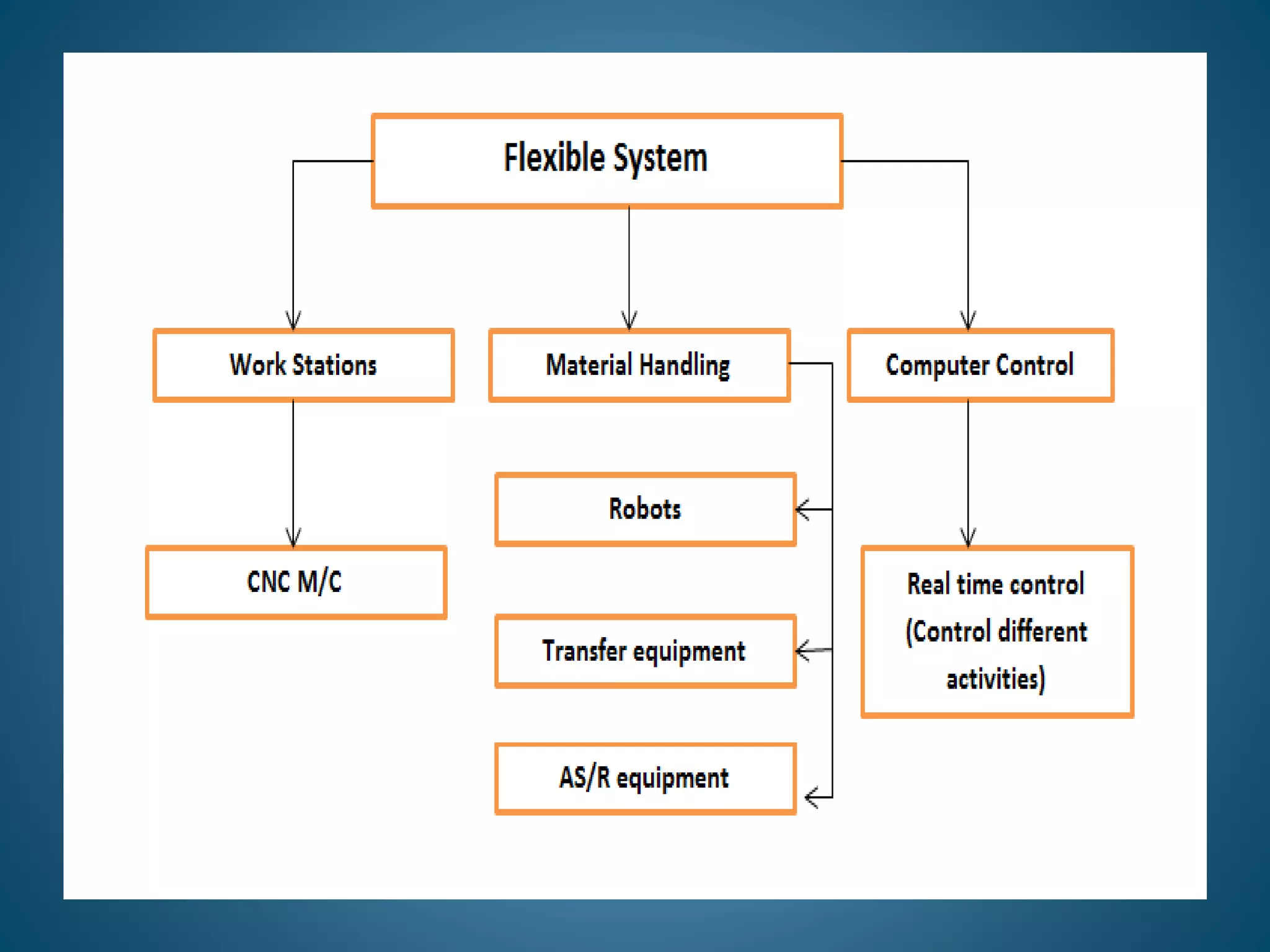
FMS COMPONENTS
• The basic components of a flexible manufacturing
system are,
1. workstations
2. material handling and storage system
3. computer control system
4. human resources
WORKSTATIONS
• Load/unload stations
• Machining stations
• Other processing stations (punching, shearing,
welding etc.)
• Assembly stations
• Other stations and equipment (inspection, vision etc.)
MATERIAL HANDLING AND STORAGE
SYSTEMS
• It is used for…
 random and independent movement of work parts
between workstations
 handling of a variety of work part configuration
 temporary storage
• Examples of this is,
 Automated Guided Vehicle (AGV)
 Automated Storage and Retrieval System (AS/RS)
COMPUTER CONTROL SYSTEM
• The FMS includes a distributed computer system that
is interfaced to …
 the workstations,
 Material handling system
 Other hardware components
HUMAN RESOURCES
• Human are needed to manage the operations of the
FMS.
• Functions typically performed by human includes:
 Loading raw work parts into the system,
 Unloading finished parts (or assemblies) from the
system,
 Changing and setting tools,
 Equipment maintenance and repair,
 NC part programming in a machining system etc.
FMS LAYOUTS
• In-line layout
• Loop layout
• Ladder layout
• Open field layout
• Robot centered cell
APPLICATIONS
• Metal-cutting machining
• Metal forming
• Assembly
• Joining-welding (arc, spot)
• Surface treatment
• Inspection
• Testing
BENEFITS
• To reduce set up and queue times
• Improve efficiency
• Reduce time for product completion
• Utilize human workers better
• Improve product routing
• Produce a variety of items under one roof
• Improve product quality
• Serve a variety of vendors simultaneously
• Produce more product more quickly
Flexible Manufacturing System

Flexible Manufacturing System

  • 1.
    Flexible Manufacturing System PreparedBy: Dhaval Chauhan Guided By: Prof. B. K. Chavda
  • 2.
    TABLE OF CONTENTS •What is FMS? • Types of Flexibility • Types of FMS • FMS Components • Workstations • Material Handling and Storage Systems • Computer Control System • Human Recourses • FMS Layout
  • 3.
    TABLE OF CONTENTS •Applications • Benefits
  • 4.
    WHAT IS FMS? •A flexible manufacturing system is a automated machine cell, consisting of a group of processing workstations, interconnected with automated material handling and storage system. • The FMS is most suited for the mid-variety, mid- volume production range.
  • 5.
    TYPES OF FLEXIBILITY •Flexibility of product variety • Flexibility of production volume • Flexibility of delivery time • Flexibility of material handling • Flexibility of operations • Flexibility of expansion • Flexibility of market
  • 6.
    TYPES OF FMS •Single machine cell - One CNC machining center combined with a parts storage system for unattended operation. • Flexible manufacturing cell - Consists of two or three processing stations plus a parts handling system connected to a load/unload station. • Flexible manufacturing system - Four or more processing workstations connected mechanically by a common parts handling system and electronically by a distributed computer system.
  • 7.
    FMS COMPONENTS • Thebasic components of a flexible manufacturing system are, 1. workstations 2. material handling and storage system 3. computer control system 4. human resources
  • 9.
    WORKSTATIONS • Load/unload stations •Machining stations • Other processing stations (punching, shearing, welding etc.) • Assembly stations • Other stations and equipment (inspection, vision etc.)
  • 10.
    MATERIAL HANDLING ANDSTORAGE SYSTEMS • It is used for…  random and independent movement of work parts between workstations  handling of a variety of work part configuration  temporary storage • Examples of this is,  Automated Guided Vehicle (AGV)  Automated Storage and Retrieval System (AS/RS)
  • 11.
    COMPUTER CONTROL SYSTEM •The FMS includes a distributed computer system that is interfaced to …  the workstations,  Material handling system  Other hardware components
  • 12.
    HUMAN RESOURCES • Humanare needed to manage the operations of the FMS. • Functions typically performed by human includes:  Loading raw work parts into the system,  Unloading finished parts (or assemblies) from the system,  Changing and setting tools,  Equipment maintenance and repair,  NC part programming in a machining system etc.
  • 13.
    FMS LAYOUTS • In-linelayout • Loop layout • Ladder layout • Open field layout • Robot centered cell
  • 14.
    APPLICATIONS • Metal-cutting machining •Metal forming • Assembly • Joining-welding (arc, spot) • Surface treatment • Inspection • Testing
  • 15.
    BENEFITS • To reduceset up and queue times • Improve efficiency • Reduce time for product completion • Utilize human workers better • Improve product routing • Produce a variety of items under one roof • Improve product quality • Serve a variety of vendors simultaneously • Produce more product more quickly