B Y
D R . M A H D I D A M G H A N I
2 0 1 6 - 2 0 1 7
Structural Design and Inspection-
Finite Element Method (Trusses)
1
Suggested Readings
Reference 1 Reference 2
2
Objective(s)
 Familiarisation with Finite Element Analysis and
Methods (FEA) of truss elements
 Familiarity with the concepts of local and global
stiffness matrices, strain matrix, shape functions,
force matrix, displacement matrix etc
 Ability to assemble global stiffness matrix for a truss
shape structure
 Familiarisation with Finite Element Modelling
(FEM) of truss structures using ABAQUS CAE
(Tutorial)
3
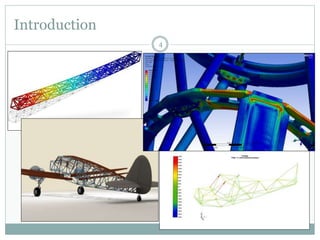
Introduction
4
Introduction
5
Solar Impulse 2
Introduction
 Refer to chapter 6 of Reference 1
 Refer to chapter 4 of Reference 2
 This method is used in most of commercially
available FE based software to solve structural
problems
 Some typical software in aerospace industry are;
 Altair HyperWorks (mostly for optimisation purposes)
 MSC Nastran (mostly for linear analysis)
 Abaqus (mostly for non-linear analysis)
 Ansys (mostly for non-linear analysis)
6
Note
7
 Consider a truss structure having a number truss or bar
members
 Each member can be called as a truss/bar element of a
uniform cross section bounded by two nodes, i.e. nd=2
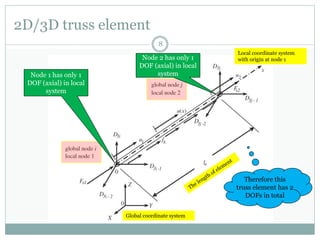
2D/3D truss element
8
Global coordinate system
Node 1 has only 1
DOF (axial) in local
system
Node 2 has only 1
DOF (axial) in local
system
Therefore this
truss element has 2
DOFs in total
Local coordinate system
with origin at node 1
The Finite Element Analysis (FEA) process
9
Displacement in FEM
10
 In finite element methods the displacement for an
element is written in the form;
e
h
xxu dN )()( 
Approximated displacement
within the element
Shape function Vectors of displacements at the
two nodes of the element
This function
approximates
displacements
within the element
by just having
displacements at
the two nodes, i.e.
de
Question:
What should
be N(x)???
Shape function
11
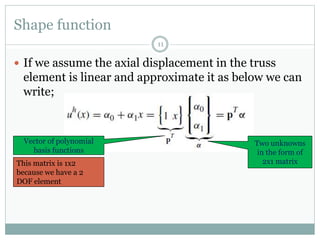
 If we assume the axial displacement in the truss
element is linear and approximate it as below we can
write;
Two unknowns
in the form of
2x1 matrix
Vector of polynomial
basis functions
This matrix is 1x2
because we have a 2
DOF element
Reminder from maths
12
 The multiplication of a 1x2 matrix by 2x1 matrix is a
1x1 matrix or a scalar value
Matrix21 Matrix12
Reminder from maths
13
 Transpose of matrix A is shown as AT
Shape function
14
 In order to construct the shape function, boundary
conditions must be met;
Inverting the matrix
Note
15
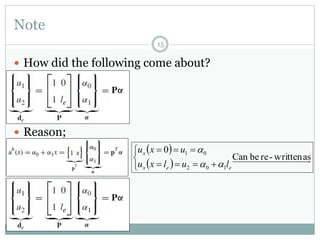
 How did the following come about?
 Reason;
 
 
aswritten-rebeCan
0
102
01





eex
x
lulxu
uxu


Shape function for the truss element
16
We have 2 shape functions
because the element has 2 DOFs
N1 is contribution of node 1 in the
overall displacement of element
and is unit at node 1
N2 is contribution of node 2 in the
overall displacement of element
and is unit at node 2
1)(
1

n
i
i xN
Note
17
 Since the shape functions bring about linear change
of displacements within the element, these elements
are called Linear Element
Strain calculation
18



 ex
x
Nd  ex LNd  ex Bd
  






2
1
/1/1
u
u
ll eex
B is called
strain matrix
L is differential
operator
Reminder
19
A
el
dx
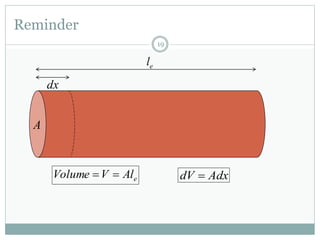
eAlVVolume  AdxdV 
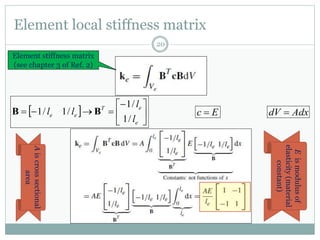
Element local stiffness matrix
20
Element stiffness matrix
(see chapter 3 of Ref. 2)
  






e
eT
ee
l
l
ll
/1
/1
/1/1 BB Ec  AdxdV 
Aiscrosssectional
area
Eismodulusof
elasticity(material
constant)
Elements mass matrix
21
 Following similar procedure as stiffness matrix;
 Students are advised to familiarise themselves with chapter 3
of ref. 2
Nodal forces
22
Surface force (applied
at the node 1)
Surface force (applied
at the node 2)
Body forces (applied
between nodes)







2/
2/
2
1
exs
exs
lfF
lfF
Note that in FEA, body forces are always
transferred to the nodes
Global stiffness matrix
23
 A structure is comprised of lots of members and each
member consists of a set of elements
 So far we got stiffness matrix of each element in its
local coordinate system
 Now the challenge is;
 To convert stiffness matrix of each element from local to global
coordinate system
 Assemble global stiffness matrix of each element into global
stiffness of the entire structure
Global stiffness matrix
24
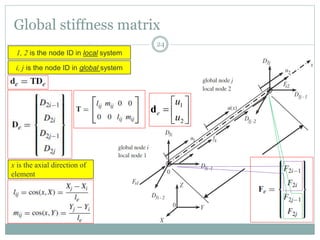
1, 2 is the node ID in local system
i, j is the node ID in global system
x is the axial direction of
element







2
1
u
u
ed
Demonstration
25
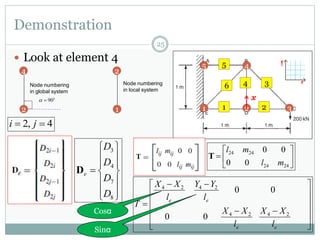
 Look at element 4
1 2 3
45
1 2
34
5
6
2
4
Node numbering
in global system
1
2
Node numbering
in local system
o
90
4,2  ji















8
7
4
3
D
D
D
D
eD















00
00
2424
2424
ee
ee
l
XX
l
XX
l
YY
l
XX
T
Cosα
Sinα
x







2424
2424
00
00
ml
ml
T
Global stiffness matrix
26
Summary in global system
27
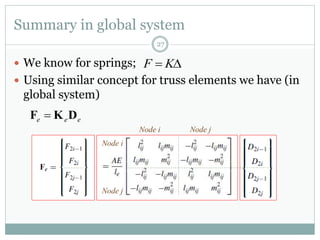
 We know for springs;
 Using similar concept for truss elements we have (in
global system)
 KF
eee DKF 
Node i Node j
Node i
Node j
Note
28
Node i Node j
Node i
Node j
 
 jijjijijiijiijij
e
i
jijijjijiijijiij
e
i
DmDmlDmDml
l
AE
F
DmlDlDmlDl
l
AE
F
2
2
122
2
122
212
2
212
2
12




Recover stresses/strain
29
 Therefore in FEA, the entire structure is discretised
into elements
 Displacements at nodes are calculated
 Then strains within elements are obtained
 Then stresses within elements are obtained
   eBdx
xx E 

Tutorial 1a
30
 follow instructions in “T1a.pdf” document to
familiarise yourself with Abaqus CAE.
Tutorial 1b
31
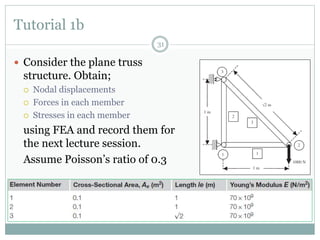
 Consider the plane truss
structure. Obtain;
 Nodal displacements
 Forces in each member
 Stresses in each member
using FEA and record them for
the next lecture session.
Assume Poisson’s ratio of 0.3
Summary
 Element stiffness in local system;
 Element stiffness in global system;
 Element strains;
 Element stresses;
 Converting local displacements to global ones;
32









11
11
k
e
e
l
AE
  






2
1
/1/1
u
u
ll eex
 ex Bd
Example
33
 Consider a bar of uniform cross-sectional area. The
bar is fixed at one end and is subjected to a
horizontal load of P at the free end. The dimensions
of the bar are shown in the figure, and the bar is
made of an isotropic material with Young’s modulus
E.
Solution
34
 We know that the exact solution for this simple
example is:
 Now let’s see how Finite Element Method (FEM)
deals with such problems
Modelling the structure with one element only
Solution
35
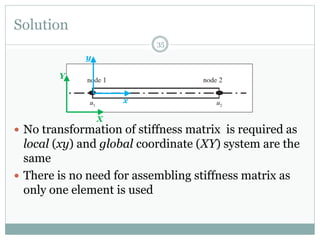
 No transformation of stiffness matrix is required as
local (xy) and global coordinate (XY) system are the
same
 There is no need for assembling stiffness matrix as
only one element is used
x
y
X
Y
Solution
36
 We do not know F1 , however it is not important as
this is on the boundary. What we know is:
 Therefore;
1 2
Rows and column of nodes with zero
displacement are omitted
Solution
37
 Stress in the bar is then calculated as;
 This was a very simple example showing the process
now let’s look at a more practical and challenging
example
Example
38
 Consider the plane truss
structure. Obtain stresses in
each element using FEA.
Solution
39
Element numbers
in squares
Node numbers
in circles
As a good practice, use node
numbering strategy such as anti-
clockwise direction (in this example) as
for large problems this saves both
computational and memory storage
costs.
X
Y
Element local
coordinate system
Structure global
coordinate system
In the global system each node has two
DOFs (as denoted by Di), whereas in
local system each element has only one
DOF.
Solution
40
Solution
41
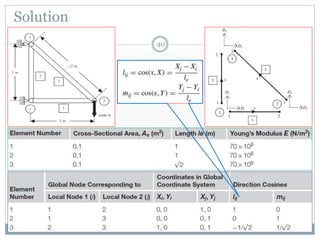
 Please note that;
θ


sin),cos(
cos),cos(


Yxm
Xxl
ij
ij
Represents the
orientation of each
element in relation to
global coordinate system
Solution
42
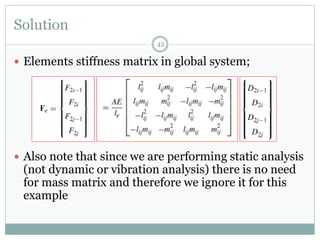
 Elements stiffness matrix in global system;
 Also note that since we are performing static analysis
(not dynamic or vibration analysis) there is no need
for mass matrix and therefore we ignore it for this
example
Solution
43
el
K
Solution
44
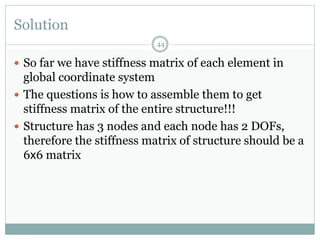
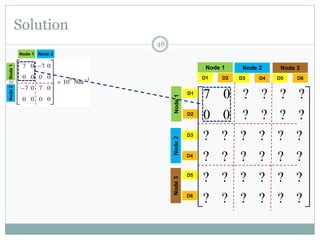
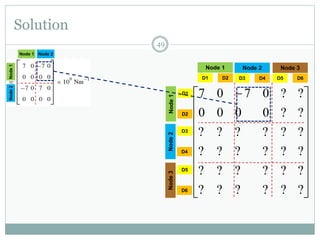
 So far we have stiffness matrix of each element in
global coordinate system
 The questions is how to assemble them to get
stiffness matrix of the entire structure!!!
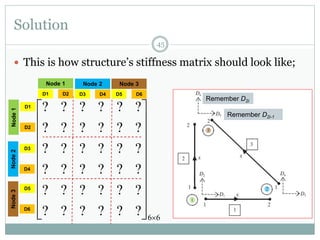
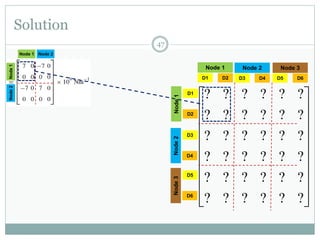
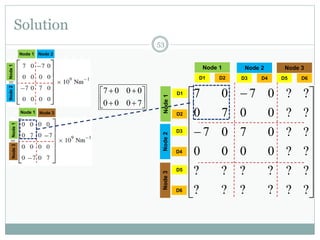
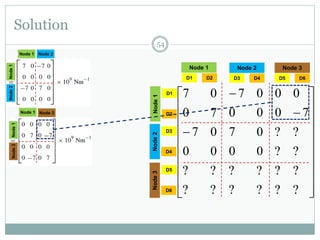
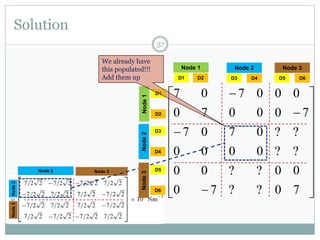
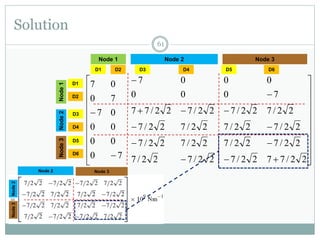
 Structure has 3 nodes and each node has 2 DOFs,
therefore the stiffness matrix of structure should be a
6x6 matrix
Solution
45
 This is how structure’s stiffness matrix should look like;
66
??????
??????
??????
??????
??????
??????





















D1 D2
Node 1
D3 D4
Node 2
D5 D6
Node 3
D1
D2
Node1
D3
D4
Node2
D5
D6
Node3
Remember D2i
Remember D2i-1
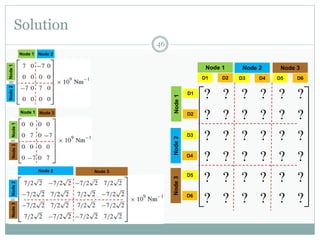
Solution
46




















??????
??????
??????
??????
??????
??????
D1 D2
Node 1
D3 D4
Node 2
D5 D6
Node 3
D1
D2
Node1
D3
D4
Node2 D5
D6
Node3
Node 1 Node 2
Node1Node2
Node 1 Node 3
Node1Node3
Node 2 Node 3
Node2Node3
Solution
47




















??????
??????
??????
??????
??????
??????
D1 D2
Node 1
D3 D4
Node 2
D5 D6
Node 3
D1
D2
Node1
D3
D4
Node2 D5
D6
Node3
Node 1 Node 2
Node1Node2
Solution
48




















??????
??????
??????
??????
????00
????07
D1 D2
Node 1
D3 D4
Node 2
D5 D6
Node 3
D1
D2
Node1
D3
D4
Node2 D5
D6
Node3
Node 1 Node 2
Node1Node2
Solution
49



















 
?
?
?
?
?
?
?
?
?
?
?
?
?
?
?
?
0
0
?
?
?
?
0
7
?
?
?
?
0
0
?
?
?
?
0
7
D1 D2
Node 1
D3 D4
Node 2
D5 D6
Node 3
D1
D2
Node1
D3
D4
Node2 D5
D6
Node3
Node 1 Node 2
Node1Node2
Solution
50



















 

?
?
?
?
?
?
?
?
?
?
?
?
?
?
?
?
0
0
?
?
?
?
0
7
?
?
0
0
0
0
?
?
0
7
0
7
D1 D2
Node 1
D3 D4
Node 2
D5 D6
Node 3
D1
D2
Node1
D3
D4
Node2
D5
D6
Node 1 Node 2
Node1Node2
Node3
Solution
51



















 

?
?
?
?
?
?
?
?
?
?
?
?
?
?
0
0
0
0
?
?
0
7
0
7
?
?
0
0
0
0
?
?
0
7
0
7
D1 D2
Node 1
D3 D4
Node 2
D5 D6
Node 3
D1
D2
Node1
D3
D4
Node2
D5
D6
Node 1 Node 2
Node1Node2
Node3
Solution
52



















 

?
?
?
?
?
?
?
?
?
?
?
?
?
?
0
0
0
0
?
?
0
7
0
7
?
?
0
0
0
0
?
?
0
7
0
7
D1 D2
Node 1
D3 D4
Node 2
D5 D6
Node 3
D1
D2
Node1
D3
D4
Node2
D5
D6
Node 1 Node 2
Node1Node2
Node 1 Node 3
Node1Node3
Node3
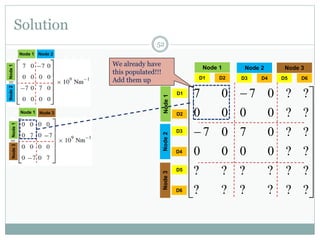
We already have
this populated!!!
Add them up
Solution
53



















 

?
?
?
?
?
?
?
?
?
?
?
?
?
?
0
0
0
0
?
?
0
7
0
7
?
?
0
0
7
0
?
?
0
7
0
7
D1 D2
Node 1
D3 D4
Node 2
D5 D6
Node 3
D1
D2
Node1
D3
D4
Node2
D5
D6
Node 1 Node 2
Node1Node2
Node 1 Node 3
Node1Node3
Node3










70
00
00
07
Solution
54























?
?
?
?
7
0
?
?
?
?
0
0
?
?
0
0
0
0
?
?
0
7
0
7
?
?
0
0
7
0
?
?
0
7
0
7
D1 D2
Node 1
D3 D4
Node 2
D5 D6
Node 3
D1
D2
Node1
D3
D4
Node2
D5
Node 1 Node 2
Node1Node2
Node 1 Node 3
Node1Node3
Node3
D6
Solution
55
























?
?
?
?
7
0
?
?
?
?
0
0
?
?
0
0
0
0
?
?
0
7
0
7
7
0
0
0
7
0
0
0
0
7
0
7
D1 D2
Node 1
D3 D4
Node 2
D5 D6
Node 3
D1
D2
Node1
D3
D4
Node2
D5
Node 1 Node 2
Node1Node2
Node 1 Node 3
Node1Node3
Node3
D6
Solution
56
























7
0
?
?
7
0
0
0
?
?
0
0
?
?
0
0
0
0
?
?
0
7
0
7
7
0
0
0
7
0
0
0
0
7
0
7
D1 D2
Node 1
D3 D4
Node 2
D5 D6
Node 3
D1
D2
Node1
D3
D4
Node2
D5
Node 1 Node 2
Node1Node2
Node 1 Node 3
Node1Node3
Node3
D6
Solution
57
























7
0
?
?
7
0
0
0
?
?
0
0
?
?
0
0
0
0
?
?
0
7
0
7
7
0
0
0
7
0
0
0
0
7
0
7
D1 D2
Node 1
D3 D4
Node 2
D5 D6
Node 3
D1
D2
Node1
D3
D4
Node2
D5Node 2 Node 3
Node2Node3
Node3
D6
We already have
this populated!!!
Add them up
Solution
58



























7
0
?
?
7
0
0
0
?
?
0
0
?
?
22/7
22/7
0
0
?
?
22/7
22/77
0
7
7
0
0
0
7
0
0
0
0
7
0
7
D1 D2
Node 1
D3 D4
Node 2
D5 D6
Node 3
D1
D2
Node1Node2
Node 2 Node 3
Node2Node3
Node3












22/70
22/70
22/70
22/77
D3
D4
D5
D6
Solution
59




























7
0
22/7
22/7
7
0
0
0
22/7
22/7
0
0
?
?
22/7
22/7
0
0
?
?
22/7
22/77
0
7
7
0
0
0
7
0
0
0
0
7
0
7
D1 D2
Node 1
D3 D4
Node 2
D5 D6
Node 3
D1
D2
Node1Node2
Node 2 Node 3
Node2Node3
Node3
D3
D4
D5
D6
Solution
60































7
0
22/7
22/7
7
0
0
0
22/7
22/7
0
0
22/7
22/7
22/7
22/7
0
0
22/7
22/7
22/7
22/77
0
7
7
0
0
0
7
0
0
0
0
7
0
7
D1 D2
Node 1
D3 D4
Node 2
D5 D6
Node 3
D1
D2
Node1Node2
Node 2 Node 3
Node2Node3
Node3
D3
D4
D5
D6
Solution
61


































22/77
22/7
22/7
22/7
7
0
22/7
22/7
22/7
22/7
0
0
22/7
22/7
22/7
22/7
0
0
22/7
22/7
22/7
22/77
0
7
7
0
0
0
7
0
0
0
0
7
0
7
D1 D2
Node 1
D3 D4
Node 2
D5 D6
Node 3
D1
D2
Node1Node2
Node 2 Node 3
Node2Node3
Node3
D3
D4
D5
D6
Solution
62
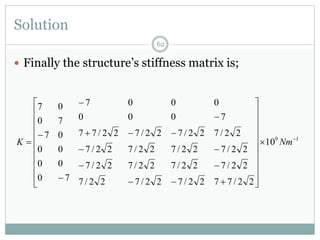
 Finally the structure’s stiffness matrix is;
19
10
22/77
22/7
22/7
22/7
7
0
22/7
22/7
22/7
22/7
0
0
22/7
22/7
22/7
22/7
0
0
22/7
22/7
22/7
22/77
0
7
7
0
0
0
7
0
0
0
0
7
0
7




































 NmK
Solution
63
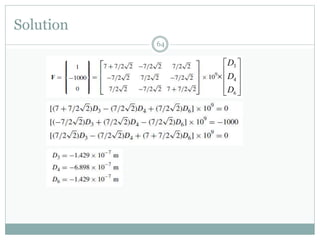
Condensed global matrix
Solution
64











6
4
3
D
D
D
Solution
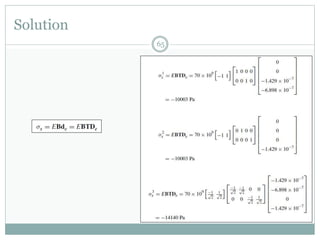
65
Note
66
 Students are advised to study about second , third
and … order elements
 What is their difference with first order elements?
 How many shape functions do they have?
 How does using higher order elements affect the
solution time of analysis?
Tutorial 2a
67
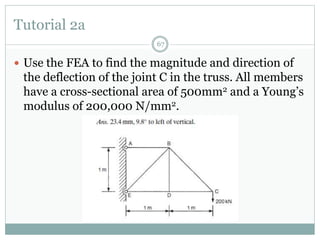
 Use the FEA to find the magnitude and direction of
the deflection of the joint C in the truss. All members
have a cross-sectional area of 500mm2 and a Young’s
modulus of 200,000 N/mm2.
Tutorial 2b
68
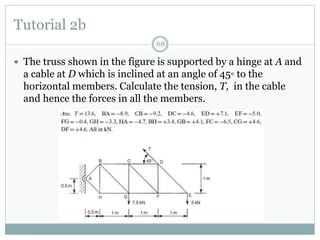
 The truss shown in the figure is supported by a hinge at A and
a cable at D which is inclined at an angle of 45◦ to the
horizontal members. Calculate the tension, T, in the cable
and hence the forces in all the members.
Tutorial 2c
69
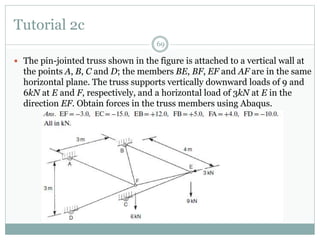
 The pin-jointed truss shown in the figure is attached to a vertical wall at
the points A, B, C and D; the members BE, BF, EF and AF are in the same
horizontal plane. The truss supports vertically downward loads of 9 and
6kN at E and F, respectively, and a horizontal load of 3kN at E in the
direction EF. Obtain forces in the truss members using Abaqus.

Finite Element Analysis of Truss Structures