Aerostructures
Column Buckling (and its similarity
with Plate Buckling)
Dr. Chris
Harrison
Dr. Mahdi
Damghani
Engineering Design
and Mathematics
2020-2021
Lecture Content
• The function of a wing spar
• Buckling in the context of aerostructures
• Buckling of columns with various boundary conditions
• The effect of eccentricity
• Similarities with buckling of plates
Suggested Reading
‘Aircraft Structural Analysis’
THG Megson
Chapters 8 and 9
Context
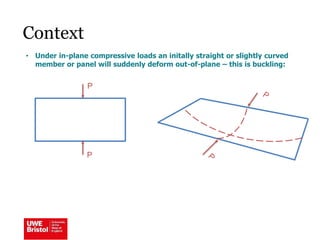
• Under in-plane compressive loads an initally straight or slightly curved
member or panel will suddenly deform out-of-plane – this is buckling:
P
P
Context
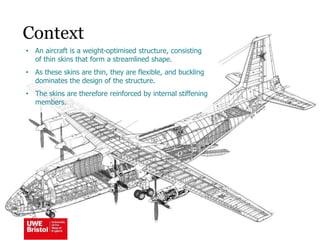
• An aircraft is a weight-optimised structure, consisting
of thin skins that form a streamlined shape.
• As these skins are thin, they are flexible, and buckling
dominates the design of the structure.
• The skins are therefore reinforced by internal stiffening
members.
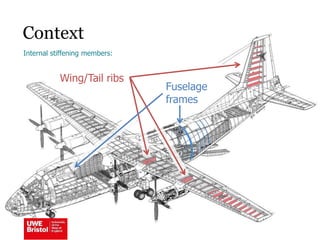
Context
Wing/Tail ribs
Internal stiffening members:
Fuselage
frames
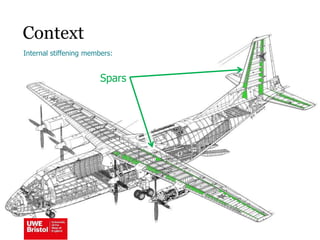
Context
Spars
Internal stiffening members:
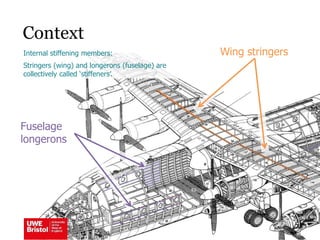
Context
Wing stringersInternal stiffening members:
Fuselage
longerons
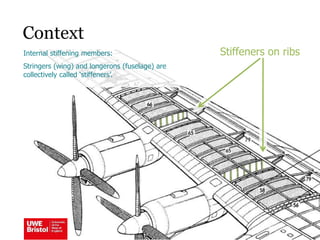
Stringers (wing) and longerons (fuselage) are
collectively called ‘stiffeners’.
Context
Stiffeners on ribsInternal stiffening members:
Stringers (wing) and longerons (fuselage) are
collectively called ‘stiffeners’.
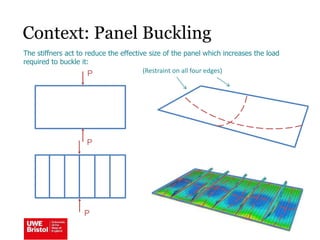
Context: Panel Buckling
The stiffners act to reduce the effective size of the panel which increases the load
required to buckle it:
P
P
P
(Restraint on all four edges)
B52
Context: Elastic or Yield?
B52 Fuselage
Buckling –
Permanent!
Racing Bearcat
wing skin buckling
– Temporary!
Column Buckling
Column Buckling
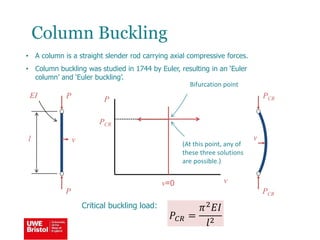
• A column is a straight slender rod carrying axial compressive forces.
• Column buckling was studied in 1744 by Euler, resulting in an ‘Euler
column’ and ‘Euler buckling’.
P
P
v
PCR
PCR
v
v
P
v=0
PCR
𝑃𝐶𝑅 =
𝜋2 𝐸𝐼
𝑙2
l
EI
Bifurcation point
(At this point, any of
these three solutions
are possible.)
Critical buckling load:
Column Buckling Derivation
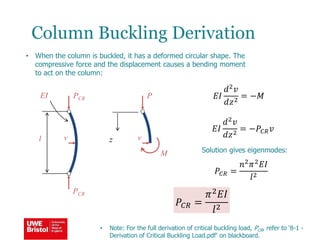
• When the column is buckled, it has a deformed circular shape. The
compressive force and the displacement causes a bending moment
to act on the column:
PCR
PCR
v
𝑃𝐶𝑅 =
𝜋2 𝐸𝐼
𝑙2
l
EI
• Note: For the full derivation of critical buckling load, PCR, refer to ‘8-1 -
Derivation of Critical Buckling Load.pdf’ on blackboard.
P
v
M
𝐸𝐼
𝑑2 𝑣
𝑑𝑧2
= −𝑀
z
𝐸𝐼
𝑑2
𝑣
𝑑𝑧2
= −𝑃𝐶𝑅 𝑣
Solution gives eigenmodes:
𝑃𝐶𝑅 =
𝑛2 𝜋2 𝐸𝐼
𝑙2
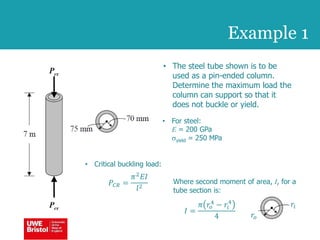
Example 1
• The steel tube shown is to be
used as a pin-ended column.
Determine the maximum load the
column can support so that it
does not buckle or yield.
• For steel:
E = 200 GPa
syield = 250 MPa
• Critical buckling load:
𝑃𝐶𝑅 =
𝜋2
𝐸𝐼
𝑙2
Where second moment of area, I, for a
tube section is:
𝐼 =
𝜋 𝑟𝑜
4 − 𝑟𝑖
4
4
𝑟𝑖
𝑟𝑜
• The steel tube shown is to be
used as a pin-ended column.
Determine the maximum load the
column can support so that it
does not buckle or yield.
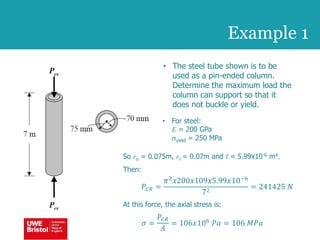
Example 1
So ro = 0.075m, ri = 0.07m and I = 5.99x10⁻⁶ m4.
Then:
𝑃𝐶𝑅 =
𝜋2
𝑥200𝑥109𝑥5.99𝑥10−6
72
= 241425 𝑁
At this force, the axial stress is:
𝜎 =
𝑃𝐶𝑅
𝐴
= 106𝑥106
𝑃𝑎 = 106 𝑀𝑃𝑎
• For steel:
E = 200 GPa
syield = 250 MPa
Column Buckling
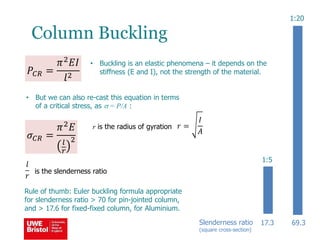
• Buckling is an elastic phenomena – it depends on the
stiffness (E and I), not the strength of the material.𝑃𝐶𝑅 =
𝜋2
𝐸𝐼
𝑙2
• But we can also re-cast this equation in terms
of a critical stress, as s = P/A :
𝜎 𝐶𝑅 =
𝜋2 𝐸
𝑙
𝑟
2
r is the radius of gyration 𝑟 =
𝐼
𝐴
𝑙
𝑟
is the slenderness ratio
17.3 69.3Slenderness ratio
(square cross-section)
1:5
1:20
Rule of thumb: Euler buckling formula appropriate
for slenderness ratio > 70 for pin-jointed column,
and > 17.6 for fixed-fixed column, for Aluminium.
Column Buckling
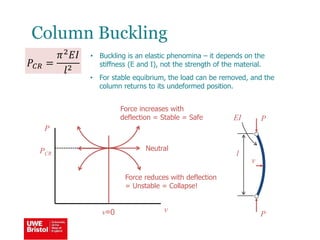
• Buckling is an elastic phenomina – it depends on the
stiffness (E and I), not the strength of the material.
v
P
v=0
PCR
𝑃𝐶𝑅 =
𝜋2 𝐸𝐼
𝑙2
P
P
v
l
EI
Force reduces with deflection
= Unstable = Collapse!
Force increases with
deflection = Stable = Safe
Neutral
• For stable equibrium, the load can be removed, and the
column returns to its undeformed position.
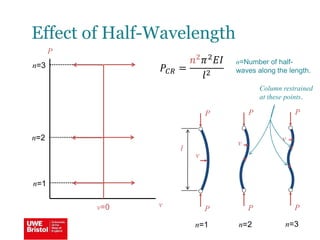
Effect of Half-Wavelength
P
P
v
v
P
v=0
𝑃𝐶𝑅 =
𝑛2 𝜋2 𝐸𝐼
𝑙2
l
P
P
v
n=1 n=2
P
P
v
n=3
n=1
n=2
n=3 n=Number of half-
waves along the length.
Column restrained
at these points.
x
x
x
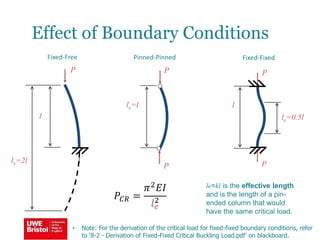
Effect of Boundary Conditions
𝑃𝐶𝑅 =
𝜋2 𝐸𝐼
𝑙 𝑒
2
P
P
le=l
• Note: For the derivation of the critical load for fixed-fixed boundary conditions, refer
to ‘8-2 - Derivation of Fixed-Fixed Critical Buckling Load.pdf’ on blackboard.
P
le=2l
l
P
P
l
Pinned-PinnedFixed-Free Fixed-Fixed
le=kl is the effective length
and is the length of a pin-
ended column that would
have the same critical load.
le=0.5l
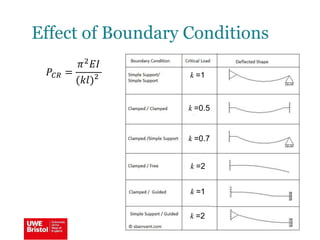
Effect of Boundary Conditions
𝑃𝐶𝑅 =
𝜋2 𝐸𝐼
(𝑘𝑙)2 k =1
k =0.5
k =0.7
k =2
k =1
k =2
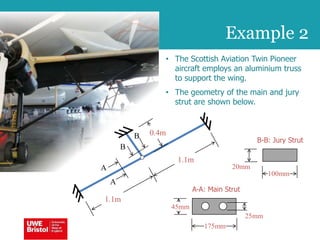
Example 2
• The Scottish Aviation Twin Pioneer
aircraft employs an aluminium truss
to support the wing.
• The geometry of the main and jury
strut are shown below.
1.1m
0.4m
1.1m
A
A
B
B
A-A: Main Strut
45mm
175mm
25mm
B-B: Jury Strut
20mm
100mm
Example 2
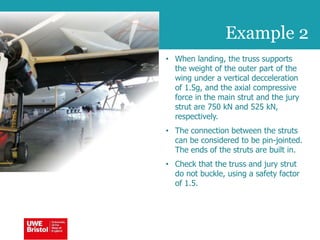
• When landing, the truss supports
the weight of the outer part of the
wing under a vertical decceleration
of 1.5g, and the axial compressive
force in the main strut and the jury
strut are 750 kN and 525 kN,
respectively.
• The connection between the struts
can be considered to be pin-jointed.
The ends of the struts are built in.
• Check that the truss and jury strut
do not buckle, using a safety factor
of 1.5.
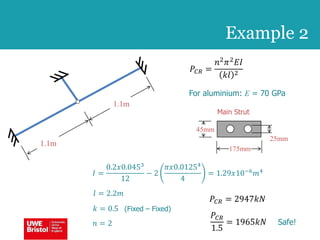
Example 2
1.1m
1.1m
Main Strut
45mm
175mm
25mm
𝑃𝐶𝑅 =
𝑛2 𝜋2 𝐸𝐼
𝑘𝑙 2
𝐼 =
0.2𝑥0.0453
12
− 2
𝜋𝑥0.01254
4
= 1.29𝑥10−6 𝑚4
For aluminium: E = 70 GPa
𝑙 = 2.2𝑚
𝑘 = 0.5 (Fixed – Fixed)
𝑛 = 2
𝑃𝐶𝑅 = 2947𝑘𝑁
𝑃𝐶𝑅
1.5
= 1965𝑘𝑁 Safe!
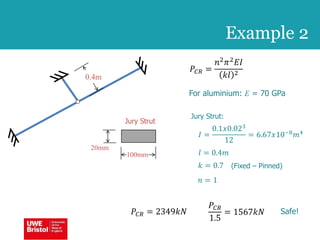
Example 2
0.4m
Jury Strut
20mm
100mm
𝑃𝐶𝑅 =
𝑛2 𝜋2 𝐸𝐼
𝑘𝑙 2
For aluminium: E = 70 GPa
Jury Strut:
𝐼 =
0.1𝑥0.023
12
= 6.67𝑥10−8 𝑚4
𝑙 = 0.4𝑚
𝑘 = 0.7 (Fixed – Pinned)
𝑛 = 1
𝑃𝐶𝑅 = 2349𝑘𝑁
𝑃𝐶𝑅
1.5
= 1567𝑘𝑁 Safe!
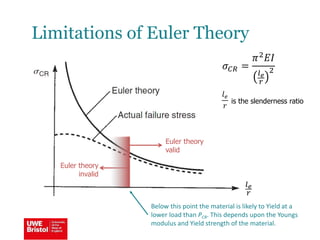
Limitations of Euler Theory
𝜎 𝐶𝑅 =
𝜋2 𝐸𝐼
𝑙 𝑒
𝑟
2
𝑙 𝑒
𝑟
is the slenderness ratio
Euler theory
valid
Euler theory
invalid
Below this point the material is likely to Yield at a
lower load than PCR. This depends upon the Youngs
modulus and Yield strength of the material.
𝑙 𝑒
𝑟
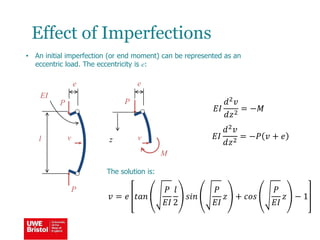
Effect of Imperfections
• An initial imperfection (or end moment) can be represented as an
eccentric load. The eccentricity is e:
l
EI
P
v
M
𝐸𝐼
𝑑2 𝑣
𝑑𝑧2
= −𝑀
z 𝐸𝐼
𝑑2 𝑣
𝑑𝑧2
= −𝑃 𝑣 + 𝑒
The solution is:
𝑣 = 𝑒 𝑡𝑎𝑛
𝑃
𝐸𝐼
𝑙
2
𝑠𝑖𝑛
𝑃
𝐸𝐼
𝑧 + 𝑐𝑜𝑠
𝑃
𝐸𝐼
𝑧 − 1
P
P
v
e e
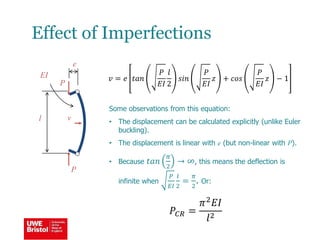
Effect of Imperfections
Some observations from this equation:
• The displacement can be calculated explicitly (unlike Euler
buckling).
• The displacement is linear with e (but non-linear with P).
• Because 𝑡𝑎𝑛
𝜋
2
→ ∞, this means the deflection is
infinite when
𝑃
𝐸𝐼
𝑙
2
=
𝜋
2
. Or:
𝑃𝐶𝑅 =
𝜋2 𝐸𝐼
𝑙2
l
EI 𝑣 = 𝑒 𝑡𝑎𝑛
𝑃
𝐸𝐼
𝑙
2
𝑠𝑖𝑛
𝑃
𝐸𝐼
𝑧 + 𝑐𝑜𝑠
𝑃
𝐸𝐼
𝑧 − 1
P
P
v
e
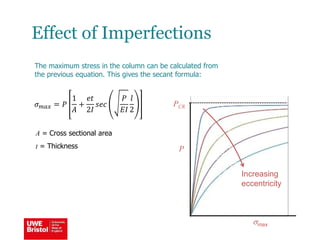
Effect of Imperfections
The maximum stress in the column can be calculated from
the previous equation. This gives the secant formula:
𝜎 𝑚𝑎𝑥 = 𝑃
1
𝐴
+
𝑒𝑡
2𝐼
𝑠𝑒𝑐
𝑃
𝐸𝐼
𝑙
2
A = Cross sectional area
t = Thickness
Increasing
eccentricity
PCR
smax
P
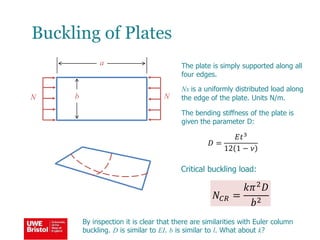
Buckling of Plates
a
bN N
𝐷 =
𝐸𝑡3
12 1 − 𝜈
Nx is a uniformly distributed load along
the edge of the plate. Units N/m.
The plate is simply supported along all
four edges.
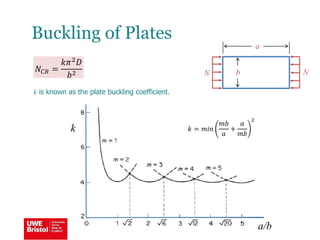
𝑁𝐶𝑅 =
𝑘𝜋2 𝐷
𝑏2
The bending stiffness of the plate is
given the parameter D:
Critical buckling load:
By inspection it is clear that there are similarities with Euler column
buckling. D is similar to EI. b is similar to l. What about k?
Buckling of Plates
a
bN N𝑁𝐶𝑅 =
𝑘𝜋2 𝐷
𝑏2
k is known as the plate buckling coefficient.
k
a/b
𝑘 = 𝑚𝑖𝑛
𝑚𝑏
𝑎
+
𝑎
𝑚𝑏
2
Buckling of Plates
a
bN N
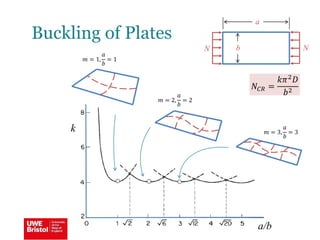
𝑁𝐶𝑅 =
𝑘𝜋2 𝐷
𝑏2
k
a/b
𝑚 = 1,
𝑎
𝑏
= 1
𝑚 = 2,
𝑎
𝑏
= 2
𝑚 = 3,
𝑎
𝑏
= 3
Key Learning Points
• Buckling is a key design driver for aircraft structures.
• Buckling is an elastic phenomina.
• Stringers and longerons are aircraft structural components that can be
approximated as an Euler column.
• An Euler column has a critical compressive load at which buckling occurs.
• The boundary conditions affect the buckling load, calculated using effective
length.
• Imperfections can mean failure before critical buckling load.
• Many structural relationships in Euler columns are the same for plates.
Thanks for your attention!
mahdi.damghani@uwe.ac.uk
Tutorial 1
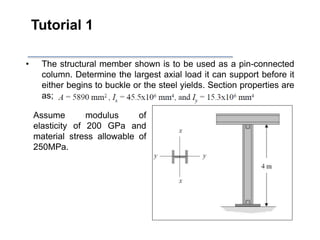
• The structural member shown is to be used as a pin-connected
column. Determine the largest axial load it can support before it
either begins to buckle or the steel yields. Section properties are
as;
Assume modulus of
elasticity of 200 GPa and
material stress allowable of
250MPa.
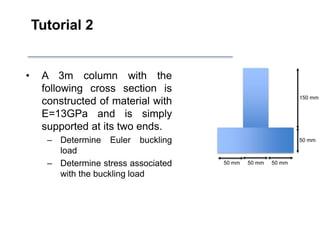
Tutorial 2
• A 3m column with the
following cross section is
constructed of material with
E=13GPa and is simply
supported at its two ends.
– Determine Euler buckling
load
– Determine stress associated
with the buckling load
50 mm 50 mm 50 mm
50 mm
150 mm
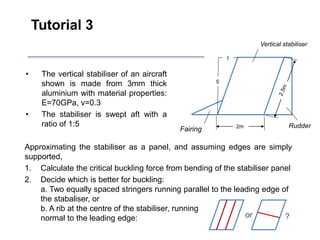
Tutorial 3
• The vertical stabiliser of an aircraft
shown is made from 3mm thick
aluminium with material properties:
E=70GPa, v=0.3
• The stabiliser is swept aft with a
ratio of 1:5 Rudder
Fairing
Vertical stabiliser
2m
1
5
Approximating the stabiliser as a panel, and assuming edges are simply
supported,
1. Calculate the critical buckling force from bending of the stabiliser panel
2. Decide which is better for buckling:
a. Two equally spaced stringers running parallel to the leading edge of
the stabaliser, or
b. A rib at the centre of the stabiliser, running
normal to the leading edge: or ?
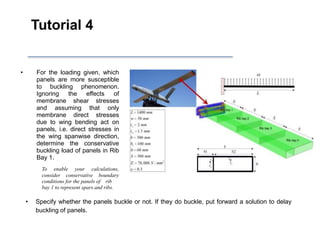
Tutorial 4
• For the loading given, which
panels are more susceptible
to buckling phenomenon.
Ignoring the effects of
membrane shear stresses
and assuming that only
membrane direct stresses
due to wing bending act on
panels, i.e. direct stresses in
the wing spanwise direction,
determine the conservative
buckling load of panels in Rib
Bay 1.
To enable your calculations,
consider conservative boundary
conditions for the panels of rib
bay 1 to represent spars and ribs.
• Specify whether the panels buckle or not. If they do buckle, put forward a solution to delay
buckling of panels.

Lec8 buckling v2_1

  • 1.
    Aerostructures Column Buckling (andits similarity with Plate Buckling) Dr. Chris Harrison Dr. Mahdi Damghani Engineering Design and Mathematics 2020-2021
  • 2.
    Lecture Content • Thefunction of a wing spar • Buckling in the context of aerostructures • Buckling of columns with various boundary conditions • The effect of eccentricity • Similarities with buckling of plates
  • 3.
    Suggested Reading ‘Aircraft StructuralAnalysis’ THG Megson Chapters 8 and 9
  • 4.
    Context • Under in-planecompressive loads an initally straight or slightly curved member or panel will suddenly deform out-of-plane – this is buckling: P P
  • 5.
    Context • An aircraftis a weight-optimised structure, consisting of thin skins that form a streamlined shape. • As these skins are thin, they are flexible, and buckling dominates the design of the structure. • The skins are therefore reinforced by internal stiffening members.
  • 6.
  • 7.
  • 8.
    Context Wing stringersInternal stiffeningmembers: Fuselage longerons Stringers (wing) and longerons (fuselage) are collectively called ‘stiffeners’.
  • 9.
    Context Stiffeners on ribsInternalstiffening members: Stringers (wing) and longerons (fuselage) are collectively called ‘stiffeners’.
  • 10.
    Context: Panel Buckling Thestiffners act to reduce the effective size of the panel which increases the load required to buckle it: P P P (Restraint on all four edges)
  • 11.
    B52 Context: Elastic orYield? B52 Fuselage Buckling – Permanent! Racing Bearcat wing skin buckling – Temporary!
  • 12.
  • 13.
    Column Buckling • Acolumn is a straight slender rod carrying axial compressive forces. • Column buckling was studied in 1744 by Euler, resulting in an ‘Euler column’ and ‘Euler buckling’. P P v PCR PCR v v P v=0 PCR 𝑃𝐶𝑅 = 𝜋2 𝐸𝐼 𝑙2 l EI Bifurcation point (At this point, any of these three solutions are possible.) Critical buckling load:
  • 14.
    Column Buckling Derivation •When the column is buckled, it has a deformed circular shape. The compressive force and the displacement causes a bending moment to act on the column: PCR PCR v 𝑃𝐶𝑅 = 𝜋2 𝐸𝐼 𝑙2 l EI • Note: For the full derivation of critical buckling load, PCR, refer to ‘8-1 - Derivation of Critical Buckling Load.pdf’ on blackboard. P v M 𝐸𝐼 𝑑2 𝑣 𝑑𝑧2 = −𝑀 z 𝐸𝐼 𝑑2 𝑣 𝑑𝑧2 = −𝑃𝐶𝑅 𝑣 Solution gives eigenmodes: 𝑃𝐶𝑅 = 𝑛2 𝜋2 𝐸𝐼 𝑙2
  • 15.
    Example 1 • Thesteel tube shown is to be used as a pin-ended column. Determine the maximum load the column can support so that it does not buckle or yield. • For steel: E = 200 GPa syield = 250 MPa • Critical buckling load: 𝑃𝐶𝑅 = 𝜋2 𝐸𝐼 𝑙2 Where second moment of area, I, for a tube section is: 𝐼 = 𝜋 𝑟𝑜 4 − 𝑟𝑖 4 4 𝑟𝑖 𝑟𝑜
  • 16.
    • The steeltube shown is to be used as a pin-ended column. Determine the maximum load the column can support so that it does not buckle or yield. Example 1 So ro = 0.075m, ri = 0.07m and I = 5.99x10⁻⁶ m4. Then: 𝑃𝐶𝑅 = 𝜋2 𝑥200𝑥109𝑥5.99𝑥10−6 72 = 241425 𝑁 At this force, the axial stress is: 𝜎 = 𝑃𝐶𝑅 𝐴 = 106𝑥106 𝑃𝑎 = 106 𝑀𝑃𝑎 • For steel: E = 200 GPa syield = 250 MPa
  • 17.
    Column Buckling • Bucklingis an elastic phenomena – it depends on the stiffness (E and I), not the strength of the material.𝑃𝐶𝑅 = 𝜋2 𝐸𝐼 𝑙2 • But we can also re-cast this equation in terms of a critical stress, as s = P/A : 𝜎 𝐶𝑅 = 𝜋2 𝐸 𝑙 𝑟 2 r is the radius of gyration 𝑟 = 𝐼 𝐴 𝑙 𝑟 is the slenderness ratio 17.3 69.3Slenderness ratio (square cross-section) 1:5 1:20 Rule of thumb: Euler buckling formula appropriate for slenderness ratio > 70 for pin-jointed column, and > 17.6 for fixed-fixed column, for Aluminium.
  • 18.
    Column Buckling • Bucklingis an elastic phenomina – it depends on the stiffness (E and I), not the strength of the material. v P v=0 PCR 𝑃𝐶𝑅 = 𝜋2 𝐸𝐼 𝑙2 P P v l EI Force reduces with deflection = Unstable = Collapse! Force increases with deflection = Stable = Safe Neutral • For stable equibrium, the load can be removed, and the column returns to its undeformed position.
  • 19.
    Effect of Half-Wavelength P P v v P v=0 𝑃𝐶𝑅= 𝑛2 𝜋2 𝐸𝐼 𝑙2 l P P v n=1 n=2 P P v n=3 n=1 n=2 n=3 n=Number of half- waves along the length. Column restrained at these points. x x x
  • 20.
    Effect of BoundaryConditions 𝑃𝐶𝑅 = 𝜋2 𝐸𝐼 𝑙 𝑒 2 P P le=l • Note: For the derivation of the critical load for fixed-fixed boundary conditions, refer to ‘8-2 - Derivation of Fixed-Fixed Critical Buckling Load.pdf’ on blackboard. P le=2l l P P l Pinned-PinnedFixed-Free Fixed-Fixed le=kl is the effective length and is the length of a pin- ended column that would have the same critical load. le=0.5l
  • 21.
    Effect of BoundaryConditions 𝑃𝐶𝑅 = 𝜋2 𝐸𝐼 (𝑘𝑙)2 k =1 k =0.5 k =0.7 k =2 k =1 k =2
  • 22.
    Example 2 • TheScottish Aviation Twin Pioneer aircraft employs an aluminium truss to support the wing. • The geometry of the main and jury strut are shown below. 1.1m 0.4m 1.1m A A B B A-A: Main Strut 45mm 175mm 25mm B-B: Jury Strut 20mm 100mm
  • 23.
    Example 2 • Whenlanding, the truss supports the weight of the outer part of the wing under a vertical decceleration of 1.5g, and the axial compressive force in the main strut and the jury strut are 750 kN and 525 kN, respectively. • The connection between the struts can be considered to be pin-jointed. The ends of the struts are built in. • Check that the truss and jury strut do not buckle, using a safety factor of 1.5.
  • 24.
    Example 2 1.1m 1.1m Main Strut 45mm 175mm 25mm 𝑃𝐶𝑅= 𝑛2 𝜋2 𝐸𝐼 𝑘𝑙 2 𝐼 = 0.2𝑥0.0453 12 − 2 𝜋𝑥0.01254 4 = 1.29𝑥10−6 𝑚4 For aluminium: E = 70 GPa 𝑙 = 2.2𝑚 𝑘 = 0.5 (Fixed – Fixed) 𝑛 = 2 𝑃𝐶𝑅 = 2947𝑘𝑁 𝑃𝐶𝑅 1.5 = 1965𝑘𝑁 Safe!
  • 25.
    Example 2 0.4m Jury Strut 20mm 100mm 𝑃𝐶𝑅= 𝑛2 𝜋2 𝐸𝐼 𝑘𝑙 2 For aluminium: E = 70 GPa Jury Strut: 𝐼 = 0.1𝑥0.023 12 = 6.67𝑥10−8 𝑚4 𝑙 = 0.4𝑚 𝑘 = 0.7 (Fixed – Pinned) 𝑛 = 1 𝑃𝐶𝑅 = 2349𝑘𝑁 𝑃𝐶𝑅 1.5 = 1567𝑘𝑁 Safe!
  • 26.
    Limitations of EulerTheory 𝜎 𝐶𝑅 = 𝜋2 𝐸𝐼 𝑙 𝑒 𝑟 2 𝑙 𝑒 𝑟 is the slenderness ratio Euler theory valid Euler theory invalid Below this point the material is likely to Yield at a lower load than PCR. This depends upon the Youngs modulus and Yield strength of the material. 𝑙 𝑒 𝑟
  • 27.
    Effect of Imperfections •An initial imperfection (or end moment) can be represented as an eccentric load. The eccentricity is e: l EI P v M 𝐸𝐼 𝑑2 𝑣 𝑑𝑧2 = −𝑀 z 𝐸𝐼 𝑑2 𝑣 𝑑𝑧2 = −𝑃 𝑣 + 𝑒 The solution is: 𝑣 = 𝑒 𝑡𝑎𝑛 𝑃 𝐸𝐼 𝑙 2 𝑠𝑖𝑛 𝑃 𝐸𝐼 𝑧 + 𝑐𝑜𝑠 𝑃 𝐸𝐼 𝑧 − 1 P P v e e
  • 28.
    Effect of Imperfections Someobservations from this equation: • The displacement can be calculated explicitly (unlike Euler buckling). • The displacement is linear with e (but non-linear with P). • Because 𝑡𝑎𝑛 𝜋 2 → ∞, this means the deflection is infinite when 𝑃 𝐸𝐼 𝑙 2 = 𝜋 2 . Or: 𝑃𝐶𝑅 = 𝜋2 𝐸𝐼 𝑙2 l EI 𝑣 = 𝑒 𝑡𝑎𝑛 𝑃 𝐸𝐼 𝑙 2 𝑠𝑖𝑛 𝑃 𝐸𝐼 𝑧 + 𝑐𝑜𝑠 𝑃 𝐸𝐼 𝑧 − 1 P P v e
  • 29.
    Effect of Imperfections Themaximum stress in the column can be calculated from the previous equation. This gives the secant formula: 𝜎 𝑚𝑎𝑥 = 𝑃 1 𝐴 + 𝑒𝑡 2𝐼 𝑠𝑒𝑐 𝑃 𝐸𝐼 𝑙 2 A = Cross sectional area t = Thickness Increasing eccentricity PCR smax P
  • 30.
    Buckling of Plates a bNN 𝐷 = 𝐸𝑡3 12 1 − 𝜈 Nx is a uniformly distributed load along the edge of the plate. Units N/m. The plate is simply supported along all four edges. 𝑁𝐶𝑅 = 𝑘𝜋2 𝐷 𝑏2 The bending stiffness of the plate is given the parameter D: Critical buckling load: By inspection it is clear that there are similarities with Euler column buckling. D is similar to EI. b is similar to l. What about k?
  • 31.
    Buckling of Plates a bNN𝑁𝐶𝑅 = 𝑘𝜋2 𝐷 𝑏2 k is known as the plate buckling coefficient. k a/b 𝑘 = 𝑚𝑖𝑛 𝑚𝑏 𝑎 + 𝑎 𝑚𝑏 2
  • 32.
    Buckling of Plates a bNN 𝑁𝐶𝑅 = 𝑘𝜋2 𝐷 𝑏2 k a/b 𝑚 = 1, 𝑎 𝑏 = 1 𝑚 = 2, 𝑎 𝑏 = 2 𝑚 = 3, 𝑎 𝑏 = 3
  • 33.
    Key Learning Points •Buckling is a key design driver for aircraft structures. • Buckling is an elastic phenomina. • Stringers and longerons are aircraft structural components that can be approximated as an Euler column. • An Euler column has a critical compressive load at which buckling occurs. • The boundary conditions affect the buckling load, calculated using effective length. • Imperfections can mean failure before critical buckling load. • Many structural relationships in Euler columns are the same for plates.
  • 34.
    Thanks for yourattention! mahdi.damghani@uwe.ac.uk
  • 35.
    Tutorial 1 • Thestructural member shown is to be used as a pin-connected column. Determine the largest axial load it can support before it either begins to buckle or the steel yields. Section properties are as; Assume modulus of elasticity of 200 GPa and material stress allowable of 250MPa.
  • 36.
    Tutorial 2 • A3m column with the following cross section is constructed of material with E=13GPa and is simply supported at its two ends. – Determine Euler buckling load – Determine stress associated with the buckling load 50 mm 50 mm 50 mm 50 mm 150 mm
  • 37.
    Tutorial 3 • Thevertical stabiliser of an aircraft shown is made from 3mm thick aluminium with material properties: E=70GPa, v=0.3 • The stabiliser is swept aft with a ratio of 1:5 Rudder Fairing Vertical stabiliser 2m 1 5 Approximating the stabiliser as a panel, and assuming edges are simply supported, 1. Calculate the critical buckling force from bending of the stabiliser panel 2. Decide which is better for buckling: a. Two equally spaced stringers running parallel to the leading edge of the stabaliser, or b. A rib at the centre of the stabiliser, running normal to the leading edge: or ?
  • 38.
    Tutorial 4 • Forthe loading given, which panels are more susceptible to buckling phenomenon. Ignoring the effects of membrane shear stresses and assuming that only membrane direct stresses due to wing bending act on panels, i.e. direct stresses in the wing spanwise direction, determine the conservative buckling load of panels in Rib Bay 1. To enable your calculations, consider conservative boundary conditions for the panels of rib bay 1 to represent spars and ribs. • Specify whether the panels buckle or not. If they do buckle, put forward a solution to delay buckling of panels.

Editor's Notes