STRUCTURAL IDEALISATION
BY DR. MAHDI DAMGHANI
1
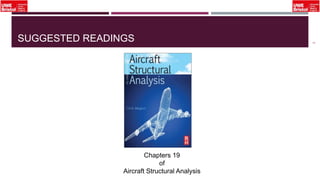
SUGGESTED READINGS
Chapters 19
of
Aircraft Structural Analysis
2
LEARNING OBJECTIVES
This Lecture (Lecture 6):
 Familiarisation with the functions of various structural components in an aircraft;
 Familiarisation with simplifying complex wing structure into an idealised structure for stress
analysis purposes;
Next lecture (Lecture 7):
 Impact of idealisation on bending of beam cross section;
 Impact of idealisation on shear flow and its distribution within the beam cross section;
 Impact of idealisation on torsion of beam cross section;
3
NOTE TO THE STUDENTS
 You are required to read the following paper before attending this lecture;
 Note that this document is uploaded on blackboard;
Odeh Dababneh, Altan Kayran, (2014) "Design, analysis and optimization of thin walled semi-
monocoque wing structures using different structural idealization in the preliminary design
phase", International Journal of Structural Integrity, Vol. 5 Issue: 3, pp.214-226,
https://doi.org/10.1108/IJSI-12-2013-0050
4
OVERVIEW
5
LIFT LOADS
 Lift is generated by producing a higher pressure below the wing than above it.
 Higher speed airflow above wing than below (streamlines closer together).
6
• Streamlines around an aerofoil.
(Above)
• Pressure Distribution around an
aerofoil. (Below)
Lift
• Resultant lift force (red arrow) acts through
centre of pressure (cop), normal to stream
• cop varies with α (angle of attack)
• Pitching Moment caused by unequal pressure
distribution around aerofoil.
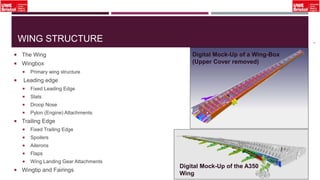
WING STRUCTURE
 The Wing
 Wingbox
 Primary wing structure
 Leading edge
 Fixed Leading Edge
 Slats
 Droop Nose
 Pylon (Engine) Attachments
 Trailing Edge
 Fixed Trailing Edge
 Spoilers
 Ailerons
 Flaps
 Wing Landing Gear Attachments
 Wingtip and Fairings
7
Digital Mock-Up of the A350
Wing
Digital Mock-Up of a Wing-Box
(Upper Cover removed)
WATCH
8
WING-BOX
 Carries the main
structural loads from
the wing;
 Aerodynamic, inertial,
movables, fuel;
 Closed-cell structure
allowing resistance to
shear, torsion and
tension loads;
 Location of fuel tanks;
 Supports the landing
gear and engines, if
they are wing mounted.
9
A380 Wingbox
in Production
Wing in
Plan View
A380 Wingbox in
Production
WING LOADS
 Wing Finite Element Model provides
Shear , Moment and Torsion
10
WING COMPLEXITY (SPARS)
 Provide mounting for WLG Fittings and Leading and
Trailing edge fittings.
11
Track Can
Cut-Outs
Rib Post
SparsExploded View of a generic Wing
Digital Mock-Up of Wingbox
(Upper Cover removed)
 Span-wise members that
carry shear loads;
 Fuel Tank Boundary;
WING COMPLEXITY (SPARS)
 For larger aircraft, the spars are usually made
up from multiple sections;
 Sections are normally joined together with joint
plates and straps.
12
Web Joint
Plate
Boom
Straps
Spar
Spar
Digital Mock-Up of Wingbox (Upper Cover removed)
LOAD CARRYING MECHANISM OF SPARS
13
WING COMPLEXITY (RIBS)
 Castellated edge allows the stringers to pass through rib feet to attached to the skin.
 Manholes allow access within the wingbox and movement of fuel.
 Stiffeners and crack stoppers are machined or bolted on to increase the strength of the overall
structure.
14
Stringer
Castellation
Manhole
Stiffener/
Crack stopper
View inside the Wing Box onto Rib looking
outboard
Computer Rendering of Typical Large Rib
LOAD CARRYING MECHANISM OF RIBS
15
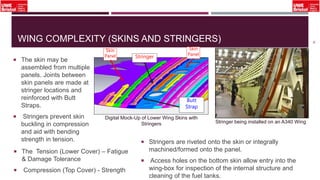
WING COMPLEXITY (SKINS AND STRINGERS)
 The skin may be
assembled from multiple
panels. Joints between
skin panels are made at
stringer locations and
reinforced with Butt
Straps.
 Stringers prevent skin
buckling in compression
and aid with bending
strength in tension.
16
Stringer
Butt
Strap
Digital Mock-Up of Lower Wing Skins with
Stringers
Skin
Panel
Skin
Panel
Stringer being installed on an A340 Wing
 The Tension (Lower Cover) – Fatigue
& Damage Tolerance
 Compression (Top Cover) - Strength
 Stringers are riveted onto the skin or integrally
machined/formed onto the panel.
 Access holes on the bottom skin allow entry into the
wing-box for inspection of the internal structure and
cleaning of the fuel tanks.
LOAD CARRYING MECHANISM OF SKINS
17
ROOT JOINT
 Where the wing attaches
to the centre wing box in
the fuselage;
 The cruciform and tri-form
fittings are used to attach
the upper and lower
covers respectively to the
centre wing box. Patent
application number:
20110089292;
 Upper and lower joint
fittings are used to attach
the spars.
18
WING TIP
 Rigid structure fixed to end of the wing-box;
 The structure is built in a similar way to the wing-box, with spars, ribs, stringers and skin
forming the structure;
 Contains the navigation and strobe lights.
19
A320 Wing tip installed on end of Wing
at Broughton
Illustration of Wing Tip Structure
Navigation
Lights
Wing Tip
Fence
Wing
Tip
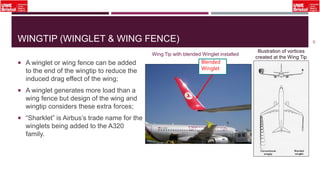
WINGTIP (WINGLET & WING FENCE)
 A winglet or wing fence can be added
to the end of the wingtip to reduce the
induced drag effect of the wing;
 A winglet generates more load than a
wing fence but design of the wing and
wingtip considers these extra forces;
 “Sharklet” is Airbus’s trade name for the
winglets being added to the A320
family.
20
Wing Tip with blended Winglet installed
Illustration of vortices
created at the Wing Tip
Blended
Winglet
WATCH
21
WHAT IS THE POINT?
 So far, we have been dealing with simple
structural components such as plates and
beams;
 Real life structures are complex and in order
to analyse them simplification must be made;
 The behaviour of the simplified/idealised
structure must be as close as that of the real
structure;
 Stresses/strains obtained from the idealised
structure are representative of the real
complex structure.
22
Actual cross-section
of a thin-walled beam
Sheet-stringer
idealisation of the
same section
IDEALISATION
23
Stringers and spar flanges
have small cross-sectional
dimensions compared to
the complete section
Replace with booms
(concentration of area) at
the midline of skin
Replace with booms
(concentration of area) at
the midline of skin
Replace with booms
(concentration of area) at
the midline of skin
Carrying direct
stress only
Carrying direct and
shear stresses
We will further assume all
direct stresses are taken
by stringers and spar
flanges. Skin takes all the
shear
The variation of stress
(due to bending) over the
cross section is small
PANEL IDEALISATION
 We would like to idealise the
panel into the following;
 Direct stress carrying booms
 Shear stress carrying skins
 All direct stresses are given
to booms;
 Note that the distribution of
stress has disappeared in
idealised structure though;
 As long as we can get the
extremes of stress, it is fine;
 What should be the area of
booms?
24
By putting the thickness as zero, i.e.
𝐴 = 0, the direct stress carrying
ability of skin vanishes (𝜎 = 𝑃 𝐴)
 For idealisation;
PANEL IDEALISATION
25
21 MM 
Taking moment about
the orange line
  bbt
b
tM DD
3
2
2
1
2
21
2
21  
Taking moment about
the orange line
bBM 112 
Actual thickness of
skin
Direct stress carrying
thickness of skin
NOTES
 If the cross-section does not include discrete stringers, or in the presence of a few
stringers with a total cross-sectional area far smaller than that of the thin walls, it is still
possible to construct a sheet-stringer model;
 In this case, an idealisation process is used to create “virtual stringers” that are assumed
to carry the axial stresses, whereas the thin-walled portions are assumed to carry only
shear stresses;
 Lumping of the axial stress-carrying portions of the thin-walled section into stringers using
previous slide is based on an a priori assumption for the axial stress distribution in the
section;
 If different distributions are considered that correspond to different loading conditions,
equivalent idealised areas must be recomputed for each case;
 Thus, it is useful to keep in mind that the idealisation process might be closely linked to
the type of analysis that is being performed.
26
WING IDEALISATION AS DONE IN INDUSTRY (GLOBAL FEM)
27
View from the top
 Skin is modelled as shell elements
 Stringers as bar elements
 Spar caps as bar elements
View from the bottom
GFEM OF A SECTION THROUGH THE WING
28
Upper skin
Lower skin
Stringer
Spar cap
Rib
WATCH (WING IDEALISATION)
29
EXAMPLE
 Part of a wing section is in the form of the
two-cell box shown in figure, in which the
vertical spars are connected to the wing
skin through angle sections, all having a
cross-sectional area of 300mm2. Idealise
the section into an arrangement of direct
stress-carrying booms and shear-stress-
only-carrying panels suitable for resisting
bending moments in a vertical plane.
Position the booms at the spar/skin
junctions.
30
SOLUTION
31
The idealised structure with booms modelled as
concentration of area located at the mid-plane of skins
What are the cross section areas?
From symmetry we know 𝐵1 = 𝐵6, 𝐵2 = 𝐵5, 𝐵3 = 𝐵4
Note that 𝜎6 𝜎1 = −1. When 1 is in tension 6 will be in
equal compression and vice versa due to bending
SOLUTION
32
The idealised structure with booms modelled as
concentration of area located at the mid-plane of skins
What are the cross section areas?
From symmetry we know 𝐵1 = 𝐵6, 𝐵2 = 𝐵5, 𝐵3 = 𝐵4
𝑦1 𝑦2 𝑦3 𝑦2𝑦5 𝑦2
SOLUTION
33
The idealised structure with booms modelled as
concentration of area located at the mid-plane of skins
What are the cross section areas?
From symmetry we know 𝐵1 = 𝐵6, 𝐵2 = 𝐵5, 𝐵3 = 𝐵4
SECOND MOMENT OF AREA FOR IDEALISED SECTIONS
 We have n booms with areas B1, B2, … Bn the second moment of areas are;
 The next example demonstrates this.
34
EXAMPLE
 Construct an idealised cross-section by evaluating the boom areas at points A, B, C, D, E and
F. Use the method based on the equilibrium of bending stresses. Moreover, calculate the
second moment of area of the idealised section.
35
SOLUTION
36
The area of the booms for F=A, E=B and D=C based
on symmetry.
SOLUTION
37
BA
BF
BB
BE
BC
BD
EXAMPLE
 Construct the idealised section for the following airfoil. It can be assumed that stringers are
spaced at 50 mm interval and 45o in the straight and curved section , respectively. It can be
further assumed that the only loading is Mx. All dimensions are in milometers.
38
x
y
SOLUTION
39
x
y
711 9 8
62 4 5
1
12
    2
76 67.6612
6
6.1100
12
6
6.150
mmBB 




    2
1098543 8012
6
6.150
12
6
6.150
mmBBBBBB 




3
10
SOLUTION
 The vertical distance between boom 1 and 2
(blue arrow in opposite figure) is as below;
 The length of chord from boom 1 to boom 2
is a quarter of circumference of the semi
circle;
 Therefore, we have;
40
x
y
711 9 8
62 4 5
1
12
3
10
mmyy 65.14
2
2
505012 
 5.1225.021  Rb
  2
112 44.75
50
2
2
50
2
6
25.12
12
6
6.150
mmBB 


















SOLUTION
 The length of chord from boom 1 to boom 12 is
half of the circumference of semi circle as
below;
 Therefore, we have;
41
  2
121 87.70
2
2
50
50
2
6
25.12
12
6
225
mmBB 


















x
y
711 9 8
62 4 5
1
12
3
10
 255.0121  Rb
TUTORIAL 1
42
 Idealise the box section into an arrangement of direct stress-carrying booms positioned at the
four corners and panels which are assumed to carry only shear stresses. Find the centroid
location of the idealised section and then calculate second moment of area for the idealised
section about x and y axis.
SOLUTION
43
1 2
34
500 mm
300mm
SOLUTION
 To obtain the second moment of area, it is
essential to find the neutral axis location;
 Taking moment about bottom skin, line 43;
 Taking moment about spar 14;
44
1 2
34
500 mm
300mm
  
4
1
4
1 i
ii
i
i yBBy
 
mmy 150
354040002
30035403004000




  
4
1
4
1 i
ii
i
i xBBx
 
mmx 75.234
354040002
50035402




SOLUTION
45
1 2
34
500 mm
300mm
x
y
234.75
150
422
000,300,3391503540215040002 mmIxx 
 
4
22
5.042,992,938
75.2345003540275.23440002
mm
Iyy


           
           
0
354015075.234500354015075.234500
400015075.234400015075.234


xyI
No need to calculate
as it is singly
symmetric

Lec6-Aircraft structural idealisation 1

  • 1.
  • 2.
  • 3.
    LEARNING OBJECTIVES This Lecture(Lecture 6):  Familiarisation with the functions of various structural components in an aircraft;  Familiarisation with simplifying complex wing structure into an idealised structure for stress analysis purposes; Next lecture (Lecture 7):  Impact of idealisation on bending of beam cross section;  Impact of idealisation on shear flow and its distribution within the beam cross section;  Impact of idealisation on torsion of beam cross section; 3
  • 4.
    NOTE TO THESTUDENTS  You are required to read the following paper before attending this lecture;  Note that this document is uploaded on blackboard; Odeh Dababneh, Altan Kayran, (2014) "Design, analysis and optimization of thin walled semi- monocoque wing structures using different structural idealization in the preliminary design phase", International Journal of Structural Integrity, Vol. 5 Issue: 3, pp.214-226, https://doi.org/10.1108/IJSI-12-2013-0050 4
  • 5.
  • 6.
    LIFT LOADS  Liftis generated by producing a higher pressure below the wing than above it.  Higher speed airflow above wing than below (streamlines closer together). 6 • Streamlines around an aerofoil. (Above) • Pressure Distribution around an aerofoil. (Below) Lift • Resultant lift force (red arrow) acts through centre of pressure (cop), normal to stream • cop varies with α (angle of attack) • Pitching Moment caused by unequal pressure distribution around aerofoil.
  • 7.
    WING STRUCTURE  TheWing  Wingbox  Primary wing structure  Leading edge  Fixed Leading Edge  Slats  Droop Nose  Pylon (Engine) Attachments  Trailing Edge  Fixed Trailing Edge  Spoilers  Ailerons  Flaps  Wing Landing Gear Attachments  Wingtip and Fairings 7 Digital Mock-Up of the A350 Wing Digital Mock-Up of a Wing-Box (Upper Cover removed)
  • 8.
  • 9.
    WING-BOX  Carries themain structural loads from the wing;  Aerodynamic, inertial, movables, fuel;  Closed-cell structure allowing resistance to shear, torsion and tension loads;  Location of fuel tanks;  Supports the landing gear and engines, if they are wing mounted. 9 A380 Wingbox in Production Wing in Plan View A380 Wingbox in Production
  • 10.
    WING LOADS  WingFinite Element Model provides Shear , Moment and Torsion 10
  • 11.
    WING COMPLEXITY (SPARS) Provide mounting for WLG Fittings and Leading and Trailing edge fittings. 11 Track Can Cut-Outs Rib Post SparsExploded View of a generic Wing Digital Mock-Up of Wingbox (Upper Cover removed)  Span-wise members that carry shear loads;  Fuel Tank Boundary;
  • 12.
    WING COMPLEXITY (SPARS) For larger aircraft, the spars are usually made up from multiple sections;  Sections are normally joined together with joint plates and straps. 12 Web Joint Plate Boom Straps Spar Spar Digital Mock-Up of Wingbox (Upper Cover removed)
  • 13.
  • 14.
    WING COMPLEXITY (RIBS) Castellated edge allows the stringers to pass through rib feet to attached to the skin.  Manholes allow access within the wingbox and movement of fuel.  Stiffeners and crack stoppers are machined or bolted on to increase the strength of the overall structure. 14 Stringer Castellation Manhole Stiffener/ Crack stopper View inside the Wing Box onto Rib looking outboard Computer Rendering of Typical Large Rib
  • 15.
  • 16.
    WING COMPLEXITY (SKINSAND STRINGERS)  The skin may be assembled from multiple panels. Joints between skin panels are made at stringer locations and reinforced with Butt Straps.  Stringers prevent skin buckling in compression and aid with bending strength in tension. 16 Stringer Butt Strap Digital Mock-Up of Lower Wing Skins with Stringers Skin Panel Skin Panel Stringer being installed on an A340 Wing  The Tension (Lower Cover) – Fatigue & Damage Tolerance  Compression (Top Cover) - Strength  Stringers are riveted onto the skin or integrally machined/formed onto the panel.  Access holes on the bottom skin allow entry into the wing-box for inspection of the internal structure and cleaning of the fuel tanks.
  • 17.
  • 18.
    ROOT JOINT  Wherethe wing attaches to the centre wing box in the fuselage;  The cruciform and tri-form fittings are used to attach the upper and lower covers respectively to the centre wing box. Patent application number: 20110089292;  Upper and lower joint fittings are used to attach the spars. 18
  • 19.
    WING TIP  Rigidstructure fixed to end of the wing-box;  The structure is built in a similar way to the wing-box, with spars, ribs, stringers and skin forming the structure;  Contains the navigation and strobe lights. 19 A320 Wing tip installed on end of Wing at Broughton Illustration of Wing Tip Structure Navigation Lights Wing Tip Fence Wing Tip
  • 20.
    WINGTIP (WINGLET &WING FENCE)  A winglet or wing fence can be added to the end of the wingtip to reduce the induced drag effect of the wing;  A winglet generates more load than a wing fence but design of the wing and wingtip considers these extra forces;  “Sharklet” is Airbus’s trade name for the winglets being added to the A320 family. 20 Wing Tip with blended Winglet installed Illustration of vortices created at the Wing Tip Blended Winglet
  • 21.
  • 22.
    WHAT IS THEPOINT?  So far, we have been dealing with simple structural components such as plates and beams;  Real life structures are complex and in order to analyse them simplification must be made;  The behaviour of the simplified/idealised structure must be as close as that of the real structure;  Stresses/strains obtained from the idealised structure are representative of the real complex structure. 22 Actual cross-section of a thin-walled beam Sheet-stringer idealisation of the same section
  • 23.
    IDEALISATION 23 Stringers and sparflanges have small cross-sectional dimensions compared to the complete section Replace with booms (concentration of area) at the midline of skin Replace with booms (concentration of area) at the midline of skin Replace with booms (concentration of area) at the midline of skin Carrying direct stress only Carrying direct and shear stresses We will further assume all direct stresses are taken by stringers and spar flanges. Skin takes all the shear The variation of stress (due to bending) over the cross section is small
  • 24.
    PANEL IDEALISATION  Wewould like to idealise the panel into the following;  Direct stress carrying booms  Shear stress carrying skins  All direct stresses are given to booms;  Note that the distribution of stress has disappeared in idealised structure though;  As long as we can get the extremes of stress, it is fine;  What should be the area of booms? 24 By putting the thickness as zero, i.e. 𝐴 = 0, the direct stress carrying ability of skin vanishes (𝜎 = 𝑃 𝐴)
  • 25.
     For idealisation; PANELIDEALISATION 25 21 MM  Taking moment about the orange line   bbt b tM DD 3 2 2 1 2 21 2 21   Taking moment about the orange line bBM 112  Actual thickness of skin Direct stress carrying thickness of skin
  • 26.
    NOTES  If thecross-section does not include discrete stringers, or in the presence of a few stringers with a total cross-sectional area far smaller than that of the thin walls, it is still possible to construct a sheet-stringer model;  In this case, an idealisation process is used to create “virtual stringers” that are assumed to carry the axial stresses, whereas the thin-walled portions are assumed to carry only shear stresses;  Lumping of the axial stress-carrying portions of the thin-walled section into stringers using previous slide is based on an a priori assumption for the axial stress distribution in the section;  If different distributions are considered that correspond to different loading conditions, equivalent idealised areas must be recomputed for each case;  Thus, it is useful to keep in mind that the idealisation process might be closely linked to the type of analysis that is being performed. 26
  • 27.
    WING IDEALISATION ASDONE IN INDUSTRY (GLOBAL FEM) 27 View from the top  Skin is modelled as shell elements  Stringers as bar elements  Spar caps as bar elements View from the bottom
  • 28.
    GFEM OF ASECTION THROUGH THE WING 28 Upper skin Lower skin Stringer Spar cap Rib
  • 29.
  • 30.
    EXAMPLE  Part ofa wing section is in the form of the two-cell box shown in figure, in which the vertical spars are connected to the wing skin through angle sections, all having a cross-sectional area of 300mm2. Idealise the section into an arrangement of direct stress-carrying booms and shear-stress- only-carrying panels suitable for resisting bending moments in a vertical plane. Position the booms at the spar/skin junctions. 30
  • 31.
    SOLUTION 31 The idealised structurewith booms modelled as concentration of area located at the mid-plane of skins What are the cross section areas? From symmetry we know 𝐵1 = 𝐵6, 𝐵2 = 𝐵5, 𝐵3 = 𝐵4 Note that 𝜎6 𝜎1 = −1. When 1 is in tension 6 will be in equal compression and vice versa due to bending
  • 32.
    SOLUTION 32 The idealised structurewith booms modelled as concentration of area located at the mid-plane of skins What are the cross section areas? From symmetry we know 𝐵1 = 𝐵6, 𝐵2 = 𝐵5, 𝐵3 = 𝐵4 𝑦1 𝑦2 𝑦3 𝑦2𝑦5 𝑦2
  • 33.
    SOLUTION 33 The idealised structurewith booms modelled as concentration of area located at the mid-plane of skins What are the cross section areas? From symmetry we know 𝐵1 = 𝐵6, 𝐵2 = 𝐵5, 𝐵3 = 𝐵4
  • 34.
    SECOND MOMENT OFAREA FOR IDEALISED SECTIONS  We have n booms with areas B1, B2, … Bn the second moment of areas are;  The next example demonstrates this. 34
  • 35.
    EXAMPLE  Construct anidealised cross-section by evaluating the boom areas at points A, B, C, D, E and F. Use the method based on the equilibrium of bending stresses. Moreover, calculate the second moment of area of the idealised section. 35
  • 36.
    SOLUTION 36 The area ofthe booms for F=A, E=B and D=C based on symmetry.
  • 37.
  • 38.
    EXAMPLE  Construct theidealised section for the following airfoil. It can be assumed that stringers are spaced at 50 mm interval and 45o in the straight and curved section , respectively. It can be further assumed that the only loading is Mx. All dimensions are in milometers. 38 x y
  • 39.
    SOLUTION 39 x y 711 9 8 624 5 1 12     2 76 67.6612 6 6.1100 12 6 6.150 mmBB          2 1098543 8012 6 6.150 12 6 6.150 mmBBBBBB      3 10
  • 40.
    SOLUTION  The verticaldistance between boom 1 and 2 (blue arrow in opposite figure) is as below;  The length of chord from boom 1 to boom 2 is a quarter of circumference of the semi circle;  Therefore, we have; 40 x y 711 9 8 62 4 5 1 12 3 10 mmyy 65.14 2 2 505012   5.1225.021  Rb   2 112 44.75 50 2 2 50 2 6 25.12 12 6 6.150 mmBB                   
  • 41.
    SOLUTION  The lengthof chord from boom 1 to boom 12 is half of the circumference of semi circle as below;  Therefore, we have; 41   2 121 87.70 2 2 50 50 2 6 25.12 12 6 225 mmBB                    x y 711 9 8 62 4 5 1 12 3 10  255.0121  Rb
  • 42.
    TUTORIAL 1 42  Idealisethe box section into an arrangement of direct stress-carrying booms positioned at the four corners and panels which are assumed to carry only shear stresses. Find the centroid location of the idealised section and then calculate second moment of area for the idealised section about x and y axis.
  • 43.
  • 44.
    SOLUTION  To obtainthe second moment of area, it is essential to find the neutral axis location;  Taking moment about bottom skin, line 43;  Taking moment about spar 14; 44 1 2 34 500 mm 300mm    4 1 4 1 i ii i i yBBy   mmy 150 354040002 30035403004000        4 1 4 1 i ii i i xBBx   mmx 75.234 354040002 50035402    
  • 45.
    SOLUTION 45 1 2 34 500 mm 300mm x y 234.75 150 422 000,300,3391503540215040002mmIxx    4 22 5.042,992,938 75.2345003540275.23440002 mm Iyy                           0 354015075.234500354015075.234500 400015075.234400015075.234   xyI No need to calculate as it is singly symmetric

Editor's Notes

  • #9 https://www.youtube.com/watch?v=60CmDTly8Dg
  • #22 https://www.youtube.com/watch?v=qbBhg8xISug
  • #30 https://www.youtube.com/watch?v=mpwfPHewUbQ