prepared by
R.Sakthivel Murugan,
Assistant Professor, KCET
• Engineering Analysis
• Analytical Methods (or) Theoretical Analysis
• Numerical Methods (or) Approximate Methods
 Functional Approximation
 Finite Difference Method (FDM)
 Finite Element Method (FEM)
-Rayleigh Ritz Method
-Weighted Residual Method
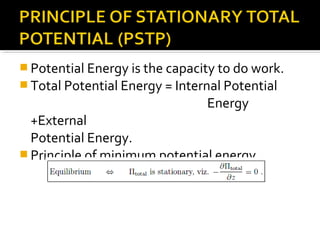
 Potential Energy is the capacity to do work.
 Total Potential Energy = Internal Potential
Energy
+External
Potential Energy.
 Principle of minimum potential energy
 It is an integral approach method
 Useful for solving Structural Mechanics
Problems.
 It is also known as Variational Approach.
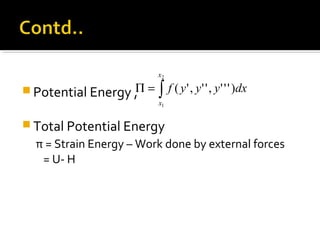
 Potential Energy ,
 Total Potential Energy
π = Strain Energy – Work done by external forces
= U- H
∫=Π
2
1
)''','','(
x
x
dxyyyf
 It should satisfy the geometric boundary
condition.
 It should have at least one Rayleigh Ritz
parameter.
 It should represented as either polynomial or
trigonometrical.
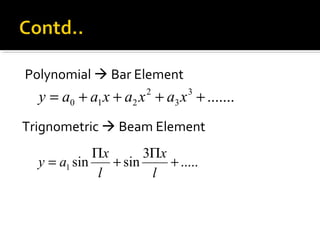
Polynomial  Bar Element
Trignometric  Beam Element
.......3
3
2
210 ++++= xaxaxaay
.....
3
sinsin1 +
Π
+
Π
=
l
x
l
x
ay
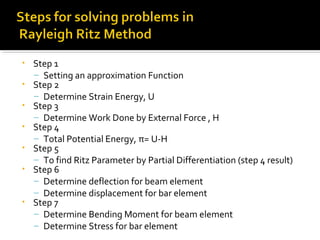
• Step 1
– Setting an approximation Function
• Step 2
– Determine Strain Energy, U
• Step 3
– Determine Work Done by External Force , H
• Step 4
– Total Potential Energy, π= U-H
• Step 5
– To find Ritz Parameter by Partial Differentiation (step 4 result)
• Step 6
– Determine deflection for beam element
– Determine displacement for bar element
• Step 7
– Determine Bending Moment for beam element
– Determine Stress for bar element
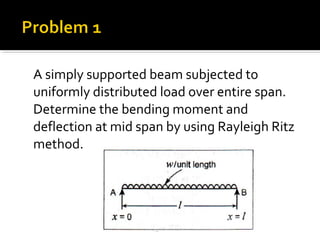
A simply supported beam subjected to
uniformly distributed load over entire span.
Determine the bending moment and
deflection at mid span by using Rayleigh Ritz
method.
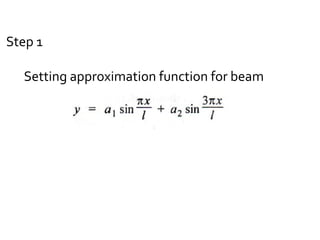
Step 1
Setting approximation function for beam
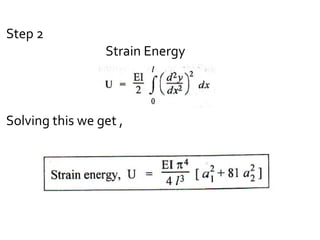
Step 2
Strain Energy
Solving this we get ,
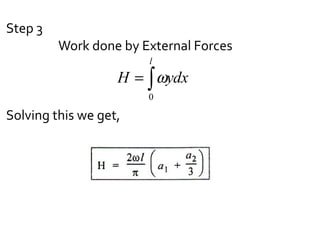
Step 3
Work done by External Forces
Solving this we get,
dxyH
l
∫=
0
ω
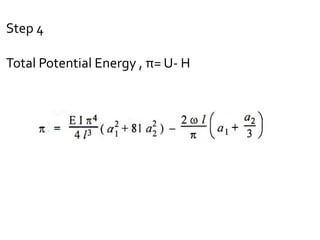
Step 4
Total Potential Energy , π= U- H
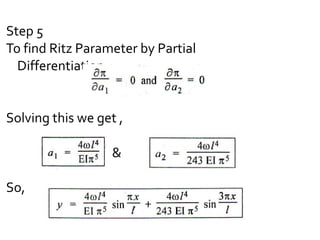
Step 5
To find Ritz Parameter by Partial
Differentiation
Solving this we get ,
&
So,
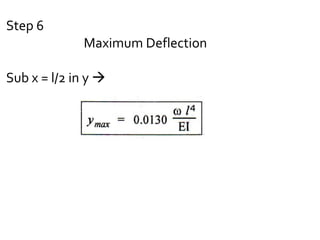
Step 6
Maximum Deflection
Sub x = l/2 in y 
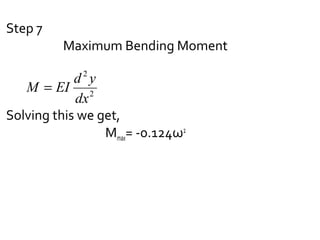
Step 7
Maximum Bending Moment
Solving this we get,
Mmax= -0.124ω2
2
2
dx
yd
EIM =
Thank you

Rayleigh Ritz Method

  • 1.
  • 2.
    • Engineering Analysis •Analytical Methods (or) Theoretical Analysis • Numerical Methods (or) Approximate Methods
  • 3.
     Functional Approximation Finite Difference Method (FDM)  Finite Element Method (FEM)
  • 4.
  • 5.
     Potential Energyis the capacity to do work.  Total Potential Energy = Internal Potential Energy +External Potential Energy.  Principle of minimum potential energy
  • 6.
     It isan integral approach method  Useful for solving Structural Mechanics Problems.  It is also known as Variational Approach.
  • 7.
     Potential Energy,  Total Potential Energy π = Strain Energy – Work done by external forces = U- H ∫=Π 2 1 )''','','( x x dxyyyf
  • 8.
     It shouldsatisfy the geometric boundary condition.  It should have at least one Rayleigh Ritz parameter.  It should represented as either polynomial or trigonometrical.
  • 9.
    Polynomial  BarElement Trignometric  Beam Element .......3 3 2 210 ++++= xaxaxaay ..... 3 sinsin1 + Π + Π = l x l x ay
  • 11.
    • Step 1 –Setting an approximation Function • Step 2 – Determine Strain Energy, U • Step 3 – Determine Work Done by External Force , H • Step 4 – Total Potential Energy, π= U-H • Step 5 – To find Ritz Parameter by Partial Differentiation (step 4 result) • Step 6 – Determine deflection for beam element – Determine displacement for bar element • Step 7 – Determine Bending Moment for beam element – Determine Stress for bar element
  • 12.
    A simply supportedbeam subjected to uniformly distributed load over entire span. Determine the bending moment and deflection at mid span by using Rayleigh Ritz method.
  • 13.
  • 14.
  • 15.
    Step 3 Work doneby External Forces Solving this we get, dxyH l ∫= 0 ω
  • 16.
    Step 4 Total PotentialEnergy , π= U- H
  • 17.
    Step 5 To findRitz Parameter by Partial Differentiation Solving this we get , & So,
  • 18.
  • 19.
    Step 7 Maximum BendingMoment Solving this we get, Mmax= -0.124ω2 2 2 dx yd EIM =
  • 20.