TO
ByBy
Dr.G.PAULRAJDr.G.PAULRAJ
Professor & HeadProfessor & Head
Department of Mechanical EngineeringDepartment of Mechanical Engineering
Vel Tech (Owned by R S Trust)Vel Tech (Owned by R S Trust)
Avadi, Chennai-600062.Avadi, Chennai-600062.
UNIT I INTRODUCTION
Dr.G.PAULRAJ,
Professor&Head(Mech.),VTRS,
Avadi, Chennai.
UNIT I INTRODUCTION
 Historical Background – Mathematical Modeling
of field problems in Engineering – Governing
Equations – Discrete and continuous models –
Boundary, Initial and Eigen Value problems–
Weighted Residual Methods – Variational
Formulation of Boundary Value Problems – Ritz
Technique – Basic concepts of the Finite
Element Method.
Dr.G.PAULRAJ,
Professor&Head(Mech.),VTRS,
Avadi, Chennai.
L=5
INTRODUCTION
Dr.G.PAULRAJ,
Professor&Head(Mech.),VTRS,
Avadi, Chennai.
FINITE ELEMET METHOD
 The FEA is a computer aided mathematical technique that is
used to obtain an approximate numerical solution to the
fundamental differential and/or integral equations that predict
the response of physical systems to external effects.
 Useful for problems with complicated geometries, loadings, and
material properties where analytical solutions can not be
obtained.
 2-D modeling conserves simplicity and allows the analysis to be
run on a normal computer, it tends to yield less accurate results.
3-D modeling, produces more accurate results while sacrificing
the ability to run on all but the fastest computers effectively.
Dr.G.PAULRAJ,
Professor&Head(Mech.),VTRS,
Avadi, Chennai.
BRIEF HISTORY OF FEM
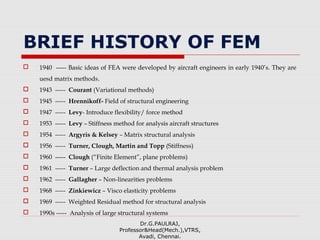
 1940 ----- Basic ideas of FEA were developed by aircraft engineers in early 1940’s. They are
uesd matrix methods.
 1943 ----- Courant (Variational methods)
 1945 ----- Hrennikoff- Field of structural engineering
 1947 ----- Levy- Introduce flexibility/ force method
 1953 ----- Levy – Stiffness method for analysis aircraft structures
 1954 ----- Argyris & Kelsey – Matrix structural analysis
 1956 ----- Turner, Clough, Martin and Topp (Stiffness)
 1960 ----- Clough (“Finite Element”, plane problems)
 1961 ----- Turner – Large deflection and thermal analysis problem
 1962 ----- Gallagher – Non-linearities problems
 1968 ----- Zinkiewicz – Visco elasticity problems
 1969 ----- Weighted Residual method for structural analysis
 1990s ----- Analysis of large structural systems
Dr.G.PAULRAJ,
Professor&Head(Mech.),VTRS,
Avadi, Chennai.
MATHEMATICAL MODELING
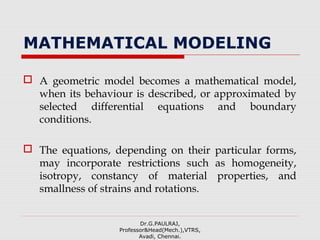
 A geometric model becomes a mathematical model,
when its behaviour is described, or approximated by
selected differential equations and boundary
conditions.
 The equations, depending on their particular forms,
may incorporate restrictions such as homogeneity,
isotropy, constancy of material properties, and
smallness of strains and rotations.
Dr.G.PAULRAJ,
Professor&Head(Mech.),VTRS,
Avadi, Chennai.
MATHEMATICAL MODELING
Dr.G.PAULRAJ,
Professor&Head(Mech.),VTRS,
Avadi, Chennai.
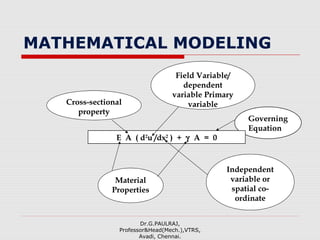
Material
Properties
Governing
Equation
Field Variable/
dependent
variable Primary
variableCross-sectional
property
Independent
variable or
spatial co-
ordinate
E A ( d2
u /dx2
) + γ A = 0
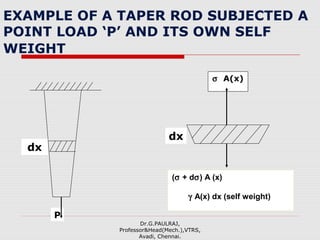
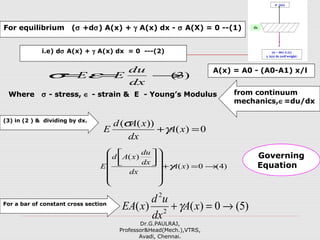
EXAMPLE OF A TAPER ROD SUBJECTED A
POINT LOAD ‘P’ AND ITS OWN SELF
WEIGHT
P
dx
σ A(x)
(σ + dσ) A (x)
γ A(x) dx (self weight)
dx
Dr.G.PAULRAJ,
Professor&Head(Mech.),VTRS,
Avadi, Chennai.
A(x) = A0 - (A0-A1) x/l
For equilibrium (σ +dσ) A(x) + γ A(x) dx - σ A(X) = 0 --(1)
i.e) dσ A(x) + γ A(x) dx = 0 ---(2)
(3) in (2 ) & dividing by dx.
from continuum
mechanics,∈=du/dx
For a bar of constant cross section
)3(→==
dx
du
EEεσ
)4(0)(
)(
→=+
















xA
dx
dx
du
xAd
E γ
0)(
))((
=+ xA
dx
xAd
E γ
σ
)5(0)()( 2
2
→=+ xA
dx
ud
xEA γ
Governing
Equation
Where σ - stress, ∈ - strain & E - Young’s Modulus
Dr.G.PAULRAJ,
Professor&Head(Mech.),VTRS,
Avadi, Chennai.
)4(0)(
)(
→=+
















xA
dx
dx
du
xAd
E γ
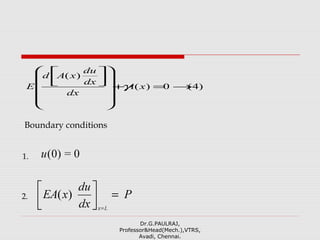
Boundary conditions
1.
2.
Dr.G.PAULRAJ,
Professor&Head(Mech.),VTRS,
Avadi, Chennai.
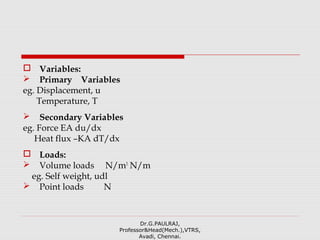
 Variables:
 Primary Variables
eg. Displacement, u
Temperature, T
 Secondary Variables
eg. Force EA du/dx
Heat flux –KA dT/dx
 Loads:
 Volume loads N/m3
N/m
eg. Self weight, udl
 Point loads N
Dr.G.PAULRAJ,
Professor&Head(Mech.),VTRS,
Avadi, Chennai.
DISCRETE AND CONTINUOUS
MODEL
Discrete elements:
 These elements have a well defined deflection equation that can
be found in an engineering handbook, such as, Truss and
Beam/Frame elements.
 The geometry of these elements is simple, and in general, mesh
refinement does not give better results.
 Discrete elements have a very limited application; bulk of the
FEA application relies on the Continuous-structure elements.
Dr.G.PAULRAJ,
Professor&Head(Mech.),VTRS,
Avadi, Chennai.
Continuous-structure Elements:
 Continuous-structure elements do not have a well define
deflection or interpolation function, it is developed and
approximated by using the theory of elasticity.
 The geometry is represented by either a 2-D or 3-D solid element
– the continuous- structure elements.
 Since elements in this category can have any shape, it is very
effective in calculation of stresses at a sharp curve or geometry,
i.e., evaluation of stress concentrations.
 Continuous structural elements are extremely useful for finding
stress concentration points in structures.
Dr.G.PAULRAJ,
Professor&Head(Mech.),VTRS,
Avadi, Chennai.
ENGINEERING APPLICATIONS
OF FEA
 Structural Engineering
 Aerospace Engineering
 Automobile Engineering
 Thermal applications
 Acoustics
 Flow Problems
 Dynamics
 Metal Forming
 Medical & Dental applications
 Soil mechanics etc Dr.G.PAULRAJ,
Professor&Head(Mech.),VTRS,
Avadi, Chennai.
NEED FOR NUMERICAL
METHODS OF SOLUTION
 The best way to solve any physical problem governed by a
differential equation is to obtain the analytical solution.
 There are many situation the analytical solution is difficult to
obtain. They are
(1)The configuration may be composed of several different
materials and
(2)Problems involving anisotropic materials
 A numerical method can be used to obtain an approximate
solution when an analytical solution cannot be developed.
 There are several procedures for obtaining a numerical solution
to a differential equation. The methods are :
1. The finite difference method, 2. the variational method, and 3.
the method that weight a residual.
Dr.G.PAULRAJ,
Professor&Head(Mech.),VTRS,
Avadi, Chennai.
FINITE DIFFERENCE METHOD
 The finite difference method approximates the derivatives in the
governing differential equation using difference equations.
 This method is used for solving heat transfer and fluid
mechanics problems.
 And it is work well for two-dimensional regions with
boundaries parallel to the co-ordinate axes.
 This method is not suitable for curved region or irregular
boundary.
Dr.G.PAULRAJ,
Professor&Head(Mech.),VTRS,
Avadi, Chennai.
VARIATIONAL METHOD
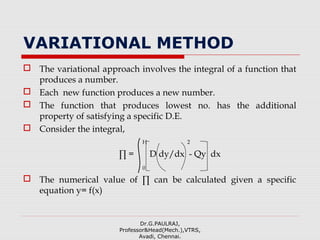
 The variational approach involves the integral of a function that
produces a number.
 Each new function produces a new number.
 The function that produces lowest no. has the additional
property of satisfying a specific D.E.
 Consider the integral,
H 2
∏ = D dy/dx - Qy dx
0
 The numerical value of ∏ can be calculated given a specific
equation y= f(x)
Dr.G.PAULRAJ,
Professor&Head(Mech.),VTRS,
Avadi, Chennai.
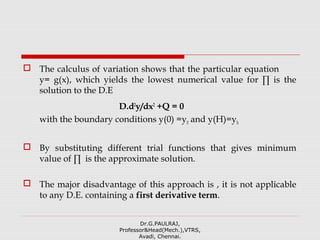
 The calculus of variation shows that the particular equation
y= g(x), which yields the lowest numerical value for ∏ is the
solution to the D.E
D.d2
y/dx2
+Q = 0
with the boundary conditions y(0) =y0 and y(H)=yh
 By substituting different trial functions that gives minimum
value of ∏ is the approximate solution.
 The major disadvantage of this approach is , it is not applicable
to any D.E. containing a first derivative term.
Dr.G.PAULRAJ,
Professor&Head(Mech.),VTRS,
Avadi, Chennai.
WEIGHTED RESIDUAL
METHODS
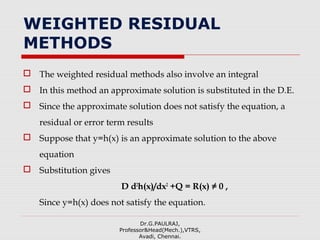
 The weighted residual methods also involve an integral
 In this method an approximate solution is substituted in the D.E.
 Since the approximate solution does not satisfy the equation, a
residual or error term results
 Suppose that y=h(x) is an approximate solution to the above
equation
 Substitution gives
D d2
h(x)/dx2
+Q = R(x) ≠ 0 ,
Since y=h(x) does not satisfy the equation.
Dr.G.PAULRAJ,
Professor&Head(Mech.),VTRS,
Avadi, Chennai.
WEIGHTED RESIDUAL…,
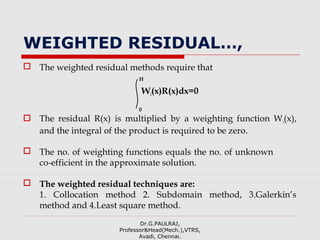
 The weighted residual methods require that
H
Wi(x)R(x)dx=0
0
 The residual R(x) is multiplied by a weighting function Wi(x),
and the integral of the product is required to be zero.
 The no. of weighting functions equals the no. of unknown
co-efficient in the approximate solution.
 The weighted residual techniques are:
1. Collocation method 2. Subdomain method, 3.Galerkin’s
method and 4.Least square method.
Dr.G.PAULRAJ,
Professor&Head(Mech.),VTRS,
Avadi, Chennai.
WEIGHTED RESIDUAL…,
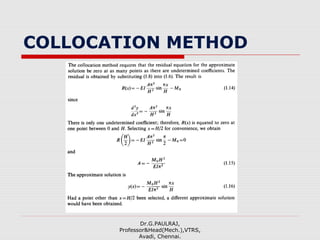
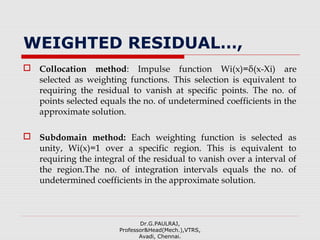
 Collocation method: Impulse function Wi(x)=δ(x-Xi) are
selected as weighting functions. This selection is equivalent to
requiring the residual to vanish at specific points. The no. of
points selected equals the no. of undetermined coefficients in the
approximate solution.
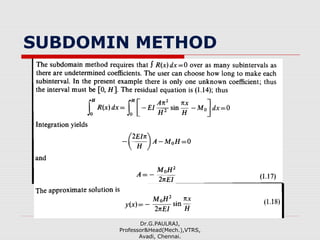
 Subdomain method: Each weighting function is selected as
unity, Wi(x)=1 over a specific region. This is equivalent to
requiring the integral of the residual to vanish over a interval of
the region.The no. of integration intervals equals the no. of
undetermined coefficients in the approximate solution.
Dr.G.PAULRAJ,
Professor&Head(Mech.),VTRS,
Avadi, Chennai.
WEIGHTED RESIDUAL…,
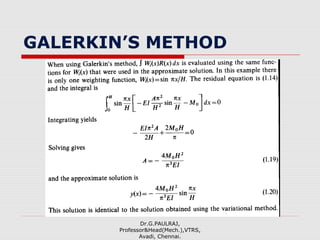
 Galerkin’s method: Galerkin’s method uses the same functions
for Wi(x) that were used in the approximating equation. This
approach is the basis of the finite element method for problems
involving first-derivative terms. This methods yields the same
result as the variational method when applied to differential
equations that are self-adjoint.
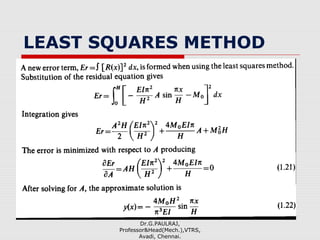
 Least Squares method: The least squares method utilizes the
residual as the weighting function and obtains a new error term
defined by H
Er = [R(x)]2
d
0
 This error is minimized w.r.t the unknown coefficient in the
approximate solution.
Dr.G.PAULRAJ,
Professor&Head(Mech.),VTRS,
Avadi, Chennai.
RAYLEIGH- RITZ METHOD
 The Rayleigh–Ritz method of expressing field variables by
approximate method clubbed with minimization of potential
energy has made a big break through in finite element analysis.
 In 1870 Rayleigh used an approximating field with single degree
of freedom for studies on vibration problems.
 In 1909 he used approximating field with several functions, each
function satisfying boundary conditions and associating with
separate degree of freedom.
 Ritz applied this technique to static equilibrium and Eigen value
problems.
 The procedure for static equilibrium problem is given below:
 Consider an elastic solid subject to a set of loads. The
displacements and stresses are to be determined.
Dr.G.PAULRAJ,
Professor&Head(Mech.),VTRS,
Avadi, Chennai.
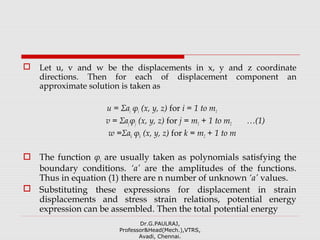
 Let u, v and w be the displacements in x, y and z coordinate
directions. Then for each of displacement component an
approximate solution is taken as
u = Σai φi (x, y, z) for i = 1 to m1
v = Σajφj (x, y, z) for j = m1 + 1 to m2 …(1)
w =Σak φk (x, y, z) for k = m2 + 1 to m
 The function φi are usually taken as polynomials satisfying the
boundary conditions. ‘a’ are the amplitudes of the functions.
Thus in equation (1) there are n number of unknown ‘a’ values.
 Substituting these expressions for displacement in strain
displacements and stress strain relations, potential energy
expression can be assembled. Then the total potential energy
Dr.G.PAULRAJ,
Professor&Head(Mech.),VTRS,
Avadi, Chennai.
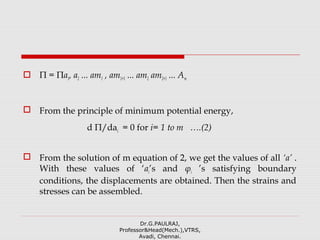
 Π = Πa1, a2 ... am1 , am1+1 ... am2 am2+1 ... Am
 From the principle of minimum potential energy,
d Π/dai = 0 for i= 1 to m ….(2)
 From the solution of m equation of 2, we get the values of all ‘a’ .
With these values of ‘ai’s and φi ’s satisfying boundary
conditions, the displacements are obtained. Then the strains and
stresses can be assembled.
Dr.G.PAULRAJ,
Professor&Head(Mech.),VTRS,
Avadi, Chennai.
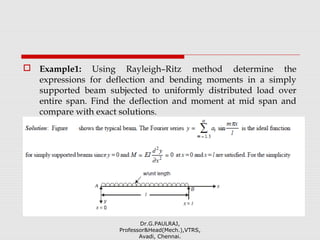
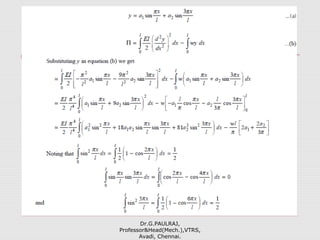
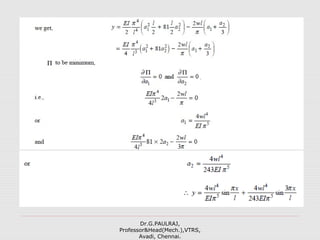
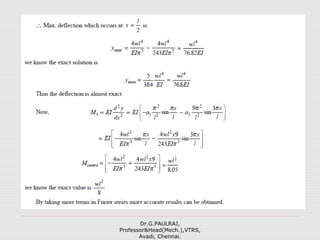
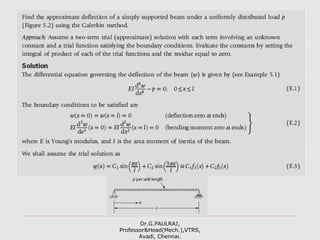
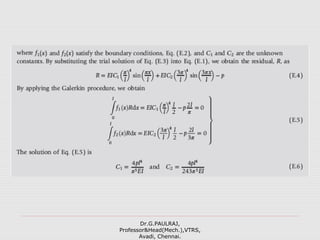
 Example1: Using Rayleigh–Ritz method determine the
expressions for deflection and bending moments in a simply
supported beam subjected to uniformly distributed load over
entire span. Find the deflection and moment at mid span and
compare with exact solutions.
Dr.G.PAULRAJ,
Professor&Head(Mech.),VTRS,
Avadi, Chennai.
FEM Vs CLASSICAL
METHODS
 In classical methods exact solutions are obtained where as in
finite element analysis approximate solutions are obtained.
 Whenever the following complexities are faced, classical method
makes the drastic assumptions’ and looks for the solutions:
 Shape, Boundary conditions and Loading
 When material property is not isotropic, solutions for the
problems become very difficult in classical method but in FEM
solutions for the problems without any difficulty.
 If structure consists of more than one material, it is difficult to
use classical method, but finite element can be used without any
difficulty.
 Problems with material and geometric non-linearities can not be
handled by classical methods. There is no difficulty in FEM.
Dr.G.PAULRAJ,
Professor&Head(Mech.),VTRS,
Avadi, Chennai.
FEM Vs FDM
 FDM makes pointwise approximation to the governing
equations i.e. it ensures continuity only at the node points.
Continuity along the sides of grid lines are not ensured.
 FEM make piecewise approximation i.e. it ensures the continuity
at node points as well as along the sides of the element.
 FDM do not give the values at any point except at node points. It
do not give any approximating function to evaluate the basic
values (deflections, in case of solid mechanics) using the nodal
values.
Dr.G.PAULRAJ,
Professor&Head(Mech.),VTRS,
Avadi, Chennai.
 FDM makes stair type approximation to sloping and curved
boundaries .
 FEM can consider the sloping boundaries exactly. If curved
elements are used, even the curved boundaries can be handled
exactly.
 FDM needs larger number of nodes to get good results while
FEM needs fewer nodes.
 With FDM fairly complicated problems can be handled where as
FEM can handle all complicated problems.
Dr.G.PAULRAJ,
Professor&Head(Mech.),VTRS,
Avadi, Chennai.
AVAILABLE COMMERCIAL
SOFTWARE
 ANSYS (General purpose, PC and workstations)
 SDRC/I-DEAS (Complete CAD/CAM/CAE package)
 NASTRAN (General purpose FEA on mainframes)
 ABAQUS (Nonlinear and dynamic analyses)
 COSMOS (General purpose FEA)
 ALGOR (PC and workstations)
 PATRAN (Pre/Post Processor)
 Hyper Mesh (Pre/Post Processor)
 Dyna-3D (Crash/impact analysis)
Dr.G.PAULRAJ,
Professor&Head(Mech.),VTRS,
Avadi, Chennai.
Dr.G.PAULRAJ,
Professor&Head(Mech.),VTRS,
Avadi, Chennai.
SIX STEPS IN THE FINITE
ELEMENT METHOD
 Step 1 - Discretization: The problem domain is discretized into a
collection of simple shapes, or elements.
 Step 2 - Develop Element Equations: Developed using the
physics of the problem, and typically Galerkin’s Method or
variational principles.
 Step 3 - Assembly: The element equations for each element in
the FEM mesh are assembled into a set of global equations that
model the properties of the entire system.
Dr.G.PAULRAJ,
Professor&Head(Mech.),VTRS,
Avadi, Chennai.
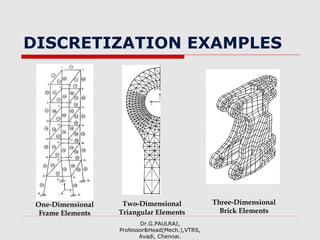
DISCRETIZATION EXAMPLES
Dr.G.PAULRAJ,
Professor&Head(Mech.),VTRS,
Avadi, Chennai.
One-Dimensional
Frame Elements
Two-Dimensional
Triangular Elements
Three-Dimensional
Brick Elements
 Step 4 - Application of Boundary Conditions: Solution cannot
be obtained unless boundary conditions are applied. They reflect
the known values for certain primary unknowns. Imposing the
boundary conditions modifies the global equations.
 Step 5 - Solve for Primary Unknowns: The modified global
equations are solved for the primary unknowns at the nodes.
 Step 6 - Calculate Derived Variables: Calculated using the
nodal values of the primary variables.
Dr.G.PAULRAJ,
Professor&Head(Mech.),VTRS,
Avadi, Chennai.
BOUNDARY CONDITIONS
 The differential equation is subjected to boundary conditions,
which are usually of two types-
(i) the essential /Geometric/Dirichlet boundary conditions
(ii) the natural /force boundary conditions
 The essential boundary conditions are the set of conditions that
are sufficient for solving the differential equations completely.
Example: u and T (Primary variables) .
 The natural boundary conditions are the boundary conditions
involving higher order derivative terms and are not sufficient for
solving the differential equation completely, requiring atleast
one essential boundary condition. Example: F and KA dT/dx
(Secondary variables)
Dr.G.PAULRAJ,
Professor&Head(Mech.),VTRS,
Avadi, Chennai.
Dr.G.PAULRAJ,
Professor&Head(Mech.),VTRS,
Avadi, Chennai.
Dr.G.PAULRAJ,
Professor&Head(Mech.),VTRS,
Avadi, Chennai.
Dr.G.PAULRAJ,
Professor&Head(Mech.),VTRS,
Avadi, Chennai.
Dr.G.PAULRAJ,
Professor&Head(Mech.),VTRS,
Avadi, Chennai.
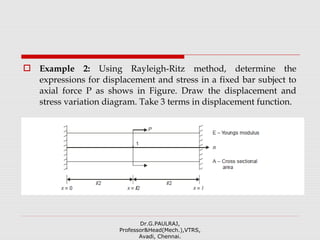
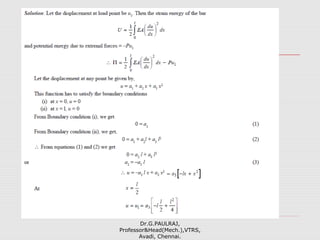
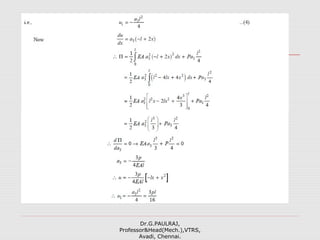
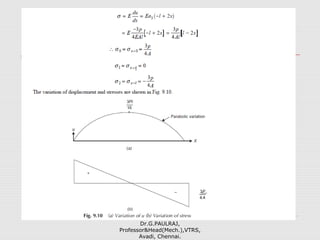
 Example 2: Using Rayleigh-Ritz method, determine the
expressions for displacement and stress in a fixed bar subject to
axial force P as shows in Figure. Draw the displacement and
stress variation diagram. Take 3 terms in displacement function.
Dr.G.PAULRAJ,
Professor&Head(Mech.),VTRS,
Avadi, Chennai.
Dr.G.PAULRAJ,
Professor&Head(Mech.),VTRS,
Avadi, Chennai.
Dr.G.PAULRAJ,
Professor&Head(Mech.),VTRS,
Avadi, Chennai.
Dr.G.PAULRAJ,
Professor&Head(Mech.),VTRS,
Avadi, Chennai.
Dr.G.PAULRAJ,
Professor&Head(Mech.),VTRS,
Avadi, Chennai.
Dr.G.PAULRAJ,
Professor&Head(Mech.),VTRS,
Avadi, Chennai.
Dr.G.PAULRAJ,
Professor&Head(Mech.),VTRS,
Avadi, Chennai.
Dr.G.PAULRAJ,
Professor&Head(Mech.),VTRS,
Avadi, Chennai.
Dr.G.PAULRAJ,
Professor&Head(Mech.),VTRS,
Avadi, Chennai.
Dr.G.PAULRAJ,
Professor&Head(Mech.),VTRS,
Avadi, Chennai.
Dr.G.PAULRAJ,
Professor&Head(Mech.),VTRS,
Avadi, Chennai.
Dr.G.PAULRAJ,
Professor&Head(Mech.),VTRS,
Avadi, Chennai.
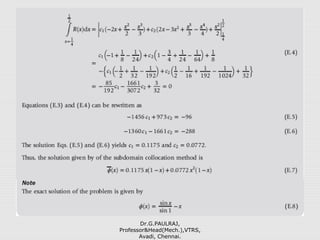
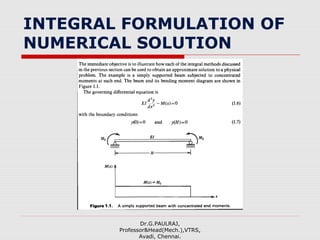
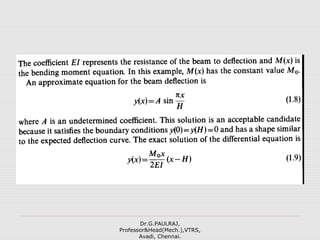
INTEGRAL FORMULATION OF
NUMERICAL SOLUTION
Dr.G.PAULRAJ,
Professor&Head(Mech.),VTRS,
Avadi, Chennai.
Dr.G.PAULRAJ,
Professor&Head(Mech.),VTRS,
Avadi, Chennai.
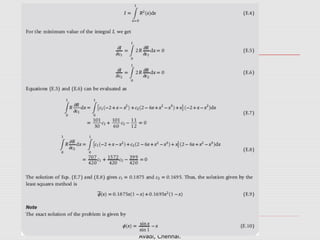
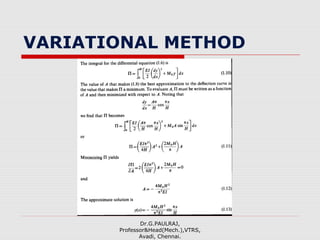
VARIATIONAL METHOD
Dr.G.PAULRAJ,
Professor&Head(Mech.),VTRS,
Avadi, Chennai.
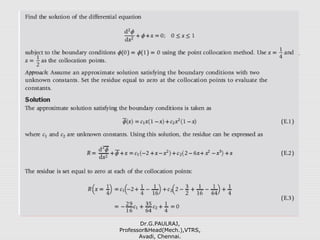
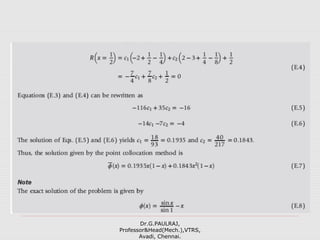
COLLOCATION METHOD
Dr.G.PAULRAJ,
Professor&Head(Mech.),VTRS,
Avadi, Chennai.
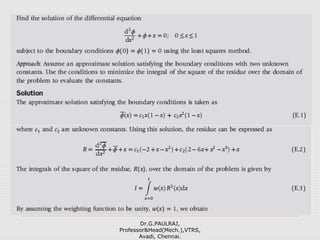
LEAST SQUARES METHOD
Dr.G.PAULRAJ,
Professor&Head(Mech.),VTRS,
Avadi, Chennai.
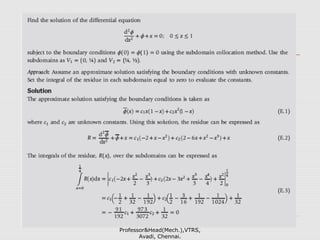
SUBDOMIN METHOD
Dr.G.PAULRAJ,
Professor&Head(Mech.),VTRS,
Avadi, Chennai.
GALERKIN’S METHOD
Dr.G.PAULRAJ,
Professor&Head(Mech.),VTRS,
Avadi, Chennai.
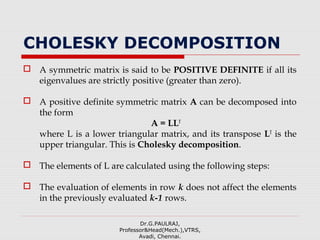
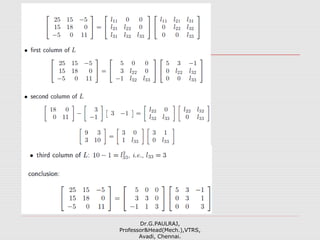
CHOLESKY DECOMPOSITION
 A symmetric matrix is said to be POSITIVE DEFINITE if all its
eigenvalues are strictly positive (greater than zero).
 A positive definite symmetric matrix A can be decomposed into
the form
A = LLT
where L is a lower triangular matrix, and its transpose LT
is the
upper triangular. This is Cholesky decomposition.
 The elements of L are calculated using the following steps:
 The evaluation of elements in row k does not affect the elements
in the previously evaluated k-1 rows.
Dr.G.PAULRAJ,
Professor&Head(Mech.),VTRS,
Avadi, Chennai.
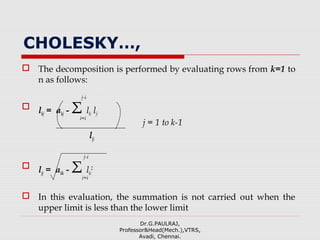
CHOLESKY…,
 The decomposition is performed by evaluating rows from k=1 to
n as follows:
 lkj = akj - Σ lki lji
j = 1 to k-1
ljj
 ljj = akk - Σ lki
2
 In this evaluation, the summation is not carried out when the
upper limit is less than the lower limit
Dr.G.PAULRAJ,
Professor&Head(Mech.),VTRS,
Avadi, Chennai.
j-i
i=i
j-i
i=i
CHOLESKY…,
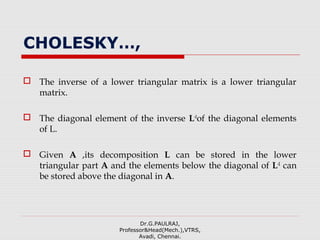
 The inverse of a lower triangular matrix is a lower triangular
matrix.
 The diagonal element of the inverse L-1
of the diagonal elements
of L.
 Given A ,its decomposition L can be stored in the lower
triangular part A and the elements below the diagonal of L-1
can
be stored above the diagonal in A.
Dr.G.PAULRAJ,
Professor&Head(Mech.),VTRS,
Avadi, Chennai.
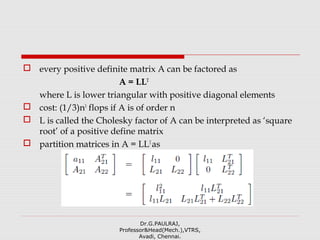
 every positive definite matrix A can be factored as
A = LLT
where L is lower triangular with positive diagonal elements
 cost: (1/3)n3
flops if A is of order n
 L is called the Cholesky factor of A can be interpreted as ‘square
root’ of a positive define matrix
 partition matrices in A = LLT
as
Dr.G.PAULRAJ,
Professor&Head(Mech.),VTRS,
Avadi, Chennai.
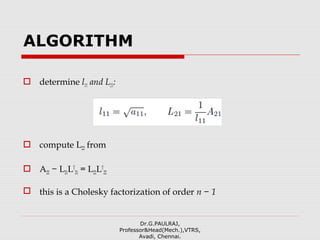
ALGORITHM
 determine l11 and L21:
 compute L22 from
 A22 − L21LT
21 = L22LT
22
 this is a Cholesky factorization of order n − 1
Dr.G.PAULRAJ,
Professor&Head(Mech.),VTRS,
Avadi, Chennai.
Dr.G.PAULRAJ,
Professor&Head(Mech.),VTRS,
Avadi, Chennai.
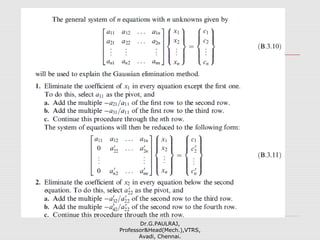
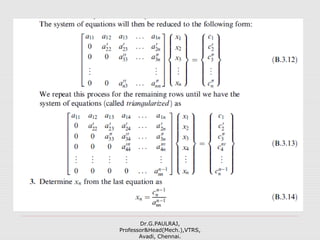
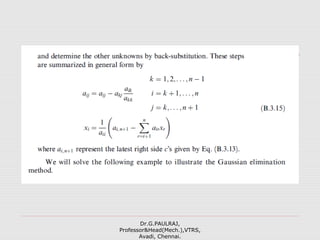
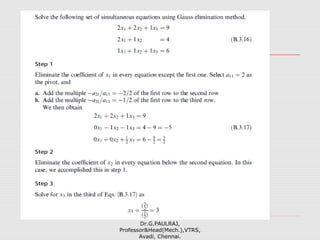
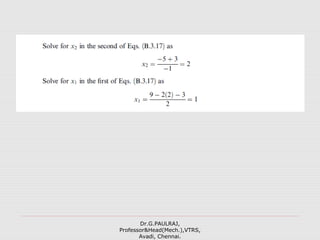
GAUSSIAN ELIMINATION
PROCEDURES
 Gaussian elimination is easily adapted to the computer for
solving systems of simultaneous equations. It is based on
triangularization of co-efficient matrix and evaluation of the
unknowns by back-substitution starting from the last equation.
Dr.G.PAULRAJ,
Professor&Head(Mech.),VTRS,
Avadi, Chennai.
Dr.G.PAULRAJ,
Professor&Head(Mech.),VTRS,
Avadi, Chennai.
Dr.G.PAULRAJ,
Professor&Head(Mech.),VTRS,
Avadi, Chennai.
Dr.G.PAULRAJ,
Professor&Head(Mech.),VTRS,
Avadi, Chennai.
Dr.G.PAULRAJ,
Professor&Head(Mech.),VTRS,
Avadi, Chennai.
Dr.G.PAULRAJ,
Professor&Head(Mech.),VTRS,
Avadi, Chennai.
FINITE ELEMENT METHOD
 Force Method: Internal forces are considered as the unknowns.
 Displacement/Stiffness Method: Displacement of nodes are
considered as unknowns of the problem
Dr.G.PAULRAJ,
Professor&Head(Mech.),VTRS,
Avadi, Chennai.
 Degree of Freedom- Minimum number of independent coordinates
required to determine completely the positions of all parts of a
system at any instant of time.
 The continuum has an infinite number of degrees of freedom
(DOF), while the discretized model has a finite number of DOF.
This is the origin of the name, finite element method.
Dr.G.PAULRAJ,
Professor&Head(Mech.),VTRS,
Avadi, Chennai.
DISCRETE AND CONTINUOUS
SYSTEMS
 Systems with a finite number of degrees of freedom are called
discrete or lumped parameter systems
 Systems with an infinite number of degrees of freedom are
called continuous or distributed systems
Dr.G.PAULRAJ,
Professor&Head(Mech.),VTRS,
Avadi, Chennai.
 The finite element method is a computational scheme to solve
field problems in engineering and science.
 The technique has very wide application, and has been used on
problems involving stress analysis, fluid mechanics, heat transfer,
diffusion, vibrations, electrical and magnetic fields, etc.
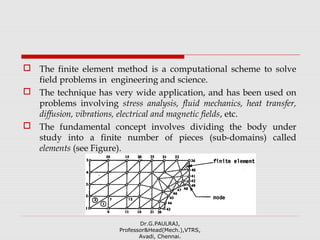
 The fundamental concept involves dividing the body under
study into a finite number of pieces (sub-domains) called
elements (see Figure).
Dr.G.PAULRAJ,
Professor&Head(Mech.),VTRS,
Avadi, Chennai.
 Particular assumptions are then made on the variation of the
unknown dependent variable(s) across each element using so-
called interpolation or approximation functions.
 This approximated variation is quantified in terms of solution
values at special element locations called nodes.
 Through this discretization process, the method sets up an
algebraic system of equations for unknown nodal values which
approximate the continuous solution.
 Because element size, shape and approximating scheme can be
varied to suit the problem, the method can accurately simulate
solutions to problems of complex geometry and loading and
thus this technique has become a very useful and practical tool.
Dr.G.PAULRAJ,
Professor&Head(Mech.),VTRS,
Avadi, Chennai.
GENERAL DESCRIPTION OF
THE METHOD
 In engineering problems there are some basic unknowns. If they
are found, the behaviour of the entire structure can be predicted.
 The basic unknowns or the Field variables which are
encountered in the engineering problems are displacements in
solid mechanics, velocities in fluid mechanics, electric and
magnetic potentials in electrical engineering and temperatures in
heat flow problems.
 In a continuum, these unknowns are infinite. The finite element
procedure reduces such unknowns to a finite number by
dividing the solution region into small parts called elements and
by expressing the unknown field variables in terms of assumed
approximating functions (Interpolating functions/Shape
functions) within each element.
Dr.G.PAULRAJ,
Professor&Head(Mech.),VTRS,
Avadi, Chennai.
 The approximating functions are defined in terms of field
variables of specified points called nodes or nodal points. Thus
in the finite element analysis the unknowns are the field
variables of the nodal points. Once these are found the field
variables at any point can be found by using interpolation
functions.
 After selecting elements and nodal unknowns next step in finite
element analysis is to assemble element properties for each
element. For example, in solid mechanics, we have to find the
force-displacement i.e. stiffness characteristics of each individual
element. Mathematically this relationship is of the form
[k]e {δ}e= {F}e
where [k]e is element stiffness matrix, {δ }e is nodal displacement
vector of the element and {F}e is nodal force vector.Dr.G.PAULRAJ,
Professor&Head(Mech.),VTRS,
Avadi, Chennai.
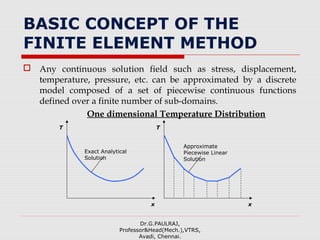
BASIC CONCEPT OF THE
FINITE ELEMENT METHOD
 Any continuous solution field such as stress, displacement,
temperature, pressure, etc. can be approximated by a discrete
model composed of a set of piecewise continuous functions
defined over a finite number of sub-domains.
One dimensional Temperature Distribution
Dr.G.PAULRAJ,
Professor&Head(Mech.),VTRS,
Avadi, Chennai.
Exact Analytical
Solution
x
T
Approximate
Piecewise Linear
Solution
x
T
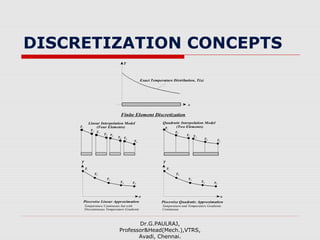
DISCRETIZATION CONCEPTS
Dr.G.PAULRAJ,
Professor&Head(Mech.),VTRS,
Avadi, Chennai.
x
T
Exact Temperature Distribution, T(x)
Finite Element Discretization
Linear Interpolation Model
(Four Elements)
Quadratic Interpolation Model
(Two Elements)
T1
T2
T2
T3 T3
T4 T4
T5
T1
T2
T3
T4 T5
Piecewise Linear Approximation
T
x
T1
T2
T3 T3
T4 T5
T
T1
T2
T3
T4 T5
Piecewise Quadratic Approximation
x
Temperature Continuous but with
Discontinuous Temperature Gradients
Temperature and Temperature Gradients
Continuous
STIFFNESS MATRIX
 The primary characteristics of a finite element are
embodied in the element stiffness matrix.
 For a structural finite element, the stiffness matrix
contains the geometric and material behavior
information that indicates the resistance of the element
to deformation when subjected to loading.
 Such deformation may include axial, bending, shear,
and torsional effects.
 For finite elements used in nonstructural analyses, such
as fluid flow and heat transfer, the term stiffness matrix is
also used, since the matrix represents the resistance of the
element to change when subjected to external influences.
Dr.G.PAULRAJ,
Professor&Head(Mech.),VTRS,
Avadi, Chennai.
MATRIX DISPLACEMENT
EQUATION
 The standard form of matrix displacement equation is,
[k] {δ} = {F}
 where [k] is stiffness matrix
 {δ} is displacement vector and
 {F} is force vector in the coordinate directions
 The element kij of stiffness matrix maybe defined as the force at
coordinate i due to unit displacement in coordinate direction j.
Dr.G.PAULRAJ,
Professor&Head(Mech.),VTRS,
Avadi, Chennai.
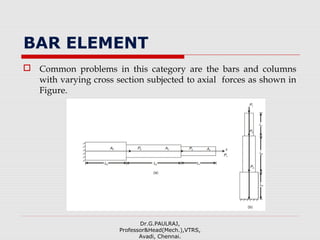
BAR ELEMENT
 Common problems in this category are the bars and columns
with varying cross section subjected to axial forces as shown in
Figure.
Dr.G.PAULRAJ,
Professor&Head(Mech.),VTRS,
Avadi, Chennai.
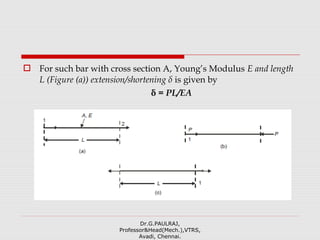
 For such bar with cross section A, Young’s Modulus E and length
L (Figure (a)) extension/shortening δ is given by
δ = PL/EA
Dr.G.PAULRAJ,
Professor&Head(Mech.),VTRS,
Avadi, Chennai.
 ∴ P=(EA/L)δ
 ∴ If δ = 1, P=EA/L
 By giving unit displacement in coordinate direction 1, the forces
development in the coordinate direction 1 and 2 can be found
(Figure(b)). Hence from the definition of stiffness matrix,
k11 = E A/L and k21 = -E A/L
 Similarly giving unit displacement in coordinate direction 2 (refer
Figure(c)), we get
k21 = -E A/L and k22 = E A/L
 Thus, [k] = E/L 1 -1
-1 1
Dr.G.PAULRAJ,
Professor&Head(Mech.),VTRS,
Avadi, Chennai.
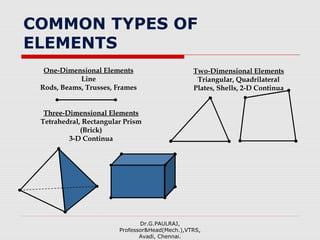
COMMON TYPES OF
ELEMENTS
Dr.G.PAULRAJ,
Professor&Head(Mech.),VTRS,
Avadi, Chennai.
One-Dimensional Elements
Line
Rods, Beams, Trusses, Frames
Two-Dimensional Elements
Triangular, Quadrilateral
Plates, Shells, 2-D Continua
Three-Dimensional Elements
Tetrahedral, Rectangular Prism
(Brick)
3-D Continua
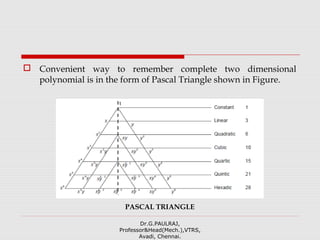
 Convenient way to remember complete two dimensional
polynomial is in the form of Pascal Triangle shown in Figure.
PASCAL TRIANGLE
Dr.G.PAULRAJ,
Professor&Head(Mech.),VTRS,
Avadi, Chennai.
WHAT'S THE DIFFERENCE
BETWEEN FEM & FEA ??
 FEA is an implementation of FEM to solve a certain type of
problem.
 For example if we were intending to solve a 2D stress problem.
For the FEM mathematical solution, we would probably use the
minimum potential energy principle, which is a variational
solution.
 As part of this, we need to generate a suitable element for our
analysis.
 We may choose a plane stress, plane strain or an axisymmetric
type formulation, with linear or higher order polynomials.
 Using a piecewise polynomial solution to solve the underlying
differential equation is FEM, while applying the specifics of
element formulation is FEA, e.g. a plane strain triangular
quadratic element.
Dr.G.PAULRAJ,
Professor&Head(Mech.),VTRS,
Avadi, Chennai.
DISCRETIZATION OF DOMIN
 to find the values of a field variable such as displacement, stress,
temperature, pressure, and velocity as a function of spatial
coordinates (x, y, z) in engineering problems.
 In the case of transient or unsteady-state problems, the field
variable has to be found as a function of not only the spatial
coordinates (x, y, z) but also time (t).
 The geometry (domain or solution region) of the problem is
often irregular.
 The first step of the finite element analysis involves the
discretization of the irregular domain into smaller and regular
subdomains, known as finite elements.
 This is equivalent to replacing the domain having an infinite
number of degrees of freedom (dof) by a system having a finite
number of dof.
Dr.G.PAULRAJ,
Professor&Head(Mech.),VTRS,
Avadi, Chennai.
 Different methods of dividing the domain into finite elements
involve varying amounts of computational time and often lead
to different approximations to the solution of the physical
problem.
 The process of discretization is essentially an exercise of
engineering judgment.
 Efficient methods of finite element idealization require some
experience and knowledge of simple guidelines.
 For large problems involving complex geometries, finite element
idealization based on manual procedures requires considerable
effort and time on the part of the analyst.
 Some automatic mesh generation programs have been
developed for the efficient idealization of complex domains
requiring minimal interface with the analyst.
Dr.G.PAULRAJ,
Professor&Head(Mech.),VTRS,
Avadi, Chennai.
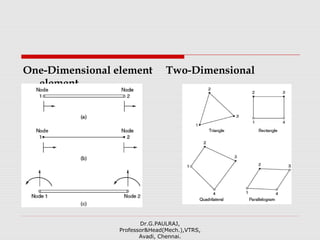
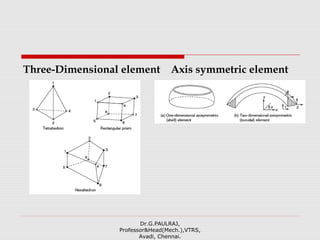
BASIC ELEMENT SHAPES
 The shapes, sizes, number, and configurations of the elements
have to be chosen carefully such that the original body or
domain is simulated as closely as possible without increasing the
computational effort needed for the solution.
Dr.G.PAULRAJ,
Professor&Head(Mech.),VTRS,
Avadi, Chennai.
One-Dimensional element Two-Dimensional
element
Dr.G.PAULRAJ,
Professor&Head(Mech.),VTRS,
Avadi, Chennai.
Three-Dimensional element Axis symmetric element
Dr.G.PAULRAJ,
Professor&Head(Mech.),VTRS,
Avadi, Chennai.
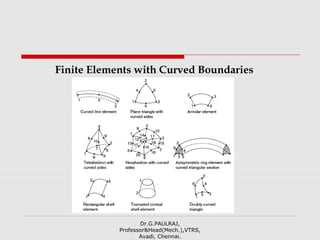
Finite Elements with Curved Boundaries
Dr.G.PAULRAJ,
Professor&Head(Mech.),VTRS,
Avadi, Chennai.
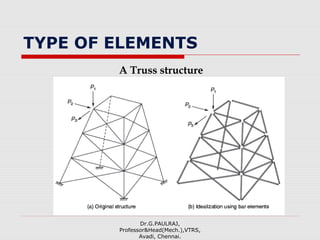
TYPE OF ELEMENTS
A Truss structure
Dr.G.PAULRAJ,
Professor&Head(Mech.),VTRS,
Avadi, Chennai.
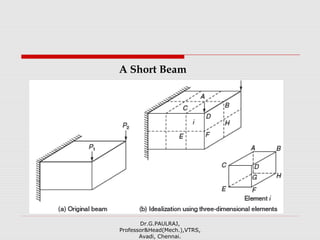
A Short Beam
Dr.G.PAULRAJ,
Professor&Head(Mech.),VTRS,
Avadi, Chennai.
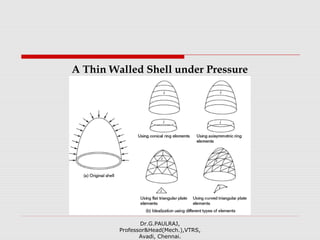
A Thin Walled Shell under Pressure
Dr.G.PAULRAJ,
Professor&Head(Mech.),VTRS,
Avadi, Chennai.
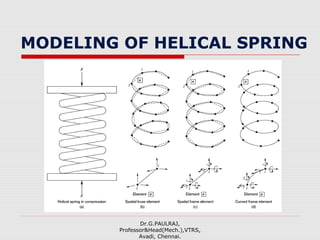
MODELING OF HELICAL SPRING
Dr.G.PAULRAJ,
Professor&Head(Mech.),VTRS,
Avadi, Chennai.
STEPS INVOLVED IN FEM-
USING CIRCLE
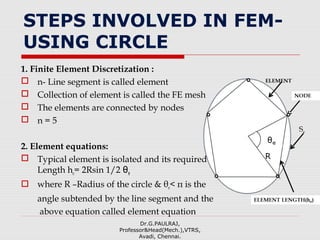
1. Finite Element Discretization :
 n- Line segment is called element
 Collection of element is called the FE mesh
 The elements are connected by nodes
 n = 5
2. Element equations:
 Typical element is isolated and its required properties i.e.,
Length he= 2Rsin 1/2 θe
 where R –Radius of the circle & θe< π is the
angle subtended by the line segment and the
above equation called element equation
Dr.G.PAULRAJ,
Professor&Head(Mech.),VTRS,
Avadi, Chennai.
ELEMENT
Se
R
3.Assembly of element equations and solution:
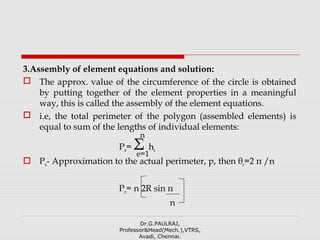
 The approx. value of the circumference of the circle is obtained
by putting together of the element properties in a meaningful
way, this is called the assembly of the element equations.
 i.e, the total perimeter of the polygon (assembled elements) is
equal to sum of the lengths of individual elements:
Pn= Σ he
 Pn- Approximation to the actual perimeter, p, then θe=2 π /n
Pn= n 2R sin π
n
Dr.G.PAULRAJ,
Professor&Head(Mech.),VTRS,
Avadi, Chennai.
n
e=1
4. Convergence and error estimate:
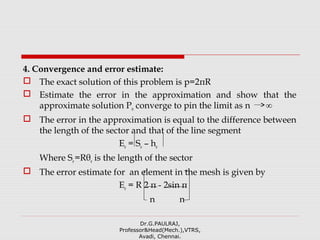
 The exact solution of this problem is p=2πR
 Estimate the error in the approximation and show that the
approximate solution Pn converge to pin the limit as n ∞
 The error in the approximation is equal to the difference between
the length of the sector and that of the line segment
Ee = Se – he
Where Se=Rθe is the length of the sector
 The error estimate for an element in the mesh is given by
Ee = R 2 π - 2sin π
n n
Dr.G.PAULRAJ,
Professor&Head(Mech.),VTRS,
Avadi, Chennai.
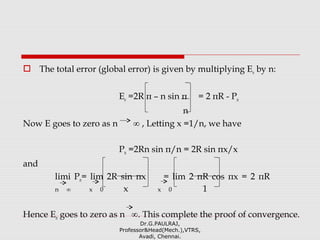
 The total error (global error) is given by multiplying Ee by n:
Ee =2R π – n sin π = 2 πR - Pn
n
Now E goes to zero as n ∞ , Letting x =1/n, we have
Pn =2Rn sin π/n = 2R sin πx/x
and
limi Pn= lim 2R sin πx = lim 2 πR cos πx = 2 πR
n ∞ x 0 x x 0 1
Hence En goes to zero as n ∞. This complete the proof of convergence.
Dr.G.PAULRAJ,
Professor&Head(Mech.),VTRS,
Avadi, Chennai.
INTERPOLATION MODELS
 The basic idea of the finite element method is piecewise
approximation that is, the solution of a complicated problem is
obtained by dividing the region of interest into small regions
(finite elements) and approximating the solution over each
subregion by a simple function.
 Thus, a necessary and important step is that of choosing a simple
function for the solution in each element.
 The functions used to represent the behavior of the solution
within an element are called interpolation functions or
approximating functions or interpolation models.
Dr.G.PAULRAJ,
Professor&Head(Mech.),VTRS,
Avadi, Chennai.
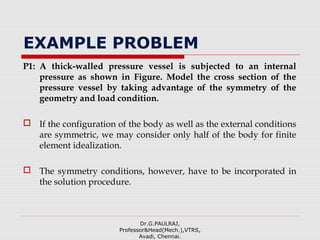
EXAMPLE PROBLEM
P1: A thick-walled pressure vessel is subjected to an internal
pressure as shown in Figure. Model the cross section of the
pressure vessel by taking advantage of the symmetry of the
geometry and load condition.
 If the configuration of the body as well as the external conditions
are symmetric, we may consider only half of the body for finite
element idealization.
 The symmetry conditions, however, have to be incorporated in
the solution procedure.
Dr.G.PAULRAJ,
Professor&Head(Mech.),VTRS,
Avadi, Chennai.
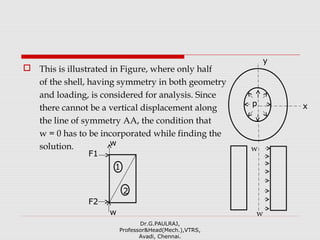
 This is illustrated in Figure, where only half
of the shell, having symmetry in both geometry
and loading, is considered for analysis. Since
there cannot be a vertical displacement along
the line of symmetry AA, the condition that
w = 0 has to be incorporated while finding the
solution.
Dr.G.PAULRAJ,
Professor&Head(Mech.),VTRS,
Avadi, Chennai.
x
y
p
w
w
1
2
F2
F1
w
w
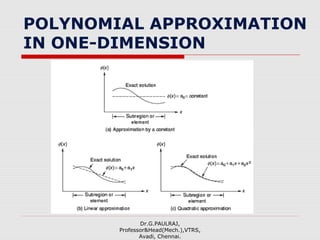
POLYNOMIAL APPROXIMATION
IN ONE-DIMENSION
Dr.G.PAULRAJ,
Professor&Head(Mech.),VTRS,
Avadi, Chennai.
 Polynomial-type interpolation functions have been most widely
used due to the following reasons:
1. It is easier to formulate and computerize the finite element
equations with polynomial type interpolation functions.
Specifically, it is easier to perform differentiation or integration
with polynomials.
2. It is possible to improve the accuracy of the results by
increasing the order of the polynomial, as shown in Figure1.
Theoretically, a polynomial of infinite order corresponds to the
exact solution. But in practice to use the polynomials of finite
order only as an approximation.
Dr.G.PAULRAJ,
Professor&Head(Mech.),VTRS,
Avadi, Chennai.
 If the order of the interpolation polynomial is fixed, the
discretization of the region (or domain) can be improved by two
methods. In the first method, known as r-method, h-method and
p-method.
 r-method: The locations of the nodes are altered without
changing the total number of elements.
 h-method: the number of elements is increased.
 p-method: If improvement in accuracy is sought by increasing
the order of the interpolation of polynomial.
Dr.G.PAULRAJ,
Professor&Head(Mech.),VTRS,
Avadi, Chennai.
POLYNOMIAL FORM OF
INTERPOLATION FUNCTIONS
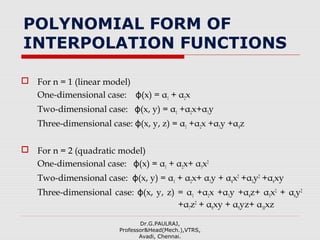
 For n = 1 (linear model)
One-dimensional case: ϕ(x) = α1 + α2x
Two-dimensional case: ϕ(x, y) = α1 +α2x+α3y
Three-dimensional case: ϕ(x, y, z) = α1 +α2x +α3y +α4z
 For n = 2 (quadratic model)
One-dimensional case: ϕ(x) = α1 + α2x+ α3x2
Two-dimensional case: ϕ(x, y) = α1 + α2x+ α3y + α4x2
+α5y2
+α6xy
Three-dimensional case: (x, y, z) = αϕ 1 +α2x +α3y +α4z+ α5x2
+ α6y2
+α7z2
+ α8xy + α9yz+ α10xz
Dr.G.PAULRAJ,
Professor&Head(Mech.),VTRS,
Avadi, Chennai.
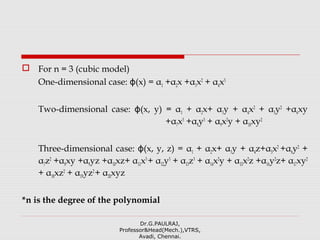
 For n = 3 (cubic model)
One-dimensional case: ϕ(x) = α1 +α2x +α3x2
+ α4x3
Two-dimensional case: (x, y) = αϕ 1 + α2x+ α3y + α4x2
+ α5y2
+α6xy
+α7x3
+α8y3
+ α9x2
y + α10xy2
Three-dimensional case: ϕ(x, y, z) = α1 + α2x+ α3y + α4z+α5x2
+α6y2
+
α7z2
+α8xy +α9yz +α10xz+ α11x3
+ α12y3
+ α13z3
+ α14x2
y + α15x2
z +α16y2
z+ α17xy2
+ α18xz2
+ α19yz2
+ α20xyz
*n is the degree of the polynomial
Dr.G.PAULRAJ,
Professor&Head(Mech.),VTRS,
Avadi, Chennai.
SELECTION OF THE ORDER OF
THE INTERPOLATION
POLYNOMIAL
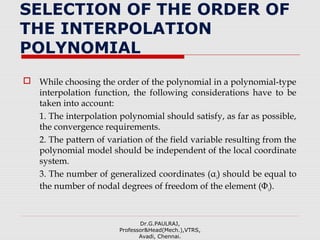
 While choosing the order of the polynomial in a polynomial-type
interpolation function, the following considerations have to be
taken into account:
1. The interpolation polynomial should satisfy, as far as possible,
the convergence requirements.
2. The pattern of variation of the field variable resulting from the
polynomial model should be independent of the local coordinate
system.
3. The number of generalized coordinates (αi) should be equal to
the number of nodal degrees of freedom of the element (Φi).
Dr.G.PAULRAJ,
Professor&Head(Mech.),VTRS,
Avadi, Chennai.
 The field variable representation within an element, and hence
the polynomial, should not change with a change in the local
coordinate system (when a linear transformation is made from
one Cartesian coordinate system to another).
 This property is called geometric isotropy or geometric
invariance or spatial isotropy.
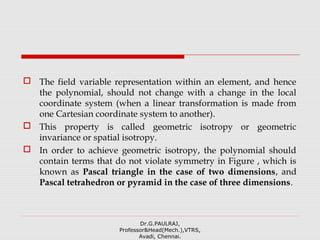
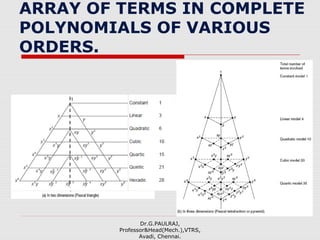
 In order to achieve geometric isotropy, the polynomial should
contain terms that do not violate symmetry in Figure , which is
known as Pascal triangle in the case of two dimensions, and
Pascal tetrahedron or pyramid in the case of three dimensions.
Dr.G.PAULRAJ,
Professor&Head(Mech.),VTRS,
Avadi, Chennai.
ARRAY OF TERMS IN COMPLETE
POLYNOMIALS OF VARIOUS
ORDERS.
Dr.G.PAULRAJ,
Professor&Head(Mech.),VTRS,
Avadi, Chennai.
CONVERGENCE REQUIREMENTS
 The finite element method is a numerical technique, to obtain a
sequence of approximate solutions as the element size is reduced
successively. This sequence will converge to the exact solution if
the interpolation polynomial satisfies the following convergence
requirements:
1. The field variable must be continuous within the elements. This
requirement is easily satisfied by choosing continuous functions
as interpolation models. Since polynomials are inherently
continuous, to satisfy this requirement.
2.All uniform states of the field variable and its partial derivativesϕ
up to the highest order appearing in the functional I( ) mustϕ
have representation in the interpolation polynomial when, in the
limit, the element size reduces to zero.
Dr.G.PAULRAJ,
Professor&Head(Mech.),VTRS,
Avadi, Chennai.

Finite Element Analysis - UNIT-1

  • 1.
    TO ByBy Dr.G.PAULRAJDr.G.PAULRAJ Professor & HeadProfessor& Head Department of Mechanical EngineeringDepartment of Mechanical Engineering Vel Tech (Owned by R S Trust)Vel Tech (Owned by R S Trust) Avadi, Chennai-600062.Avadi, Chennai-600062.
  • 2.
  • 3.
    UNIT I INTRODUCTION Historical Background – Mathematical Modeling of field problems in Engineering – Governing Equations – Discrete and continuous models – Boundary, Initial and Eigen Value problems– Weighted Residual Methods – Variational Formulation of Boundary Value Problems – Ritz Technique – Basic concepts of the Finite Element Method. Dr.G.PAULRAJ, Professor&Head(Mech.),VTRS, Avadi, Chennai. L=5
  • 4.
  • 5.
    FINITE ELEMET METHOD The FEA is a computer aided mathematical technique that is used to obtain an approximate numerical solution to the fundamental differential and/or integral equations that predict the response of physical systems to external effects.  Useful for problems with complicated geometries, loadings, and material properties where analytical solutions can not be obtained.  2-D modeling conserves simplicity and allows the analysis to be run on a normal computer, it tends to yield less accurate results. 3-D modeling, produces more accurate results while sacrificing the ability to run on all but the fastest computers effectively. Dr.G.PAULRAJ, Professor&Head(Mech.),VTRS, Avadi, Chennai.
  • 6.
    BRIEF HISTORY OFFEM  1940 ----- Basic ideas of FEA were developed by aircraft engineers in early 1940’s. They are uesd matrix methods.  1943 ----- Courant (Variational methods)  1945 ----- Hrennikoff- Field of structural engineering  1947 ----- Levy- Introduce flexibility/ force method  1953 ----- Levy – Stiffness method for analysis aircraft structures  1954 ----- Argyris & Kelsey – Matrix structural analysis  1956 ----- Turner, Clough, Martin and Topp (Stiffness)  1960 ----- Clough (“Finite Element”, plane problems)  1961 ----- Turner – Large deflection and thermal analysis problem  1962 ----- Gallagher – Non-linearities problems  1968 ----- Zinkiewicz – Visco elasticity problems  1969 ----- Weighted Residual method for structural analysis  1990s ----- Analysis of large structural systems Dr.G.PAULRAJ, Professor&Head(Mech.),VTRS, Avadi, Chennai.
  • 7.
    MATHEMATICAL MODELING  Ageometric model becomes a mathematical model, when its behaviour is described, or approximated by selected differential equations and boundary conditions.  The equations, depending on their particular forms, may incorporate restrictions such as homogeneity, isotropy, constancy of material properties, and smallness of strains and rotations. Dr.G.PAULRAJ, Professor&Head(Mech.),VTRS, Avadi, Chennai.
  • 8.
    MATHEMATICAL MODELING Dr.G.PAULRAJ, Professor&Head(Mech.),VTRS, Avadi, Chennai. Material Properties Governing Equation FieldVariable/ dependent variable Primary variableCross-sectional property Independent variable or spatial co- ordinate E A ( d2 u /dx2 ) + γ A = 0
  • 9.
    EXAMPLE OF ATAPER ROD SUBJECTED A POINT LOAD ‘P’ AND ITS OWN SELF WEIGHT P dx σ A(x) (σ + dσ) A (x) γ A(x) dx (self weight) dx Dr.G.PAULRAJ, Professor&Head(Mech.),VTRS, Avadi, Chennai.
  • 10.
    A(x) = A0- (A0-A1) x/l For equilibrium (σ +dσ) A(x) + γ A(x) dx - σ A(X) = 0 --(1) i.e) dσ A(x) + γ A(x) dx = 0 ---(2) (3) in (2 ) & dividing by dx. from continuum mechanics,∈=du/dx For a bar of constant cross section )3(→== dx du EEεσ )4(0)( )( →=+                 xA dx dx du xAd E γ 0)( ))(( =+ xA dx xAd E γ σ )5(0)()( 2 2 →=+ xA dx ud xEA γ Governing Equation Where σ - stress, ∈ - strain & E - Young’s Modulus Dr.G.PAULRAJ, Professor&Head(Mech.),VTRS, Avadi, Chennai.
  • 11.
  • 12.
     Variables:  PrimaryVariables eg. Displacement, u Temperature, T  Secondary Variables eg. Force EA du/dx Heat flux –KA dT/dx  Loads:  Volume loads N/m3 N/m eg. Self weight, udl  Point loads N Dr.G.PAULRAJ, Professor&Head(Mech.),VTRS, Avadi, Chennai.
  • 13.
    DISCRETE AND CONTINUOUS MODEL Discreteelements:  These elements have a well defined deflection equation that can be found in an engineering handbook, such as, Truss and Beam/Frame elements.  The geometry of these elements is simple, and in general, mesh refinement does not give better results.  Discrete elements have a very limited application; bulk of the FEA application relies on the Continuous-structure elements. Dr.G.PAULRAJ, Professor&Head(Mech.),VTRS, Avadi, Chennai.
  • 14.
    Continuous-structure Elements:  Continuous-structureelements do not have a well define deflection or interpolation function, it is developed and approximated by using the theory of elasticity.  The geometry is represented by either a 2-D or 3-D solid element – the continuous- structure elements.  Since elements in this category can have any shape, it is very effective in calculation of stresses at a sharp curve or geometry, i.e., evaluation of stress concentrations.  Continuous structural elements are extremely useful for finding stress concentration points in structures. Dr.G.PAULRAJ, Professor&Head(Mech.),VTRS, Avadi, Chennai.
  • 15.
    ENGINEERING APPLICATIONS OF FEA Structural Engineering  Aerospace Engineering  Automobile Engineering  Thermal applications  Acoustics  Flow Problems  Dynamics  Metal Forming  Medical & Dental applications  Soil mechanics etc Dr.G.PAULRAJ, Professor&Head(Mech.),VTRS, Avadi, Chennai.
  • 16.
    NEED FOR NUMERICAL METHODSOF SOLUTION  The best way to solve any physical problem governed by a differential equation is to obtain the analytical solution.  There are many situation the analytical solution is difficult to obtain. They are (1)The configuration may be composed of several different materials and (2)Problems involving anisotropic materials  A numerical method can be used to obtain an approximate solution when an analytical solution cannot be developed.  There are several procedures for obtaining a numerical solution to a differential equation. The methods are : 1. The finite difference method, 2. the variational method, and 3. the method that weight a residual. Dr.G.PAULRAJ, Professor&Head(Mech.),VTRS, Avadi, Chennai.
  • 17.
    FINITE DIFFERENCE METHOD The finite difference method approximates the derivatives in the governing differential equation using difference equations.  This method is used for solving heat transfer and fluid mechanics problems.  And it is work well for two-dimensional regions with boundaries parallel to the co-ordinate axes.  This method is not suitable for curved region or irregular boundary. Dr.G.PAULRAJ, Professor&Head(Mech.),VTRS, Avadi, Chennai.
  • 18.
    VARIATIONAL METHOD  Thevariational approach involves the integral of a function that produces a number.  Each new function produces a new number.  The function that produces lowest no. has the additional property of satisfying a specific D.E.  Consider the integral, H 2 ∏ = D dy/dx - Qy dx 0  The numerical value of ∏ can be calculated given a specific equation y= f(x) Dr.G.PAULRAJ, Professor&Head(Mech.),VTRS, Avadi, Chennai.
  • 19.
     The calculusof variation shows that the particular equation y= g(x), which yields the lowest numerical value for ∏ is the solution to the D.E D.d2 y/dx2 +Q = 0 with the boundary conditions y(0) =y0 and y(H)=yh  By substituting different trial functions that gives minimum value of ∏ is the approximate solution.  The major disadvantage of this approach is , it is not applicable to any D.E. containing a first derivative term. Dr.G.PAULRAJ, Professor&Head(Mech.),VTRS, Avadi, Chennai.
  • 20.
    WEIGHTED RESIDUAL METHODS  Theweighted residual methods also involve an integral  In this method an approximate solution is substituted in the D.E.  Since the approximate solution does not satisfy the equation, a residual or error term results  Suppose that y=h(x) is an approximate solution to the above equation  Substitution gives D d2 h(x)/dx2 +Q = R(x) ≠ 0 , Since y=h(x) does not satisfy the equation. Dr.G.PAULRAJ, Professor&Head(Mech.),VTRS, Avadi, Chennai.
  • 21.
    WEIGHTED RESIDUAL…,  Theweighted residual methods require that H Wi(x)R(x)dx=0 0  The residual R(x) is multiplied by a weighting function Wi(x), and the integral of the product is required to be zero.  The no. of weighting functions equals the no. of unknown co-efficient in the approximate solution.  The weighted residual techniques are: 1. Collocation method 2. Subdomain method, 3.Galerkin’s method and 4.Least square method. Dr.G.PAULRAJ, Professor&Head(Mech.),VTRS, Avadi, Chennai.
  • 22.
    WEIGHTED RESIDUAL…,  Collocationmethod: Impulse function Wi(x)=δ(x-Xi) are selected as weighting functions. This selection is equivalent to requiring the residual to vanish at specific points. The no. of points selected equals the no. of undetermined coefficients in the approximate solution.  Subdomain method: Each weighting function is selected as unity, Wi(x)=1 over a specific region. This is equivalent to requiring the integral of the residual to vanish over a interval of the region.The no. of integration intervals equals the no. of undetermined coefficients in the approximate solution. Dr.G.PAULRAJ, Professor&Head(Mech.),VTRS, Avadi, Chennai.
  • 23.
    WEIGHTED RESIDUAL…,  Galerkin’smethod: Galerkin’s method uses the same functions for Wi(x) that were used in the approximating equation. This approach is the basis of the finite element method for problems involving first-derivative terms. This methods yields the same result as the variational method when applied to differential equations that are self-adjoint.  Least Squares method: The least squares method utilizes the residual as the weighting function and obtains a new error term defined by H Er = [R(x)]2 d 0  This error is minimized w.r.t the unknown coefficient in the approximate solution. Dr.G.PAULRAJ, Professor&Head(Mech.),VTRS, Avadi, Chennai.
  • 24.
    RAYLEIGH- RITZ METHOD The Rayleigh–Ritz method of expressing field variables by approximate method clubbed with minimization of potential energy has made a big break through in finite element analysis.  In 1870 Rayleigh used an approximating field with single degree of freedom for studies on vibration problems.  In 1909 he used approximating field with several functions, each function satisfying boundary conditions and associating with separate degree of freedom.  Ritz applied this technique to static equilibrium and Eigen value problems.  The procedure for static equilibrium problem is given below:  Consider an elastic solid subject to a set of loads. The displacements and stresses are to be determined. Dr.G.PAULRAJ, Professor&Head(Mech.),VTRS, Avadi, Chennai.
  • 25.
     Let u,v and w be the displacements in x, y and z coordinate directions. Then for each of displacement component an approximate solution is taken as u = Σai φi (x, y, z) for i = 1 to m1 v = Σajφj (x, y, z) for j = m1 + 1 to m2 …(1) w =Σak φk (x, y, z) for k = m2 + 1 to m  The function φi are usually taken as polynomials satisfying the boundary conditions. ‘a’ are the amplitudes of the functions. Thus in equation (1) there are n number of unknown ‘a’ values.  Substituting these expressions for displacement in strain displacements and stress strain relations, potential energy expression can be assembled. Then the total potential energy Dr.G.PAULRAJ, Professor&Head(Mech.),VTRS, Avadi, Chennai.
  • 26.
     Π =Πa1, a2 ... am1 , am1+1 ... am2 am2+1 ... Am  From the principle of minimum potential energy, d Π/dai = 0 for i= 1 to m ….(2)  From the solution of m equation of 2, we get the values of all ‘a’ . With these values of ‘ai’s and φi ’s satisfying boundary conditions, the displacements are obtained. Then the strains and stresses can be assembled. Dr.G.PAULRAJ, Professor&Head(Mech.),VTRS, Avadi, Chennai.
  • 27.
     Example1: UsingRayleigh–Ritz method determine the expressions for deflection and bending moments in a simply supported beam subjected to uniformly distributed load over entire span. Find the deflection and moment at mid span and compare with exact solutions. Dr.G.PAULRAJ, Professor&Head(Mech.),VTRS, Avadi, Chennai.
  • 28.
    FEM Vs CLASSICAL METHODS In classical methods exact solutions are obtained where as in finite element analysis approximate solutions are obtained.  Whenever the following complexities are faced, classical method makes the drastic assumptions’ and looks for the solutions:  Shape, Boundary conditions and Loading  When material property is not isotropic, solutions for the problems become very difficult in classical method but in FEM solutions for the problems without any difficulty.  If structure consists of more than one material, it is difficult to use classical method, but finite element can be used without any difficulty.  Problems with material and geometric non-linearities can not be handled by classical methods. There is no difficulty in FEM. Dr.G.PAULRAJ, Professor&Head(Mech.),VTRS, Avadi, Chennai.
  • 29.
    FEM Vs FDM FDM makes pointwise approximation to the governing equations i.e. it ensures continuity only at the node points. Continuity along the sides of grid lines are not ensured.  FEM make piecewise approximation i.e. it ensures the continuity at node points as well as along the sides of the element.  FDM do not give the values at any point except at node points. It do not give any approximating function to evaluate the basic values (deflections, in case of solid mechanics) using the nodal values. Dr.G.PAULRAJ, Professor&Head(Mech.),VTRS, Avadi, Chennai.
  • 30.
     FDM makesstair type approximation to sloping and curved boundaries .  FEM can consider the sloping boundaries exactly. If curved elements are used, even the curved boundaries can be handled exactly.  FDM needs larger number of nodes to get good results while FEM needs fewer nodes.  With FDM fairly complicated problems can be handled where as FEM can handle all complicated problems. Dr.G.PAULRAJ, Professor&Head(Mech.),VTRS, Avadi, Chennai.
  • 31.
    AVAILABLE COMMERCIAL SOFTWARE  ANSYS(General purpose, PC and workstations)  SDRC/I-DEAS (Complete CAD/CAM/CAE package)  NASTRAN (General purpose FEA on mainframes)  ABAQUS (Nonlinear and dynamic analyses)  COSMOS (General purpose FEA)  ALGOR (PC and workstations)  PATRAN (Pre/Post Processor)  Hyper Mesh (Pre/Post Processor)  Dyna-3D (Crash/impact analysis) Dr.G.PAULRAJ, Professor&Head(Mech.),VTRS, Avadi, Chennai.
  • 32.
  • 33.
    SIX STEPS INTHE FINITE ELEMENT METHOD  Step 1 - Discretization: The problem domain is discretized into a collection of simple shapes, or elements.  Step 2 - Develop Element Equations: Developed using the physics of the problem, and typically Galerkin’s Method or variational principles.  Step 3 - Assembly: The element equations for each element in the FEM mesh are assembled into a set of global equations that model the properties of the entire system. Dr.G.PAULRAJ, Professor&Head(Mech.),VTRS, Avadi, Chennai.
  • 34.
    DISCRETIZATION EXAMPLES Dr.G.PAULRAJ, Professor&Head(Mech.),VTRS, Avadi, Chennai. One-Dimensional FrameElements Two-Dimensional Triangular Elements Three-Dimensional Brick Elements
  • 35.
     Step 4- Application of Boundary Conditions: Solution cannot be obtained unless boundary conditions are applied. They reflect the known values for certain primary unknowns. Imposing the boundary conditions modifies the global equations.  Step 5 - Solve for Primary Unknowns: The modified global equations are solved for the primary unknowns at the nodes.  Step 6 - Calculate Derived Variables: Calculated using the nodal values of the primary variables. Dr.G.PAULRAJ, Professor&Head(Mech.),VTRS, Avadi, Chennai.
  • 36.
    BOUNDARY CONDITIONS  Thedifferential equation is subjected to boundary conditions, which are usually of two types- (i) the essential /Geometric/Dirichlet boundary conditions (ii) the natural /force boundary conditions  The essential boundary conditions are the set of conditions that are sufficient for solving the differential equations completely. Example: u and T (Primary variables) .  The natural boundary conditions are the boundary conditions involving higher order derivative terms and are not sufficient for solving the differential equation completely, requiring atleast one essential boundary condition. Example: F and KA dT/dx (Secondary variables) Dr.G.PAULRAJ, Professor&Head(Mech.),VTRS, Avadi, Chennai.
  • 37.
  • 38.
  • 39.
  • 40.
  • 41.
     Example 2:Using Rayleigh-Ritz method, determine the expressions for displacement and stress in a fixed bar subject to axial force P as shows in Figure. Draw the displacement and stress variation diagram. Take 3 terms in displacement function. Dr.G.PAULRAJ, Professor&Head(Mech.),VTRS, Avadi, Chennai.
  • 42.
  • 43.
  • 44.
  • 45.
  • 46.
  • 47.
  • 48.
  • 49.
  • 50.
  • 51.
  • 52.
  • 53.
    INTEGRAL FORMULATION OF NUMERICALSOLUTION Dr.G.PAULRAJ, Professor&Head(Mech.),VTRS, Avadi, Chennai.
  • 54.
  • 55.
  • 56.
  • 57.
  • 58.
  • 59.
  • 60.
    CHOLESKY DECOMPOSITION  Asymmetric matrix is said to be POSITIVE DEFINITE if all its eigenvalues are strictly positive (greater than zero).  A positive definite symmetric matrix A can be decomposed into the form A = LLT where L is a lower triangular matrix, and its transpose LT is the upper triangular. This is Cholesky decomposition.  The elements of L are calculated using the following steps:  The evaluation of elements in row k does not affect the elements in the previously evaluated k-1 rows. Dr.G.PAULRAJ, Professor&Head(Mech.),VTRS, Avadi, Chennai.
  • 61.
    CHOLESKY…,  The decompositionis performed by evaluating rows from k=1 to n as follows:  lkj = akj - Σ lki lji j = 1 to k-1 ljj  ljj = akk - Σ lki 2  In this evaluation, the summation is not carried out when the upper limit is less than the lower limit Dr.G.PAULRAJ, Professor&Head(Mech.),VTRS, Avadi, Chennai. j-i i=i j-i i=i
  • 62.
    CHOLESKY…,  The inverseof a lower triangular matrix is a lower triangular matrix.  The diagonal element of the inverse L-1 of the diagonal elements of L.  Given A ,its decomposition L can be stored in the lower triangular part A and the elements below the diagonal of L-1 can be stored above the diagonal in A. Dr.G.PAULRAJ, Professor&Head(Mech.),VTRS, Avadi, Chennai.
  • 63.
     every positivedefinite matrix A can be factored as A = LLT where L is lower triangular with positive diagonal elements  cost: (1/3)n3 flops if A is of order n  L is called the Cholesky factor of A can be interpreted as ‘square root’ of a positive define matrix  partition matrices in A = LLT as Dr.G.PAULRAJ, Professor&Head(Mech.),VTRS, Avadi, Chennai.
  • 64.
    ALGORITHM  determine l11and L21:  compute L22 from  A22 − L21LT 21 = L22LT 22  this is a Cholesky factorization of order n − 1 Dr.G.PAULRAJ, Professor&Head(Mech.),VTRS, Avadi, Chennai.
  • 65.
  • 66.
    GAUSSIAN ELIMINATION PROCEDURES  Gaussianelimination is easily adapted to the computer for solving systems of simultaneous equations. It is based on triangularization of co-efficient matrix and evaluation of the unknowns by back-substitution starting from the last equation. Dr.G.PAULRAJ, Professor&Head(Mech.),VTRS, Avadi, Chennai.
  • 67.
  • 68.
  • 69.
  • 70.
  • 71.
  • 72.
    FINITE ELEMENT METHOD Force Method: Internal forces are considered as the unknowns.  Displacement/Stiffness Method: Displacement of nodes are considered as unknowns of the problem Dr.G.PAULRAJ, Professor&Head(Mech.),VTRS, Avadi, Chennai.
  • 73.
     Degree ofFreedom- Minimum number of independent coordinates required to determine completely the positions of all parts of a system at any instant of time.  The continuum has an infinite number of degrees of freedom (DOF), while the discretized model has a finite number of DOF. This is the origin of the name, finite element method. Dr.G.PAULRAJ, Professor&Head(Mech.),VTRS, Avadi, Chennai.
  • 74.
    DISCRETE AND CONTINUOUS SYSTEMS Systems with a finite number of degrees of freedom are called discrete or lumped parameter systems  Systems with an infinite number of degrees of freedom are called continuous or distributed systems Dr.G.PAULRAJ, Professor&Head(Mech.),VTRS, Avadi, Chennai.
  • 75.
     The finiteelement method is a computational scheme to solve field problems in engineering and science.  The technique has very wide application, and has been used on problems involving stress analysis, fluid mechanics, heat transfer, diffusion, vibrations, electrical and magnetic fields, etc.  The fundamental concept involves dividing the body under study into a finite number of pieces (sub-domains) called elements (see Figure). Dr.G.PAULRAJ, Professor&Head(Mech.),VTRS, Avadi, Chennai.
  • 76.
     Particular assumptionsare then made on the variation of the unknown dependent variable(s) across each element using so- called interpolation or approximation functions.  This approximated variation is quantified in terms of solution values at special element locations called nodes.  Through this discretization process, the method sets up an algebraic system of equations for unknown nodal values which approximate the continuous solution.  Because element size, shape and approximating scheme can be varied to suit the problem, the method can accurately simulate solutions to problems of complex geometry and loading and thus this technique has become a very useful and practical tool. Dr.G.PAULRAJ, Professor&Head(Mech.),VTRS, Avadi, Chennai.
  • 77.
    GENERAL DESCRIPTION OF THEMETHOD  In engineering problems there are some basic unknowns. If they are found, the behaviour of the entire structure can be predicted.  The basic unknowns or the Field variables which are encountered in the engineering problems are displacements in solid mechanics, velocities in fluid mechanics, electric and magnetic potentials in electrical engineering and temperatures in heat flow problems.  In a continuum, these unknowns are infinite. The finite element procedure reduces such unknowns to a finite number by dividing the solution region into small parts called elements and by expressing the unknown field variables in terms of assumed approximating functions (Interpolating functions/Shape functions) within each element. Dr.G.PAULRAJ, Professor&Head(Mech.),VTRS, Avadi, Chennai.
  • 78.
     The approximatingfunctions are defined in terms of field variables of specified points called nodes or nodal points. Thus in the finite element analysis the unknowns are the field variables of the nodal points. Once these are found the field variables at any point can be found by using interpolation functions.  After selecting elements and nodal unknowns next step in finite element analysis is to assemble element properties for each element. For example, in solid mechanics, we have to find the force-displacement i.e. stiffness characteristics of each individual element. Mathematically this relationship is of the form [k]e {δ}e= {F}e where [k]e is element stiffness matrix, {δ }e is nodal displacement vector of the element and {F}e is nodal force vector.Dr.G.PAULRAJ, Professor&Head(Mech.),VTRS, Avadi, Chennai.
  • 79.
    BASIC CONCEPT OFTHE FINITE ELEMENT METHOD  Any continuous solution field such as stress, displacement, temperature, pressure, etc. can be approximated by a discrete model composed of a set of piecewise continuous functions defined over a finite number of sub-domains. One dimensional Temperature Distribution Dr.G.PAULRAJ, Professor&Head(Mech.),VTRS, Avadi, Chennai. Exact Analytical Solution x T Approximate Piecewise Linear Solution x T
  • 80.
    DISCRETIZATION CONCEPTS Dr.G.PAULRAJ, Professor&Head(Mech.),VTRS, Avadi, Chennai. x T ExactTemperature Distribution, T(x) Finite Element Discretization Linear Interpolation Model (Four Elements) Quadratic Interpolation Model (Two Elements) T1 T2 T2 T3 T3 T4 T4 T5 T1 T2 T3 T4 T5 Piecewise Linear Approximation T x T1 T2 T3 T3 T4 T5 T T1 T2 T3 T4 T5 Piecewise Quadratic Approximation x Temperature Continuous but with Discontinuous Temperature Gradients Temperature and Temperature Gradients Continuous
  • 81.
    STIFFNESS MATRIX  Theprimary characteristics of a finite element are embodied in the element stiffness matrix.  For a structural finite element, the stiffness matrix contains the geometric and material behavior information that indicates the resistance of the element to deformation when subjected to loading.  Such deformation may include axial, bending, shear, and torsional effects.  For finite elements used in nonstructural analyses, such as fluid flow and heat transfer, the term stiffness matrix is also used, since the matrix represents the resistance of the element to change when subjected to external influences. Dr.G.PAULRAJ, Professor&Head(Mech.),VTRS, Avadi, Chennai.
  • 82.
    MATRIX DISPLACEMENT EQUATION  Thestandard form of matrix displacement equation is, [k] {δ} = {F}  where [k] is stiffness matrix  {δ} is displacement vector and  {F} is force vector in the coordinate directions  The element kij of stiffness matrix maybe defined as the force at coordinate i due to unit displacement in coordinate direction j. Dr.G.PAULRAJ, Professor&Head(Mech.),VTRS, Avadi, Chennai.
  • 83.
    BAR ELEMENT  Commonproblems in this category are the bars and columns with varying cross section subjected to axial forces as shown in Figure. Dr.G.PAULRAJ, Professor&Head(Mech.),VTRS, Avadi, Chennai.
  • 84.
     For suchbar with cross section A, Young’s Modulus E and length L (Figure (a)) extension/shortening δ is given by δ = PL/EA Dr.G.PAULRAJ, Professor&Head(Mech.),VTRS, Avadi, Chennai.
  • 85.
     ∴ P=(EA/L)δ ∴ If δ = 1, P=EA/L  By giving unit displacement in coordinate direction 1, the forces development in the coordinate direction 1 and 2 can be found (Figure(b)). Hence from the definition of stiffness matrix, k11 = E A/L and k21 = -E A/L  Similarly giving unit displacement in coordinate direction 2 (refer Figure(c)), we get k21 = -E A/L and k22 = E A/L  Thus, [k] = E/L 1 -1 -1 1 Dr.G.PAULRAJ, Professor&Head(Mech.),VTRS, Avadi, Chennai.
  • 86.
    COMMON TYPES OF ELEMENTS Dr.G.PAULRAJ, Professor&Head(Mech.),VTRS, Avadi,Chennai. One-Dimensional Elements Line Rods, Beams, Trusses, Frames Two-Dimensional Elements Triangular, Quadrilateral Plates, Shells, 2-D Continua Three-Dimensional Elements Tetrahedral, Rectangular Prism (Brick) 3-D Continua
  • 87.
     Convenient wayto remember complete two dimensional polynomial is in the form of Pascal Triangle shown in Figure. PASCAL TRIANGLE Dr.G.PAULRAJ, Professor&Head(Mech.),VTRS, Avadi, Chennai.
  • 88.
    WHAT'S THE DIFFERENCE BETWEENFEM & FEA ??  FEA is an implementation of FEM to solve a certain type of problem.  For example if we were intending to solve a 2D stress problem. For the FEM mathematical solution, we would probably use the minimum potential energy principle, which is a variational solution.  As part of this, we need to generate a suitable element for our analysis.  We may choose a plane stress, plane strain or an axisymmetric type formulation, with linear or higher order polynomials.  Using a piecewise polynomial solution to solve the underlying differential equation is FEM, while applying the specifics of element formulation is FEA, e.g. a plane strain triangular quadratic element. Dr.G.PAULRAJ, Professor&Head(Mech.),VTRS, Avadi, Chennai.
  • 89.
    DISCRETIZATION OF DOMIN to find the values of a field variable such as displacement, stress, temperature, pressure, and velocity as a function of spatial coordinates (x, y, z) in engineering problems.  In the case of transient or unsteady-state problems, the field variable has to be found as a function of not only the spatial coordinates (x, y, z) but also time (t).  The geometry (domain or solution region) of the problem is often irregular.  The first step of the finite element analysis involves the discretization of the irregular domain into smaller and regular subdomains, known as finite elements.  This is equivalent to replacing the domain having an infinite number of degrees of freedom (dof) by a system having a finite number of dof. Dr.G.PAULRAJ, Professor&Head(Mech.),VTRS, Avadi, Chennai.
  • 90.
     Different methodsof dividing the domain into finite elements involve varying amounts of computational time and often lead to different approximations to the solution of the physical problem.  The process of discretization is essentially an exercise of engineering judgment.  Efficient methods of finite element idealization require some experience and knowledge of simple guidelines.  For large problems involving complex geometries, finite element idealization based on manual procedures requires considerable effort and time on the part of the analyst.  Some automatic mesh generation programs have been developed for the efficient idealization of complex domains requiring minimal interface with the analyst. Dr.G.PAULRAJ, Professor&Head(Mech.),VTRS, Avadi, Chennai.
  • 91.
    BASIC ELEMENT SHAPES The shapes, sizes, number, and configurations of the elements have to be chosen carefully such that the original body or domain is simulated as closely as possible without increasing the computational effort needed for the solution. Dr.G.PAULRAJ, Professor&Head(Mech.),VTRS, Avadi, Chennai.
  • 92.
  • 93.
    Three-Dimensional element Axissymmetric element Dr.G.PAULRAJ, Professor&Head(Mech.),VTRS, Avadi, Chennai.
  • 94.
    Finite Elements withCurved Boundaries Dr.G.PAULRAJ, Professor&Head(Mech.),VTRS, Avadi, Chennai.
  • 95.
    TYPE OF ELEMENTS ATruss structure Dr.G.PAULRAJ, Professor&Head(Mech.),VTRS, Avadi, Chennai.
  • 96.
  • 97.
    A Thin WalledShell under Pressure Dr.G.PAULRAJ, Professor&Head(Mech.),VTRS, Avadi, Chennai.
  • 98.
    MODELING OF HELICALSPRING Dr.G.PAULRAJ, Professor&Head(Mech.),VTRS, Avadi, Chennai.
  • 99.
    STEPS INVOLVED INFEM- USING CIRCLE 1. Finite Element Discretization :  n- Line segment is called element  Collection of element is called the FE mesh  The elements are connected by nodes  n = 5 2. Element equations:  Typical element is isolated and its required properties i.e., Length he= 2Rsin 1/2 θe  where R –Radius of the circle & θe< π is the angle subtended by the line segment and the above equation called element equation Dr.G.PAULRAJ, Professor&Head(Mech.),VTRS, Avadi, Chennai. ELEMENT Se R
  • 100.
    3.Assembly of elementequations and solution:  The approx. value of the circumference of the circle is obtained by putting together of the element properties in a meaningful way, this is called the assembly of the element equations.  i.e, the total perimeter of the polygon (assembled elements) is equal to sum of the lengths of individual elements: Pn= Σ he  Pn- Approximation to the actual perimeter, p, then θe=2 π /n Pn= n 2R sin π n Dr.G.PAULRAJ, Professor&Head(Mech.),VTRS, Avadi, Chennai. n e=1
  • 101.
    4. Convergence anderror estimate:  The exact solution of this problem is p=2πR  Estimate the error in the approximation and show that the approximate solution Pn converge to pin the limit as n ∞  The error in the approximation is equal to the difference between the length of the sector and that of the line segment Ee = Se – he Where Se=Rθe is the length of the sector  The error estimate for an element in the mesh is given by Ee = R 2 π - 2sin π n n Dr.G.PAULRAJ, Professor&Head(Mech.),VTRS, Avadi, Chennai.
  • 102.
     The totalerror (global error) is given by multiplying Ee by n: Ee =2R π – n sin π = 2 πR - Pn n Now E goes to zero as n ∞ , Letting x =1/n, we have Pn =2Rn sin π/n = 2R sin πx/x and limi Pn= lim 2R sin πx = lim 2 πR cos πx = 2 πR n ∞ x 0 x x 0 1 Hence En goes to zero as n ∞. This complete the proof of convergence. Dr.G.PAULRAJ, Professor&Head(Mech.),VTRS, Avadi, Chennai.
  • 103.
    INTERPOLATION MODELS  Thebasic idea of the finite element method is piecewise approximation that is, the solution of a complicated problem is obtained by dividing the region of interest into small regions (finite elements) and approximating the solution over each subregion by a simple function.  Thus, a necessary and important step is that of choosing a simple function for the solution in each element.  The functions used to represent the behavior of the solution within an element are called interpolation functions or approximating functions or interpolation models. Dr.G.PAULRAJ, Professor&Head(Mech.),VTRS, Avadi, Chennai.
  • 104.
    EXAMPLE PROBLEM P1: Athick-walled pressure vessel is subjected to an internal pressure as shown in Figure. Model the cross section of the pressure vessel by taking advantage of the symmetry of the geometry and load condition.  If the configuration of the body as well as the external conditions are symmetric, we may consider only half of the body for finite element idealization.  The symmetry conditions, however, have to be incorporated in the solution procedure. Dr.G.PAULRAJ, Professor&Head(Mech.),VTRS, Avadi, Chennai.
  • 105.
     This isillustrated in Figure, where only half of the shell, having symmetry in both geometry and loading, is considered for analysis. Since there cannot be a vertical displacement along the line of symmetry AA, the condition that w = 0 has to be incorporated while finding the solution. Dr.G.PAULRAJ, Professor&Head(Mech.),VTRS, Avadi, Chennai. x y p w w 1 2 F2 F1 w w
  • 106.
  • 107.
     Polynomial-type interpolationfunctions have been most widely used due to the following reasons: 1. It is easier to formulate and computerize the finite element equations with polynomial type interpolation functions. Specifically, it is easier to perform differentiation or integration with polynomials. 2. It is possible to improve the accuracy of the results by increasing the order of the polynomial, as shown in Figure1. Theoretically, a polynomial of infinite order corresponds to the exact solution. But in practice to use the polynomials of finite order only as an approximation. Dr.G.PAULRAJ, Professor&Head(Mech.),VTRS, Avadi, Chennai.
  • 108.
     If theorder of the interpolation polynomial is fixed, the discretization of the region (or domain) can be improved by two methods. In the first method, known as r-method, h-method and p-method.  r-method: The locations of the nodes are altered without changing the total number of elements.  h-method: the number of elements is increased.  p-method: If improvement in accuracy is sought by increasing the order of the interpolation of polynomial. Dr.G.PAULRAJ, Professor&Head(Mech.),VTRS, Avadi, Chennai.
  • 109.
    POLYNOMIAL FORM OF INTERPOLATIONFUNCTIONS  For n = 1 (linear model) One-dimensional case: ϕ(x) = α1 + α2x Two-dimensional case: ϕ(x, y) = α1 +α2x+α3y Three-dimensional case: ϕ(x, y, z) = α1 +α2x +α3y +α4z  For n = 2 (quadratic model) One-dimensional case: ϕ(x) = α1 + α2x+ α3x2 Two-dimensional case: ϕ(x, y) = α1 + α2x+ α3y + α4x2 +α5y2 +α6xy Three-dimensional case: (x, y, z) = αϕ 1 +α2x +α3y +α4z+ α5x2 + α6y2 +α7z2 + α8xy + α9yz+ α10xz Dr.G.PAULRAJ, Professor&Head(Mech.),VTRS, Avadi, Chennai.
  • 110.
     For n= 3 (cubic model) One-dimensional case: ϕ(x) = α1 +α2x +α3x2 + α4x3 Two-dimensional case: (x, y) = αϕ 1 + α2x+ α3y + α4x2 + α5y2 +α6xy +α7x3 +α8y3 + α9x2 y + α10xy2 Three-dimensional case: ϕ(x, y, z) = α1 + α2x+ α3y + α4z+α5x2 +α6y2 + α7z2 +α8xy +α9yz +α10xz+ α11x3 + α12y3 + α13z3 + α14x2 y + α15x2 z +α16y2 z+ α17xy2 + α18xz2 + α19yz2 + α20xyz *n is the degree of the polynomial Dr.G.PAULRAJ, Professor&Head(Mech.),VTRS, Avadi, Chennai.
  • 111.
    SELECTION OF THEORDER OF THE INTERPOLATION POLYNOMIAL  While choosing the order of the polynomial in a polynomial-type interpolation function, the following considerations have to be taken into account: 1. The interpolation polynomial should satisfy, as far as possible, the convergence requirements. 2. The pattern of variation of the field variable resulting from the polynomial model should be independent of the local coordinate system. 3. The number of generalized coordinates (αi) should be equal to the number of nodal degrees of freedom of the element (Φi). Dr.G.PAULRAJ, Professor&Head(Mech.),VTRS, Avadi, Chennai.
  • 112.
     The fieldvariable representation within an element, and hence the polynomial, should not change with a change in the local coordinate system (when a linear transformation is made from one Cartesian coordinate system to another).  This property is called geometric isotropy or geometric invariance or spatial isotropy.  In order to achieve geometric isotropy, the polynomial should contain terms that do not violate symmetry in Figure , which is known as Pascal triangle in the case of two dimensions, and Pascal tetrahedron or pyramid in the case of three dimensions. Dr.G.PAULRAJ, Professor&Head(Mech.),VTRS, Avadi, Chennai.
  • 113.
    ARRAY OF TERMSIN COMPLETE POLYNOMIALS OF VARIOUS ORDERS. Dr.G.PAULRAJ, Professor&Head(Mech.),VTRS, Avadi, Chennai.
  • 114.
    CONVERGENCE REQUIREMENTS  Thefinite element method is a numerical technique, to obtain a sequence of approximate solutions as the element size is reduced successively. This sequence will converge to the exact solution if the interpolation polynomial satisfies the following convergence requirements: 1. The field variable must be continuous within the elements. This requirement is easily satisfied by choosing continuous functions as interpolation models. Since polynomials are inherently continuous, to satisfy this requirement. 2.All uniform states of the field variable and its partial derivativesϕ up to the highest order appearing in the functional I( ) mustϕ have representation in the interpolation polynomial when, in the limit, the element size reduces to zero. Dr.G.PAULRAJ, Professor&Head(Mech.),VTRS, Avadi, Chennai.