Aero Structure-Fatigue Analysis
By
Dr. Mahdi Damghani
2016-2017
1
Suggested Readings
Reference 1 Reference 2
2
Chapter 10 of Ref [1], Chapter 6 of Ref [2], Chapter 4 of Ref [3]
Reference 3
Topics
• Familiarisation with fatigue of metals
• Life estimates
• Endurance limit
• Fluctuating stresses
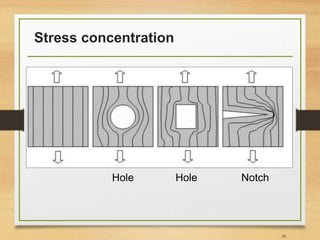
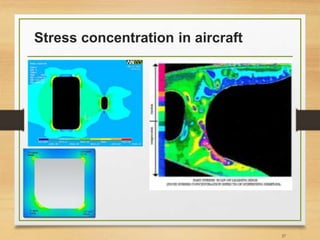
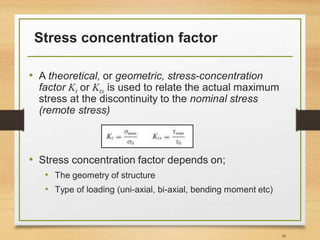
• Stress concentration and Notch sensitivity
3
Your Questions
• Feel free to ask your questions in the following link:
https://padlet.com/mahdi_damghani/Fatigue_Analysis
4
Introduction
• In most testing of those properties of materials that relate to the
stress-strain diagram, the load is applied gradually, to give
sufficient time for the strain to fully develop.
• Furthermore, the specimen is tested to destruction, and so the
stresses are applied only once
• Testing of this kind is applicable, to what are known as static
conditions
• The condition frequently arises, however, in which the stresses
vary with time or they fluctuate between different levels.
• For example, a particular fiber on the surface of a rotating shaft
subjected to the action of bending loads undergoes both tension
and compression for each revolution of the shaft.
5
Introduction
6
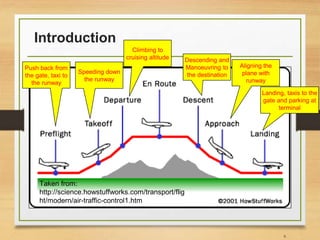
Taken from:
http://science.howstuffworks.com/transport/flig
ht/modern/air-traffic-control1.htm
Push back from
the gate, taxi to
the runway
Speeding down
the runway
Climbing to
cruising altitude Descending and
Manoeuvring to
the destination
Aligning the
plane with
runway
Landing, taxis to the
gate and parking at
terminal
Introduction
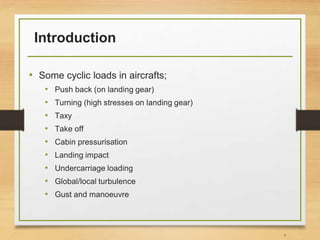
• Some cyclic loads in aircrafts;
• Push back (on landing gear)
• Turning (high stresses on landing gear)
• Taxy
• Take off
• Cabin pressurisation
• Landing impact
• Undercarriage loading
• Global/local turbulence
• Gust and manoeuvre
7
Introduction
• Often, machine members are found to have failed
under the action of repeated or fluctuating stresses
• The most careful analysis reveals that the actual
maximum stresses were well below the ultimate
strength of the material, and quite frequently even
below the yield strength
• The most distinguishing characteristic of these
failures is that the stresses have been repeated a
very large number of times. Hence the failure is called
a fatigue failure
8
Introduction
• Fatigue failure
• Gives no warning (no large deflection etc) and it is very
sudden=brittle fracture
• Dangerous (because it is sudden)
• Complicated phenomenon (partially understood)
• Life of a component must be obtained based on empirical
methods
9
Introduction
10
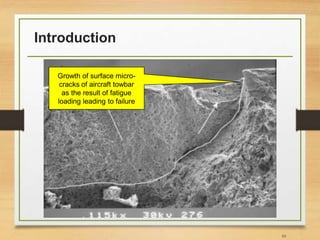
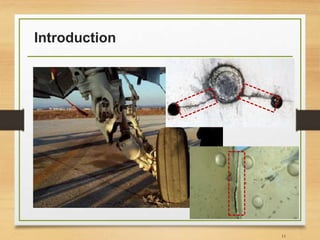
Growth of surface micro-
cracks of aircraft towbar
as the result of fatigue
loading leading to failure
Introduction
11
Introduction
12
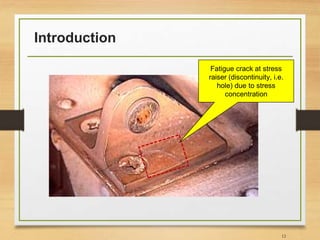
Fatigue crack at stress
raiser (discontinuity, i.e.
hole) due to stress
concentration
Introduction
• Micro-cracks formation on the surface of part due to
cyclic plastic deformations
• During cyclic loading, these cracked surfaces open
and close, rubbing together
• The beach mark appearance depends on the
changes in the level or frequency of loading and the
corrosive nature of the environment
• Cracks keep growing up to a critical length and
suddenly part fails
13
Fatigue analysis approaches
• Stress-life method
• Will be covered in the lecture
• Strain-life method
• Beyond the scope of this lecture
• Linear elastic fracture mechanics method
• Beyond the scope of this lecture
14
• Generally speaking we have;
• Low cycle fatigue (1<=N<=103)
• High cycle fatigue (N>103)
Stress-life method
• The least accurate method
• Specially for low cycle fatigue
• Good approximation for high cycle fatigue
• Assumes little plastic deformation due to cyclic loading
• The most widely used since mid-1800s
• A lot of data and understanding is available
• Good predictions for high cycle fatigue
• Easy to perform
15
Strain-life method
• Detailed analysis of the plastic deformation at
localized regions where the stresses and strains are
considered for life estimates
• Good for low-cycle fatigue
• Several idealizations must be compounded, and so
some uncertainties will exist in the results
16
Fracture mechanics method
• The fracture mechanics method assumes a crack is
already present and detected
• It is then employed to predict crack growth with
respect to stress intensity
• It is most practical when applied to large structures in
conjunction with computer codes and a periodic
inspection program
• Currently Airbus uses this method in combination with
stress-life method
17
Stress-life method
• To determine the strength of materials under the
action of fatigue loads, specimens are subjected to
repeated or varying forces of specified magnitudes
while the cycles or stress reversals are counted to
destruction
• Therefore graphs of subsequent slides (S-N
diagrams) can be produced
18
Watch
19
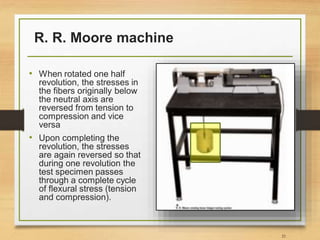
Fatigue machine (for R=-1 only)
• R. R. Moore high-speed
rotating-beam machine
• Specimen is subjected to
pure bending (no
transverse shear) by
means of weights
20
• The specimen is very carefully machined and
polished, with a final polishing in an axial direction to
avoid circumferential scratches and minimize surface
roughness
R. R. Moore machine
21
• When rotated one half
revolution, the stresses in
the fibers originally below
the neutral axis are
reversed from tension to
compression and vice
versa
• Upon completing the
revolution, the stresses
are again reversed so that
during one revolution the
test specimen passes
through a complete cycle
of flexural stress (tension
and compression).
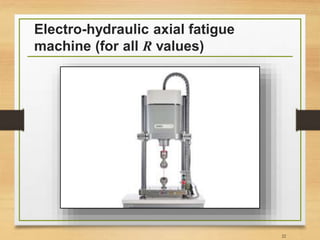
Electro-hydraulic axial fatigue
machine (for all R values)
22
Output from fatigue test (see Ref [3])
23
The number of cycles to failure is called
fatigue life Nf
Each cycle is equal
to two reversals
Stress in the component some
books use symbol σ instead
time
Stress
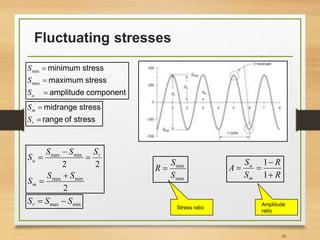
Fluctuating stresses
24
Stress ratio
Amplitude
ratio
2
22
minmax
minmax
SS
S
SSS
S
m
r
a





minmax SSSr 
R
R
S
S
A
m
a



1
1
max
min
S
S
R 
componentamplitude
stressmaximum
stressminimum



aS
S
S
max
min
stressofrange
stressmidrange


r
m
S
S
S-N/Wohler diagram (see Ref [2])
25
Results of completely
reversed axial fatigue tests.
Material: UNS G41300 steel,
normalized; Sut = 116 kpsi;
maximum Sut = 125 kpsi.
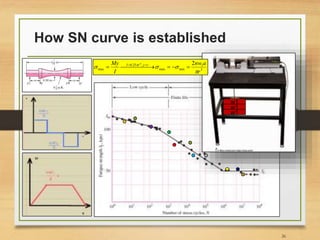
Often plotted in log-log or semi-log graphs. If
plotted in log-log, y axis is in terms of stress
amplitude or stress range and x axis in terms
of number of reversals or cycles to failure
How SN curve is established
26
w1
w1
w1
3
1
minmax
,25.0
max
24
r
anw
I
My ryrI

 
  
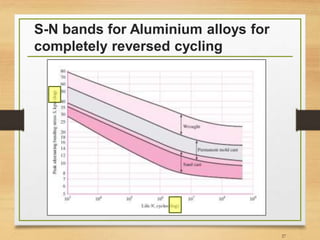
S-N bands for Aluminium alloys for
completely reversed cycling
27
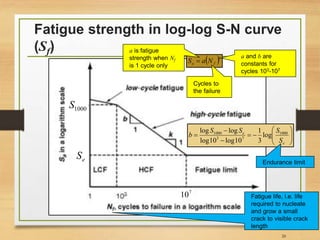
Fatigue strength in log-log S-N curve
(Sf)
28










e
e
S
SSS
b 1000
73
1000
log
3
1
10log10log
loglog
Endurance limit
Fatigue life, i.e. life
required to nucleate
and grow a small
crack to visible crack
length
 b
fa NaS 
eS
a and b are
constants for
cycles 103-107
1000S
Cycles to
the failure
a is fatigue
strength when Nf
is 1 cycle only
7
10
Note
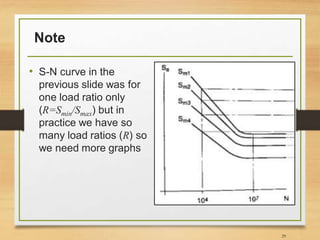
• S-N curve in the
previous slide was for
one load ratio only
(R=Smin/Smax) but in
practice we have so
many load ratios (R) so
we need more graphs
29
Note
30
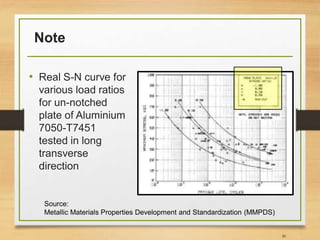
• Real S-N curve for
various load ratios
for un-notched
plate of Aluminium
7050-T7451
tested in long
transverse
direction
Source:
Metallic Materials Properties Development and Standardization (MMPDS)
Endurance limit of steel vs aluminium (Se)
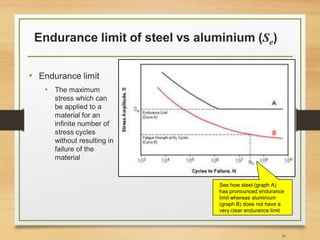
• Endurance limit
• The maximum
stress which can
be applied to a
material for an
infinite number of
stress cycles
without resulting in
failure of the
material
31
See how steel (graph A)
has pronounced endurance
limit whereas aluminium
(graph B) does not have a
very clear endurance limit
Endurance limit (Se)
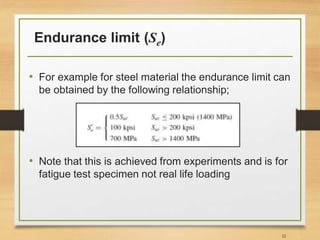
• For example for steel material the endurance limit can
be obtained by the following relationship;
• Note that this is achieved from experiments and is for
fatigue test specimen not real life loading
32
Endurance limit (Se)
• In real life endurance limit can be different due to
many factors (see Ref [2] for more details);
33
Fatigue prone locations
• The following locations in the structure are prone to
fatigue failure (formation of crack) due to stress
concentration and therefore illustrated in subsequent
slides;
• Holes
• Notches
• Lugs
• Pins
• Fillets
• Joints
34
Stress Concentration and Notch
Sensitivity
• Any discontinuity in a machine part alters the stress
distribution in the immediate vicinity of the
discontinuity
• Elementary stress equations no longer describe the
state of stress in the part at these locations
• Such discontinuities are called stress raisers,
• Regions in which they occur are called areas of stress
concentration
35
Stress concentration
36
NotchHoleHole
Stress concentration in aircraft
37
Stress Concentration around a circular hole subjected to
remote loading in an infinite composite panel
38
Stress concentration factor
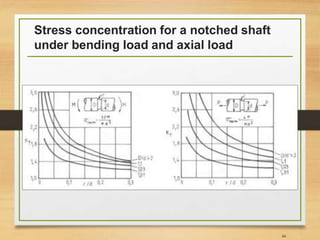
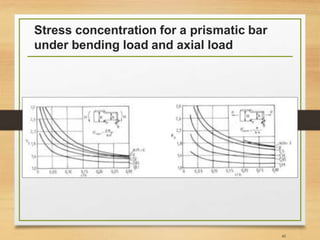
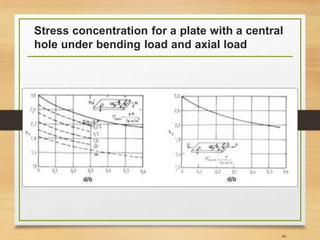
• A theoretical, or geometric, stress-concentration
factor Kt or Kts is used to relate the actual maximum
stress at the discontinuity to the nominal stress
(remote stress)
• Stress concentration factor depends on;
• The geometry of structure
• Type of loading (uni-axial, bi-axial, bending moment etc)
39
How to get stress concentration value?
• Experimental procedures
• Photoelasticity
• grid methods
• brittle-coating methods
• Electrical strain-gauge methods
40
• Finite element analysis
• Not exact
• Analytical approaches based on conformal mapping
and complex algebra
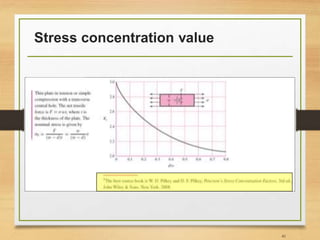
Stress concentration value
41
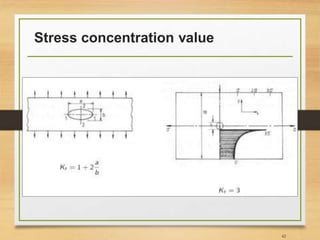
Stress concentration value
42
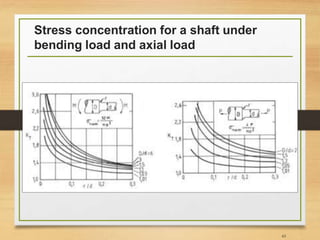
Stress concentration for a shaft under
bending load and axial load
43
Stress concentration for a notched shaft
under bending load and axial load
44
Stress concentration for a prismatic bar
under bending load and axial load
45
Stress concentration for a plate with a central
hole under bending load and axial load
46
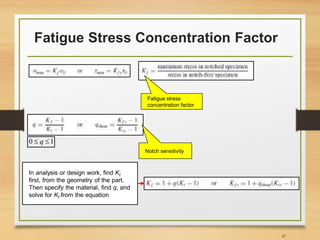
Fatigue Stress Concentration Factor
47
Fatigue stress
concentration factor
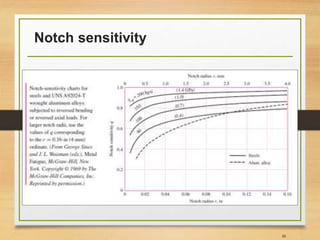
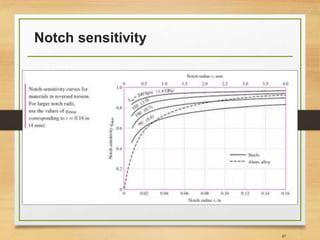
Notch sensitivity
10  q
In analysis or design work, find Kt
first, from the geometry of the part.
Then specify the material, find q, and
solve for Kf from the equation
Notch sensitivity
48
Notch sensitivity
49
Note
• In using these charts it is well to know that the actual
test results from which the curves were derived
exhibit a large amount of scatter
• It is always safe to use Kf = Kt if there is any doubt
about the true value of q
• Often q is not far from unity for large notch radii
50
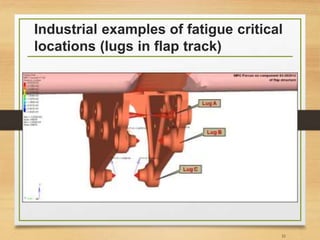
Industrial examples of fatigue critical
locations (lugs in flap track)
51
Industrial examples of fatigue critical
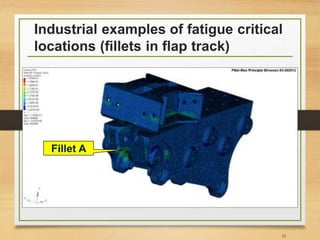
locations (fillets in flap track)
52
Fillet A
Industrial examples of fatigue critical
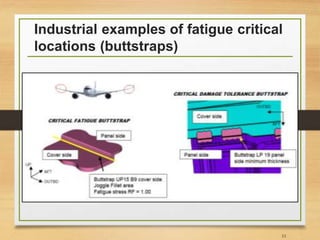
locations (buttstraps)
53
Industrial examples of fatigue critical
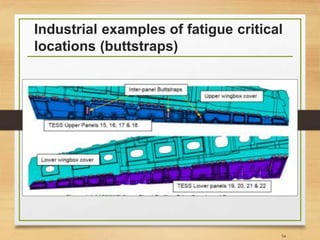
locations (buttstraps)
54
Industrial examples of fatigue critical
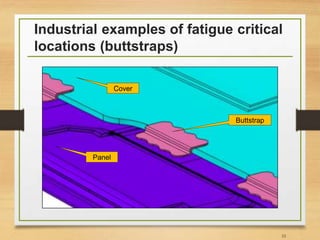
locations (buttstraps)
55
Cover
Panel
Buttstrap
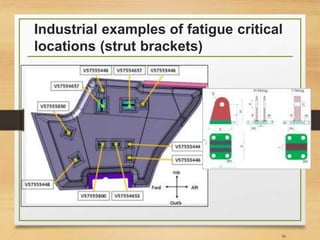
Industrial examples of fatigue critical
locations (strut brackets)
56
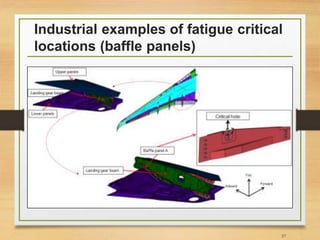
Industrial examples of fatigue critical
locations (baffle panels)
57
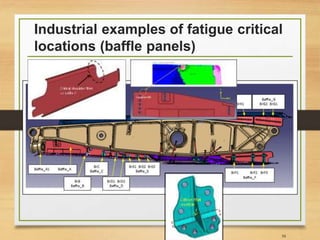
Industrial examples of fatigue critical
locations (baffle panels)
58
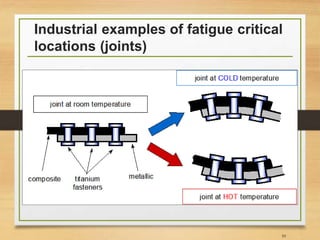
Industrial examples of fatigue critical
locations (joints)
59
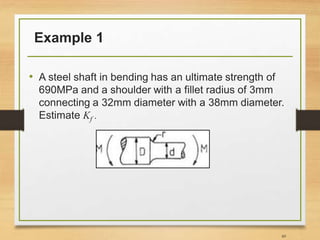
Example 1
• A steel shaft in bending has an ultimate strength of
690MPa and a shoulder with a fillet radius of 3mm
connecting a 32mm diameter with a 38mm diameter.
Estimate Kf .
60
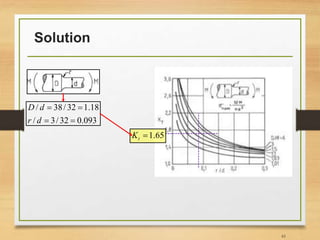
Solution
61
093.032/3/
18.132/38/


dr
dD
65.1tK
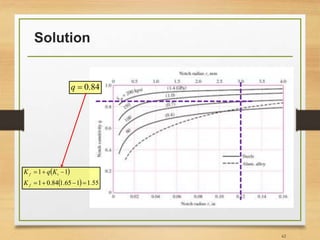
Solution
62
84.0q
 
  55.1165.184.01
11


f
tf
K
KqK
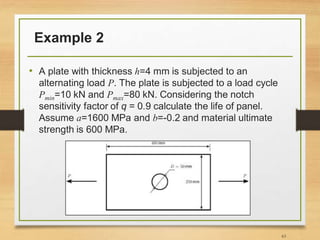
Example 2
• A plate with thickness h=4 mm is subjected to an
alternating load P. The plate is subjected to a load cycle
Pmin=10 kN and Pmax=80 kN. Considering the notch
sensitivity factor of q = 0.9 calculate the life of panel.
Assume a=1600 MPa and b=-0.2 and material ultimate
strength is 600 MPa.
63
Solution
64
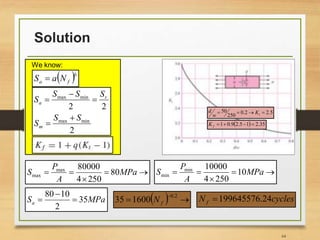
We know:
 b
fa NaS 
2
22
minmax
minmax
SS
S
SSS
S
m
r
a







 MPa
A
P
S 80
2504
80000max
max 

 MPa
A
P
S 10
2504
10000min
min
MPaSa 35
2
1080



5.22.0
250
50  tK
w
d
  35.215.29.01 fK
  
 2.0
160035 fN cyclesN f 24.199645576
Solution
• Solve the same question assuming that the hole
exists on a plate with infinite length and width
• What is the difference between this situation and
previous situation?
65
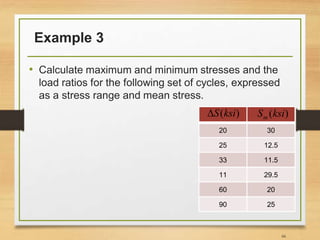
Example 3
• Calculate maximum and minimum stresses and the
load ratios for the following set of cycles, expressed
as a stress range and mean stress.
66
20 30
25 12.5
33 11.5
11 29.5
60 20
90 25
)(ksiS )(ksiSm
Solution
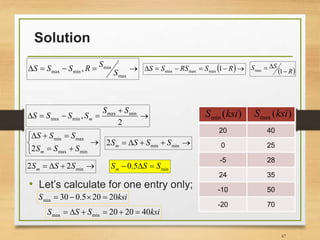
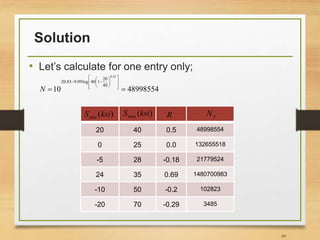
• Let’s calculate for one entry only;
67

max
min
minmax ,
S
S
RSSS
20 40
0 25
-5 28
24 35
-10 50
-20 70
)(min ksiS )(max ksiS
  RSRSSS 1maxmaxmax  R
SS


1max



2
, minmax
minmax
SS
SSSS m






minmax
maxmin
2 SSS
SSS
m
 minmin2 SSSSm
 min22 SSSm min5.0 SSSm 
ksiS 20205.030min 
ksiSSS 402020minmax 
Example 4
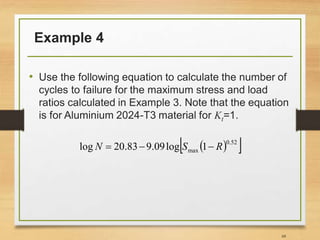
• Use the following equation to calculate the number of
cycles to failure for the maximum stress and load
ratios calculated in Example 3. Note that the equation
is for Aluminium 2024-T3 material for Kt=1.
68
  52.0
max 1log09.983.20log RSN 
Solution
• Let’s calculate for one entry only;
69
20 40 0.5 48998554
0 25 0.0 132655518
-5 28 -0.18 21779524
24 35 0.69 1480700983
-10 50 -0.2 102823
-20 70 -0.29 3485
)(min ksiS )(max ksiS R fN
4899855410
52.0
40
20
140log09.983.20
















N
Tutorial 1
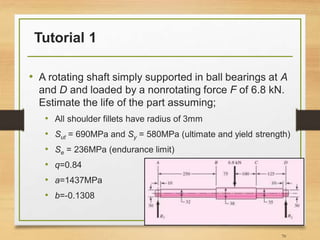
• A rotating shaft simply supported in ball bearings at A
and D and loaded by a nonrotating force F of 6.8 kN.
Estimate the life of the part assuming;
• All shoulder fillets have radius of 3mm
• Sut = 690MPa and Sy = 580MPa (ultimate and yield strength)
• Se = 236MPa (endurance limit)
• q=0.84
• a=1437MPa
• b=-0.1308
70
Solution for Tutorial 1
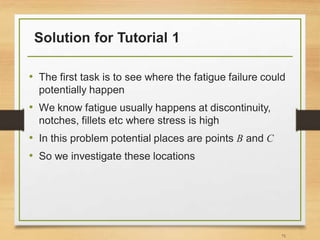
• The first task is to see where the fatigue failure could
potentially happen
• We know fatigue usually happens at discontinuity,
notches, fillets etc where stress is high
• In this problem potential places are points B and C
• So we investigate these locations
71
Solution for Tutorial 1
72
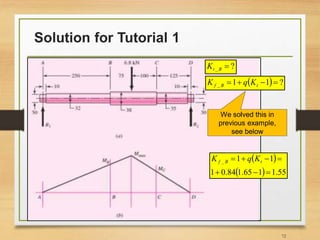
  ?11_  tBf KqK
?_ BtK
 
  55.1165.184.01
11_

 tBf KqK
We solved this in
previous example,
see below
Solution for Tutorial 1
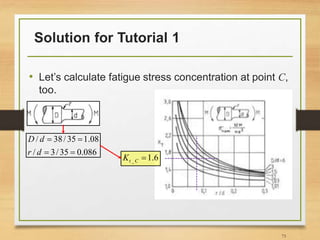
• Let’s calculate fatigue stress concentration at point C,
too.
73
086.035/3/
08.135/38/


dr
dD
6.1_ CtK
Solution for Tutorial 1
74
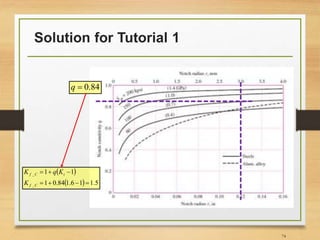
84.0q
 
  5.116.184.01
11
_
_


Cf
tCf
K
KqK
Solution for Tutorial 1
75
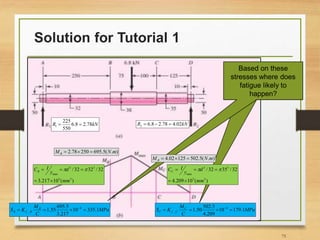
kNR 78.28.6
550
225
1  kNR 02.478.28.62 
).(5.69525078.2 mNMB 
)(10217.3
32/3232/
33
33
max
mm
d
y
ICB

 
MPa
C
M
KS B
BfB 1.33510
217.3
5.695
55.1 6
_  
MPa
C
M
KS C
CfC 1.17910
209.4
5.502
50.1 6
_  
Based on these
stresses where does
fatigue likely to
happen?
)(10209.4
32/3532/
33
33
max
mm
d
y
ICC

 
Based on these
stresses where does
fatigue likely to
happen?
).(5.50212502.4 mNMB 
Solution for Tutorial 1
76
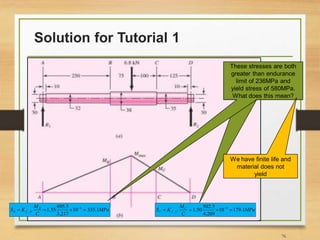
MPa
C
M
KS B
BfB 1.33510
217.3
5.695
55.1 6
_  
MPa
C
M
KS C
CfC 1.17910
209.4
5.502
50.1 6
_  
Based on these
stresses where does
fatigue likely to
happen?
These stresses are both
greater than endurance
limit of 236MPa and
yield stress of 580MPa.
What does this mean?
We have finite life and
material does not
yield
Solution for Tutorial 1
77
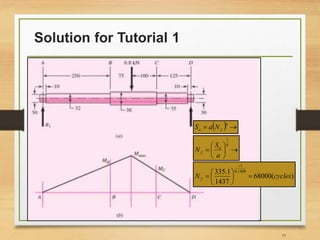
  
b
fa NaS







b
a
f
a
S
N
1
)(68000
1437
1.335 1308.0
1
cyclesN f 







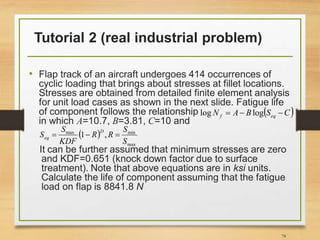
Tutorial 2 (real industrial problem)
• Flap track of an aircraft undergoes 414 occurrences of
cyclic loading that brings about stresses at fillet locations.
Stresses are obtained from detailed finite element analysis
for unit load cases as shown in the next slide. Fatigue life
of component follows the relationship
in which A=10.7, B=3.81, C=10 and
It can be further assumed that minimum stresses are zero
and KDF=0.651 (knock down factor due to surface
treatment). Note that above equations are in ksi units.
Calculate the life of component assuming that the fatigue
load on flap is 8841.8 N
78
 CSBAN eqf  loglog
 
max
minmax
,1
S
S
RR
KDF
S
S
D
eq 
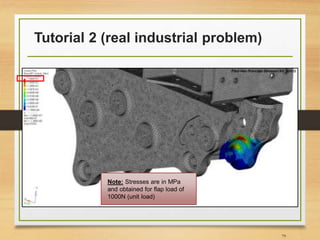
Tutorial 2 (real industrial problem)
79
Note: Stresses are in MPa
and obtained for flap load of
1000N (unit load)
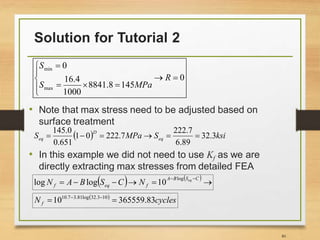
Solution for Tutorial 2
80
• Note that max stress need to be adjusted based on
surface treatment
• In this example we did not need to use Kf as we are
directly extracting max stresses from detailed FEA
0
1458.8841
1000
4.16
0
max
min







R
MPaS
S
  ksiSMPaS eq
D
eq 3.32
89.6
7.222
7.22201
651.0
0.145

   

 CSBA
feqf
eq
NCSBAN
log
10loglog
 
cyclesN f 83.36555910 103.32log81.37.10
 
Important Notes [3]
• Fatigue damage of components correlates strongly with;
• Applied stress amplitude/range
• Applied mean stress (mostly in high cycle fatigue region)
• In high cycle fatigue, direct (normal) mean stress is
responsible for opening and closing micro-cracks
• Normal tensile mean stresses are detrimental and
compressive mean stress are beneficial for fatigue
strength (why?)
• Shear mean stress has little effect on crack propagation
• There is no/little effect of mean stress in low cycle fatigue
due to large amount of plastic deformation
81
Important Notes [3]
• So far, what we have been doing was based on not taking
into account the effects of tensile normal mean stresses on
the high cycle fatigue strength of components
• We have been assuming Sm=0
• Therefore, below scientists proposed empirical equations
to take such effect into account;
• Gerber (1874)
• Goodman (1899)
• Haigh (1917)
• Soderberg (1930)
82
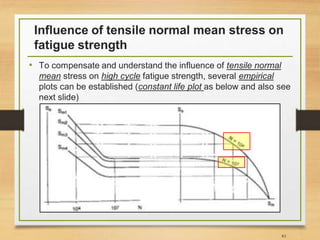
Influence of tensile normal mean stress on
fatigue strength
• To compensate and understand the influence of tensile normal
mean stress on high cycle fatigue strength, several empirical
plots can be established (constant life plot as below and also see
next slide)
83
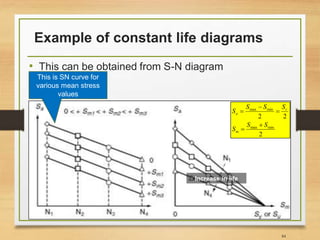
Example of constant life diagrams
84
• This can be obtained from S-N diagram
Increase in life
2
22
minmax
minmax
SS
S
SSS
S
m
r
a





This is SN curve for
various mean stress
values
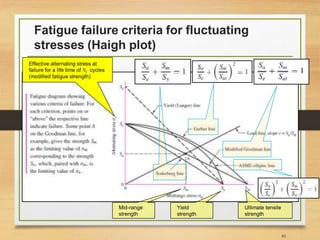
Fatigue failure criteria for fluctuating
stresses (Haigh plot)
85
Mid-range
strength
Yield
strength
Ultimate tensile
strength
Effective alternating stress at
failure for a life time of Nf cycles
(modified fatigue strength)
Note
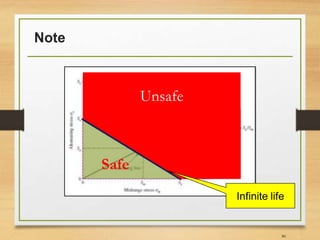
86
Safe
Unsafe
Infinite life
Note
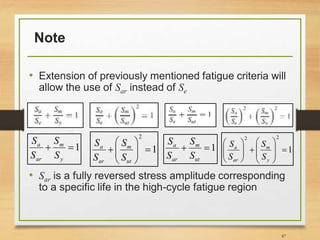
• Extension of previously mentioned fatigue criteria will
allow the use of Sar instead of Se
• Sar is a fully reversed stress amplitude corresponding
to a specific life in the high-cycle fatigue region
87
1
y
m
ar
a
S
S
S
S
1
2







ut
m
ar
a
S
S
S
S 1
ut
m
ar
a
S
S
S
S
1
22















y
m
ar
a
S
S
S
S
General observations
88
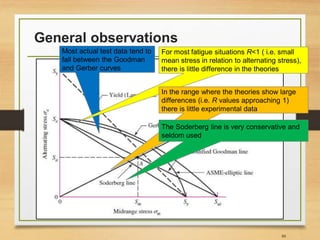
Most actual test data tend to
fall between the Goodman
and Gerber curves
For most fatigue situations R<1 ( i.e. small
mean stress in relation to alternating stress),
there is little difference in the theories
In the range where the theories show large
differences (i.e. R values approaching 1)
there is little experimental data
The Soderberg line is very conservative and
seldom used
Complex loading and cycle counting
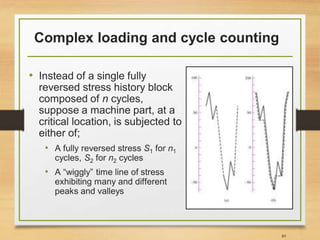
• Instead of a single fully
reversed stress history block
composed of n cycles,
suppose a machine part, at a
critical location, is subjected to
either of;
• A fully reversed stress S1 for n1
cycles, S2 for n2 cycles
• A “wiggly” time line of stress
exhibiting many and different
peaks and valleys
89
Complex loading and cycle counting
90
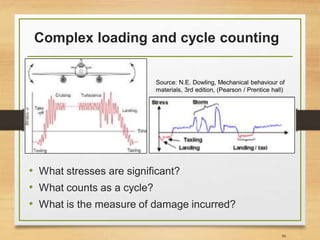
Source: N.E. Dowling, Mechanical behaviour of
materials, 3rd edition, (Pearson / Prentice hall)
• What stresses are significant?
• What counts as a cycle?
• What is the measure of damage incurred?
Methods of cycle counting
• Beyond the scope of this lecture
• Interested readers are recommended to refer to
chapter 3 of Ref. [3];
• Level crossing cycle counting
• Peak-valley cycle counting
• Range counting
• Three-point cycle counting method
• Four-point cycle counting method
• Rain-flow counting technique
91
Output form cycle counting
• A typical result of cycle counting would look like;
92
After cycle counting it
becomes fairly straightforward
to calculate stress range and
mean stress values and
proceed as normal
Cumulative damage
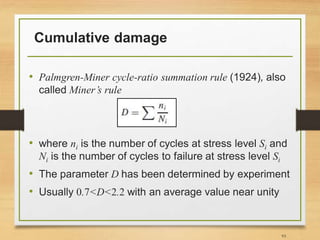
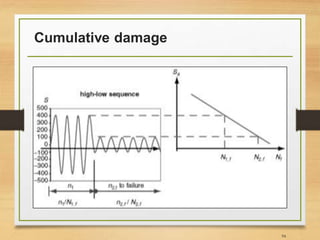
• Palmgren-Miner cycle-ratio summation rule (1924), also
called Miner’s rule
• where ni is the number of cycles at stress level Si and
Ni is the number of cycles to failure at stress level Si
• The parameter D has been determined by experiment
• Usually 0.7<D<2.2 with an average value near unity
93
Cumulative damage
94
Note on cumulative damage
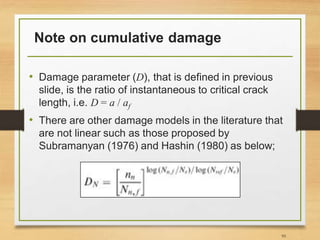
• Damage parameter (D), that is defined in previous
slide, is the ratio of instantaneous to critical crack
length, i.e. D = a / af
• There are other damage models in the literature that
are not linear such as those proposed by
Subramanyan (1976) and Hashin (1980) as below;
95
Example 3
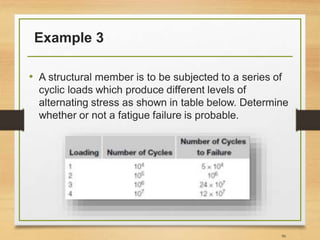
• A structural member is to be subjected to a series of
cyclic loads which produce different levels of
alternating stress as shown in table below. Determine
whether or not a fatigue failure is probable.
96
Solution
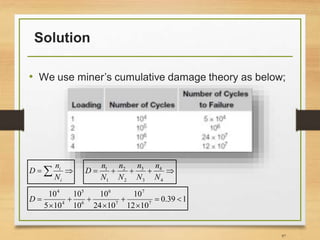
• We use miner’s cumulative damage theory as below;
97
 
i
i
N
n
D 
4
4
3
3
2
2
1
1
N
n
N
n
N
n
N
n
D
139.0
1012
10
1024
10
10
10
105
10
7
7
7
6
6
5
4
4






D
Example 4
• Calculate the total number of repetitions required for
the loading of example 4 to reach the fatigue failure
point.
98
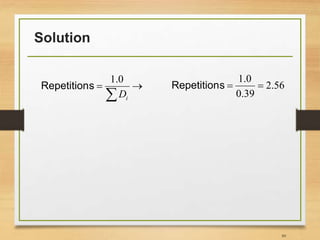
Solution
99

 iD
0.1
sRepetition 56.2
39.0
0.1
sRepetition
Example 5
• For the question of Tutorial 2 calculate damage for
the following cases;
• Damage calculation for single occurrence at each cycle
• Damage calculation for all occurrences at each cycle
• Damage calculation for 15000 hours (3000 hours per block)
100
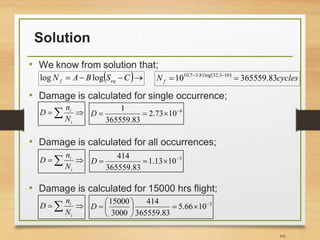
Solution
• We know from solution that;
• Damage is calculated for single occurrence;
• Damage is calculated for all occurrences;
• Damage is calculated for 15000 hrs flight;
101
 
cyclesN f 83.36555910 103.32log81.37.10
 
 
i
i
N
n
D 6
1073.2
83.365559
1 
D
 
i
i
N
n
D 3
1013.1
83.365559
414 
D
 
i
i
N
n
D 3
1066.5
83.365559
414
3000
15000 






D
  CSBAN eqf loglog
Solution
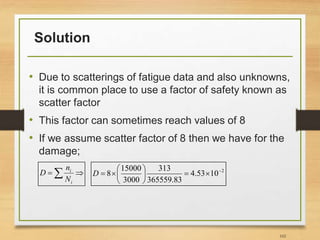
• Due to scatterings of fatigue data and also unknowns,
it is common place to use a factor of safety known as
scatter factor
• This factor can sometimes reach values of 8
• If we assume scatter factor of 8 then we have for the
damage;
102
 
i
i
N
n
D 2
1053.4
83.365559
313
3000
15000
8 






D
Example 6
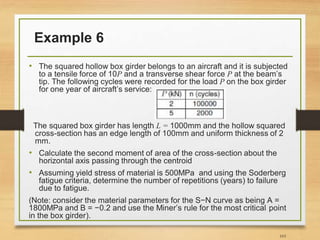
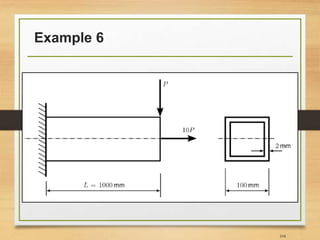
• The squared hollow box girder belongs to an aircraft and it is subjected
to a tensile force of 10P and a transverse shear force P at the beam’s
tip. The following cycles were recorded for the load P on the box girder
for one year of aircraft’s service:
The squared box girder has length L = 1000mm and the hollow squared
cross-section has an edge length of 100mm and uniform thickness of 2
mm.
• Calculate the second moment of area of the cross-section about the
horizontal axis passing through the centroid
• Assuming yield stress of material is 500MPa and using the Soderberg
fatigue criteria, determine the number of repetitions (years) to failure
due to fatigue.
(Note: consider the material parameters for the S−N curve as being A =
1800MPa and B = −0.2 and use the Miner’s rule for the most critical point
in the box girder).
103
Example 6
104
Solution
105
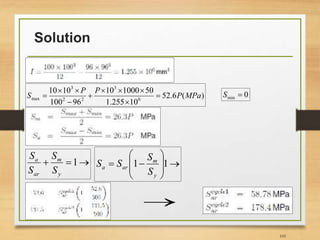
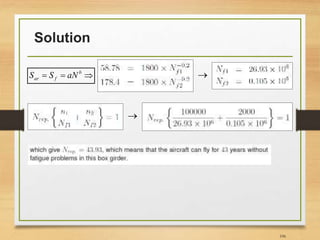
)(6.52
10255.1
50100010
96100
1010
6
3
22
3
max MPaP
PP
S 





 0min S
 1
y
m
ar
a
S
S
S
S









 11
y
m
ara
S
S
SS

Solution
106
 b
far aNSS 

Tutorial 3
107
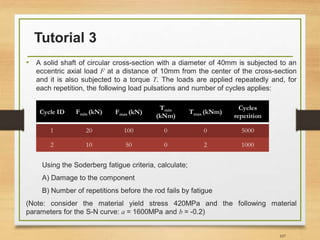
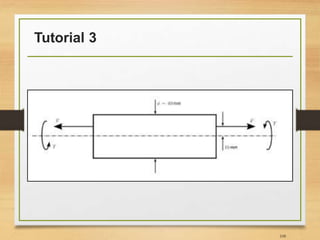
• A solid shaft of circular cross-section with a diameter of 40mm is subjected to an
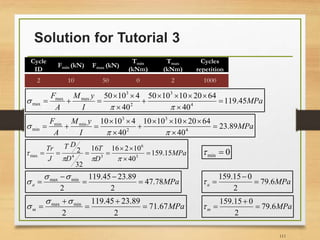
eccentric axial load F at a distance of 10mm from the center of the cross-section
and it is also subjected to a torque T. The loads are applied repeatedly and, for
each repetition, the following load pulsations and number of cycles applies:
Using the Soderberg fatigue criteria, calculate;
A) Damage to the component
B) Number of repetitions before the rod fails by fatigue
(Note: consider the material yield stress 420MPa and the following material
parameters for the S-N curve: a = 1600MPa and b = -0.2)
Cycle ID Fmin (kN) Fmax (kN)
Tmin
(kNm)
Tmax (kNm)
Cycles
repetition
1 20 100 0 0 5000
2 10 50 0 2 1000
Tutorial 3
108
Solution for Tutorial 3
109
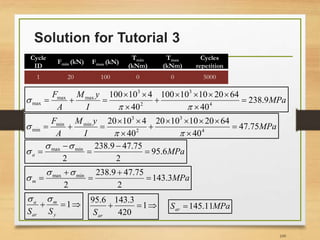
MPa
I
yM
A
F
9.238
40
64201010100
40
410100
4
3
2
3
maxmax
max 








MPa
I
yM
A
F
75.47
40
6420101020
40
41020
4
3
2
3
minmin
min 








MPaa 6.95
2
75.479.238
2
minmax







MPam 3.143
2
75.479.238
2
minmax







 1
y
m
ar
a
SS

 1
420
3.1436.95
arS
MPaSar 11.145
Cycle
ID
Fmin (kN) Fmax (kN)
Tmin
(kNm)
Tmax
(kNm)
Cycles
repetition
1 20 100 0 0 5000
Solution for Tutorial 3
• From S-N curve we remember;
110
 b
far aNSS   2.0
160011.145 N cyclesN 3
10972.162 
Solution for Tutorial 3
111
MPa
I
yM
A
F
45.119
40
6420101050
40
41050
4
3
2
3
maxmax
max 








MPa
I
yM
A
F
89.23
40
6420101010
40
41010
4
3
2
3
minmin
min 








MPa
D
T
D
DT
J
Tr
15.159
40
1021616
32
2
3
6
34max 




 0min 
MPaa 78.47
2
89.2345.119
2
minmax







MPam 67.71
2
89.2345.119
2
minmax







MPaa 6.79
2
015.159



MPam 6.79
2
015.159



Cycle
ID
Fmin (kN) Fmax (kN)
Tmin
(kNm)
Tmax
(kNm)
Cycles
repetition
2 10 50 0 2 1000
Solution for Tutorial 3
112
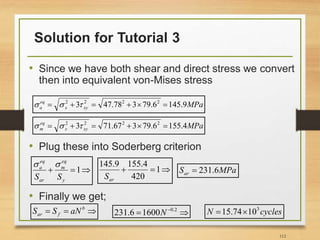
• Since we have both shear and direct stress we convert
then into equivalent von-Mises stress
• Plug these into Soderberg criterion
• Finally we get;
MPaxyx
eq
a 9.1456.79378.473 2222
 
MPaxyx
eq
m 4.1556.79367.713 2222
 
 1
y
eq
m
ar
eq
a
SS

 1
420
4.1559.145
arS
MPaSar 6.231
 b
far aNSS   2.0
16006.231 N cyclesN 3
1074.15 
Solution for Tutorial 3
113
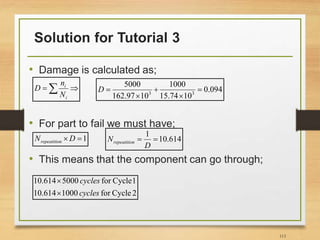
• Damage is calculated as;
• For part to fail we must have;
• This means that the component can go through;
 
i
i
N
n
D 094.0
1074.15
1000
1097.162
5000
33




D
1 DN nrepeatitio 614.10
1

D
N nrepeatitio
2Cyclefor1000614.10
1Cyclefor5000614.10
cycles
cycles



Fatigue Analysis of Structures (Aerospace Application)

  • 1.
    Aero Structure-Fatigue Analysis By Dr.Mahdi Damghani 2016-2017 1
  • 2.
    Suggested Readings Reference 1Reference 2 2 Chapter 10 of Ref [1], Chapter 6 of Ref [2], Chapter 4 of Ref [3] Reference 3
  • 3.
    Topics • Familiarisation withfatigue of metals • Life estimates • Endurance limit • Fluctuating stresses • Stress concentration and Notch sensitivity 3
  • 4.
    Your Questions • Feelfree to ask your questions in the following link: https://padlet.com/mahdi_damghani/Fatigue_Analysis 4
  • 5.
    Introduction • In mosttesting of those properties of materials that relate to the stress-strain diagram, the load is applied gradually, to give sufficient time for the strain to fully develop. • Furthermore, the specimen is tested to destruction, and so the stresses are applied only once • Testing of this kind is applicable, to what are known as static conditions • The condition frequently arises, however, in which the stresses vary with time or they fluctuate between different levels. • For example, a particular fiber on the surface of a rotating shaft subjected to the action of bending loads undergoes both tension and compression for each revolution of the shaft. 5
  • 6.
    Introduction 6 Taken from: http://science.howstuffworks.com/transport/flig ht/modern/air-traffic-control1.htm Push backfrom the gate, taxi to the runway Speeding down the runway Climbing to cruising altitude Descending and Manoeuvring to the destination Aligning the plane with runway Landing, taxis to the gate and parking at terminal
  • 7.
    Introduction • Some cyclicloads in aircrafts; • Push back (on landing gear) • Turning (high stresses on landing gear) • Taxy • Take off • Cabin pressurisation • Landing impact • Undercarriage loading • Global/local turbulence • Gust and manoeuvre 7
  • 8.
    Introduction • Often, machinemembers are found to have failed under the action of repeated or fluctuating stresses • The most careful analysis reveals that the actual maximum stresses were well below the ultimate strength of the material, and quite frequently even below the yield strength • The most distinguishing characteristic of these failures is that the stresses have been repeated a very large number of times. Hence the failure is called a fatigue failure 8
  • 9.
    Introduction • Fatigue failure •Gives no warning (no large deflection etc) and it is very sudden=brittle fracture • Dangerous (because it is sudden) • Complicated phenomenon (partially understood) • Life of a component must be obtained based on empirical methods 9
  • 10.
    Introduction 10 Growth of surfacemicro- cracks of aircraft towbar as the result of fatigue loading leading to failure
  • 11.
  • 12.
    Introduction 12 Fatigue crack atstress raiser (discontinuity, i.e. hole) due to stress concentration
  • 13.
    Introduction • Micro-cracks formationon the surface of part due to cyclic plastic deformations • During cyclic loading, these cracked surfaces open and close, rubbing together • The beach mark appearance depends on the changes in the level or frequency of loading and the corrosive nature of the environment • Cracks keep growing up to a critical length and suddenly part fails 13
  • 14.
    Fatigue analysis approaches •Stress-life method • Will be covered in the lecture • Strain-life method • Beyond the scope of this lecture • Linear elastic fracture mechanics method • Beyond the scope of this lecture 14 • Generally speaking we have; • Low cycle fatigue (1<=N<=103) • High cycle fatigue (N>103)
  • 15.
    Stress-life method • Theleast accurate method • Specially for low cycle fatigue • Good approximation for high cycle fatigue • Assumes little plastic deformation due to cyclic loading • The most widely used since mid-1800s • A lot of data and understanding is available • Good predictions for high cycle fatigue • Easy to perform 15
  • 16.
    Strain-life method • Detailedanalysis of the plastic deformation at localized regions where the stresses and strains are considered for life estimates • Good for low-cycle fatigue • Several idealizations must be compounded, and so some uncertainties will exist in the results 16
  • 17.
    Fracture mechanics method •The fracture mechanics method assumes a crack is already present and detected • It is then employed to predict crack growth with respect to stress intensity • It is most practical when applied to large structures in conjunction with computer codes and a periodic inspection program • Currently Airbus uses this method in combination with stress-life method 17
  • 18.
    Stress-life method • Todetermine the strength of materials under the action of fatigue loads, specimens are subjected to repeated or varying forces of specified magnitudes while the cycles or stress reversals are counted to destruction • Therefore graphs of subsequent slides (S-N diagrams) can be produced 18
  • 19.
  • 20.
    Fatigue machine (forR=-1 only) • R. R. Moore high-speed rotating-beam machine • Specimen is subjected to pure bending (no transverse shear) by means of weights 20 • The specimen is very carefully machined and polished, with a final polishing in an axial direction to avoid circumferential scratches and minimize surface roughness
  • 21.
    R. R. Mooremachine 21 • When rotated one half revolution, the stresses in the fibers originally below the neutral axis are reversed from tension to compression and vice versa • Upon completing the revolution, the stresses are again reversed so that during one revolution the test specimen passes through a complete cycle of flexural stress (tension and compression).
  • 22.
  • 23.
    Output from fatiguetest (see Ref [3]) 23 The number of cycles to failure is called fatigue life Nf Each cycle is equal to two reversals Stress in the component some books use symbol σ instead time Stress
  • 24.
    Fluctuating stresses 24 Stress ratio Amplitude ratio 2 22 minmax minmax SS S SSS S m r a      minmaxSSSr  R R S S A m a    1 1 max min S S R  componentamplitude stressmaximum stressminimum    aS S S max min stressofrange stressmidrange   r m S S
  • 25.
    S-N/Wohler diagram (seeRef [2]) 25 Results of completely reversed axial fatigue tests. Material: UNS G41300 steel, normalized; Sut = 116 kpsi; maximum Sut = 125 kpsi. Often plotted in log-log or semi-log graphs. If plotted in log-log, y axis is in terms of stress amplitude or stress range and x axis in terms of number of reversals or cycles to failure
  • 26.
    How SN curveis established 26 w1 w1 w1 3 1 minmax ,25.0 max 24 r anw I My ryrI      
  • 27.
    S-N bands forAluminium alloys for completely reversed cycling 27
  • 28.
    Fatigue strength inlog-log S-N curve (Sf) 28           e e S SSS b 1000 73 1000 log 3 1 10log10log loglog Endurance limit Fatigue life, i.e. life required to nucleate and grow a small crack to visible crack length  b fa NaS  eS a and b are constants for cycles 103-107 1000S Cycles to the failure a is fatigue strength when Nf is 1 cycle only 7 10
  • 29.
    Note • S-N curvein the previous slide was for one load ratio only (R=Smin/Smax) but in practice we have so many load ratios (R) so we need more graphs 29
  • 30.
    Note 30 • Real S-Ncurve for various load ratios for un-notched plate of Aluminium 7050-T7451 tested in long transverse direction Source: Metallic Materials Properties Development and Standardization (MMPDS)
  • 31.
    Endurance limit ofsteel vs aluminium (Se) • Endurance limit • The maximum stress which can be applied to a material for an infinite number of stress cycles without resulting in failure of the material 31 See how steel (graph A) has pronounced endurance limit whereas aluminium (graph B) does not have a very clear endurance limit
  • 32.
    Endurance limit (Se) •For example for steel material the endurance limit can be obtained by the following relationship; • Note that this is achieved from experiments and is for fatigue test specimen not real life loading 32
  • 33.
    Endurance limit (Se) •In real life endurance limit can be different due to many factors (see Ref [2] for more details); 33
  • 34.
    Fatigue prone locations •The following locations in the structure are prone to fatigue failure (formation of crack) due to stress concentration and therefore illustrated in subsequent slides; • Holes • Notches • Lugs • Pins • Fillets • Joints 34
  • 35.
    Stress Concentration andNotch Sensitivity • Any discontinuity in a machine part alters the stress distribution in the immediate vicinity of the discontinuity • Elementary stress equations no longer describe the state of stress in the part at these locations • Such discontinuities are called stress raisers, • Regions in which they occur are called areas of stress concentration 35
  • 36.
  • 37.
  • 38.
    Stress Concentration arounda circular hole subjected to remote loading in an infinite composite panel 38
  • 39.
    Stress concentration factor •A theoretical, or geometric, stress-concentration factor Kt or Kts is used to relate the actual maximum stress at the discontinuity to the nominal stress (remote stress) • Stress concentration factor depends on; • The geometry of structure • Type of loading (uni-axial, bi-axial, bending moment etc) 39
  • 40.
    How to getstress concentration value? • Experimental procedures • Photoelasticity • grid methods • brittle-coating methods • Electrical strain-gauge methods 40 • Finite element analysis • Not exact • Analytical approaches based on conformal mapping and complex algebra
  • 41.
  • 42.
  • 43.
    Stress concentration fora shaft under bending load and axial load 43
  • 44.
    Stress concentration fora notched shaft under bending load and axial load 44
  • 45.
    Stress concentration fora prismatic bar under bending load and axial load 45
  • 46.
    Stress concentration fora plate with a central hole under bending load and axial load 46
  • 47.
    Fatigue Stress ConcentrationFactor 47 Fatigue stress concentration factor Notch sensitivity 10  q In analysis or design work, find Kt first, from the geometry of the part. Then specify the material, find q, and solve for Kf from the equation
  • 48.
  • 49.
  • 50.
    Note • In usingthese charts it is well to know that the actual test results from which the curves were derived exhibit a large amount of scatter • It is always safe to use Kf = Kt if there is any doubt about the true value of q • Often q is not far from unity for large notch radii 50
  • 51.
    Industrial examples offatigue critical locations (lugs in flap track) 51
  • 52.
    Industrial examples offatigue critical locations (fillets in flap track) 52 Fillet A
  • 53.
    Industrial examples offatigue critical locations (buttstraps) 53
  • 54.
    Industrial examples offatigue critical locations (buttstraps) 54
  • 55.
    Industrial examples offatigue critical locations (buttstraps) 55 Cover Panel Buttstrap
  • 56.
    Industrial examples offatigue critical locations (strut brackets) 56
  • 57.
    Industrial examples offatigue critical locations (baffle panels) 57
  • 58.
    Industrial examples offatigue critical locations (baffle panels) 58
  • 59.
    Industrial examples offatigue critical locations (joints) 59
  • 60.
    Example 1 • Asteel shaft in bending has an ultimate strength of 690MPa and a shoulder with a fillet radius of 3mm connecting a 32mm diameter with a 38mm diameter. Estimate Kf . 60
  • 61.
  • 62.
    Solution 62 84.0q    55.1165.184.01 11   f tf K KqK
  • 63.
    Example 2 • Aplate with thickness h=4 mm is subjected to an alternating load P. The plate is subjected to a load cycle Pmin=10 kN and Pmax=80 kN. Considering the notch sensitivity factor of q = 0.9 calculate the life of panel. Assume a=1600 MPa and b=-0.2 and material ultimate strength is 600 MPa. 63
  • 64.
    Solution 64 We know:  b faNaS  2 22 minmax minmax SS S SSS S m r a         MPa A P S 80 2504 80000max max    MPa A P S 10 2504 10000min min MPaSa 35 2 1080    5.22.0 250 50  tK w d   35.215.29.01 fK     2.0 160035 fN cyclesN f 24.199645576
  • 65.
    Solution • Solve thesame question assuming that the hole exists on a plate with infinite length and width • What is the difference between this situation and previous situation? 65
  • 66.
    Example 3 • Calculatemaximum and minimum stresses and the load ratios for the following set of cycles, expressed as a stress range and mean stress. 66 20 30 25 12.5 33 11.5 11 29.5 60 20 90 25 )(ksiS )(ksiSm
  • 67.
    Solution • Let’s calculatefor one entry only; 67  max min minmax , S S RSSS 20 40 0 25 -5 28 24 35 -10 50 -20 70 )(min ksiS )(max ksiS   RSRSSS 1maxmaxmax  R SS   1max    2 , minmax minmax SS SSSS m       minmax maxmin 2 SSS SSS m  minmin2 SSSSm  min22 SSSm min5.0 SSSm  ksiS 20205.030min  ksiSSS 402020minmax 
  • 68.
    Example 4 • Usethe following equation to calculate the number of cycles to failure for the maximum stress and load ratios calculated in Example 3. Note that the equation is for Aluminium 2024-T3 material for Kt=1. 68   52.0 max 1log09.983.20log RSN 
  • 69.
    Solution • Let’s calculatefor one entry only; 69 20 40 0.5 48998554 0 25 0.0 132655518 -5 28 -0.18 21779524 24 35 0.69 1480700983 -10 50 -0.2 102823 -20 70 -0.29 3485 )(min ksiS )(max ksiS R fN 4899855410 52.0 40 20 140log09.983.20                 N
  • 70.
    Tutorial 1 • Arotating shaft simply supported in ball bearings at A and D and loaded by a nonrotating force F of 6.8 kN. Estimate the life of the part assuming; • All shoulder fillets have radius of 3mm • Sut = 690MPa and Sy = 580MPa (ultimate and yield strength) • Se = 236MPa (endurance limit) • q=0.84 • a=1437MPa • b=-0.1308 70
  • 71.
    Solution for Tutorial1 • The first task is to see where the fatigue failure could potentially happen • We know fatigue usually happens at discontinuity, notches, fillets etc where stress is high • In this problem potential places are points B and C • So we investigate these locations 71
  • 72.
    Solution for Tutorial1 72   ?11_  tBf KqK ?_ BtK     55.1165.184.01 11_   tBf KqK We solved this in previous example, see below
  • 73.
    Solution for Tutorial1 • Let’s calculate fatigue stress concentration at point C, too. 73 086.035/3/ 08.135/38/   dr dD 6.1_ CtK
  • 74.
    Solution for Tutorial1 74 84.0q     5.116.184.01 11 _ _   Cf tCf K KqK
  • 75.
    Solution for Tutorial1 75 kNR 78.28.6 550 225 1  kNR 02.478.28.62  ).(5.69525078.2 mNMB  )(10217.3 32/3232/ 33 33 max mm d y ICB    MPa C M KS B BfB 1.33510 217.3 5.695 55.1 6 _   MPa C M KS C CfC 1.17910 209.4 5.502 50.1 6 _   Based on these stresses where does fatigue likely to happen? )(10209.4 32/3532/ 33 33 max mm d y ICC    Based on these stresses where does fatigue likely to happen? ).(5.50212502.4 mNMB 
  • 76.
    Solution for Tutorial1 76 MPa C M KS B BfB 1.33510 217.3 5.695 55.1 6 _   MPa C M KS C CfC 1.17910 209.4 5.502 50.1 6 _   Based on these stresses where does fatigue likely to happen? These stresses are both greater than endurance limit of 236MPa and yield stress of 580MPa. What does this mean? We have finite life and material does not yield
  • 77.
    Solution for Tutorial1 77    b fa NaS        b a f a S N 1 )(68000 1437 1.335 1308.0 1 cyclesN f        
  • 78.
    Tutorial 2 (realindustrial problem) • Flap track of an aircraft undergoes 414 occurrences of cyclic loading that brings about stresses at fillet locations. Stresses are obtained from detailed finite element analysis for unit load cases as shown in the next slide. Fatigue life of component follows the relationship in which A=10.7, B=3.81, C=10 and It can be further assumed that minimum stresses are zero and KDF=0.651 (knock down factor due to surface treatment). Note that above equations are in ksi units. Calculate the life of component assuming that the fatigue load on flap is 8841.8 N 78  CSBAN eqf  loglog   max minmax ,1 S S RR KDF S S D eq 
  • 79.
    Tutorial 2 (realindustrial problem) 79 Note: Stresses are in MPa and obtained for flap load of 1000N (unit load)
  • 80.
    Solution for Tutorial2 80 • Note that max stress need to be adjusted based on surface treatment • In this example we did not need to use Kf as we are directly extracting max stresses from detailed FEA 0 1458.8841 1000 4.16 0 max min        R MPaS S   ksiSMPaS eq D eq 3.32 89.6 7.222 7.22201 651.0 0.145        CSBA feqf eq NCSBAN log 10loglog   cyclesN f 83.36555910 103.32log81.37.10  
  • 81.
    Important Notes [3] •Fatigue damage of components correlates strongly with; • Applied stress amplitude/range • Applied mean stress (mostly in high cycle fatigue region) • In high cycle fatigue, direct (normal) mean stress is responsible for opening and closing micro-cracks • Normal tensile mean stresses are detrimental and compressive mean stress are beneficial for fatigue strength (why?) • Shear mean stress has little effect on crack propagation • There is no/little effect of mean stress in low cycle fatigue due to large amount of plastic deformation 81
  • 82.
    Important Notes [3] •So far, what we have been doing was based on not taking into account the effects of tensile normal mean stresses on the high cycle fatigue strength of components • We have been assuming Sm=0 • Therefore, below scientists proposed empirical equations to take such effect into account; • Gerber (1874) • Goodman (1899) • Haigh (1917) • Soderberg (1930) 82
  • 83.
    Influence of tensilenormal mean stress on fatigue strength • To compensate and understand the influence of tensile normal mean stress on high cycle fatigue strength, several empirical plots can be established (constant life plot as below and also see next slide) 83
  • 84.
    Example of constantlife diagrams 84 • This can be obtained from S-N diagram Increase in life 2 22 minmax minmax SS S SSS S m r a      This is SN curve for various mean stress values
  • 85.
    Fatigue failure criteriafor fluctuating stresses (Haigh plot) 85 Mid-range strength Yield strength Ultimate tensile strength Effective alternating stress at failure for a life time of Nf cycles (modified fatigue strength)
  • 86.
  • 87.
    Note • Extension ofpreviously mentioned fatigue criteria will allow the use of Sar instead of Se • Sar is a fully reversed stress amplitude corresponding to a specific life in the high-cycle fatigue region 87 1 y m ar a S S S S 1 2        ut m ar a S S S S 1 ut m ar a S S S S 1 22                y m ar a S S S S
  • 88.
    General observations 88 Most actualtest data tend to fall between the Goodman and Gerber curves For most fatigue situations R<1 ( i.e. small mean stress in relation to alternating stress), there is little difference in the theories In the range where the theories show large differences (i.e. R values approaching 1) there is little experimental data The Soderberg line is very conservative and seldom used
  • 89.
    Complex loading andcycle counting • Instead of a single fully reversed stress history block composed of n cycles, suppose a machine part, at a critical location, is subjected to either of; • A fully reversed stress S1 for n1 cycles, S2 for n2 cycles • A “wiggly” time line of stress exhibiting many and different peaks and valleys 89
  • 90.
    Complex loading andcycle counting 90 Source: N.E. Dowling, Mechanical behaviour of materials, 3rd edition, (Pearson / Prentice hall) • What stresses are significant? • What counts as a cycle? • What is the measure of damage incurred?
  • 91.
    Methods of cyclecounting • Beyond the scope of this lecture • Interested readers are recommended to refer to chapter 3 of Ref. [3]; • Level crossing cycle counting • Peak-valley cycle counting • Range counting • Three-point cycle counting method • Four-point cycle counting method • Rain-flow counting technique 91
  • 92.
    Output form cyclecounting • A typical result of cycle counting would look like; 92 After cycle counting it becomes fairly straightforward to calculate stress range and mean stress values and proceed as normal
  • 93.
    Cumulative damage • Palmgren-Minercycle-ratio summation rule (1924), also called Miner’s rule • where ni is the number of cycles at stress level Si and Ni is the number of cycles to failure at stress level Si • The parameter D has been determined by experiment • Usually 0.7<D<2.2 with an average value near unity 93
  • 94.
  • 95.
    Note on cumulativedamage • Damage parameter (D), that is defined in previous slide, is the ratio of instantaneous to critical crack length, i.e. D = a / af • There are other damage models in the literature that are not linear such as those proposed by Subramanyan (1976) and Hashin (1980) as below; 95
  • 96.
    Example 3 • Astructural member is to be subjected to a series of cyclic loads which produce different levels of alternating stress as shown in table below. Determine whether or not a fatigue failure is probable. 96
  • 97.
    Solution • We useminer’s cumulative damage theory as below; 97   i i N n D  4 4 3 3 2 2 1 1 N n N n N n N n D 139.0 1012 10 1024 10 10 10 105 10 7 7 7 6 6 5 4 4       D
  • 98.
    Example 4 • Calculatethe total number of repetitions required for the loading of example 4 to reach the fatigue failure point. 98
  • 99.
  • 100.
    Example 5 • Forthe question of Tutorial 2 calculate damage for the following cases; • Damage calculation for single occurrence at each cycle • Damage calculation for all occurrences at each cycle • Damage calculation for 15000 hours (3000 hours per block) 100
  • 101.
    Solution • We knowfrom solution that; • Damage is calculated for single occurrence; • Damage is calculated for all occurrences; • Damage is calculated for 15000 hrs flight; 101   cyclesN f 83.36555910 103.32log81.37.10     i i N n D 6 1073.2 83.365559 1  D   i i N n D 3 1013.1 83.365559 414  D   i i N n D 3 1066.5 83.365559 414 3000 15000        D   CSBAN eqf loglog
  • 102.
    Solution • Due toscatterings of fatigue data and also unknowns, it is common place to use a factor of safety known as scatter factor • This factor can sometimes reach values of 8 • If we assume scatter factor of 8 then we have for the damage; 102   i i N n D 2 1053.4 83.365559 313 3000 15000 8        D
  • 103.
    Example 6 • Thesquared hollow box girder belongs to an aircraft and it is subjected to a tensile force of 10P and a transverse shear force P at the beam’s tip. The following cycles were recorded for the load P on the box girder for one year of aircraft’s service: The squared box girder has length L = 1000mm and the hollow squared cross-section has an edge length of 100mm and uniform thickness of 2 mm. • Calculate the second moment of area of the cross-section about the horizontal axis passing through the centroid • Assuming yield stress of material is 500MPa and using the Soderberg fatigue criteria, determine the number of repetitions (years) to failure due to fatigue. (Note: consider the material parameters for the S−N curve as being A = 1800MPa and B = −0.2 and use the Miner’s rule for the most critical point in the box girder). 103
  • 104.
  • 105.
    Solution 105 )(6.52 10255.1 50100010 96100 1010 6 3 22 3 max MPaP PP S       0min S  1 y m ar a S S S S           11 y m ara S S SS 
  • 106.
  • 107.
    Tutorial 3 107 • Asolid shaft of circular cross-section with a diameter of 40mm is subjected to an eccentric axial load F at a distance of 10mm from the center of the cross-section and it is also subjected to a torque T. The loads are applied repeatedly and, for each repetition, the following load pulsations and number of cycles applies: Using the Soderberg fatigue criteria, calculate; A) Damage to the component B) Number of repetitions before the rod fails by fatigue (Note: consider the material yield stress 420MPa and the following material parameters for the S-N curve: a = 1600MPa and b = -0.2) Cycle ID Fmin (kN) Fmax (kN) Tmin (kNm) Tmax (kNm) Cycles repetition 1 20 100 0 0 5000 2 10 50 0 2 1000
  • 108.
  • 109.
    Solution for Tutorial3 109 MPa I yM A F 9.238 40 64201010100 40 410100 4 3 2 3 maxmax max          MPa I yM A F 75.47 40 6420101020 40 41020 4 3 2 3 minmin min          MPaa 6.95 2 75.479.238 2 minmax        MPam 3.143 2 75.479.238 2 minmax         1 y m ar a SS   1 420 3.1436.95 arS MPaSar 11.145 Cycle ID Fmin (kN) Fmax (kN) Tmin (kNm) Tmax (kNm) Cycles repetition 1 20 100 0 0 5000
  • 110.
    Solution for Tutorial3 • From S-N curve we remember; 110  b far aNSS   2.0 160011.145 N cyclesN 3 10972.162 
  • 111.
    Solution for Tutorial3 111 MPa I yM A F 45.119 40 6420101050 40 41050 4 3 2 3 maxmax max          MPa I yM A F 89.23 40 6420101010 40 41010 4 3 2 3 minmin min          MPa D T D DT J Tr 15.159 40 1021616 32 2 3 6 34max       0min  MPaa 78.47 2 89.2345.119 2 minmax        MPam 67.71 2 89.2345.119 2 minmax        MPaa 6.79 2 015.159    MPam 6.79 2 015.159    Cycle ID Fmin (kN) Fmax (kN) Tmin (kNm) Tmax (kNm) Cycles repetition 2 10 50 0 2 1000
  • 112.
    Solution for Tutorial3 112 • Since we have both shear and direct stress we convert then into equivalent von-Mises stress • Plug these into Soderberg criterion • Finally we get; MPaxyx eq a 9.1456.79378.473 2222   MPaxyx eq m 4.1556.79367.713 2222    1 y eq m ar eq a SS   1 420 4.1559.145 arS MPaSar 6.231  b far aNSS   2.0 16006.231 N cyclesN 3 1074.15 
  • 113.
    Solution for Tutorial3 113 • Damage is calculated as; • For part to fail we must have; • This means that the component can go through;   i i N n D 094.0 1074.15 1000 1097.162 5000 33     D 1 DN nrepeatitio 614.10 1  D N nrepeatitio 2Cyclefor1000614.10 1Cyclefor5000614.10 cycles cycles  

Editor's Notes

  • #6 Source: https://en.wikipedia.org/wiki/Buckling
  • #20 https://www.youtube.com/watch?v=LhUclxBUV_E
  • #83 See ref. [3]
  • #91 Source: N.E. Dowling, Mechanical behaviour of materials, 3rd edition, (Pearson / Prentice hall)