10/6/2015
Step 1. Symmetry
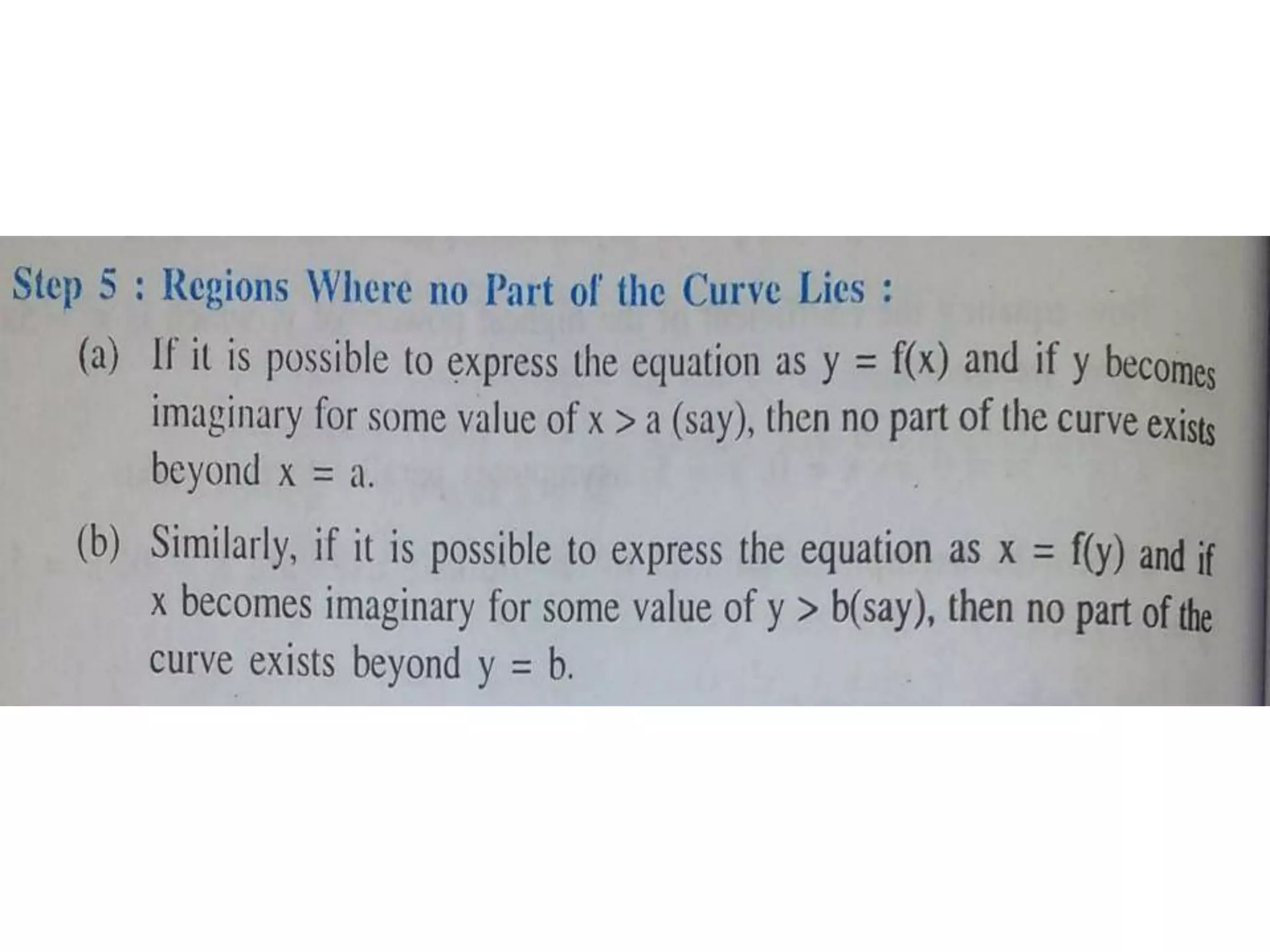
• Find out whether the curve is symmetric about any line
or a point. The various kinds of symmetry arising from
the form of the equation are as follows:
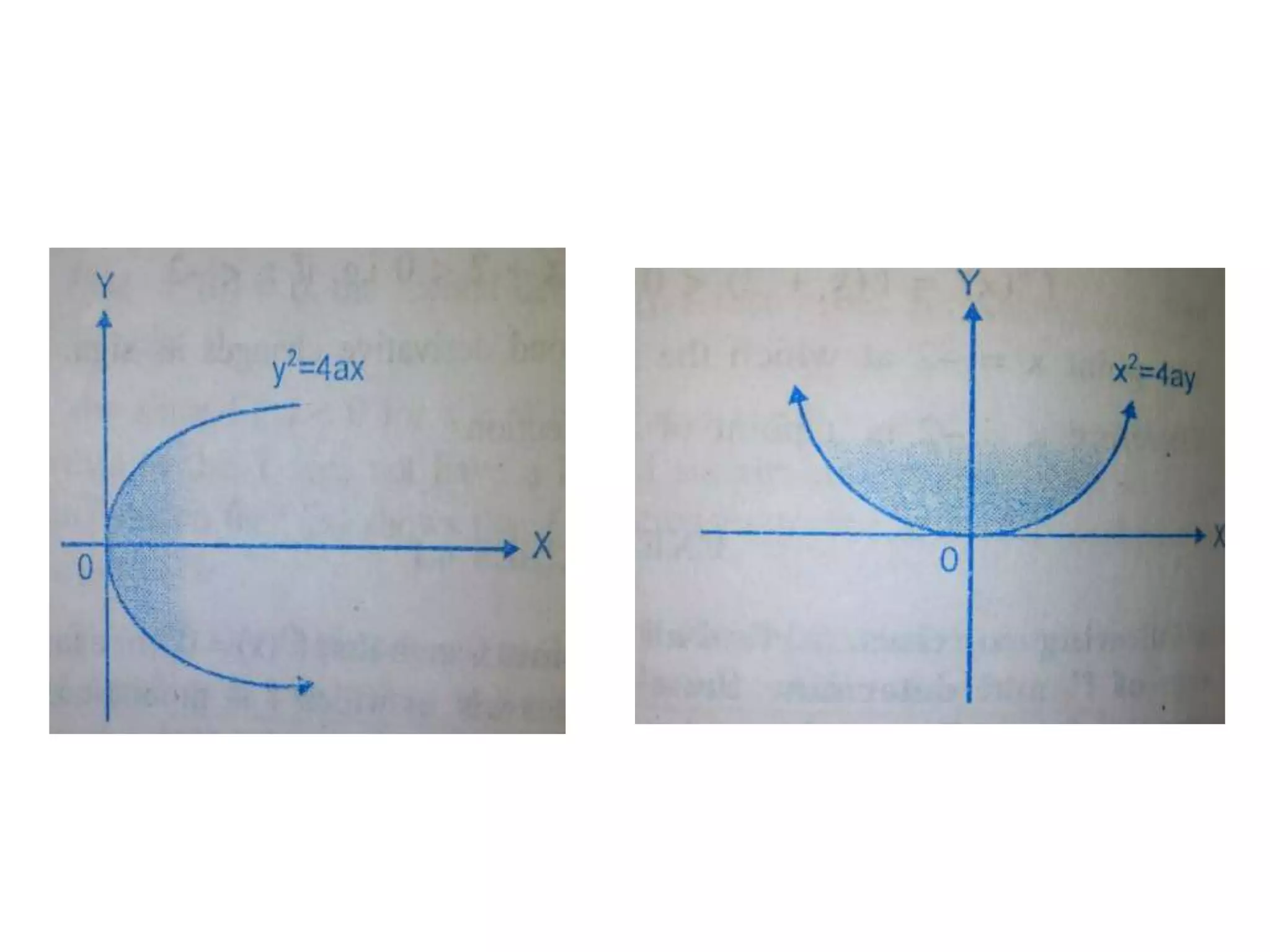
• i) symmetric about the y-axis
• If the equation of the curve remain unaltered when x is
replace by –x and the curve is an even function of x.
• ii) symmetric about x-axis
• If the equation of the curve remains unaltered when y is
replaced by –y and the curve is an even function of y.
10/6/2015
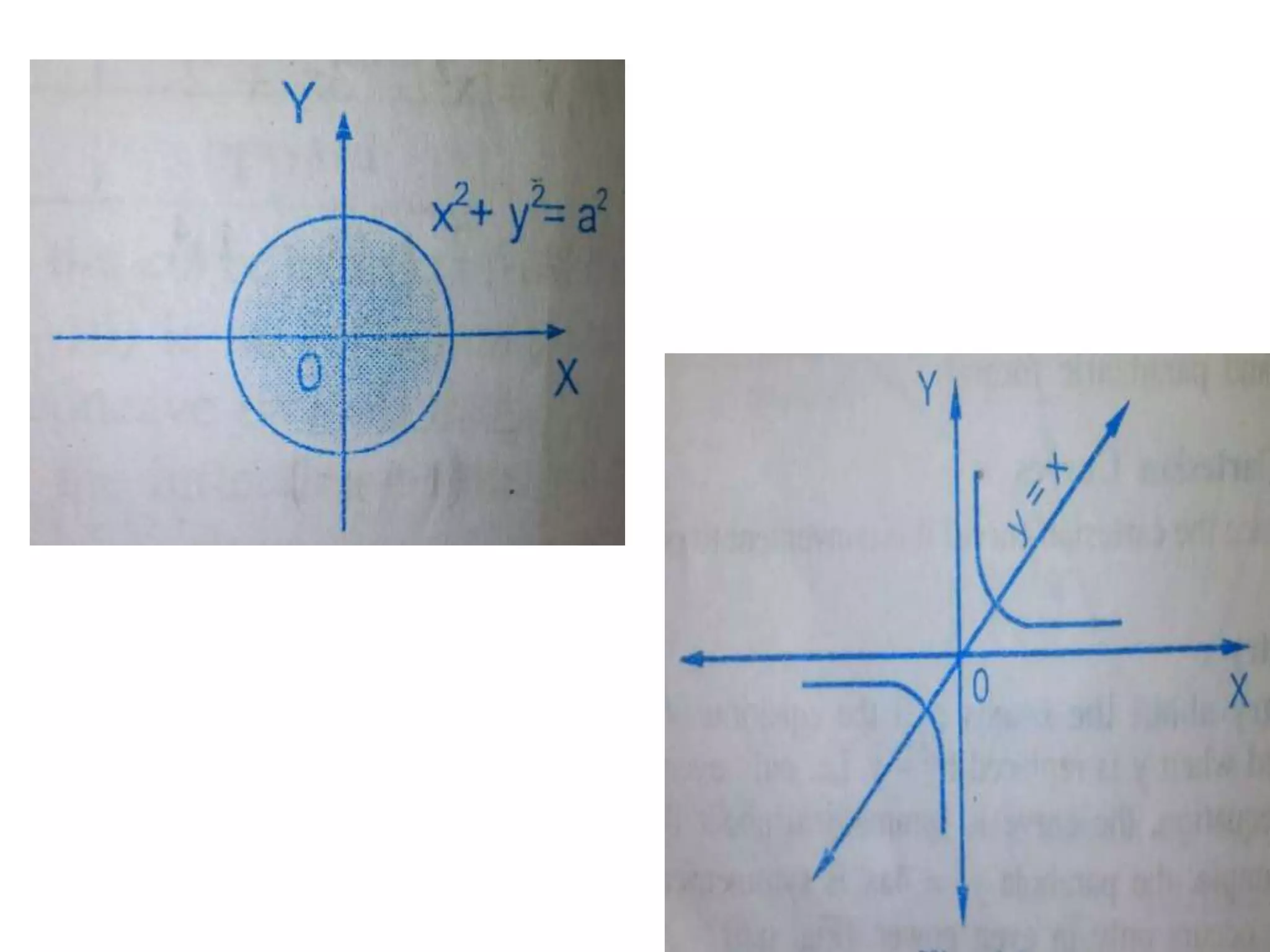
• iii) symmetric about both x and y axes
• If the equations of the curve is such that the powers of x
and y both are even everywhere then the curve is
symmetrical about both the axes. for example, the circle..
• iv) symmetry in the opposite quadrants
• If the equation of the curve remains unaltered when x is
replaced by –x and y is replaced by –y simultaneously,
the curve is symmetrical in opposite quadrant. for
example, the hyperbola…
• v) symmetrical about the line y = x
• If the equation of the curve remains unaltered when x
and y are interchanged, the curve is symmetrical about
the line y=x
10/6/2015
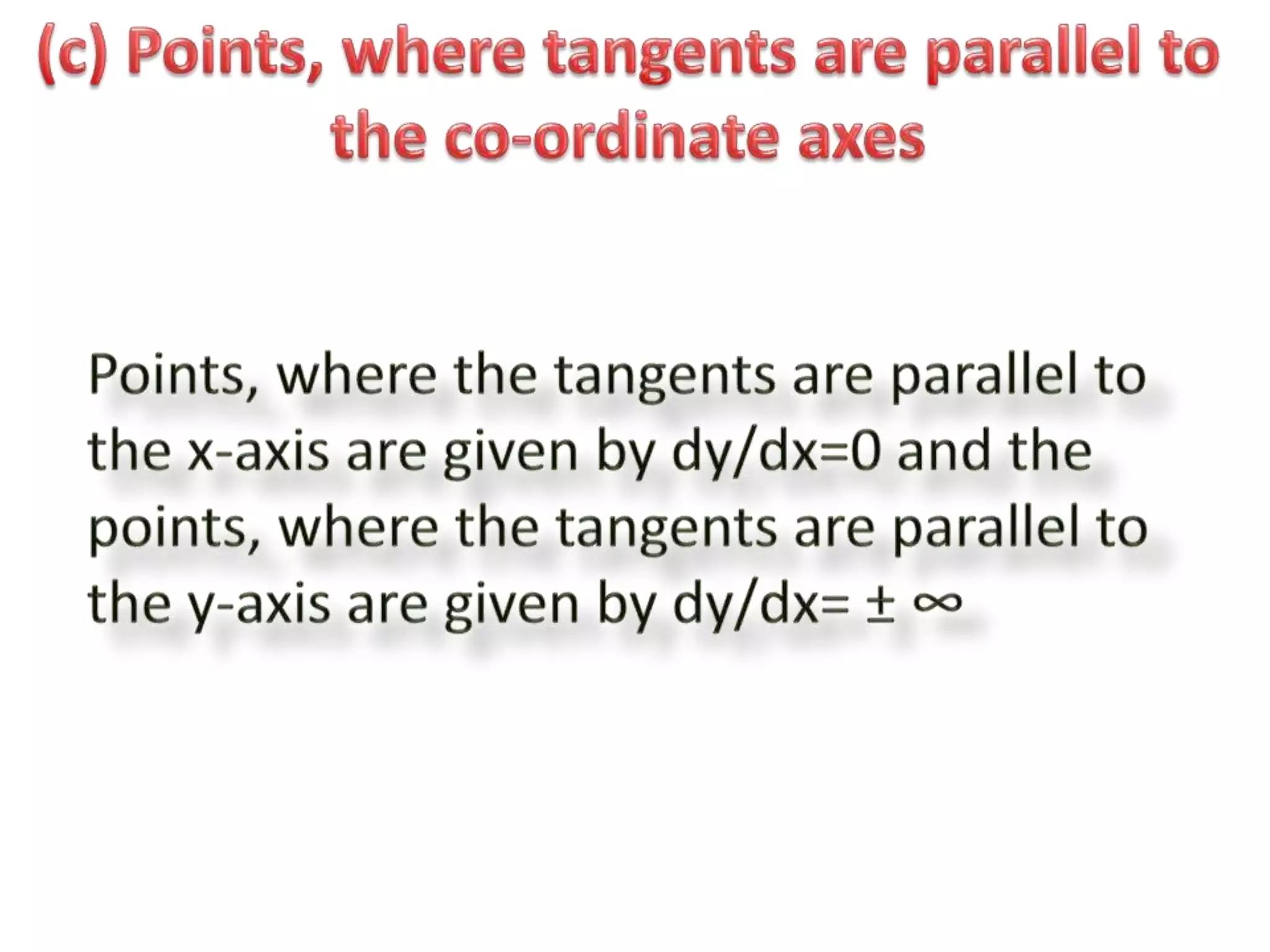
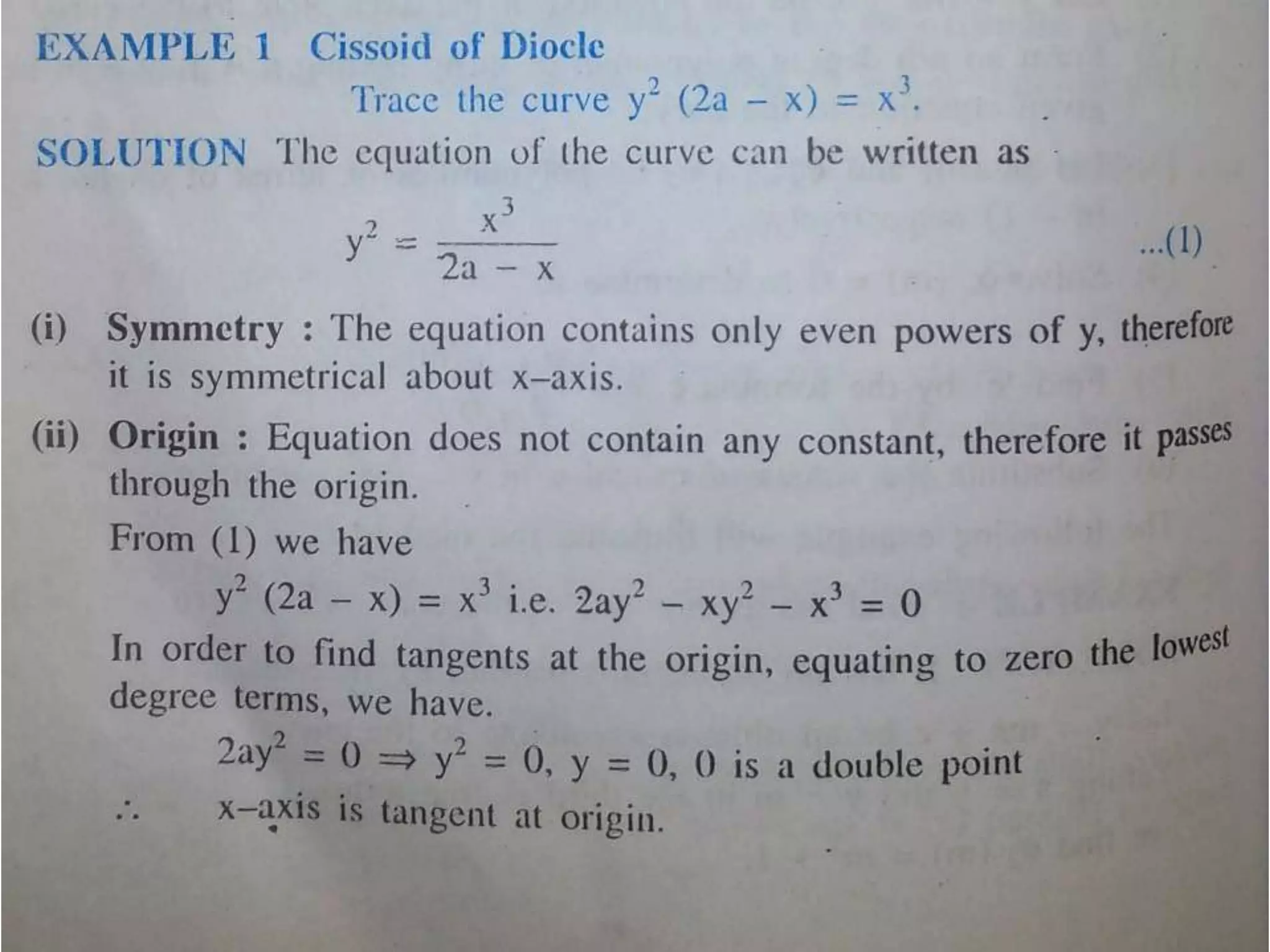
Step 2. Origin:
• (A)Tangents at the origin
• The equations of the tangents to the curve at the origin
is obtained by equating the lowest degree terms in x
and y in the given equation to zero, provided the curve
passes through the origin.
• (B)Curve through the origin
• If the equations of the curve does not contain any
constant term,the curve passes through the origin.it will
pass through the origin if the equation is satisfied by
(0,0) .
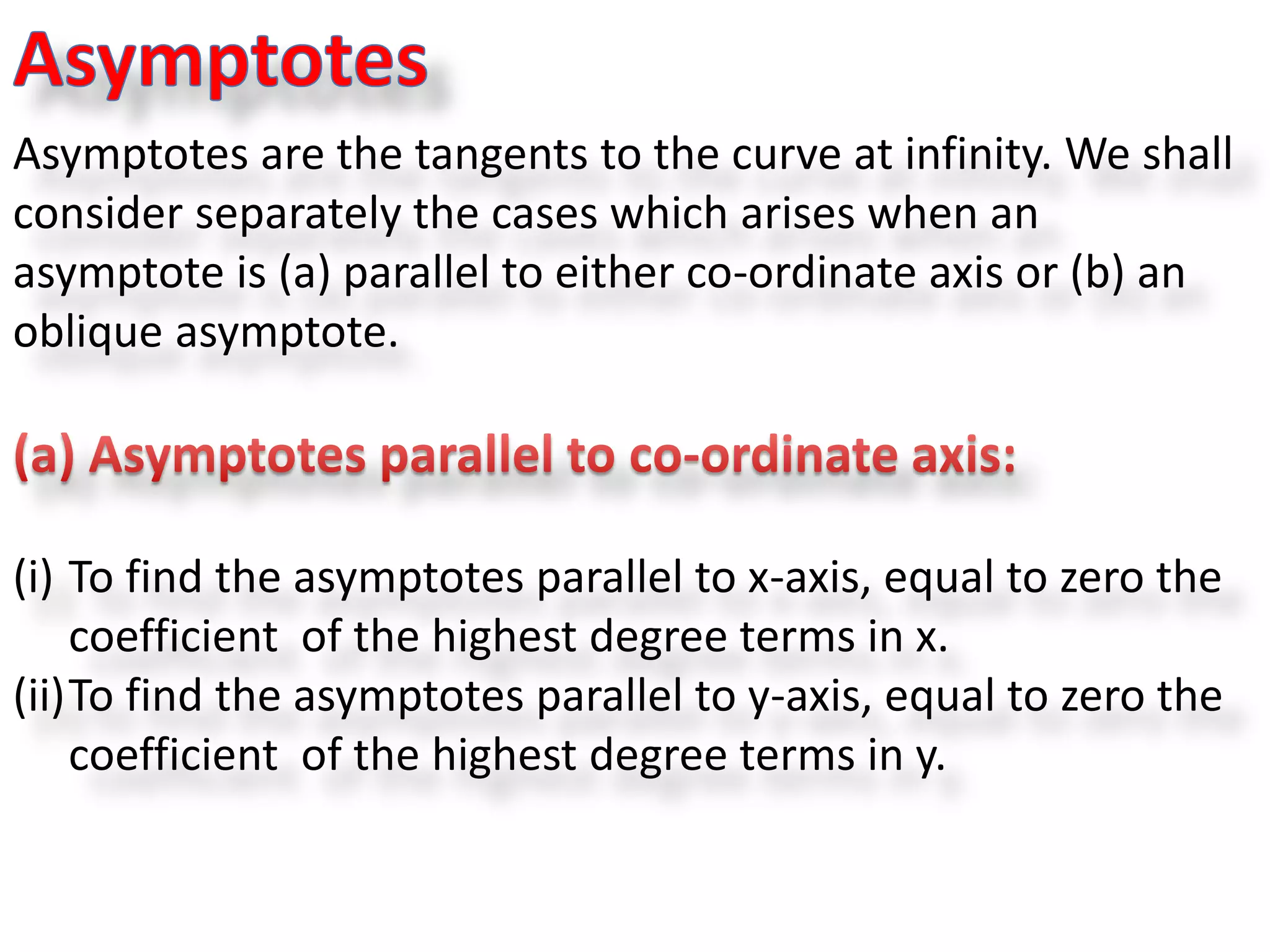
Asymptotes are the tangents to the curve at infinity. We shall
consider separately the cases which arises when an
asymptote is (a) parallel to either co-ordinate axis or (b) an
oblique asymptote.
(i) To find the asymptotes parallel to x-axis, equal to zero the
coefficient of the highest degree terms in x.
(ii)To find the asymptotes parallel to y-axis, equal to zero the
coefficient of the highest degree terms in y.
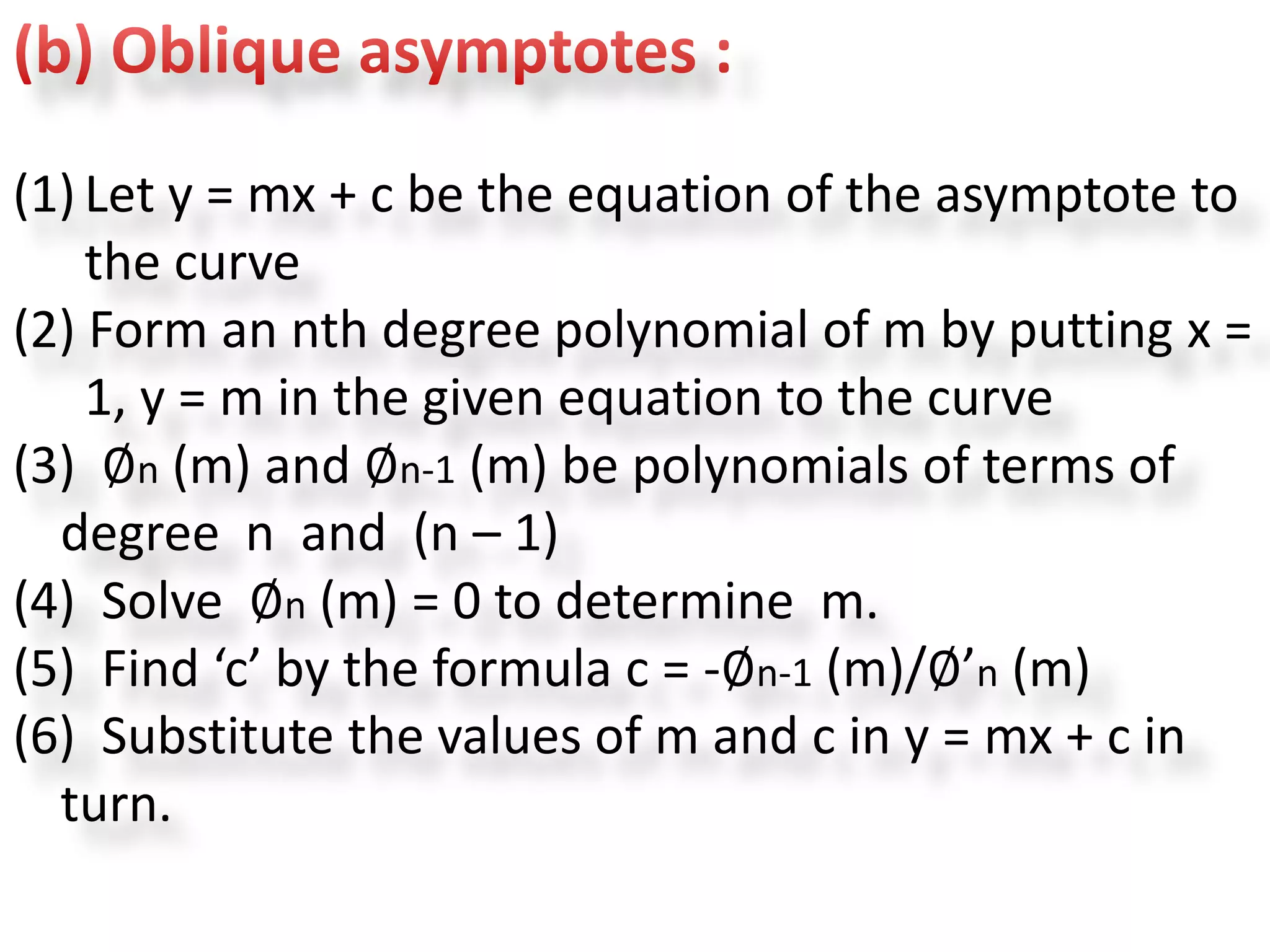
(1) Let y = mx + c be the equation of the asymptote to
the curve
(2) Form an nth degree polynomial of m by putting x =
1, y = m in the given equation to the curve
(3) ∅n (m) and ∅n-1 (m) be polynomials of terms of
degree n and (n – 1)
(4) Solve ∅n (m) = 0 to determine m.
(5) Find ‘c’ by the formula c = -∅n-1 (m)/∅’n (m)
(6) Substitute the values of m and c in y = mx + c in
turn.
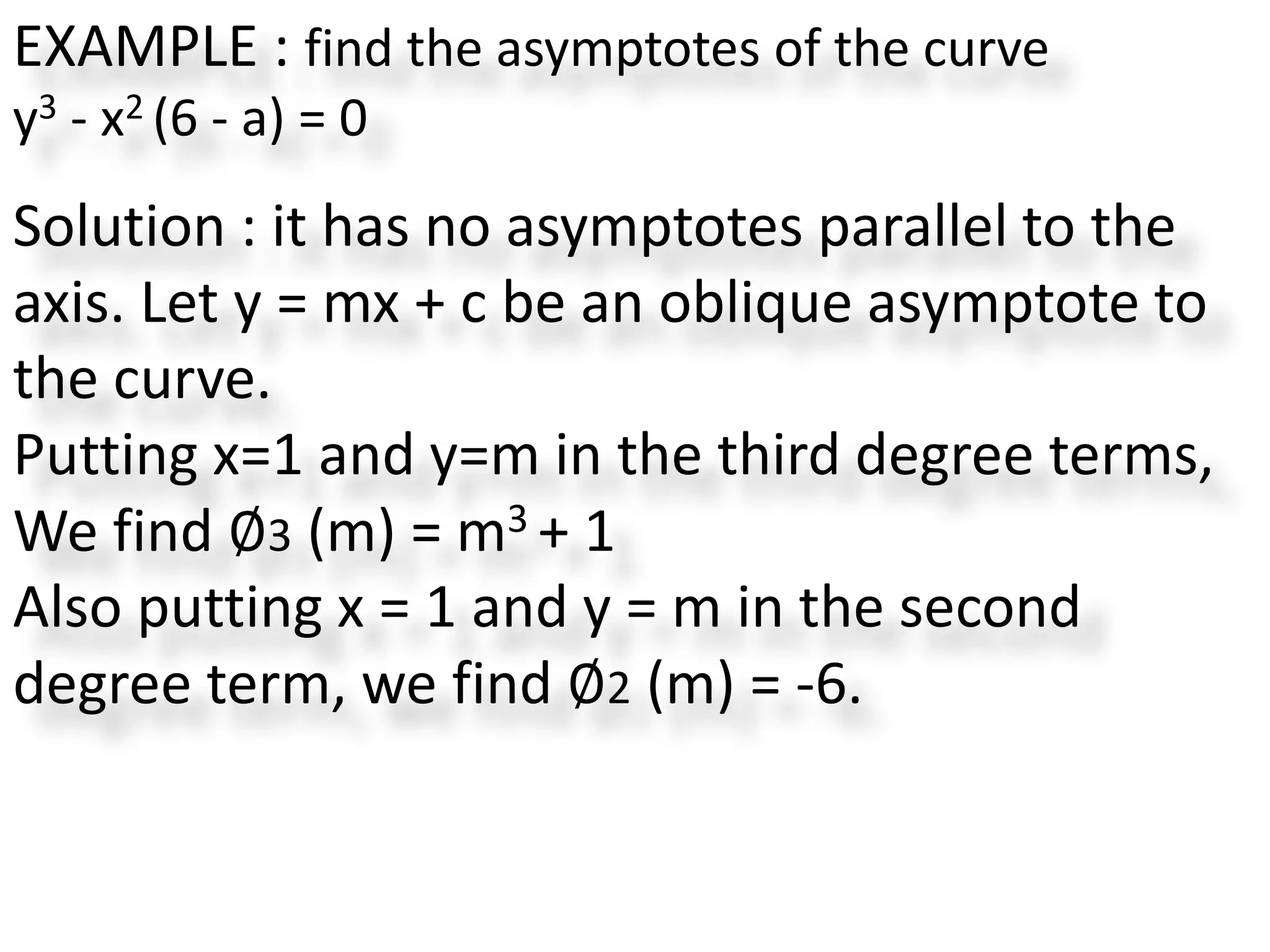
EXAMPLE : find the asymptotes of the curve
y3 - x2 (6 - a) = 0
Solution : it has no asymptotes parallel to the
axis. Let y = mx + c be an oblique asymptote to
the curve.
Putting x=1 and y=m in the third degree terms,
We find ∅3 (m) = m3 + 1
Also putting x = 1 and y = m in the second
degree term, we find ∅2 (m) = -6.
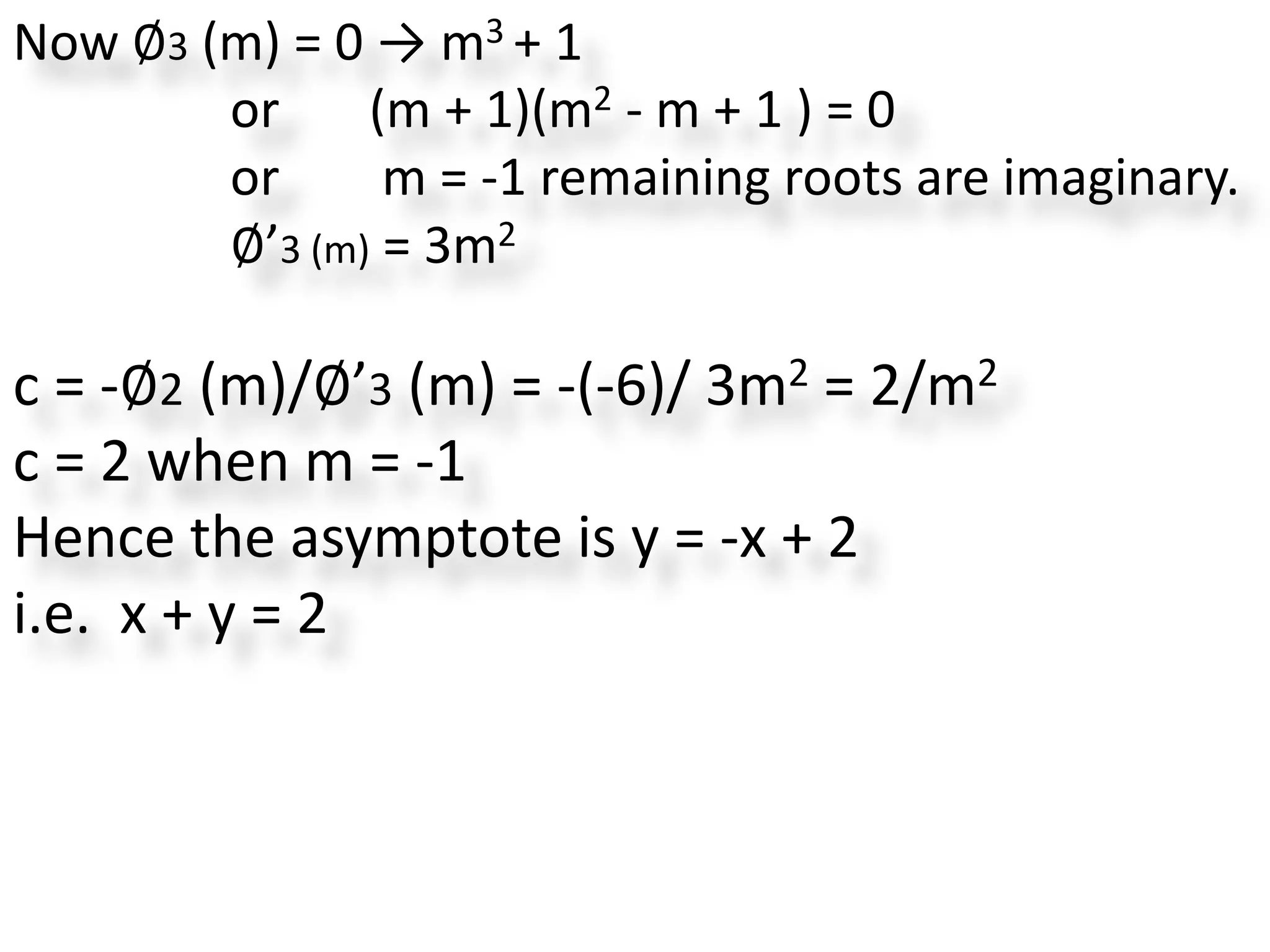
Now ∅3 (m) = 0 → m3 + 1
or (m + 1)(m2 - m + 1 ) = 0
or m = -1 remaining roots are imaginary.
∅’3 (m) = 3m2
c = -∅2 (m)/∅’3 (m) = -(-6)/ 3m2 = 2/m2
c = 2 when m = -1
Hence the asymptote is y = -x + 2
i.e. x + y = 2
10/6/2015
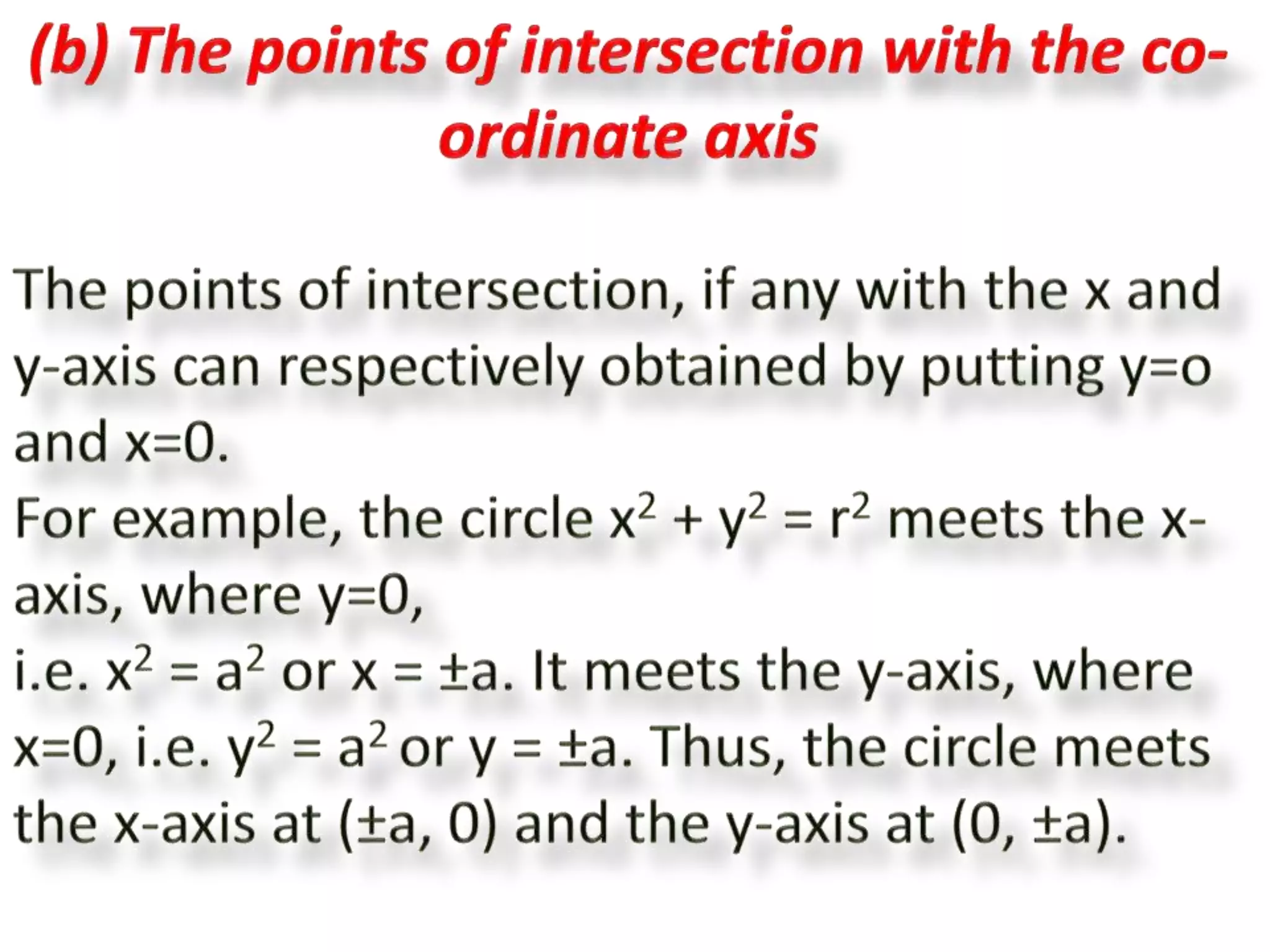
II. Tracing of Polar Curves
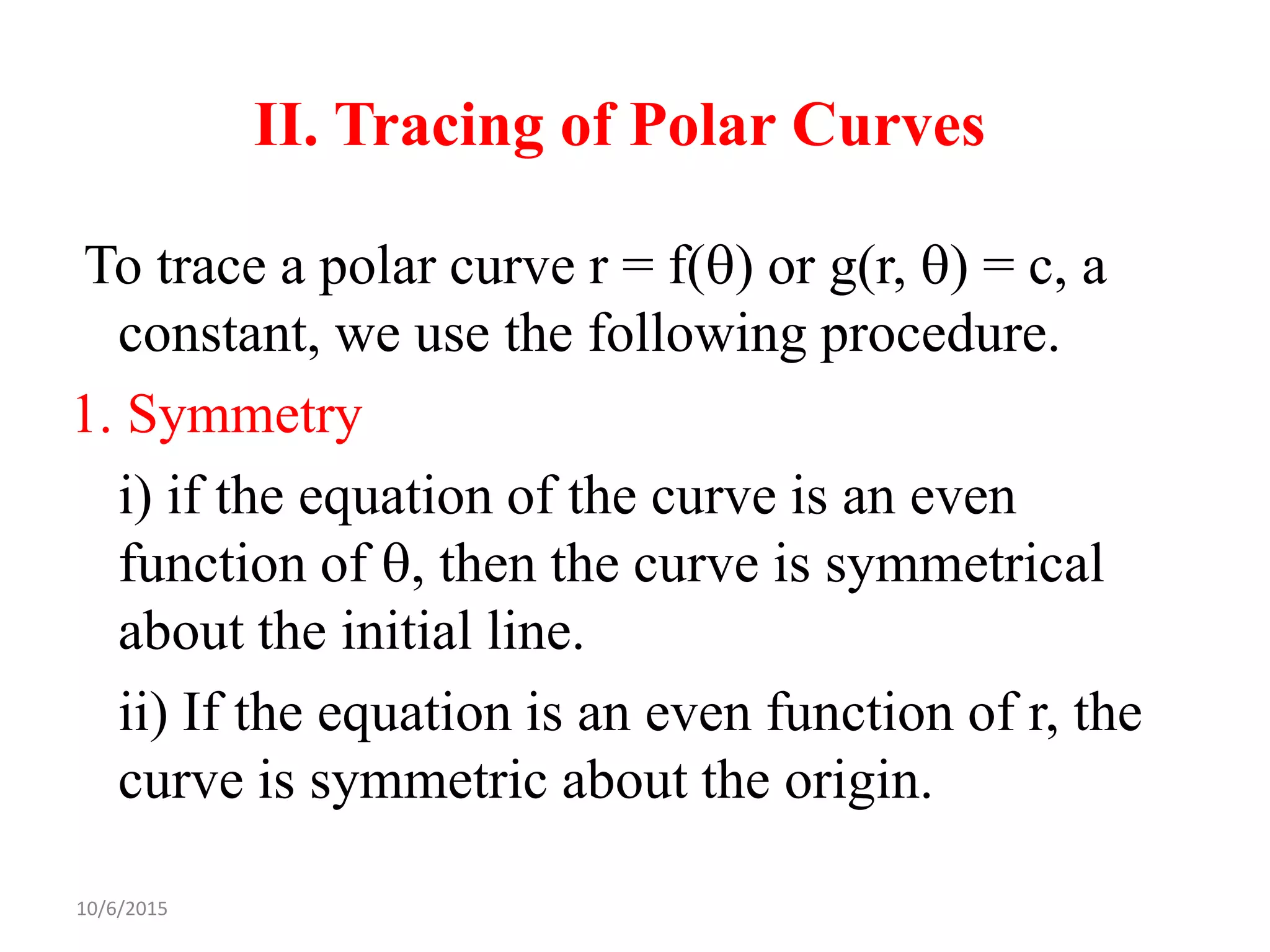
To trace a polar curve r = f() or g(r, ) = c, a
constant, we use the following procedure.
1. Symmetry
i) if the equation of the curve is an even
function of , then the curve is symmetrical
about the initial line.
ii) If the equation is an even function of r, the
curve is symmetric about the origin.
10/6/2015
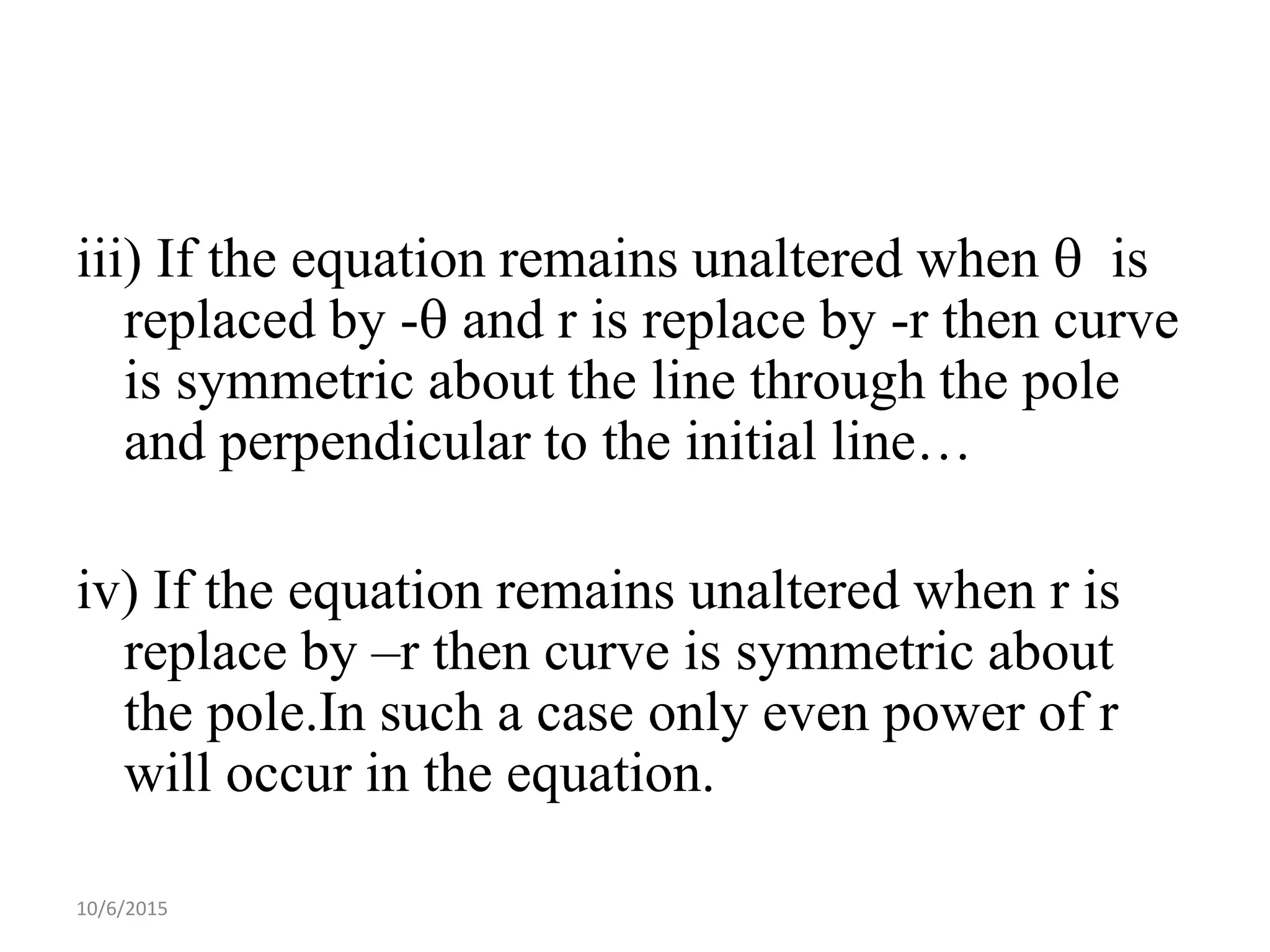
iii) If the equation remains unaltered when  is
replaced by - and r is replace by -r then curve
is symmetric about the line through the pole
and perpendicular to the initial line…
iv) If the equation remains unaltered when r is
replace by –r then curve is symmetric about
the pole.In such a case only even power of r
will occur in the equation.
10/6/2015
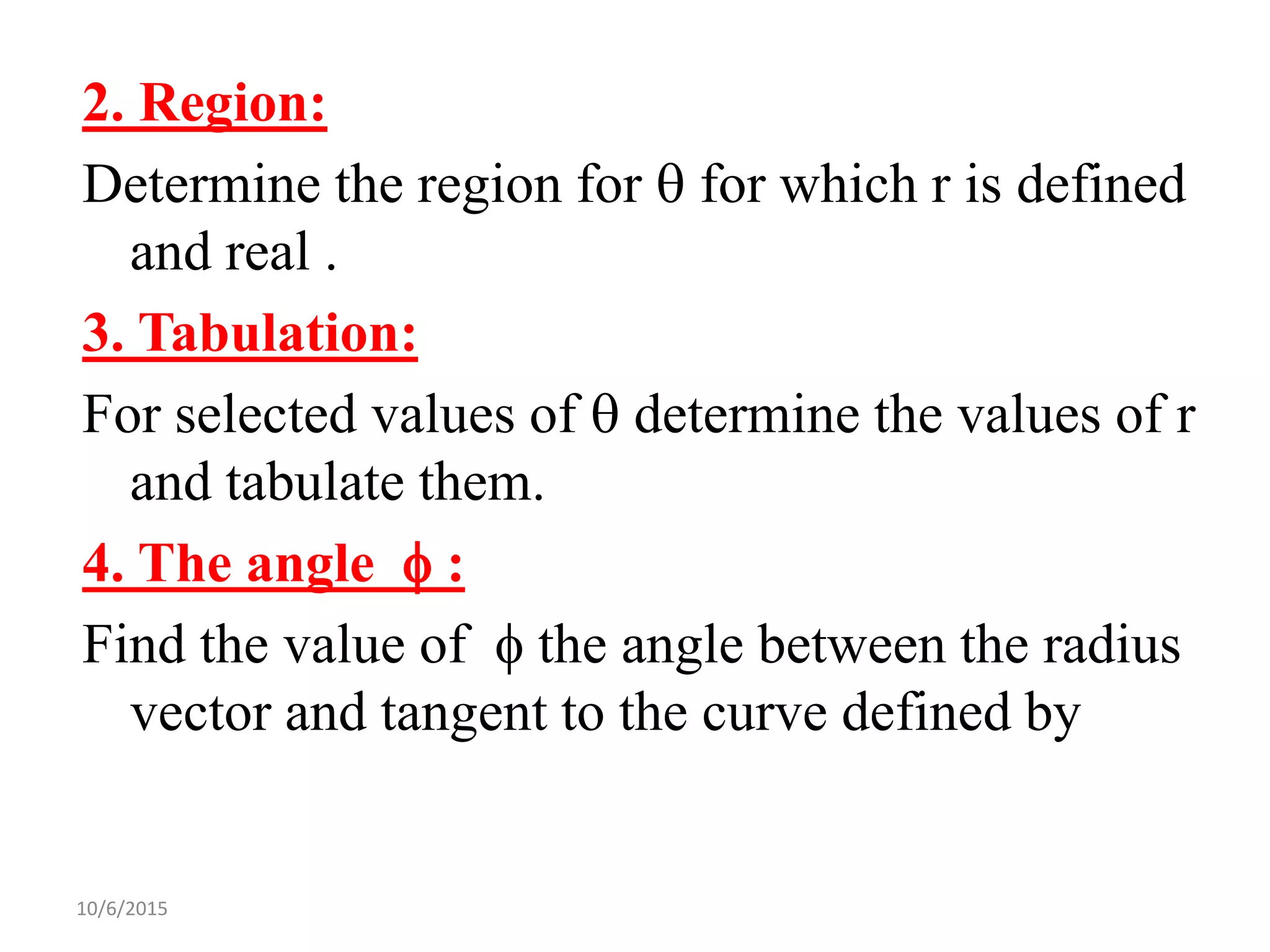
2. Region:
Determine the region for  for which r is defined
and real .
3. Tabulation:
For selected values of  determine the values of r
and tabulate them.
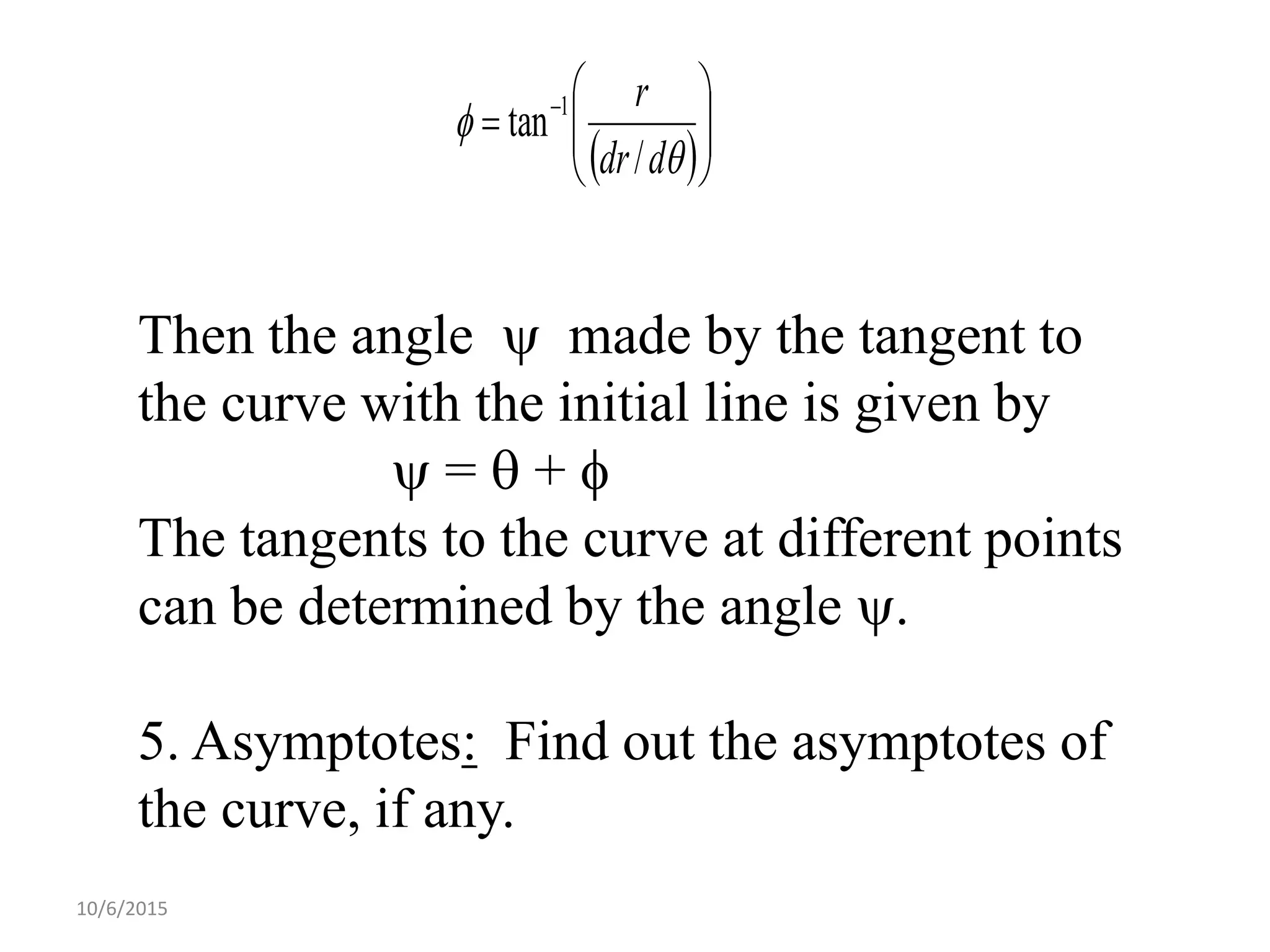
4. The angle  :
Find the value of  the angle between the radius
vector and tangent to the curve defined by
10/6/2015
Then the angle  made by the tangent to
the curve with the initial line is given by
 =  + 
The tangents to the curve at different points
can be determined by the angle .
5. Asymptotes: Find out the asymptotes of
the curve, if any.
 





 


ddr
r
/
tan 1
10/6/2015
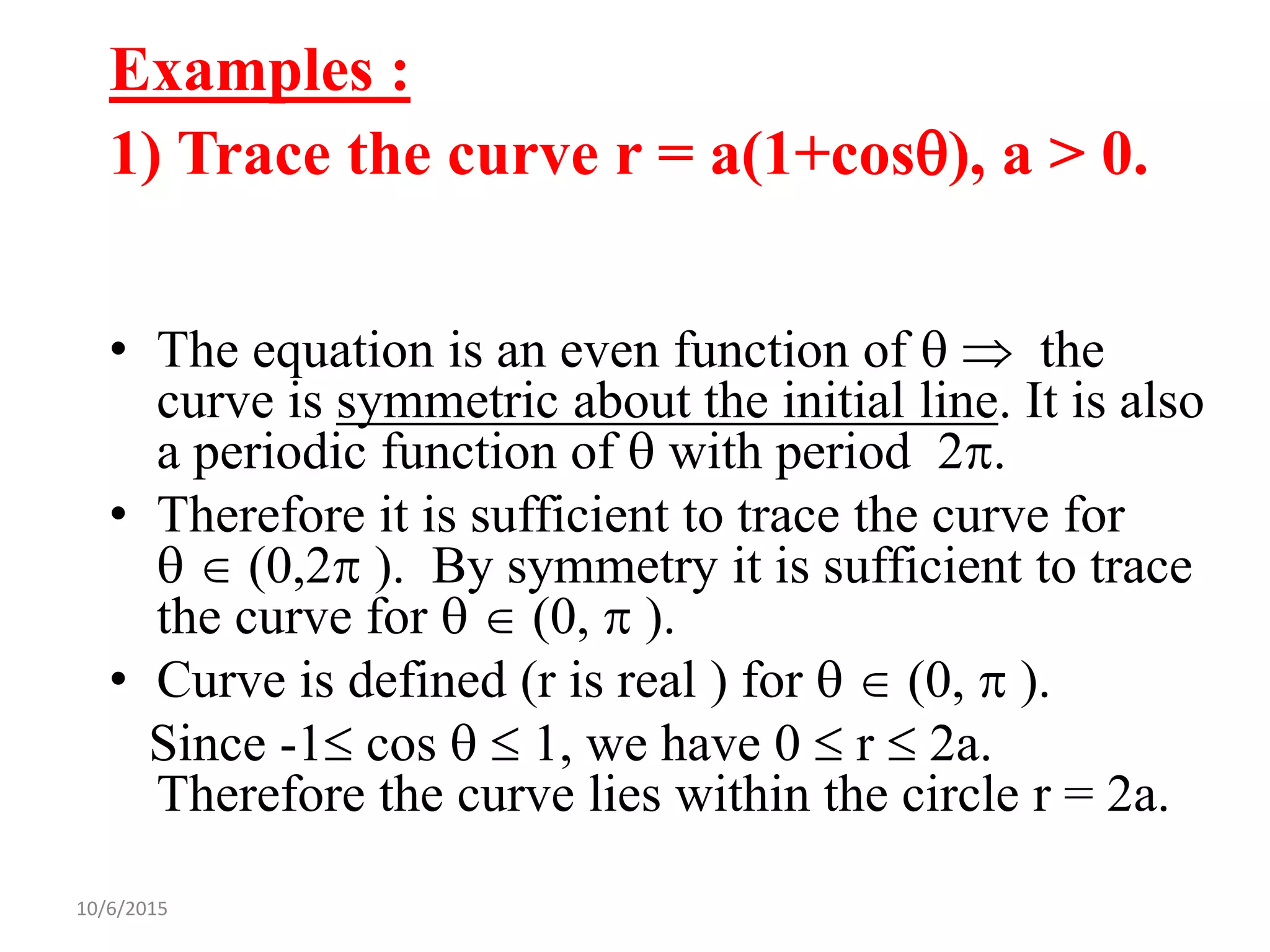
Examples :
1) Trace the curve r = a(1+cos), a > 0.
• The equation is an even function of   the
curve is symmetric about the initial line. It is also
a periodic function of  with period 2.
• Therefore it is sufficient to trace the curve for
  (0,2 ). By symmetry it is sufficient to trace
the curve for   (0,  ).
• Curve is defined (r is real ) for   (0,  ).
Since -1 cos   1, we have 0  r  2a.
Therefore the curve lies within the circle r = 2a.
10/6/2015
2
(1 cos ) 2cos / 2
tan
( / ) sin 2(sin / 2)(cos / 2)
cot / 2 tan( )
2 2
2 2
3
2 2 2 2
r a
dr d a
Therefore
 

   
 

 

   
   

  
 
   
 
      
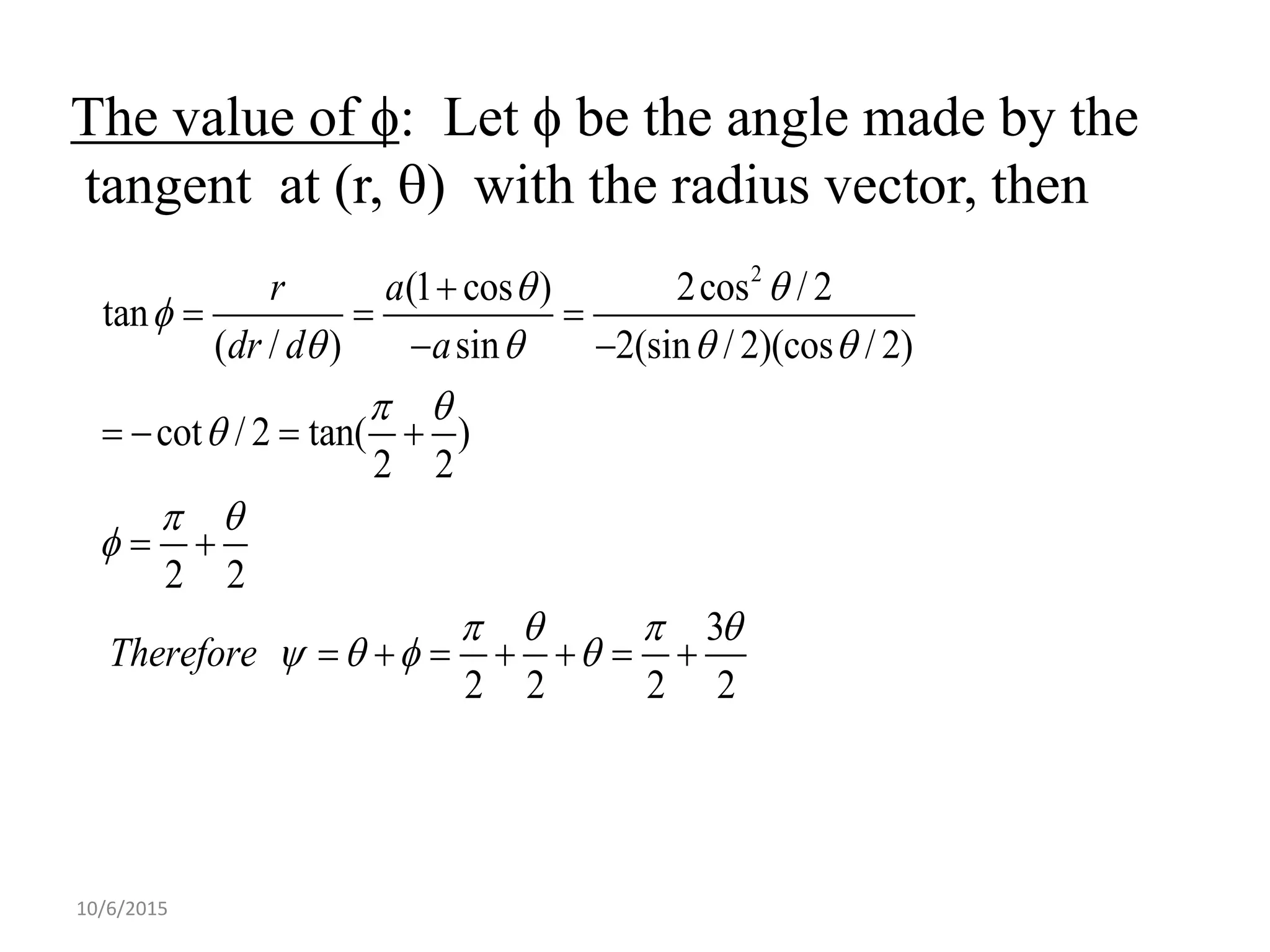
The value of : Let  be the angle made by the
tangent at (r, ) with the radius vector, then
10/6/2015
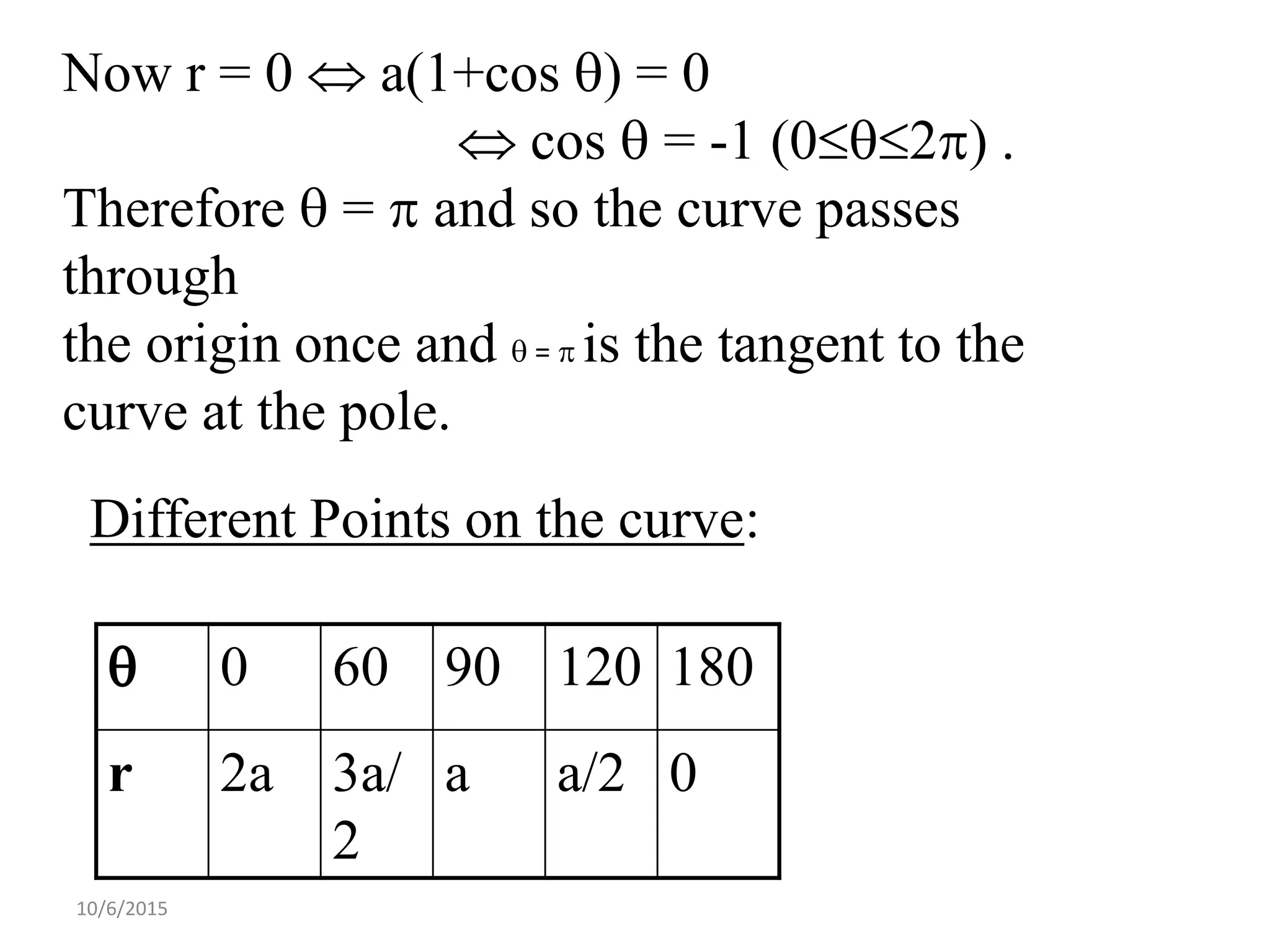
 0 60 90 120 180
r 2a 3a/
2
a a/2 0
Different Points on the curve:
Now r = 0  a(1+cos ) = 0
 cos  = -1 (02) .
Therefore  =  and so the curve passes
through
the origin once and  =  is the tangent to the
curve at the pole.
10/6/2015
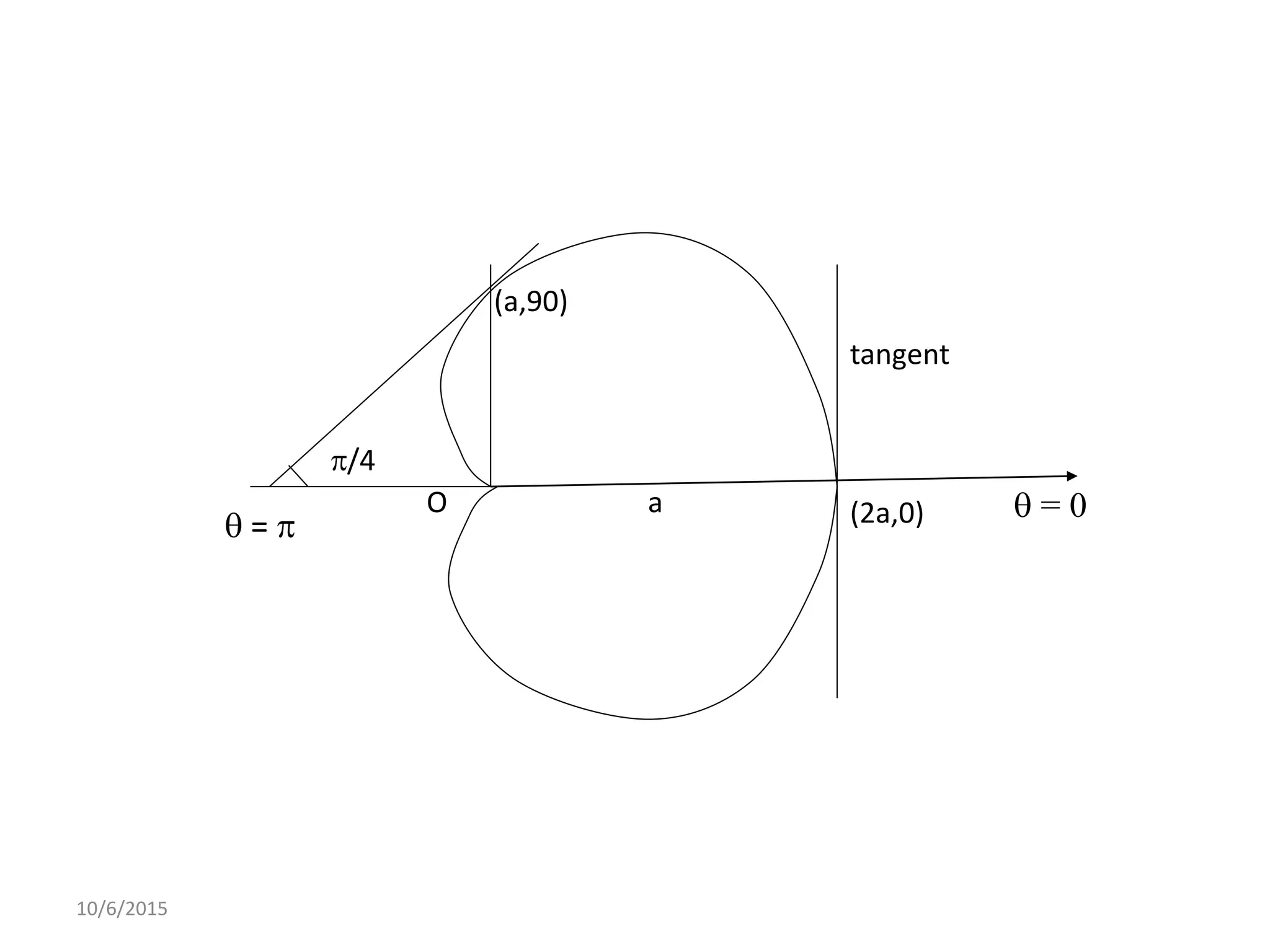
 = 0O
/4
 =  (2a,0)
tangent
(a,90)
a
10/6/2015
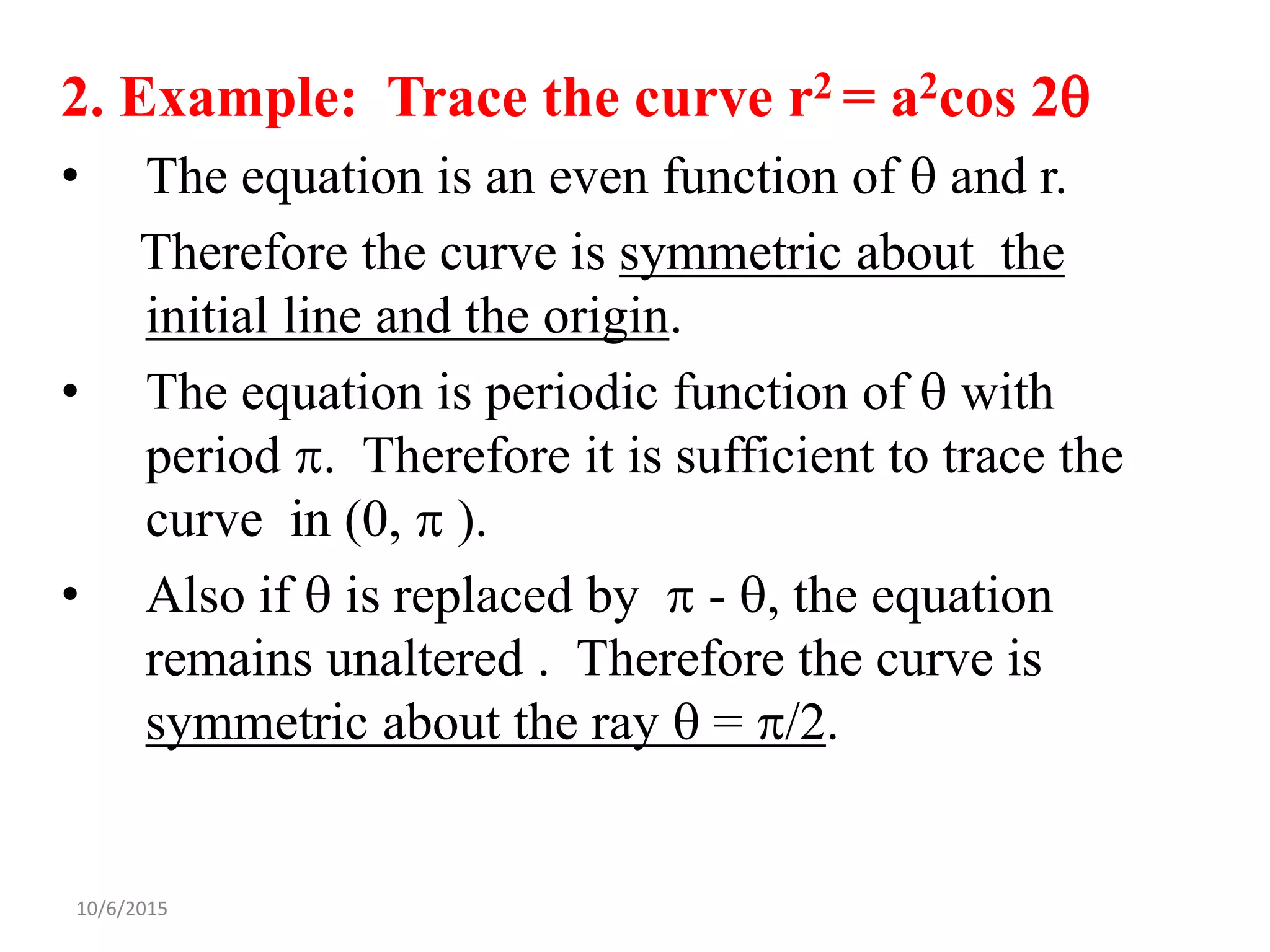
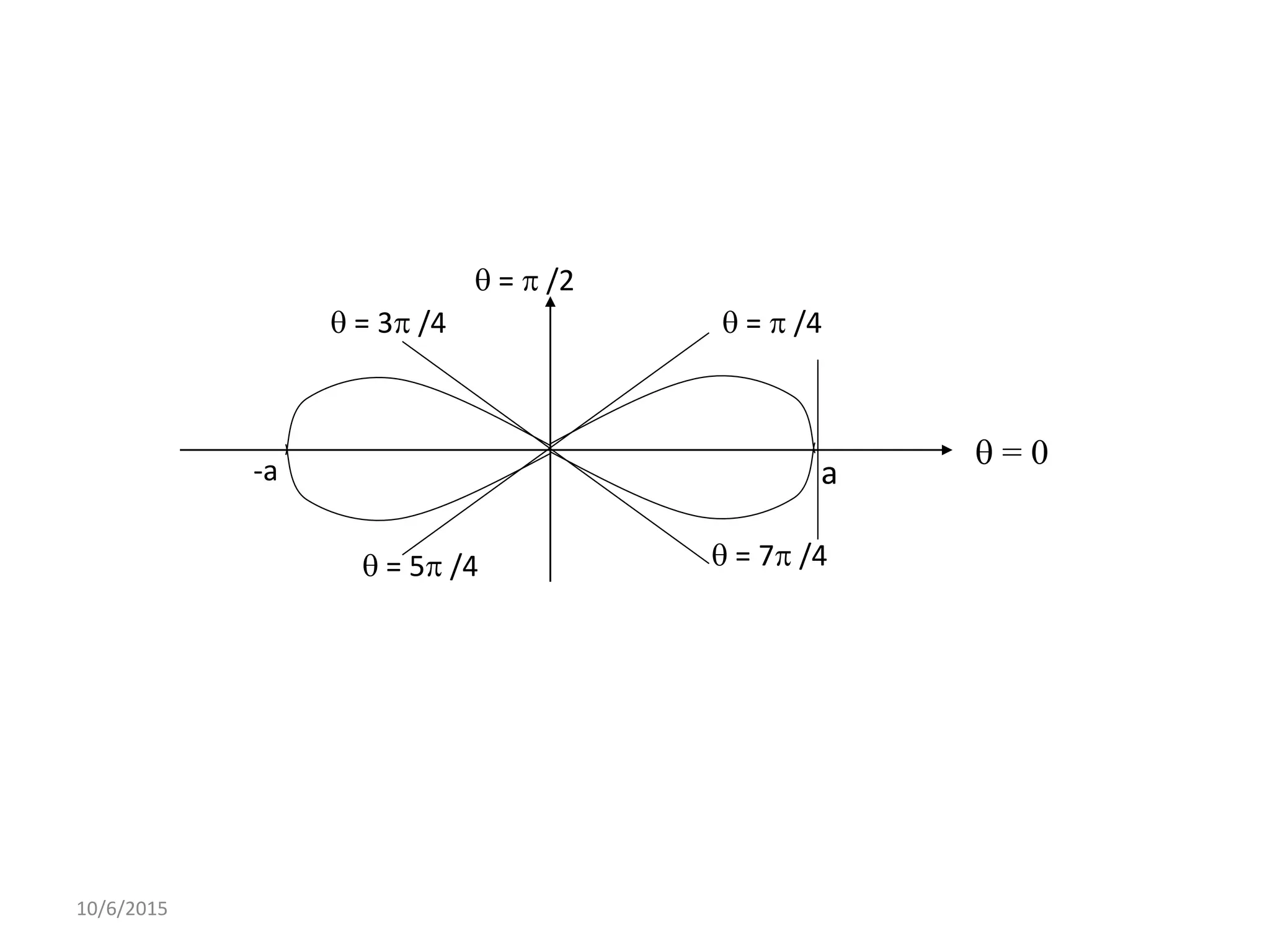
2. Example: Trace the curve r2 = a2cos 2
• The equation is an even function of  and r.
Therefore the curve is symmetric about the
initial line and the origin.
• The equation is periodic function of  with
period . Therefore it is sufficient to trace the
curve in (0,  ).
• Also if  is replaced by  - , the equation
remains unaltered . Therefore the curve is
symmetric about the ray  = /2.
10/6/2015
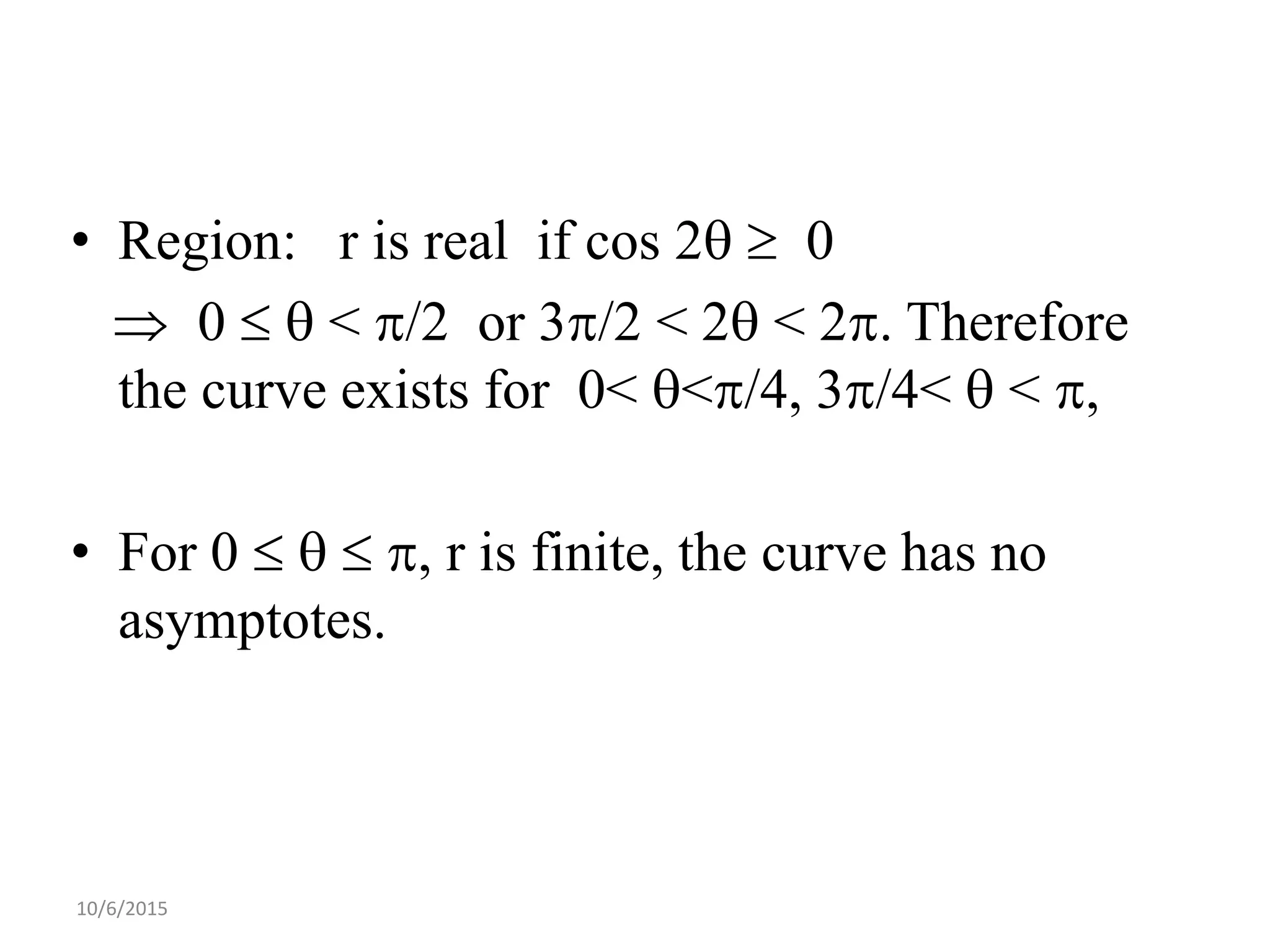
• Region: r is real if cos 2  0
 0   < /2 or 3/2 < 2 < 2. Therefore
the curve exists for 0< </4, 3/4<  < ,
• For 0    , r is finite, the curve has no
asymptotes.
10/6/2015
 0 /4 3/4 
r a 0 0 a
•Taking log both sides
2 log r = 2 log a + log cos 2
Differentiate with respect to 
2 (1/r) (dr/d) = 0 = 2 sin 2 /cos2
Therefore tan  = - cos2 /sin 2 = -cot2 =
tan(/2+2)
10/6/2015
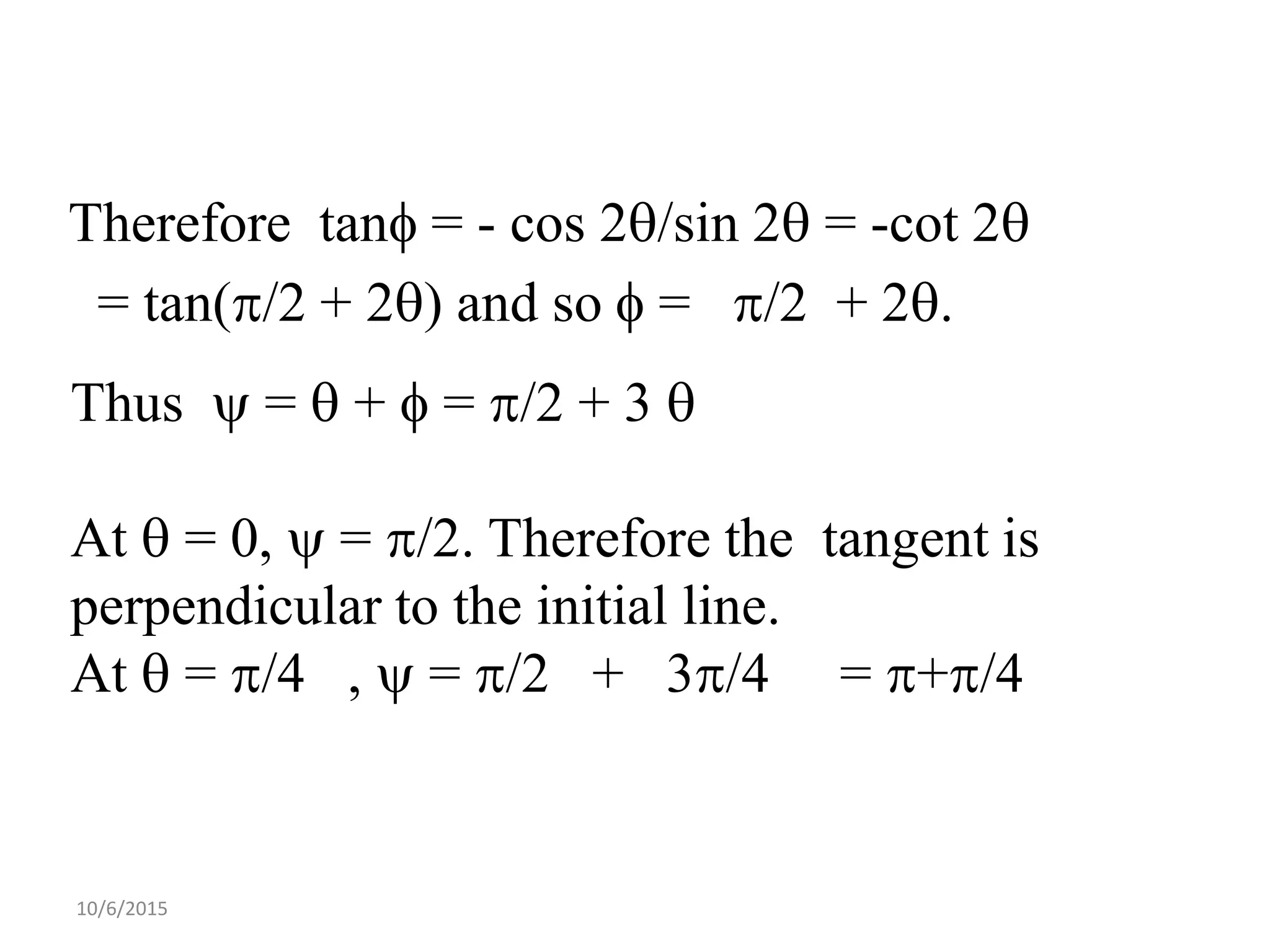
Therefore tan = - cos 2/sin 2 = -cot 2
= tan(/2 + 2) and so  = /2 + 2.
Thus  =  +  = /2 + 3 
At  = 0,  = /2. Therefore the tangent is
perpendicular to the initial line.
At  = /4 ,  = /2 + 3/4 = +/4
10/6/2015
 =  /2
 = 3 /4  =  /4
 = 7 /4 = 5 /4
-a a
 = 0
TRACING OF CURVE (CARTESIAN AND POLAR)

TRACING OF CURVE (CARTESIAN AND POLAR)

  • 3.
    10/6/2015 Step 1. Symmetry •Find out whether the curve is symmetric about any line or a point. The various kinds of symmetry arising from the form of the equation are as follows: • i) symmetric about the y-axis • If the equation of the curve remain unaltered when x is replace by –x and the curve is an even function of x. • ii) symmetric about x-axis • If the equation of the curve remains unaltered when y is replaced by –y and the curve is an even function of y.
  • 5.
    10/6/2015 • iii) symmetricabout both x and y axes • If the equations of the curve is such that the powers of x and y both are even everywhere then the curve is symmetrical about both the axes. for example, the circle.. • iv) symmetry in the opposite quadrants • If the equation of the curve remains unaltered when x is replaced by –x and y is replaced by –y simultaneously, the curve is symmetrical in opposite quadrant. for example, the hyperbola… • v) symmetrical about the line y = x • If the equation of the curve remains unaltered when x and y are interchanged, the curve is symmetrical about the line y=x
  • 7.
    10/6/2015 Step 2. Origin: •(A)Tangents at the origin • The equations of the tangents to the curve at the origin is obtained by equating the lowest degree terms in x and y in the given equation to zero, provided the curve passes through the origin. • (B)Curve through the origin • If the equations of the curve does not contain any constant term,the curve passes through the origin.it will pass through the origin if the equation is satisfied by (0,0) .
  • 12.
    Asymptotes are thetangents to the curve at infinity. We shall consider separately the cases which arises when an asymptote is (a) parallel to either co-ordinate axis or (b) an oblique asymptote. (i) To find the asymptotes parallel to x-axis, equal to zero the coefficient of the highest degree terms in x. (ii)To find the asymptotes parallel to y-axis, equal to zero the coefficient of the highest degree terms in y.
  • 13.
    (1) Let y= mx + c be the equation of the asymptote to the curve (2) Form an nth degree polynomial of m by putting x = 1, y = m in the given equation to the curve (3) ∅n (m) and ∅n-1 (m) be polynomials of terms of degree n and (n – 1) (4) Solve ∅n (m) = 0 to determine m. (5) Find ‘c’ by the formula c = -∅n-1 (m)/∅’n (m) (6) Substitute the values of m and c in y = mx + c in turn.
  • 14.
    EXAMPLE : findthe asymptotes of the curve y3 - x2 (6 - a) = 0 Solution : it has no asymptotes parallel to the axis. Let y = mx + c be an oblique asymptote to the curve. Putting x=1 and y=m in the third degree terms, We find ∅3 (m) = m3 + 1 Also putting x = 1 and y = m in the second degree term, we find ∅2 (m) = -6.
  • 15.
    Now ∅3 (m)= 0 → m3 + 1 or (m + 1)(m2 - m + 1 ) = 0 or m = -1 remaining roots are imaginary. ∅’3 (m) = 3m2 c = -∅2 (m)/∅’3 (m) = -(-6)/ 3m2 = 2/m2 c = 2 when m = -1 Hence the asymptote is y = -x + 2 i.e. x + y = 2
  • 19.
    10/6/2015 II. Tracing ofPolar Curves To trace a polar curve r = f() or g(r, ) = c, a constant, we use the following procedure. 1. Symmetry i) if the equation of the curve is an even function of , then the curve is symmetrical about the initial line. ii) If the equation is an even function of r, the curve is symmetric about the origin.
  • 20.
    10/6/2015 iii) If theequation remains unaltered when  is replaced by - and r is replace by -r then curve is symmetric about the line through the pole and perpendicular to the initial line… iv) If the equation remains unaltered when r is replace by –r then curve is symmetric about the pole.In such a case only even power of r will occur in the equation.
  • 21.
    10/6/2015 2. Region: Determine theregion for  for which r is defined and real . 3. Tabulation: For selected values of  determine the values of r and tabulate them. 4. The angle  : Find the value of  the angle between the radius vector and tangent to the curve defined by
  • 22.
    10/6/2015 Then the angle made by the tangent to the curve with the initial line is given by  =  +  The tangents to the curve at different points can be determined by the angle . 5. Asymptotes: Find out the asymptotes of the curve, if any.            ddr r / tan 1
  • 23.
    10/6/2015 Examples : 1) Tracethe curve r = a(1+cos), a > 0. • The equation is an even function of   the curve is symmetric about the initial line. It is also a periodic function of  with period 2. • Therefore it is sufficient to trace the curve for   (0,2 ). By symmetry it is sufficient to trace the curve for   (0,  ). • Curve is defined (r is real ) for   (0,  ). Since -1 cos   1, we have 0  r  2a. Therefore the curve lies within the circle r = 2a.
  • 24.
    10/6/2015 2 (1 cos )2cos / 2 tan ( / ) sin 2(sin / 2)(cos / 2) cot / 2 tan( ) 2 2 2 2 3 2 2 2 2 r a dr d a Therefore                                         The value of : Let  be the angle made by the tangent at (r, ) with the radius vector, then
  • 25.
    10/6/2015  0 6090 120 180 r 2a 3a/ 2 a a/2 0 Different Points on the curve: Now r = 0  a(1+cos ) = 0  cos  = -1 (02) . Therefore  =  and so the curve passes through the origin once and  =  is the tangent to the curve at the pole.
  • 26.
    10/6/2015  = 0O /4 =  (2a,0) tangent (a,90) a
  • 27.
    10/6/2015 2. Example: Tracethe curve r2 = a2cos 2 • The equation is an even function of  and r. Therefore the curve is symmetric about the initial line and the origin. • The equation is periodic function of  with period . Therefore it is sufficient to trace the curve in (0,  ). • Also if  is replaced by  - , the equation remains unaltered . Therefore the curve is symmetric about the ray  = /2.
  • 28.
    10/6/2015 • Region: ris real if cos 2  0  0   < /2 or 3/2 < 2 < 2. Therefore the curve exists for 0< </4, 3/4<  < , • For 0    , r is finite, the curve has no asymptotes.
  • 29.
    10/6/2015  0 /43/4  r a 0 0 a •Taking log both sides 2 log r = 2 log a + log cos 2 Differentiate with respect to  2 (1/r) (dr/d) = 0 = 2 sin 2 /cos2 Therefore tan  = - cos2 /sin 2 = -cot2 = tan(/2+2)
  • 30.
    10/6/2015 Therefore tan =- cos 2/sin 2 = -cot 2 = tan(/2 + 2) and so  = /2 + 2. Thus  =  +  = /2 + 3  At  = 0,  = /2. Therefore the tangent is perpendicular to the initial line. At  = /4 ,  = /2 + 3/4 = +/4
  • 31.
    10/6/2015  = /2  = 3 /4  =  /4  = 7 /4 = 5 /4 -a a  = 0