Dr. Joel Arudchelvam
ConsultantVascular andTransplant Surgeon
Teaching Hospital Anuradhapura
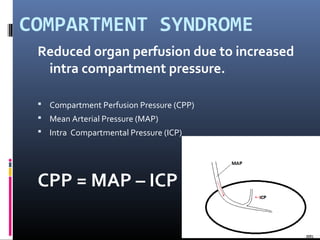
COMPARTMENT SYNDROME
Reduced organ perfusion due to increased
intra compartment pressure.
 Compartment Perfusion Pressure (CPP)
 Mean Arterial Pressure (MAP)
 Intra Compartmental Pressure (ICP)
CPP = MAP – ICP
HISTORY
 Richard von Volkmann[1](1881)
 Described irreversible contractures of the muscles
because of ischemic processes
 Hildebrand (1906)
 first to suggest that elevated tissue pressure may be
related to ischemic contracture
 Murphy (1914)
 First to suggest that Fasciotomy might prevent the
contracture.
Volkmann R. Die ischaemischen Muskellahmungen and Kontrakturen. Zentralbl Chir. 1881;8:801–3
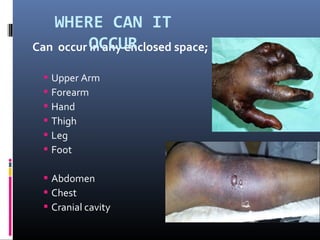
Can occur in any enclosed space;
 Upper Arm
 Forearm
 Hand
 Thigh
 Leg
 Foot
 Abdomen
 Chest
 Cranial cavity
WHERE CAN IT
OCCUR
CAUSES OF COMPARTMENT
SYNDROME
 Fracture s and haematoma
 Crush injuries
 Ischemia / Reperfusion
 Tight bandages
 Burns Eschar
 Tourniquet
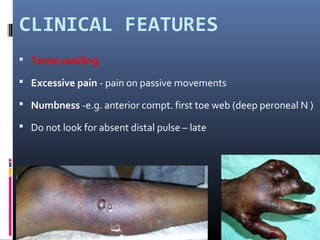
CLINICAL FEATURES
 Tense swelling
 Excessive pain - pain on passive movements
 Numbness -e.g. anterior compt. first toe web (deep peroneal N )
 Do not look for absent distal pulse – late
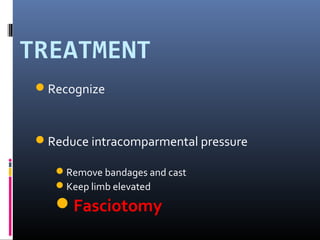
TREATMENT
Recognize
Reduce intracomparmental pressure
Remove bandages and cast
Keep limb elevated
Fasciotomy
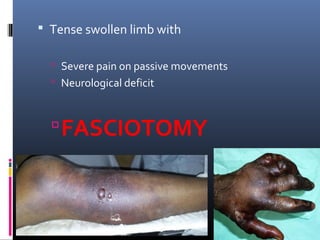
 Tense swollen limb with
 Severe pain on passive movements
 Neurological deficit
FASCIOTOMY
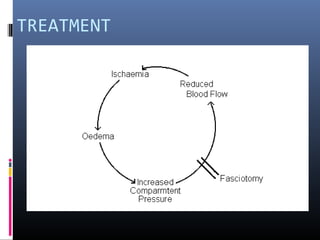
TREATMENT
FASCIOTOMY
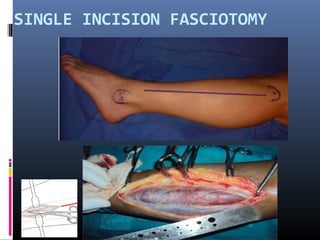
 Principles
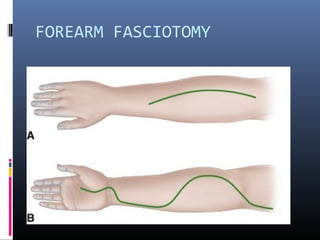
 Long extensile incisions
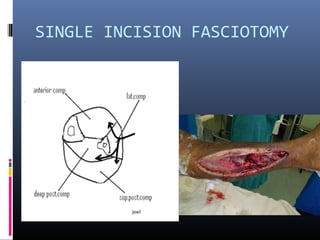
 Release all fascial compartments
 Preserve neurovascular structures
 Debride necrotic tissues
COMMONLY DONE FASCIOTOMIES
 Leg
 Forearm
 Hand
 Thigh
 Foot
 Arm
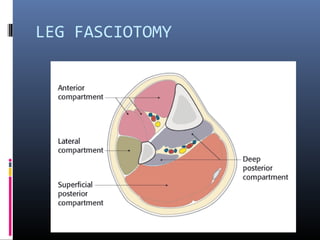
LEG FASCIOTOMY
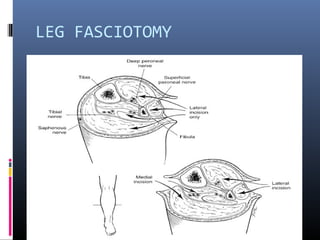
LEG FASCIOTOMY
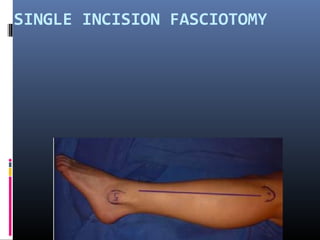
SINGLE INCISION FASCIOTOMY
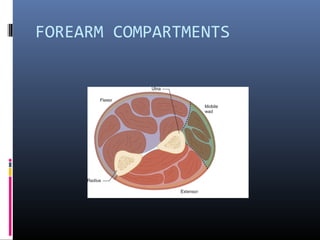
FOREARM COMPARTMENTS
FOREARM FASCIOTOMY
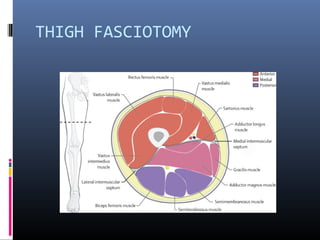
THIGH FASCIOTOMY
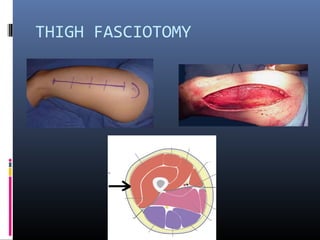
THIGH FASCIOTOMY
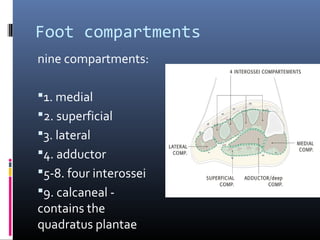
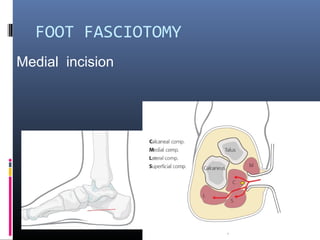
Foot compartments
nine compartments:
1. medial
2. superficial
3. lateral
4. adductor
5-8. four interossei
9. calcaneal -
contains the
quadratus plantae
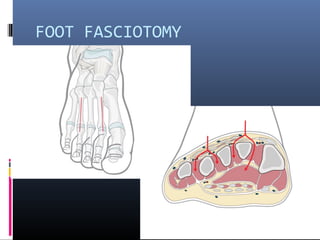
FOOT FASCIOTOMY
FOOT FASCIOTOMY
Medial incision
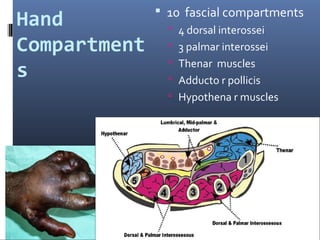
Hand
Compartment
s
 10 fascial compartments
 4 dorsal interossei
 3 palmar interossei
 Thenar muscles
 Adducto r pollicis
 Hypothena r muscles
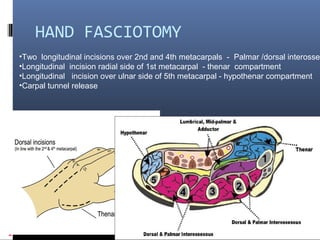
HAND FASCIOTOMY
•Two longitudinal incisions over 2nd and 4th metacarpals - Palmar /dorsal interossei
•Longitudinal incision radial side of 1st metacarpal - thenar compartment
•Longitudinal incision over ulnar side of 5th metacarpal - hypothenar compartment
•Carpal tunnel release
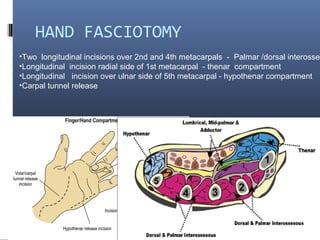
HAND FASCIOTOMY
•Two longitudinal incisions over 2nd and 4th metacarpals - Palmar /dorsal interossei
•Longitudinal incision radial side of 1st metacarpal - thenar compartment
•Longitudinal incision over ulnar side of 5th metacarpal - hypothenar compartment
•Carpal tunnel release
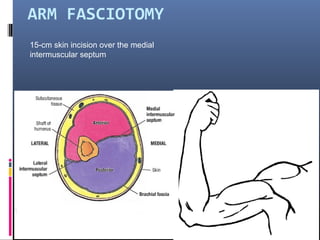
ARM FASCIOTOMY
15-cm skin incision over the medial
intermuscular septum
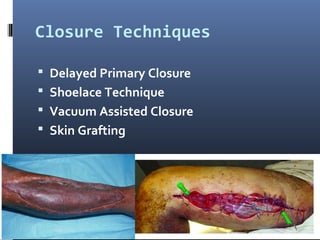
Closure Techniques
 Delayed Primary Closure
 Shoelace Technique
 Vacuum Assisted Closure
 Skin Grafting
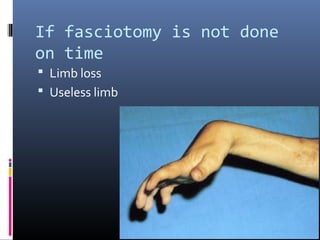
If fasciotomy is not done
on time
 Limb loss
 Useless limb
Thank You

Fasciotomy

Editor's Notes

  • #28 Fasciotomy of the Anterior and Posterior Compartments of the Arm Using 1 Skin Incision. A 15-cm skin incision is made over the medial intermuscular septum, carefully avoiding the underlying neurovascular bundle. Using rake retractors and the electrocautery device, skin and subcutaneous tissue flaps are raised anteriorly and posteriorly. The fascia over the anterior compartment is then opened midway between the anterior border of the biceps muscle and the medial intermuscular septum for the length of the skin incision. The fascia over the posterior compartment is then opened midway between the posterior border of the triceps muscle and the medial intermuscular septum for the length of the skin incision. Fasciotomy of the Anterior and Posterior Compartments of the Arm Using 2 Skin Incisions. A 15-cm skin incision starting medial to the bicipital sulcus is extended up the anteromedial arm to the acromion and through the fascia to decompress the anterior compartment. A 15-cm skin incision starting at the tip of the olecranon is extended up the posterolateral arm and through the fascia to decompress the posterior compartment.