C
FASCIOTOMY &
ESCHAROTOMY
Introduction, Indication & Techniques
C
DR. M. ZAID UR REHMAN
HOUSE OFFICER
ALLIED BURN & RECONSTRUCTIVE SURGERY CENTRE, FAISALABAD
Compartment Syndrome
• It develops when the pressure within an osteofascial compartment of muscle causes
ischemia and subsequent necrosis.
• Common areas for compartment syndrome include Lower leg, Forearm, foot, hand,
gluteal region & thigh.
• The end results of unchecked compartment syndrome are catastrophic. They include
neurologic deficit, muscle necrosis, ischemia contracture, infection, possible
amputation.
Causes
• Bone fracture
• Crush injuries
• Burns
• Overly tight bandaging
• Vigorous exercise
Signs & Symptoms
• Increasing pain greater than expected and out of proportion to the
stimulus.
• Palpable tenderness of the compartment
• Pain on passive stretch of the affected muscle
• Altered sensation
• Don’t look for absent distal pulses (Late finding)
Diagnosis
• Clinical diagnosis is based on the history of injury & physical signs.
• Intra-compartmental pressure measurements may be helpful in diagnosing this.
• Tissue pressures that are greater than 30-45 mmHg suggest decreased capillary
blood flow.
• “Delta-P” method is used to calculate the tissue pressure.
• If Delta-P value is 30 mmHg or less, it indicates the patient may have a compartment
syndrome .
Fasciotomy
• It is a surgical procedure where the fascia is cut to relieve tension or
pressure commonly to treat the resulting loss of circulation to an area
of tissue or muscle. Fasciotomy is a limb-saving procedure when used
to treat acute compartment syndrome.
Principles
• Release all fascial compartments
• Preserve neurovascular structures
• Debride necrotic tissues
Indications
• Following are the indications for Fasciotomy :
1) Crush injuries
2) Athletes who have sustained one or more serious impact injuries
3) People with severe burns
4) Persons who are severely overweight
Commonly done Fasciotomies are :
 Leg
Forearm
Hand
Thigh
Foot
Arm
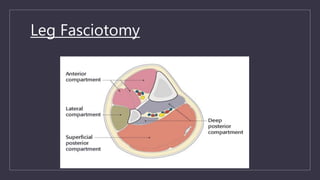
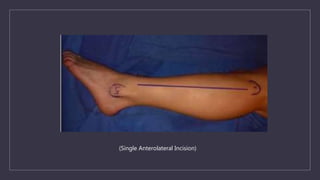
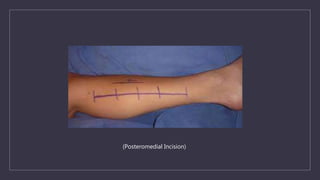
Leg Fasciotomy
(Single Anterolateral Incision)
(Posteromedial Incision)
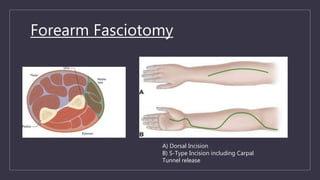
Forearm Fasciotomy
A) Dorsal Incision
B) S-Type Incision including Carpal
Tunnel release
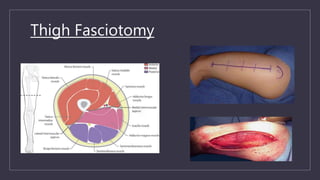
Thigh Fasciotomy
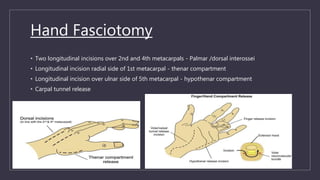
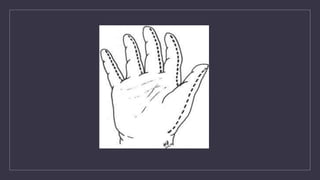
Hand Fasciotomy
• Two longitudinal incisions over 2nd and 4th metacarpals - Palmar /dorsal interossei
• Longitudinal incision radial side of 1st metacarpal - thenar compartment
• Longitudinal incision over ulnar side of 5th metacarpal - hypothenar compartment
• Carpal tunnel release
Foot Fasciotomy
Medial Incision Dorsal Incisions
CESCHAROTOMY
Eschar: A thick, coagulated crust, slough which develops following a
burn injury or chemical or physical cauterization of skin.
In full thickness circumferential burns, coagulated collagen acts as a
tourniquet in leading to vascular compromise of the affected body
parts.
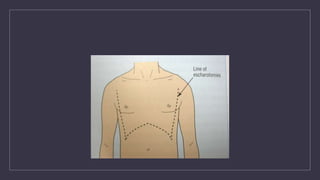
Escharotomy: incision of eschar for decompressing the constrictive
effects caused by deep circumferential burns.
• Role of escharotomy in deep circumferential burns is crucial for relief of
peripheral ischaemia or respiratory embarrassment.
• Indications should be based on both careful clinical assessment and
appropriate tissue pressure monitoring.
Indications
Indications for emergency escharotomy are the presence of a
circumferential eschar with one of the following :
• impending or established vascular compromise of the extremities or
digits.
• impending or established respiratory compromise due to
circumferential torso burns.
Contraindication
• Established irreversible gangrene of the extremity or digit.
Technique
• Clean the proposed surgical site with pyodine & drape with sterile drapes.
• Use electrocautery to create incisions in eschar upto the level of subcutaneous fat.
• Severely burned limbs may require performance of fasciotomy concomitantly with the
escharotomy.
• After giving incision, an immediate release in tissue pressure is experienced as
discernible popping sensation.
• Carry the incisions approx. 1 cm proximal and distal to the extent of the burn.
• Areas overlying joints have densely adherent skin and the incisions should extend
across joints to allow for more decompression of neurovascular structures. Take care
to avoid damage to the neurovascular bundles that run superficially and near joints.
• Bleeding from incisions should be controlled by use of electrocautery
• The resulting wounds are potential source of infection and should be treated with the
application of topical antimicrobial and dressing
• Adequacy of the escharotomy can be tested after completion by checking capillary
filling pressures, using a handheld Doppler and by checking compartment pressures.
Complications
• Excessive blood loss
• Incision / injury to underlying healthy tissue
• Injury to neurovascular structures
• Infection
• Septic shock
CANY QUESTIONS?
Fasciotomy & Escharotomy

Fasciotomy & Escharotomy

  • 2.
  • 3.
    C DR. M. ZAIDUR REHMAN HOUSE OFFICER ALLIED BURN & RECONSTRUCTIVE SURGERY CENTRE, FAISALABAD
  • 4.
    Compartment Syndrome • Itdevelops when the pressure within an osteofascial compartment of muscle causes ischemia and subsequent necrosis. • Common areas for compartment syndrome include Lower leg, Forearm, foot, hand, gluteal region & thigh. • The end results of unchecked compartment syndrome are catastrophic. They include neurologic deficit, muscle necrosis, ischemia contracture, infection, possible amputation.
  • 5.
    Causes • Bone fracture •Crush injuries • Burns • Overly tight bandaging • Vigorous exercise
  • 6.
    Signs & Symptoms •Increasing pain greater than expected and out of proportion to the stimulus. • Palpable tenderness of the compartment • Pain on passive stretch of the affected muscle • Altered sensation • Don’t look for absent distal pulses (Late finding)
  • 7.
    Diagnosis • Clinical diagnosisis based on the history of injury & physical signs. • Intra-compartmental pressure measurements may be helpful in diagnosing this. • Tissue pressures that are greater than 30-45 mmHg suggest decreased capillary blood flow. • “Delta-P” method is used to calculate the tissue pressure. • If Delta-P value is 30 mmHg or less, it indicates the patient may have a compartment syndrome .
  • 8.
    Fasciotomy • It isa surgical procedure where the fascia is cut to relieve tension or pressure commonly to treat the resulting loss of circulation to an area of tissue or muscle. Fasciotomy is a limb-saving procedure when used to treat acute compartment syndrome.
  • 9.
    Principles • Release allfascial compartments • Preserve neurovascular structures • Debride necrotic tissues
  • 10.
    Indications • Following arethe indications for Fasciotomy : 1) Crush injuries 2) Athletes who have sustained one or more serious impact injuries 3) People with severe burns 4) Persons who are severely overweight
  • 11.
    Commonly done Fasciotomiesare :  Leg Forearm Hand Thigh Foot Arm
  • 12.
  • 13.
  • 14.
  • 15.
    Forearm Fasciotomy A) DorsalIncision B) S-Type Incision including Carpal Tunnel release
  • 16.
  • 17.
    Hand Fasciotomy • Twolongitudinal incisions over 2nd and 4th metacarpals - Palmar /dorsal interossei • Longitudinal incision radial side of 1st metacarpal - thenar compartment • Longitudinal incision over ulnar side of 5th metacarpal - hypothenar compartment • Carpal tunnel release
  • 18.
  • 19.
  • 20.
    Eschar: A thick,coagulated crust, slough which develops following a burn injury or chemical or physical cauterization of skin. In full thickness circumferential burns, coagulated collagen acts as a tourniquet in leading to vascular compromise of the affected body parts. Escharotomy: incision of eschar for decompressing the constrictive effects caused by deep circumferential burns.
  • 21.
    • Role ofescharotomy in deep circumferential burns is crucial for relief of peripheral ischaemia or respiratory embarrassment. • Indications should be based on both careful clinical assessment and appropriate tissue pressure monitoring.
  • 22.
    Indications Indications for emergencyescharotomy are the presence of a circumferential eschar with one of the following : • impending or established vascular compromise of the extremities or digits. • impending or established respiratory compromise due to circumferential torso burns.
  • 23.
    Contraindication • Established irreversiblegangrene of the extremity or digit.
  • 24.
    Technique • Clean theproposed surgical site with pyodine & drape with sterile drapes. • Use electrocautery to create incisions in eschar upto the level of subcutaneous fat. • Severely burned limbs may require performance of fasciotomy concomitantly with the escharotomy. • After giving incision, an immediate release in tissue pressure is experienced as discernible popping sensation. • Carry the incisions approx. 1 cm proximal and distal to the extent of the burn. • Areas overlying joints have densely adherent skin and the incisions should extend across joints to allow for more decompression of neurovascular structures. Take care to avoid damage to the neurovascular bundles that run superficially and near joints.
  • 28.
    • Bleeding fromincisions should be controlled by use of electrocautery • The resulting wounds are potential source of infection and should be treated with the application of topical antimicrobial and dressing • Adequacy of the escharotomy can be tested after completion by checking capillary filling pressures, using a handheld Doppler and by checking compartment pressures.
  • 29.
    Complications • Excessive bloodloss • Incision / injury to underlying healthy tissue • Injury to neurovascular structures • Infection • Septic shock
  • 30.