
Intertrochanteric fracture
Definition :
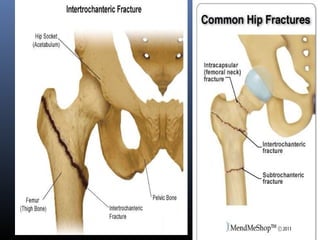
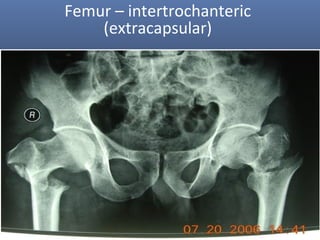
These fractures are ‘ extracapsular ’ and occur in the
wide metaphyseal region between the two
trochanters of the femur.
Why such fractures tend to unite without difficulty
and seldom cause avascular necrosis?
Because the blood supply to the fracture is adequate
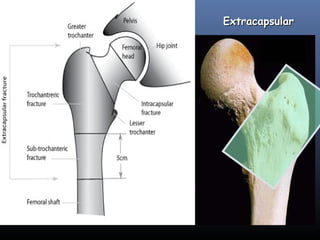
ExtracapsularExtracapsular
Femur – intertrochanteric
(extracapsular)
Intertrochanteric fracture
They are common in
Elderly, osteoporotic people; most of the patients
are women in the 8th decade.
Risk factors
-Age (>70 years)
-Sex (female>male)
-Rheumatoid arthritis
-Pathologic fractures may occur in the presence
of tumor or metastatic bone lesions.
Intertrochanteric fracture
Mechanism of injury
The fracture is caused either by a fall
directly onto the greater trochanter or by
an indirect twisting injury.
The crack runs up between the lesser and
greater trochanter and the proximal
fragment tends to displace in varus.
Intertrochanteric fracture
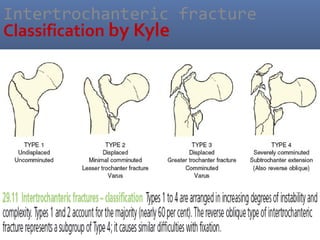
Classification by Kyle
Intertrochanteric fracture
Diagnosis:
Clinical features
1-pain
2-unable to stand.
3-The leg is shorter and
more externally rotated
than with a transcervical
fracture (because the
fracture is extracapsular)
4-The patient cannot
lift his or her leg.
5- Swelling in the
hip region
Intertrochanteric fracture
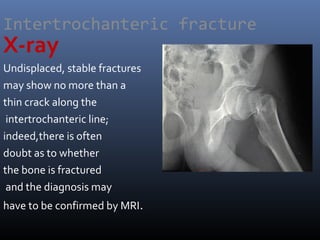
X-ray
Undisplaced, stable fractures
may show no more than a
thin crack along the
intertrochanteric line;
indeed,there is often
doubt as to whether
the bone is fractured
and the diagnosis may
have to be confirmed by MRI.
Intertrochanteric fracture
Treatment
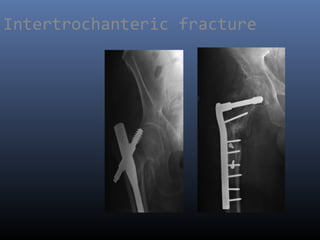
Intertrochanteric fractures are almost always
treated by early internal fixation
not because they fail to unite with conservative
treatment but
(a) to obtain the best possible position and
(b) to get the patient up and walking as soon as
possible and there by reduce the complications
associated with prolonged lying down
Intertrochanteric fracture
Treatment
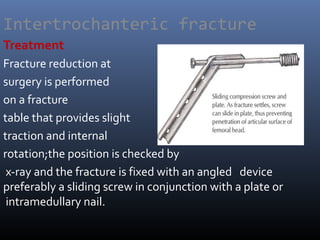
Fracture reduction at
surgery is performed
on a fracture
table that provides slight
traction and internal
rotation;the position is checked by
x-ray and the fracture is fixed with an angled device
preferably a sliding screw in conjunction with a plate or
intramedullary nail.
Intertrochanteric fracture
Treatment
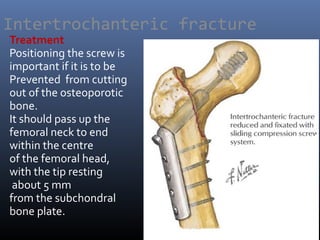
Positioning the screw is
important if it is to be
Prevented from cutting
out of the osteoporotic
bone.
It should pass up the
femoral neck to end
within the centre
of the femoral head,
with the tip resting
about 5 mm
from the subchondral
bone plate.
Intertrochanteric fracture
Treatment
Non-operative treatment may be appropriate for a
small group who are too ill to undergo anaesthesia;
traction in bed until there is sufficient reduction of
pain to allow mobilization can yield reasonable results
but much depends on the quality of nursing care and
physical therapy.
Intertrochanteric fracture
PRIMARY PROSTHETIC REPLACEMENT
 Peritrochanteric fractures in the presence of severe
arthritis of the hip, especially if the hip is stiff
 Pathologic fractures in which the bone stock
preclude internal fixation
 Unstable, severely comminuted fractures in the
very elderly, whose bone is so osteoporotic that
internal fixation, even with cement augmentation,
is expected to fail

Intertrochanteric fracture
Complications
EARLY
1-DVT
2-Pulmonary embolism
3-Bed sores
4-Hemorrhage as it’s occur in a region of ample
blood supply
Intertrochanteric fracture
Complications
LATE
1-Failed fixation Screws may cut out of the osteoporotic bone
if reduction is poor or if the fixation device is incorrectly
positioned
2-Malunion Varus and external rotation deformities are
common. Fortunately they are seldom severe and rarely
interfere with function.
3-Non-union Intertrochanteric fractures seldom fail to unite
Intertrochanteric fracture
Subtrochanteric Fracture
They are common in
 In elderly patient with osteoporosis,
osteomalacia, paget’s disease or secondary
deposit
 Blood loss is greater than with femoral neck
or trochanteric fracture
Subtrochanteric Fracture
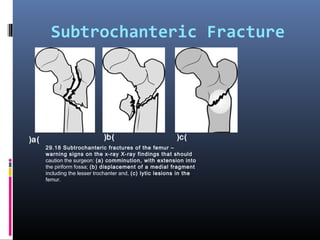
29.18 Subtrochanteric fractures of the femur –
warning signs on the x-ray X-ray findings that should
caution the surgeon: (a) comminution, with extension into
the piriform fossa; (b) displacement of a medial fragment
including the lesser trochanter and, (c) lytic lesions in the
femur.
)a( )b( )c(
Subtrochanteric Fracture
Subtrochanteric fractures have several features
which make them interesting (and challenging to
treat):
1. Blood loss is greater than with femoral neck or
trochanteric fractures – the region is covered with
anastomosing branches of the medial and lateral
circumflex femoral arteries which come off the
profunda femoris trunk
Subtrochanteric Fracture
2. There may be subtle extensions of the fracture
into the intertrochanteric region, which may
influence the manner in which internal fixation
can be performed.
3. The proximal part is abducted and externally
rotated by the gluteal muscles, and flexed by the
psoas. The shaft of the femur has to be brought
into a position to match the proximal part or else
a malunion is created by internal fixation
Subtrochanteric Fracture
Diagnosis:
Clinical features
 The leg is externally rotated and short
 The thigh is markedly swollen
 Movement is excruciating painful
Subtrochanteric Fracture
 X-ray
 The fracture is through or below the lesser trochanter.
It may be transverse, oblique or spiral, and is frequently
comminuted. The upper fragment is flexed
and appears deceptively short; the shaft is adducted
and is displaced proximally
Subtrochanteric Fracture
 Open reduction and internal fixation is the treatment
of hoice
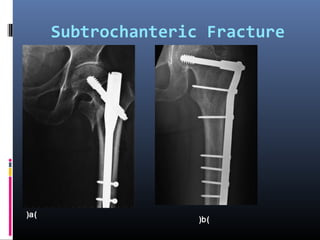
 Two main types of implant are used
For fracture fixation:
(a ) an intramedullary nail with aproximal interlocking
screw.
(b) a 95 degree hip screw-and-plate device.
Subtrochanteric Fracture
)a(
)b(
Subtrochanteric Fracture
 Treatment
Traction may help to reduce blood loss and pain. It is
an interim measure until the patient, especially if elderly
and with multiple medical problems, is stabilized
and prepared for surgery
Malunion :Is Fairly common and may need
operative correction
Non-union This occurs in about 5 per cent of cases; it
will require operative correction of any deformity,
renewed fixation and bone grafting
Intertrochanteric fracture

Intertrochanteric fracture

  • 2.
    Intertrochanteric fracture Definition : Thesefractures are ‘ extracapsular ’ and occur in the wide metaphyseal region between the two trochanters of the femur. Why such fractures tend to unite without difficulty and seldom cause avascular necrosis? Because the blood supply to the fracture is adequate
  • 3.
  • 5.
  • 6.
    Intertrochanteric fracture They arecommon in Elderly, osteoporotic people; most of the patients are women in the 8th decade. Risk factors -Age (>70 years) -Sex (female>male) -Rheumatoid arthritis -Pathologic fractures may occur in the presence of tumor or metastatic bone lesions.
  • 7.
    Intertrochanteric fracture Mechanism ofinjury The fracture is caused either by a fall directly onto the greater trochanter or by an indirect twisting injury. The crack runs up between the lesser and greater trochanter and the proximal fragment tends to displace in varus.
  • 8.
  • 9.
    Intertrochanteric fracture Diagnosis: Clinical features 1-pain 2-unableto stand. 3-The leg is shorter and more externally rotated than with a transcervical fracture (because the fracture is extracapsular) 4-The patient cannot lift his or her leg. 5- Swelling in the hip region
  • 10.
    Intertrochanteric fracture X-ray Undisplaced, stablefractures may show no more than a thin crack along the intertrochanteric line; indeed,there is often doubt as to whether the bone is fractured and the diagnosis may have to be confirmed by MRI.
  • 11.
    Intertrochanteric fracture Treatment Intertrochanteric fracturesare almost always treated by early internal fixation not because they fail to unite with conservative treatment but (a) to obtain the best possible position and (b) to get the patient up and walking as soon as possible and there by reduce the complications associated with prolonged lying down
  • 12.
    Intertrochanteric fracture Treatment Fracture reductionat surgery is performed on a fracture table that provides slight traction and internal rotation;the position is checked by x-ray and the fracture is fixed with an angled device preferably a sliding screw in conjunction with a plate or intramedullary nail.
  • 13.
    Intertrochanteric fracture Treatment Positioning thescrew is important if it is to be Prevented from cutting out of the osteoporotic bone. It should pass up the femoral neck to end within the centre of the femoral head, with the tip resting about 5 mm from the subchondral bone plate.
  • 14.
    Intertrochanteric fracture Treatment Non-operative treatmentmay be appropriate for a small group who are too ill to undergo anaesthesia; traction in bed until there is sufficient reduction of pain to allow mobilization can yield reasonable results but much depends on the quality of nursing care and physical therapy.
  • 15.
    Intertrochanteric fracture PRIMARY PROSTHETICREPLACEMENT  Peritrochanteric fractures in the presence of severe arthritis of the hip, especially if the hip is stiff  Pathologic fractures in which the bone stock preclude internal fixation  Unstable, severely comminuted fractures in the very elderly, whose bone is so osteoporotic that internal fixation, even with cement augmentation, is expected to fail 
  • 16.
    Intertrochanteric fracture Complications EARLY 1-DVT 2-Pulmonary embolism 3-Bedsores 4-Hemorrhage as it’s occur in a region of ample blood supply
  • 17.
    Intertrochanteric fracture Complications LATE 1-Failed fixationScrews may cut out of the osteoporotic bone if reduction is poor or if the fixation device is incorrectly positioned 2-Malunion Varus and external rotation deformities are common. Fortunately they are seldom severe and rarely interfere with function. 3-Non-union Intertrochanteric fractures seldom fail to unite
  • 18.
  • 19.
    Subtrochanteric Fracture They arecommon in  In elderly patient with osteoporosis, osteomalacia, paget’s disease or secondary deposit  Blood loss is greater than with femoral neck or trochanteric fracture
  • 20.
    Subtrochanteric Fracture 29.18 Subtrochantericfractures of the femur – warning signs on the x-ray X-ray findings that should caution the surgeon: (a) comminution, with extension into the piriform fossa; (b) displacement of a medial fragment including the lesser trochanter and, (c) lytic lesions in the femur. )a( )b( )c(
  • 21.
    Subtrochanteric Fracture Subtrochanteric fractureshave several features which make them interesting (and challenging to treat): 1. Blood loss is greater than with femoral neck or trochanteric fractures – the region is covered with anastomosing branches of the medial and lateral circumflex femoral arteries which come off the profunda femoris trunk
  • 22.
    Subtrochanteric Fracture 2. Theremay be subtle extensions of the fracture into the intertrochanteric region, which may influence the manner in which internal fixation can be performed. 3. The proximal part is abducted and externally rotated by the gluteal muscles, and flexed by the psoas. The shaft of the femur has to be brought into a position to match the proximal part or else a malunion is created by internal fixation
  • 23.
    Subtrochanteric Fracture Diagnosis: Clinical features The leg is externally rotated and short  The thigh is markedly swollen  Movement is excruciating painful
  • 24.
    Subtrochanteric Fracture  X-ray The fracture is through or below the lesser trochanter. It may be transverse, oblique or spiral, and is frequently comminuted. The upper fragment is flexed and appears deceptively short; the shaft is adducted and is displaced proximally
  • 25.
    Subtrochanteric Fracture  Openreduction and internal fixation is the treatment of hoice  Two main types of implant are used For fracture fixation: (a ) an intramedullary nail with aproximal interlocking screw. (b) a 95 degree hip screw-and-plate device.
  • 26.
  • 27.
    Subtrochanteric Fracture  Treatment Tractionmay help to reduce blood loss and pain. It is an interim measure until the patient, especially if elderly and with multiple medical problems, is stabilized and prepared for surgery
  • 28.
    Malunion :Is Fairlycommon and may need operative correction Non-union This occurs in about 5 per cent of cases; it will require operative correction of any deformity, renewed fixation and bone grafting