AO SEC Trauma May, 15-17, Chittagong. Welcome
Prof. Muhammad Shahiduzzaman Head, Department of Orthopaedics and Traumatology Dhaka Medical College Hospital
Definition Etiology Evaluation Classification Treatment principles Stabilization Biology Prevention
Non Union 9 months elapsed time with no healing progress for 3 months.  Union is delayed and a fracture has ceased to show any evidence of healing  Practically, A fracture that has no potential to heal without further intervention
Delayed union Failure to consolidate within the normally expected time for fracture types and location Pseudoarthrosis Formation of a false joint where a fibro-cartilaginous cavity is lined with synovial membrane
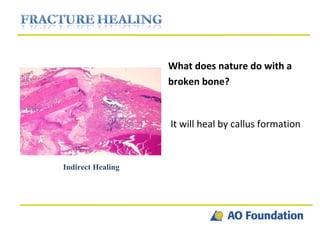
What does nature do with a broken bone? Indirect Healing It will heal by callus formation
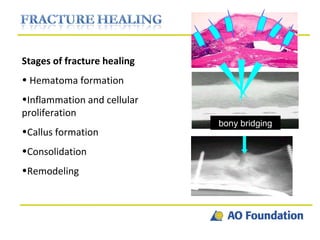
Stages of fracture healing Hematoma formation Inflammation and cellular proliferation Callus formation Consolidation Remodeling bony bridging
Poor Vascularity (biology) Instability Infection Others
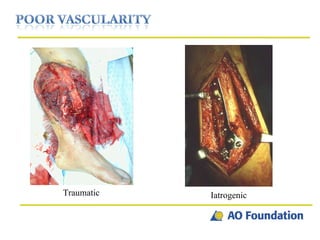
Traumatic Iatrogenic
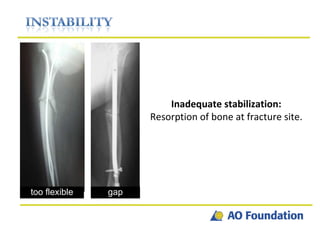
Inadequate stabilization: Resorption of bone at fracture site. too flexible gap
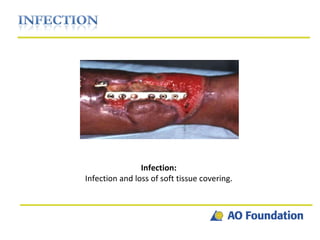
Infection: Infection and loss of soft tissue covering.
Local Risk factors Open Fractures High energy fractures with bone devitalization. Severe associated soft tissue injury Bone loss Infection
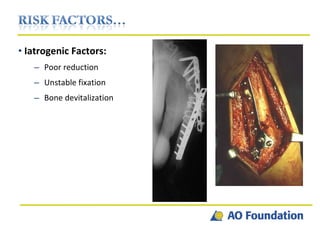
Iatrogenic Factors: Poor reduction Unstable fixation Bone devitalization
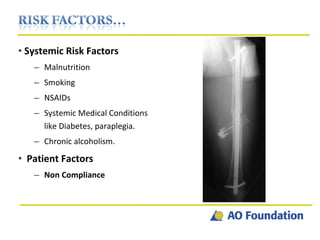
Systemic Risk Factors Malnutrition Smoking NSAIDs Systemic Medical Conditions like Diabetes, paraplegia. Chronic alcoholism. Patient Factors Non Compliance
Site - Diaphyseal - Metaphyseal: - Extraarticular - Intraarticular Callus - Hypertrophic - Oligotropic - Atropic Infection - Aseptic - Infected
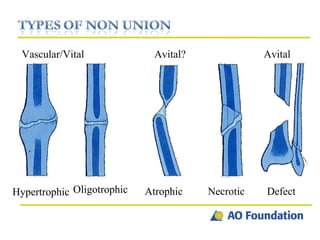
Hypertrophic Atrophic Necrotic Defect Oligotrophic Vascular/Vital Avital? Avital
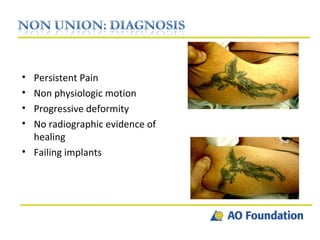
Persistent Pain Non physiologic motion Progressive deformity No radiographic evidence of healing Failing implants
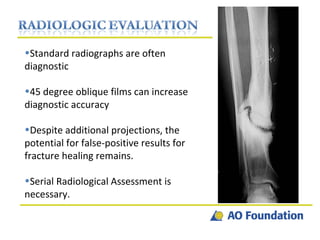
Standard radiographs are often diagnostic 45 degree oblique films can increase diagnostic accuracy Despite additional projections, the potential for false-positive results for fracture healing remains. Serial Radiological Assessment is necessary.
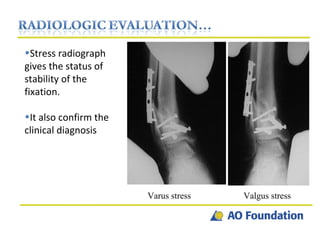
Stress radiograph gives the status of stability of the fixation. It also confirm the clinical diagnosis Varus stress  Valgus stress
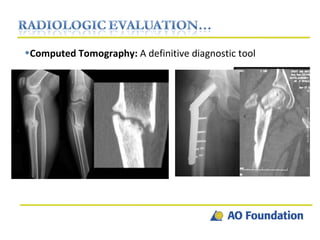
Computed Tomography:  A definitive diagnostic tool
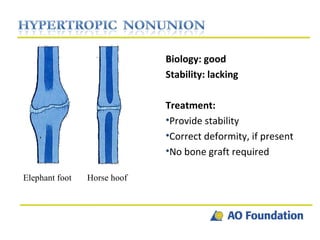
Biology: good  Stability: lacking  Treatment: Provide stability Correct deformity, if present  No bone graft required  Elephant foot  Horse hoof
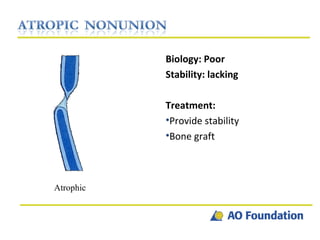
Biology: Poor Stability: lacking  Treatment: Provide stability Bone graft Atrophic
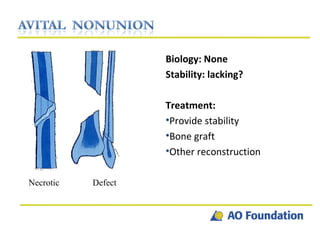
Biology: None Stability: lacking?  Treatment: Provide stability Bone graft Other reconstruction Necrotic Defect
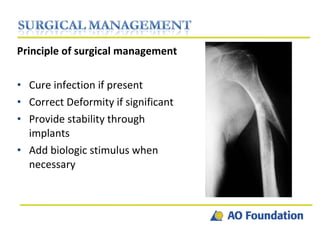
Principle of surgical management Cure infection if present Correct Deformity if significant Provide stability through implants Add biologic stimulus when necessary
Treatment principle of infected non union Contaminated implants and devitalized implants must be removed Infection treated: Temporary stabilization (external fixation) Culture specific antibiotics +/- local antibiotic delivery (antibiobic beads) Secondary stabilization with augmentation of osteogenesis (cancellous grafting)
External Fixation Plate Intramedullary Devices
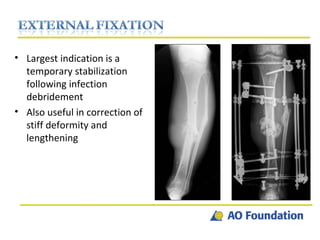
Largest indication is a temporary stabilization following infection debridement Also useful in correction of stiff deformity and lengthening
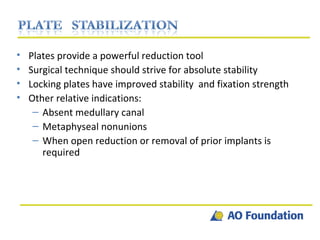
Plates provide a powerful reduction tool Surgical technique should strive for absolute stability Locking plates have improved stability  and fixation strength Other relative indications: Absent medullary canal Metaphyseal nonunions When open reduction or removal of prior implants is required
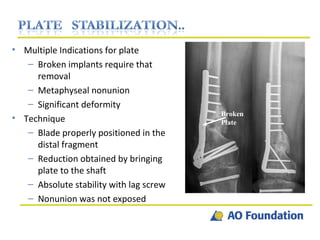
Multiple Indications for plate Broken implants require that removal Metaphyseal nonunion Significant deformity Technique Blade properly positioned in the distal fragment Reduction obtained by bringing plate to the shaft Absolute stability with lag screw Nonunion was not exposed Broken Plate
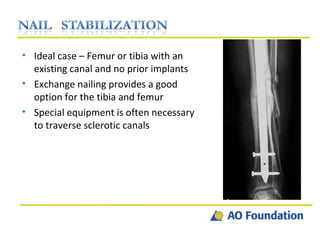
Broken Plate Ideal case – Femur or tibia with an existing canal and no prior implants Exchange nailing provides a good option for the tibia and femur Special equipment is often necessary to traverse sclerotic canals
Broken Plate Often unnecessary in hypertrophic cases with sufficient inherent biologic activity Options Aspirated stem cells (with or without expansion) Demineralized Bone Matrix Autogenous Cancellous Graft Growth Factors Platelet derived Recombinant BMPs Gene Therapy
Gold standard for biological and mechanical purposes. Properties of Autograft: Osteogenic a source of vital bone cells Osteoinductive recruitment of local mesenchymal cells Osteoconductive scaffold for ingrowth of new bone Bone graft can also be allograft.
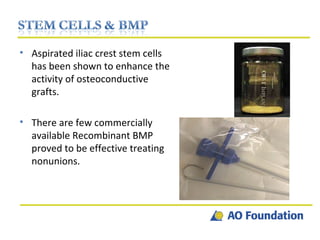
Aspirated iliac crest stem cells has been shown to enhance the activity of osteoconductive grafts. There are few commercially available Recombinant BMP proved to be effective treating nonunions.
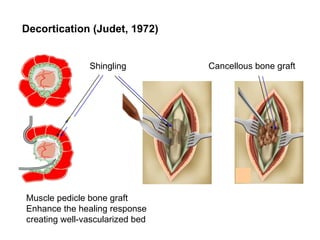
Decortication (Judet, 1972) Muscle pedicle bone graft Enhance the healing response creating well-vascularized bed Shingling Cancellous bone graft
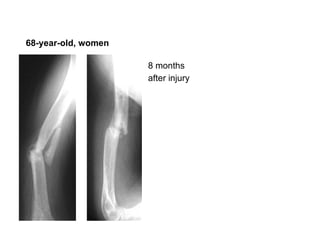
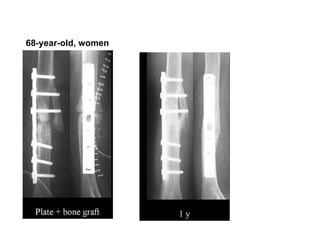
8 months after injury   68-year-old, women
68-year-old, women
Electromagnetic Direct Current Inductive coupling (PEMF, CMF) Capacitive coupling Ultrasound mechanical energy in the form of low frequency acoustic waves  30 mW/cm 2
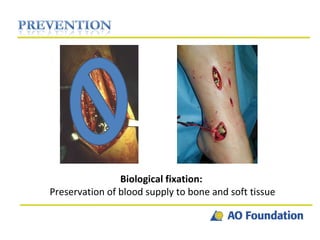
Biological fixation:  Preservation of blood supply to bone and soft tissue
The commonest cause of nonunion is the failure to diagnose and treat delayed union - Careful evaluation of abnormal findings clinically and radiologically - Adequate regimen of aftertreatment
Definition of delayed unions/nonunions and natural course of fracture healing Causes of disturbed bone healing such as vascularity, instability, and infection Principles of treatment applied based on types of nonunion: - stabilization - enhancement of biology  - eradication of infection if any How to prevent delayed unions/nonunions: - biological fixation in original operation - early recognition of delayed union
Thank You all

Non Union

  • 1.
    AO SEC TraumaMay, 15-17, Chittagong. Welcome
  • 2.
    Prof. Muhammad ShahiduzzamanHead, Department of Orthopaedics and Traumatology Dhaka Medical College Hospital
  • 3.
    Definition Etiology EvaluationClassification Treatment principles Stabilization Biology Prevention
  • 4.
    Non Union 9months elapsed time with no healing progress for 3 months. Union is delayed and a fracture has ceased to show any evidence of healing Practically, A fracture that has no potential to heal without further intervention
  • 5.
    Delayed union Failureto consolidate within the normally expected time for fracture types and location Pseudoarthrosis Formation of a false joint where a fibro-cartilaginous cavity is lined with synovial membrane
  • 6.
    What does naturedo with a broken bone? Indirect Healing It will heal by callus formation
  • 7.
    Stages of fracturehealing Hematoma formation Inflammation and cellular proliferation Callus formation Consolidation Remodeling bony bridging
  • 8.
    Poor Vascularity (biology)Instability Infection Others
  • 9.
  • 10.
    Inadequate stabilization: Resorptionof bone at fracture site. too flexible gap
  • 11.
    Infection: Infection andloss of soft tissue covering.
  • 12.
    Local Risk factorsOpen Fractures High energy fractures with bone devitalization. Severe associated soft tissue injury Bone loss Infection
  • 13.
    Iatrogenic Factors: Poorreduction Unstable fixation Bone devitalization
  • 14.
    Systemic Risk FactorsMalnutrition Smoking NSAIDs Systemic Medical Conditions like Diabetes, paraplegia. Chronic alcoholism. Patient Factors Non Compliance
  • 15.
    Site - Diaphyseal- Metaphyseal: - Extraarticular - Intraarticular Callus - Hypertrophic - Oligotropic - Atropic Infection - Aseptic - Infected
  • 16.
    Hypertrophic Atrophic NecroticDefect Oligotrophic Vascular/Vital Avital? Avital
  • 17.
    Persistent Pain Nonphysiologic motion Progressive deformity No radiographic evidence of healing Failing implants
  • 18.
    Standard radiographs areoften diagnostic 45 degree oblique films can increase diagnostic accuracy Despite additional projections, the potential for false-positive results for fracture healing remains. Serial Radiological Assessment is necessary.
  • 19.
    Stress radiograph givesthe status of stability of the fixation. It also confirm the clinical diagnosis Varus stress Valgus stress
  • 20.
    Computed Tomography: A definitive diagnostic tool
  • 21.
    Biology: good Stability: lacking Treatment: Provide stability Correct deformity, if present No bone graft required Elephant foot Horse hoof
  • 22.
    Biology: Poor Stability:lacking Treatment: Provide stability Bone graft Atrophic
  • 23.
    Biology: None Stability:lacking? Treatment: Provide stability Bone graft Other reconstruction Necrotic Defect
  • 24.
    Principle of surgicalmanagement Cure infection if present Correct Deformity if significant Provide stability through implants Add biologic stimulus when necessary
  • 25.
    Treatment principle ofinfected non union Contaminated implants and devitalized implants must be removed Infection treated: Temporary stabilization (external fixation) Culture specific antibiotics +/- local antibiotic delivery (antibiobic beads) Secondary stabilization with augmentation of osteogenesis (cancellous grafting)
  • 26.
    External Fixation PlateIntramedullary Devices
  • 27.
    Largest indication isa temporary stabilization following infection debridement Also useful in correction of stiff deformity and lengthening
  • 28.
    Plates provide apowerful reduction tool Surgical technique should strive for absolute stability Locking plates have improved stability and fixation strength Other relative indications: Absent medullary canal Metaphyseal nonunions When open reduction or removal of prior implants is required
  • 29.
    Multiple Indications forplate Broken implants require that removal Metaphyseal nonunion Significant deformity Technique Blade properly positioned in the distal fragment Reduction obtained by bringing plate to the shaft Absolute stability with lag screw Nonunion was not exposed Broken Plate
  • 30.
    Broken Plate Idealcase – Femur or tibia with an existing canal and no prior implants Exchange nailing provides a good option for the tibia and femur Special equipment is often necessary to traverse sclerotic canals
  • 31.
    Broken Plate Oftenunnecessary in hypertrophic cases with sufficient inherent biologic activity Options Aspirated stem cells (with or without expansion) Demineralized Bone Matrix Autogenous Cancellous Graft Growth Factors Platelet derived Recombinant BMPs Gene Therapy
  • 32.
    Gold standard forbiological and mechanical purposes. Properties of Autograft: Osteogenic a source of vital bone cells Osteoinductive recruitment of local mesenchymal cells Osteoconductive scaffold for ingrowth of new bone Bone graft can also be allograft.
  • 33.
    Aspirated iliac creststem cells has been shown to enhance the activity of osteoconductive grafts. There are few commercially available Recombinant BMP proved to be effective treating nonunions.
  • 34.
    Decortication (Judet, 1972)Muscle pedicle bone graft Enhance the healing response creating well-vascularized bed Shingling Cancellous bone graft
  • 35.
    8 months afterinjury 68-year-old, women
  • 36.
  • 37.
    Electromagnetic Direct CurrentInductive coupling (PEMF, CMF) Capacitive coupling Ultrasound mechanical energy in the form of low frequency acoustic waves 30 mW/cm 2
  • 38.
    Biological fixation: Preservation of blood supply to bone and soft tissue
  • 39.
    The commonest causeof nonunion is the failure to diagnose and treat delayed union - Careful evaluation of abnormal findings clinically and radiologically - Adequate regimen of aftertreatment
  • 40.
    Definition of delayedunions/nonunions and natural course of fracture healing Causes of disturbed bone healing such as vascularity, instability, and infection Principles of treatment applied based on types of nonunion: - stabilization - enhancement of biology - eradication of infection if any How to prevent delayed unions/nonunions: - biological fixation in original operation - early recognition of delayed union
  • 41.