Presenter:
Chong Song Ying
Song Zhi Liang
Song Poh Siang
Emmanuel Xavier Raj
Supervisor: Mr Sanjeevan
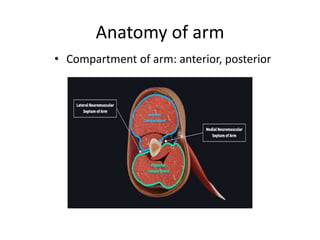
Anatomy of arm
• Compartment of arm: anterior, posterior
Anterior compartment
• Muscles: Bicep brachii,
coracobrachialis, brachialis
• Blood supply: Brachial
artery
• Nerve supply:
Musculocutaneous nerve
• Structures pass through
compartments:
– Musculocutaneous nerve
– median nerve
– ulnar nerve
– Brachial artery
– Basilic vein
Posterior compartment
• Muscle: Tricep muscle
• Nerve supply: Radial
nerve
• Blood supply:
Profundus brachiiand
ulnar collateral arteries
• Structure passing
through compartment:
– Radial nerve
– ulnar nerve
Forearm compartments
1. volar (most commonly
affected)
I. superficial
II. Deep
2. dorsal
3. mobile wad (lateral)
• rarely involved
• muscles:
– brachioradialis
– extensor carpi radialis longus
– extensor carpi radialis brevis
Volar compartment of forearm
Superficial
• Flexor carpi radialis
• Flexor carpi ulnaris
• Flexor digitorum
superficialis
• Palmaris longus
• Pronator teres
Deep
• Flexor digitorum profundus
• Flexor pollicis longus
• Pronator quadratus
Dorsal compartment of forearm
• Superficial muscle:
supply by radial nerve
• Deep muscle: supply by
radial nerve
Compartment of hand
10 in total
• hypothenar
• thenar
• adductor pollicis
• dorsal interosseous (x4)
• volar (palmar)
interosseous (x3)
ANATOMY OF LOWER LIMB
COMPARTMENTS OF THIGH
COMPARTMENTS OF LEG
COMPARTMENTS OF THE FOOT
9 MAIN COMPARTMENTS
MEDIAL
• abductor hallucis
• flexor hallucis brevis
LATERAL
• abductor digiti minimi
• flexor digiti minimi brevis
INTEROSSEOUS (X4)
CENTRAL (X3)
superficial
• flexor digitorum brevis
central
• quadratus plantae
deep
• adductor hallucis
• posterior tibial neurovascular bundle
The normal pressure within the compartment is
between 0 mmHg to 8 mmHg
The increased compartment pressure restricts local
tissue perfusion by reducing the arteriovenous
pressure gradient (reduced arterial pressure,
increased venous pressure)
If prolonged, cellular anoxia occurs leading to
damage to nerve and muscle tissues.
A vicious cycle ensues, in which capillary flow
deteriorates owing to an increase in compartment
pressure, which further reduces tissue perfusion,
enhancing blood vessel permeability and further
increasing internal pressure.
Inadequate venous drainage further increases
pressure.
Acute Compartment Syndrome
Oak NR, Abrams RA. Compartment Syndrome of the Hand. Orthop Clin North Am. 2016 Jul;47(3):609-16. doi: 10.1016/j.ocl.2016.03.006. PMID: 27241383.
Elliott KG, Johnstone AJ. Diagnosing acute compartment syndrome. J Bone Joint Surg Br. 2003 Jul;85(5):625-32. PMID: 12892179.
Common Causes
• Intrinsic vs Extrinsic causes
– Intrinsic causes (Bleeding, Oedema)
– Extrinsic causes (Tightly applied casts and splints)
• Long bone fractures (75%)
– Tibia
– Comminuted fractures
– Forearm
• Burn injury
– Full-thickness burns
– Large fluid shifts associated with burn resuscitation contribute to tissue edema
– Burn eschar may restrict tissue swelling
• Crush injury
• Snakebite (due to location of most snakebites)
– Most snakes deposit venom into subcutaneous tissue - rarely affects compartment pressure.
– Snakes (eg, rattlesnakes) with longer fangs can inject venom directly into the muscular compartment.
• Extravasation injury-
Elliott KG, Johnstone AJ. Diagnosing acute compartment syndrome. J Bone Joint Surg Br. 2003
Jul;85(5):625-32. PMID: 12892179.
Diagnosis Criteria(Clinical)
Signs and Symptoms
Physical examination alone has limited sensitivity and specificity for ACS. Serial examinations are
important in patients at risk. Clinical features include:
• Significant extremity pain is the primary feature; pain can be "out of proportion" to apparent
injury.
• Pain and other features can progress rapidly over a few hours.
• Tense, firm compartment (note: deep posterior compartment of the leg cannot be palpated).
• Pain exacerbated by passive stretch of muscle within the compartment.
• Compartment-specific neurovascular findings (eg, paresthesias, reduced sensation, muscle
weakness, diminished pulses).
Other clinical findings that suggest impending ACS include:
• Excessive or disproportionate increase in extremity girth.
• Acidosis or hyperkalemia following reperfusion.
• Clinical evidence of rhabdomyolysis (eg, high CK >30,000 units).
Clinical features
Physical examination alone has limited sensitivity and specificity for ACS. Serial examinations are
important in patients at risk. Clinical features include:
•Significant extremity pain is the primary feature; pain can be "out of proportion" to apparent
injury.
•Pain and other features can progress rapidly over a few hours.
•Tense, firm compartment (note: deep posterior compartment of the leg cannot be palpated).
•Pain exacerbated by passive stretch of muscle within the compartment.
•Compartment-specific neurovascular findings (eg, paresthesias, reduced sensation, muscle
weakness, diminished pulses).

Other clinical findings that suggest impending ACS include:
•Excessive or disproportionate increase in extremity girth.
•Acidosis or hyperkalemia following reperfusion.
•Clinical evidence of rhabdomyolysis (eg, high CK >30,000 units).
Tissue Survival Rate
Muscle:
3-4 Hr – Reversible changes
6 Hr - Variable damage
8 Hr - Irreversible changes
Nerve:
2 Hr - Loose nerve conduction
4 Hr - neuropraxia
8 Hr - Irreversible changes
Measurement of intercompartmental pressure
Needle placement when
measuring pressures for
each of the four leg
compartments:
(A) Anterior
(B) Lateral
(C) Deep posterior
(D) superficial posterior
Horizontal positioning of
the needle for entry is
preferred and may be
required to access the
deep posterior
compartment.
Chronic Exertional Compartment Syndrome
• Reversible form of acute compartment syndrome that develops when increased
hydrostatic pressure within a skeletal muscle compartment compromises local
tissue perfusion leading to pain and other symptoms.
• The typical patient with CECS is a young athlete, often a runner, describes
gradually increasing pain in a specific muscle region (usually the lower leg)
during physical exertion.
• Pain develops shortly after the start of exercise and resolves soon (typically within
10 to 20 minutes) after the activity stops. The pain may be described as aching,
squeezing, cramping, or tightness.
• Patients with CECS are typically asymptomatic at rest and during activities of
daily living
• Many conditions can mimic CECS, including medial tibial stress syndrome (shin
splints), stress fracture of the tibia or fibula, tendinopathy, and deep vein
thrombosis.
Chronic Exertional Compartment Syndrome
Surgical Management of
Compartment Syndrome
Immediate management
• Removal of external compressive forces and releasing casts or
dressing down to skin
• Limb should not be elevated, instead kept at the level of heart
• Early assessment of hypovolaemia, metabolic acidosis and
myoglobinaemia is mandatory to avoid potential renal failure
• Intravenous fluids and supplemental oxygen may be needed
• If the clinical features of ACS do not improve following simple
measures, definitive surgical fasciotomy is required
• 8 hour ischemia time can cause irreversible damage to muscle
Fasciotomy
Principles
• adequate and extensile incision
• complete release of all compartments
• preservation of vital structure
• thorough debridement
• skin coverage at a later date (7-10 days)
Compartments of Thigh
Fasciotomy of the thigh
• Single lateral incision is usually
adequate to decompress the thigh
• Medial compartment rarely involved
• Mid lateral skin incision of the thigh
Compartments of leg
Most common occur in the anterior
compartment of the leg
Fasciotomy of
the leg
• Lateral leg
incision Is
made halfway
between the
tibia and the
fibula for the
release of the
anterior and
lateral
compartent.
Fasciotomy of
the leg
• Medial leg
incision is made
2cm posterior to
the tibia for the
release of the
deep and
superficial
posterior
compartment.
Fasciotomy of the foot
• Two dorsal incisions centered
over the 2nd and the 4th
metatarsals
Fasciotomy of foot
• Medial incision to release medial and central compartment of foot
Compartment of the forearm
Fasciotomy forearm
Volar part:
• Skin incision
• Release of superficial
volar compartment
• Release of deep volar
compartment
Fasciotomy forearm
Dorsal incision
• Skin incision
• Release of dorsal
compartment
10 compartments in the hand
• Dorsal incision of the hand in line
with 2nd and 4th metacarpals
Hand Fasciotomy
• incision made along radial aspect of 1st metacarpal to release thenar
compartment
• incision made along ulnar aspect of 5th metacarpal to release
hypothenar compartment
Hand Fasciotomy
Hand Fasciotomy
Hand fasciotomy
Wound management
Wet to dry dressing.
• Wet or moist
gauze/cloth is
dressed on the
wound.
• Often be replaced
• Will remove wound
drainage and dead
tissue
• Reduce chance of
infection
Wound management
Vacuum dressing
• Negative pressure wound
therapy
• Reduce swelling
• Promote tissue granulation
• Increase tissue perfusion
• Keep the wound cover which
limits the chances of wound
infection.
Benefits :
• Faster wound closure
• Reduce scarring
• Lower complication rate of
following fasciotomy
Thank you

Compartment_Syndrome_CME-1.pptx

  • 1.
    Presenter: Chong Song Ying SongZhi Liang Song Poh Siang Emmanuel Xavier Raj Supervisor: Mr Sanjeevan
  • 2.
    Anatomy of arm •Compartment of arm: anterior, posterior
  • 3.
    Anterior compartment • Muscles:Bicep brachii, coracobrachialis, brachialis • Blood supply: Brachial artery • Nerve supply: Musculocutaneous nerve • Structures pass through compartments: – Musculocutaneous nerve – median nerve – ulnar nerve – Brachial artery – Basilic vein
  • 6.
    Posterior compartment • Muscle:Tricep muscle • Nerve supply: Radial nerve • Blood supply: Profundus brachiiand ulnar collateral arteries • Structure passing through compartment: – Radial nerve – ulnar nerve
  • 8.
    Forearm compartments 1. volar(most commonly affected) I. superficial II. Deep 2. dorsal 3. mobile wad (lateral) • rarely involved • muscles: – brachioradialis – extensor carpi radialis longus – extensor carpi radialis brevis
  • 9.
    Volar compartment offorearm Superficial • Flexor carpi radialis • Flexor carpi ulnaris • Flexor digitorum superficialis • Palmaris longus • Pronator teres Deep • Flexor digitorum profundus • Flexor pollicis longus • Pronator quadratus
  • 10.
    Dorsal compartment offorearm • Superficial muscle: supply by radial nerve • Deep muscle: supply by radial nerve
  • 12.
    Compartment of hand 10in total • hypothenar • thenar • adductor pollicis • dorsal interosseous (x4) • volar (palmar) interosseous (x3)
  • 14.
  • 16.
  • 17.
  • 22.
    COMPARTMENTS OF THEFOOT 9 MAIN COMPARTMENTS MEDIAL • abductor hallucis • flexor hallucis brevis LATERAL • abductor digiti minimi • flexor digiti minimi brevis INTEROSSEOUS (X4) CENTRAL (X3) superficial • flexor digitorum brevis central • quadratus plantae deep • adductor hallucis • posterior tibial neurovascular bundle
  • 25.
    The normal pressurewithin the compartment is between 0 mmHg to 8 mmHg The increased compartment pressure restricts local tissue perfusion by reducing the arteriovenous pressure gradient (reduced arterial pressure, increased venous pressure) If prolonged, cellular anoxia occurs leading to damage to nerve and muscle tissues. A vicious cycle ensues, in which capillary flow deteriorates owing to an increase in compartment pressure, which further reduces tissue perfusion, enhancing blood vessel permeability and further increasing internal pressure. Inadequate venous drainage further increases pressure. Acute Compartment Syndrome Oak NR, Abrams RA. Compartment Syndrome of the Hand. Orthop Clin North Am. 2016 Jul;47(3):609-16. doi: 10.1016/j.ocl.2016.03.006. PMID: 27241383. Elliott KG, Johnstone AJ. Diagnosing acute compartment syndrome. J Bone Joint Surg Br. 2003 Jul;85(5):625-32. PMID: 12892179.
  • 26.
    Common Causes • Intrinsicvs Extrinsic causes – Intrinsic causes (Bleeding, Oedema) – Extrinsic causes (Tightly applied casts and splints) • Long bone fractures (75%) – Tibia – Comminuted fractures – Forearm • Burn injury – Full-thickness burns – Large fluid shifts associated with burn resuscitation contribute to tissue edema – Burn eschar may restrict tissue swelling • Crush injury • Snakebite (due to location of most snakebites) – Most snakes deposit venom into subcutaneous tissue - rarely affects compartment pressure. – Snakes (eg, rattlesnakes) with longer fangs can inject venom directly into the muscular compartment. • Extravasation injury- Elliott KG, Johnstone AJ. Diagnosing acute compartment syndrome. J Bone Joint Surg Br. 2003 Jul;85(5):625-32. PMID: 12892179.
  • 27.
  • 28.
    Signs and Symptoms Physicalexamination alone has limited sensitivity and specificity for ACS. Serial examinations are important in patients at risk. Clinical features include: • Significant extremity pain is the primary feature; pain can be "out of proportion" to apparent injury. • Pain and other features can progress rapidly over a few hours. • Tense, firm compartment (note: deep posterior compartment of the leg cannot be palpated). • Pain exacerbated by passive stretch of muscle within the compartment. • Compartment-specific neurovascular findings (eg, paresthesias, reduced sensation, muscle weakness, diminished pulses). Other clinical findings that suggest impending ACS include: • Excessive or disproportionate increase in extremity girth. • Acidosis or hyperkalemia following reperfusion. • Clinical evidence of rhabdomyolysis (eg, high CK >30,000 units).
  • 29.
    Clinical features Physical examinationalone has limited sensitivity and specificity for ACS. Serial examinations are important in patients at risk. Clinical features include: •Significant extremity pain is the primary feature; pain can be "out of proportion" to apparent injury. •Pain and other features can progress rapidly over a few hours. •Tense, firm compartment (note: deep posterior compartment of the leg cannot be palpated). •Pain exacerbated by passive stretch of muscle within the compartment. •Compartment-specific neurovascular findings (eg, paresthesias, reduced sensation, muscle weakness, diminished pulses). ¶ Other clinical findings that suggest impending ACS include: •Excessive or disproportionate increase in extremity girth. •Acidosis or hyperkalemia following reperfusion. •Clinical evidence of rhabdomyolysis (eg, high CK >30,000 units).
  • 30.
    Tissue Survival Rate Muscle: 3-4Hr – Reversible changes 6 Hr - Variable damage 8 Hr - Irreversible changes Nerve: 2 Hr - Loose nerve conduction 4 Hr - neuropraxia 8 Hr - Irreversible changes
  • 31.
    Measurement of intercompartmentalpressure Needle placement when measuring pressures for each of the four leg compartments: (A) Anterior (B) Lateral (C) Deep posterior (D) superficial posterior Horizontal positioning of the needle for entry is preferred and may be required to access the deep posterior compartment.
  • 33.
    Chronic Exertional CompartmentSyndrome • Reversible form of acute compartment syndrome that develops when increased hydrostatic pressure within a skeletal muscle compartment compromises local tissue perfusion leading to pain and other symptoms. • The typical patient with CECS is a young athlete, often a runner, describes gradually increasing pain in a specific muscle region (usually the lower leg) during physical exertion. • Pain develops shortly after the start of exercise and resolves soon (typically within 10 to 20 minutes) after the activity stops. The pain may be described as aching, squeezing, cramping, or tightness. • Patients with CECS are typically asymptomatic at rest and during activities of daily living • Many conditions can mimic CECS, including medial tibial stress syndrome (shin splints), stress fracture of the tibia or fibula, tendinopathy, and deep vein thrombosis.
  • 34.
  • 35.
  • 36.
    Immediate management • Removalof external compressive forces and releasing casts or dressing down to skin • Limb should not be elevated, instead kept at the level of heart • Early assessment of hypovolaemia, metabolic acidosis and myoglobinaemia is mandatory to avoid potential renal failure • Intravenous fluids and supplemental oxygen may be needed • If the clinical features of ACS do not improve following simple measures, definitive surgical fasciotomy is required • 8 hour ischemia time can cause irreversible damage to muscle
  • 37.
    Fasciotomy Principles • adequate andextensile incision • complete release of all compartments • preservation of vital structure • thorough debridement • skin coverage at a later date (7-10 days)
  • 38.
  • 39.
    Fasciotomy of thethigh • Single lateral incision is usually adequate to decompress the thigh • Medial compartment rarely involved • Mid lateral skin incision of the thigh
  • 41.
    Compartments of leg Mostcommon occur in the anterior compartment of the leg
  • 42.
    Fasciotomy of the leg •Lateral leg incision Is made halfway between the tibia and the fibula for the release of the anterior and lateral compartent.
  • 43.
    Fasciotomy of the leg •Medial leg incision is made 2cm posterior to the tibia for the release of the deep and superficial posterior compartment.
  • 46.
    Fasciotomy of thefoot • Two dorsal incisions centered over the 2nd and the 4th metatarsals
  • 47.
    Fasciotomy of foot •Medial incision to release medial and central compartment of foot
  • 49.
  • 50.
    Fasciotomy forearm Volar part: •Skin incision • Release of superficial volar compartment • Release of deep volar compartment
  • 51.
    Fasciotomy forearm Dorsal incision •Skin incision • Release of dorsal compartment
  • 55.
  • 56.
    • Dorsal incisionof the hand in line with 2nd and 4th metacarpals Hand Fasciotomy
  • 57.
    • incision madealong radial aspect of 1st metacarpal to release thenar compartment • incision made along ulnar aspect of 5th metacarpal to release hypothenar compartment Hand Fasciotomy
  • 58.
  • 59.
  • 60.
    Wound management Wet todry dressing. • Wet or moist gauze/cloth is dressed on the wound. • Often be replaced • Will remove wound drainage and dead tissue • Reduce chance of infection
  • 61.
    Wound management Vacuum dressing •Negative pressure wound therapy • Reduce swelling • Promote tissue granulation • Increase tissue perfusion • Keep the wound cover which limits the chances of wound infection. Benefits : • Faster wound closure • Reduce scarring • Lower complication rate of following fasciotomy
  • 63.

Editor's Notes

  • #42 ** Ant: EHL Lat: Peroneus longus, peroneus brevis Sup post: Gastroc, Soleus Deep post: FHL (do FHL ex) tension- should not have pain, if pain, ACS) Most common occur in the anterior compartment of the leg
  • #47 releases 1st and 2nd interosseous, medial, and deep central compartment dorsal lateral incision ateral to 4th metatarsal releases 3rd and 4th interosseous, lateral, superficial and middle central compartments
  • #50 Dorsal: Extensor digitorum Extensor digiti minimi Extensor carpi ulnaris Abductor pollicis longus Extensor pollicis brevis Extensor pollicis longus Nerve : post interosseous nerve Henry’s mobile wad compartment: Brachioradialis Extensor carpi radialis longus and brevis Nerve: superficial rdial nerve Superficiak volar compartment: Flexor carpi ulnaris Palmaris longus Flexor digitorum superficialis Flexor carpi radialis Pronator teres Nerve: median and ulnar nerve Deep : Flexor digitorum profundus Palmaris longus Flexor pollicis longus Nerve ; ant interosseous nerve
  • #60 Left- carpal tunnel release