Speaker-Dr. Mithilesh Ranjan
 Definition
 Types
 Pathophysiology
 Etiology
 Clinical evaluation
 Diagnosis
 Management
 Complications
Compartment syndrome is a clinical condition
characterized by the increased tissue pressure
within a closed anatomic space that
compromises the circulation and function of
that space.
True Orthopaedic Emergency
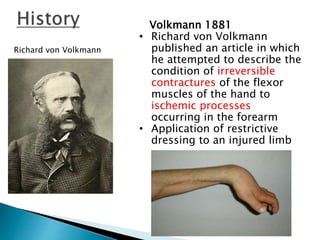
Richard von Volkmann
Volkmann 1881
• Richard von Volkmann
published an article in which
he attempted to describe the
condition of irreversible
contractures of the flexor
muscles of the hand to
ischemic processes
occurring in the forearm
• Application of restrictive
dressing to an injured limb
Hildebrand 1906
• First used the term Volkmann ischemic
contracture to describe the final result of any
untreated compartment syndrome, and was
the first to suggest that elevated tissue
pressure may be related to ischemic
contracture.
Thomas 1909
• Reviewed the 112 published cases of Volkmann
ischemic contracture and found fractures to be
the predominant cause. Also, noted that tight
bandages, an arterial embolus, or arterial
insufficiency could also lead to the problem
Murphy 1914
• First to suggest that fasciotomy might prevent
the contracture. Also, suggested that tissue
pressure and fasciotomy were related to the
development of contracture
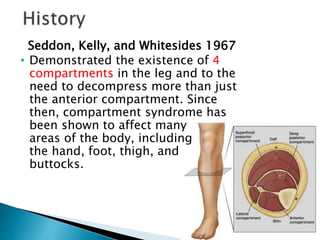
Seddon, Kelly, and Whitesides 1967
• Demonstrated the existence of 4
compartments in the leg and to the
need to decompress more than just
the anterior compartment. Since
then, compartment syndrome has
been shown to affect many
areas of the body, including
the hand, foot, thigh, and
buttocks.
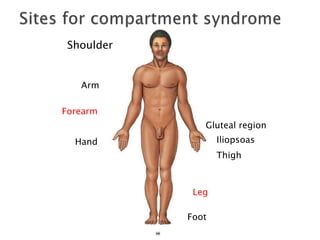
Shoulder
Arm
Forearm
Hand
Gluteal region
Thigh
Iliopsoas
Foot
Leg
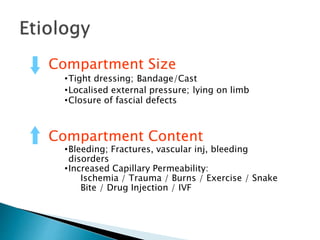
Compartment Size
•Tight dressing; Bandage/Cast
•Localised external pressure; lying on limb
•Closure of fascial defects
Compartment Content
•Bleeding; Fractures, vascular inj, bleeding
disorders
•Increased Capillary Permeability:
Ischemia / Trauma / Burns / Exercise / Snake
Bite / Drug Injection / IVF
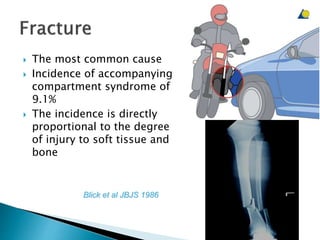
 The most common cause
 Incidence of accompanying
compartment syndrome of
9.1%
 The incidence is directly
proportional to the degree
of injury to soft tissue and
bone
Blick et al JBJS 1986
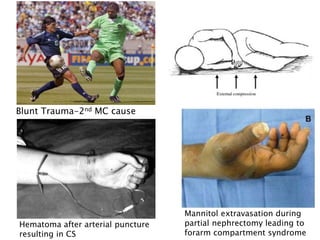
Blunt Trauma-2nd MC cause
Mannitol extravasation during
partial nephrectomy leading to
forarm compartment syndrome
Hematoma after arterial puncture
resulting in CS
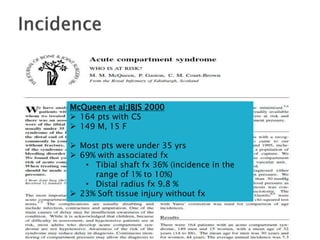
McQueen et al;JBJS 2000
 164 pts with CS
 149 M, 15 F
 Most pts were under 35 yrs
 69% with associated fx
• Tibial shaft fx 36% (incidence in the
range of 1% to 10%)
• Distal radius fx 9.8 %
 23% Soft tissue injury without fx
 Acute compartment syndrome
 Medical emergency
 Requires urgent intervention to correct
 Can lead to permanent muscle and nerve damage and
can result in the loss of function of the limb.
 Chronic compartment syndrome
 Also known as exertional compartment syndrome
 Not a medical emergency
 Most often caused by athletic exertion
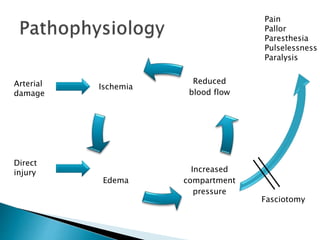
Ischemia
Edema
Increased
compartment
pressure
Reduced
blood flow
Arterial
damage
Direct
injury
Pain
Pallor
Paresthesia
Pulselessness
Paralysis
Fasciotomy
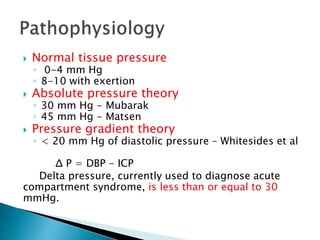
 Normal tissue pressure
◦ 0-4 mm Hg
◦ 8-10 with exertion
 Absolute pressure theory
◦ 30 mm Hg - Mubarak
◦ 45 mm Hg - Matsen
 Pressure gradient theory
◦ < 20 mm Hg of diastolic pressure – Whitesides et al
Δ P = DBP - ICP
Delta pressure, currently used to diagnose acute
compartment syndrome, is less than or equal to 30
mmHg.
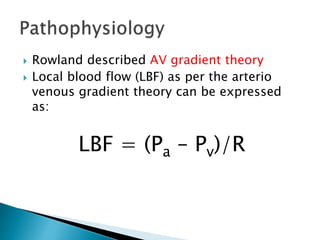
 Rowland described AV gradient theory
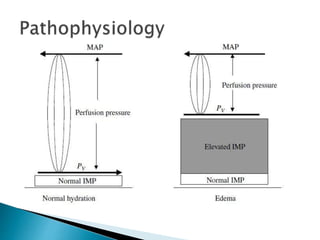
 Local blood flow (LBF) as per the arterio
venous gradient theory can be expressed
as:
LBF = (Pa – Pv)/R
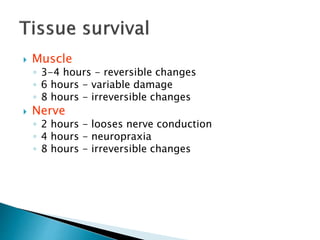
 Muscle
◦ 3-4 hours - reversible changes
◦ 6 hours - variable damage
◦ 8 hours - irreversible changes
 Nerve
◦ 2 hours - looses nerve conduction
◦ 4 hours - neuropraxia
◦ 8 hours - irreversible changes
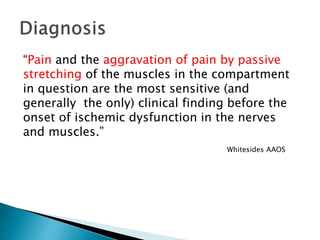
“Pain and the aggravation of pain by passive
stretching of the muscles in the compartment
in question are the most sensitive (and
generally the only) clinical finding before the
onset of ischemic dysfunction in the nerves
and muscles.”
Whitesides AAOS
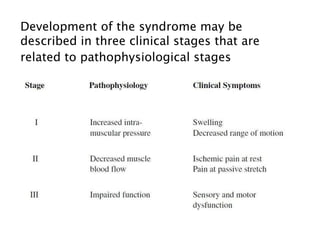
Development of the syndrome may be
described in three clinical stages that are
related to pathophysiological stages
History- Tightness of compartment, local
pain,duration
Clinical examination: the P’s
 Pain out of proportion
 Palpably tense compartment
 Pain with passive stretch
 Paresthesia/hypoesthesia
 Paralysis
 Pulselessness/Pallor
Compartment pressures- Objective parameter
Lab tests: CPK, Urine myoglobin
Pulse oximetry
 Is helpful in identifying limb hypoperfusion
 Is not sensitive enough to exclude compartment
syndrome.
Most reliable
Pain
 First symptom
 Classically out of proportion to injury
 Exaggerated with passive stretch of involved
muscles in compartment
 Earliest symptom but inconsistent, minimal in
deep post. compartment
 Not applicable in unconscious/obtunded
patient
Tense compartment
 Early finding
 Compared to other side
Paresthesia
 Peripheral nerve tissue is more sensitive than
muscle to ischemia.
 Difficult to interpret
 Will progress to anesthesia if pressure not
relieved
Paralysis
 Very late finding
Irreversible nerve and muscle damage present.
 Paresis may be present early
Difficult to evaluate because of pain
If motor deficit develops, full recovery is rare
Pallor and Pulselessness
 Rarely present
Indicates direct damage to vessels rather than
compartment syndrome (therefore arteriography
indicated)
Vascular injury may be more of contributing factor to
syndrome rather than result.
 Beware of epidural analgesia
 Beware long acting nerve blocks
 Beware of controlled intravenous opiate
analgesia
 Raised tissue pressure is primary event in
compartment syndrome and changes in ICP
precede the clinical signs and symptoms.
 When to monitor ?
 Where to monitor ?
 Threshold for diagnosis of Compartment
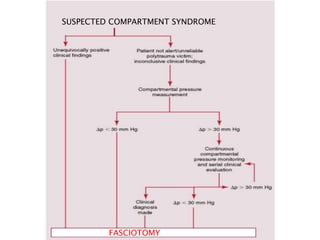
syndrome and fasciotomy ?
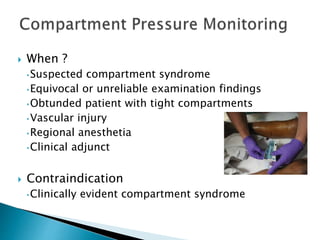
 When ?
•Suspected compartment syndrome
•Equivocal or unreliable examination findings
•Obtunded patient with tight compartments
•Vascular injury
•Regional anesthetia
•Clinical adjunct
 Contraindication
•Clinically evident compartment syndrome
Harris et al, J Trauma
 Randomized 200 acute extra articular tibia fractures
• Monitored – 36 hrs continuous pressure monitoring
• Nonmonitored - Usual post operative observation
 Patients were followed up for a minimum of 6 months or
till fracture union
Results
 5 cases of CS in nonmonitored group and 0 cases in
monitored group
 Monitored group18 patients had Δ P < 30 mm Hg, none of
them developed CS or late sequelae
Conclusion
In awake and alert pt. dx of CS using clinical signs in
appropriate time is possible and continuous compartment
pressure monitoring is not indicated.
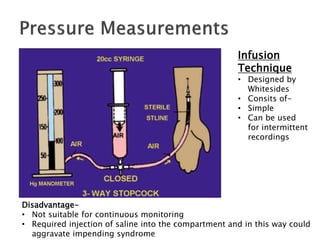
Infusion
Technique
• Designed by
Whitesides
• Consits of-
• Simple
• Can be used
for intermittent
recordings
Disadvantage-
• Not suitable for continuous monitoring
• Required injection of saline into the compartment and in this way could
aggravate impending syndrome
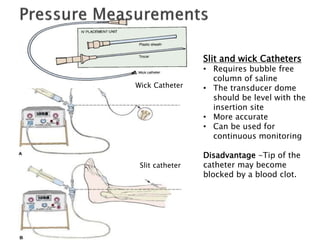
Wick Catheter
Slit catheter
Slit and wick Catheters
• Requires bubble free
column of saline
• The transducer dome
should be level with the
insertion site
• More accurate
• Can be used for
continuous monitoring
Disadvantage -Tip of the
catheter may become
blocked by a blood clot.
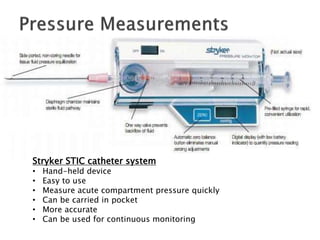
Stryker STIC catheter system
• Hand-held device
• Easy to use
• Measure acute compartment pressure quickly
• Can be carried in pocket
• More accurate
• Can be used for continuous monitoring
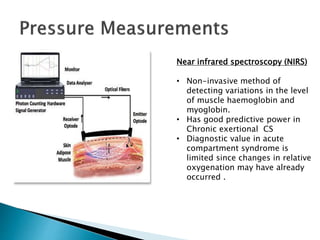
Near infrared spectroscopy (NIRS)
• Non-invasive method of
detecting variations in the level
of muscle haemoglobin and
myoglobin.
• Has good predictive power in
Chronic exertional CS
• Diagnostic value in acute
compartment syndrome is
limited since changes in relative
oxygenation may have already
occurred .
Scintigraphy
• Is used to evaluate regional perfusion, in
particular myocardial perfusion
• Edwards et al investigated 99Tcm-
methoxyisobutyl isonitril (MIBI) scintigraphy
in 46 patients with suspected CECS.
• Found positive predictive value of 89%
• Unlikely to be of value in acute trauma as it
can not be used for continuous monitoring of
perfusion.
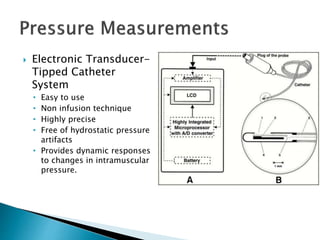
 Electronic Transducer-
Tipped Catheter
System
• Easy to use
• Non infusion technique
• Highly precise
• Free of hydrostatic pressure
artifacts
• Provides dynamic responses
to changes in intramuscular
pressure.
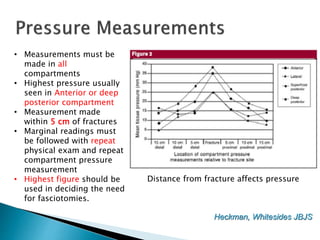
Distance from fracture affects pressure
• Measurements must be
made in all
compartments
• Highest pressure usually
seen in Anterior or deep
posterior compartment
• Measurement made
within 5 cm of fractures
• Marginal readings must
be followed with repeat
physical exam and repeat
compartment pressure
measurement
• Highest figure should be
used in deciding the need
for fasciotomies.
Heckman, Whitesides JBJS
McQueen, Court-Brown JBJS Br 1996
 116 pts with tibial diaphyseal fx had continuous
monitoring of anterior compartment pressure for
24 hours
• 53 pts had ICP over 30 mmHg
• 30 pts had ICP over 40 mmHg
• 4 pts had ICP over 50 mmHg
 Only 3 had Δ P (DBP-ICP) of < 30, they had
fasciotomy
 None of the patients had any sequelae of the
compartment syndrome
 Decompression should be performed if the
differential pressure level drops to under 30 mmHg
SUSPECTED COMPARTMENT SYNDROME
FASCIOTOMY
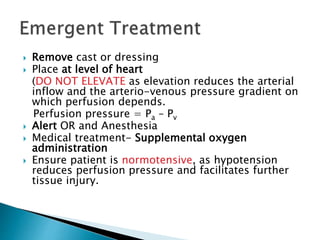
 Remove cast or dressing
 Place at level of heart
(DO NOT ELEVATE as elevation reduces the arterial
inflow and the arterio-venous pressure gradient on
which perfusion depends.
Perfusion pressure = Pa – Pv
 Alert OR and Anesthesia
 Medical treatment- Supplemental oxygen
administration
 Ensure patient is normotensive, as hypotension
reduces perfusion pressure and facilitates further
tissue injury.
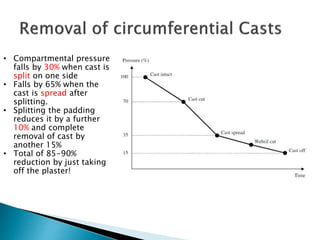
• Compartmental pressure
falls by 30% when cast is
split on one side
• Falls by 65% when the
cast is spread after
splitting.
• Splitting the padding
reduces it by a further
10% and complete
removal of cast by
another 15%
• Total of 85-90%
reduction by just taking
off the plaster!
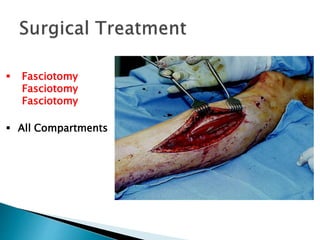
 Fasciotomy
Fasciotomy
Fasciotomy
 All Compartments
Fasciotomy
 Prophylactic release of pressure before
permanent damage occurs
 Does not reverse the damage present but can
prevent secondary sequelae of the CS
 Look for direct injury to vessels and nerves,
should be repaired, if these exist.
 Fracture care- stabilise
• Plating
• Intramedullary nailing or
• External fixator
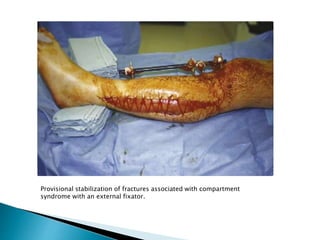
Provisional stabilization of fractures associated with compartment
syndrome with an external fixator.
 Unequivocal positive clinical findings
 Pressure within 15-20 mm hg of DBP
 Rising tissue pressure
 Significant tissue injury or high risk pt
 > 6 hours of total limb ischemia
 Injury at high risk of compartment syndrome
CONTRAINDICATION –
Missed compartment syndrome (>24-48 hrs)
(Sheridan and Matsen reported an infection rate of
46 % and an amputation rate of 21 % after late
fasciotomy.)
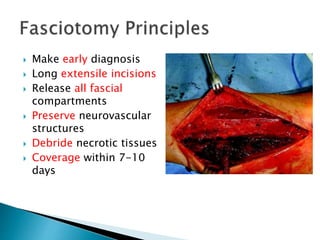
 Make early diagnosis
 Long extensile incisions
 Release all fascial
compartments
 Preserve neurovascular
structures
 Debride necrotic tissues
 Coverage within 7-10
days
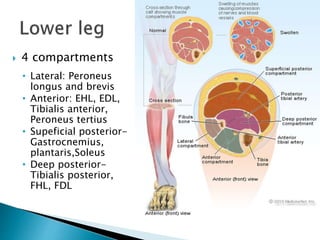
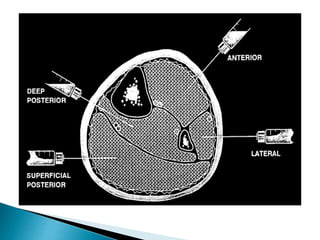
 4 compartments
• Lateral: Peroneus
longus and brevis
• Anterior: EHL, EDL,
Tibialis anterior,
Peroneus tertius
• Supeficial posterior-
Gastrocnemius,
plantaris,Soleus
• Deep posterior-
Tibialis posterior,
FHL, FDL
 Three decompression techniques
• Fibulectomy
• Perifibular fasciotomy
• Double-incision fasciotomy
 Fibulectomy
• Described by Patman and Thompson
• Is unnecessary and too radical
• Obsolete now
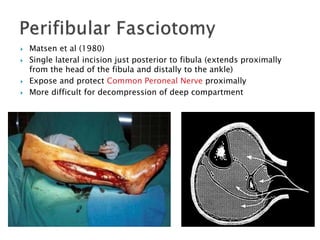
 Matsen et al (1980)
 Single lateral incision just posterior to fibula (extends proximally
from the head of the fibula and distally to the ankle)
 Expose and protect Common Peroneal Nerve proximally
 More difficult for decompression of deep compartment
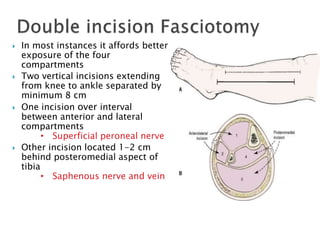
 In most instances it affords better
exposure of the four
compartments
 Two vertical incisions extending
from knee to ankle separated by
minimum 8 cm
 One incision over interval
between anterior and lateral
compartments
• Superficial peroneal nerve
 Other incision located 1-2 cm
behind posteromedial aspect of
tibia
• Saphenous nerve and vein
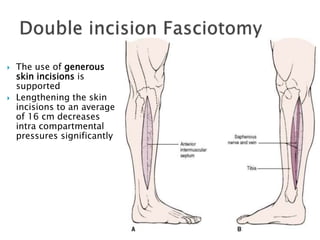
 The use of generous
skin incisions is
supported
 Lengthening the skin
incisions to an average
of 16 cm decreases
intra compartmental
pressures significantly
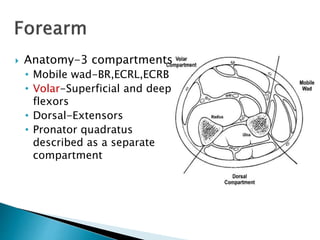
 Anatomy-3 compartments
• Mobile wad-BR,ECRL,ECRB
• Volar-Superficial and deep
flexors
• Dorsal-Extensors
• Pronator quadratus
described as a separate
compartment
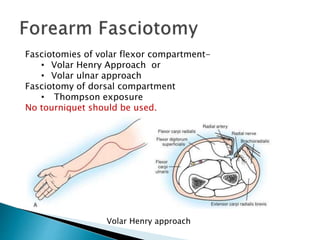
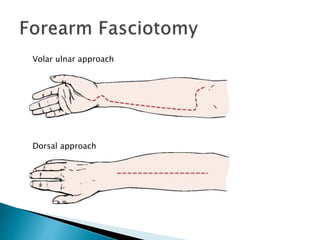
Fasciotomies of volar flexor compartment-
• Volar Henry Approach or
• Volar ulnar approach
Fasciotomy of dorsal compartment
• Thompson exposure
No tourniquet should be used.
Volar Henry approach
Volar ulnar approach
Dorsal approach
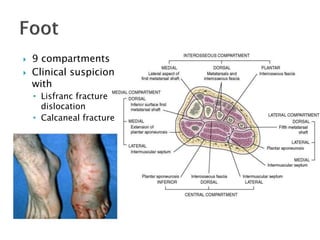
 9 compartments
 Clinical suspicion
with
• Lisfranc fracture
dislocation
• Calcaneal fracture
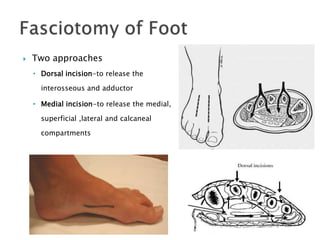
 Two approaches
• Dorsal incision-to release the
interosseous and adductor
• Medial incision-to release the medial,
superficial ,lateral and calcaneal
compartments
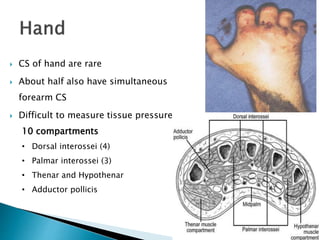
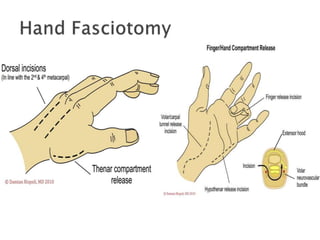
 CS of hand are rare
 About half also have simultaneous
forearm CS
 Difficult to measure tissue pressure
10 compartments
• Dorsal interossei (4)
• Palmar interossei (3)
• Thenar and Hypothenar
• Adductor pollicis
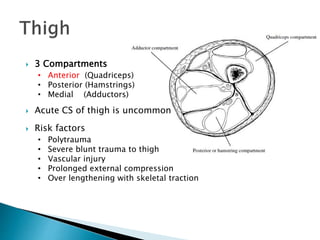
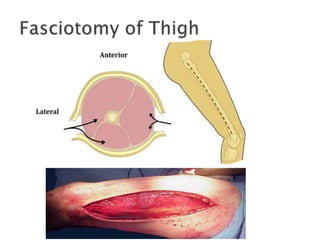
 3 Compartments
• Anterior (Quadriceps)
• Posterior (Hamstrings)
• Medial (Adductors)
 Acute CS of thigh is uncommon
 Risk factors
• Polytrauma
• Severe blunt trauma to thigh
• Vascular injury
• Prolonged external compression
• Over lengthening with skeletal traction
 Limited evidence
 Infection rate of 46% and amputation rate of 21% after a
delay of 12 hours (Sheridan, Matsen.JBJS 1976)
 Finkelstein et al. J Trauma 1996
• 5 pts, nine fasciotomies in lower limbs
• Avg delay 56 h. (35-96 hrs).
• 1 pt died of septicaemia and multi organ failure, the
others required amputations
 Recommendations
• If the CS has existed for more than 8-10 hrs,
supportive treatment of acute renal failure should be
considered.
• Routine fasciotomy may not be successful in delayed
cases and the decision to perform fasciotomy requires
judgment by the most experienced surgeon available.
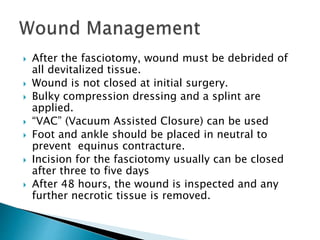
 After the fasciotomy, wound must be debrided of
all devitalized tissue.
 Wound is not closed at initial surgery.
 Bulky compression dressing and a splint are
applied.
 “VAC” (Vacuum Assisted Closure) can be used
 Foot and ankle should be placed in neutral to
prevent equinus contracture.
 Incision for the fasciotomy usually can be closed
after three to five days
 After 48 hours, the wound is inspected and any
further necrotic tissue is removed.
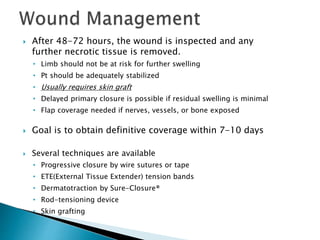
 After 48-72 hours, the wound is inspected and any
further necrotic tissue is removed.
• Limb should not be at risk for further swelling
• Pt should be adequately stabilized
• Usually requires skin graft
• Delayed primary closure is possible if residual swelling is minimal
• Flap coverage needed if nerves, vessels, or bone exposed
 Goal is to obtain definitive coverage within 7-10 days
 Several techniques are available
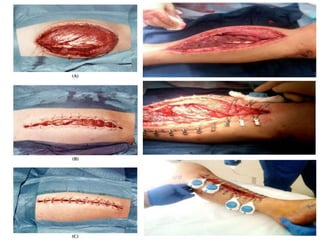
• Progressive closure by wire sutures or tape
• ETE(External Tissue Extender) tension bands
• Dermatotraction by Sure-Closure®
• Rod-tensioning device
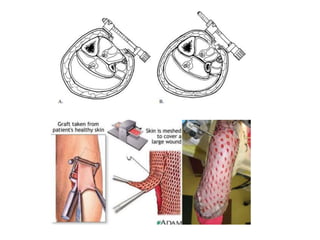
• Skin grafting
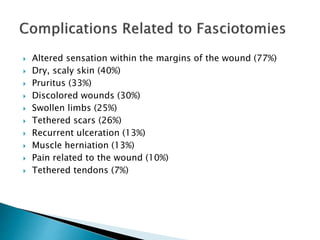
 Altered sensation within the margins of the wound (77%)
 Dry, scaly skin (40%)
 Pruritus (33%)
 Discolored wounds (30%)
 Swollen limbs (25%)
 Tethered scars (26%)
 Recurrent ulceration (13%)
 Muscle herniation (13%)
 Pain related to the wound (10%)
 Tethered tendons (7%)
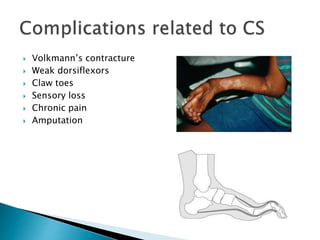
 Volkmann’s contracture
 Weak dorsiflexors
 Claw toes
 Sensory loss
 Chronic pain
 Amputation
 Keep a high index of suspicion
 Monitoring of the intracompartmental pressure should
be routine, particularly in patients in whom subjective
clinical assessment is not available, i.e. in unconscious
or uncooperative patients, and in those under the age of
35 years with injuries to the lower leg.
 Emergency conservative measures should be instituted
if the delta pressure approaches or drops below 30
mmHg, or clinical symptoms develop.
 Fasciotomy
• Reliable, safe, and effective
• The only treatment for compartment syndrome,
when performed in time.
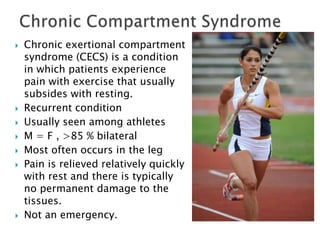
 Chronic exertional compartment
syndrome (CECS) is a condition
in which patients experience
pain with exercise that usually
subsides with resting.
 Recurrent condition
 Usually seen among athletes
 M = F , >85 % bilateral
 Most often occurs in the leg
 Pain is relieved relatively quickly
with rest and there is typically
no permanent damage to the
tissues.
 Not an emergency.
 Probably multifactorial
• Thickened, inelastic fascia
• Possible small muscle herniation, fascial defects
• Muscle hypertrophy
 DDs
• Tibial or fibular Stress fracture
• Peroneal nerve entrapment
• Tenosynovitis
• Vascular claudication
• Neurogenic claudication
 Treatment
• Nonsurgical- Physical therapy, activity modification, orthotics
(inserts for shoes), and anti-inflammatory medicines
• Surgical- Subcutaneous fasciotomy of the involved
compartment
Compartment syndrome is a potential
complication during surgery when patients are
placed in which position?
a. Supine
b. Prone
c. Trendelenburg
d. Lithotomy
e. Lateral decubitus
When a patient is placed in a lithotomy
position, there is a risk for compartment
syndrome. Which factor has consistently been
identified as the biggest risk factor for
development of this serious problem?
a. Use of rigid foot stirrups lone
b. Use of rigid calf stirrups alone
c. Duration of surgery
d. Extreme flexion of the knee
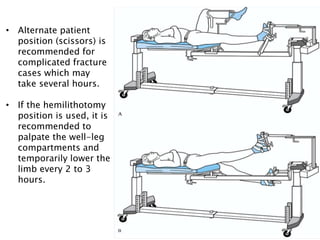
• Alternate patient
position (scissors) is
recommended for
complicated fracture
cases which may
take several hours.
• If the hemilithotomy
position is used, it is
recommended to
palpate the well-leg
compartments and
temporarily lower the
limb every 2 to 3
hours.
A 34-year-old male is 2 days post operative following a surgical
reduction of an open fracture of the right tibia. He is complaining of
increasing pain that is not adequately controlled with analgesia. On
examination the right leg is swollen and firm. While dorsi-flexing the
limb, the patient describes increased pain. Which of the following
statements is correct?
a) This is a surgical emergency requiring immediate fasciotomy of the
responsible compartment of the calf
b) Pain on passive movement is the most important clinical sign in
compartment syndrome.
c) Absence of a pulse rules out compartment syndrome
d) A common complication is tibial nerve palsy
e) Initial treatment should include splitting the case, removing
dressings and placing the extremity below the level of the heart to
promote circulation
Which of the following causes of lower leg pain
in runners presents with exertional lower leg
pain along the posterotibial border, typically
from first impact when exercising which is
diffuse in nature and generally tender in the
absence of visible signs?
A. Medial tibial stress syndrome
B. Chronic exertional compartment syndrome
C. Stress fracture

Compartment syndromes

  • 1.
  • 2.
     Definition  Types Pathophysiology  Etiology  Clinical evaluation  Diagnosis  Management  Complications
  • 3.
    Compartment syndrome isa clinical condition characterized by the increased tissue pressure within a closed anatomic space that compromises the circulation and function of that space. True Orthopaedic Emergency
  • 4.
    Richard von Volkmann Volkmann1881 • Richard von Volkmann published an article in which he attempted to describe the condition of irreversible contractures of the flexor muscles of the hand to ischemic processes occurring in the forearm • Application of restrictive dressing to an injured limb
  • 5.
    Hildebrand 1906 • Firstused the term Volkmann ischemic contracture to describe the final result of any untreated compartment syndrome, and was the first to suggest that elevated tissue pressure may be related to ischemic contracture.
  • 6.
    Thomas 1909 • Reviewedthe 112 published cases of Volkmann ischemic contracture and found fractures to be the predominant cause. Also, noted that tight bandages, an arterial embolus, or arterial insufficiency could also lead to the problem Murphy 1914 • First to suggest that fasciotomy might prevent the contracture. Also, suggested that tissue pressure and fasciotomy were related to the development of contracture
  • 7.
    Seddon, Kelly, andWhitesides 1967 • Demonstrated the existence of 4 compartments in the leg and to the need to decompress more than just the anterior compartment. Since then, compartment syndrome has been shown to affect many areas of the body, including the hand, foot, thigh, and buttocks.
  • 8.
  • 9.
    Compartment Size •Tight dressing;Bandage/Cast •Localised external pressure; lying on limb •Closure of fascial defects Compartment Content •Bleeding; Fractures, vascular inj, bleeding disorders •Increased Capillary Permeability: Ischemia / Trauma / Burns / Exercise / Snake Bite / Drug Injection / IVF
  • 10.
     The mostcommon cause  Incidence of accompanying compartment syndrome of 9.1%  The incidence is directly proportional to the degree of injury to soft tissue and bone Blick et al JBJS 1986
  • 11.
    Blunt Trauma-2nd MCcause Mannitol extravasation during partial nephrectomy leading to forarm compartment syndrome Hematoma after arterial puncture resulting in CS
  • 12.
    McQueen et al;JBJS2000  164 pts with CS  149 M, 15 F  Most pts were under 35 yrs  69% with associated fx • Tibial shaft fx 36% (incidence in the range of 1% to 10%) • Distal radius fx 9.8 %  23% Soft tissue injury without fx
  • 13.
     Acute compartmentsyndrome  Medical emergency  Requires urgent intervention to correct  Can lead to permanent muscle and nerve damage and can result in the loss of function of the limb.  Chronic compartment syndrome  Also known as exertional compartment syndrome  Not a medical emergency  Most often caused by athletic exertion
  • 14.
  • 15.
     Normal tissuepressure ◦ 0-4 mm Hg ◦ 8-10 with exertion  Absolute pressure theory ◦ 30 mm Hg - Mubarak ◦ 45 mm Hg - Matsen  Pressure gradient theory ◦ < 20 mm Hg of diastolic pressure – Whitesides et al Δ P = DBP - ICP Delta pressure, currently used to diagnose acute compartment syndrome, is less than or equal to 30 mmHg.
  • 16.
     Rowland describedAV gradient theory  Local blood flow (LBF) as per the arterio venous gradient theory can be expressed as: LBF = (Pa – Pv)/R
  • 18.
     Muscle ◦ 3-4hours - reversible changes ◦ 6 hours - variable damage ◦ 8 hours - irreversible changes  Nerve ◦ 2 hours - looses nerve conduction ◦ 4 hours - neuropraxia ◦ 8 hours - irreversible changes
  • 19.
    “Pain and theaggravation of pain by passive stretching of the muscles in the compartment in question are the most sensitive (and generally the only) clinical finding before the onset of ischemic dysfunction in the nerves and muscles.” Whitesides AAOS
  • 20.
    Development of thesyndrome may be described in three clinical stages that are related to pathophysiological stages
  • 21.
    History- Tightness ofcompartment, local pain,duration Clinical examination: the P’s  Pain out of proportion  Palpably tense compartment  Pain with passive stretch  Paresthesia/hypoesthesia  Paralysis  Pulselessness/Pallor Compartment pressures- Objective parameter Lab tests: CPK, Urine myoglobin Pulse oximetry  Is helpful in identifying limb hypoperfusion  Is not sensitive enough to exclude compartment syndrome. Most reliable
  • 22.
    Pain  First symptom Classically out of proportion to injury  Exaggerated with passive stretch of involved muscles in compartment  Earliest symptom but inconsistent, minimal in deep post. compartment  Not applicable in unconscious/obtunded patient
  • 23.
    Tense compartment  Earlyfinding  Compared to other side Paresthesia  Peripheral nerve tissue is more sensitive than muscle to ischemia.  Difficult to interpret  Will progress to anesthesia if pressure not relieved
  • 24.
    Paralysis  Very latefinding Irreversible nerve and muscle damage present.  Paresis may be present early Difficult to evaluate because of pain If motor deficit develops, full recovery is rare Pallor and Pulselessness  Rarely present Indicates direct damage to vessels rather than compartment syndrome (therefore arteriography indicated) Vascular injury may be more of contributing factor to syndrome rather than result.
  • 25.
     Beware ofepidural analgesia  Beware long acting nerve blocks  Beware of controlled intravenous opiate analgesia
  • 26.
     Raised tissuepressure is primary event in compartment syndrome and changes in ICP precede the clinical signs and symptoms.  When to monitor ?  Where to monitor ?  Threshold for diagnosis of Compartment syndrome and fasciotomy ?
  • 27.
     When ? •Suspectedcompartment syndrome •Equivocal or unreliable examination findings •Obtunded patient with tight compartments •Vascular injury •Regional anesthetia •Clinical adjunct  Contraindication •Clinically evident compartment syndrome
  • 28.
    Harris et al,J Trauma  Randomized 200 acute extra articular tibia fractures • Monitored – 36 hrs continuous pressure monitoring • Nonmonitored - Usual post operative observation  Patients were followed up for a minimum of 6 months or till fracture union Results  5 cases of CS in nonmonitored group and 0 cases in monitored group  Monitored group18 patients had Δ P < 30 mm Hg, none of them developed CS or late sequelae Conclusion In awake and alert pt. dx of CS using clinical signs in appropriate time is possible and continuous compartment pressure monitoring is not indicated.
  • 29.
    Infusion Technique • Designed by Whitesides •Consits of- • Simple • Can be used for intermittent recordings Disadvantage- • Not suitable for continuous monitoring • Required injection of saline into the compartment and in this way could aggravate impending syndrome
  • 30.
    Wick Catheter Slit catheter Slitand wick Catheters • Requires bubble free column of saline • The transducer dome should be level with the insertion site • More accurate • Can be used for continuous monitoring Disadvantage -Tip of the catheter may become blocked by a blood clot.
  • 31.
    Stryker STIC cathetersystem • Hand-held device • Easy to use • Measure acute compartment pressure quickly • Can be carried in pocket • More accurate • Can be used for continuous monitoring
  • 32.
    Near infrared spectroscopy(NIRS) • Non-invasive method of detecting variations in the level of muscle haemoglobin and myoglobin. • Has good predictive power in Chronic exertional CS • Diagnostic value in acute compartment syndrome is limited since changes in relative oxygenation may have already occurred .
  • 33.
    Scintigraphy • Is usedto evaluate regional perfusion, in particular myocardial perfusion • Edwards et al investigated 99Tcm- methoxyisobutyl isonitril (MIBI) scintigraphy in 46 patients with suspected CECS. • Found positive predictive value of 89% • Unlikely to be of value in acute trauma as it can not be used for continuous monitoring of perfusion.
  • 34.
     Electronic Transducer- TippedCatheter System • Easy to use • Non infusion technique • Highly precise • Free of hydrostatic pressure artifacts • Provides dynamic responses to changes in intramuscular pressure.
  • 35.
    Distance from fractureaffects pressure • Measurements must be made in all compartments • Highest pressure usually seen in Anterior or deep posterior compartment • Measurement made within 5 cm of fractures • Marginal readings must be followed with repeat physical exam and repeat compartment pressure measurement • Highest figure should be used in deciding the need for fasciotomies. Heckman, Whitesides JBJS
  • 37.
    McQueen, Court-Brown JBJSBr 1996  116 pts with tibial diaphyseal fx had continuous monitoring of anterior compartment pressure for 24 hours • 53 pts had ICP over 30 mmHg • 30 pts had ICP over 40 mmHg • 4 pts had ICP over 50 mmHg  Only 3 had Δ P (DBP-ICP) of < 30, they had fasciotomy  None of the patients had any sequelae of the compartment syndrome  Decompression should be performed if the differential pressure level drops to under 30 mmHg
  • 38.
  • 39.
     Remove castor dressing  Place at level of heart (DO NOT ELEVATE as elevation reduces the arterial inflow and the arterio-venous pressure gradient on which perfusion depends. Perfusion pressure = Pa – Pv  Alert OR and Anesthesia  Medical treatment- Supplemental oxygen administration  Ensure patient is normotensive, as hypotension reduces perfusion pressure and facilitates further tissue injury.
  • 40.
    • Compartmental pressure fallsby 30% when cast is split on one side • Falls by 65% when the cast is spread after splitting. • Splitting the padding reduces it by a further 10% and complete removal of cast by another 15% • Total of 85-90% reduction by just taking off the plaster!
  • 41.
  • 42.
    Fasciotomy  Prophylactic releaseof pressure before permanent damage occurs  Does not reverse the damage present but can prevent secondary sequelae of the CS  Look for direct injury to vessels and nerves, should be repaired, if these exist.  Fracture care- stabilise • Plating • Intramedullary nailing or • External fixator
  • 43.
    Provisional stabilization offractures associated with compartment syndrome with an external fixator.
  • 44.
     Unequivocal positiveclinical findings  Pressure within 15-20 mm hg of DBP  Rising tissue pressure  Significant tissue injury or high risk pt  > 6 hours of total limb ischemia  Injury at high risk of compartment syndrome CONTRAINDICATION – Missed compartment syndrome (>24-48 hrs) (Sheridan and Matsen reported an infection rate of 46 % and an amputation rate of 21 % after late fasciotomy.)
  • 45.
     Make earlydiagnosis  Long extensile incisions  Release all fascial compartments  Preserve neurovascular structures  Debride necrotic tissues  Coverage within 7-10 days
  • 46.
     4 compartments •Lateral: Peroneus longus and brevis • Anterior: EHL, EDL, Tibialis anterior, Peroneus tertius • Supeficial posterior- Gastrocnemius, plantaris,Soleus • Deep posterior- Tibialis posterior, FHL, FDL
  • 47.
     Three decompressiontechniques • Fibulectomy • Perifibular fasciotomy • Double-incision fasciotomy  Fibulectomy • Described by Patman and Thompson • Is unnecessary and too radical • Obsolete now
  • 48.
     Matsen etal (1980)  Single lateral incision just posterior to fibula (extends proximally from the head of the fibula and distally to the ankle)  Expose and protect Common Peroneal Nerve proximally  More difficult for decompression of deep compartment
  • 49.
     In mostinstances it affords better exposure of the four compartments  Two vertical incisions extending from knee to ankle separated by minimum 8 cm  One incision over interval between anterior and lateral compartments • Superficial peroneal nerve  Other incision located 1-2 cm behind posteromedial aspect of tibia • Saphenous nerve and vein
  • 50.
     The useof generous skin incisions is supported  Lengthening the skin incisions to an average of 16 cm decreases intra compartmental pressures significantly
  • 51.
     Anatomy-3 compartments •Mobile wad-BR,ECRL,ECRB • Volar-Superficial and deep flexors • Dorsal-Extensors • Pronator quadratus described as a separate compartment
  • 52.
    Fasciotomies of volarflexor compartment- • Volar Henry Approach or • Volar ulnar approach Fasciotomy of dorsal compartment • Thompson exposure No tourniquet should be used. Volar Henry approach
  • 53.
  • 54.
     9 compartments Clinical suspicion with • Lisfranc fracture dislocation • Calcaneal fracture
  • 55.
     Two approaches •Dorsal incision-to release the interosseous and adductor • Medial incision-to release the medial, superficial ,lateral and calcaneal compartments
  • 56.
     CS ofhand are rare  About half also have simultaneous forearm CS  Difficult to measure tissue pressure 10 compartments • Dorsal interossei (4) • Palmar interossei (3) • Thenar and Hypothenar • Adductor pollicis
  • 58.
     3 Compartments •Anterior (Quadriceps) • Posterior (Hamstrings) • Medial (Adductors)  Acute CS of thigh is uncommon  Risk factors • Polytrauma • Severe blunt trauma to thigh • Vascular injury • Prolonged external compression • Over lengthening with skeletal traction
  • 60.
     Limited evidence Infection rate of 46% and amputation rate of 21% after a delay of 12 hours (Sheridan, Matsen.JBJS 1976)  Finkelstein et al. J Trauma 1996 • 5 pts, nine fasciotomies in lower limbs • Avg delay 56 h. (35-96 hrs). • 1 pt died of septicaemia and multi organ failure, the others required amputations  Recommendations • If the CS has existed for more than 8-10 hrs, supportive treatment of acute renal failure should be considered. • Routine fasciotomy may not be successful in delayed cases and the decision to perform fasciotomy requires judgment by the most experienced surgeon available.
  • 61.
     After thefasciotomy, wound must be debrided of all devitalized tissue.  Wound is not closed at initial surgery.  Bulky compression dressing and a splint are applied.  “VAC” (Vacuum Assisted Closure) can be used  Foot and ankle should be placed in neutral to prevent equinus contracture.  Incision for the fasciotomy usually can be closed after three to five days  After 48 hours, the wound is inspected and any further necrotic tissue is removed.
  • 62.
     After 48-72hours, the wound is inspected and any further necrotic tissue is removed. • Limb should not be at risk for further swelling • Pt should be adequately stabilized • Usually requires skin graft • Delayed primary closure is possible if residual swelling is minimal • Flap coverage needed if nerves, vessels, or bone exposed  Goal is to obtain definitive coverage within 7-10 days  Several techniques are available • Progressive closure by wire sutures or tape • ETE(External Tissue Extender) tension bands • Dermatotraction by Sure-Closure® • Rod-tensioning device • Skin grafting
  • 65.
     Altered sensationwithin the margins of the wound (77%)  Dry, scaly skin (40%)  Pruritus (33%)  Discolored wounds (30%)  Swollen limbs (25%)  Tethered scars (26%)  Recurrent ulceration (13%)  Muscle herniation (13%)  Pain related to the wound (10%)  Tethered tendons (7%)
  • 66.
     Volkmann’s contracture Weak dorsiflexors  Claw toes  Sensory loss  Chronic pain  Amputation
  • 67.
     Keep ahigh index of suspicion  Monitoring of the intracompartmental pressure should be routine, particularly in patients in whom subjective clinical assessment is not available, i.e. in unconscious or uncooperative patients, and in those under the age of 35 years with injuries to the lower leg.  Emergency conservative measures should be instituted if the delta pressure approaches or drops below 30 mmHg, or clinical symptoms develop.  Fasciotomy • Reliable, safe, and effective • The only treatment for compartment syndrome, when performed in time.
  • 68.
     Chronic exertionalcompartment syndrome (CECS) is a condition in which patients experience pain with exercise that usually subsides with resting.  Recurrent condition  Usually seen among athletes  M = F , >85 % bilateral  Most often occurs in the leg  Pain is relieved relatively quickly with rest and there is typically no permanent damage to the tissues.  Not an emergency.
  • 69.
     Probably multifactorial •Thickened, inelastic fascia • Possible small muscle herniation, fascial defects • Muscle hypertrophy  DDs • Tibial or fibular Stress fracture • Peroneal nerve entrapment • Tenosynovitis • Vascular claudication • Neurogenic claudication  Treatment • Nonsurgical- Physical therapy, activity modification, orthotics (inserts for shoes), and anti-inflammatory medicines • Surgical- Subcutaneous fasciotomy of the involved compartment
  • 70.
    Compartment syndrome isa potential complication during surgery when patients are placed in which position? a. Supine b. Prone c. Trendelenburg d. Lithotomy e. Lateral decubitus
  • 71.
    When a patientis placed in a lithotomy position, there is a risk for compartment syndrome. Which factor has consistently been identified as the biggest risk factor for development of this serious problem? a. Use of rigid foot stirrups lone b. Use of rigid calf stirrups alone c. Duration of surgery d. Extreme flexion of the knee
  • 72.
    • Alternate patient position(scissors) is recommended for complicated fracture cases which may take several hours. • If the hemilithotomy position is used, it is recommended to palpate the well-leg compartments and temporarily lower the limb every 2 to 3 hours.
  • 73.
    A 34-year-old maleis 2 days post operative following a surgical reduction of an open fracture of the right tibia. He is complaining of increasing pain that is not adequately controlled with analgesia. On examination the right leg is swollen and firm. While dorsi-flexing the limb, the patient describes increased pain. Which of the following statements is correct? a) This is a surgical emergency requiring immediate fasciotomy of the responsible compartment of the calf b) Pain on passive movement is the most important clinical sign in compartment syndrome. c) Absence of a pulse rules out compartment syndrome d) A common complication is tibial nerve palsy e) Initial treatment should include splitting the case, removing dressings and placing the extremity below the level of the heart to promote circulation
  • 74.
    Which of thefollowing causes of lower leg pain in runners presents with exertional lower leg pain along the posterotibial border, typically from first impact when exercising which is diffuse in nature and generally tender in the absence of visible signs? A. Medial tibial stress syndrome B. Chronic exertional compartment syndrome C. Stress fracture

Editor's Notes

  • #4 Anterior and deep posterior compartments of the leg and the volar compartment of the forearm- MC involved, but may also occur in the arm, thigh, foot, buttock , hand and abdomen.
  • #5 Volkmann attempted to related irreversible contracture of flexor group of muscles of forearm to ischemic processes.
  • #9 Most commonly seen in-Ant. and deep post. compartments of leg,Volar compartment of forearm
  • #10 Pressure = Force/Area
  • #13 The incidence is significantly higher in patients under 35 years of age. The young patient with tibial diaphyseal fracture and the young male with a forearm fracture sustained in high energy trauma have increased risk for developing an acute compartment syndrome. So these types of patients require extra vigilance.
  • #14 An acute compartment syndrome is a surgical emergency, which if not recognised and treated early, can lead to devastating disabilities, amputation and even death.
  • #15 This sets a vicious cycle. Unless the viscious cycle is intervened at an appropriately early time it will result in irreversible damage leading to disability
  • #16 Many attempts have been made to identify the critical level of pressure above which the viability of the compartment is compromised. The lower level of 30 mmHg, which is most commonly used, is based on the view that when the tissue fluid pressure is greater than 30 mmHg, the capillary pressure is insufficient to maintain muscle capillary blood flow. Setting an absolute pressure ignores the role of the blood pressure in maintaining an adequate blood flow within the compartment. Whitesides et al introduced the concept of delta P in which he related and the blood flow within the microcirculation is dependent on both the tissue and venous pressures.
  • #17 The relationship between the local blood flow (LBF) and the AV gradient can be expressed by the following equation: Pa is pressure at arterial end, Pv is pressure at venous end. R is resistance to blood flow.
  • #18 The effect of increased tissue pressure on local blood flow can be seen in this diagram. This is perfusion pressure at normal IMP. As the intracompartmental pressure rises, the intraluminal venous pressures also increase leading to a reduction in the arteriovenous pressure gradient with subsequent diminished or absent local perfusion.
  • #22 By the time pallor, pulselessness and paresthesia are observed, ischemic changes may be irreversible.we should not wait for these things.
  • #30 After the needle was injected into the compartment, the air pressure within the syringe was raised until the saline-air meniscus was seen to move. The pressure was then read off the mercury manometer
  • #31 The technique requires a slit catheter, an insertion needle, a pressure transducer connected to a three-way stopcock, and a pressure monitor
  • #40 Although it would seem to be a good idea to elevate the swollen extremity, it has been shown experimentally and clinically that limb elevation reduces mean arterial pressure in the arteries of the lower extremity and thereby reduces blood flow to the compartment
  • #42 surgical decompression for acute compartment syndrome must adequately decompress all compartments that are at risk or likely to become at risk. Skin, fat, and fascial layers must all be widely decompressed and left open.
  • #43 Acute compartment syndrome of the upper or lower extremity is seldom an isolated condition and is almost always seen in association with a long bone fracture Fasciotomies destabilize any long bone or extremity fracture and it should be be stabilized. Depending on the location and character of the fracture and the skill of the surgeon Should minimise operative trauma to a limb that may already have had its circulation compromised
  • #45 A missed CS > 24-48 hours should not be opened. The damage cannot be reversed and there is a significant infection rate when the dead tissue is exposed to the hospital environment.
  • #46 High index of clinical suspicion to be maintained in all potential cases of CS
  • #47 Lat-Superficial peroneal nerve Ant.-Deep peroneal nerve, anterior tibial vessels Sup. Post.- Sural nerve Deep post- Tibial nerve, posterior tibial vessels
  • #49 Care must be taken proximally because the peroneal nerve can be injured
  • #50 Care must be taken to identify and protect the superficial peroneal nerve
  • #51 Skin envelope is contributing factor in ACS
  • #52 Forearm compartment syndrome tended to occur with associated fractures of the distal radius
  • #53 The skin incision should begin proximal to the antecubital fossa and extend to the palm across the carpal tunnel. it is mandatory that both the superficial and deep volar compartments be decompressed. VH approach- include release of carpal tunnel
  • #54 The volar ulnar approach is performed in a similar fashion to the Henry approach. incision is begun proximally medial to the biceps tendon, passes the elbow crease, extends distally along the ulnar border of the forearm, and proceeds across the carpal tunnel along the thenar crease After the superficial and deep flexor compartments of the forearm have been decompressed, it must be decided whether a fasciotomy of the dorsal (extensor) compartment is necessary. The need is best determined by pressure measurements made in the operating room after the flexor compartment fasciotomies have been completed.
  • #55 Medial, Superficial, Lateral, Calcaneal,Interossei(4), Adductor. Three run entire length of the foot (medial, lateral,superficial). Five in the forefoot (1 adductor, 4 interossei) and one located deep in the hindfoot (calcaneal). It is seen most commonly after calcaneal fractures, Lisfranc injuries, or significant blunt trauma to the foot. Lisfranc injury is an injury of the foot in which one or more of the metatarsal bones are displaced from the tarsus.
  • #56 Medial- 5- to 7-cm skin incision starts on the medial side of the heel, runs distally parallel to the sole. Dorsal- centered over the second and fourth metatarsals
  • #57 Clinically pt has Painful, tense and swollen hand. Pain out of proportion. Pain intensity increases by passive stretching of involved intrinsic muscles. Extension at MCP and IP joints are flexed.
  • #58  Incision on radial side of 1st metacarpal releases thenar compartment
  • #59 ACS uncommon in thigh because of large potential volume of compartment and blending of fascial compartments of thigh with hip, potentially allowing extravasation of blood outside compartment
  • #60 The three thigh compartments may be decompressed through a single, straight lateral skin incision from GT to lat. condyle of femur. May require medial skin incision for adductor compartment.
  • #61 Muscle necrosis or rhabdomyolysis may lead to the accumulation of myoglobin in the kidneys, causing acute renal failure. Adequate hydration shd be maintained. Serial measurements of CK can be made to assess the response to hydration therapy.
  • #62 A sterile polyurethane sponge is cut to fit with the entire wound surface. An adherent plastic sheet is placed to cover the wound and the tubing, which is connected to a reservoir and a pump. Mechanical tension stimulates proliferation of granulation tissue.
  • #63 To facilitate the closure of wounds
  • #64 Secondary wound closure by wire sutures in a patient 3 days after fasciotomy of the thigh. (B) Wire sutures are applied 3 days after fasciotomy.(C) On Day 5 the sutures are tightened to completely close the wound. ETE unit consists of a silicon band connected to two friction stoppers. The silicon bands can be tightened twice daily without anesthesia
  • #65 The tensile forces acting over the wound edges can be kept constant at a desirable level by a threaded screw
  • #69 Chronic exertional compartment syndrome has been reported in the hand, forearm, thigh, gluteus, lower leg, and foot. incidence among men and women appears to be similar
  • #71 Well leg compartment syndrome (WLCS) is compartment syndrome that develops in a healthy leg and can occur after prolonged positioning in lithotomy. It is reported in 1/3500 patients undergoing procedures in lithotomy and can be seen after urological, gynaecological or colorectal procedures.
  • #72 The most consistent factor in development of compartment syndromes is the duration of the procedure. Patients requiring the lithotomy position for a period of >5 h may be considered for continuous invasive compartment pressure measurement.
  • #73 Several cases have been reported of compartment syndrome of the leg from the use of a well-leg holder
  • #75 This describe medial tibial stress syndrome or ‘shin splints’. Stress fractures have point tenderness and CECS develops gradually over 5-10 minutes of exercise.