TOPIC : COMPARTMENT
SYNDROME
MODERATOR : DR. JAYANT JAIN
PRESENTER : DR. KARTHIK M V
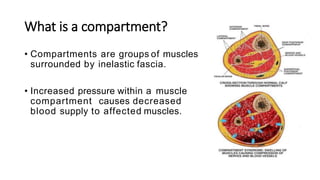
What is a compartment?
• Compartments are groups of muscles
surrounded by inelastic fascia.
• Increased pressure within a muscle
compartment causes decreased
blood supply to affected muscles.
Compartment syndrome
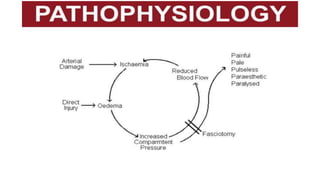
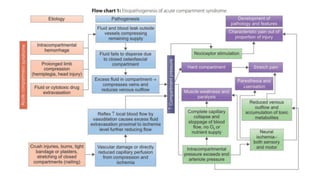
• Compartment syndrome is a condition in which the circulation within
a closed osteofacial compartment is compromised by an increase in
pressure within the compartment
• Causes necrosis of muscles, nerves, and eventually the skin because
of excessive swelling.
• Compartment syndrome is the emergency condition in which the
pressure within an osteofascial compartment rises to a level that
exceeds the intramuscular arteriolar pressure
• Results in decreased blood flow to capillaries, reduced oxygen
diffusion to the tissues and ultimately cell death
Types
• Acute compartment syndrome is defined as the elevation of Intra-
compartmental pressure (ICP) to a level and for a duration that
without decompression will cause tissue ischemia and necrosis.
• Exertional compartment syndrome is the elevation of intra-
compartmental pressure during exercise, causing ischemia, pain, and
rarely neurologic symptoms and signs. It is characterized by resolution
of symptoms with rest but may proceed to acute compartment
syndrome if exercise continues.
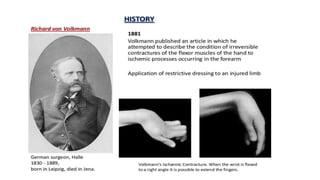
History
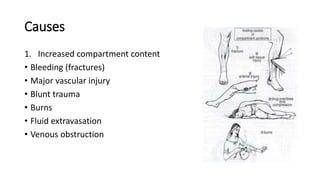
Causes
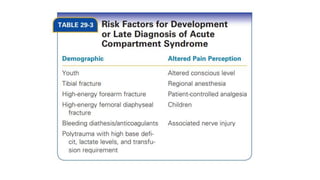
1. Increased compartment content
• Bleeding (fractures)
• Major vascular injury
• Blunt trauma
• Burns
• Fluid extravasation
• Venous obstruction
2. Decreased compartment volume
• Tight cast / dressings
• Torniquet
• Prolong lithotomy position
• Tight closure of facial defects
Patient with coagulopathy/ bleeding disorders are at high risk of
developing compartment syndrome.
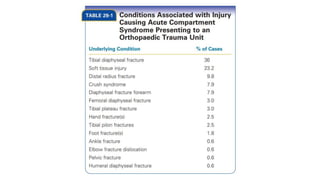
Fractures
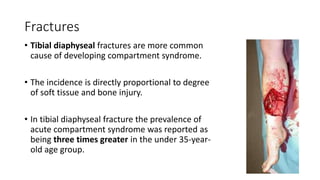
• Tibial diaphyseal fractures are more common
cause of developing compartment syndrome.
• The incidence is directly proportional to degree
of soft tissue and bone injury.
• In tibial diaphyseal fracture the prevalence of
acute compartment syndrome was reported as
being three times greater in the under 35-year-
old age group.
• The second most common fracture to be complicated by acute
compartment syndrome is the distal radius fracture.
• Distal radial and forearm diaphyseal fractures associated with high-
energy injury are more likely to be complicated by acute
compartment syndrome
Blunt trauma
• Blunt trauma is the 2nd most common cause of compartment
syndrome.
• The second most common cause of acute compartment syndrome is
Blunt trauma, which when added to tibial diaphyseal fracture makes
up almost two-thirds of the cases.
Preponderance
• Young Males high preponderance
• Young have relatively large muscle volumes, whereas their
compartment size does not change after growth is complete.
• Thus younger patients may have less space for swelling of the muscle
after injury.
• Older person has smaller hypotrophic muscles allowing more space
for swelling. There may also be a protective effect of hypertension in
the older patient.
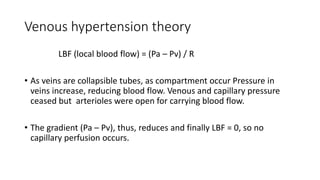
Venous hypertension theory
LBF (local blood flow) = (Pa – Pv) / R
• As veins are collapsible tubes, as compartment occur Pressure in
veins increase, reducing blood flow. Venous and capillary pressure
ceased but arterioles were open for carrying blood flow.
• The gradient (Pa – Pv), thus, reduces and finally LBF = 0, so no
capillary perfusion occurs.
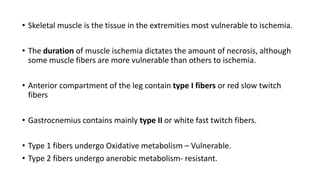
• Skeletal muscle is the tissue in the extremities most vulnerable to ischemia.
• The duration of muscle ischemia dictates the amount of necrosis, although
some muscle fibers are more vulnerable than others to ischemia.
• Anterior compartment of the leg contain type I fibers or red slow twitch
fibers
• Gastrocnemius contains mainly type II or white fast twitch fibers.
• Type 1 fibers undergo Oxidative metabolism – Vulnerable.
• Type 2 fibers undergo anerobic metabolism- resistant.
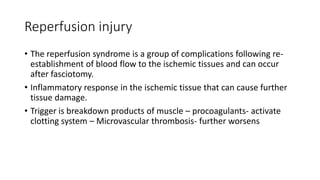
Reperfusion injury
• The reperfusion syndrome is a group of complications following re-
establishment of blood flow to the ischemic tissues and can occur
after fasciotomy.
• Inflammatory response in the ischemic tissue that can cause further
tissue damage.
• Trigger is breakdown products of muscle – procoagulants- activate
clotting system – Microvascular thrombosis- further worsens
Signs and Symptoms
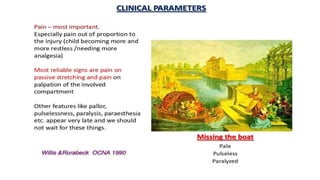
1. Pain
• most sensitive and earliest indicator
• Earliest and 1st symptom.
• Pain is out-of-proportion for the injury (1st symptom)
• Pain on passive stretching ( 1st sign)
• Difficulties : patient with head injury, under alcohol influence,
sedation or intubated.
2. Paraesthesia
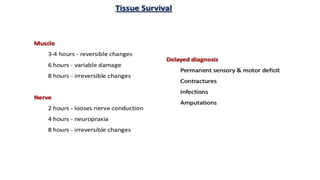
• Paresthesia develop early within 2 hours due to early involvement of
sensory nerves.
• Will progress to anaesthesia if pressure isn’t released.
3. Pressure
• Feeling of tightness or firmness of compartment.
• Objective finding
4. Pallor
• Reflects loss of arterial flow and is rarely present ever.
5. Pulselessness
• Not a reliable sign of compartment syndrome.
6. Paralysis
• Very late finding.
• Irreversible nerve and muscle damage already occurred.
• Diagnosis
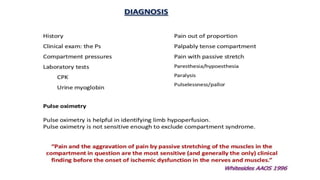
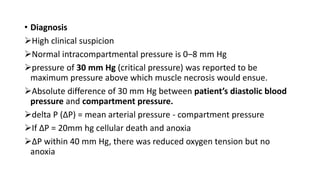
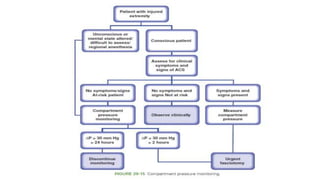
High clinical suspicion
Normal intracompartmental pressure is 0–8 mm Hg
pressure of 30 mm Hg (critical pressure) was reported to be
maximum pressure above which muscle necrosis would ensue.
Absolute difference of 30 mm Hg between patient’s diastolic blood
pressure and compartment pressure.
delta P (ΔP) = mean arterial pressure - compartment pressure
If ΔP = 20mm hg cellular death and anoxia
ΔP within 40 mm Hg, there was reduced oxygen tension but no
anoxia
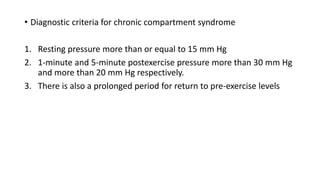
• Diagnostic criteria for chronic compartment syndrome
1. Resting pressure more than or equal to 15 mm Hg
2. 1-minute and 5-minute postexercise pressure more than 30 mm Hg
and more than 20 mm Hg respectively.
3. There is also a prolonged period for return to pre-exercise levels
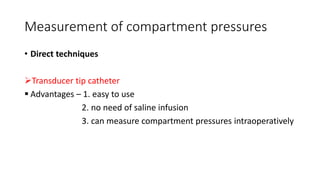
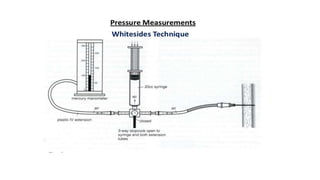
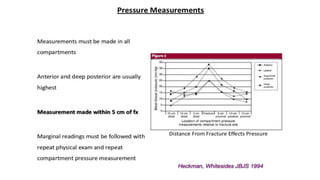
Measurement of compartment pressures
• Direct techniques
Transducer tip catheter
 Advantages – 1. easy to use
2. no need of saline infusion
3. can measure compartment pressures intraoperatively
• Indirect techniques
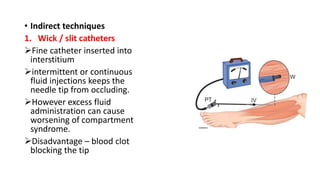
1. Wick / slit catheters
Fine catheter inserted into
interstitium
intermittent or continuous
fluid injections keeps the
needle tip from occluding.
However excess fluid
administration can cause
worsening of compartment
syndrome.
Disadvantage – blood clot
blocking the tip
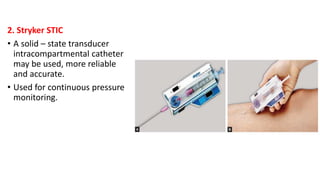
2. Stryker STIC
• A solid – state transducer
intracompartmental catheter
may be used, more reliable
and accurate.
• Used for continuous pressure
monitoring.
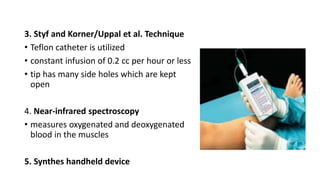
3. Styf and Korner/Uppal et al. Technique
• Teflon catheter is utilized
• constant infusion of 0.2 cc per hour or less
• tip has many side holes which are kept
open
4. Near-infrared spectroscopy
• measures oxygenated and deoxygenated
blood in the muscles
5. Synthes handheld device
Management
• High index of clinical suspicion
• Ensure patient is normotensive, hypotension reduces the perfusion
pressure and facilitates further tissue damage.
• Remove circumferential bandage and cast.
• Oxygen supplementation.
Surgical treatment
Fasciotomy
Fasciotomy
Fasciotomy
All Compartments
Fasciotomy
Surgical procedure where fascia is cut to Prophylactic release of
pressure before permanent damage occurs
Principles
• Early diagnosis.
• Long extensile incisions.
• Release of all fascial compartments.
• Preserve neurovascular structures.
• Debride necrotic tissues.
• Coverage within 7-10 days.
Indications of Fasciotomy
• Evident clinical findings
• Pressure within 15-20mm hg
• Rising tissue pressure
• > 6 hours of total limb ischemia
• Injury at high risk of compartment syndrome
• Significant tissue injury or high risk pt
CONTRAINDICATIONS
• Missed compartment syndrome (>24-48 hours)
• As a general rule, when in doubt, the compartment should be
released.
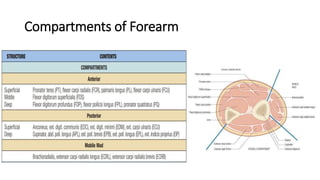
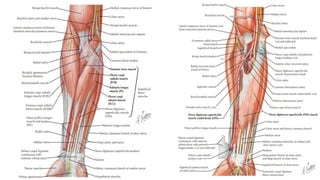
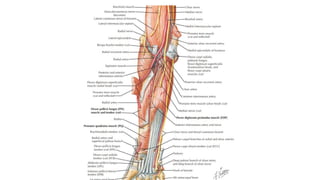
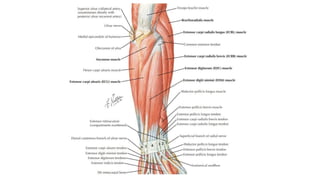
Compartments of Forearm
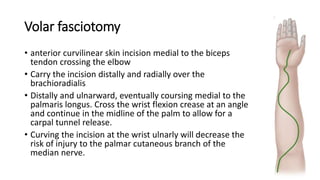
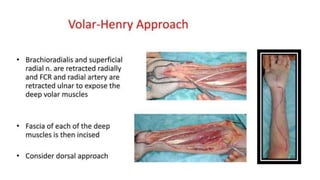
Volar fasciotomy
• anterior curvilinear skin incision medial to the biceps
tendon crossing the elbow
• Carry the incision distally and radially over the
brachioradialis
• Distally and ulnarward, eventually coursing medial to the
palmaris longus. Cross the wrist flexion crease at an angle
and continue in the midline of the palm to allow for a
carpal tunnel release.
• Curving the incision at the wrist ulnarly will decrease the
risk of injury to the palmar cutaneous branch of the
median nerve.
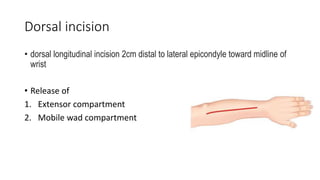
Dorsal incision
• dorsal longitudinal incision 2cm distal to lateral epicondyle toward midline of
wrist
• Release of
1. Extensor compartment
2. Mobile wad compartment
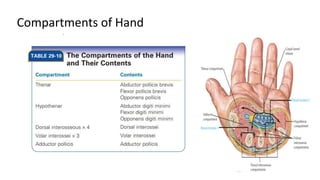
Compartments of Hand
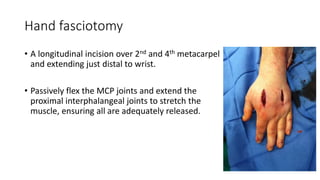
Hand fasciotomy
• A longitudinal incision over 2nd and 4th metacarpel
and extending just distal to wrist.
• Passively flex the MCP joints and extend the
proximal interphalangeal joints to stretch the
muscle, ensuring all are adequately released.
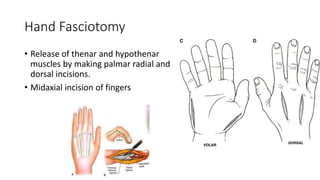
Hand Fasciotomy
• Release of thenar and hypothenar
muscles by making palmar radial and
dorsal incisions.
• Midaxial incision of fingers
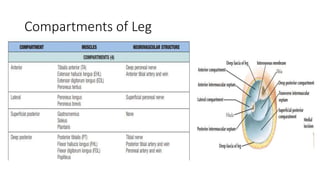
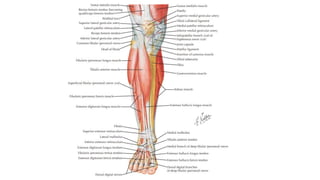
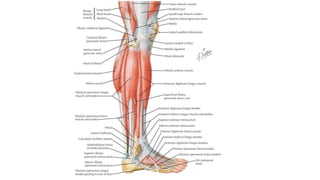
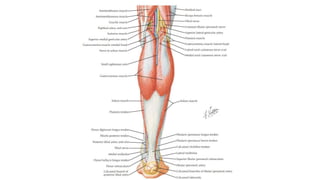
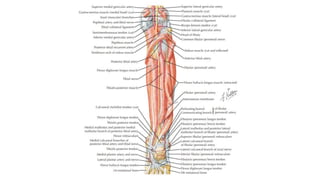
Compartments of Leg
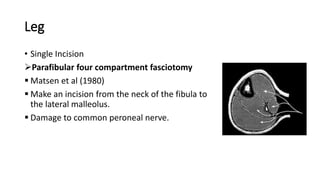
Leg
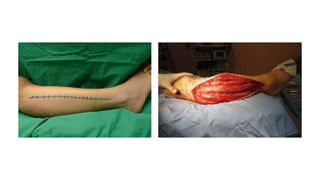
• Single Incision
Parafibular four compartment fasciotomy
 Matsen et al (1980)
 Make an incision from the neck of the fibula to
the lateral malleolus.
 Damage to common peroneal nerve.
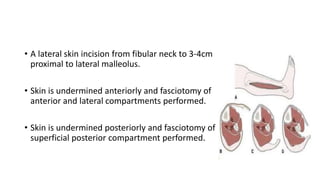
• A lateral skin incision from fibular neck to 3-4cm
proximal to lateral malleolus.
• Skin is undermined anteriorly and fasciotomy of
anterior and lateral compartments performed.
• Skin is undermined posteriorly and fasciotomy of
superficial posterior compartment performed.
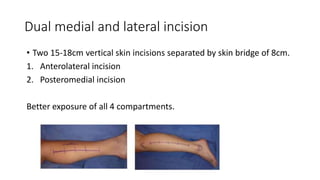
Dual medial and lateral incision
• Two 15-18cm vertical skin incisions separated by skin bridge of 8cm.
1. Anterolateral incision
2. Posteromedial incision
Better exposure of all 4 compartments.
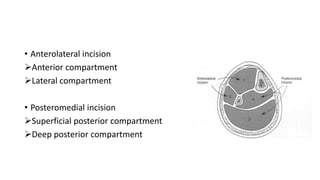
• Anterolateral incision
Anterior compartment
Lateral compartment
• Posteromedial incision
Superficial posterior compartment
Deep posterior compartment
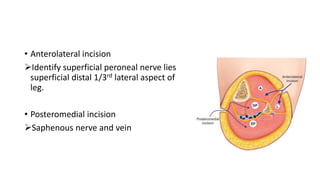
• Anterolateral incision
Identify superficial peroneal nerve lies
superficial distal 1/3rd lateral aspect of
leg.
• Posteromedial incision
Saphenous nerve and vein
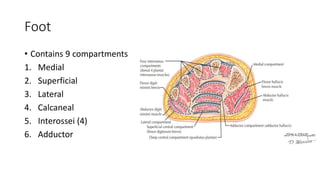
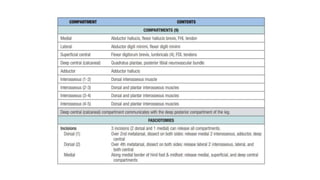
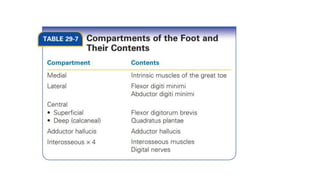
Foot
• Contains 9 compartments
1. Medial
2. Superficial
3. Lateral
4. Calcaneal
5. Interossei (4)
6. Adductor
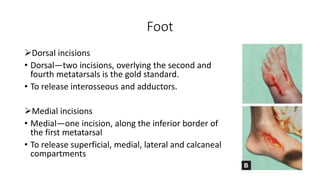
Foot
Dorsal incisions
• Dorsal—two incisions, overlying the second and
fourth metatarsals is the gold standard.
• To release interosseous and adductors.
Medial incisions
• Medial—one incision, along the inferior border of
the first metatarsal
• To release superficial, medial, lateral and calcaneal
compartments
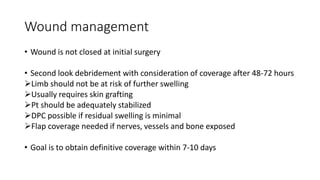
Wound management
• Wound is not closed at initial surgery
• Second look debridement with consideration of coverage after 48-72 hours
Limb should not be at risk of further swelling
Usually requires skin grafting
Pt should be adequately stabilized
DPC possible if residual swelling is minimal
Flap coverage needed if nerves, vessels and bone exposed
• Goal is to obtain definitive coverage within 7-10 days
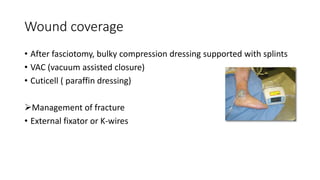
Wound coverage
• After fasciotomy, bulky compression dressing supported with splints
• VAC (vacuum assisted closure)
• Cuticell ( paraffin dressing)
Management of fracture
• External fixator or K-wires
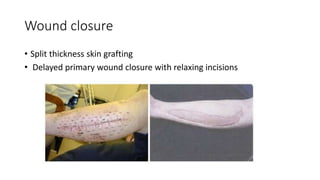
Wound closure
• Split thickness skin grafting
• Delayed primary wound closure with relaxing incisions
Complications of compartment syndrome
• Infection
• Gangrene
• Amputation
• Sensory loss & Motor weakness
• Chronic pain
• Volkmann’s contracture
Volkmann’s ischemic contracture
• Ischemic necrosis of the structures in forearm (extending to lower
arm and hand) and subsequent crippling contractures associated
with varying degrees of neurologic deficit.
• Richard van Volkmann in 1881, but his name was associated with
the contracture later in 1889 by Hildebrand end result of any
untreated/inadequately treated compartment syndrome
• The ischemic muscles are gradually replaced by fibrous tissue,
which contract and draw the wrist and fingers in flexion
Causes
• Compartment syndrome of forearm
• Supracondylar fractures in children's
• Crush injuries
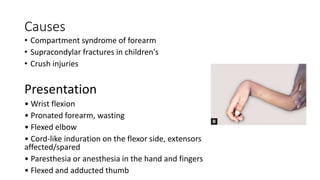
Presentation
• Wrist flexion
• Pronated forearm, wasting
• Flexed elbow
• Cord-like induration on the flexor side, extensors
affected/spared
• Paresthesia or anesthesia in the hand and fingers
• Flexed and adducted thumb
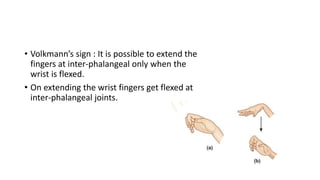
• Volkmann’s sign : It is possible to extend the
fingers at inter-phalangeal only when the
wrist is flexed.
• On extending the wrist fingers get flexed at
inter-phalangeal joints.
Diagnosis
• Clinical diagnosis
• Electromyography
• Angiography
• MRI demonstrates fibrosis and the extent of loss
of muscular tissue
Management
• Conservative – exercise and orthosis of wrist, hand and fingers.
• Tendon lengthening
• Tendon transfer
• Nerve grafting
• Severe cases- 2 stage procedure
1. Early excision of all necrotic tissue
2. Reconstruction is then done in second stage by tendon transfer
Conclusion
• Compartment syndrome is a emergency condition, which needs to be
diagnosed early.
• Palpable pulse doesn’t exclude compartment syndrome.
• If diagnosis and fasciotomy done early, prognosis is good.
• If delayed lead to devastating complications.
The earlier you diagnosis, the safer you are.
References
• Rockwood and green’s fracture in adults ( Edition 8)
• Netter’s Concise orthopaedic anatomy ( Edition 2)
• Campbell’s operative orthopaedics ( Edition 14)
• Essential orthopaedics Principles and practices- Manish kumar
Varshney
THANK YOU

compartment syndrome.pptx

  • 1.
    TOPIC : COMPARTMENT SYNDROME MODERATOR: DR. JAYANT JAIN PRESENTER : DR. KARTHIK M V
  • 2.
    What is acompartment? • Compartments are groups of muscles surrounded by inelastic fascia. • Increased pressure within a muscle compartment causes decreased blood supply to affected muscles.
  • 3.
    Compartment syndrome • Compartmentsyndrome is a condition in which the circulation within a closed osteofacial compartment is compromised by an increase in pressure within the compartment • Causes necrosis of muscles, nerves, and eventually the skin because of excessive swelling.
  • 4.
    • Compartment syndromeis the emergency condition in which the pressure within an osteofascial compartment rises to a level that exceeds the intramuscular arteriolar pressure • Results in decreased blood flow to capillaries, reduced oxygen diffusion to the tissues and ultimately cell death
  • 5.
    Types • Acute compartmentsyndrome is defined as the elevation of Intra- compartmental pressure (ICP) to a level and for a duration that without decompression will cause tissue ischemia and necrosis. • Exertional compartment syndrome is the elevation of intra- compartmental pressure during exercise, causing ischemia, pain, and rarely neurologic symptoms and signs. It is characterized by resolution of symptoms with rest but may proceed to acute compartment syndrome if exercise continues.
  • 6.
  • 7.
    Causes 1. Increased compartmentcontent • Bleeding (fractures) • Major vascular injury • Blunt trauma • Burns • Fluid extravasation • Venous obstruction
  • 8.
    2. Decreased compartmentvolume • Tight cast / dressings • Torniquet • Prolong lithotomy position • Tight closure of facial defects Patient with coagulopathy/ bleeding disorders are at high risk of developing compartment syndrome.
  • 10.
    Fractures • Tibial diaphysealfractures are more common cause of developing compartment syndrome. • The incidence is directly proportional to degree of soft tissue and bone injury. • In tibial diaphyseal fracture the prevalence of acute compartment syndrome was reported as being three times greater in the under 35-year- old age group.
  • 11.
    • The secondmost common fracture to be complicated by acute compartment syndrome is the distal radius fracture. • Distal radial and forearm diaphyseal fractures associated with high- energy injury are more likely to be complicated by acute compartment syndrome
  • 12.
    Blunt trauma • Blunttrauma is the 2nd most common cause of compartment syndrome. • The second most common cause of acute compartment syndrome is Blunt trauma, which when added to tibial diaphyseal fracture makes up almost two-thirds of the cases.
  • 13.
    Preponderance • Young Maleshigh preponderance • Young have relatively large muscle volumes, whereas their compartment size does not change after growth is complete. • Thus younger patients may have less space for swelling of the muscle after injury. • Older person has smaller hypotrophic muscles allowing more space for swelling. There may also be a protective effect of hypertension in the older patient.
  • 15.
    Venous hypertension theory LBF(local blood flow) = (Pa – Pv) / R • As veins are collapsible tubes, as compartment occur Pressure in veins increase, reducing blood flow. Venous and capillary pressure ceased but arterioles were open for carrying blood flow. • The gradient (Pa – Pv), thus, reduces and finally LBF = 0, so no capillary perfusion occurs.
  • 17.
    • Skeletal muscleis the tissue in the extremities most vulnerable to ischemia. • The duration of muscle ischemia dictates the amount of necrosis, although some muscle fibers are more vulnerable than others to ischemia. • Anterior compartment of the leg contain type I fibers or red slow twitch fibers • Gastrocnemius contains mainly type II or white fast twitch fibers. • Type 1 fibers undergo Oxidative metabolism – Vulnerable. • Type 2 fibers undergo anerobic metabolism- resistant.
  • 18.
    Reperfusion injury • Thereperfusion syndrome is a group of complications following re- establishment of blood flow to the ischemic tissues and can occur after fasciotomy. • Inflammatory response in the ischemic tissue that can cause further tissue damage. • Trigger is breakdown products of muscle – procoagulants- activate clotting system – Microvascular thrombosis- further worsens
  • 21.
    Signs and Symptoms 1.Pain • most sensitive and earliest indicator • Earliest and 1st symptom. • Pain is out-of-proportion for the injury (1st symptom) • Pain on passive stretching ( 1st sign) • Difficulties : patient with head injury, under alcohol influence, sedation or intubated.
  • 22.
    2. Paraesthesia • Paresthesiadevelop early within 2 hours due to early involvement of sensory nerves. • Will progress to anaesthesia if pressure isn’t released. 3. Pressure • Feeling of tightness or firmness of compartment. • Objective finding 4. Pallor • Reflects loss of arterial flow and is rarely present ever.
  • 23.
    5. Pulselessness • Nota reliable sign of compartment syndrome. 6. Paralysis • Very late finding. • Irreversible nerve and muscle damage already occurred.
  • 26.
    • Diagnosis High clinicalsuspicion Normal intracompartmental pressure is 0–8 mm Hg pressure of 30 mm Hg (critical pressure) was reported to be maximum pressure above which muscle necrosis would ensue. Absolute difference of 30 mm Hg between patient’s diastolic blood pressure and compartment pressure. delta P (ΔP) = mean arterial pressure - compartment pressure If ΔP = 20mm hg cellular death and anoxia ΔP within 40 mm Hg, there was reduced oxygen tension but no anoxia
  • 27.
    • Diagnostic criteriafor chronic compartment syndrome 1. Resting pressure more than or equal to 15 mm Hg 2. 1-minute and 5-minute postexercise pressure more than 30 mm Hg and more than 20 mm Hg respectively. 3. There is also a prolonged period for return to pre-exercise levels
  • 28.
    Measurement of compartmentpressures • Direct techniques Transducer tip catheter  Advantages – 1. easy to use 2. no need of saline infusion 3. can measure compartment pressures intraoperatively
  • 29.
    • Indirect techniques 1.Wick / slit catheters Fine catheter inserted into interstitium intermittent or continuous fluid injections keeps the needle tip from occluding. However excess fluid administration can cause worsening of compartment syndrome. Disadvantage – blood clot blocking the tip
  • 30.
    2. Stryker STIC •A solid – state transducer intracompartmental catheter may be used, more reliable and accurate. • Used for continuous pressure monitoring.
  • 31.
    3. Styf andKorner/Uppal et al. Technique • Teflon catheter is utilized • constant infusion of 0.2 cc per hour or less • tip has many side holes which are kept open 4. Near-infrared spectroscopy • measures oxygenated and deoxygenated blood in the muscles 5. Synthes handheld device
  • 35.
    Management • High indexof clinical suspicion • Ensure patient is normotensive, hypotension reduces the perfusion pressure and facilitates further tissue damage. • Remove circumferential bandage and cast. • Oxygen supplementation.
  • 36.
  • 37.
    Fasciotomy Surgical procedure wherefascia is cut to Prophylactic release of pressure before permanent damage occurs Principles • Early diagnosis. • Long extensile incisions. • Release of all fascial compartments. • Preserve neurovascular structures. • Debride necrotic tissues. • Coverage within 7-10 days.
  • 38.
    Indications of Fasciotomy •Evident clinical findings • Pressure within 15-20mm hg • Rising tissue pressure • > 6 hours of total limb ischemia • Injury at high risk of compartment syndrome • Significant tissue injury or high risk pt CONTRAINDICATIONS • Missed compartment syndrome (>24-48 hours)
  • 39.
    • As ageneral rule, when in doubt, the compartment should be released.
  • 40.
  • 44.
    Volar fasciotomy • anteriorcurvilinear skin incision medial to the biceps tendon crossing the elbow • Carry the incision distally and radially over the brachioradialis • Distally and ulnarward, eventually coursing medial to the palmaris longus. Cross the wrist flexion crease at an angle and continue in the midline of the palm to allow for a carpal tunnel release. • Curving the incision at the wrist ulnarly will decrease the risk of injury to the palmar cutaneous branch of the median nerve.
  • 46.
    Dorsal incision • dorsallongitudinal incision 2cm distal to lateral epicondyle toward midline of wrist • Release of 1. Extensor compartment 2. Mobile wad compartment
  • 47.
  • 48.
    Hand fasciotomy • Alongitudinal incision over 2nd and 4th metacarpel and extending just distal to wrist. • Passively flex the MCP joints and extend the proximal interphalangeal joints to stretch the muscle, ensuring all are adequately released.
  • 49.
    Hand Fasciotomy • Releaseof thenar and hypothenar muscles by making palmar radial and dorsal incisions. • Midaxial incision of fingers
  • 50.
  • 55.
    Leg • Single Incision Parafibularfour compartment fasciotomy  Matsen et al (1980)  Make an incision from the neck of the fibula to the lateral malleolus.  Damage to common peroneal nerve.
  • 56.
    • A lateralskin incision from fibular neck to 3-4cm proximal to lateral malleolus. • Skin is undermined anteriorly and fasciotomy of anterior and lateral compartments performed. • Skin is undermined posteriorly and fasciotomy of superficial posterior compartment performed.
  • 58.
    Dual medial andlateral incision • Two 15-18cm vertical skin incisions separated by skin bridge of 8cm. 1. Anterolateral incision 2. Posteromedial incision Better exposure of all 4 compartments.
  • 59.
    • Anterolateral incision Anteriorcompartment Lateral compartment • Posteromedial incision Superficial posterior compartment Deep posterior compartment
  • 60.
    • Anterolateral incision Identifysuperficial peroneal nerve lies superficial distal 1/3rd lateral aspect of leg. • Posteromedial incision Saphenous nerve and vein
  • 61.
    Foot • Contains 9compartments 1. Medial 2. Superficial 3. Lateral 4. Calcaneal 5. Interossei (4) 6. Adductor
  • 64.
    Foot Dorsal incisions • Dorsal—twoincisions, overlying the second and fourth metatarsals is the gold standard. • To release interosseous and adductors. Medial incisions • Medial—one incision, along the inferior border of the first metatarsal • To release superficial, medial, lateral and calcaneal compartments
  • 65.
    Wound management • Woundis not closed at initial surgery • Second look debridement with consideration of coverage after 48-72 hours Limb should not be at risk of further swelling Usually requires skin grafting Pt should be adequately stabilized DPC possible if residual swelling is minimal Flap coverage needed if nerves, vessels and bone exposed • Goal is to obtain definitive coverage within 7-10 days
  • 66.
    Wound coverage • Afterfasciotomy, bulky compression dressing supported with splints • VAC (vacuum assisted closure) • Cuticell ( paraffin dressing) Management of fracture • External fixator or K-wires
  • 67.
    Wound closure • Splitthickness skin grafting • Delayed primary wound closure with relaxing incisions
  • 69.
    Complications of compartmentsyndrome • Infection • Gangrene • Amputation • Sensory loss & Motor weakness • Chronic pain • Volkmann’s contracture
  • 70.
    Volkmann’s ischemic contracture •Ischemic necrosis of the structures in forearm (extending to lower arm and hand) and subsequent crippling contractures associated with varying degrees of neurologic deficit. • Richard van Volkmann in 1881, but his name was associated with the contracture later in 1889 by Hildebrand end result of any untreated/inadequately treated compartment syndrome • The ischemic muscles are gradually replaced by fibrous tissue, which contract and draw the wrist and fingers in flexion
  • 71.
    Causes • Compartment syndromeof forearm • Supracondylar fractures in children's • Crush injuries Presentation • Wrist flexion • Pronated forearm, wasting • Flexed elbow • Cord-like induration on the flexor side, extensors affected/spared • Paresthesia or anesthesia in the hand and fingers • Flexed and adducted thumb
  • 72.
    • Volkmann’s sign: It is possible to extend the fingers at inter-phalangeal only when the wrist is flexed. • On extending the wrist fingers get flexed at inter-phalangeal joints.
  • 73.
    Diagnosis • Clinical diagnosis •Electromyography • Angiography • MRI demonstrates fibrosis and the extent of loss of muscular tissue
  • 74.
    Management • Conservative –exercise and orthosis of wrist, hand and fingers. • Tendon lengthening • Tendon transfer • Nerve grafting • Severe cases- 2 stage procedure 1. Early excision of all necrotic tissue 2. Reconstruction is then done in second stage by tendon transfer
  • 75.
    Conclusion • Compartment syndromeis a emergency condition, which needs to be diagnosed early. • Palpable pulse doesn’t exclude compartment syndrome. • If diagnosis and fasciotomy done early, prognosis is good. • If delayed lead to devastating complications. The earlier you diagnosis, the safer you are.
  • 76.
    References • Rockwood andgreen’s fracture in adults ( Edition 8) • Netter’s Concise orthopaedic anatomy ( Edition 2) • Campbell’s operative orthopaedics ( Edition 14) • Essential orthopaedics Principles and practices- Manish kumar Varshney
  • 77.