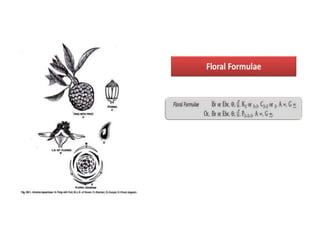
Family- Annonaceae
Dr. A.S.Naik
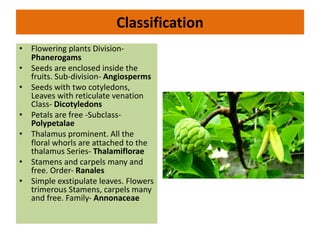
Classification
• Flowering plants Division-
Phanerogams
• Seeds are enclosed inside the
fruits. Sub-division- Angiosperms
• Seeds with two cotyledons,
Leaves with reticulate venation
Class- Dicotyledons
• Petals are free -Subclass-
Polypetalae
• Thalamus prominent. All the
floral whorls are attached to the
thalamus Series- Thalamiflorae
• Stamens and carpels many and
free. Order- Ranales
• Simple exstipulate leaves. Flowers
trimerous Stamens, carpels many
and free. Family- Annonaceae
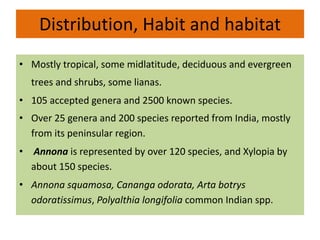
Distribution, Habit and habitat
• Mostly tropical, some midlatitude, deciduous and evergreen
trees and shrubs, some lianas.
• 105 accepted genera and 2500 known species.
• Over 25 genera and 200 species reported from India, mostly
from its peninsular region.
• Annona is represented by over 120 species, and Xylopia by
about 150 species.
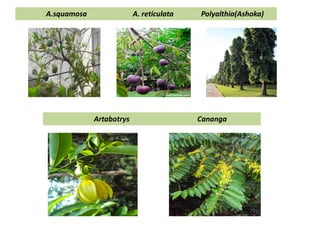
• Annona squamosa, Cananga odorata, Arta botrys
odoratissimus, Polyalthia longifolia common Indian spp.
A.squamosa A. reticulata Polyalthia(Ashoka)
Artabotrys Cananga
Description
• Root-Extensively branched tap
roots.
• Stem-Woody, branched, erect,
rarely climbing, aerial, hard.
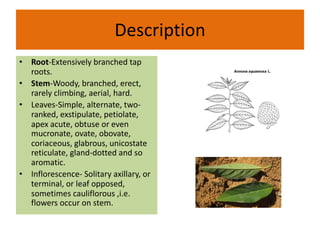
• Leaves-Simple, alternate, two-
ranked, exstipulate, petiolate,
apex acute, obtuse or even
mucronate, ovate, obovate,
coriaceous, glabrous, unicostate
reticulate, gland-dotted and so
aromatic.
• Inflorescence- Solitary axillary, or
terminal, or leaf opposed,
sometimes cauliflorous ,i.e.
flowers occur on stem.
Floral morphology
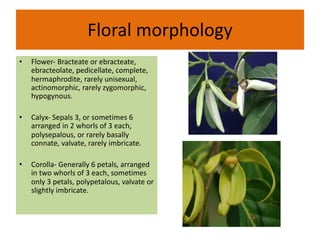
• Flower- Bracteate or ebracteate,
ebracteolate, pedicellate, complete,
hermaphrodite, rarely unisexual,
actinomorphic, rarely zygomorphic,
hypogynous.
• Calyx- Sepals 3, or sometimes 6
arranged in 2 whorls of 3 each,
polysepalous, or rarely basally
connate, valvate, rarely imbricate.
• Corolla- Generally 6 petals, arranged
in two whorls of 3 each, sometimes
only 3 petals, polypetalous, valvate or
slightly imbricate.
Floral morphology contd.
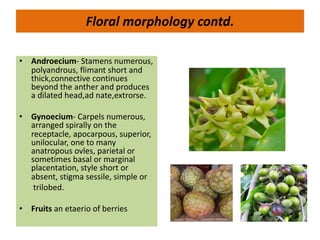
• Androecium- Stamens numerous,
polyandrous, flimant short and
thick,connective continues
beyond the anther and produces
a dilated head,ad nate,extrorse.
• Gynoecium- Carpels numerous,
arranged spirally on the
receptacle, apocarpous, superior,
unilocular, one to many
anatropous ovles, parietal or
sometimes basal or marginal
placentation, style short or
absent, stigma sessile, simple or
trilobed.
• Fruits an etaerio of berries
Economic Importance
• Annona squamosa,L (Sitaphal): Plants are cultivated for edible
fruits. Custard powder is made from the fruit. Fruits are also used in
the preparation of milkshakes and sweets.
• Annona reticulate, L (ramphal) Plants are cultivated for the edible
fruits.
• Polyalthia longifolia, Benth & Hook. (Ashoka) This beautiful tree is
grown in the garden as an Avenue plant.
• Artabotrys unicantus, Merr It is evergreen climber grown in the
garden. Sweet scented flowers are used in perfume industry.
• Cananga odorata, Hook Small evergreen tree is grown in the
garden. Scented flowers yield perfume.

: Family Annonaceae

  • 1.
  • 2.
    Classification • Flowering plantsDivision- Phanerogams • Seeds are enclosed inside the fruits. Sub-division- Angiosperms • Seeds with two cotyledons, Leaves with reticulate venation Class- Dicotyledons • Petals are free -Subclass- Polypetalae • Thalamus prominent. All the floral whorls are attached to the thalamus Series- Thalamiflorae • Stamens and carpels many and free. Order- Ranales • Simple exstipulate leaves. Flowers trimerous Stamens, carpels many and free. Family- Annonaceae
  • 3.
    Distribution, Habit andhabitat • Mostly tropical, some midlatitude, deciduous and evergreen trees and shrubs, some lianas. • 105 accepted genera and 2500 known species. • Over 25 genera and 200 species reported from India, mostly from its peninsular region. • Annona is represented by over 120 species, and Xylopia by about 150 species. • Annona squamosa, Cananga odorata, Arta botrys odoratissimus, Polyalthia longifolia common Indian spp.
  • 4.
    A.squamosa A. reticulataPolyalthia(Ashoka) Artabotrys Cananga
  • 5.
    Description • Root-Extensively branchedtap roots. • Stem-Woody, branched, erect, rarely climbing, aerial, hard. • Leaves-Simple, alternate, two- ranked, exstipulate, petiolate, apex acute, obtuse or even mucronate, ovate, obovate, coriaceous, glabrous, unicostate reticulate, gland-dotted and so aromatic. • Inflorescence- Solitary axillary, or terminal, or leaf opposed, sometimes cauliflorous ,i.e. flowers occur on stem.
  • 6.
    Floral morphology • Flower-Bracteate or ebracteate, ebracteolate, pedicellate, complete, hermaphrodite, rarely unisexual, actinomorphic, rarely zygomorphic, hypogynous. • Calyx- Sepals 3, or sometimes 6 arranged in 2 whorls of 3 each, polysepalous, or rarely basally connate, valvate, rarely imbricate. • Corolla- Generally 6 petals, arranged in two whorls of 3 each, sometimes only 3 petals, polypetalous, valvate or slightly imbricate.
  • 7.
    Floral morphology contd. •Androecium- Stamens numerous, polyandrous, flimant short and thick,connective continues beyond the anther and produces a dilated head,ad nate,extrorse. • Gynoecium- Carpels numerous, arranged spirally on the receptacle, apocarpous, superior, unilocular, one to many anatropous ovles, parietal or sometimes basal or marginal placentation, style short or absent, stigma sessile, simple or trilobed. • Fruits an etaerio of berries
  • 9.
    Economic Importance • Annonasquamosa,L (Sitaphal): Plants are cultivated for edible fruits. Custard powder is made from the fruit. Fruits are also used in the preparation of milkshakes and sweets. • Annona reticulate, L (ramphal) Plants are cultivated for the edible fruits. • Polyalthia longifolia, Benth & Hook. (Ashoka) This beautiful tree is grown in the garden as an Avenue plant. • Artabotrys unicantus, Merr It is evergreen climber grown in the garden. Sweet scented flowers are used in perfume industry. • Cananga odorata, Hook Small evergreen tree is grown in the garden. Scented flowers yield perfume.