COLLEGE : COLLEGE OF AGRICULTURE , JAU ,
AMRELI
B.SC.AGRI. 1ST SEM.
COURSE : P.B.G.1.1
TITLE : ECONOMIC BOTANY
ROLL NO. : 07
TOPIC : A PRESENTATION OF ASTERACEAE FAMILY
(COMPOSITAE)
SUBMITTED TO : PROF. R.S.PARMAR
SUBMITTED BY : DHAVAL BHANDERI
CLASSIFICATION :
DIVISION : ANGIOSPERMS
CLASS : DICOTS
SUB CLASS : GAMOPETALAE
SERIES : INFERAE
ORDER : ASTERALES
FAMILY : ASTERACEAE
HABIT :
These are herbs and shrubs ,
rarely twiners , e.g. Mikarnia scandens ,
or trees , e.g. Vernonia arborea . They
sometimes have internal phloem .
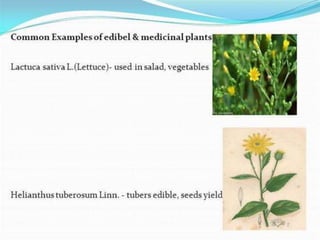
Some genera have latex , e.g. Sonchus ,
Crepis , Lactuca , Picris , etc.
LEAVES :
The leaves are simple , alternate
or opposite , rarely compound .
INFLORESCENCE :
The inflorescence is a head
( or capitulum ) , with an involucre of
bracts .
FLOWERS (FLORETS) :
The flowers are of two
kinds – the central ones (called disc
florets ) are tubular and the marginal
ones ( called ray florets ) are ligulate .
Sometimes all florets are of one kind ,
either tubular or ligulate . The disc
flowers are regular , tubular , bisexual
and epigynous , each usually in the axil
of a bracteole .
CALYX :
The calyx is often modified into
a cluster of hairs called pappus , as in
Tridax and Ageratum , or into scales , as
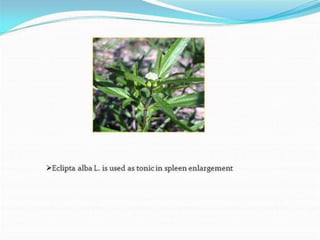
in sunflower and Eclipta , or absent , as
in water cress (Enhydra) .
COROLLA :
There are (5) petals. It is
gamopetalous and tubular.
ANDROECIUM :
The 5 stamens are
epipetalous. The filaments are free but
the anthers united (syngenesious).
GYNOECIUM :
The carpels are (2) ,
syncarpous. The ovary inferior , 1-celled
with one basal , anatropous ovule.
There is one style and the stigma is
bifid.
FRUIT :
The fruit is a cypsela.
The ray florets are zygomorphic ,
ligulate , unisexual (female) , or
sometimes neuter , as in sunflower and
epigynous , each usually modified into
pappus. Sometimes it is scaly or absent.
The Corolla has (5) petals , is
gamopetalous and ligulate (strap-
shaped).
SYSTEMATIC POSITION OF
COMPOSITAE :
For its many special characters
Compositae is assigned an advanced position ,
the highest according to Engler , in systematic
botany. This means that the family is of recent
origin ; fossils of this family have been traced
down to only the Oligocene period ( and not
further back). Fossil records indicate that the
genus Senecio came into existence first and
other genera developed from it in due course.
 It is likely that Compositae and Rubiaceae arose
from a common ancestry. The former also
maintains a phylogenetic connecion with
Umbelliferae by virtue of inflorescence and
floral mechanism.
 Compositae is remarkable in many respects : it
has the maximum number of species among
dicotyledons and some genera with a very large
number of species ; its worldwide distribution ;
its variety of forms and its very effective
mechanism for cross-pollination.
SPECIAL FEATURES :
The special features characterizing
Compositae as an advanced family are as follows :
1. Predominantly herbaceous forms ;
2. Flowers massed together in a head (a perfect type of
inflorescence) with the following decided advantages
–
i. Greater conspicuousness to attract insects for
cross-pollination ;
ii. Considerable saving of corolla-material and
iii. Achievement of cross-pollination by a single
insect within a very short time;
3. Very simple but effective type of floral mechanism
to achieve cross-pollination without at the same
time losing a chance for self-pollination if the
former method fails;
4. Easy access of insects to the nectary which lies at
the base of the style and is protected from rain;
5. Flowers typically pentamerous , gamopetalous ,
bisexual , epigynous with definite number of
stamens and carpels – an almost similar type of
floral construction throughout the whole family ;
6. Efficient protection of floral buds by the involucral
bracts;
7. Very effective mechanism for seed-(fruit-) dispersal
by parachute-like pappus (calyx) or by hooks or
glands developing on the fruit.
Asteraceae Family
Asteraceae Family
Asteraceae Family
Asteraceae Family
Asteraceae Family
Asteraceae Family
Asteraceae Family
Asteraceae Family