Family
• A taxonomic rank in the classification of
organisms between genus and order
A taxonomic rank in the classification of
organisms between genus and order.
A taxonomic group of one or more genera,
especially sharing a common attribute
 A collection of things or entities grouped by
their common attributes,
e.g. protein family, gene family, etc.
A group of people descended from a common
ancestor; a kin; a tribe.
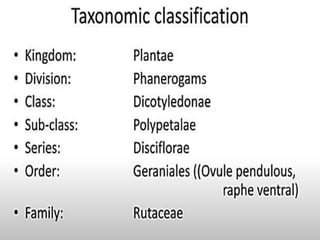
RUTACEAE
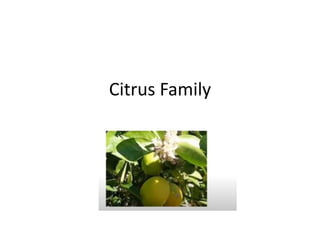
Citrus Family
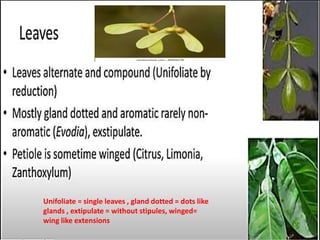
Unifoliate = single leaves , gland dotted = dots like
glands , extipulate = without stipules, winged=
wing like extensions
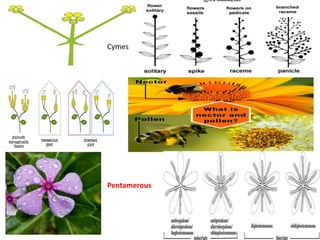
Cymes
Pentamerous
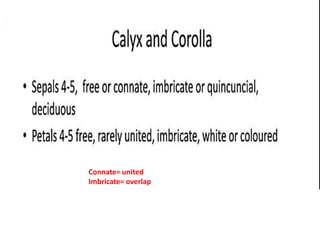
Connate= united
Imbricate= overlap
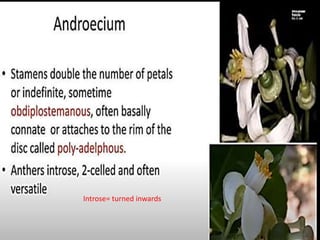
Introse= turned inwards
Umbelliferae
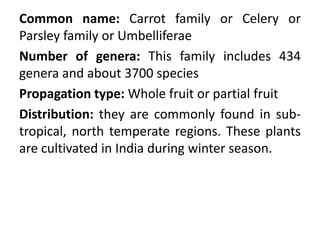
Common name: Carrot family or Celery or
Parsley family or Umbelliferae
Number of genera: This family includes 434
genera and about 3700 species
Propagation type: Whole fruit or partial fruit
Distribution: they are commonly found in sub-
tropical, north temperate regions. These plants
are cultivated in India during winter season.
Vegetative characters
• Habitat: Members of this family are adapted to
conditions that encourage heavy concentrations
of essential oils.
• Habit: Most of this family are herbaceous annual,
biennial (having a 2 year cycle), or perennial
plants
• Root system: These plants have tap root system.
The roots are large enough to store the useful
food materials. For example: carrot and parsnip.
• Stem: Stems are hollow at the points where
the leaves are attached. Usually stems are
soft, green, aerial. Either prostrate or erect.
Sometimes stems penetrate underground and
store food materials. The nodes of the stem
are swollen.
• Leaf: Leaves are alternate, exstipulate,
pinnately compound or palmately lobed with
reticulate venation. Leaf petiole is broadened
with sheath surrounding stem or base of leaf.
Floral characters
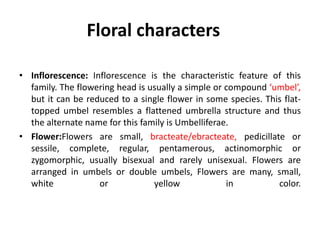
• Inflorescence: Inflorescence is the characteristic feature of this
family. The flowering head is usually a simple or compound ‘umbel’,
but it can be reduced to a single flower in some species. This flat-
topped umbel resembles a flattened umbrella structure and thus
the alternate name for this family is Umbelliferae.
• Flower:Flowers are small, bracteate/ebracteate, pedicillate or
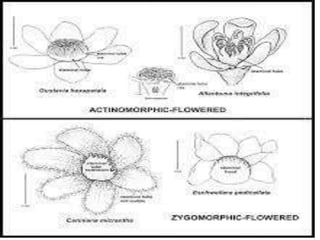
sessile, complete, regular, pentamerous, actinomorphic or
zygomorphic, usually bisexual and rarely unisexual. Flowers are
arranged in umbels or double umbels, Flowers are many, small,
white or yellow in color.
s
• Calyx: The calyx consists of 5 sepals which remain
joined by having grown together to the ovary
wall. Sometimes sepals may be absent.
• Corolla:The corolla consists of 5 free petals
alternating with sepals. Petals are usually apically
inflexed (bent or curved inwards) in bud and they
fall off soon. The aestivation is imbricate or
valvate. The petals are two lobes. The peripheral
flowers of Coriandrum have unequal petals.
• Androecium: The Androecium consists of 5 free
stamens, alternating with the petals. They arise
from an epigynous disc. The filaments are equal
in length, inflexed in bug and the anthers are
basifixed or dorsifixed, dithecous, introse and
dehisce longitudinally.
• Gynoecium: The Gynoecium is bicarpellary
and syncarpous with an inferior bilocular
ovary. Each carpel has a single pendulous and
anatropus ovule.
• Pollination: Flowers are pollinated by a wide
variety of insects – mostly flies, mosquitoes or
gnats, bees, butterflies or moths.
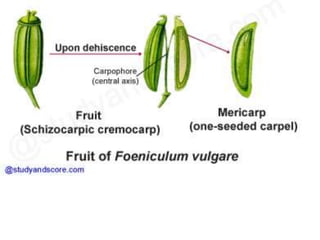
• Fruit: The fruit can be divided into 2 parts. The
fruit is schizocarpic cremocarp. A cremocarp is
made up of two one-seeded carpels called as
mericarps. Mericarps remain attached to the
central axis known as carpophore. Mericarps are
longitudinally ridged and in between the ridges
resinous or oil ducts called vittae are present.
• Seed: Seeds are endospermic with a small
embryo. The endosperm may be flat, crescent
or concave on the ventral side.
Important plants of umbellifera
• Anethum graveolens (Dill)
• Angelica geniculata
• Anthriscus cerefolium (Chervil)
• Apium graveolens (Celery seed)
• Apium graveolens (Celery)
• Azorella compacta (Yareta)
• Carum bulbocastanum (Black caraway)
• Carum carvi (caraway)
• Centella asiatica (Gotu kola)
• Cicuta douglasii (Western Water Hemlock)
• Coriandrum sativum (Coriander)
• Cuminum cyminum (cumin, Jeera)
• Daucus carota (Carrot)
• Dorema ammoniacum (gum ammoniac)
• Ferula asafoetids (Asafoetida)
Economic Importance of Apiaceae
• Apium graveolens: It is cultivated in Himalayas, Uttaranchal,
Himachal Pradesh and South India. It is used as a vegetable. Its
roots and seeds are used medicinally. The fruits are used for
extracting valuable oil and the seeds are used as spices.
• Coriandrum sativum: It is chiefly grown in Madhya Pradesh,
Maharashtra, Karnataka, Bihar and Uttar Pradesh. The fruits and
leaves are used as condiment and spice. The fruit of this aromatic
herb is used as stimulant, carminative, stomachic and tonic.
• Cuminum cyminum: It is grown in the Punjab and Uttar Pradesh.
This plant gives aromatic fruits which are used as flavoring agents.
• Carum carvi: It is cultivated in Bihar, Orissa, the Punjab, Bengal and
Andhra Pradesh. The fruits are used as condiment. Its fruits are also
used as stomachic and carminative.
• Bunium persicum: It is found in Kashmir. The starchy tubers are
eaten as vegetable. Its seeds are used as spice.
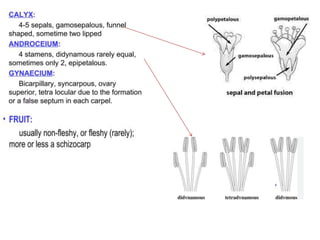
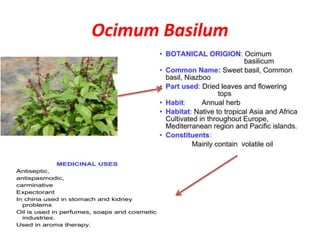
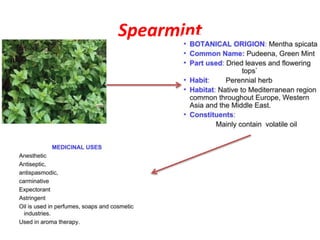
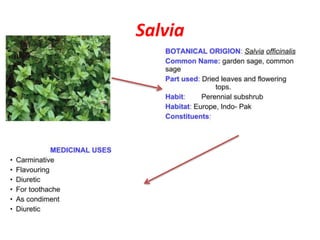
Labiatea
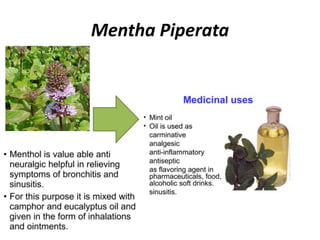
Mentha Piperata
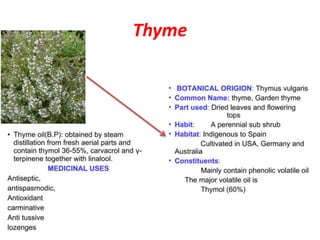
Thyme
Ocimum Basilum
Spearmint
Salvia
Solanaceae
Nightshade Family
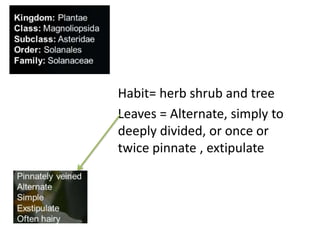
Habit= herb shrub and tree
Leaves = Alternate, simply to
deeply divided, or once or
twice pinnate , extipulate
Inflorescence
• Cymose
• solitary
Floral character
Flower perfect and actinomorphic , anthers
often conivalent around style and dehising by
terminal pores
Calyx
• 5
• 4-7 sepals distinct or conate
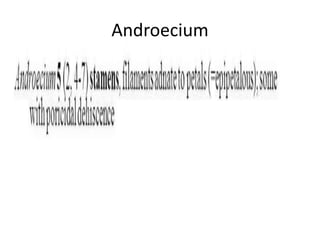
Androecium
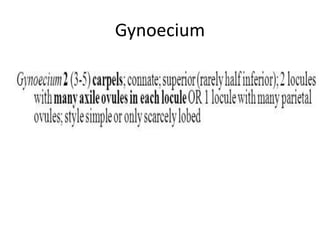
Gynoecium
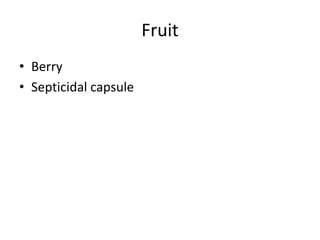
Fruit
• Berry
• Septicidal capsule
LIST OUT THE SPECIES
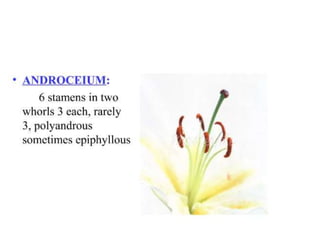
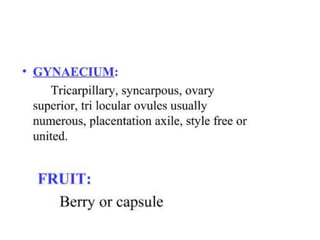
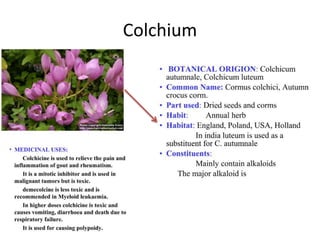
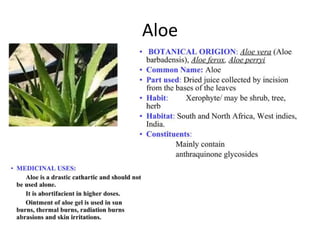
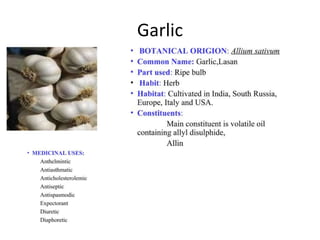
Liliaceae
Colchium
Aloe
Garlic
Myrtaceae
• Habit: These are mostly herbs and under-shrubs.
• Leaves: These are simple, alternate, opposite or
whorled, exstipulate, and sometimes exhibit
heterophylly.
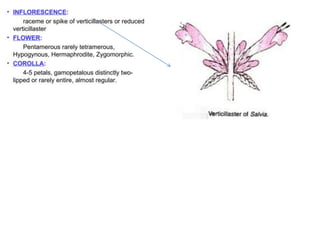
• Inflorescence: This is usually racemose (raceme
or spike), and sometimes cymose (dichasium). It
can be axillary or terminal. The flowers are
solitary in some species.
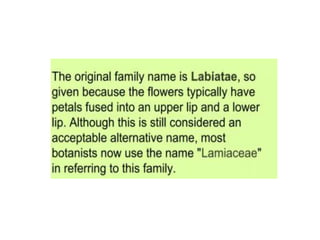
• Flowers: These are zygomorphic, two-lipped and
some-times personate. They often have a great
diversity of form. They are bisexual and
hypogynous. Bracts and bracteoles are generally
present.
• Calyx: The sepals are (5), gamosepalous, five-
lobed and often imbricate.
• Corolla: The petals are (5), gamopetalous, often
two-lipped and sometimes spurred or saccate.
They are medianly zygomorphic, very rarely
regular (as in Sco-paria), and imbricate.
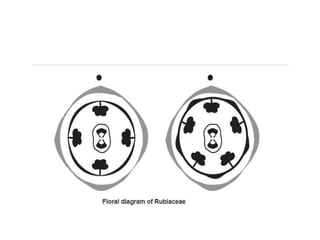
Rubiaceae
• Habit: These are shrubs and trees (rarely herbs).
• Leaves: The leaves are simple or compound,
alternate or rarely opposite and gland dotted.
• Flowers: These are regular, bisexual and
hypogynous. The disc below the ovary is
prominent and ring or cap like.
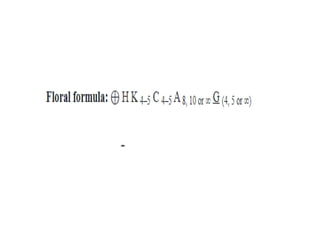
• Calyx: There are four or five sepals free or
connate below and imbricate.
• Corolla: Petals four or five, free, imbricate.
• Androecium: The number of stamens varies,
they can be as many, or more often twice, as
many, as the petals (obdiplostemonous), or
numerous, as in citrus and aegle. They are free
or united in irregular bundles (polyadel-
phous), and inserted on the disc.
• Gynoecium: There are generally (4) or (5)
carpels, or ∞, as in citrus. They are syncarpous
or free at the base and united above, and
either sessile or seated on the disc. The ovary
is generally four- or five-locular, or
multilocular as in citrus, with axile
placentation (parietal in limonia only).
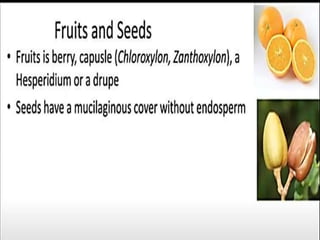
• Fruit: This is a berry, capsule or hesperidium.
• Seeds: The seeds may or may not have an
endosperm. Polyembryony is frequent in
Citrus, e.g. lemon and orange (but not
pummelo and citron)
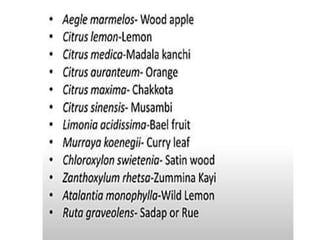
Plant species

RUTACEAE.pptx

  • 1.
  • 2.
    • A taxonomicrank in the classification of organisms between genus and order A taxonomic rank in the classification of organisms between genus and order. A taxonomic group of one or more genera, especially sharing a common attribute  A collection of things or entities grouped by their common attributes, e.g. protein family, gene family, etc. A group of people descended from a common ancestor; a kin; a tribe.
  • 3.
  • 4.
  • 6.
    Unifoliate = singleleaves , gland dotted = dots like glands , extipulate = without stipules, winged= wing like extensions
  • 8.
  • 9.
  • 10.
  • 19.
  • 21.
    Common name: Carrotfamily or Celery or Parsley family or Umbelliferae Number of genera: This family includes 434 genera and about 3700 species Propagation type: Whole fruit or partial fruit Distribution: they are commonly found in sub- tropical, north temperate regions. These plants are cultivated in India during winter season.
  • 22.
    Vegetative characters • Habitat:Members of this family are adapted to conditions that encourage heavy concentrations of essential oils. • Habit: Most of this family are herbaceous annual, biennial (having a 2 year cycle), or perennial plants • Root system: These plants have tap root system. The roots are large enough to store the useful food materials. For example: carrot and parsnip.
  • 23.
    • Stem: Stemsare hollow at the points where the leaves are attached. Usually stems are soft, green, aerial. Either prostrate or erect. Sometimes stems penetrate underground and store food materials. The nodes of the stem are swollen. • Leaf: Leaves are alternate, exstipulate, pinnately compound or palmately lobed with reticulate venation. Leaf petiole is broadened with sheath surrounding stem or base of leaf.
  • 25.
    Floral characters • Inflorescence:Inflorescence is the characteristic feature of this family. The flowering head is usually a simple or compound ‘umbel’, but it can be reduced to a single flower in some species. This flat- topped umbel resembles a flattened umbrella structure and thus the alternate name for this family is Umbelliferae. • Flower:Flowers are small, bracteate/ebracteate, pedicillate or sessile, complete, regular, pentamerous, actinomorphic or zygomorphic, usually bisexual and rarely unisexual. Flowers are arranged in umbels or double umbels, Flowers are many, small, white or yellow in color.
  • 26.
  • 28.
    • Calyx: Thecalyx consists of 5 sepals which remain joined by having grown together to the ovary wall. Sometimes sepals may be absent. • Corolla:The corolla consists of 5 free petals alternating with sepals. Petals are usually apically inflexed (bent or curved inwards) in bud and they fall off soon. The aestivation is imbricate or valvate. The petals are two lobes. The peripheral flowers of Coriandrum have unequal petals. • Androecium: The Androecium consists of 5 free stamens, alternating with the petals. They arise from an epigynous disc. The filaments are equal in length, inflexed in bug and the anthers are basifixed or dorsifixed, dithecous, introse and dehisce longitudinally.
  • 29.
    • Gynoecium: TheGynoecium is bicarpellary and syncarpous with an inferior bilocular ovary. Each carpel has a single pendulous and anatropus ovule.
  • 30.
    • Pollination: Flowersare pollinated by a wide variety of insects – mostly flies, mosquitoes or gnats, bees, butterflies or moths. • Fruit: The fruit can be divided into 2 parts. The fruit is schizocarpic cremocarp. A cremocarp is made up of two one-seeded carpels called as mericarps. Mericarps remain attached to the central axis known as carpophore. Mericarps are longitudinally ridged and in between the ridges resinous or oil ducts called vittae are present.
  • 32.
    • Seed: Seedsare endospermic with a small embryo. The endosperm may be flat, crescent or concave on the ventral side.
  • 33.
    Important plants ofumbellifera • Anethum graveolens (Dill) • Angelica geniculata • Anthriscus cerefolium (Chervil) • Apium graveolens (Celery seed) • Apium graveolens (Celery) • Azorella compacta (Yareta) • Carum bulbocastanum (Black caraway) • Carum carvi (caraway) • Centella asiatica (Gotu kola) • Cicuta douglasii (Western Water Hemlock) • Coriandrum sativum (Coriander) • Cuminum cyminum (cumin, Jeera) • Daucus carota (Carrot) • Dorema ammoniacum (gum ammoniac) • Ferula asafoetids (Asafoetida)
  • 34.
    Economic Importance ofApiaceae • Apium graveolens: It is cultivated in Himalayas, Uttaranchal, Himachal Pradesh and South India. It is used as a vegetable. Its roots and seeds are used medicinally. The fruits are used for extracting valuable oil and the seeds are used as spices. • Coriandrum sativum: It is chiefly grown in Madhya Pradesh, Maharashtra, Karnataka, Bihar and Uttar Pradesh. The fruits and leaves are used as condiment and spice. The fruit of this aromatic herb is used as stimulant, carminative, stomachic and tonic. • Cuminum cyminum: It is grown in the Punjab and Uttar Pradesh. This plant gives aromatic fruits which are used as flavoring agents. • Carum carvi: It is cultivated in Bihar, Orissa, the Punjab, Bengal and Andhra Pradesh. The fruits are used as condiment. Its fruits are also used as stomachic and carminative. • Bunium persicum: It is found in Kashmir. The starchy tubers are eaten as vegetable. Its seeds are used as spice.
  • 35.
  • 41.
  • 42.
  • 43.
  • 44.
  • 45.
  • 46.
  • 47.
    Habit= herb shruband tree Leaves = Alternate, simply to deeply divided, or once or twice pinnate , extipulate
  • 48.
  • 49.
    Floral character Flower perfectand actinomorphic , anthers often conivalent around style and dehising by terminal pores
  • 50.
    Calyx • 5 • 4-7sepals distinct or conate
  • 51.
  • 52.
  • 53.
  • 54.
    LIST OUT THESPECIES
  • 55.
  • 62.
  • 63.
  • 64.
  • 66.
  • 67.
    • Habit: Theseare mostly herbs and under-shrubs. • Leaves: These are simple, alternate, opposite or whorled, exstipulate, and sometimes exhibit heterophylly. • Inflorescence: This is usually racemose (raceme or spike), and sometimes cymose (dichasium). It can be axillary or terminal. The flowers are solitary in some species.
  • 68.
    • Flowers: Theseare zygomorphic, two-lipped and some-times personate. They often have a great diversity of form. They are bisexual and hypogynous. Bracts and bracteoles are generally present. • Calyx: The sepals are (5), gamosepalous, five- lobed and often imbricate. • Corolla: The petals are (5), gamopetalous, often two-lipped and sometimes spurred or saccate. They are medianly zygomorphic, very rarely regular (as in Sco-paria), and imbricate.
  • 72.
  • 73.
    • Habit: Theseare shrubs and trees (rarely herbs). • Leaves: The leaves are simple or compound, alternate or rarely opposite and gland dotted. • Flowers: These are regular, bisexual and hypogynous. The disc below the ovary is prominent and ring or cap like. • Calyx: There are four or five sepals free or connate below and imbricate.
  • 74.
    • Corolla: Petalsfour or five, free, imbricate. • Androecium: The number of stamens varies, they can be as many, or more often twice, as many, as the petals (obdiplostemonous), or numerous, as in citrus and aegle. They are free or united in irregular bundles (polyadel- phous), and inserted on the disc.
  • 75.
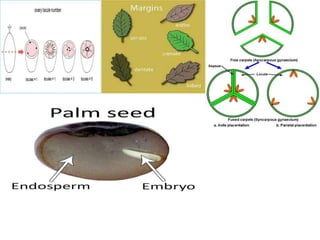
    • Gynoecium: Thereare generally (4) or (5) carpels, or ∞, as in citrus. They are syncarpous or free at the base and united above, and either sessile or seated on the disc. The ovary is generally four- or five-locular, or multilocular as in citrus, with axile placentation (parietal in limonia only). • Fruit: This is a berry, capsule or hesperidium.
  • 76.
    • Seeds: Theseeds may or may not have an endosperm. Polyembryony is frequent in Citrus, e.g. lemon and orange (but not pummelo and citron)
  • 79.