 Range from woody shrubs to tall trees
 Leaves are aromatic, containing oil glands
 Flowers may be white, pink, red, purple, yellow.
They usually have five sepals and petals and
many stamens. Stamens are long and
conspicuous.
 Fruit is generally woody
 Some plants in this family are:
Syzygium aromaticum (Lwang) , Syzygium
cumini (Jamuna) and other Syzygium species
Psidium guajava (Amba) and Psidium species
Eucalyptus globulus and other Eucalyptus species
Synonyms:
 Eugenia aromatica
 Eugenia caryophyllatum
 Jambosa caryophyllus
 Myrtus caryophyllus
Common names:
 Nepali: Lwang
 English: clove
Distribution and Habitat:
 Plants grows well in rich, loamy soil with high humus content
 Also grows well near the sea in open sandy loam and at altitudes
from sea level to 600m (Tropical)
 Native to North Moluccas, the spice Islands of Indonesia. It is
cultivated in Mauritius, India, Srilanka, Brazil, the West Indies,
Pemba Islands
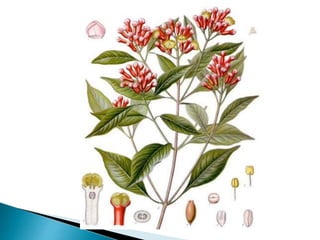
 Evergreen plant,10-20m high
 Leaves: opposite, egg-shaped to elliptic 6-13cm by 3-6cm
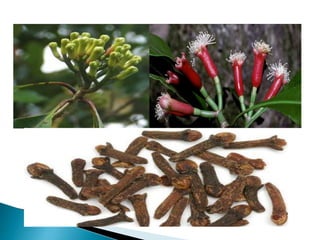
 Flower
 reddish brown in color
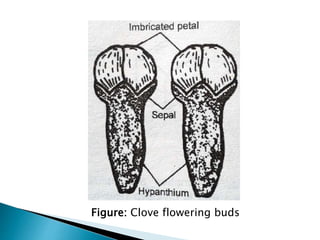
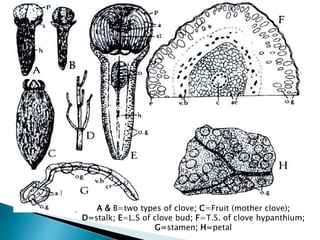
 Lower stalk-like ‘hypanthium’ and upper called ‘crown’ or ‘cap’
 Hypanthium is surrounded with 4 thick divergent sepals and
dome-shaped corolla
 Upper portion shows inferior bilocular ovary and oil glands
 Crown consists of Calyx, Corolla, Stamen and Style
 Corolla-imbricate membranous petals
 Stamens-numerous, free, introse, tetradelphous
 Gynoecium-inferior bilocular ovary with numerous ovules and
axile placentation, style in centre, nectar disc at the base
 Fruit: small, dark red colored berry, 2-2.5 cm long
 Odour: Strong, spicy and aromatic
 Taste: Pungent aromatic
Figure: Clove flowering buds
T.S of hypanthium shows:
 Epidermis with thick cuticle and stomata
 Collenchymatus Parenchyma containing
numerous schizoly-sigenous oil glands
 Calcium oxalate clusters in Parenchyma
 Zone of slightly thick walled cells embedding
arising of about 15 bilateral vascular bundles
 Parenchyma containing air spaces or lacuna
(Arenchyma)
 Central columella-Thick walled Parenchymatous
cells containing cluster crystals of calcium
oxalate and 20-25 small vascular bundles
Figure: Transverse section of Clove hypanthium
A & B=two types of clove; C=Fruit (mother clove);
D=stalk; E=L.S of clove bud; F=T.S. of clove hypanthium;
G=stamen; H=petal
 Dried flower buds
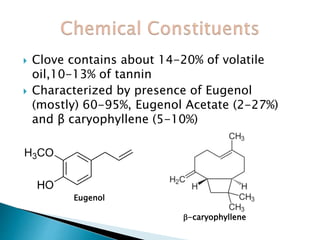
 Clove contains about 14-20% of volatile
oil,10-13% of tannin
 Characterized by presence of Eugenol
(mostly) 60-95%, Eugenol Acetate (2-27%)
and β caryophyllene (5-10%)
Eugenol
-caryophyllene
 Clove oil used as analgesic, antiseptic, aromatic,
anthelmintic, mosquito repellent, anti-rheumatic,
carminative agent, antibiotic
 Dentists also use clove oil to disinfect root canal
 Clove’s oil is used aromatherapy when
stimulation and warming are needed , especially
for digestive problems
 Used in preparation of gargles, mouthwash and
toothpastes
 Clove oil is used in the preparation of scented
cigarettes
 The Natural History Museum,2013,Viable
Herbal Solutions Website
 Kokate C.K, 1996, Practical of
Pharmacognosy, 4th edition, Deihi-110034,
Vallabh Prakashan