ANNONACEAE
(Custard Apple Family)
Dr. T. A. Gitte,
Assistant Professor & Head,
Department of Botany,
Vaidyanath College, Parli-Vaijnath.
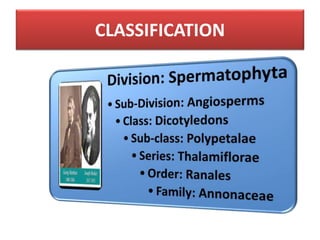
CLASSIFICATION
General Characters
• This is large family of 130 genera and 2300
species, distributed in tropical parts of world.
• From India more than 25 genera and 200
species have been reported.
• General Habit: Usually aromatic trees or
shrubs, rarely liana-like (i.e. woody climbers)
e.g. species of Oxymitra.
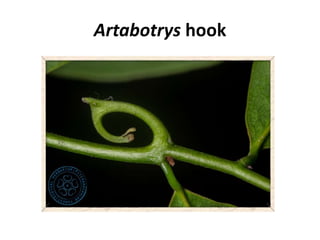
• Artabotrys is a hook climber.
• Bark, leaves and floral parts contain oil ducts.
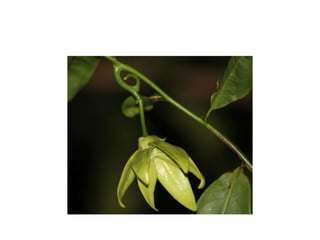
Artabotrys hook
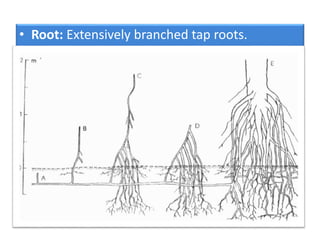
• Root: Extensively branched tap roots.
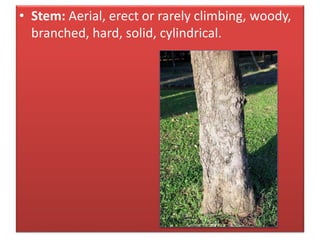
• Stem: Aerial, erect or rarely climbing, woody,
branched, hard, solid, cylindrical.
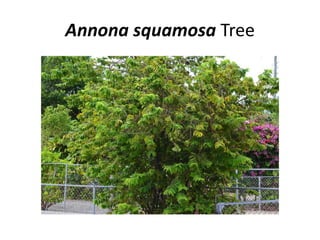
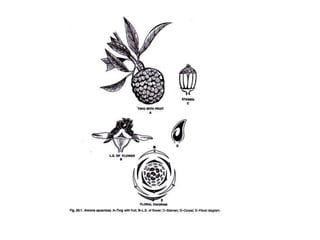
Annona squamosa Tree
• Leaves: Simple, alternate, exstipulate,
petiolate, apex acute, obtuse or even
mucronate (Annona mucronata); ovate,
obovate or lanceolate; coriaceous, glabrous;
unicostate reticulate; gland-dotted and
aromatic.
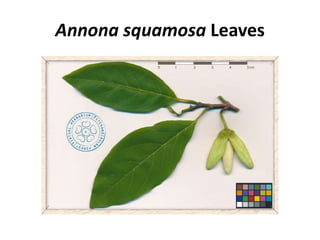
Annona squamosa Leaves
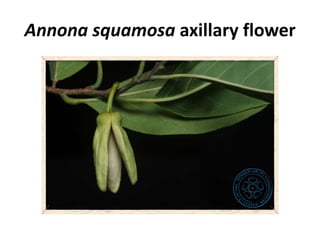
• Inflorescence: Solitary, axillary or terminal, or
leaf opposed; sometimes cauliflorous i.e.
flowers occur on stem (Polyalthia fragrans)
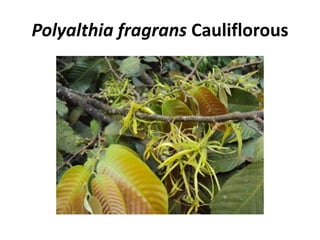
Polyalthia fragrans Cauliflorous
Annona squamosa axillary flower
• Flower: Bracteate or ebracteate, ebracteolate,
pedicellate, complete, bisexual, rarely
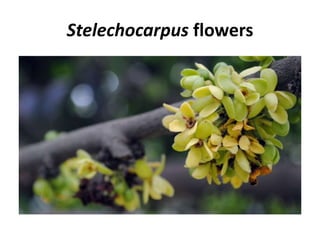
unisexual (Stelechocarpus), actinomorphic,
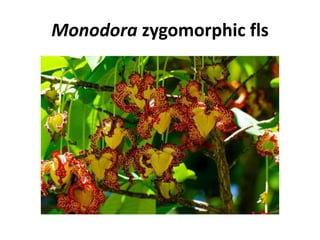
rarerly zygomorphic (Monodora); hypogynous.
Stelechocarpus flowers
Monodora zygomorphic fls
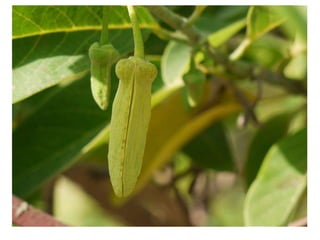
• Calyx: Sepals 3, sometimes 6 arranged in two
whorls of three each; polysepalous or rarely
basally connate; valvate; rarely imbricate.
• Corolla: Generally 6 petals, arranged in two
whorls of three each, sometimes only 3 petals;
polypetalous; valvate or slightly imbricate.
• Sometimes,sepals and petals are same so
called as perianth.
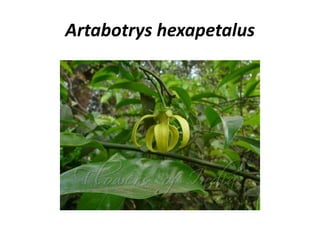
Artabotrys hexapetalus
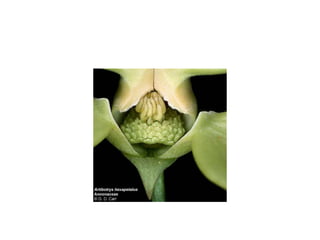
• Androecium: Stamens numerous,
polyandrous; spirally arranged on large,
convex receptacle; filaments short and thick;
connective continues beyond the anther and
produces a dilated head; adnate; extrorse.
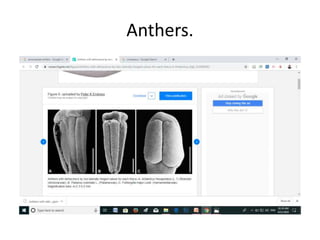
Anthers.
• Gynoecium: Carpels numerous, arranged
spirally on the raised receptacle (Polyalthia,
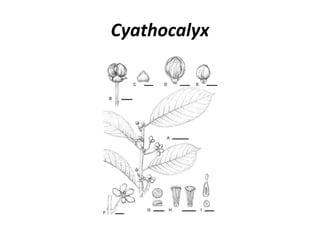
Artabotrys); only 1 -3 carpels in Cyathocalyx;
apocarpous; superior, unilocular, one to many
ovules in the locule; parietal or sometimes
basal or sometimes marginal placentation;
style short or absent; stigma sessile, simple or
trilobed (Tetrameranthus).
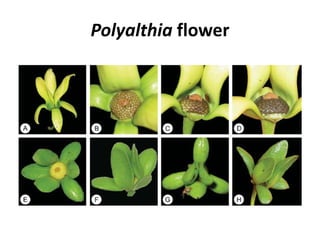
Polyalthia flower
Cyathocalyx
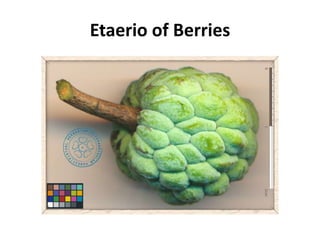
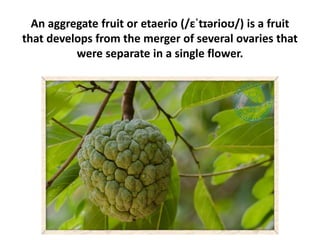
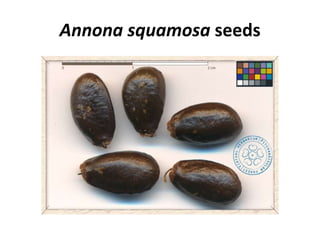
• Fruits and seeds: Fruit an etaerio of berries,
seeds large, endospermic.
Etaerio of Berries
An aggregate fruit or etaerio (/ɛˈtɪərioʊ/) is a fruit
that develops from the merger of several ovaries that
were separate in a single flower.
Annona squamosa seeds
• Pollination and Dispersal: Pollination
generally by flies; dispersal by birds, bats or
mammals.
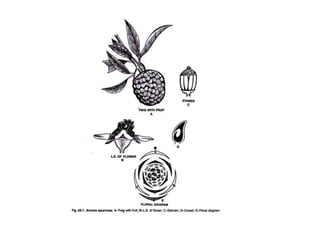
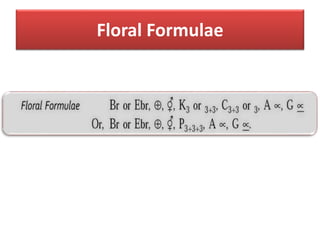
Floral Formulae
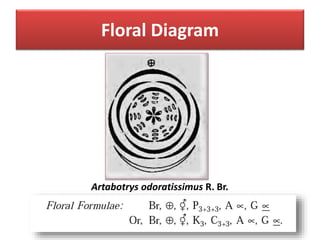
Floral Diagram
Artabotrys odoratissimus R. Br.
Economic Importance of Annonaceae
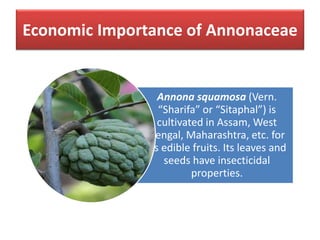
Annona squamosa (Vern.
“Sharifa” or “Sitaphal”) is
cultivated in Assam, West
Bengal, Maharashtra, etc. for
its edible fruits. Its leaves and
seeds have insecticidal
properties.
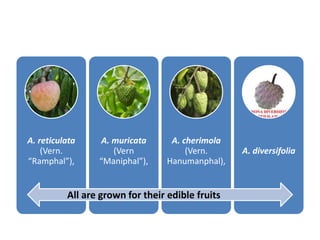
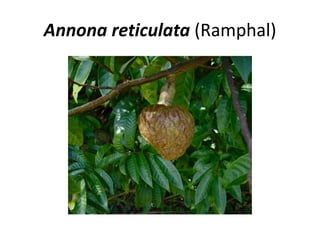
A. reticulata
(Vern.
“Ramphal”),
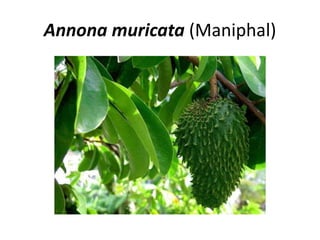
A. muricata
(Vern
“Maniphal”),
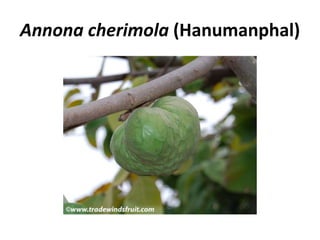
A. cherimola
(Vern.
Hanumanphal),
A. diversifolia
All are grown for their edible fruits
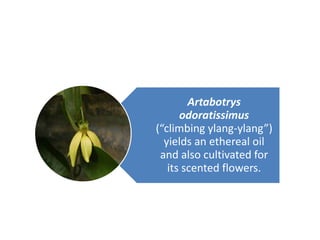
Artabotrys
odoratissimus
(“climbing ylang-ylang”)
yields an ethereal oil
and also cultivated for
its scented flowers.
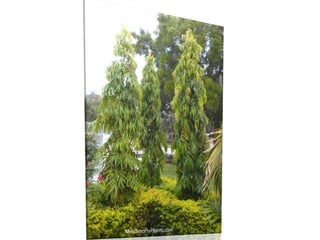
Polyalthia longifolia & P. pendula (Ashok)
are grown for their beautiful drooping green
branches on road sides and in gardens.
Polyalthia longifolia wood is used for
making pencils, boxes, match-box industry
etc.
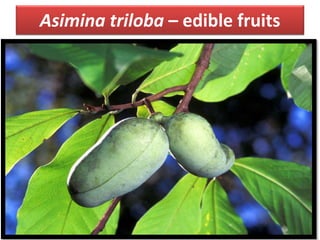
Asimina triloba – edible fruits
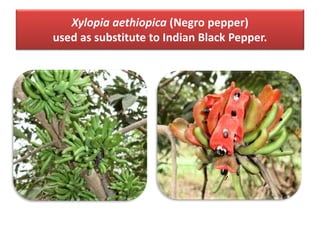
Xylopia aethiopica (Negro pepper)
used as substitute to Indian Black Pepper.
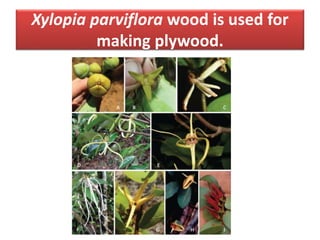
Xylopia parviflora wood is used for
making plywood.
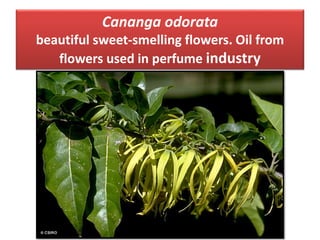
Cananga odorata
beautiful sweet-smelling flowers. Oil from
flowers used in perfume industry
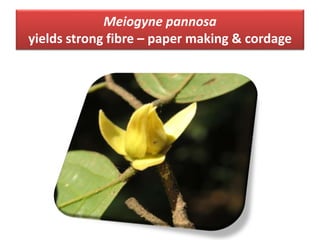
Meiogyne pannosa
yields strong fibre – paper making & cordage
Annona reticulata (Ramphal)
Annona muricata (Maniphal)
Annona cherimola (Hanumanphal)
Thank You