FMEA
• Intelligent use of FMEA
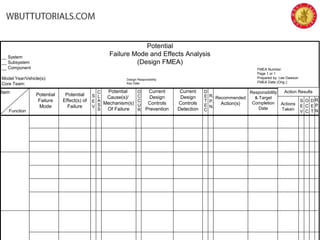
Potential
Failure Mode and Effects Analysis
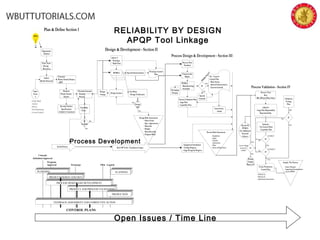
(Design FMEA)
__ System
__ Subsystem
__ Component
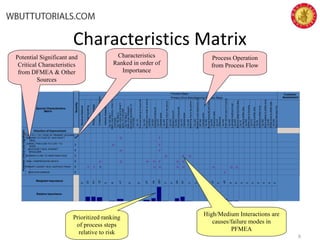
Model Year/Vehicle(s):
Core Team:
Design Responsibility
Key Date:
FMEA Number:
Page 1 or 1
Prepared by: Lee Dawson
FMEA Date (Orig.):
Item
Function
Potential
Failure
Mode
Potential
Effect(s) of
Failure
Potential
Cause(s)/
Mechanism(s)
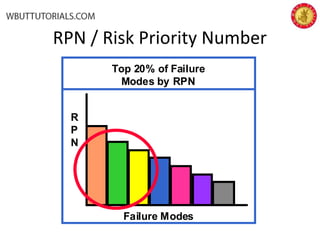
Of Failure
Current
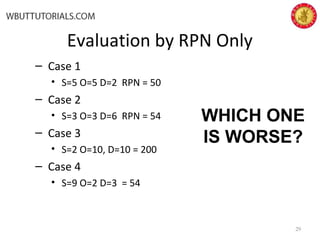
Design
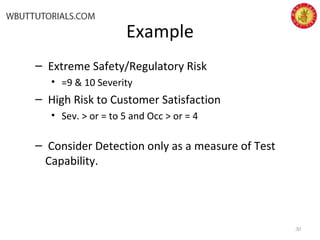
Controls
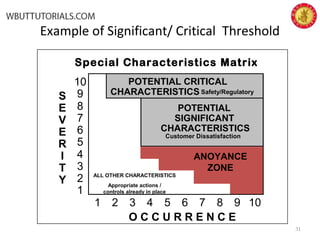
Prevention
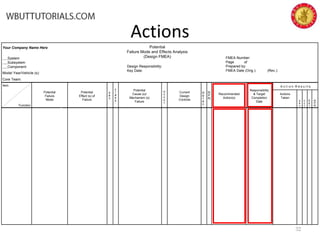
Current
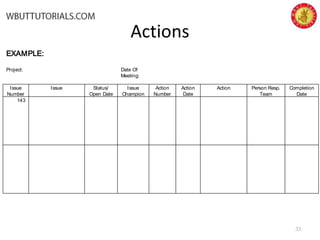
Design
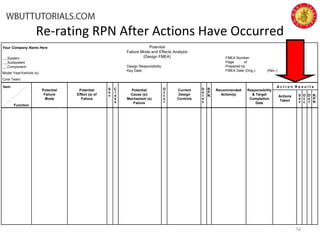
Controls
Detection
Recommended
Action(s)
Responsibility
& Target
Completion
Date
Actions
Taken
Action Results
S
E
V
C
L
A
S
S
O
C
C
U
R
D
E
T
E
C
R.
P.
N.
S
E
V
O
C
C
D
E
T
R.
P.
N.
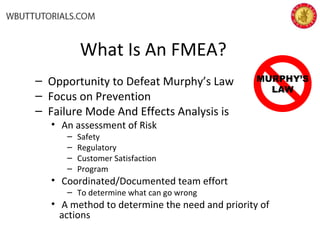
What Is An FMEA?
– Opportunity to Defeat Murphy’s Law
– Focus on Prevention
– Failure Mode And Effects Analysis is
• An assessment of Risk
– Safety
– Regulatory
– Customer Satisfaction
– Program
• Coordinated/Documented team effort
– To determine what can go wrong
• A method to determine the need and priority of
actions
MURPHY’S
LAW
DFMEA
Design & Development - Section II
GD & T
- Drawings
- Math Data
DFMEA
Design Actions
Test Plans
- Design Verification
Design
Change
IF
Design
OK
Special Characteristics
Design Risk Assessment
- Open Issues
- Spec. Agreements
- Materials
- Budget
- Manufacturing
- Program Risks
Kick Off Tools / Equipment Gages
No
Yes
Prototype Control
Plan
Plan & Define Section 1
IDEA
Opportunity
Defined
Form Team
- Timing
- Resources
Collect
Market Research
Customer
Wants/Needs/Desires
- QFD
Priorities
Wants/Needs/
Desires
Develop Product
Specifications
- Linked to Customers
Develop Concepts
- Product
- Process
Input
From
5
- Failure Mode
Analysis
- History
- Past Performance
- Lessons Learned
IF
Feasible
No
Yes
Initial Process
Feasibility
- Team
Process Design & Development - Section III
Process Flow
Finalized
Characteristic
Matrix
PFMEA
- Manufacturing
- Assembly
Process Validation Plan
- Gage Plan
- Capability Plan
Packaging
Designs
IF
Process Risk Assessment
- Equipment
- Gages
- Controls
- Instructions
- Plans
- Status of Open Issues
- Equipment Installation
- Tooling Progress
- Gage Design & Progress
Special
Controls
Instructions
- Initial
YES
NO
MistakeProof?
Pre - Launch
Control Plan
- Risk/Action
- Special Characteristics
- Current Controls Process Validation - Section IV
Process Trial
Run
Min 300 pcs/Hits/shots
GR & R
- Gage Plan Repeatability
Reproducibility
Statistics
- Via Control Plans
- Capability Plan
Validation
Testing
Plan
Sample The Process
- Source Warrants
- Supporting Documentation
- Level of PPAP
Design
Change
Back to II
YES
NO
- Reduced (n)
- Reduced (f)
- Optimizing Characteristics
IF
IF
Can we change
process to
contain?
IF
YES
STABLE?
CAPABLE?
IF
OK?
YES
NO
NO
Revisit III
PFMEA
For Additional
Potential
Failures
NO
YES
Create Production
Control Plan
PLANNING
Concept
Initiation/Approval
Program
Approval Prototype Pilot Launch
PLANNING
CONTROL PLANS
PRODUCT DESIGN AND DEV.
PROCESS DESIGN AND DEVELOPMENT.
PRODUCT AND PROCESS VALIDATION.
FEEDBACK ASSESSMENT AND CORRECTIVE ACTION
PRODUCTION
Open Issues / Time Line
RELIABILITY BY DESIGN
APQP Tool Linkage
Process Development
Requirements
Cascade
• How Fmea fits into Product and
Process Development
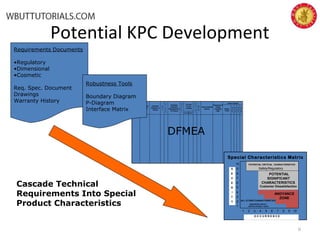
Potential KPC Development
6
DetectPrevent
R
P
N
D
E
T
O
C
C
S
E
V
Action
Taken
Action Results
Response &
Target
Complete
Date
Recommended
Actions
R
P
N
D
e
t
e
c
Current
Controls
O
c
c
u
r
Potential
Cause(s)/
Mechanism(s)
Of Failure
C
l
a
s
s
S
e
v
Potential
Effect(s) of
Failure
Potential
Failure
Mode
Item /
Process
Step
DetectPrevent
R
P
N
D
E
T
O
C
C
S
E
V
Action
Taken
Action Results
Response &
Target
Complete
Date
Recommended
Actions
R
P
N
D
e
t
e
c
Current
Design
Controls
O
c
c
u
r
Potential
Cause(s)/
Mechanism(s)
Of Failure
C
l
a
s
s
S
e
v
Potential
Effect(s) of
Failure
Potential
Failure
Mode
Item /
Process
Step
Function
DFMEA
Requirements Documents
•Regulatory
•Dimensional
•Cosmetic
Req. Spec. Document
Drawings
Warranty History
Robustness Tools
Boundary Diagram
P-Diagram
Interface Matrix
10
9
8
7
6
5
4
3
2
1
1 2 3 4 5 6 7 8 9 10
S
E
V
E
R
I
T
Y
O C C U R R E N C E
POTENTIAL CRITICAL CHARACTERISTICS
Safety/Regulatory
POTENTIAL
SIGNIFICANT
CHARACTERISTICS
Customer Dissatisfaction
Special Characteristics Matrix
ANOYANCE
ZONE
ALL OTHER CHARACTERISTICS
Appropriate actions /
controls already in place
Cascade Technical
Requirements Into Special
Product Characteristics
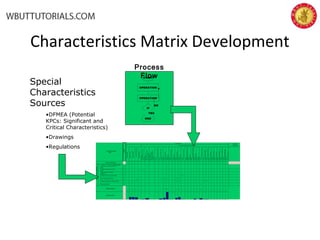
Characteristics Matrix Development
Severity
Process Steps
ReceiveMaterial
Materialhandling
ShippingDamage
ComponentManufacture
VehicleAssembly
Primary Drive Manufacturing Process Steps
Op100Step1
PRE-LOADDOWELPINSTO
FIXTURE
Op100Step2
PRE-LOADJACKSHAFT
SEALTOFIXTURE
Op100Step3
PRE-LOADPRIMARY
HOUSINGBUSHINGTO
FIXTURE
Op110
Pre-loadbearingtofixture#2
Op120
Pre-loadmainshaftoilsealto
mandrel
Op200
Housingtofixture#1
Op210
Operatepress
Op220
Retainingringtotopgroove
Op230
Reloadfixture#1
Op300
Housingtofixture#2
Op310
Operatepress
Op320
Retainingringtotopgroove
Op330
MandreltomainshaftboreI.D.
OP340
Operatepress
Op350
Re-loadfixture#2andmandrel
Op400
Housingtotable
Op410
Reserved
Op420
Chainadjsubassytohousing
Op430
Lubricatebushing&seal
Op445
Moveorstageforfinalassy
Op10
O-ringtoshiftertube
Op500
Shiftertubetohousing
Op510
Clamptoshiftertube
Op20
Assembleshifterlever
Op520
Wavewashertoshifterlever
Op530
Shifterlevertoshiftertube
Op535
Queforfinalassyline
Customer
Assessment
Direction of Improvement
PotentialCriticalandSignificant
1.090 TO 1.110 " FACE OF PRIMARY HOUSING
BUSHING TO FACE OF JACK SHAFT
SEAL
DOWEL PINS 0.260 TO 0.270 " TO
FACE
JACK SHAFT SEAL AGAINST
SHOULDER
BEARING FLUSH TO SNAP RING FACE
SEAL COMPRESSION HEIGHT
PRIMARY GASKET SEAL SURFACE FINISH
SERATION DAMAGE
Weighted Importance
Relative Importance
G F
H F
H F
G F G
H G H H F H H
F F Y H H H H H G G
F
5
3
9
3
9
9
5
0
81
81
72
0
9
41
0
0
27
54
261
3
0
54
81
3
0
0
0
27
0
45
9
9
0
0
0
0
0
0
0
Special Characteristics
Matrix
START
OPERATION
OPERATION
IF
END
YES
NO
Process
Flow
Special
Characteristics
Sources
•DFMEA (Potential
KPCs: Significant and
Critical Characteristics)
•Drawings
•Regulations
Characteristics Matrix
8
Severity
Process Steps
ReceiveMaterial
Materialhandling
ShippingDamage
ComponentManufacture
VehicleAssembly
Primary Drive Manufacturing Process Steps
Op100Step1
PRE-LOADDOWELPINSTO
FIXTURE
Op100Step2
PRE-LOADJACKSHAFT
SEALTOFIXTURE
Op100Step3
PRE-LOADPRIMARY
HOUSINGBUSHINGTO
FIXTURE
Op110
Pre-loadbearingtofixture#2
Op120
Pre-loadmainshaftoilsealto
mandrel
Op200
Housingtofixture#1
Op210
Operatepress
Op220
Retainingringtotopgroove
Op230
Reloadfixture#1
Op300
Housingtofixture#2
Op310
Operatepress
Op320
Retainingringtotopgroove
Op330
MandreltomainshaftboreI.D.
OP340
Operatepress
Op350
Re-loadfixture#2andmandrel
Op400
Housingtotable
Op410
Reserved
Op420
Chainadjsubassytohousing
Op430
Lubricatebushing&seal
Op445
Moveorstageforfinalassy
Op10
O-ringtoshiftertube
Op500
Shiftertubetohousing
Op510
Clamptoshiftertube
Op20
Assembleshifterlever
Op520
Wavewashertoshifterlever
Op530
Shifterlevertoshiftertube
Op535
Queforfinalassyline
Customer
Assessment
Direction of Improvement
PotentialCriticalandSignificant
1.090 TO 1.110 " FACE OF PRIMARY HOUSING
BUSHING TO FACE OF JACK SHAFT
SEAL
DOWEL PINS 0.260 TO 0.270 " TO
FACE
JACK SHAFT SEAL AGAINST
SHOULDER
BEARING FLUSH TO SNAP RING FACE
SEAL COMPRESSION HEIGHT
PRIMARY GASKET SEAL SURFACE FINISH
SERATION DAMAGE
Weighted Importance
Relative Importance
G F
H F
H F
G F G
H G H H F H H
F F Y H H H H H G G
F
5
3
9
3
9
9
5
0
81
81
72
0
9
41
0
0
27
54
261
3
0
54
81
3
0
0
0
27
0
45
9
9
0
0
0
0
0
0
0
Special Characteristics
Matrix
Process Operation
from Process Flow
Potential Significant and
Critical Characteristics
from DFMEA & Other
Sources
High/Medium Interactions are
causes/failure modes in
PFMEA
Characteristics
Ranked in order of
Importance
Prioritized ranking
of process steps
relative to risk
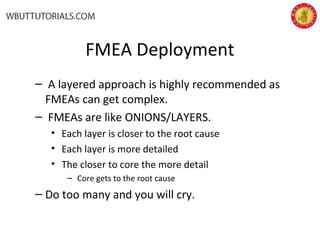
FMEA Deployment
– A layered approach is highly recommended as
FMEAs can get complex.
– FMEAs are like ONIONS/LAYERS.
• Each layer is closer to the root cause
• Each layer is more detailed
• The closer to core the more detail
– Core gets to the root cause
– Do too many and you will cry.
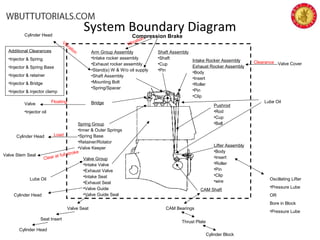
System Boundary Diagram
Lifter Assembly
•Body
•Insert
•Roller
•Pin
•Clip
•wire
CAM Shaft
Pushrod
•Rod
•Cup
•Ball
Intake Rocker Assembly
Exhaust Rocker Assembly
•Body
•Insert
•Roller
•Pin
•Clip
Arm Group Assembly
•Intake rocker assembly
•Exhaust rocker assembly
•Stand(s) W & W/o oil supply
•Shaft Assembly
•Mounting Bolt
•Spring/Spacer
Bridge
Spring Group
•Inner & Outer Springs
•Spring Base
•Retainer/Rotator
•Valve Keeper
Valve Group
•Intake Valve
•Exhaust Valve
•Intake Seat
•Exhaust Seat
•Valve Guide
•Valve Guide Seal
CAM Bearings
Thrust Plate
Cylinder Block
Oscillating Lifter
•Pressure Lube
OR
Bore in Block
•Pressure Lube
Lube Oil
Cylinder Head
Vibration
Valve CoverClearance
Shaft Assembly
•Shaft
•Cup
•Pin
Valve
•Injector oil
Floating
Cylinder Head Load
Valve Stem Seal
Clear at full stroke
Lube Oil
Cylinder Head
Cylinder Head
Seat Insert
Valve Seat
Additional Clearances
•Injector & Spring
•Injector & Spring Base
•Injector & retainer
•Injector & Bridge
•Injector & injector clamp
Compression Brake
Vibration
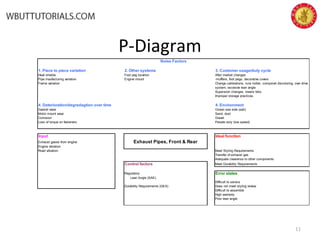
P-Diagram
11
1. Piece to piece variation 2. Other systems 3. Customer usage/duty cycle
Heat shields Foot peg location After market changes
Pipe maufacturing variation Engine mount -mufflers, foot pegs, decorative covers
Frame variation Change calibrations, runs hotter, componet discoloring, over drive
system, excesive lean angle
Supension changes, lowers bike
Improper storage practices
4. Deterioration/degredagtion over time 4. Environment
Gasket wear Ocean sea side (salt)
Motor mount wear Sand, dust
Corrosion Gravel
Loss of torque on fasteners Parade duty (low speed)
Input Ideal function
Exhaust gases from engine Exhaust Pipes, Front & Rear
Engine vibration
Road vibration Meet Styling Requirements
Transfer of exhaust gas
Adequate clearance to other components
Control factors Meet Durability Requirements
Regulatory Error states
Lean Angle (SAE)
Difficult to service
Durability Requirements (GES) Does not meet styling review
Difficult to assemble
High warranty
Poor lean angle
Noise Factors
FMEA Preparation Vertical Approach
– Key Elements of Efficient Development
– Identify all functions/process steps
• Boundary Diagram
• P Diagram
– Identify all failure modes via
brainstorming/data/warranty/COQ
– Identify all effects via brainstorming/data
• Customer focus
– Develop data pools for
• Failure Modes, Effects and Causes for future/ faster
FMEA development 12
System/Subsystem/ Design FMEA
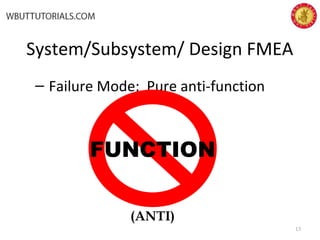
– Failure Mode: Pure anti-function
13
FUNCTION
(ANTI)
System/Subsystem/ Design FMEA
– Effect
• Customer view/customers words
• Regulation violation
• Level of dissatisfaction
– Consider All Customers
• End User
• Engineering Community
• Manufacturing Community
• (Operators/Employees)
• Regulatory Body
14
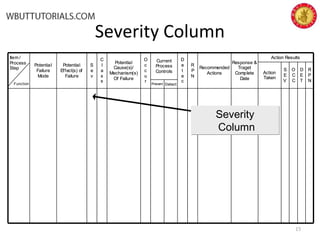
Severity Column
15
DetectPrevent
R
P
N
D
E
T
O
C
C
S
E
V
Action
Taken
Action Results
Response &
Traget
Complete
Date
Recommended
Actions
R
P
N
D
e
t
e
c
Current
Process
Controls
O
c
c
u
r
Potential
Cause(s)/
Mechanism(s)
Of Failure
C
l
a
s
s
S
e
v
Potential
Effect(s) of
Failure
Potential
Failure
Mode
Item /
Process
Step
DetectPrevent
R
P
N
D
E
T
O
C
C
S
E
V
Action
Taken
Action Results
Response &
Traget
Complete
Date
Recommended
Actions
R
P
N
D
e
t
e
c
Current
Process
Controls
O
c
c
u
r
Potential
Cause(s)/
Mechanism(s)
Of Failure
C
l
a
s
s
S
e
v
Potential
Effect(s) of
Failure
Potential
Failure
Mode
Item /
Process
Step
Function
Severity
Column
Severity
Column
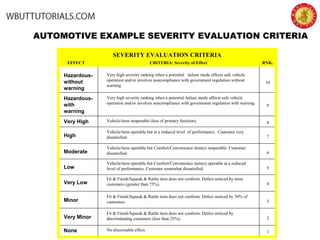
AUTOMOTIVE EXAMPLE SEVERITY EVALUATION CRITERIA
Hazardous-
with
warning
Very High
High
Very high severity ranking when a potential failure mode affects safe vehicle
operation and/or involves noncompliance with government regulation without
warning
Low
Very Low
Minor
Very Minor
None
Very high severity ranking when a potential failure mode affects safe vehicle
operation and/or involves noncompliance with government regulation with warning
Vehicle/item inoperable (loss of primary function).
Vehicle/item operable but at a reduced level of performance. Customer very
dissatisfied.
Vehicle/item operable but Comfort/Convenience item(s) inoperable. Customer
dissatisfied.
Vehicle/item operable but Comfort/Convenience item(s) operable at a reduced
level of performance. Customer somewhat dissatisfied.
Fit & Finish/Squeak & Rattle item does not conform. Defect noticed by most
customers (greater than 75%).
Fit & Finish/Squeak & Rattle item does not conform. Defect noticed by 50% of
customers.
Fit & Finish/Squeak & Rattle item does not conform. Defect noticed by
discriminating customers (less than 25%).
No discernable effect.
10
8
7
6
3
2
1
Hazardous-
without
warning
Moderate
4
5
EFFECT CRITERIA: Severity of Effect RNK.
SEVERITY EVALUATION CRITERIA
9
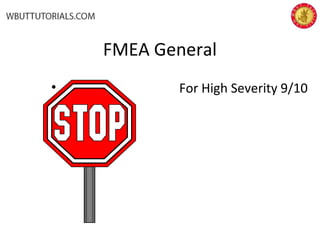
FMEA General
• For High Severity 9/10
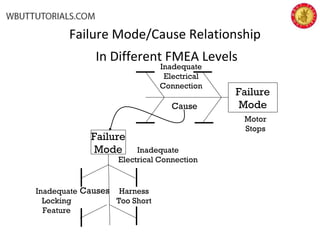
Failure Mode/Cause Relationship
In Different FMEA Levels
Inadequate
Electrical
Connection
Inadequate
Electrical Connection
Motor
Stops
Causes
Cause
Failure
Mode
Failure
Mode
Inadequate
Locking
Feature
Harness
Too Short
Causes
– Causes from P-Diagram
• Noise factors
– Continue through all failure modes.
– Note that many causes are recurring.
19
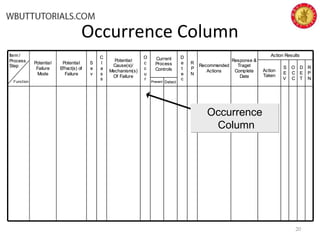
Occurrence Column
20
DetectPrevent
R
P
N
D
E
T
O
C
C
S
E
V
Action
Taken
Action Results
Response &
Traget
Complete
Date
Recommended
Actions
R
P
N
D
e
t
e
c
Current
Process
Controls
O
c
c
u
r
Potential
Cause(s)/
Mechanism(s)
Of Failure
C
l
a
s
s
S
e
v
Potential
Effect(s) of
Failure
Potential
Failure
Mode
Item /
Process
Step
DetectPrevent
R
P
N
D
E
T
O
C
C
S
E
V
Action
Taken
Action Results
Response &
Traget
Complete
Date
Recommended
Actions
R
P
N
D
e
t
e
c
Current
Process
Controls
O
c
c
u
r
Potential
Cause(s)/
Mechanism(s)
Of Failure
C
l
a
s
s
S
e
v
Potential
Effect(s) of
Failure
Potential
Failure
Mode
Item /
Process
Step
Function
Occurrence
Column
Occurrence
Column
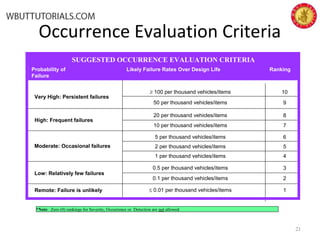
Occurrence Evaluation Criteria
21
*Note: Zero (0) rankings for Severity, Occurrence or Detection are not allowed
Probability of Likely Failure Rates Over Design Life Ranking
Failure
SUGGESTED OCCURRENCE EVALUATION CRITERIA
Very High: Persistent failures
High: Frequent failures
Moderate: Occasional failures
Low: Relatively few failures
Remote: Failure is unlikely
≥ 100 per thousand vehicles/items
50 per thousand vehicles/items
20 per thousand vehicles/items
10 per thousand vehicles/items
5 per thousand vehicles/items
2 per thousand vehicles/items
1 per thousand vehicles/items
0.5 per thousand vehicles/items
0.1 per thousand vehicles/items
≤ 0.01 per thousand vehicles/items
10
9
8
7
6
5
4
3
2
1
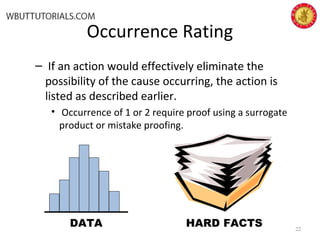
Occurrence Rating
– If an action would effectively eliminate the
possibility of the cause occurring, the action is
listed as described earlier.
• Occurrence of 1 or 2 require proof using a surrogate
product or mistake proofing.
22
DATA HARD FACTS
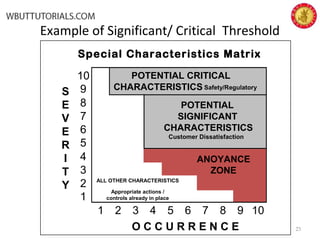
Example of Significant/ Critical Threshold
23
10
9
8
7
6
5
4
3
2
1
1 2 3 4 5 6 7 8 9 10
S
E
V
E
R
I
T
Y
O C C U R R E N C E
POTENTIAL CRITICAL
CHARACTERISTICS Safety/Regulatory
POTENTIAL
SIGNIFICANT
CHARACTERISTICS
Customer Dissatisfaction
ALL OTHER CHARACTERISTICS
Appropriate actions /
controls already in place
Special Characteristics Matrix
ANOYANCE
ZONE
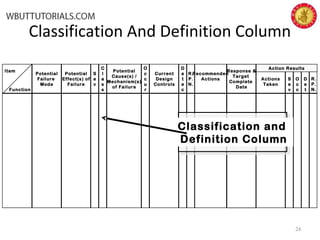
Classification And Definition Column
24
S
e
v
R.
P.
N.
Item
Function
Potential
Failure
Mode
Potential
Effect(s) of
Failure
C
l
a
s
s
Potential
Cause(s) /
Mechanism(s)
of Failure
O
c
c
u
r
Current
Design
Controls
D
e
t
e
c
Recommended
Actions
Response &
Target
Complete
Date
Actions
Taken
Classification and
Definition Column
Action Results
O
c
c
S
e
v
D
e
t
R.
P.
N.
Design Verification (Current Design Controls)
– Think of Design Control in two ways; Prevention
and Detection. List them separately.
– To save time, add any new (untried)
prevention/detection ideas to the document
under Recommended Actions column.
• Prevention is specifically related to reduction or
elimination of a cause.
• Detection is how well the test or series of tests may
find the design flaw
– Causes
– Failure Mode
25
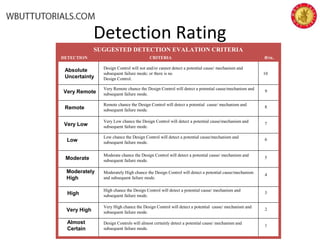
Detection Rating
Absolute
Uncertainty
Very Remote
Remote
Very Low
Low
Moderate
Moderately
High
High
Very High
Almost
Certain
10
9
8
7
6
5
4
3
2
1
Design Control will not and/or cannot detect a potential cause/ mechanism and
subsequent failure mode; or there is no
Design Control.
Very Remote chance the Design Control will detect a potential cause/mechanism and
subsequent failure mode.
Remote chance the Design Control will detect a potential cause/ mechanism and
subsequent failure mode.
Very Low chance the Design Control will detect a potential cause/mechanism and
subsequent failure mode.
Low chance the Design Control will detect a potential cause/mechanism and
subsequent failure mode.
Moderate chance the Design Control will detect a potential cause/ mechanism and
subsequent failure mode.
Moderately High chance the Design Control will detect a potential cause/mechanism
and subsequent failure mode.
Very High chance the Design Control will detect a potential cause/ mechanism and
subsequent failure mode.
High chance the Design Control will detect a potential cause/ mechanism and
subsequent failure mode.
Design Controls will almost certainly detect a potential cause/ mechanism and
subsequent failure mode.
DETECTION
SUGGESTED DETECTION EVALATION CRITERIA
CRITERIA RNK.
Analysis Of Risk
– RPN / RISK PRIORITY NUMBER
– What Is Risk?
– Probability of danger
– Severity/Occurrence/Cause
27
RPN / Risk Priority Number
Top 20% of Failure
Modes by RPN
R
P
N
Failure Modes
Evaluation by RPN Only
– Case 1
• S=5 O=5 D=2 RPN = 50
– Case 2
• S=3 O=3 D=6 RPN = 54
– Case 3
• S=2 O=10, D=10 = 200
– Case 4
• S=9 O=2 D=3 = 54
29
WHICH ONE
IS WORSE?
Example
– Extreme Safety/Regulatory Risk
• =9 & 10 Severity
– High Risk to Customer Satisfaction
• Sev. > or = to 5 and Occ > or = 4
– Consider Detection only as a measure of Test
Capability.
30
Example of Significant/ Critical Threshold
31
10
9
8
7
6
5
4
3
2
1
1 2 3 4 5 6 7 8 9 10
S
E
V
E
R
I
T
Y
O C C U R R E N C E
POTENTIAL CRITICAL
CHARACTERISTICS Safety/Regulatory
POTENTIAL
SIGNIFICANT
CHARACTERISTICS
Customer Dissatisfaction
ALL OTHER CHARACTERISTICS
Appropriate actions /
controls already in place
Special Characteristics Matrix
ANOYANCE
ZONE
Actions
32
Item
Function
System
Subsystem
Component:
Model Year/Vehicle (s):
Core Team:
Your Company Name Here Potential
Failure Mode and Effects Analysis
(Design FMEA)
Design Responsibility:
Key Date:
FMEA Number:
Page of
Prepared by:
FMEA Date (Orig.): (Rev.):
Potential
Failure
Mode
Potential
Effect (s) of
Failure
s
e
v
c
l
a
s
s
Potential
Cause (s)/
Mechanism (s)
Failure
o
c
c
u
r
Current
Design
Controls
D
e
t
e
c
R.
P.
N.
Recommended
Action(s)
Responsibility
& Target
Completion
Date
Actions
Taken
s
e
v
o
c
c
D
e
t
R.
P.
N.
A c t i o n R e s u l t s
Actions
33
EXAMPLE:
Project: Date Of
Meeting:
Issue
Number
Issue Status/
Open Date
Issue
Champion
Action
Number
Action
Date
Action Person Resp.
Team
Completion
Date
143
Re-rating RPN After Actions Have Occurred
34
Item
Function
System
Subsystem
Component:
Model Year/Vehicle (s):
Core Team:
Your Company Name Here Potential
Failure Mode and Effects Analysis
(Design FMEA)
Design Responsibility:
Key Date:
FMEA Number:
Page of
Prepared by:
FMEA Date (Orig.): (Rev.):
Potential
Failure
Mode
Potential
Effect (s) of
Failure
S
e
v
C
l
a
s
s
Potential
Cause (s)/
Mechanism (s)
Failure
O
c
c
u
r
Current
Design
Controls
D
e
t
e
c
R.
P.
N.
Recommended
Action(s)
Responsibility
& Target
Completion
Date
Actions
Taken
S
e
v
O
c
c
D
e
t
R.
P.
N.
A c t i o n R e s u l t s
Re-rating RPN After Actions Have Occurred
– Severity typically stays the same.
– Occurrence is the primary item to reduce / focus
on.
– Detection is reduced only as a last resort.
– Do not plan to REDUCE RPN with detection
actions!!!
• 100% inspection is only 80% effective!
• Reducing RPN with detection does not eliminate
failure mode, or reduce probability of causes
• Detection of 10 is not bad if occurrence is 1
35
FMEA in a continuous flow process
• Steel Making example:
– Design FMEA was performed on a Crankshaft to
determine the best material for the product being
considered. This was a critical application.
– Key features such as Geometry, Strength, Duty
Cycle, were described to the Steel producer.
36
– The key product requirements were mapped
against the required customer features. E.g.
chemistry and microstructure, Internal stress at
ingot level,
– Product Grade and requirements documents
created.
– Key characteristics mapped against processes
– Process FMEA was performed on processes that
affected customer wants based on priority.
37
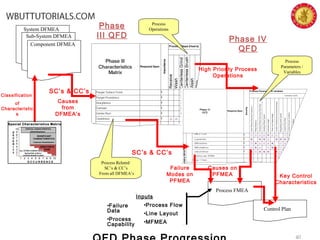
Phase I QFD
Phase II
QFD
Product
Specifications
Customer
Wants
(Marketing
Information)
Product
Specifications
Systems / Sub-
Systems / Components
Phase
Progressio
n
System DFMEA
Sub-System DFMEA
Component DFMEA
DFMEA Failure Modes
QFD Phase Progression
Inputs
•Boundary
Diagram
•P-Diagram
•Interface Matrix
•Drawings
•Warranty
•FMA
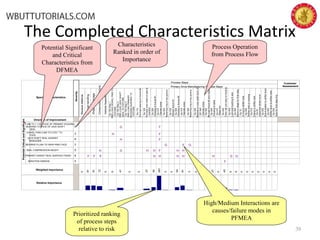
The Completed Characteristics Matrix
39
Severity
Process StepsReceiveMaterial
Materialhandling
ShippingDamage
ComponentManufacture
VehicleAssembly
Primary Drive Manufacturing Process Steps
Op100Step1
PRE-LOADDOWELPINSTO
FIXTURE
Op100Step2
PRE-LOADJACKSHAFT
SEALTOFIXTURE
Op100Step3
PRE-LOADPRIMARY
HOUSINGBUSHINGTO
FIXTURE
Op110
Pre-loadbearingtofixture#2
Op120
Pre-loadmainshaftoilsealto
mandrel
Op200
Housingtofixture#1
Op210
Operatepress
Op220
Retainingringtotopgroove
Op230
Reloadfixture#1
Op300
Housingtofixture#2
Op310
Operatepress
Op320
Retainingringtotopgroove
Op330
MandreltomainshaftboreI.D.
OP340
Operatepress
Op350
Re-loadfixture#2andmandrel
Op400
Housingtotable
Op410
Reserved
Op420
Chainadjsubassytohousing
Op430
Lubricatebushing&seal
Op445
Moveorstageforfinalassy
Op10
O-ringtoshiftertube
Op500
Shiftertubetohousing
Op510
Clamptoshiftertube
Op20
Assembleshifterlever
Op520
Wavewashertoshifterlever
Op530
Shifterlevertoshiftertube
Op535
Queforfinalassyline
Customer
Assessment
Direction of Improvement
PotentialCriticalandSignificant
1.090 TO 1.110 " FACE OF PRIMARY HOUSING
BUSHING TO FACE OF JACK SHAFT
SEAL
DOWEL PINS 0.260 TO 0.270 " TO
FACE
JACK SHAFT SEAL AGAINST
SHOULDER
BEARING FLUSH TO SNAP RING FACE
SEAL COMPRESSION HEIGHT
PRIMARY GASKET SEAL SURFACE FINISH
SERATION DAMAGE
Weighted Importance
Relative Importance
G F
H F
H F
G F G
H G H H F H H
F F Y H H H H H G G
F
5
3
9
3
9
9
5
0
81
81
72
0
9
41
0
0
27
54
261
3
0
54
81
3
0
0
0
27
0
45
9
9
0
0
0
0
0
0
0
Special Characteristics
Matrix
Process Operation
from Process Flow
Potential Significant
and Critical
Characteristics from
DFMEA
High/Medium Interactions are
causes/failure modes in
PFMEA
Characteristics
Ranked in order of
Importance
Prioritized ranking
of process steps
relative to risk
40
System DFMEA
Sub-System DFMEA
Component DFMEA
Classification
of
Characteristic
s
SC’s & CC’s
Process
Operations
Process Related
SC’s & CC’s
From all DFMEA’s
Process FMEA
SC’s & CC’s
Phase
III QFD Phase IV
QFD
Process
Parameters /
Variables
High Priority Process
Operations
Causes on
PFMEA
Failure
Modes on
PFMEA
Causes
from
DFMEA’s
Control Plan
Key Control
Characteristics
Inputs
•Process Flow
•Line Layout
•MFMEA
•Failure
Data
•Process
Capability
10
9
8
7
6
5
4
3
2
1
1 2 3 4 5 6 7 8 9 10
S
E
V
E
R
I
T
Y
O C C U R R E N C E
CRITICAL CHARACTERISTICS
Safety/Regulatory
SIGNIFICANT
CHARACTERISTICS
Customer Dissatisfaction
ALL OTHER CHARACTERISTICS
Appropriate actions /
controls already in place
Special Characteristics Matrix
ANNOYANCE
ZONE
Summary
– FMEA can be used creatively in continuous
processing.
– Linking key customer requirements to process
outputs instead of standard product grade is
valuable.
– Future customer requirements will drive new and
modified processes to achieve specialty results as
a normal practice
41
Q&A

Failure mode-and-effects-analysis

  • 1.
  • 2.
    Potential Failure Mode andEffects Analysis (Design FMEA) __ System __ Subsystem __ Component Model Year/Vehicle(s): Core Team: Design Responsibility Key Date: FMEA Number: Page 1 or 1 Prepared by: Lee Dawson FMEA Date (Orig.): Item Function Potential Failure Mode Potential Effect(s) of Failure Potential Cause(s)/ Mechanism(s) Of Failure Current Design Controls Prevention Current Design Controls Detection Recommended Action(s) Responsibility & Target Completion Date Actions Taken Action Results S E V C L A S S O C C U R D E T E C R. P. N. S E V O C C D E T R. P. N.
  • 3.
    What Is AnFMEA? – Opportunity to Defeat Murphy’s Law – Focus on Prevention – Failure Mode And Effects Analysis is • An assessment of Risk – Safety – Regulatory – Customer Satisfaction – Program • Coordinated/Documented team effort – To determine what can go wrong • A method to determine the need and priority of actions MURPHY’S LAW
  • 4.
    DFMEA Design & Development- Section II GD & T - Drawings - Math Data DFMEA Design Actions Test Plans - Design Verification Design Change IF Design OK Special Characteristics Design Risk Assessment - Open Issues - Spec. Agreements - Materials - Budget - Manufacturing - Program Risks Kick Off Tools / Equipment Gages No Yes Prototype Control Plan Plan & Define Section 1 IDEA Opportunity Defined Form Team - Timing - Resources Collect Market Research Customer Wants/Needs/Desires - QFD Priorities Wants/Needs/ Desires Develop Product Specifications - Linked to Customers Develop Concepts - Product - Process Input From 5 - Failure Mode Analysis - History - Past Performance - Lessons Learned IF Feasible No Yes Initial Process Feasibility - Team Process Design & Development - Section III Process Flow Finalized Characteristic Matrix PFMEA - Manufacturing - Assembly Process Validation Plan - Gage Plan - Capability Plan Packaging Designs IF Process Risk Assessment - Equipment - Gages - Controls - Instructions - Plans - Status of Open Issues - Equipment Installation - Tooling Progress - Gage Design & Progress Special Controls Instructions - Initial YES NO MistakeProof? Pre - Launch Control Plan - Risk/Action - Special Characteristics - Current Controls Process Validation - Section IV Process Trial Run Min 300 pcs/Hits/shots GR & R - Gage Plan Repeatability Reproducibility Statistics - Via Control Plans - Capability Plan Validation Testing Plan Sample The Process - Source Warrants - Supporting Documentation - Level of PPAP Design Change Back to II YES NO - Reduced (n) - Reduced (f) - Optimizing Characteristics IF IF Can we change process to contain? IF YES STABLE? CAPABLE? IF OK? YES NO NO Revisit III PFMEA For Additional Potential Failures NO YES Create Production Control Plan PLANNING Concept Initiation/Approval Program Approval Prototype Pilot Launch PLANNING CONTROL PLANS PRODUCT DESIGN AND DEV. PROCESS DESIGN AND DEVELOPMENT. PRODUCT AND PROCESS VALIDATION. FEEDBACK ASSESSMENT AND CORRECTIVE ACTION PRODUCTION Open Issues / Time Line RELIABILITY BY DESIGN APQP Tool Linkage Process Development
  • 5.
    Requirements Cascade • How Fmeafits into Product and Process Development
  • 6.
    Potential KPC Development 6 DetectPrevent R P N D E T O C C S E V Action Taken ActionResults Response & Target Complete Date Recommended Actions R P N D e t e c Current Controls O c c u r Potential Cause(s)/ Mechanism(s) Of Failure C l a s s S e v Potential Effect(s) of Failure Potential Failure Mode Item / Process Step DetectPrevent R P N D E T O C C S E V Action Taken Action Results Response & Target Complete Date Recommended Actions R P N D e t e c Current Design Controls O c c u r Potential Cause(s)/ Mechanism(s) Of Failure C l a s s S e v Potential Effect(s) of Failure Potential Failure Mode Item / Process Step Function DFMEA Requirements Documents •Regulatory •Dimensional •Cosmetic Req. Spec. Document Drawings Warranty History Robustness Tools Boundary Diagram P-Diagram Interface Matrix 10 9 8 7 6 5 4 3 2 1 1 2 3 4 5 6 7 8 9 10 S E V E R I T Y O C C U R R E N C E POTENTIAL CRITICAL CHARACTERISTICS Safety/Regulatory POTENTIAL SIGNIFICANT CHARACTERISTICS Customer Dissatisfaction Special Characteristics Matrix ANOYANCE ZONE ALL OTHER CHARACTERISTICS Appropriate actions / controls already in place Cascade Technical Requirements Into Special Product Characteristics
  • 7.
    Characteristics Matrix Development Severity ProcessSteps ReceiveMaterial Materialhandling ShippingDamage ComponentManufacture VehicleAssembly Primary Drive Manufacturing Process Steps Op100Step1 PRE-LOADDOWELPINSTO FIXTURE Op100Step2 PRE-LOADJACKSHAFT SEALTOFIXTURE Op100Step3 PRE-LOADPRIMARY HOUSINGBUSHINGTO FIXTURE Op110 Pre-loadbearingtofixture#2 Op120 Pre-loadmainshaftoilsealto mandrel Op200 Housingtofixture#1 Op210 Operatepress Op220 Retainingringtotopgroove Op230 Reloadfixture#1 Op300 Housingtofixture#2 Op310 Operatepress Op320 Retainingringtotopgroove Op330 MandreltomainshaftboreI.D. OP340 Operatepress Op350 Re-loadfixture#2andmandrel Op400 Housingtotable Op410 Reserved Op420 Chainadjsubassytohousing Op430 Lubricatebushing&seal Op445 Moveorstageforfinalassy Op10 O-ringtoshiftertube Op500 Shiftertubetohousing Op510 Clamptoshiftertube Op20 Assembleshifterlever Op520 Wavewashertoshifterlever Op530 Shifterlevertoshiftertube Op535 Queforfinalassyline Customer Assessment Direction of Improvement PotentialCriticalandSignificant 1.090 TO 1.110 " FACE OF PRIMARY HOUSING BUSHING TO FACE OF JACK SHAFT SEAL DOWEL PINS 0.260 TO 0.270 " TO FACE JACK SHAFT SEAL AGAINST SHOULDER BEARING FLUSH TO SNAP RING FACE SEAL COMPRESSION HEIGHT PRIMARY GASKET SEAL SURFACE FINISH SERATION DAMAGE Weighted Importance Relative Importance G F H F H F G F G H G H H F H H F F Y H H H H H G G F 5 3 9 3 9 9 5 0 81 81 72 0 9 41 0 0 27 54 261 3 0 54 81 3 0 0 0 27 0 45 9 9 0 0 0 0 0 0 0 Special Characteristics Matrix START OPERATION OPERATION IF END YES NO Process Flow Special Characteristics Sources •DFMEA (Potential KPCs: Significant and Critical Characteristics) •Drawings •Regulations
  • 8.
    Characteristics Matrix 8 Severity Process Steps ReceiveMaterial Materialhandling ShippingDamage ComponentManufacture VehicleAssembly PrimaryDrive Manufacturing Process Steps Op100Step1 PRE-LOADDOWELPINSTO FIXTURE Op100Step2 PRE-LOADJACKSHAFT SEALTOFIXTURE Op100Step3 PRE-LOADPRIMARY HOUSINGBUSHINGTO FIXTURE Op110 Pre-loadbearingtofixture#2 Op120 Pre-loadmainshaftoilsealto mandrel Op200 Housingtofixture#1 Op210 Operatepress Op220 Retainingringtotopgroove Op230 Reloadfixture#1 Op300 Housingtofixture#2 Op310 Operatepress Op320 Retainingringtotopgroove Op330 MandreltomainshaftboreI.D. OP340 Operatepress Op350 Re-loadfixture#2andmandrel Op400 Housingtotable Op410 Reserved Op420 Chainadjsubassytohousing Op430 Lubricatebushing&seal Op445 Moveorstageforfinalassy Op10 O-ringtoshiftertube Op500 Shiftertubetohousing Op510 Clamptoshiftertube Op20 Assembleshifterlever Op520 Wavewashertoshifterlever Op530 Shifterlevertoshiftertube Op535 Queforfinalassyline Customer Assessment Direction of Improvement PotentialCriticalandSignificant 1.090 TO 1.110 " FACE OF PRIMARY HOUSING BUSHING TO FACE OF JACK SHAFT SEAL DOWEL PINS 0.260 TO 0.270 " TO FACE JACK SHAFT SEAL AGAINST SHOULDER BEARING FLUSH TO SNAP RING FACE SEAL COMPRESSION HEIGHT PRIMARY GASKET SEAL SURFACE FINISH SERATION DAMAGE Weighted Importance Relative Importance G F H F H F G F G H G H H F H H F F Y H H H H H G G F 5 3 9 3 9 9 5 0 81 81 72 0 9 41 0 0 27 54 261 3 0 54 81 3 0 0 0 27 0 45 9 9 0 0 0 0 0 0 0 Special Characteristics Matrix Process Operation from Process Flow Potential Significant and Critical Characteristics from DFMEA & Other Sources High/Medium Interactions are causes/failure modes in PFMEA Characteristics Ranked in order of Importance Prioritized ranking of process steps relative to risk
  • 9.
    FMEA Deployment – Alayered approach is highly recommended as FMEAs can get complex. – FMEAs are like ONIONS/LAYERS. • Each layer is closer to the root cause • Each layer is more detailed • The closer to core the more detail – Core gets to the root cause – Do too many and you will cry.
  • 10.
    System Boundary Diagram LifterAssembly •Body •Insert •Roller •Pin •Clip •wire CAM Shaft Pushrod •Rod •Cup •Ball Intake Rocker Assembly Exhaust Rocker Assembly •Body •Insert •Roller •Pin •Clip Arm Group Assembly •Intake rocker assembly •Exhaust rocker assembly •Stand(s) W & W/o oil supply •Shaft Assembly •Mounting Bolt •Spring/Spacer Bridge Spring Group •Inner & Outer Springs •Spring Base •Retainer/Rotator •Valve Keeper Valve Group •Intake Valve •Exhaust Valve •Intake Seat •Exhaust Seat •Valve Guide •Valve Guide Seal CAM Bearings Thrust Plate Cylinder Block Oscillating Lifter •Pressure Lube OR Bore in Block •Pressure Lube Lube Oil Cylinder Head Vibration Valve CoverClearance Shaft Assembly •Shaft •Cup •Pin Valve •Injector oil Floating Cylinder Head Load Valve Stem Seal Clear at full stroke Lube Oil Cylinder Head Cylinder Head Seat Insert Valve Seat Additional Clearances •Injector & Spring •Injector & Spring Base •Injector & retainer •Injector & Bridge •Injector & injector clamp Compression Brake Vibration
  • 11.
    P-Diagram 11 1. Piece topiece variation 2. Other systems 3. Customer usage/duty cycle Heat shields Foot peg location After market changes Pipe maufacturing variation Engine mount -mufflers, foot pegs, decorative covers Frame variation Change calibrations, runs hotter, componet discoloring, over drive system, excesive lean angle Supension changes, lowers bike Improper storage practices 4. Deterioration/degredagtion over time 4. Environment Gasket wear Ocean sea side (salt) Motor mount wear Sand, dust Corrosion Gravel Loss of torque on fasteners Parade duty (low speed) Input Ideal function Exhaust gases from engine Exhaust Pipes, Front & Rear Engine vibration Road vibration Meet Styling Requirements Transfer of exhaust gas Adequate clearance to other components Control factors Meet Durability Requirements Regulatory Error states Lean Angle (SAE) Difficult to service Durability Requirements (GES) Does not meet styling review Difficult to assemble High warranty Poor lean angle Noise Factors
  • 12.
    FMEA Preparation VerticalApproach – Key Elements of Efficient Development – Identify all functions/process steps • Boundary Diagram • P Diagram – Identify all failure modes via brainstorming/data/warranty/COQ – Identify all effects via brainstorming/data • Customer focus – Develop data pools for • Failure Modes, Effects and Causes for future/ faster FMEA development 12
  • 13.
    System/Subsystem/ Design FMEA –Failure Mode: Pure anti-function 13 FUNCTION (ANTI)
  • 14.
    System/Subsystem/ Design FMEA –Effect • Customer view/customers words • Regulation violation • Level of dissatisfaction – Consider All Customers • End User • Engineering Community • Manufacturing Community • (Operators/Employees) • Regulatory Body 14
  • 15.
    Severity Column 15 DetectPrevent R P N D E T O C C S E V Action Taken Action Results Response& Traget Complete Date Recommended Actions R P N D e t e c Current Process Controls O c c u r Potential Cause(s)/ Mechanism(s) Of Failure C l a s s S e v Potential Effect(s) of Failure Potential Failure Mode Item / Process Step DetectPrevent R P N D E T O C C S E V Action Taken Action Results Response & Traget Complete Date Recommended Actions R P N D e t e c Current Process Controls O c c u r Potential Cause(s)/ Mechanism(s) Of Failure C l a s s S e v Potential Effect(s) of Failure Potential Failure Mode Item / Process Step Function Severity Column Severity Column
  • 16.
    AUTOMOTIVE EXAMPLE SEVERITYEVALUATION CRITERIA Hazardous- with warning Very High High Very high severity ranking when a potential failure mode affects safe vehicle operation and/or involves noncompliance with government regulation without warning Low Very Low Minor Very Minor None Very high severity ranking when a potential failure mode affects safe vehicle operation and/or involves noncompliance with government regulation with warning Vehicle/item inoperable (loss of primary function). Vehicle/item operable but at a reduced level of performance. Customer very dissatisfied. Vehicle/item operable but Comfort/Convenience item(s) inoperable. Customer dissatisfied. Vehicle/item operable but Comfort/Convenience item(s) operable at a reduced level of performance. Customer somewhat dissatisfied. Fit & Finish/Squeak & Rattle item does not conform. Defect noticed by most customers (greater than 75%). Fit & Finish/Squeak & Rattle item does not conform. Defect noticed by 50% of customers. Fit & Finish/Squeak & Rattle item does not conform. Defect noticed by discriminating customers (less than 25%). No discernable effect. 10 8 7 6 3 2 1 Hazardous- without warning Moderate 4 5 EFFECT CRITERIA: Severity of Effect RNK. SEVERITY EVALUATION CRITERIA 9
  • 17.
    FMEA General • ForHigh Severity 9/10
  • 18.
    Failure Mode/Cause Relationship InDifferent FMEA Levels Inadequate Electrical Connection Inadequate Electrical Connection Motor Stops Causes Cause Failure Mode Failure Mode Inadequate Locking Feature Harness Too Short
  • 19.
    Causes – Causes fromP-Diagram • Noise factors – Continue through all failure modes. – Note that many causes are recurring. 19
  • 20.
    Occurrence Column 20 DetectPrevent R P N D E T O C C S E V Action Taken Action Results Response& Traget Complete Date Recommended Actions R P N D e t e c Current Process Controls O c c u r Potential Cause(s)/ Mechanism(s) Of Failure C l a s s S e v Potential Effect(s) of Failure Potential Failure Mode Item / Process Step DetectPrevent R P N D E T O C C S E V Action Taken Action Results Response & Traget Complete Date Recommended Actions R P N D e t e c Current Process Controls O c c u r Potential Cause(s)/ Mechanism(s) Of Failure C l a s s S e v Potential Effect(s) of Failure Potential Failure Mode Item / Process Step Function Occurrence Column Occurrence Column
  • 21.
    Occurrence Evaluation Criteria 21 *Note:Zero (0) rankings for Severity, Occurrence or Detection are not allowed Probability of Likely Failure Rates Over Design Life Ranking Failure SUGGESTED OCCURRENCE EVALUATION CRITERIA Very High: Persistent failures High: Frequent failures Moderate: Occasional failures Low: Relatively few failures Remote: Failure is unlikely ≥ 100 per thousand vehicles/items 50 per thousand vehicles/items 20 per thousand vehicles/items 10 per thousand vehicles/items 5 per thousand vehicles/items 2 per thousand vehicles/items 1 per thousand vehicles/items 0.5 per thousand vehicles/items 0.1 per thousand vehicles/items ≤ 0.01 per thousand vehicles/items 10 9 8 7 6 5 4 3 2 1
  • 22.
    Occurrence Rating – Ifan action would effectively eliminate the possibility of the cause occurring, the action is listed as described earlier. • Occurrence of 1 or 2 require proof using a surrogate product or mistake proofing. 22 DATA HARD FACTS
  • 23.
    Example of Significant/Critical Threshold 23 10 9 8 7 6 5 4 3 2 1 1 2 3 4 5 6 7 8 9 10 S E V E R I T Y O C C U R R E N C E POTENTIAL CRITICAL CHARACTERISTICS Safety/Regulatory POTENTIAL SIGNIFICANT CHARACTERISTICS Customer Dissatisfaction ALL OTHER CHARACTERISTICS Appropriate actions / controls already in place Special Characteristics Matrix ANOYANCE ZONE
  • 24.
    Classification And DefinitionColumn 24 S e v R. P. N. Item Function Potential Failure Mode Potential Effect(s) of Failure C l a s s Potential Cause(s) / Mechanism(s) of Failure O c c u r Current Design Controls D e t e c Recommended Actions Response & Target Complete Date Actions Taken Classification and Definition Column Action Results O c c S e v D e t R. P. N.
  • 25.
    Design Verification (CurrentDesign Controls) – Think of Design Control in two ways; Prevention and Detection. List them separately. – To save time, add any new (untried) prevention/detection ideas to the document under Recommended Actions column. • Prevention is specifically related to reduction or elimination of a cause. • Detection is how well the test or series of tests may find the design flaw – Causes – Failure Mode 25
  • 26.
    Detection Rating Absolute Uncertainty Very Remote Remote VeryLow Low Moderate Moderately High High Very High Almost Certain 10 9 8 7 6 5 4 3 2 1 Design Control will not and/or cannot detect a potential cause/ mechanism and subsequent failure mode; or there is no Design Control. Very Remote chance the Design Control will detect a potential cause/mechanism and subsequent failure mode. Remote chance the Design Control will detect a potential cause/ mechanism and subsequent failure mode. Very Low chance the Design Control will detect a potential cause/mechanism and subsequent failure mode. Low chance the Design Control will detect a potential cause/mechanism and subsequent failure mode. Moderate chance the Design Control will detect a potential cause/ mechanism and subsequent failure mode. Moderately High chance the Design Control will detect a potential cause/mechanism and subsequent failure mode. Very High chance the Design Control will detect a potential cause/ mechanism and subsequent failure mode. High chance the Design Control will detect a potential cause/ mechanism and subsequent failure mode. Design Controls will almost certainly detect a potential cause/ mechanism and subsequent failure mode. DETECTION SUGGESTED DETECTION EVALATION CRITERIA CRITERIA RNK.
  • 27.
    Analysis Of Risk –RPN / RISK PRIORITY NUMBER – What Is Risk? – Probability of danger – Severity/Occurrence/Cause 27
  • 28.
    RPN / RiskPriority Number Top 20% of Failure Modes by RPN R P N Failure Modes
  • 29.
    Evaluation by RPNOnly – Case 1 • S=5 O=5 D=2 RPN = 50 – Case 2 • S=3 O=3 D=6 RPN = 54 – Case 3 • S=2 O=10, D=10 = 200 – Case 4 • S=9 O=2 D=3 = 54 29 WHICH ONE IS WORSE?
  • 30.
    Example – Extreme Safety/RegulatoryRisk • =9 & 10 Severity – High Risk to Customer Satisfaction • Sev. > or = to 5 and Occ > or = 4 – Consider Detection only as a measure of Test Capability. 30
  • 31.
    Example of Significant/Critical Threshold 31 10 9 8 7 6 5 4 3 2 1 1 2 3 4 5 6 7 8 9 10 S E V E R I T Y O C C U R R E N C E POTENTIAL CRITICAL CHARACTERISTICS Safety/Regulatory POTENTIAL SIGNIFICANT CHARACTERISTICS Customer Dissatisfaction ALL OTHER CHARACTERISTICS Appropriate actions / controls already in place Special Characteristics Matrix ANOYANCE ZONE
  • 32.
    Actions 32 Item Function System Subsystem Component: Model Year/Vehicle (s): CoreTeam: Your Company Name Here Potential Failure Mode and Effects Analysis (Design FMEA) Design Responsibility: Key Date: FMEA Number: Page of Prepared by: FMEA Date (Orig.): (Rev.): Potential Failure Mode Potential Effect (s) of Failure s e v c l a s s Potential Cause (s)/ Mechanism (s) Failure o c c u r Current Design Controls D e t e c R. P. N. Recommended Action(s) Responsibility & Target Completion Date Actions Taken s e v o c c D e t R. P. N. A c t i o n R e s u l t s
  • 33.
    Actions 33 EXAMPLE: Project: Date Of Meeting: Issue Number IssueStatus/ Open Date Issue Champion Action Number Action Date Action Person Resp. Team Completion Date 143
  • 34.
    Re-rating RPN AfterActions Have Occurred 34 Item Function System Subsystem Component: Model Year/Vehicle (s): Core Team: Your Company Name Here Potential Failure Mode and Effects Analysis (Design FMEA) Design Responsibility: Key Date: FMEA Number: Page of Prepared by: FMEA Date (Orig.): (Rev.): Potential Failure Mode Potential Effect (s) of Failure S e v C l a s s Potential Cause (s)/ Mechanism (s) Failure O c c u r Current Design Controls D e t e c R. P. N. Recommended Action(s) Responsibility & Target Completion Date Actions Taken S e v O c c D e t R. P. N. A c t i o n R e s u l t s
  • 35.
    Re-rating RPN AfterActions Have Occurred – Severity typically stays the same. – Occurrence is the primary item to reduce / focus on. – Detection is reduced only as a last resort. – Do not plan to REDUCE RPN with detection actions!!! • 100% inspection is only 80% effective! • Reducing RPN with detection does not eliminate failure mode, or reduce probability of causes • Detection of 10 is not bad if occurrence is 1 35
  • 36.
    FMEA in acontinuous flow process • Steel Making example: – Design FMEA was performed on a Crankshaft to determine the best material for the product being considered. This was a critical application. – Key features such as Geometry, Strength, Duty Cycle, were described to the Steel producer. 36
  • 37.
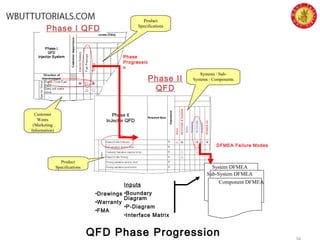
    – The keyproduct requirements were mapped against the required customer features. E.g. chemistry and microstructure, Internal stress at ingot level, – Product Grade and requirements documents created. – Key characteristics mapped against processes – Process FMEA was performed on processes that affected customer wants based on priority. 37
  • 38.
    Phase I QFD PhaseII QFD Product Specifications Customer Wants (Marketing Information) Product Specifications Systems / Sub- Systems / Components Phase Progressio n System DFMEA Sub-System DFMEA Component DFMEA DFMEA Failure Modes QFD Phase Progression Inputs •Boundary Diagram •P-Diagram •Interface Matrix •Drawings •Warranty •FMA
  • 39.
    The Completed CharacteristicsMatrix 39 Severity Process StepsReceiveMaterial Materialhandling ShippingDamage ComponentManufacture VehicleAssembly Primary Drive Manufacturing Process Steps Op100Step1 PRE-LOADDOWELPINSTO FIXTURE Op100Step2 PRE-LOADJACKSHAFT SEALTOFIXTURE Op100Step3 PRE-LOADPRIMARY HOUSINGBUSHINGTO FIXTURE Op110 Pre-loadbearingtofixture#2 Op120 Pre-loadmainshaftoilsealto mandrel Op200 Housingtofixture#1 Op210 Operatepress Op220 Retainingringtotopgroove Op230 Reloadfixture#1 Op300 Housingtofixture#2 Op310 Operatepress Op320 Retainingringtotopgroove Op330 MandreltomainshaftboreI.D. OP340 Operatepress Op350 Re-loadfixture#2andmandrel Op400 Housingtotable Op410 Reserved Op420 Chainadjsubassytohousing Op430 Lubricatebushing&seal Op445 Moveorstageforfinalassy Op10 O-ringtoshiftertube Op500 Shiftertubetohousing Op510 Clamptoshiftertube Op20 Assembleshifterlever Op520 Wavewashertoshifterlever Op530 Shifterlevertoshiftertube Op535 Queforfinalassyline Customer Assessment Direction of Improvement PotentialCriticalandSignificant 1.090 TO 1.110 " FACE OF PRIMARY HOUSING BUSHING TO FACE OF JACK SHAFT SEAL DOWEL PINS 0.260 TO 0.270 " TO FACE JACK SHAFT SEAL AGAINST SHOULDER BEARING FLUSH TO SNAP RING FACE SEAL COMPRESSION HEIGHT PRIMARY GASKET SEAL SURFACE FINISH SERATION DAMAGE Weighted Importance Relative Importance G F H F H F G F G H G H H F H H F F Y H H H H H G G F 5 3 9 3 9 9 5 0 81 81 72 0 9 41 0 0 27 54 261 3 0 54 81 3 0 0 0 27 0 45 9 9 0 0 0 0 0 0 0 Special Characteristics Matrix Process Operation from Process Flow Potential Significant and Critical Characteristics from DFMEA High/Medium Interactions are causes/failure modes in PFMEA Characteristics Ranked in order of Importance Prioritized ranking of process steps relative to risk
  • 40.
    40 System DFMEA Sub-System DFMEA ComponentDFMEA Classification of Characteristic s SC’s & CC’s Process Operations Process Related SC’s & CC’s From all DFMEA’s Process FMEA SC’s & CC’s Phase III QFD Phase IV QFD Process Parameters / Variables High Priority Process Operations Causes on PFMEA Failure Modes on PFMEA Causes from DFMEA’s Control Plan Key Control Characteristics Inputs •Process Flow •Line Layout •MFMEA •Failure Data •Process Capability 10 9 8 7 6 5 4 3 2 1 1 2 3 4 5 6 7 8 9 10 S E V E R I T Y O C C U R R E N C E CRITICAL CHARACTERISTICS Safety/Regulatory SIGNIFICANT CHARACTERISTICS Customer Dissatisfaction ALL OTHER CHARACTERISTICS Appropriate actions / controls already in place Special Characteristics Matrix ANNOYANCE ZONE
  • 41.
    Summary – FMEA canbe used creatively in continuous processing. – Linking key customer requirements to process outputs instead of standard product grade is valuable. – Future customer requirements will drive new and modified processes to achieve specialty results as a normal practice 41
  • 42.

Editor's Notes

  • #2 DESIGN FMEA - GENERAL MODULE 2 Notes:
  • #5 Notes:
  • #10 FMEA Deployment A layered approach is highly recommended as FMEAs can get complex. FMEAs are like ONIONS/LAYERS. Each layer is closer to the root cause Each layer is more detailed The closer to core the more detail Core gets to the root cause Notes:
  • #13 Key Elements of Efficient Development Identify all functions/process steps Identify all failure modes via brainstorming/data/warranty/COQ Identify all effects via brainstorming/data Customer focus Develop data pools for Failure Modes, Effects and Causes for future/ faster FMEA development Notes:
  • #15 System/Subsystem/Design FMEA Effect Customer view/customers words Regulation violation Level of dissatisfaction Consider All Customers End User Engineering Community Manufacturing Community (Operators/Employees) Notes:
  • #22 Notes:
  • #31 Example Extreme Safety/Regulatory Risk =9 & 10 Severity High Risk to Customer Satisfaction Sev. > or = to 5 and Occ > or = 4 Consider Detection only as a measure of Test Capability.