Process Failure
Mode Effect
Analysis
CA/PA-RCA : Advanced Tool

Northrop Grumman Corporation
Integrated Systems
Overview Objective
 Failure Mode Effect Analysis (FMEA) – Provide a Basic
familiarization with a tool that aids in quantifying
severity, occurrences and detection of failures, and
guides the creation of corrective action, process
improvement and risk mitigation plans.

2
Agenda
 FMEA History
 What IS FMEA
 Definitions
 What it Can Do For You
 Types of FMEA
 Team Members Roles
 FMEA Terminology
 Getting Started with an FMEA
 The Worksheet
 FMEA Scoring

3
Agenda

4

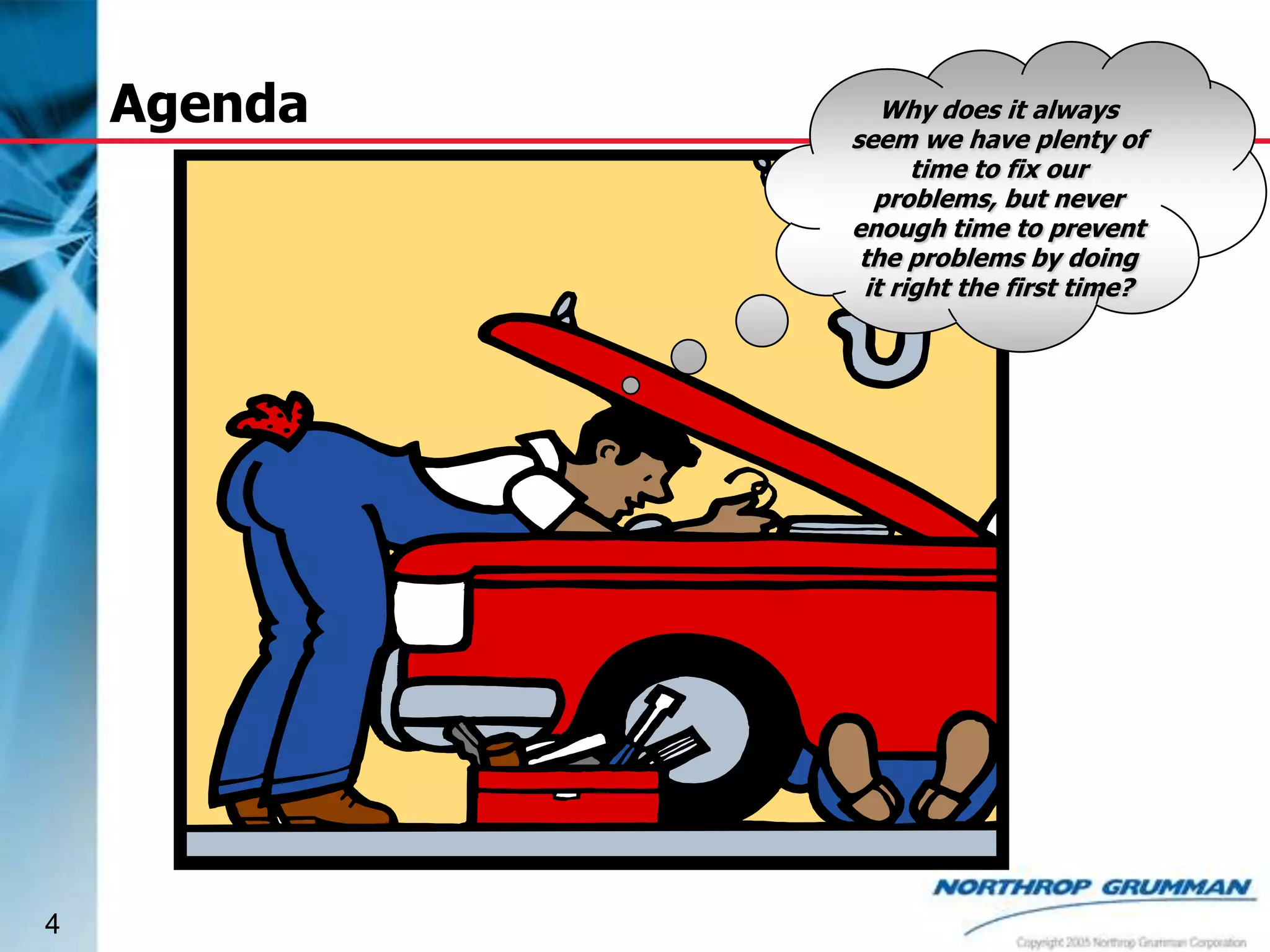
Why does it always
seem we have plenty of
time to fix our
problems, but never
enough time to prevent
the problems by doing
it right the first time?
FMEA History
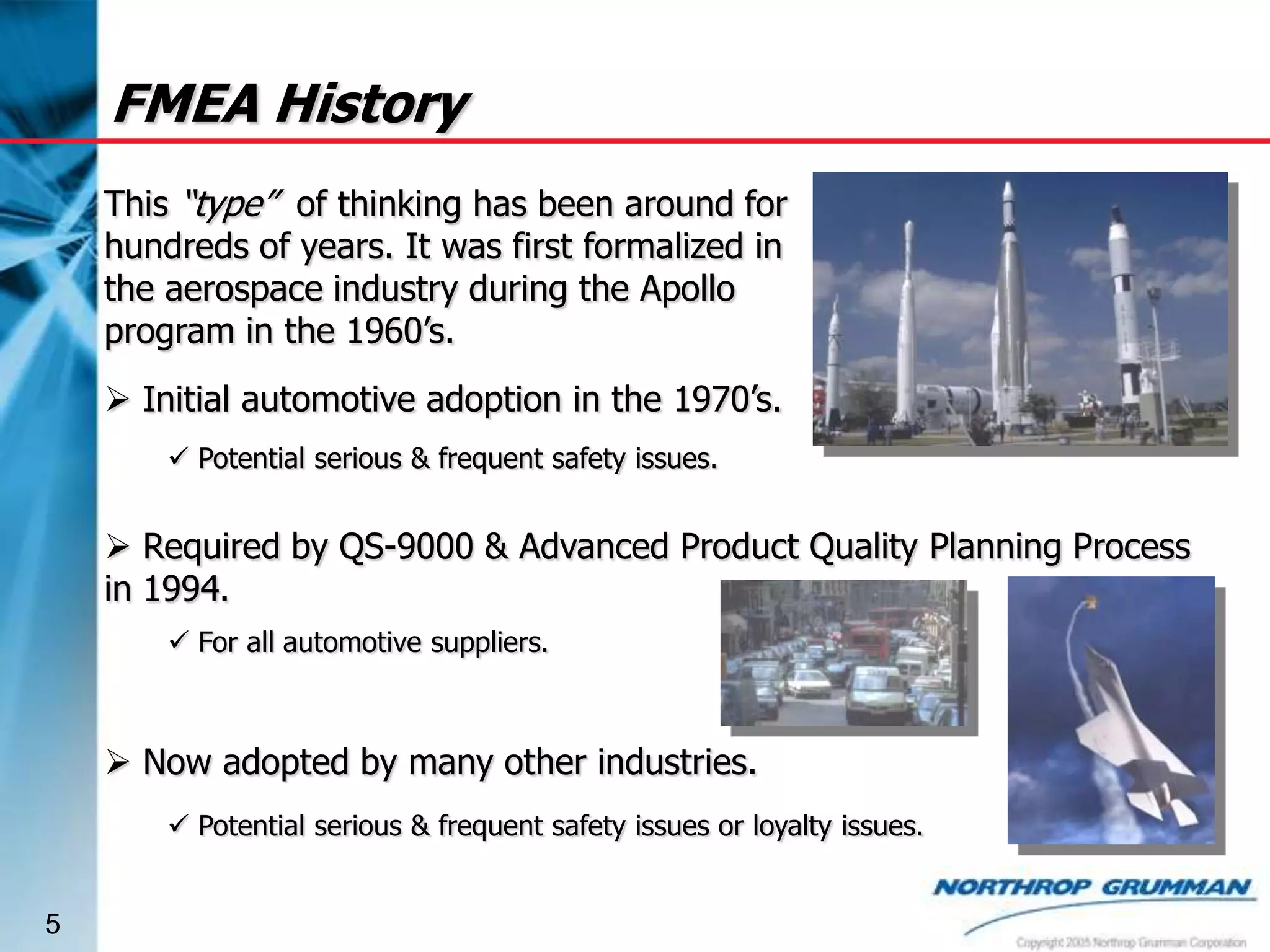
This “type” of thinking has been around for
hundreds of years. It was first formalized in
the aerospace industry during the Apollo
program in the 1960’s.
 Initial automotive adoption in the 1970’s.
 Potential serious & frequent safety issues.

 Required by QS-9000 & Advanced Product Quality Planning Process
in 1994.
 For all automotive suppliers.

 Now adopted by many other industries.
 Potential serious & frequent safety issues or loyalty issues.

5
What is FMEA ?
Cause & effect, Root Cause Analysis,
Fishbone Diagram Etc

Failure Mode Effect Analysis

6
What is FMEA ?
Definition: FMEA is an Engineering “Reliability Tool” That:
 Helps define, identify, prioritize, and eliminate known and/or
potential failures of the system, design, or manufacturing process
before they reach the customer. The goal is to eliminate the Failure
Modes and reduce their risks.
 Provides structure for a Cross Functional Critique of a design or a
Process
 Facilitates inter-departmental dialog.
 Is a mental discipline “great” engineering teams go through, when
critiquing what might go wrong with the product or process.
 Is a living document which ultimately helps prevent, and not react
to problems.

7
What is FMEA ?
What it can do for you!
1.) Identifies Design or process related Failure Modes before they
happen.
2.) Determines the Effect & Severity of these failure modes.
3.) Identifies the Causes and probability of Occurrence of the
Failure Modes.
4.) Identifies the Controls and their Effectiveness.
5.) Quantifies and prioritizes the Risks associated with
the Failure Modes.
6.) Develops & documents Action Plans that will occur to
reduce risk.

8
Types of FMEAs ?
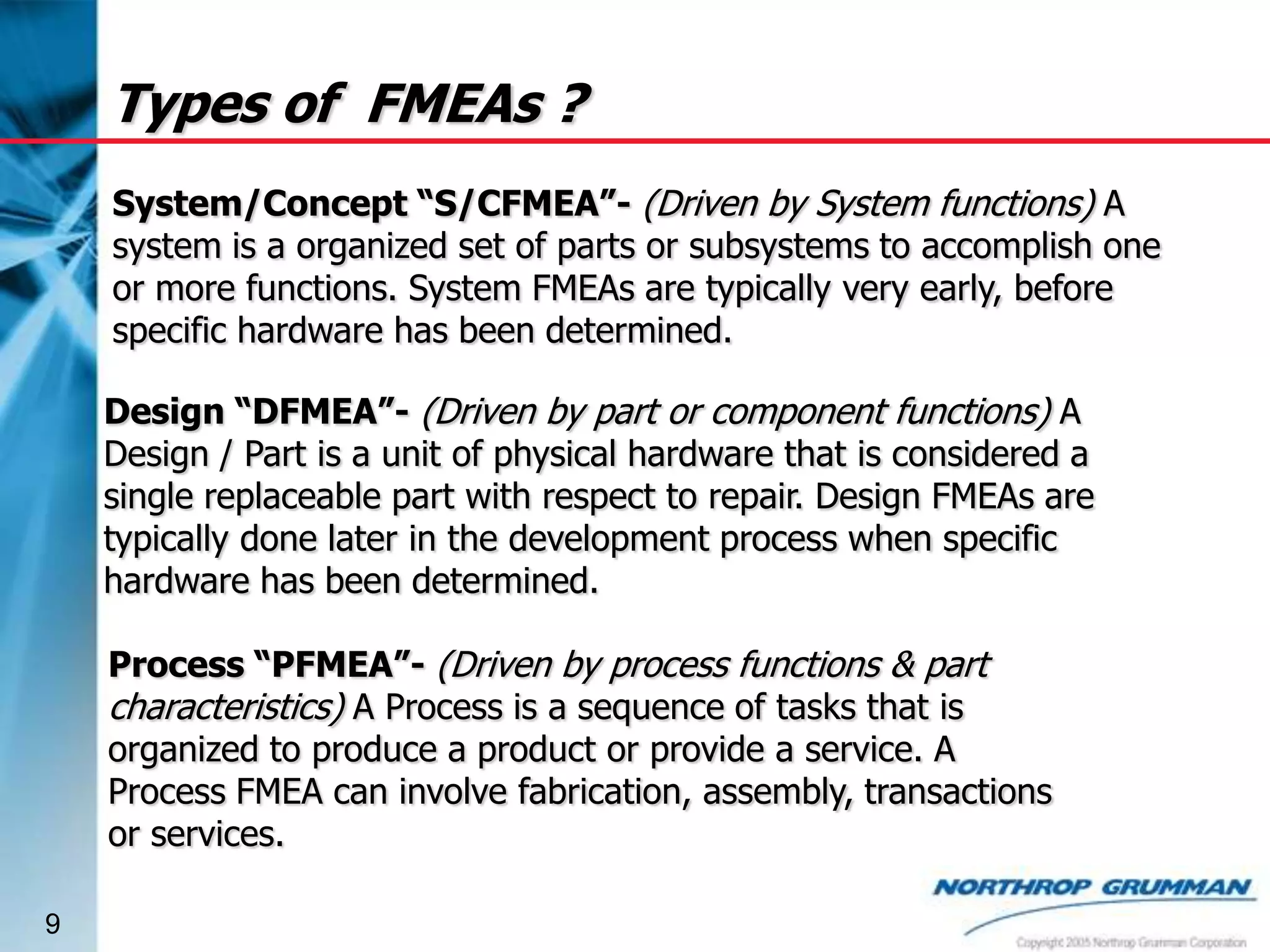
System/Concept “S/CFMEA”- (Driven by System functions) A
system is a organized set of parts or subsystems to accomplish one
or more functions. System FMEAs are typically very early, before
specific hardware has been determined.
Design “DFMEA”- (Driven by part or component functions) A
Design / Part is a unit of physical hardware that is considered a
single replaceable part with respect to repair. Design FMEAs are
typically done later in the development process when specific
hardware has been determined.

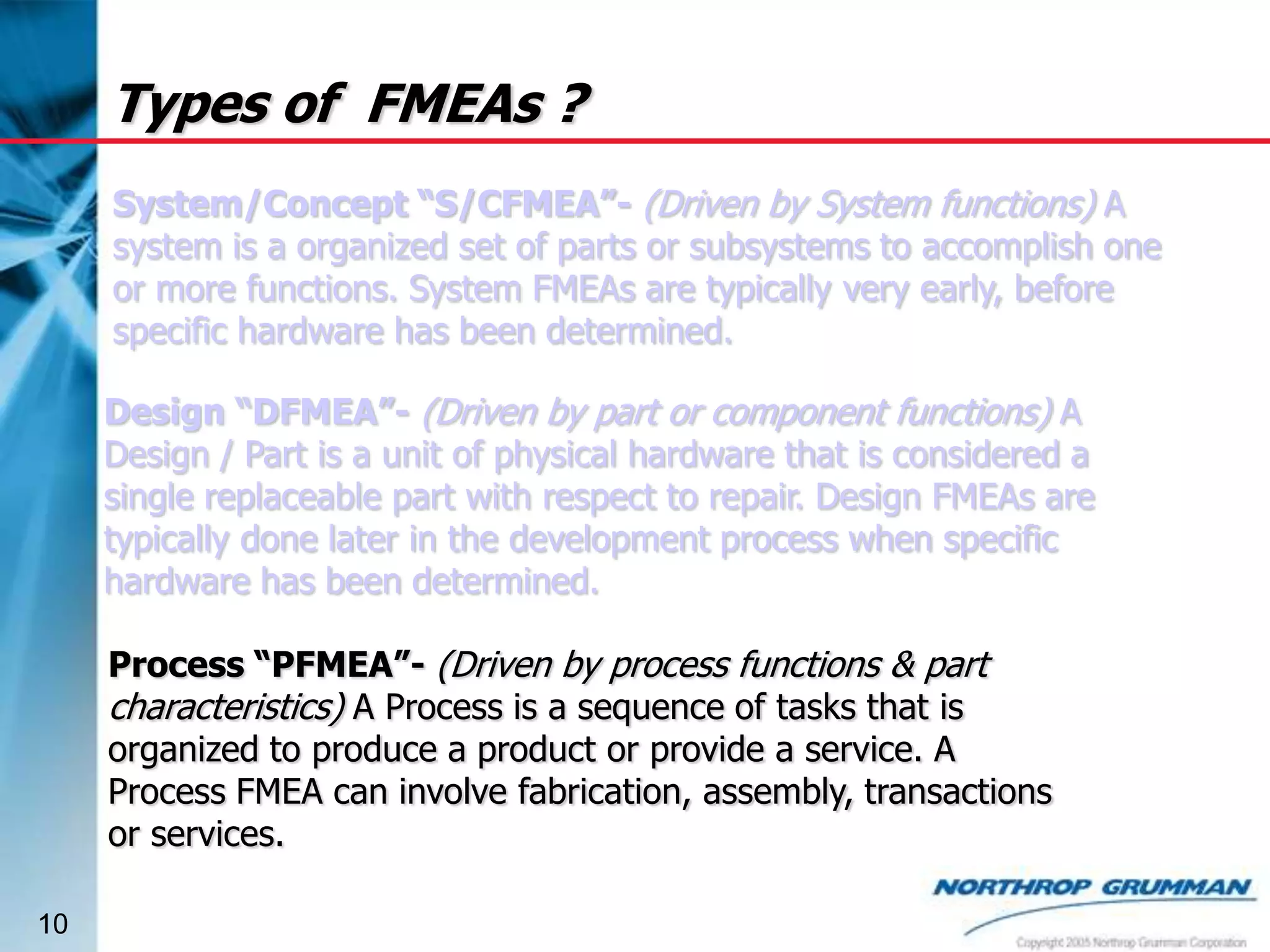
Process “PFMEA”- (Driven by process functions & part
characteristics) A Process is a sequence of tasks that is
organized to produce a product or provide a service. A
Process FMEA can involve fabrication, assembly, transactions
or services.
9
Types of FMEAs ?
System/Concept “S/CFMEA”- (Driven by System functions) A
system is a organized set of parts or subsystems to accomplish one
or more functions. System FMEAs are typically very early, before
specific hardware has been determined.
Design “DFMEA”- (Driven by part or component functions) A
Design / Part is a unit of physical hardware that is considered a
single replaceable part with respect to repair. Design FMEAs are
typically done later in the development process when specific
hardware has been determined.

Process “PFMEA”- (Driven by process functions & part
characteristics) A Process is a sequence of tasks that is
organized to produce a product or provide a service. A
Process FMEA can involve fabrication, assembly, transactions
or services.
10
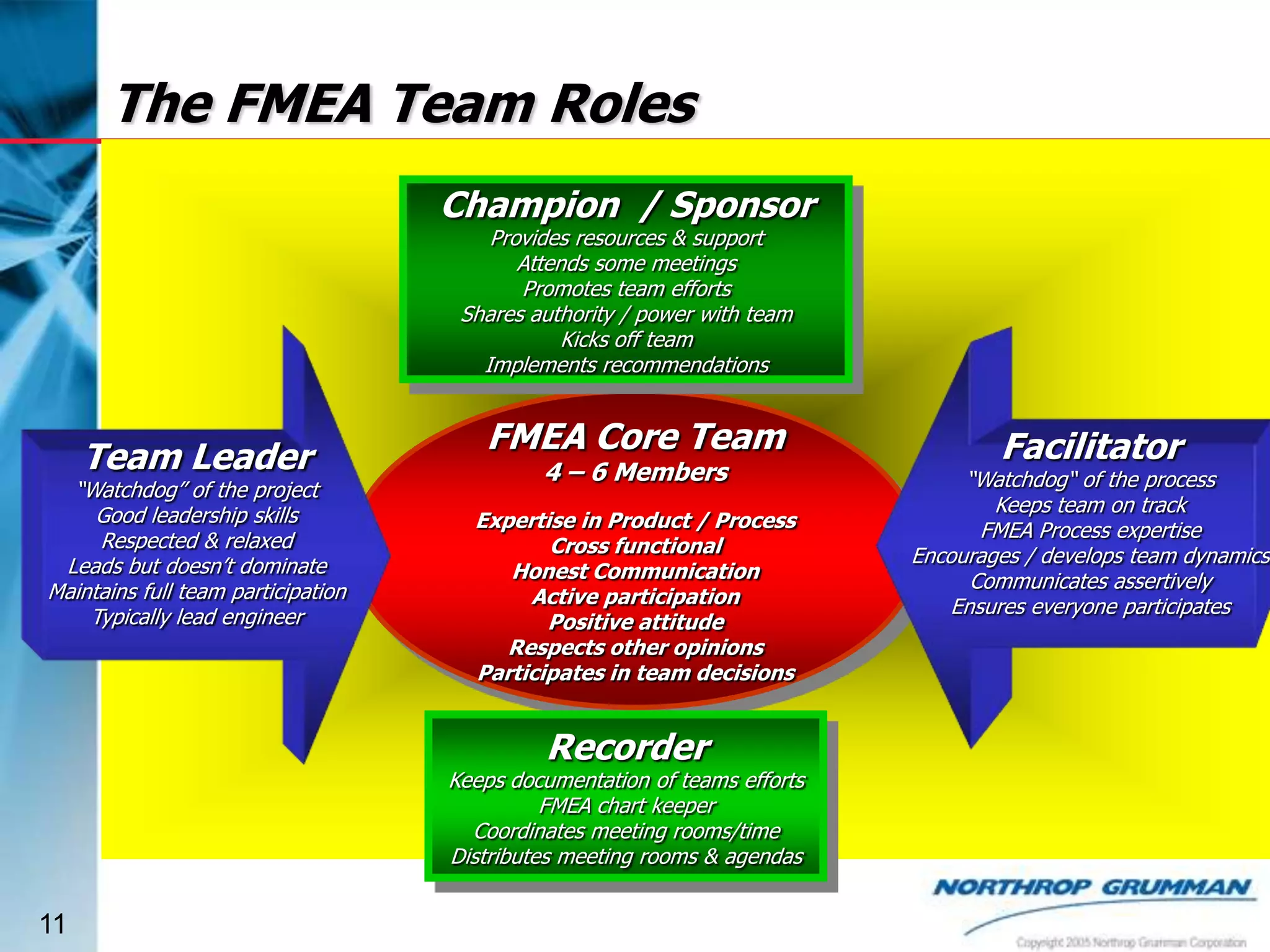
The FMEA Team Roles
Champion / Sponsor
Provides resources & support
Attends some meetings
Promotes team efforts
Shares authority / power with team
Kicks off team
Implements recommendations

Team Leader

“Watchdog” of the project
Good leadership skills
Respected & relaxed
Leads but doesn’t dominate
Maintains full team participation
Typically lead engineer

FMEA Core Team
4 – 6 Members

Expertise in Product / Process
Cross functional
Honest Communication
Active participation
Positive attitude
Respects other opinions
Participates in team decisions

Recorder

Keeps documentation of teams efforts
FMEA chart keeper
Coordinates meeting rooms/time
Distributes meeting rooms & agendas

11

Facilitator

“Watchdog“ of the process
Keeps team on track
FMEA Process expertise
Encourages / develops team dynamics
Communicates assertively
Ensures everyone participates
FMEA Terminology
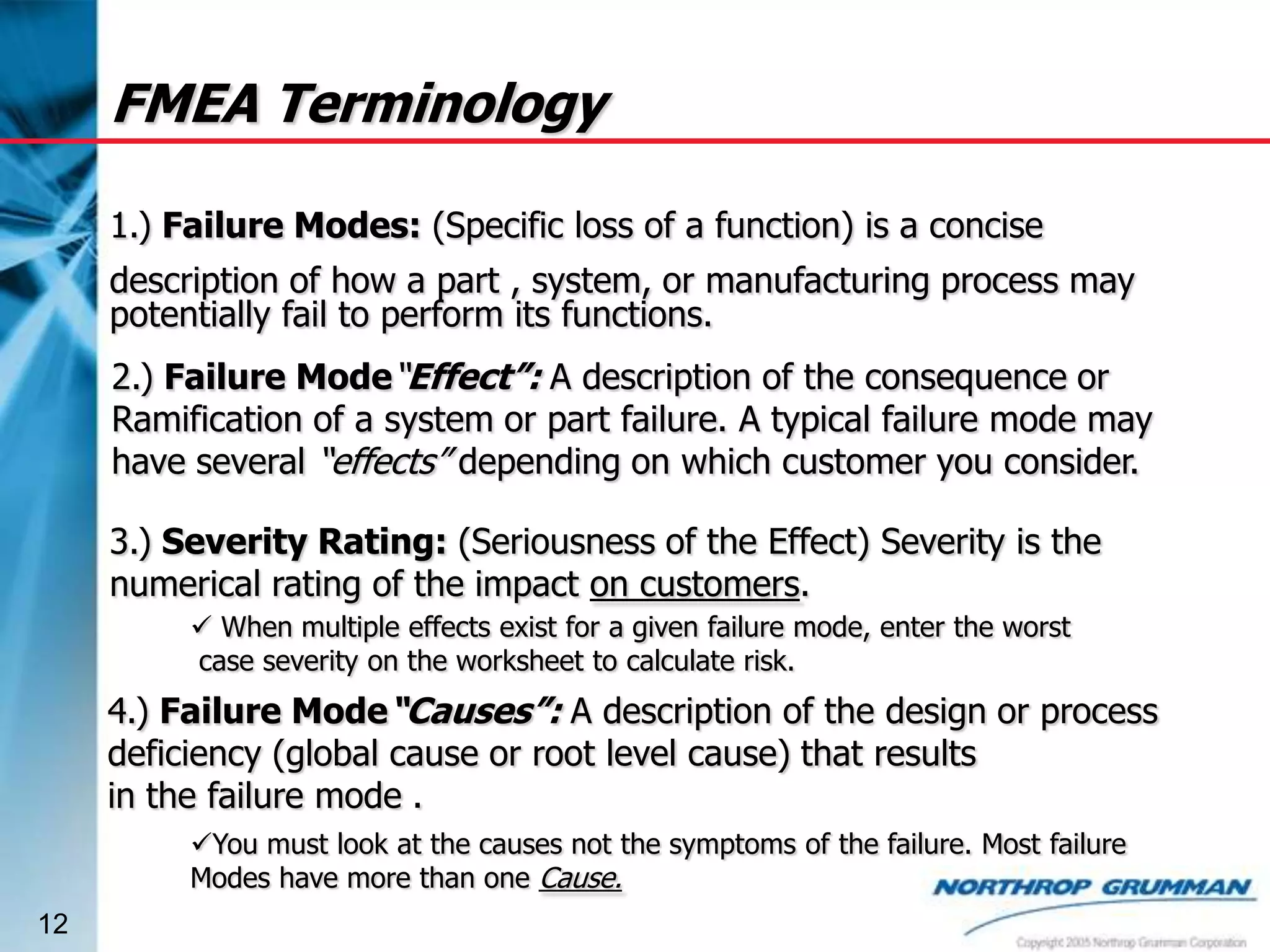
1.) Failure Modes: (Specific loss of a function) is a concise

description of how a part , system, or manufacturing process may
potentially fail to perform its functions.
2.) Failure Mode“Effect”: A description of the consequence or
Ramification of a system or part failure. A typical failure mode may
have several “effects” depending on which customer you consider.
3.) Severity Rating: (Seriousness of the Effect) Severity is the
numerical rating of the impact on customers.
 When multiple effects exist for a given failure mode, enter the worst
case severity on the worksheet to calculate risk.

4.) Failure Mode“Causes”: A description of the design or process
deficiency (global cause or root level cause) that results
in the failure mode .
You must look at the causes not the symptoms of the failure. Most failure
Modes have more than one Cause.
12
FMEA Terminology (continued)
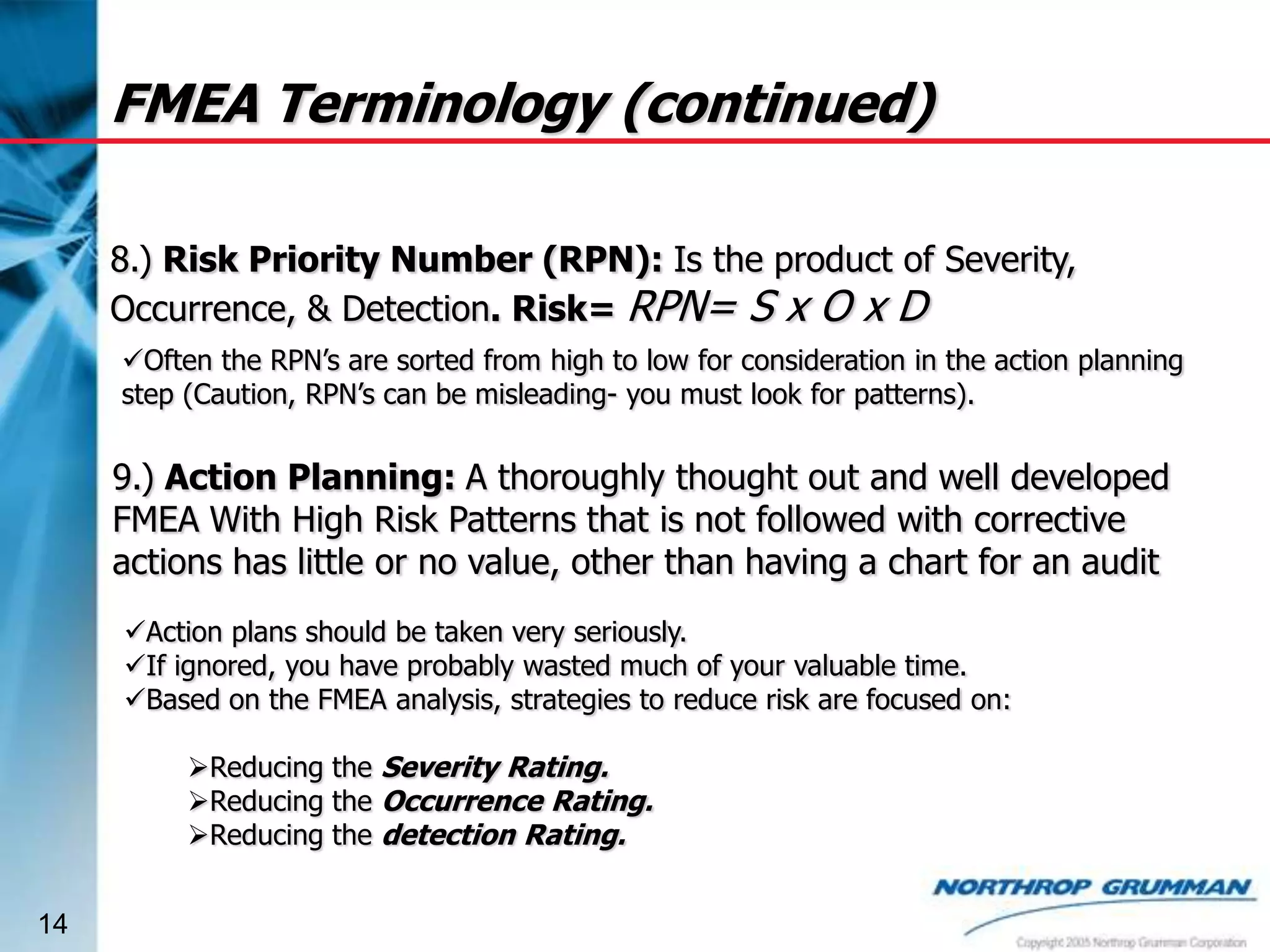
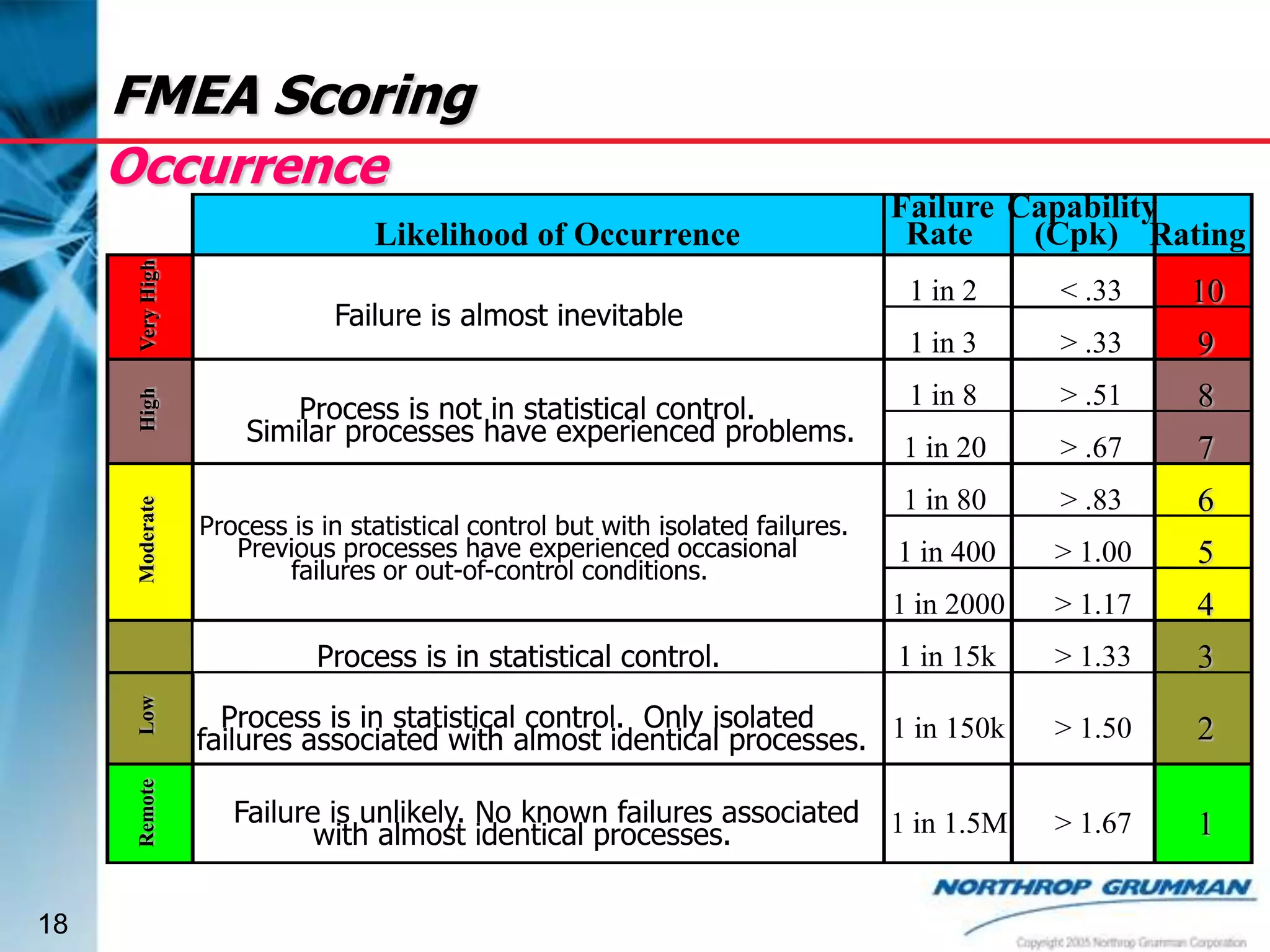
5.) Occurrence Rating: Is an estimate number of frequencies or
cumulative number of failures (based on experience) that will
occur (in our design concept) for a given cause over the intended
“life of the design”.
6.) Failure Mode“Controls”: The mechanisms, methods, tests,
procedures, or controls that we have in place to PREVENT the
Cause of the Failure Mode or DETECT the Failure Mode or Cause
should it occur .
Design Controls prevent or detect the Failure Mode prior to engineering
release

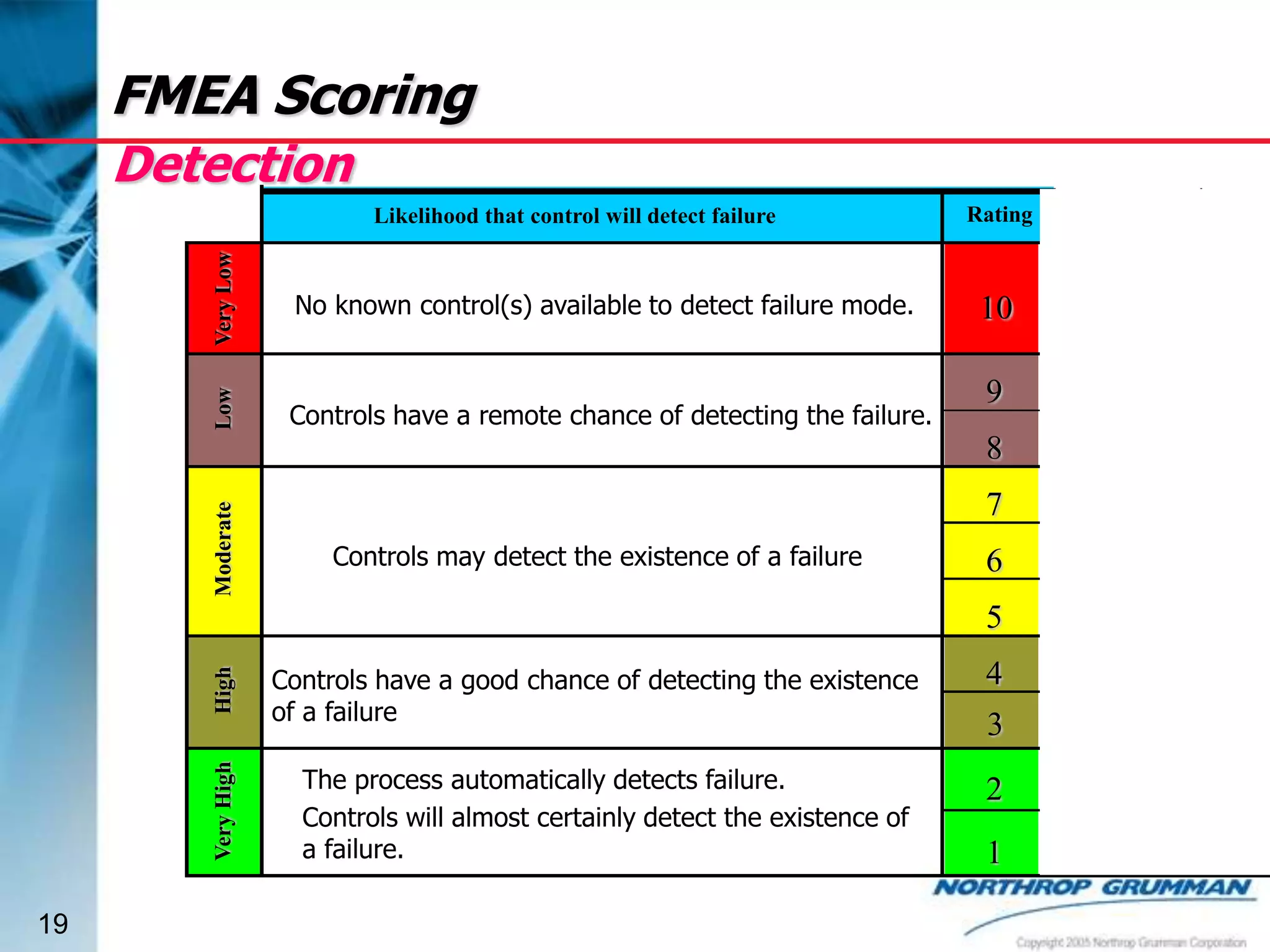
7.) Detection Rating: A numerical rating of the probability that a given
set of controls WILL DISCOVER a specific Cause of Failure Mode to
prevent bad parts leaving the facility or getting to the ultimate customer.
Assuming that the cause of the failure did occur, assess the capabilities of the
controls to find the design flaw..
13
FMEA Terminology (continued)
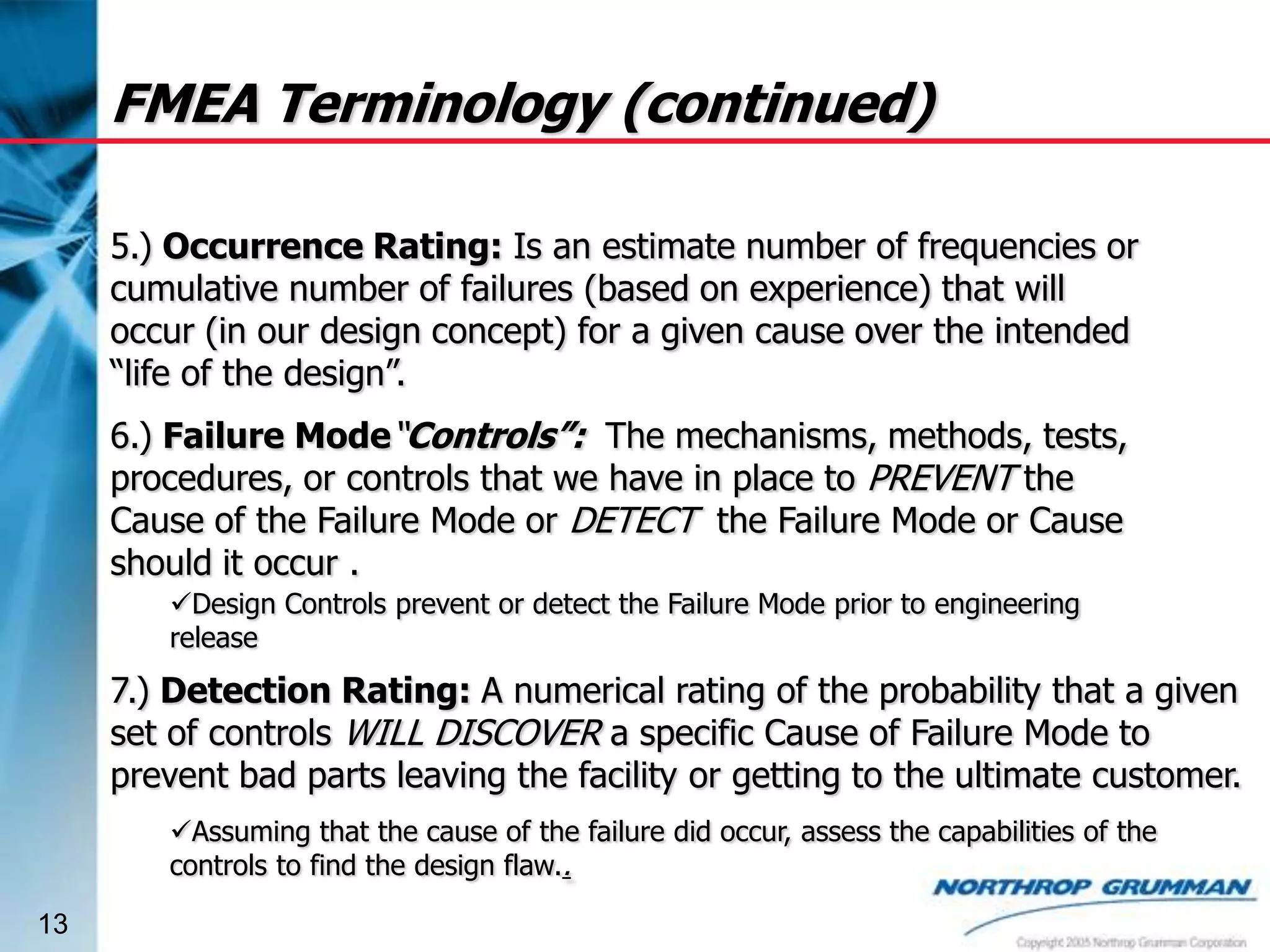
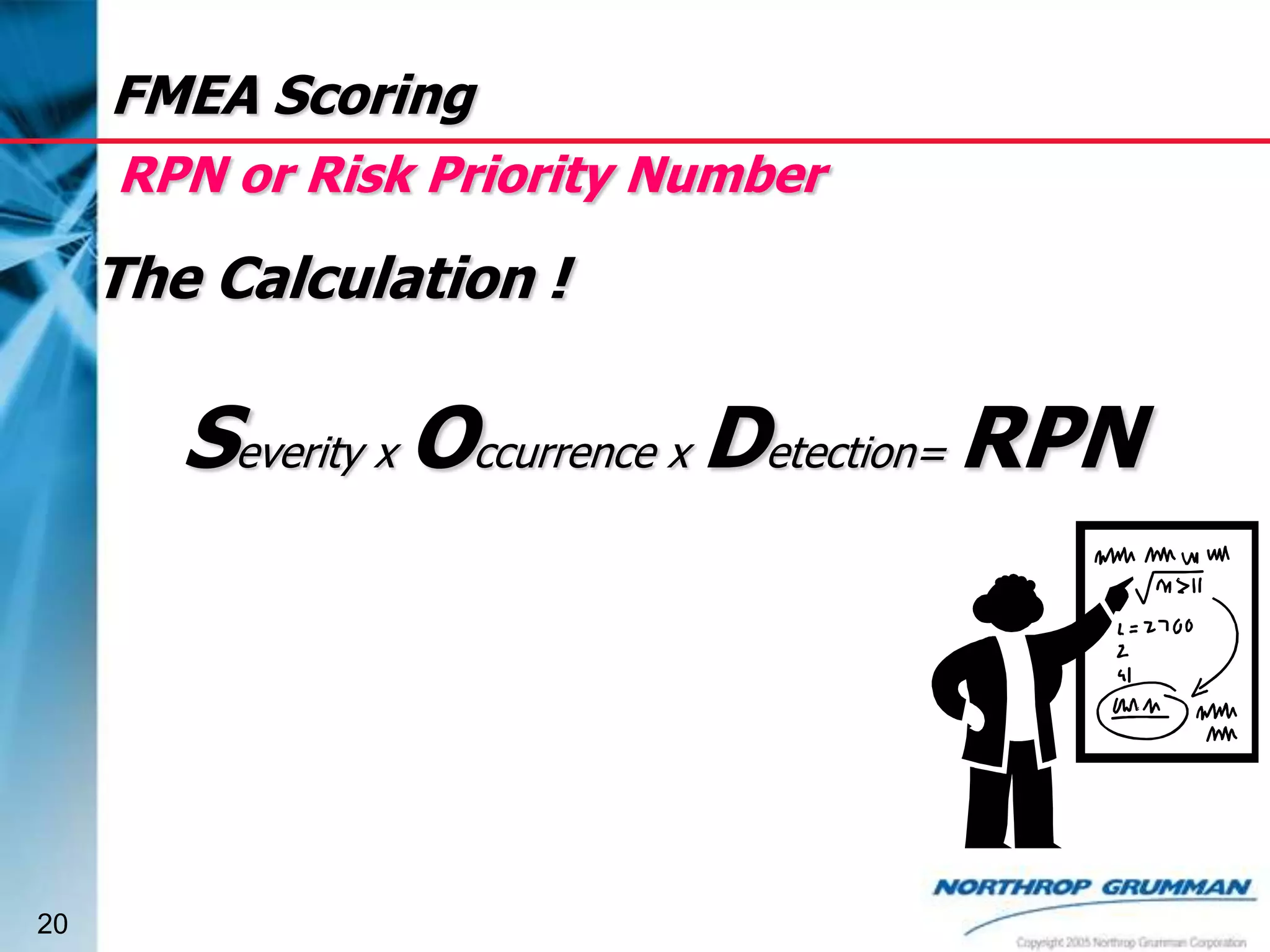
8.) Risk Priority Number (RPN): Is the product of Severity,
Occurrence, & Detection. Risk= RPN= S x O x D
Often the RPN’s are sorted from high to low for consideration in the action planning
step (Caution, RPN’s can be misleading- you must look for patterns).

9.) Action Planning: A thoroughly thought out and well developed
FMEA With High Risk Patterns that is not followed with corrective
actions has little or no value, other than having a chart for an audit
Action plans should be taken very seriously.
If ignored, you have probably wasted much of your valuable time.
Based on the FMEA analysis, strategies to reduce risk are focused on:
Reducing the Severity Rating.
Reducing the Occurrence Rating.
Reducing the detection Rating.
14
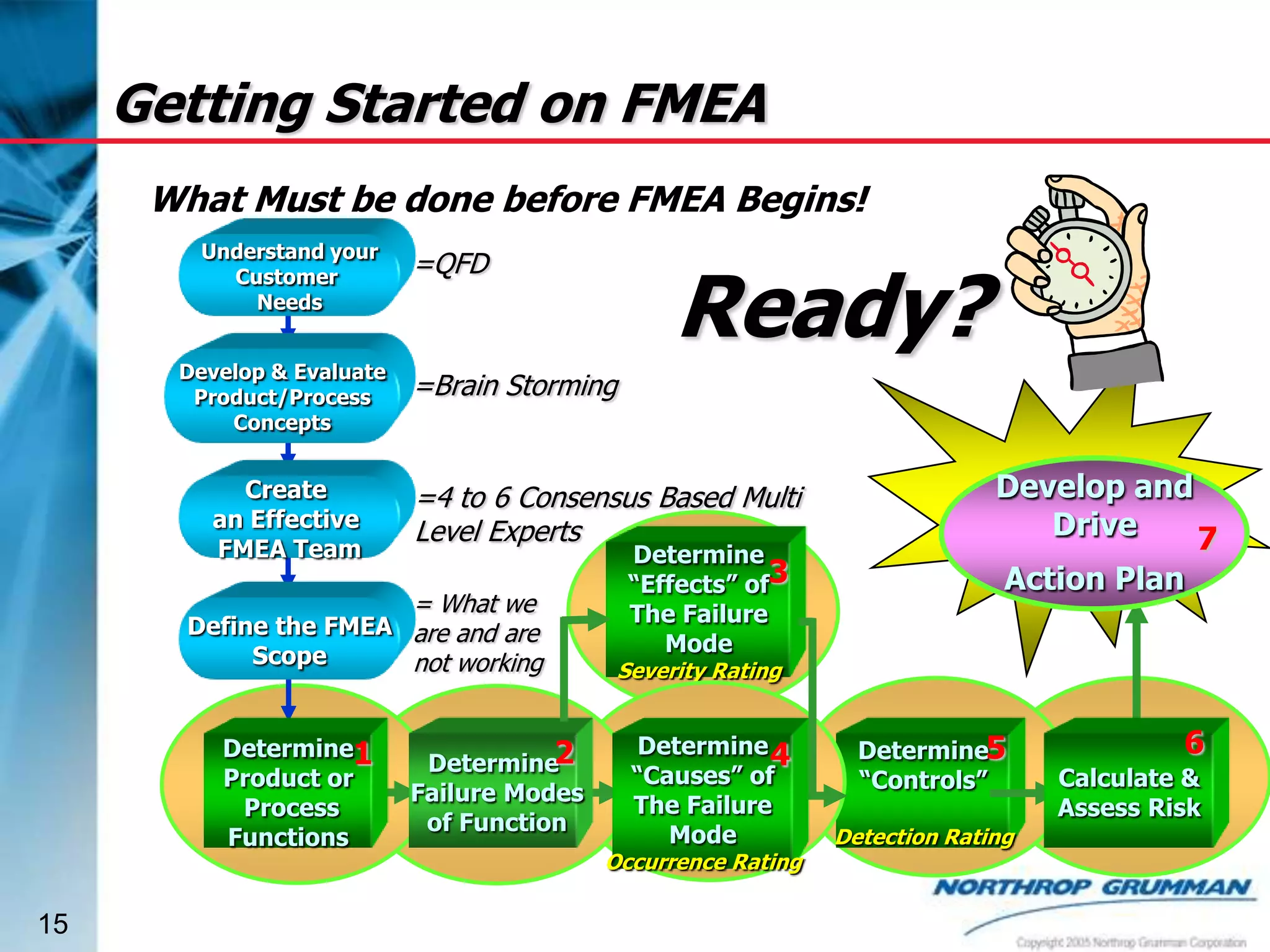
Getting Started on FMEA
What Must be done before FMEA Begins!
Understand your
Customer
Needs
Develop & Evaluate
Product/Process
Concepts

Create
an Effective
FMEA Team

=QFD

=Brain Storming

=4 to 6 Consensus Based Multi
Level Experts

= What we
Define the FMEA are and are
Scope
not working
Determine1
Product or
Process
Functions

15

Ready?

2
Determine
Failure Modes
of Function

Determine
“Effects” of3
The Failure
Mode

Develop and
Drive
7
Action Plan

Severity Rating

Determine 4
“Causes” of
The Failure
Mode

Occurrence Rating

Determine5
“Controls”
Detection Rating

6
6

Calculate &
Assess Risk
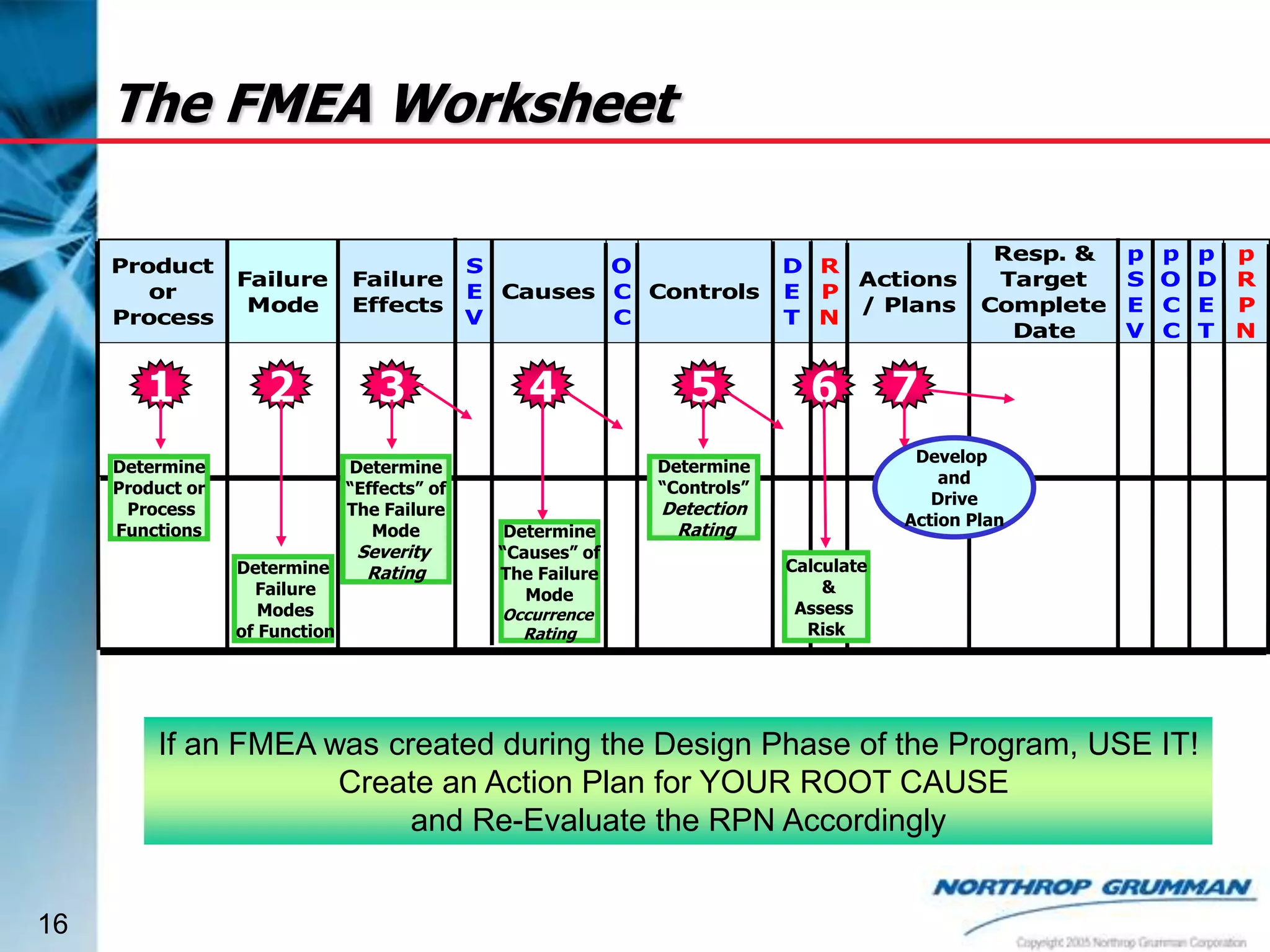
The FMEA Worksheet
Product
or
Process

Failure
Mode

Failure
Effects

1

2

3

Determine
Product or
Process
Functions

Determine
“Effects” of
The Failure
Mode
Determine
Failure
Modes
of Function

Severity
Rating

S
O
E Causes C Controls
V
C

4

5

D R
Actions
E P
/ Plans
T N

6

p
O
C
C

p p
D R
E P
T N

7
Develop
and
Drive
Action Plan

Determine
“Controls”
Determine
“Causes” of
The Failure
Mode
Occurrence
Rating

Resp. &
p
Target
S
Complete E
Date
V

Detection
Rating

Calculate
&
Assess
Risk

If an FMEA was created during the Design Phase of the Program, USE IT!
Create an Action Plan for YOUR ROOT CAUSE
and Re-Evaluate the RPN Accordingly
16
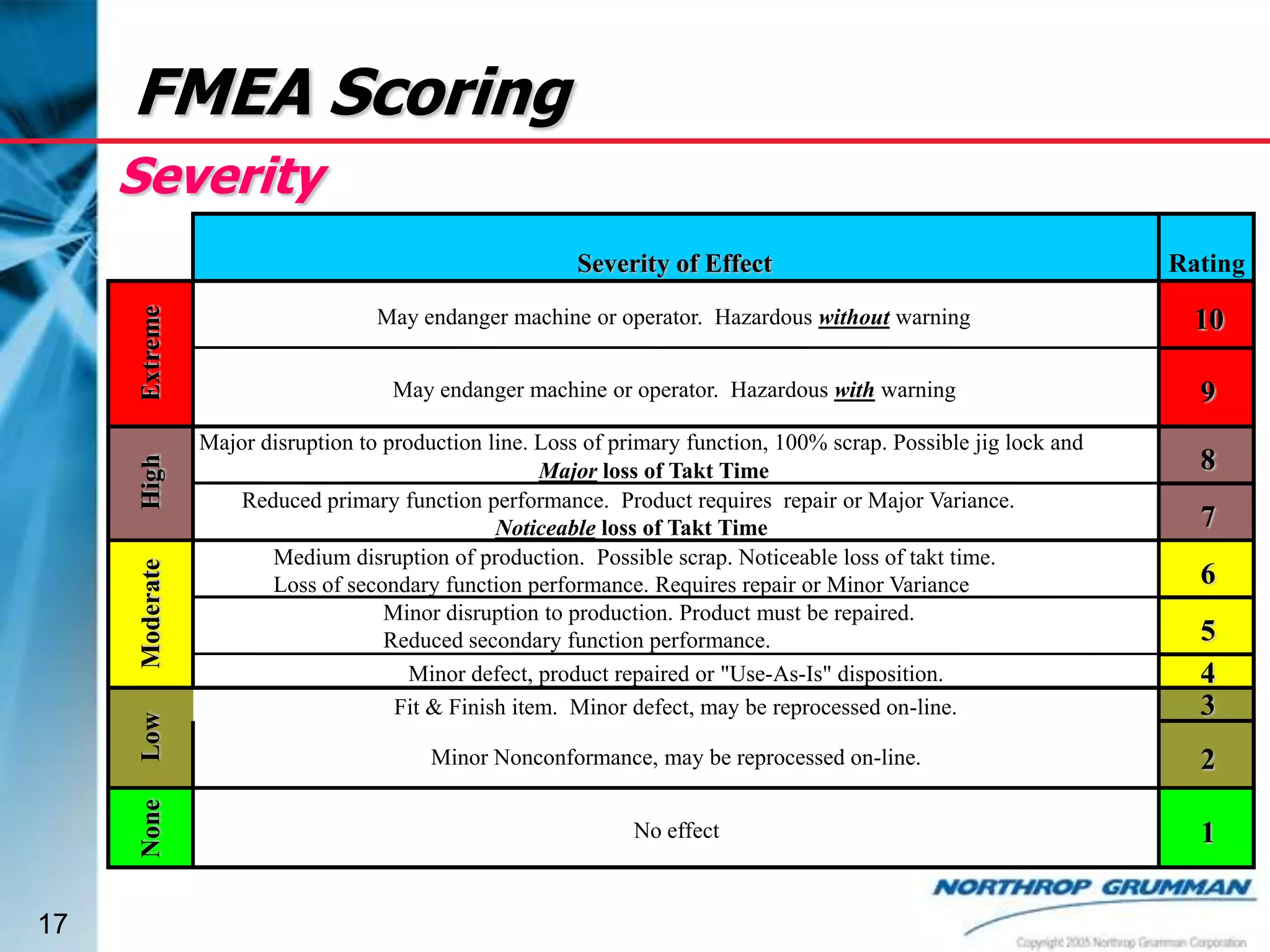
FMEA Scoring
Severity

None

Low

Moderate

High

Extreme

Severity of Effect

17

Rating

May endanger machine or operator. Hazardous without warning

10

May endanger machine or operator. Hazardous with warning

9

Major disruption to production line. Loss of primary function, 100% scrap. Possible jig lock and
Major loss of Takt Time
Reduced primary function performance. Product requires repair or Major Variance.
Noticeable loss of Takt Time
Medium disruption of production. Possible scrap. Noticeable loss of takt time.
Loss of secondary function performance. Requires repair or Minor Variance
Minor disruption to production. Product must be repaired.
Reduced secondary function performance.
Minor defect, product repaired or "Use-As-Is" disposition.
Fit & Finish item. Minor defect, may be reprocessed on-line.

8
7
6
5
4
3

Minor Nonconformance, may be reprocessed on-line.

2

No effect

1
FMEA Scoring
Occurrence
Very High

Likelihood of Occurrence

Failure Capability
Rate
(Cpk) Rating

High

Moderate

Process is not in statistical control.
Similar processes have experienced problems.
Process is in statistical control but with isolated failures.
Previous processes have experienced occasional
failures or out-of-control conditions.

Remote

Low

Process is in statistical control.

18

< .33

10

1 in 3

> .33

9

1 in 8

> .51

8

1 in 20

> .67

7

1 in 80

> .83

6

1 in 400

> 1.00

5

1 in 2000

Failure is almost inevitable

1 in 2

> 1.17

4

1 in 15k

> 1.33

3

> 1.50

2

> 1.67

1

Process is in statistical control. Only isolated
failures associated with almost identical processes. 1 in 150k
Failure is unlikely. No known failures associated
with almost identical processes.

1 in 1.5M
FMEA Scoring
Detection
Very Low

No known control(s) available to detect failure mode.

Low

Likelihood that control will detect failure

Controls have a remote chance of detecting the failure.

Rating

10
9

Moderate

8
7
Controls may detect the existence of a failure

6

Very High

High

5

19

Controls have a good chance of detecting the existence
of a failure
The process automatically detects failure.
Controls will almost certainly detect the existence of
a failure.

4

3
2
1
FMEA Scoring
RPN or Risk Priority Number

The Calculation !

Severity x Occurrence x Detection= RPN

20
Failure Modes & Effect Analysis
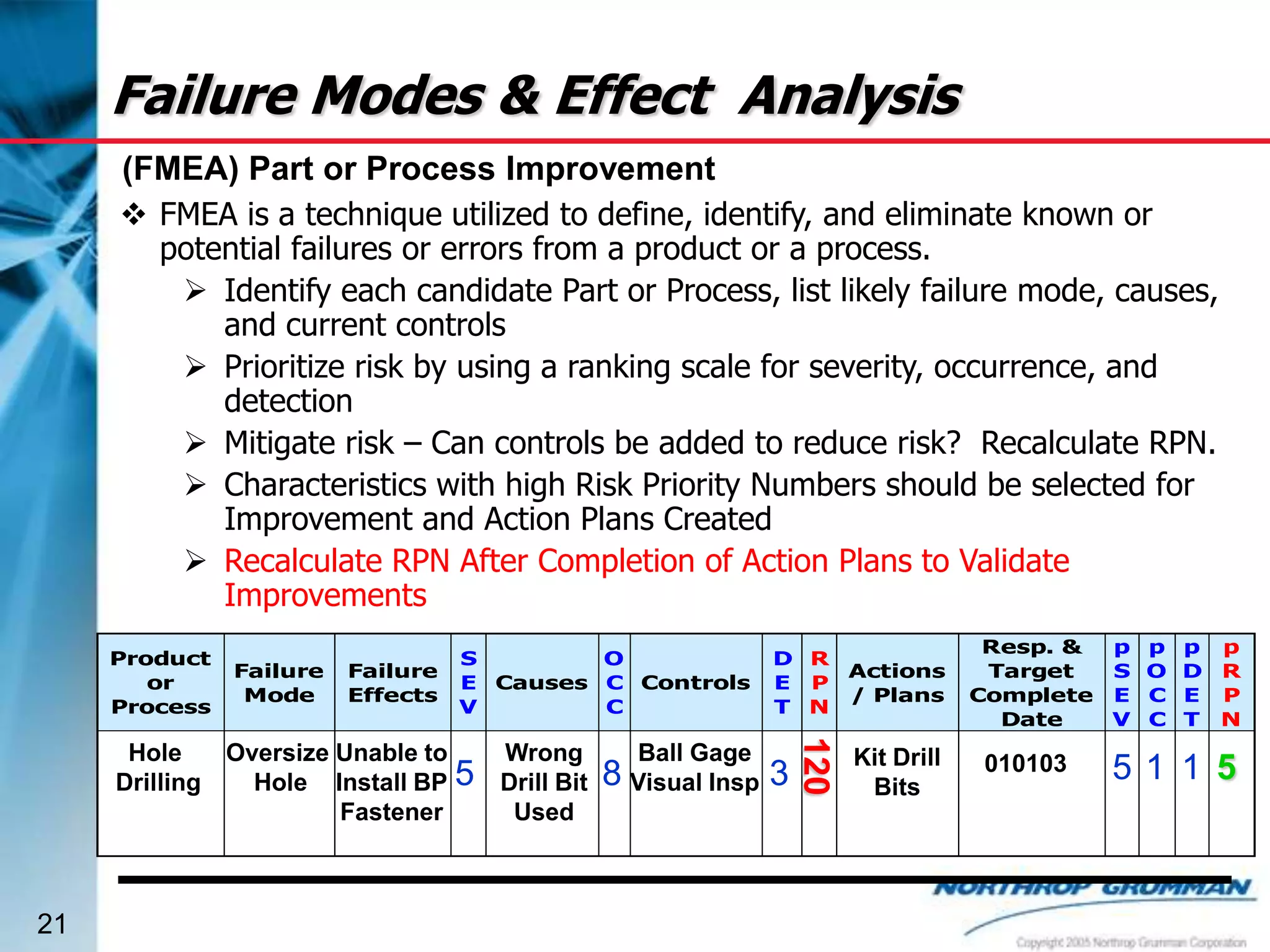
(FMEA) Part or Process Improvement
 FMEA is a technique utilized to define, identify, and eliminate known or
potential failures or errors from a product or a process.
 Identify each candidate Part or Process, list likely failure mode, causes,
and current controls
 Prioritize risk by using a ranking scale for severity, occurrence, and
detection
 Mitigate risk – Can controls be added to reduce risk? Recalculate RPN.
 Characteristics with high Risk Priority Numbers should be selected for
Improvement and Action Plans Created
 Recalculate RPN After Completion of Action Plans to Validate
Improvements

Hole
Drilling

21

Failure
Mode

Failure
Effects

S
O
E Causes C Controls
V
C

Oversize Unable to
Hole Install BP 5
Fastener

Wrong
Drill Bit
Used

8

Ball Gage
Visual Insp

D R
E P
T N

Actions
/ Plans

Resp. &
Target
Complete
Date

120

Product
or
Process

Kit Drill
Bits

010103

3

p
S
E
V

p
O
C
C

p p
D R
E P
T N

51 1 5
Failure Modes & Effect Analysis

Questions?
Call or e-mail:
Kevin M. Treanor
310-863-4182
kevin.treanor@ngc.com

22

Bob Ollerton
310-332-1972/310-350-9121
robert.ollerton@ngc.com

Advanced pfmea

  • 1.
    Process Failure Mode Effect Analysis CA/PA-RCA: Advanced Tool Northrop Grumman Corporation Integrated Systems
  • 2.
    Overview Objective  FailureMode Effect Analysis (FMEA) – Provide a Basic familiarization with a tool that aids in quantifying severity, occurrences and detection of failures, and guides the creation of corrective action, process improvement and risk mitigation plans. 2
  • 3.
    Agenda  FMEA History What IS FMEA  Definitions  What it Can Do For You  Types of FMEA  Team Members Roles  FMEA Terminology  Getting Started with an FMEA  The Worksheet  FMEA Scoring 3
  • 4.
    Agenda 4 Why does italways seem we have plenty of time to fix our problems, but never enough time to prevent the problems by doing it right the first time?
  • 5.
    FMEA History This “type”of thinking has been around for hundreds of years. It was first formalized in the aerospace industry during the Apollo program in the 1960’s.  Initial automotive adoption in the 1970’s.  Potential serious & frequent safety issues.  Required by QS-9000 & Advanced Product Quality Planning Process in 1994.  For all automotive suppliers.  Now adopted by many other industries.  Potential serious & frequent safety issues or loyalty issues. 5
  • 6.
    What is FMEA? Cause & effect, Root Cause Analysis, Fishbone Diagram Etc Failure Mode Effect Analysis 6
  • 7.
    What is FMEA? Definition: FMEA is an Engineering “Reliability Tool” That:  Helps define, identify, prioritize, and eliminate known and/or potential failures of the system, design, or manufacturing process before they reach the customer. The goal is to eliminate the Failure Modes and reduce their risks.  Provides structure for a Cross Functional Critique of a design or a Process  Facilitates inter-departmental dialog.  Is a mental discipline “great” engineering teams go through, when critiquing what might go wrong with the product or process.  Is a living document which ultimately helps prevent, and not react to problems. 7
  • 8.
    What is FMEA? What it can do for you! 1.) Identifies Design or process related Failure Modes before they happen. 2.) Determines the Effect & Severity of these failure modes. 3.) Identifies the Causes and probability of Occurrence of the Failure Modes. 4.) Identifies the Controls and their Effectiveness. 5.) Quantifies and prioritizes the Risks associated with the Failure Modes. 6.) Develops & documents Action Plans that will occur to reduce risk. 8
  • 9.
    Types of FMEAs? System/Concept “S/CFMEA”- (Driven by System functions) A system is a organized set of parts or subsystems to accomplish one or more functions. System FMEAs are typically very early, before specific hardware has been determined. Design “DFMEA”- (Driven by part or component functions) A Design / Part is a unit of physical hardware that is considered a single replaceable part with respect to repair. Design FMEAs are typically done later in the development process when specific hardware has been determined. Process “PFMEA”- (Driven by process functions & part characteristics) A Process is a sequence of tasks that is organized to produce a product or provide a service. A Process FMEA can involve fabrication, assembly, transactions or services. 9
  • 10.
    Types of FMEAs? System/Concept “S/CFMEA”- (Driven by System functions) A system is a organized set of parts or subsystems to accomplish one or more functions. System FMEAs are typically very early, before specific hardware has been determined. Design “DFMEA”- (Driven by part or component functions) A Design / Part is a unit of physical hardware that is considered a single replaceable part with respect to repair. Design FMEAs are typically done later in the development process when specific hardware has been determined. Process “PFMEA”- (Driven by process functions & part characteristics) A Process is a sequence of tasks that is organized to produce a product or provide a service. A Process FMEA can involve fabrication, assembly, transactions or services. 10
  • 11.
    The FMEA TeamRoles Champion / Sponsor Provides resources & support Attends some meetings Promotes team efforts Shares authority / power with team Kicks off team Implements recommendations Team Leader “Watchdog” of the project Good leadership skills Respected & relaxed Leads but doesn’t dominate Maintains full team participation Typically lead engineer FMEA Core Team 4 – 6 Members Expertise in Product / Process Cross functional Honest Communication Active participation Positive attitude Respects other opinions Participates in team decisions Recorder Keeps documentation of teams efforts FMEA chart keeper Coordinates meeting rooms/time Distributes meeting rooms & agendas 11 Facilitator “Watchdog“ of the process Keeps team on track FMEA Process expertise Encourages / develops team dynamics Communicates assertively Ensures everyone participates
  • 12.
    FMEA Terminology 1.) FailureModes: (Specific loss of a function) is a concise description of how a part , system, or manufacturing process may potentially fail to perform its functions. 2.) Failure Mode“Effect”: A description of the consequence or Ramification of a system or part failure. A typical failure mode may have several “effects” depending on which customer you consider. 3.) Severity Rating: (Seriousness of the Effect) Severity is the numerical rating of the impact on customers.  When multiple effects exist for a given failure mode, enter the worst case severity on the worksheet to calculate risk. 4.) Failure Mode“Causes”: A description of the design or process deficiency (global cause or root level cause) that results in the failure mode . You must look at the causes not the symptoms of the failure. Most failure Modes have more than one Cause. 12
  • 13.
    FMEA Terminology (continued) 5.)Occurrence Rating: Is an estimate number of frequencies or cumulative number of failures (based on experience) that will occur (in our design concept) for a given cause over the intended “life of the design”. 6.) Failure Mode“Controls”: The mechanisms, methods, tests, procedures, or controls that we have in place to PREVENT the Cause of the Failure Mode or DETECT the Failure Mode or Cause should it occur . Design Controls prevent or detect the Failure Mode prior to engineering release 7.) Detection Rating: A numerical rating of the probability that a given set of controls WILL DISCOVER a specific Cause of Failure Mode to prevent bad parts leaving the facility or getting to the ultimate customer. Assuming that the cause of the failure did occur, assess the capabilities of the controls to find the design flaw.. 13
  • 14.
    FMEA Terminology (continued) 8.)Risk Priority Number (RPN): Is the product of Severity, Occurrence, & Detection. Risk= RPN= S x O x D Often the RPN’s are sorted from high to low for consideration in the action planning step (Caution, RPN’s can be misleading- you must look for patterns). 9.) Action Planning: A thoroughly thought out and well developed FMEA With High Risk Patterns that is not followed with corrective actions has little or no value, other than having a chart for an audit Action plans should be taken very seriously. If ignored, you have probably wasted much of your valuable time. Based on the FMEA analysis, strategies to reduce risk are focused on: Reducing the Severity Rating. Reducing the Occurrence Rating. Reducing the detection Rating. 14
  • 15.
    Getting Started onFMEA What Must be done before FMEA Begins! Understand your Customer Needs Develop & Evaluate Product/Process Concepts Create an Effective FMEA Team =QFD =Brain Storming =4 to 6 Consensus Based Multi Level Experts = What we Define the FMEA are and are Scope not working Determine1 Product or Process Functions 15 Ready? 2 Determine Failure Modes of Function Determine “Effects” of3 The Failure Mode Develop and Drive 7 Action Plan Severity Rating Determine 4 “Causes” of The Failure Mode Occurrence Rating Determine5 “Controls” Detection Rating 6 6 Calculate & Assess Risk
  • 16.
    The FMEA Worksheet Product or Process Failure Mode Failure Effects 1 2 3 Determine Productor Process Functions Determine “Effects” of The Failure Mode Determine Failure Modes of Function Severity Rating S O E Causes C Controls V C 4 5 D R Actions E P / Plans T N 6 p O C C p p D R E P T N 7 Develop and Drive Action Plan Determine “Controls” Determine “Causes” of The Failure Mode Occurrence Rating Resp. & p Target S Complete E Date V Detection Rating Calculate & Assess Risk If an FMEA was created during the Design Phase of the Program, USE IT! Create an Action Plan for YOUR ROOT CAUSE and Re-Evaluate the RPN Accordingly 16
  • 17.
    FMEA Scoring Severity None Low Moderate High Extreme Severity ofEffect 17 Rating May endanger machine or operator. Hazardous without warning 10 May endanger machine or operator. Hazardous with warning 9 Major disruption to production line. Loss of primary function, 100% scrap. Possible jig lock and Major loss of Takt Time Reduced primary function performance. Product requires repair or Major Variance. Noticeable loss of Takt Time Medium disruption of production. Possible scrap. Noticeable loss of takt time. Loss of secondary function performance. Requires repair or Minor Variance Minor disruption to production. Product must be repaired. Reduced secondary function performance. Minor defect, product repaired or "Use-As-Is" disposition. Fit & Finish item. Minor defect, may be reprocessed on-line. 8 7 6 5 4 3 Minor Nonconformance, may be reprocessed on-line. 2 No effect 1
  • 18.
    FMEA Scoring Occurrence Very High Likelihoodof Occurrence Failure Capability Rate (Cpk) Rating High Moderate Process is not in statistical control. Similar processes have experienced problems. Process is in statistical control but with isolated failures. Previous processes have experienced occasional failures or out-of-control conditions. Remote Low Process is in statistical control. 18 < .33 10 1 in 3 > .33 9 1 in 8 > .51 8 1 in 20 > .67 7 1 in 80 > .83 6 1 in 400 > 1.00 5 1 in 2000 Failure is almost inevitable 1 in 2 > 1.17 4 1 in 15k > 1.33 3 > 1.50 2 > 1.67 1 Process is in statistical control. Only isolated failures associated with almost identical processes. 1 in 150k Failure is unlikely. No known failures associated with almost identical processes. 1 in 1.5M
  • 19.
    FMEA Scoring Detection Very Low Noknown control(s) available to detect failure mode. Low Likelihood that control will detect failure Controls have a remote chance of detecting the failure. Rating 10 9 Moderate 8 7 Controls may detect the existence of a failure 6 Very High High 5 19 Controls have a good chance of detecting the existence of a failure The process automatically detects failure. Controls will almost certainly detect the existence of a failure. 4 3 2 1
  • 20.
    FMEA Scoring RPN orRisk Priority Number The Calculation ! Severity x Occurrence x Detection= RPN 20
  • 21.
    Failure Modes &Effect Analysis (FMEA) Part or Process Improvement  FMEA is a technique utilized to define, identify, and eliminate known or potential failures or errors from a product or a process.  Identify each candidate Part or Process, list likely failure mode, causes, and current controls  Prioritize risk by using a ranking scale for severity, occurrence, and detection  Mitigate risk – Can controls be added to reduce risk? Recalculate RPN.  Characteristics with high Risk Priority Numbers should be selected for Improvement and Action Plans Created  Recalculate RPN After Completion of Action Plans to Validate Improvements Hole Drilling 21 Failure Mode Failure Effects S O E Causes C Controls V C Oversize Unable to Hole Install BP 5 Fastener Wrong Drill Bit Used 8 Ball Gage Visual Insp D R E P T N Actions / Plans Resp. & Target Complete Date 120 Product or Process Kit Drill Bits 010103 3 p S E V p O C C p p D R E P T N 51 1 5
  • 22.
    Failure Modes &Effect Analysis Questions? Call or e-mail: Kevin M. Treanor 310-863-4182 kevin.treanor@ngc.com 22 Bob Ollerton 310-332-1972/310-350-9121 robert.ollerton@ngc.com