FAILURE MODES EFFECT ANALYSIS
(FMEA)
WHAT IS FMEA?
A systemized group of activities designed to:
▪ recognize and evaluate the potential failure of
a product/process and its effects
▪ identify actions which could eliminate or
reduce the chance of potential failure
▪ document the process
Failure Mode and Effect Analysis
FAILURE MODE AND EFFECT ANALYSIS
Simply put FMEA is:
a process that identifies all the possible types of
failures that could happen to a product and potential
consequences of those failures.
FMEA TERMS
Failure mode - the way in which something
might fail
Effects analysis – studying the consequences of
the various failure modes to determine their
severity to the customer.
5
WHAT IS FMEA?
FMEA--a tool to identify risks in your
process
Can be used in multiple places in process
improvement
Determine where problems are
Help identify cause/effect relationships
Highlight risks in solutions and actions to take
Starts with input from processes
Identifies three risk categories
Severity of impact
Probability of occurrence
Ability to detect the occurrence
6
WHEN TO USE
Early stages (Define) to understand process and
identify problem areas
Analyze data (Analyze) to help identify root
causes
Determine best solutions (Improve) with lowest
risk
Close out stage (Control) to document
improvement and identify actions needed to
continue to reduce risk
THE REASONS FOR FMEA
Get it right the first time
Identifies any inadequacies in the development
of the product
Tests and trials may be limited to a few
products
Regulatory reasons
Continuous improvement
Preventive approach
Team building
Required procedures
FMEA PROVIDES THE POTENTIAL TO:
Reduce the likelihood of customer complaints
Reduce the likelihood of campaign changes
Reduce maintenance and warranty costs
Reduce the possibility of safety failures
Reduce the possibility of extended life or reliability
failures
Reduce the likelihood of product liability claims
BENEFITS
Identify potential and known failures
Reduce the number of engineering changes
Reduce product development time
Lower start-up costs
Greater customer satisfaction
Increased cooperation and teamwork between
various functions
Continuous improvement
TYPES OF FMEA
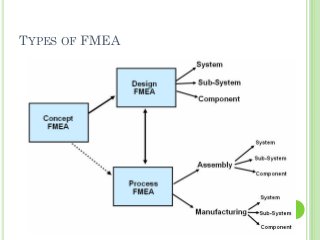
System - focuses on global system functions
Design - focuses on components and subsystems
Process - focuses on manufacturing and assembly
processes
Service - focuses on service functions
Software - focuses on software functions
TYPES OF FMEA
CONCEPT FMEA
Used to analyze concepts in the early stages
before hardware is defined (most often at
system and subsystem)
Focuses on potential failure modes associated
with the proposed functions of a concept
proposal
Includes the interaction of multiple systems
and interaction between the elements of a
system at the concept stages.
DESIGN FMEA
Aid in the objective evaluation of design requirements
and design alternatives
Aid in the initial design for manufacturing and
assembly
Increase the probability that potential failure modes
have been considered
Provide additional information to aid in the planning of
efficient design testing
PROCESS FMEA
Indentify potential product related process
failure modes
Assess the potential customer effects of the
failures
Indentify the potential manufacturing causes
on which to focus on
Develop a ranked list of potential failure modes
Document the results of the manufacturing
APPLICATION EXAMPLES
Manufacturing: A manager is responsible for
moving a manufacturing operation to a new
facility. He/she wants to be sure the move goes as
smoothly as possible and that there are no
surprises.
Design: A design engineer wants to think of all
the possible ways a product being designed could
fail so that robustness can be built into the
product.
Software: A software engineer wants to think of
possible problems a software product could fail
when scaled up to large databases. This is a core
issue for the Internet.
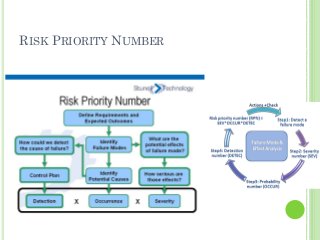
RISK PRIORITY NUMBER
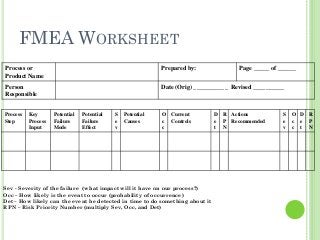
FMEA WORKSHEET
Process or
Product Name
Prepared by: Page _____ of ______
Person
Responsible
Date (Orig) ___________ Revised __________
Process
Step
Key
Process
Input
Potential
Failure
Mode
Potential
Failure
Effect
S
e
v
Potential
Causes
O
c
c
Current
Controls
D
e
t
R
P
N
Actions
Recommended
S
e
v
O
c
c
D
e
t
R
P
N
Sev - Severity of the failure (what impact will it have on our process?)
Occ – How likely is the event to occur (probability of occurrence)
Det – How likely can the event be detected in time to do something about it
RPN – Risk Priority Number (multiply Sev, Occ, and Det)
18
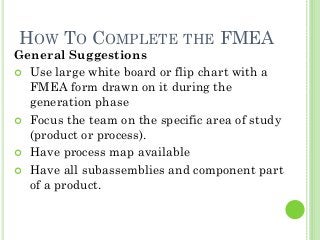
HOW TO COMPLETE THE FMEA
General Suggestions
Use large white board or flip chart with a
FMEA form drawn on it during the
generation phase
Focus the team on the specific area of study
(product or process).
Have process map available
Have all subassemblies and component part
of a product.
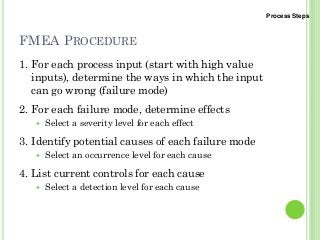
FMEA PROCEDURE
1. For each process input (start with high value
inputs), determine the ways in which the input
can go wrong (failure mode)
2. For each failure mode, determine effects
Select a severity level for each effect
3. Identify potential causes of each failure mode
Select an occurrence level for each cause
4. List current controls for each cause
Select a detection level for each cause
Process Steps
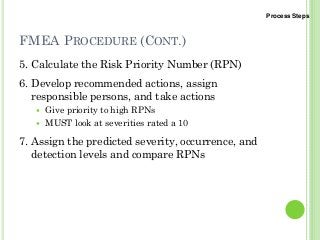
FMEA PROCEDURE (CONT.)
5. Calculate the Risk Priority Number (RPN)
6. Develop recommended actions, assign
responsible persons, and take actions
Give priority to high RPNs
MUST look at severities rated a 10
7. Assign the predicted severity, occurrence, and
detection levels and compare RPNs
Process Steps
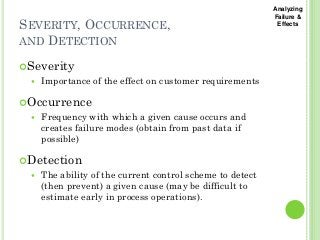
SEVERITY, OCCURRENCE,
AND DETECTION
Severity
Importance of the effect on customer requirements
Occurrence
Frequency with which a given cause occurs and
creates failure modes (obtain from past data if
possible)
Detection
The ability of the current control scheme to detect
(then prevent) a given cause (may be difficult to
estimate early in process operations).
Analyzing
Failure &
Effects
RATING SCALES
2
2
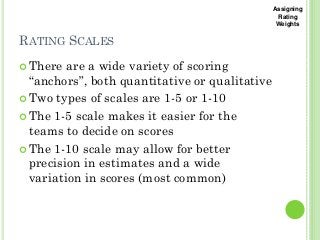
There are a wide variety of scoring
“anchors”, both quantitative or qualitative
Two types of scales are 1-5 or 1-10
The 1-5 scale makes it easier for the
teams to decide on scores
The 1-10 scale may allow for better
precision in estimates and a wide
variation in scores (most common)
Assigning
Rating
Weights
RATING SCALES
2
3
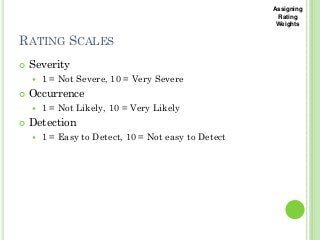
Severity
1 = Not Severe, 10 = Very Severe
Occurrence
1 = Not Likely, 10 = Very Likely
Detection
1 = Easy to Detect, 10 = Not easy to Detect
Assigning
Rating
Weights
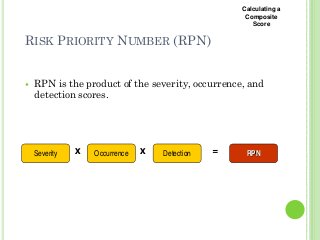
RISK PRIORITY NUMBER (RPN)
RPN is the product of the severity, occurrence, and
detection scores.
Severity Occurrence Detection RPNX X =
Calculating a
Composite
Score
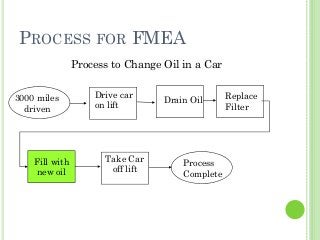
PROCESS FOR FMEA
Process to Change Oil in a Car
3000 miles
driven
Drive car
on lift
Fill with
new oil
Drain Oil Replace
Filter
Take Car
off lift
Process
Complete
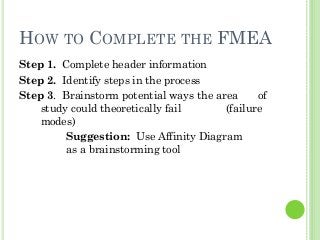
HOW TO COMPLETE THE FMEA
Step 1. Complete header information
Step 2. Identify steps in the process
Step 3. Brainstorm potential ways the area of
study could theoretically fail (failure
modes)
Suggestion: Use Affinity Diagram
as a brainstorming tool
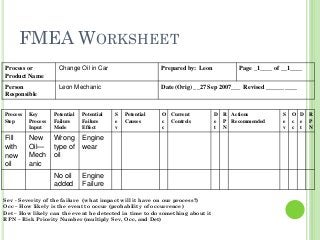
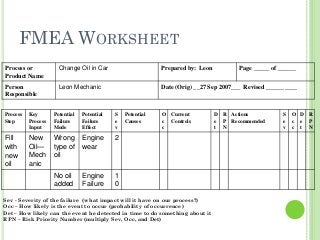
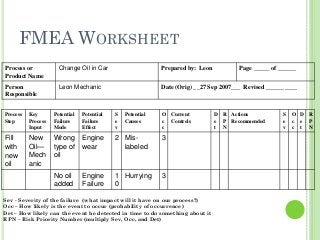
FMEA WORKSHEET
Process or
Product Name
Change Oil in Car Prepared by: Leon Page _1____ of __1____
Person
Responsible
Leon Mechanic Date (Orig) __27 Sep 2007___ Revised __________
Process
Step
Key
Process
Input
Potential
Failure
Mode
Potential
Failure
Effect
S
e
v
Potential
Causes
O
c
c
Current
Controls
D
e
t
R
P
N
Actions
Recommended
S
e
v
O
c
c
D
e
t
R
P
N
Fill
with
new
oil
New
Oil—
Mech
anic
Wrong
type of
oil
Engine
wear
No oil
added
Engine
Failure
Sev - Severity of the failure (what impact will it have on our process?)
Occ – How likely is the event to occur (probability of occurrence)
Det – How likely can the event be detected in time to do something about it
RPN – Risk Priority Number (multiply Sev, Occ, and Det)
28
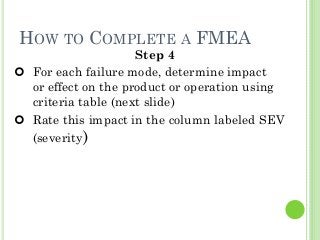
HOW TO COMPLETE A FMEA
Step 4
For each failure mode, determine impact
or effect on the product or operation using
criteria table (next slide)
Rate this impact in the column labeled SEV
(severity)
29
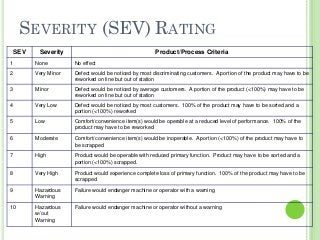
SEVERITY (SEV) RATING
SEV Severity Product/Process Criteria
1 None No effect
2 Very Minor Defect would be noticed by most discriminating customers. A portion of the product may have to be
reworked on line but out of station
3 Minor Defect would be noticed by average customers. A portion of the product (<100%) may have to be
reworked on line but out of station
4 Very Low Defect would be noticed by most customers. 100% of the product may have to be sorted and a
portion (<100%) reworked
5 Low Comfort/convenience item(s) would be operable at a reduced level of performance. 100% of the
product may have to be reworked
6 Moderate Comfort/convenience item(s) would be inoperable. A portion (<100%) of the product may have to
be scrapped
7 High Product would be operable with reduced primary function. Product may have to be sorted and a
portion (<100%) scrapped.
8 Very High Product would experience complete loss of primary function. 100% of the product may have to be
scrapped
9 Hazardous
Warning
Failure would endanger machine or operator with a warning
10 Hazardous
w/out
Warning
Failure would endanger machine or operator without a warning
30
FMEA WORKSHEET
Process or
Product Name
Change Oil in Car Prepared by: Leon Page _____ of ______
Person
Responsible
Leon Mechanic Date (Orig) __27 Sep 2007___ Revised __________
Process
Step
Key
Process
Input
Potential
Failure
Mode
Potential
Failure
Effect
S
e
v
Potential
Causes
O
c
c
Current
Controls
D
e
t
R
P
N
Actions
Recommended
S
e
v
O
c
c
D
e
t
R
P
N
Fill
with
new
oil
New
Oil—
Mech
anic
Wrong
type of
oil
Engine
wear
2
No oil
added
Engine
Failure
1
0
Sev - Severity of the failure (what impact will it have on our process?)
Occ – How likely is the event to occur (probability of occurrence)
Det – How likely can the event be detected in time to do something about it
RPN – Risk Priority Number (multiply Sev, Occ, and Det)
31
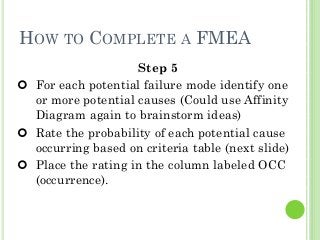
HOW TO COMPLETE A FMEA
Step 5
For each potential failure mode identify one
or more potential causes (Could use Affinity
Diagram again to brainstorm ideas)
Rate the probability of each potential cause
occurring based on criteria table (next slide)
Place the rating in the column labeled OCC
(occurrence).
32
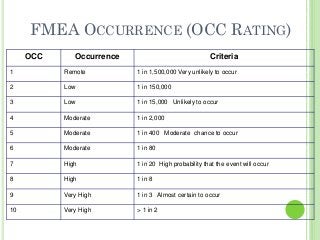
FMEA OCCURRENCE (OCC RATING)
OCC Occurrence Criteria
1 Remote 1 in 1,500,000 Very unlikely to occur
2 Low 1 in 150,000
3 Low 1 in 15,000 Unlikely to occur
4 Moderate 1 in 2,000
5 Moderate 1 in 400 Moderate chance to occur
6 Moderate 1 in 80
7 High 1 in 20 High probability that the event will occur
8 High 1 in 8
9 Very High 1 in 3 Almost certain to occur
10 Very High > 1 in 2
FMEA WORKSHEET
Process or
Product Name
Change Oil in Car Prepared by: Leon Page _____ of ______
Person
Responsible
Leon Mechanic Date (Orig) __27 Sep 2007___ Revised __________
Process
Step
Key
Process
Input
Potential
Failure
Mode
Potential
Failure
Effect
S
e
v
Potential
Causes
O
c
c
Current
Controls
D
e
t
R
P
N
Actions
Recommended
S
e
v
O
c
c
D
e
t
R
P
N
Fill
with
new
oil
New
Oil—
Mech
anic
Wrong
type of
oil
Engine
wear
2 Mis-
labeled
3
No oil
added
Engine
Failure
1
0
Hurrying 3
Sev - Severity of the failure (what impact will it have on our process?)
Occ – How likely is the event to occur (probability of occurrence)
Det – How likely can the event be detected in time to do something about it
RPN – Risk Priority Number (multiply Sev, Occ, and Det)
34
HOW TO COMPLETE THE FMEA
Step 6
Identify current controls or detection
Rate ability of each current control to prevent
or detect the failure mode once it occurs
using criteria table (next slide)
Place rating in Det column
35
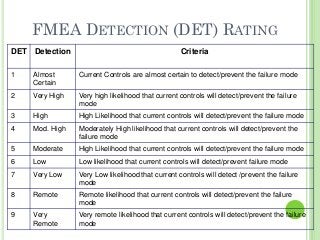
FMEA DETECTION (DET) RATING
DET Detection Criteria
1 Almost
Certain
Current Controls are almost certain to detect/prevent the failure mode
2 Very High Very high likelihood that current controls will detect/prevent the failure
mode
3 High High Likelihood that current controls will detect/prevent the failure mode
4 Mod. High Moderately High likelihood that current controls will detect/prevent the
failure mode
5 Moderate High Likelihood that current controls will detect/prevent the failure mode
6 Low Low likelihood that current controls will detect/prevent failure mode
7 Very Low Very Low likelihood that current controls will detect /prevent the failure
mode
8 Remote Remote likelihood that current controls will detect/prevent the failure
mode
9 Very
Remote
Very remote likelihood that current controls will detect/prevent the failure
mode
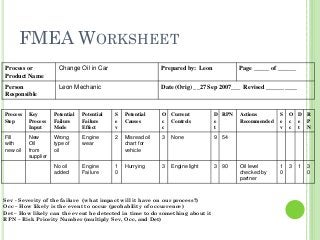
FMEA WORKSHEET
Process or
Product Name
Change Oil in Car Prepared by: Leon Page _____ of ______
Person
Responsible
Leon Mechanic Date (Orig) __27 Sep 2007___ Revised __________
Process
Step
Key
Process
Input
Potential
Failure
Mode
Potential
Failure
Effect
S
e
v
Potential
Causes
O
c
c
Current
Controls
D
e
t
RPN Actions
Recommended
S
e
v
O
c
c
D
e
t
R
P
N
Fill
with
new oil
New
Oil
from
supplier
Wrong
type of
oil
Engine
wear
2 Misread oil
chart for
vehicle
3 None 9
No oil
added
Engine
Failure
1
0
Hurrying 3 Engine light 3
Sev - Severity of the failure (what impact will it have on our process?)
Occ – How likely is the event to occur (probability of occurrence)
Det – How likely can the event be detected in time to do something about it
RPN – Risk Priority Number (multiply Sev, Occ, and Det)
37
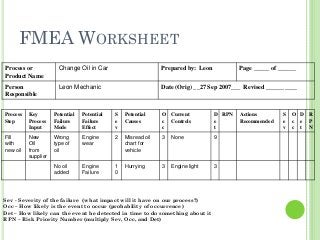
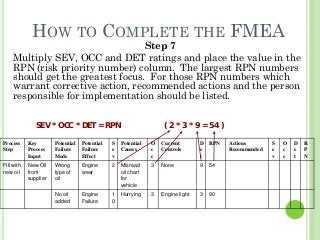
HOW TO COMPLETE THE FMEA
Step 7
Multiply SEV, OCC and DET ratings and place the value in the
RPN (risk priority number) column. The largest RPN numbers
should get the greatest focus. For those RPN numbers which
warrant corrective action, recommended actions and the person
responsible for implementation should be listed.
SEV * OCC * DET = RPN ( 2 * 3 * 9 = 54 )
Process
Step
Key
Process
Input
Potential
Failure
Mode
Potential
Failure
Effect
S
e
v
Potential
Causes
O
c
c
Current
Controls
D
e
t
RPN Actions
Recommended
S
e
v
O
c
c
D
e
t
R
P
N
Fill with
new oil
New Oil
from
supplier
Wrong
type of
oil
Engine
wear
2 Misread
oil chart
for
vehicle
3 None 9 54
No oil
added
Engine
Failure
1
0
Hurrying 3 Engine light 3 90
38
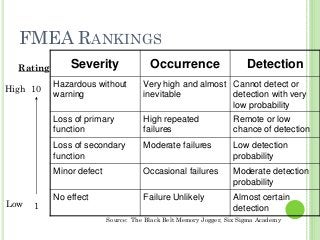
FMEA RANKINGS
Severity Occurrence Detection
Hazardous without
warning
Very high and almost
inevitable
Cannot detect or
detection with very
low probability
Loss of primary
function
High repeated
failures
Remote or low
chance of detection
Loss of secondary
function
Moderate failures Low detection
probability
Minor defect Occasional failures Moderate detection
probability
No effect Failure Unlikely Almost certain
detection
Rating
10
1
High
Low
Source: The Black Belt Memory Jogger, Six Sigma Academy
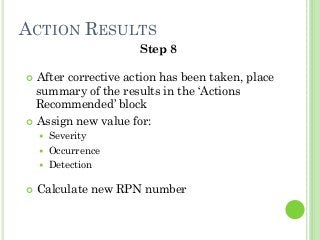
ACTION RESULTS
Step 8
After corrective action has been taken, place
summary of the results in the ‘Actions
Recommended’ block
Assign new value for:
Severity
Occurrence
Detection
Calculate new RPN number
FMEA WORKSHEET
Process or
Product Name
Change Oil in Car Prepared by: Leon Page _____ of ______
Person
Responsible
Leon Mechanic Date (Orig) __27 Sep 2007___ Revised __________
Process
Step
Key
Process
Input
Potential
Failure
Mode
Potential
Failure
Effect
S
e
v
Potential
Causes
O
c
c
Current
Controls
D
e
t
RPN Actions
Recommended
S
e
v
O
c
c
D
e
t
R
P
N
Fill
with
new oil
New
Oil
from
supplier
Wrong
type of
oil
Engine
wear
2 Misread oil
chart for
vehicle
3 None 9 54
No oil
added
Engine
Failure
1
0
Hurrying 3 Engine light 3 90 Oil level
checked by
partner
1
0
3 1 3
0
Sev - Severity of the failure (what impact will it have on our process?)
Occ – How likely is the event to occur (probability of occurrence)
Det – How likely can the event be detected in time to do something about it
RPN – Risk Priority Number (multiply Sev, Occ, and Det)
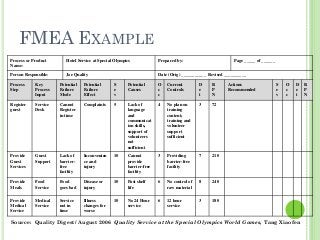
FMEA EXAMPLE
Source: Quality Digest/ August 2006 Quality Service at the Special Olympics World Games, Tang Xiaofen
Process or Product
Name:
Hotel Service at Special Olympics Prepared by: Page _____ of ______
Person Responsible: Joe Quality Date (Orig) ___________ Revised __________
Process
Step
Key
Process
Input
Potential
Failure
Mode
Potential
Failure
Effect
S
e
v
Potential
Causes
O
c
c
Current
Controls
D
e
t
R
P
N
Actions
Recommended
S
e
v
O
c
c
D
e
t
R
P
N
Register
guest
Service
Desk
Cannot
Register
in time
Complaints 5 Lack of
language
and
communicat
ion skills,
support of
volunteers
not
sufficient
4 No plan on
training
content;
training and
volunteer
support
sufficient
3 72
Provide
Guest
Services
Guest
Support
Lack of
barrier-
free
facility
Inconvenien
ce and
injury
10 Cannot
provide
barrier-free
facility
3 Providing
barrier-free
facility
7 210
Provide
Meals
Food
Service
Food
goes bad
Disease or
injury
10 Past shelf
life
6 No control of
raw material
8 240
Provide
Medical
Service
Medical
Service
Service
not in
time
Illness
changes for
worse
10 No 24 Hour
service
6 12 hour
service
3 180
FAULT TREE ANALYSIS
INTRODUCTION
Fault Tree Analysis was originally developed in
1962 at Bell Laboratories by H.A. Watson.
FTA is a deductive analysis approach for
resolving an undesired event into its causes.
Logic diagrams and Boolean Algebra are used to
identify the cause of the top event.
2
CONTD…
A logic diagram called Fault tree is constructed
to show the event relationship.
Probability of occurrence values are assigned to
the lowest events in the tree in order to obtain
the probability of occurrence of the top event.
3
WHY FTA IS CARRIED OUT?
Identify the cause of a failure.
Monitor and control safety performance of a
complex system.
To identify the effects of human errors .
Minimize and optimize resources.
4
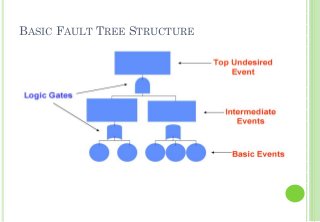
THE FAULT TREE
Fault tree is the logical model of the relationship of
the undesired event to more basic events.
The top event of the Fault tree is the undesired
event.
The middle events are intermediate events and the
basic events are at the bottom.
The logic relationship of events are shown by logic
symbols or gates.
5
BASIC FAULT TREE STRUCTURE
6
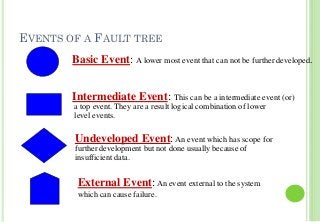
EVENTS OF A FAULT TREE
7
Basic Event: A lower most event that can not be further developed.
Intermediate Event: This can be a intermediate event (or)
a top event. They are a result logical combination of lower
level events.
Undeveloped Event:An event which has scope for
further development but not done usually because of
insufficient data.
External Event:An event external to the system
which can cause failure.
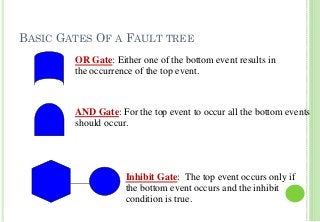
BASIC GATES OF A FAULT TREE
8
OR Gate: Either one of the bottom event results in
the occurrence of the top event.
AND Gate: For the top event to occur all the bottom events
should occur.
Inhibit Gate: The top event occurs only if
the bottom event occurs and the inhibit
condition is true.
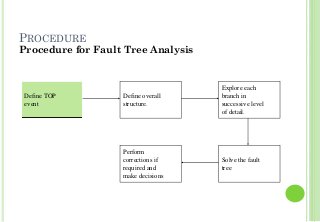
PROCEDURE
9
Procedure for Fault Tree Analysis
Define TOP
event
Define overall
structure.
Explore each
branch in
successive level
of detail.
Solve the fault
tree
Perform
corrections if
required and
make decisions
PROCEDURE
Define Top Event:
Use Process hazard assessment (PHA), Piping & Instrumentation
Diagram (P&ID), Process description etc., to define the top event.
If its too broad, overly large FTA will result. E.g. Fire in process.
If its too narrow, the exercise will be costly. E.g. Leak in the valve.
The boundaries for top event definition can be a System, Sub-system,
Unit, Equipment (or) a Function.
Some good examples are: Overpressure in vessel V1, Motor fails to
start, Reactor high temperature safety function fails etc.,
10
PROCEDURE
Define overall structure:
Determine the intermediate events &
combination of failure that will lead to the
top event.
Arrange them accordingly using logical
relationship
11
PROCEDURE
Explore each branch in successive level of detail:
Continue the top down process until the root cause for each
branch is identified and/or until further decomposition is
considered unnecessary.
So each branch will end with a basic event or an
undeveloped event.
Consider Common cause failure & Systematic failures in
the process of decomposition.
A good guide to stop decomposing is to go no further than
physical (or) functional bounds set by the top event.
12
PROCEDURE
13
Solve the Fault Tree:
Assign probabilities of failure to the lowest level
event in each branch of the tree.
From this data the intermediate event frequency
and the top level event frequency can be
determined using Boolean Algebra and Minimal
Cut Set methods.
PROCEDURE
14
Minimal Cut Set theory:
The fault tree consists of many levels of basic and intermediate
events linked together by AND and OR gates. Some basic events
may appear in different places of the fault tree.
The minimal cut set analysis provides a new fault tree, logically
equivalent to the original, with an OR gate beneath the top event,
whose inputs (bottom)are minimal cut sets.
Each minimal cut set is an AND gate with a set of basic event
inputs necessary and sufficient to cause the top event.
PROCEDURE
15
Perform corrections and make decisions:
Application of Boolean Algebra and Minimal Cut
Set theory will result in identifying the basic
events(A) and combination of basic events(B.C.D)
that have major influence on the TOP event.
• This will give clear insight on what needs to be
attended and where resources has to be put for
problem solving.
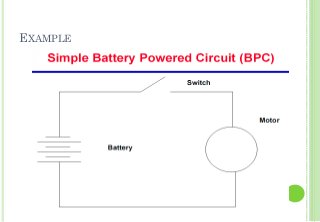
EXAMPLE
16
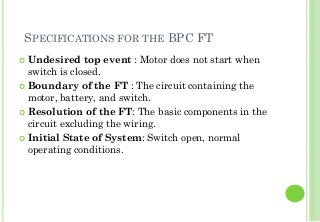
SPECIFICATIONS FOR THE BPC FT
Undesired top event : Motor does not start when
switch is closed.
Boundary of the FT : The circuit containing the
motor, battery, and switch.
Resolution of the FT: The basic components in the
circuit excluding the wiring.
Initial State of System: Switch open, normal
operating conditions.
17
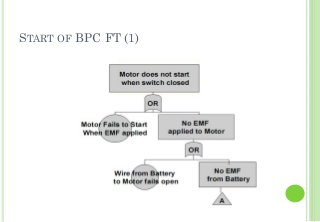
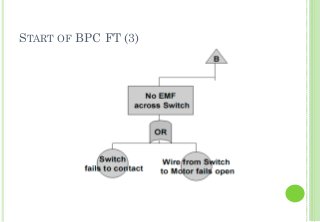
START OF BPC FT (1)
18
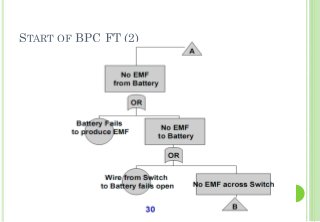
START OF BPC FT (2)
19
START OF BPC FT (3)
20
ADVANTAGES OF FTA
21
•Deals well with parallel, redundant or alternative fault
paths.
•Searches for possible causes of an end effect which may
not have been foreseen.
•The cut sets derived in FTA can give enormous insight
into various ways top event occurs.
•Very useful tool for focused analysis where analysis is
required for one or two major outcomes.
DISADVANTAGES OF FTA
Requires a separate fault tree for each top
event and makes it difficult to analyze complex
systems.
Fault trees developed by different individuals
are usually different in structure, producing
different cut set elements and results.
The same event may appear in different parts
of the tree, leading to some initial confusion.
22
APPLICATIONS
Used in the field of safety engineering and Reliability
engineering to determine the probability of a safety
accident or a particular system level failure.
Aerospace Engineering.
23
POKA-YOKE
24
INTRODUCTION
What is a Poka- yoke?
Shigeo shingo defined poka-yoke as POKA- ‘Inadvertent
mistake that anyone can make’ and YOKE- ‘To prevent or
proof’
Poka-yoke is a tool to have “zero defects” and even reduce or
eliminate quality control.
Poka-yoke is a Japanese name for “fool-proofing”.
Poke-yoke represents the intelligence of the operator by
excluding repetitive actions that require a thinking process.
25
MISTAKE PROOFING
Mistake-Proofing a product's design and its manufacturing
process is a key element of design for manufacturability /
assembly (DFM/A)
Mistake proofing is also a key element of improving product
quality and reliability
FACTORS CONTRIBUTING TO MISTAKE PROOFING:
Attention
Perception
Memory
Logical reasoning
26
PRINCIPLES OF MISTAKE-PROOFING
There are six mistake-proofing principles or methods.
Elimination seeks to eliminate the possibility of error by
redesigning the product or process so that the task or part is no
longer necessary.
Replacement substitutes a more reliable process to improve
consistency.
Prevention engineers the product or process so that it is
impossible to make a mistake at all.
Facilitation employs techniques and combining steps to make
work easier to perform.
Detection involves identifying an error before further
processing occurs so that the user can quickly correct the
problem.
Mitigation seeks to minimize the effects of errors. 27
2-STATUS & 3-FUNCTIONS OF POKA-YOKE
POKA-YOKE HAS 2 STATUS AND 3 FUNCTIONS:
Status:
1.The fault will happen or
2.The fault has happened
Functions:
1.Stop
2.Check or
3.Alarm
28
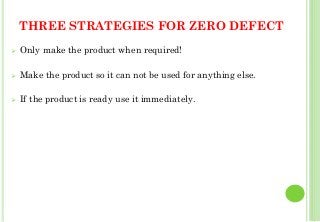
THREE STRATEGIES FOR ZERO DEFECT
Only make the product when required!
Make the product so it can not be used for anything else.
If the product is ready use it immediately.
29
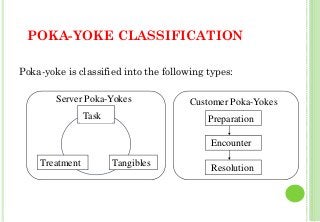
POKA-YOKE CLASSIFICATION
Poka-yoke is classified into the following types:
Server Poka-Yokes
Task
Treatment Tangibles
Customer Poka-Yokes
Preparation
Encounter
Resolution
30
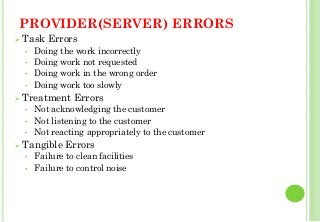
PROVIDER(SERVER) ERRORS
Task Errors
• Doing the work incorrectly
• Doing work not requested
• Doing work in the wrong order
• Doing work too slowly
Treatment Errors
• Not acknowledging the customer
• Not listening to the customer
• Not reacting appropriately to the customer
Tangible Errors
• Failure to clean facilities
• Failure to control noise
31
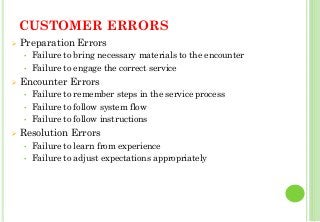
CUSTOMER ERRORS
Preparation Errors
• Failure to bring necessary materials to the encounter
• Failure to engage the correct service
Encounter Errors
• Failure to remember steps in the service process
• Failure to follow system flow
• Failure to follow instructions
Resolution Errors
• Failure to learn from experience
• Failure to adjust expectations appropriately
32
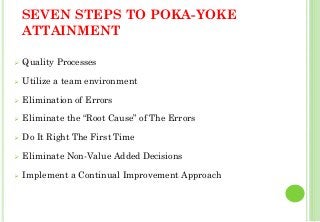
SEVEN STEPS TO POKA-YOKE
ATTAINMENT
Quality Processes
Utilize a team environment
Elimination of Errors
Eliminate the “Root Cause” of The Errors
Do It Right The First Time
Eliminate Non-Value Added Decisions
Implement a Continual Improvement Approach
33
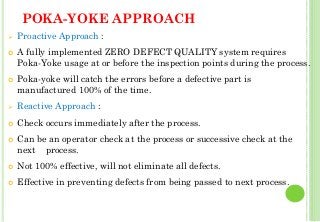
POKA-YOKE APPROACH
Proactive Approach :
A fully implemented ZERO DEFECT QUALITY system requires
Poka-Yoke usage at or before the inspection points during the process.
Poka-yoke will catch the errors before a defective part is
manufactured 100% of the time.
Reactive Approach :
Check occurs immediately after the process.
Can be an operator check at the process or successive check at the
next process.
Not 100% effective, will not eliminate all defects.
Effective in preventing defects from being passed to next process.
34
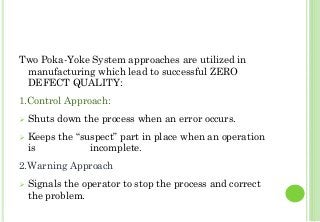
Two Poka-Yoke System approaches are utilized in
manufacturing which lead to successful ZERO
DEFECT QUALITY:
1.Control Approach:
Shuts down the process when an error occurs.
Keeps the “suspect” part in place when an operation
is incomplete.
2.Warning Approach
Signals the operator to stop the process and correct
the problem.
35
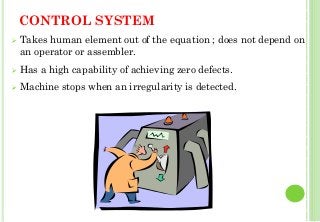
CONTROL SYSTEM
Takes human element out of the equation ; does not depend on
an operator or assembler.
Has a high capability of achieving zero defects.
Machine stops when an irregularity is detected.
36
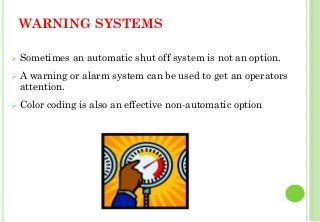
WARNING SYSTEMS
Sometimes an automatic shut off system is not an option.
A warning or alarm system can be used to get an operators
attention.
Color coding is also an effective non-automatic option
37
TEN TYPES OF HUMAN MISTAKES
Forgetfulness
Mis-understanding
Wrong identification
Lack of experience
Willful (ignoring rules or procedure)
Inadvertent or sloppiness
Slowliness
Lack of standardization
Surprise (unexpected machine operation, etc.)
Intentional (sabotage)
38
POKA-YOKE DEVICES
Poka yoke is implemented by using simple objects like fixtures,
jigs, warning devices and the like to prevent people from
committing mistakes, even if they try to!.
The main feature of poka-yoke devices is their exceptional
suitability for reducing or eliminating defects through effective
feedback and instantaneous corrective action.
These devices are capable of being used all the time by all
workers; simple and usually installed with low implementation
cost.
Poka-yoke devices help eliminate errors and defects by giving
machines the “intelligence” to stop and signal when a error
occurs.
Poka-yoke devices stop machines and alert workers when a
problem exists. 39
THE THREE LEVELS OF POKA-YOKE:
There are three levels at which your company can effect poka-
yoke:
Eliminating errors defects and losses at the source or
prevention of a mistake from being committed..
Detection of a loss or mistakes it occurs,allowing correction
before it becomes a problem.
Detection of a loss or mistakes after it has occurred,just in time
before it blows up into a major issue(least effective).
40
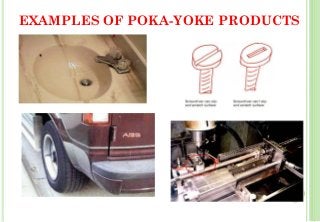
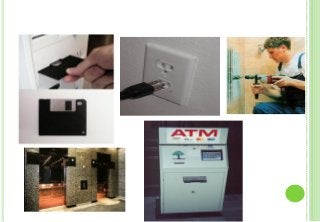
EXAMPLES OF POKA-YOKE PRODUCTS
41
42
IMPLEMENTATION IN MANUFACTURING
Poka-yoke can be implemented at any step of a
manufacturing process where something can go wrong or an
error can be made.
Shigeo Shingo recognized three types of poka-yoke for
detecting and preventing errors in a mass production system:
The contact method identifies product defects by testing the
product's shape, size, color, or other physical attributes.
The fixed-value (or constant number) method alerts the operator
if a certain number of movements are not made.
The motion-step (or sequence) method determines whether the
prescribed steps of the process have been followed.
43
ADVANTAGES
They are simple and cheap.
They are part of the process, implementing what Shingo calls
"100%" inspection.
They are placed close to where the mistakes occur, providing
quick feedback to the workers so that the mistakes can be
corrected.
Once put in place, they require minimal supervision.
44
CONCLUSION
Poka-yokes deals with understanding why
people make errors and how to analyze the process to know
where errors are likely to occur and what root causes
contribute to them.
Since the poka-yoke devices detect errors at their roots
& prevent them from blowing up to become bigger
problems, there is consistency in the quality of the
products, saving the cost and time spent in subsequent
quality inspection processes.
45
New management Tools
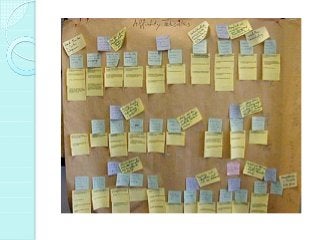
Affinity diagrams:
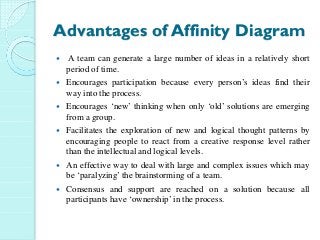
Advantages of Affinity Diagram
A team can generate a large number of ideas in a relatively short
period of time.
Encourages participation because every person’s ideas find their
way into the process.
Encourages ‘new’ thinking when only ‘old’ solutions are emerging
from a group.
Facilitates the exploration of new and logical thought patterns by
encouraging people to react from a creative response level rather
than the intellectual and logical levels.
An effective way to deal with large and complex issues which may
be ‘paralyzing’ the brainstorming of a team.
Consensus and support are reached on a solution because all
participants have ‘ownership’ in the process.
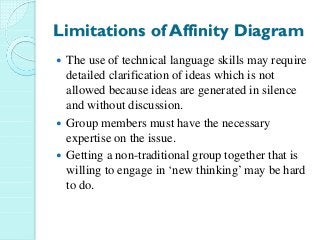
Limitations of Affinity Diagram
The use of technical language skills may require
detailed clarification of ideas which is not
allowed because ideas are generated in silence
and without discussion.
Group members must have the necessary
expertise on the issue.
Getting a non-traditional group together that is
willing to engage in ‘new thinking’ may be hard
to do.
QUALITY FUNCTION
DEPLOYMENT
Brief History of QFD
Origin - Mitsubishi Kobe Shipyard 1972
Foundation - Belief That Products Should Be Designed
To Reflect Customer Desires and Tastes
Developed By Toyota and Its Suppliers
Expanded To Other Japanese Manufacturers
Consumer Electronics, Home Appliances, Clothing, Integrated
Circuits, Apartment Layout Planning
Adopted By Ford and GM in 1980s
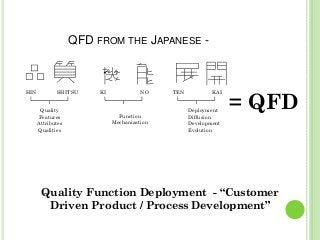
= QFD
HIN SHITSU
Quality
Features
Attributes
Qualities
KI NO TEN KAI
Deployment
Diffusion
Development
Evolution
Function
Mechanization
Quality Function Deployment - “Customer
Driven Product / Process Development”
QFD FROM THE JAPANESE -
There is no single, right definition for QFD; this one
captures its essential meaning:
A system for translating customer requirements into
appropriate company requirements at each stage
from research and product development to
engineering and manufacturing to marketing/sales
and distribution
DEFINITION OF QUALITY FUNCTION
DEPLOYMENT :
Prerequisites to QFD are ‘Market Research’ and ‘VOC
gathering’.
Quality Function Deployment
Is a structured method that is intended to transmit and
translate customer requirements, that is, the
Voice of the Customer
through each stage of the product development and
production process, that is, through the product
realization cycle.
These requirements are the collection of customer needs,
including all satisfiers, exciters/delighters, and
dissatisfiers.
Return on Investment from
Using QFD
Companies using QFD to reflect "The Voice of the
Customer" in defining quality have a competitive
advantage because there is/are:
1. Fewer and Earlier Design Changes
2. Fewer Start-up Problems
3. Shorter Development Time
4. Lower Start-up Costs
5. Warranty Cost Reductions
6. Knowledge Transfer to the Next Product
7. Customer Satisfaction
QUALITY FUNCTION DEPLOYMENT
Identify customer wants
Identify how the good/service will satisfy
customer wants
Relate customer wants to product hows
Identify relationships between the firm’s
hows
Develop importance ratings
Evaluate competing products
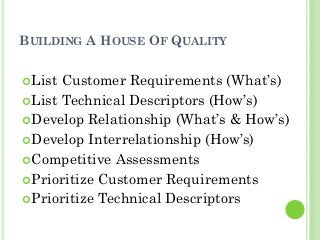
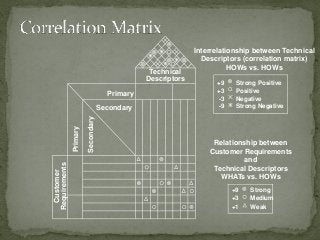
BUILDING A HOUSE OF QUALITY
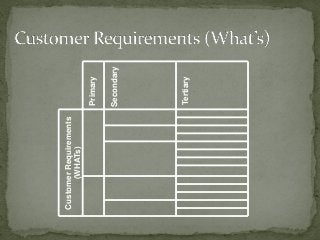
List Customer Requirements (What’s)
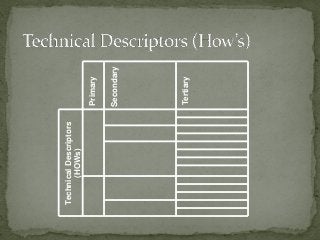
List Technical Descriptors (How’s)
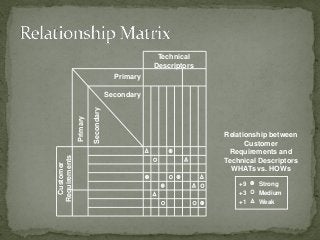
Develop Relationship (What’s & How’s)
Develop Interrelationship (How’s)
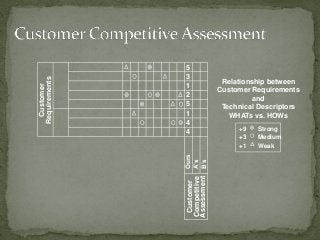
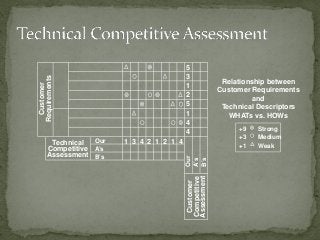
Competitive Assessments
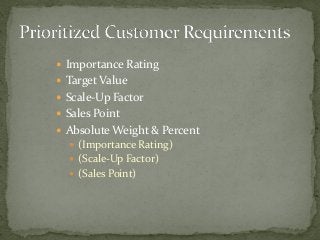
Prioritize Customer Requirements
Prioritize Technical Descriptors
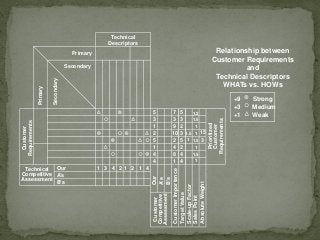
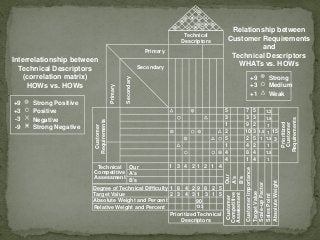
QFD HOUSE OF QUALITY
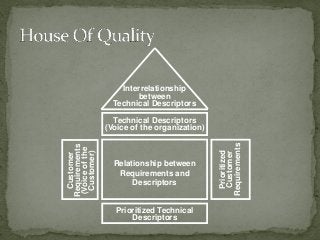
Technical Descriptors
(Voice of the organization)
Prioritized Technical
Descriptors
Interrelationship
between
Technical Descriptors
Customer
Requirements
(Voiceofthe
Customer)
Prioritized
Customer
Requirements
Relationship between
Requirements and
Descriptors
Absolute Weight and Percent
Prioritized Technical
Descriptors
Degree of Technical Difficulty
Relative Weight and Percent
Target Value
Customer
Requirements
Prioritized
Customer
Requirements
Technical
Descriptors
Primary
Primary
Secondary
Secondary
Technical
Competitive
Assessment
Customer
Competitive
Assessment
Our
A’s
B’s
CustomerImportance
TargetValue
Scale-upFactor
SalesPoint
AbsoluteWeight
Our
A’s
B’s
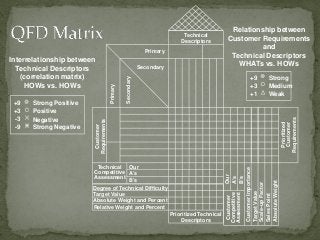
Relationship between
Customer Requirements
and
Technical Descriptors
WHATs vs. HOWs
Strong
Medium
Weak
+9
+3
+1
Strong Positive
Positive
Negative
Strong Negative
+9
+3
-3
-9
Interrelationship between
Technical Descriptors
(correlation matrix)
HOWs vs. HOWs
CustomerRequirements
(WHATs)
Primary
Secondary
Tertiary
TechnicalDescriptors
(HOWs)
Primary
Secondary
Tertiary
Customer
Requirements
Technical
Descriptors
Primary
Primary
Secondary
Secondary
Customer
Requirements
Technical
Descriptors
Primary
Primary
Secondary Secondary
Relationship between
Customer
Requirements and
Technical Descriptors
WHATs vs. HOWs
Strong
Medium
Weak
+9
+3
+1
Customer
Requirements
Technical
Descriptors
Primary
Primary
Secondary
Secondary
Relationship between
Customer Requirements
and
Technical Descriptors
WHATs vs. HOWs
Strong Positive
Positive
Negative
Strong Negative
+9
+3
-3
-9
Interrelationship between Technical
Descriptors (correlation matrix)
HOWs vs. HOWs
Strong
Medium
Weak
+9
+3
+1
Customer
Requirements
Customer
Competitive
Assessment
Ours
A’s
B’s
5
3
1
2
5
1
4
4
Relationship between
Customer Requirements
and
Technical Descriptors
WHATs vs. HOWs
Strong
Medium
Weak
+9
+3
+1
1 3 4 2 1 2 1 4
Customer
Requirements
Customer
Competitive
Assessment
Our
A’s
B’s
5
3
1
2
5
1
4
4
Relationship between
Customer Requirements
and
Technical Descriptors
WHATs vs. HOWs
Strong
Medium
Weak
+9
+3
+1Technical
Competitive
Assessment
Our
A’s
B’s
Importance Rating
Target Value
Scale‐Up Factor
Sales Point
Absolute Weight & Percent
(Importance Rating)
(Scale‐Up Factor)
(Sales Point)
7
3
9
10
2
4
8
1
Customer
Requirements
Prioritized
Customer
Requirements
Technical
Descriptors
Primary
Primary
Secondary
Secondary
Technical
Competitive
Assessment
Customer
Competitive
Assessment
Our
A’s
B’s
CustomerImportance
TargetValue
Scale-upFactor
SalesPoint
AbsoluteWeight
1 3 4 2 1 2 1 4
5
3
1
2
5
1
4
4
5
3
2
3
5
2
4
4
1.5
1
1.2
1.5
1
1
1.5
1
1.5
1
15
3
Our
A’s
B’s
Relationship between
Customer Requirements
and
Technical Descriptors
WHATs vs. HOWs
Strong
Medium
Weak
+9
+3
+1
Absolute Weight and Percent
Prioritized Technical
Descriptors
Degree of Technical Difficulty
Relative Weight and Percent
Target Value
1 8 4 2 9 8 2 5
90
133
2 3 4 3 1 3 1 5
7
3
9
10
2
4
8
1
Customer
Requirements
Prioritized
Customer
Requirements
Technical
Descriptors
Primary
Primary
Secondary
Secondary
Technical
Competitive
Assessment
Customer
Competitive
Assessment
Our
A’s
B’s
CustomerImportance
TargetValue
Scale-upFactor
SalesPoint
AbsoluteWeight
1 3 4 2 1 2 1 4
5
3
1
2
5
1
4
4
5
3
2
3
5
2
4
4
1.5
1
1.2
1.5
1
1
1.5
1
1.5
1
15
3
Our
A’s
B’s
Relationship between
Customer Requirements
and
Technical Descriptors
WHATs vs. HOWs
Strong
Medium
Weak
+9
+3
+1
Strong Positive
Positive
Negative
Strong Negative
+9
+3
-3
-9
Interrelationship between
Technical Descriptors
(correlation matrix)
HOWs vs. HOWs
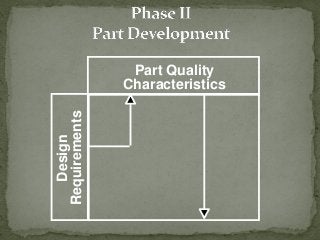
Design
Requirements
Customer
Requirements
Part Quality
Characteristics
Design
Requirements
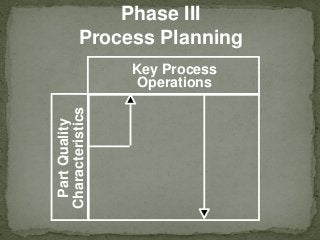
Phase III
Process Planning
Key Process
Operations
PartQuality
Characteristics
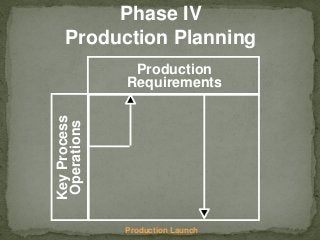
Phase IV
Production Planning
Production
Requirements
KeyProcess
Operations
Production Launch
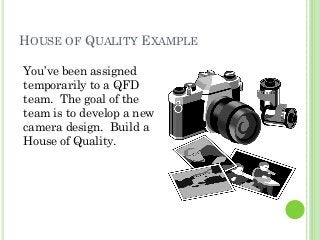
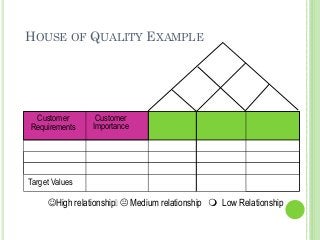
HOUSE OF QUALITY EXAMPLE
You’ve been assigned
temporarily to a QFD
team. The goal of the
team is to develop a new
camera design. Build a
House of Quality.
HOUSE OF QUALITY EXAMPLE
☺High relationship Medium relationship Low Relationship
Customer
Requirements
Customer
Importance
Target Values
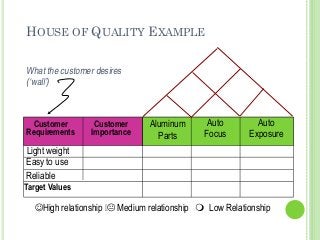
HOUSE OF QUALITY EXAMPLE
☺High relationship Medium relationship Low Relationship
Target Values
Light weight
Easy to use
Reliable
What the customer desires
(‘wall’)
Aluminum
Parts
Auto
Focus
Auto
Exposure
Customer
Requirements
Customer
Importance
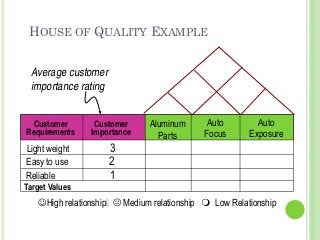
HOUSE OF QUALITY EXAMPLE
☺High relationship Medium relationship Low Relationship
Customer
Requirements
Customer
Importance
Target Values
Light weight
Easy to use
Reliable
Aluminum
Parts
Auto
Focus
Auto
Exposure
3
1
2
Average customer
importance rating
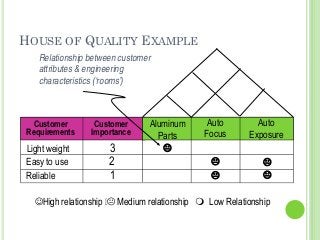
HOUSE OF QUALITY EXAMPLE
☺High relationship Medium relationship Low Relationship
Customer
Requirements
Customer
Importance
Light weight
Easy to use
Reliable
Aluminum
Parts
Auto
Focus
Auto
Exposure
3
2
1
Relationship between customer
attributes & engineering
characteristics (‘rooms’)
HOUSE OF QUALITY EXAMPLE
☺High relationship Medium relationship Low Relationship
Customer
Requirements
Customer
Importance
Target Values
Light weight
Easy to use
Reliable
Aluminum
Parts
Auto
Focus
Auto
Exposure
3
2
1
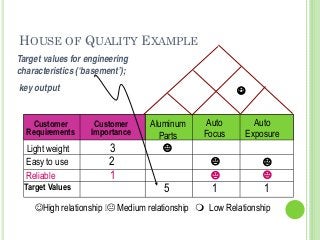
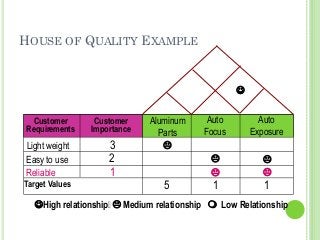
5 1 1
Target values for engineering
characteristics (‘basement’);
key output ☺
HOUSE OF QUALITY EXAMPLE
☺High relationship Medium relationship Low Relationship
Customer
Requirements
Customer
Importance
Target Values
Light weight
Easy to use
Reliable
Aluminum
Parts
Auto
Focus
Auto
Exposure
3
2
1
5 1 1
☺
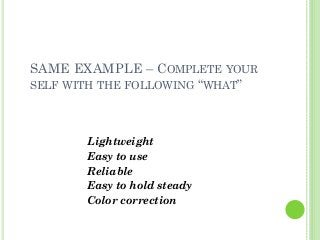
SAME EXAMPLE – COMPLETE YOUR
SELF WITH THE FOLLOWING “WHAT”
Lightweight
Easy to use
Reliable
Easy to hold steady
Color correction
SOLUTION
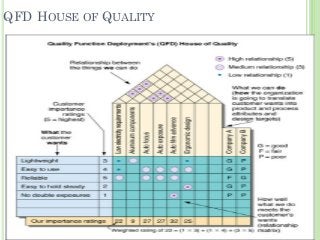
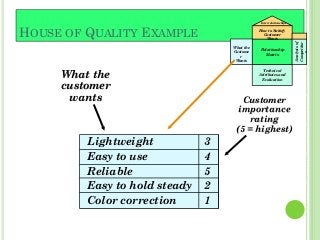
HOUSE OF QUALITY EXAMPLE
Customer
importance
rating
(5 = highest)
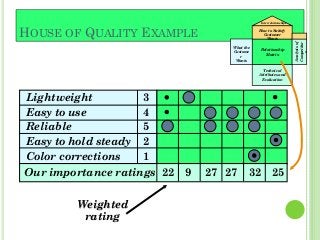
Lightweight 3
Easy to use 4
Reliable 5
Easy to hold steady 2
Color correction 1
What the
customer
wants
What the
Custome
r
Wants
Relationship
Matrix
Technical
Attributes and
Evaluation
How to Satisfy
Customer
Wants
Interrelationships
Analysisof
Competitor
s
HOUSE OF QUALITY EXAMPLE
What the
Custome
r
Wants
Relationship
Matrix
Technical
Attributes and
Evaluation
How to Satisfy
Customer
Wants
Interrelationships
Analysisof
Competitor
s
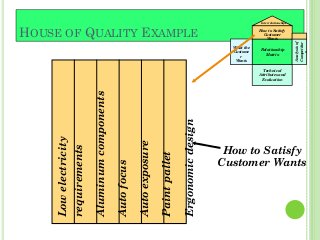
Lowelectricity
requirements
Aluminumcomponents
Autofocus
Autoexposure
Paintpallet
Ergonomicdesign
How to Satisfy
Customer Wants
Lightweight 3
Easy to use 4
Reliable 5
Easy to hold steady 2
Color corrections 1
HOUSE OF QUALITY EXAMPLE
What the
Custome
r
Wants
Relationship
Matrix
Technical
Attributes and
Evaluation
How to Satisfy
Customer
Wants
Interrelationships
Analysisof
Competitor
s
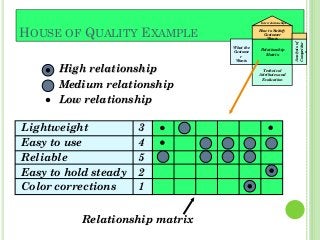
High relationship
Medium relationship
Low relationship
Relationship matrix
HOUSE OF QUALITY EXAMPLE
What the
Custome
r
Wants
Relationship
Matrix
Technical
Attributes and
Evaluation
How to Satisfy
Customer
Wants
Interrelationships
Analysisof
Competitor
s
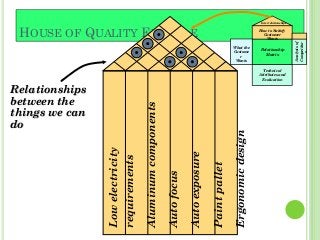
Lowelectricity
requirements
Aluminumcomponents
Autofocus
Autoexposure
Paintpallet
Ergonomicdesign
Relationships
between the
things we can
do
HOUSE OF QUALITY EXAMPLE
Weighted
rating
What the
Custome
r
Wants
Relationship
Matrix
Technical
Attributes and
Evaluation
How to Satisfy
Customer
Wants
Interrelationships
Analysisof
Competitor
s
Lightweight 3
Easy to use 4
Reliable 5
Easy to hold steady 2
Color corrections 1
Our importance ratings 22 9 27 27 32 25
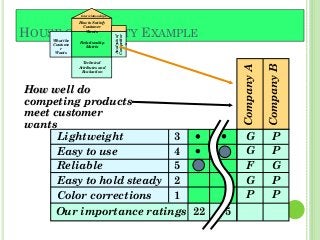
HOUSE OF QUALITY EXAMPLE
CompanyA
CompanyB
G P
G P
F G
G P
P P
Lightweight 3
Easy to use 4
Reliable 5
Easy to hold steady 2
Color corrections 1
Our importance ratings 22 5
How well do
competing products
meet customer
wants
What the
Custome
r
Wants
Relationship
Matrix
Technical
Attributes and
Evaluation
How to Satisfy
Customer
Wants
Interrelationships
Analysisof
Competitor
s
HOUSE OF QUALITY EXAMPLEWhat the
Custome
r
Wants
Relationship
Matrix
Technical
Attributes and
Evaluation
How to Satisfy
Customer
Wants
Interrelationships
Analysisof
Competitor
s
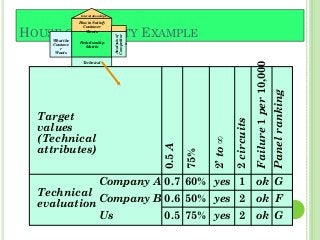
Target
values
(Technical
attributes)
Technical
evaluation
Company A 0.7 60% yes 1 ok G
Company B 0.6 50% yes 2 ok F
Us 0.5 75% yes 2 ok G
0.5A
75%
2’to∞
2circuits
Failure1per10,000
Panelranking
HOUSE OF QUALITY EXAMPLE
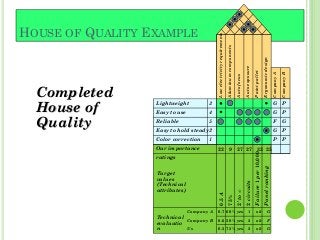
Completed
House of
Quality
Lightweight 3
Easy to use 4
Reliable 5
Easy to hold steady 2
Color correction 1
Our importance
ratings
Lowelectricityrequirements
Aluminumcomponents
Autofocus
Autoexposure
Paintpallet
Ergonomicdesign
CompanyA
CompanyB
G P
G P
F G
G P
P P
Target
values
(Technical
attributes)
Technical
evaluatio
n
Company A 0.7 60% yes 1 ok G
Company B 0.6 50% yes 2 ok F
Us 0.5 75% yes 2 ok G
0.5A
75%
2’to∞
2circuits
Failure1per10,000
Panelranking
22 9 27 27 32 25
TAGUCHI LOSS FUNCTION
WHAT IS QUALITY?
Quality means different things to different people
Following Taguchi, the quality of a product is
measured in terms of the total loss to society due to
functional variation and harmful effects. The loss
would be zero for the ideal quality.
TAGUCHI LOSS FUNCTION
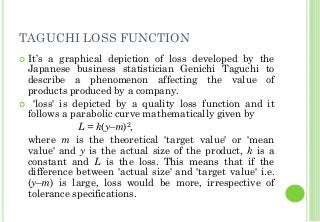
It’s a graphical depiction of loss developed by the
Japanese business statistician Genichi Taguchi to
describe a phenomenon affecting the value of
products produced by a company.
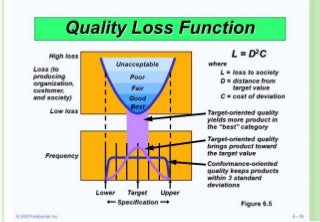
'loss' is depicted by a quality loss function and it
follows a parabolic curve mathematically given by
L = k(y–m)2,
where m is the theoretical 'target value' or 'mean
value' and y is the actual size of the product, k is a
constant and L is the loss. This means that if the
difference between 'actual size' and 'target value' i.e.
(y–m) is large, loss would be more, irrespective of
tolerance specifications.
In Taguchi's view tolerance specifications are given by
engineers and not by customers; what the customer
experiences is 'loss'. This equation is true for a single
product; if 'loss' is to be calculated for multiple
products the loss function is given by
L = k[S2 + y – m)2],
where S2 is the 'variance of product size' and y is the
average product size.
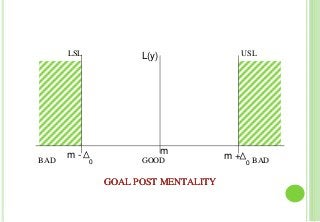
LSL USL
BAD BADGOOD
GOAL POST MENTALITYGOAL POST MENTALITY
0
m -
0
m +
m
L(y)
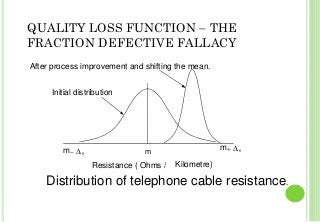
QUALITY LOSS FUNCTION − THE
FRACTION DEFECTIVE FALLACY
m− Δ 0 m
Distribution of telephone cable resistance.
Initial distribution
After process improvement and shifting the mean.
Resistance ( Ohms / Kilometre)
m+ Δ0
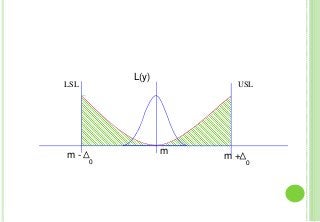
LSL USL
0
m -
0
m +
m
L(y)
Average quality loss
Q = k [( m - μ )2 + σ 2 ]
It consists of two components:
Shift of process average (μ) from the target
value (m)
Spread of the process (σ2)
S/N ratios are a log-modified form of Average
quality loss function
TAGUCHI PHILOSOPHY
1. Quality should be designed into the product and not
inspected into it.
2. Quality is best achieved by minimizing the deviation
from a target. The product should be so designed
that it is immune to uncontrollable environmental
factors.
3. The cost of quality should be measured as a function
of deviation from the standard and the losses should
be measured system-wide.
Maximizing S/N ratio is equivalent to reducing variance
due to various noise factors and hence improves quality
during manufacturing, customer usage and aging and
simultaneously reducing cost substantially.
S/N ratio
Taguchi specified three situations:
Larger the better (for example, agricultural yield);
Smaller the better (for example, carbon dioxide emissions);
On-target, minimum-variation (for example, a mating part in
an assembly).
The first two cases are represented by simple monotonic loss
functions. In the third case, Taguchi adopted a squared-error loss
function for several reasons:
Taguchi’s Specification
USUAL APPROACH TO IMPROVE THE QUALITY OF
A PRODUCT OR PROCESS
Identify various causes, known as noise factors, that
degrade the product (process) performance
variations in raw materials and components, machinery,
workmanship, temperature, humidity, loading, etc.
Eliminate the noise factors one by one
RESULT OF USUAL APPROACH TO IMPROVE THE
QUALITY OF A PRODUCT OR PROCESS
Eliminating noise factors always leads to
increased costs
Reduction in profitability or loss of market
share in the face of global competition
TAGUCHI/ ROBUST DESIGN METHOD
New method of design optimization for
performance, quality, & cost
For existing processes, emphasis is on
parameter design
Smallest, affordable development cost
TAGUCHI/ ROBUST DESIGN METHOD
All engineering designs involve setting values
of a large number of decision variables.
Common approach is to study one variable at
a time or by trial and error
Either long and expensive time span for completing
the design / premature termination of the design
process
TAGUCHI/ ROBUST DESIGN METHOD
MATHEMATICAL TOOL
Orthogonal arrays to study large number of
decision variables with a small number of
experiments
NEW MEASURE OF QUALITY
Signal to noise (s/n) ratio to predict the quality from the
customer perspective
ANALYSIS OF RESULTS
1. To establish the best or the optimum condition for a
product or a process.
2. To estimate the contribution of individual factors.
3. To estimate the response under the optimum
conditions.
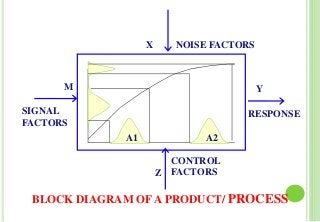
RESPONSE
NOISE FACTORS
CONTROL
FACTORS
SIGNAL
FACTORS
M
X
Y
BLOCK DIAGRAM OF A PRODUCT/ PROCESS
Z
A1 A2
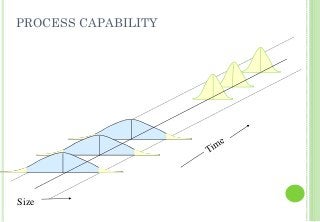
PROCESS CAPABILITY
Size
TAGUCHI/ ROBUST DESIGN METHOD
Many cos. Big or small, high-tech and low-
tech have found the method valuable
High quality at a low competitive price while
maintaining profit margin
THE NEW APPROACH –ITS APPEAL AND
LIMITATIONS
Upfront improvement of quality by design
and process development.
Measurement of quality in terms of
deviation from the target (loss function).
Problem solution by team approach and
brainstorming.
THE NEW APPROACH –ITS APPEAL AND
LIMITATIONS (CONT.)
Consistency in experimental design and analysis.
Reduction of time and cost of experiments.
Design of robustness into product/process.
Reduction of variation without removing its
causes.
Reduction of product warranty and service costs
by addressing them with the loss function.
Overview of ISO 9001
and ISO 14001
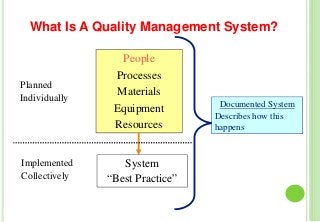
What Is A Quality Management System?
People
Processes
Materials
Equipment
Resources
Planned
Individually
System
“Best Practice”
Implemented
Collectively
Documented System
Describes how this
happens
Why Document?
• Communication Tool
• Manage Change
• Aids consistency
• Record of Best Practice
• Enables Effective Audit
• ISO 9001 Pre-requisite
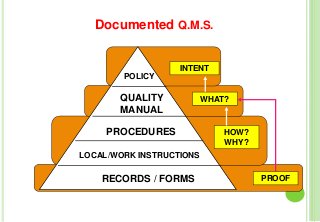
Documented Q.M.S.
POLICY
QUALITY
MANUAL
PROCEDURES
LOCAL/WORK INSTRUCTIONS
RECORDS / FORMS
INTENT
WHAT?
PROOF
HOW?
WHY?
ISO 9001 AND ISO 14001 IN BRIEF
ISO 9001 and ISO 14001 are among ISO's most well
known standards ever.
They are implemented by more than a million
organizations in some 175 countries.
ISO 9001 helps organizations to implement quality
management.
ISO 14001 helps organizations to implement
environmental management.
QUALITY MANAGEMENT
ISO 9001 is for quality management.
Quality refers to all those features of a product (or
service) which are required by the customer.
Quality management means what the organization
does to
ensure that its products or services satisfy the
customer's quality requirements and
comply with any regulations applicable to those
products or services.
QUALITY MANAGEMENT (CONT.)
Quality management also means what the
organization does to
enhance customer satisfaction, and
achieve continual improvement of its performance.
ENVIRONMENTAL MANAGEMENT
ISO 14001 is for environmental management. This
means what the organization does to:
minimize harmful effects on the environment
caused by its activities,
to conform to applicable regulatory requirements,
and to
achieve continual improvement of its environmental
performance.
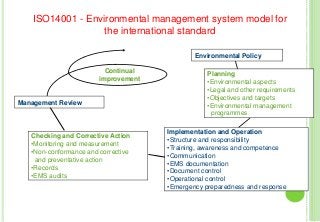
ISO14001 - Environmental management system model for
the international standard
Environmental Policy
Planning
•Environmental aspects
•Legal and other requirements
•Objectives and targets
•Environmental management
programmes
Implementation and Operation
•Structure and responsibility
•Training, awareness and competence
•Communication
•EMS documentation
•Document control
•Operational control
•Emergency preparedness and response
Checking and Corrective Action
•Monitoring and measurement
•Non-conformance and corrective
and preventative action
•Records
•EMS audits
Continual
improvement
Management Review
GENERIC STANDARDS
ISO 9001 and ISO 14001 are generic standards.
Generic means that the same standards can be
applied:
to any organization, large or small, whatever its
product or service,
in any sector of activity, and
whether it is a business enterprise, a public
administration, or a government department.
GENERIC STANDARDS (CONT.)
Generic also signifies that
no matter what the organization's scope of activity
if it wants to establish a quality management
system, ISO 9001 gives the essential features
or if it wants to establish an environmental
management system, ISO 14001 gives the essential
features.
MANAGEMENT SYSTEMS
Management system means what the organization
does to manage its processes, or activities in order
that
its products or services meet the organization’s
objectives, such as
satisfying the customer's quality requirements,
complying to regulations, or
meeting environmental objectives
MANAGEMENT SYSTEMS
To be really efficient and effective, the organization
can manage its way of doing things by systemizing
it.
Nothing important is left out.
Everyone is clear about who is responsible for
doing what, when, how, why and where.
Management system standards provide the
organization with an international, state-of-the-art
model to follow.
MANAGEMENT SYSTEMS (CONT.)
Large organizations, or ones with complicated
processes, could not function well without
management systems.
Companies in such fields as aerospace, automobiles,
defence, or health care devices have been operating
management systems for years.
The ISO 9001 and ISO 14001 management system
standards now make these successful practices
available for all organizations.
PROCESSES, NOT PRODUCTS
Both ISO 9001 and ISO 14001 concern the way an
organization goes about its work.
They are not product standards.
They are not service standards.
They are process standards.
They can be used by product manufacturers and
service providers.
PROCESSES, NOT PRODUCTS (CONT.)
Processes affect final products or services.
ISO 9001 gives the requirements for what the
organization must do to manage processes
affecting quality of its products and services.
ISO 14001 gives the requirements for what the
organization must do to manage processes
affecting the impact of its activities on the
environment.
BENEFITS OF ISO 9001 AND ISO 14001
International, expert consensus on state-of-the-art
practices for quality and environmental management.
Common language for dealing with customers and
suppliers worldwide .
Increase efficiency and effectiveness.
Model for continual improvement.
BENEFITS OF ISO 9001 AND ISO 14001
(CONT.)
Model for satisfying customers and other
stakeholders.
Build quality into products and services from design
onwards.
Address environmental concerns of customers and
public, and comply with government regulations.
Integrate with global economy.
BENEFITS OF ISO 9001 AND
ISO 14001 (CONT.)
Sustainable business
Unifying base for industry sectors
Qualify suppliers for global supply chains
Technical support for regulations
BENEFITS OF ISO 9001 AND ISO 14001
(CONT.)
Transfer of good practice to developing countries
Tools for new economic players
Regional integration
Facilitate rise of services
MORE INFORMATION
ISO 9000/ISO 14000 section on ISO Web site:
www.iso.org
ISO Management Systems magazine
www.iso.org/ims
IMS Alerts free electronic newsletter
www.iso.org/imsalerts

Unit 3

  • 1.
    FAILURE MODES EFFECTANALYSIS (FMEA)
  • 2.
    WHAT IS FMEA? Asystemized group of activities designed to: ▪ recognize and evaluate the potential failure of a product/process and its effects ▪ identify actions which could eliminate or reduce the chance of potential failure ▪ document the process Failure Mode and Effect Analysis
  • 3.
    FAILURE MODE ANDEFFECT ANALYSIS Simply put FMEA is: a process that identifies all the possible types of failures that could happen to a product and potential consequences of those failures.
  • 4.
    FMEA TERMS Failure mode- the way in which something might fail Effects analysis – studying the consequences of the various failure modes to determine their severity to the customer.
  • 5.
    5 WHAT IS FMEA? FMEA--atool to identify risks in your process Can be used in multiple places in process improvement Determine where problems are Help identify cause/effect relationships Highlight risks in solutions and actions to take Starts with input from processes Identifies three risk categories Severity of impact Probability of occurrence Ability to detect the occurrence
  • 6.
    6 WHEN TO USE Earlystages (Define) to understand process and identify problem areas Analyze data (Analyze) to help identify root causes Determine best solutions (Improve) with lowest risk Close out stage (Control) to document improvement and identify actions needed to continue to reduce risk
  • 7.
    THE REASONS FORFMEA Get it right the first time Identifies any inadequacies in the development of the product Tests and trials may be limited to a few products Regulatory reasons Continuous improvement Preventive approach Team building Required procedures
  • 8.
    FMEA PROVIDES THEPOTENTIAL TO: Reduce the likelihood of customer complaints Reduce the likelihood of campaign changes Reduce maintenance and warranty costs Reduce the possibility of safety failures Reduce the possibility of extended life or reliability failures Reduce the likelihood of product liability claims
  • 9.
    BENEFITS Identify potential andknown failures Reduce the number of engineering changes Reduce product development time Lower start-up costs Greater customer satisfaction Increased cooperation and teamwork between various functions Continuous improvement
  • 10.
    TYPES OF FMEA System- focuses on global system functions Design - focuses on components and subsystems Process - focuses on manufacturing and assembly processes Service - focuses on service functions Software - focuses on software functions
  • 11.
  • 12.
    CONCEPT FMEA Used toanalyze concepts in the early stages before hardware is defined (most often at system and subsystem) Focuses on potential failure modes associated with the proposed functions of a concept proposal Includes the interaction of multiple systems and interaction between the elements of a system at the concept stages.
  • 13.
    DESIGN FMEA Aid inthe objective evaluation of design requirements and design alternatives Aid in the initial design for manufacturing and assembly Increase the probability that potential failure modes have been considered Provide additional information to aid in the planning of efficient design testing
  • 14.
    PROCESS FMEA Indentify potentialproduct related process failure modes Assess the potential customer effects of the failures Indentify the potential manufacturing causes on which to focus on Develop a ranked list of potential failure modes Document the results of the manufacturing
  • 15.
    APPLICATION EXAMPLES Manufacturing: Amanager is responsible for moving a manufacturing operation to a new facility. He/she wants to be sure the move goes as smoothly as possible and that there are no surprises. Design: A design engineer wants to think of all the possible ways a product being designed could fail so that robustness can be built into the product. Software: A software engineer wants to think of possible problems a software product could fail when scaled up to large databases. This is a core issue for the Internet.
  • 16.
  • 17.
    FMEA WORKSHEET Process or ProductName Prepared by: Page _____ of ______ Person Responsible Date (Orig) ___________ Revised __________ Process Step Key Process Input Potential Failure Mode Potential Failure Effect S e v Potential Causes O c c Current Controls D e t R P N Actions Recommended S e v O c c D e t R P N Sev - Severity of the failure (what impact will it have on our process?) Occ – How likely is the event to occur (probability of occurrence) Det – How likely can the event be detected in time to do something about it RPN – Risk Priority Number (multiply Sev, Occ, and Det)
  • 18.
    18 HOW TO COMPLETETHE FMEA General Suggestions Use large white board or flip chart with a FMEA form drawn on it during the generation phase Focus the team on the specific area of study (product or process). Have process map available Have all subassemblies and component part of a product.
  • 19.
    FMEA PROCEDURE 1. Foreach process input (start with high value inputs), determine the ways in which the input can go wrong (failure mode) 2. For each failure mode, determine effects Select a severity level for each effect 3. Identify potential causes of each failure mode Select an occurrence level for each cause 4. List current controls for each cause Select a detection level for each cause Process Steps
  • 20.
    FMEA PROCEDURE (CONT.) 5.Calculate the Risk Priority Number (RPN) 6. Develop recommended actions, assign responsible persons, and take actions Give priority to high RPNs MUST look at severities rated a 10 7. Assign the predicted severity, occurrence, and detection levels and compare RPNs Process Steps
  • 21.
    SEVERITY, OCCURRENCE, AND DETECTION Severity Importanceof the effect on customer requirements Occurrence Frequency with which a given cause occurs and creates failure modes (obtain from past data if possible) Detection The ability of the current control scheme to detect (then prevent) a given cause (may be difficult to estimate early in process operations). Analyzing Failure & Effects
  • 22.
    RATING SCALES 2 2 There area wide variety of scoring “anchors”, both quantitative or qualitative Two types of scales are 1-5 or 1-10 The 1-5 scale makes it easier for the teams to decide on scores The 1-10 scale may allow for better precision in estimates and a wide variation in scores (most common) Assigning Rating Weights
  • 23.
    RATING SCALES 2 3 Severity 1 =Not Severe, 10 = Very Severe Occurrence 1 = Not Likely, 10 = Very Likely Detection 1 = Easy to Detect, 10 = Not easy to Detect Assigning Rating Weights
  • 24.
    RISK PRIORITY NUMBER(RPN) RPN is the product of the severity, occurrence, and detection scores. Severity Occurrence Detection RPNX X = Calculating a Composite Score
  • 25.
    PROCESS FOR FMEA Processto Change Oil in a Car 3000 miles driven Drive car on lift Fill with new oil Drain Oil Replace Filter Take Car off lift Process Complete
  • 26.
    HOW TO COMPLETETHE FMEA Step 1. Complete header information Step 2. Identify steps in the process Step 3. Brainstorm potential ways the area of study could theoretically fail (failure modes) Suggestion: Use Affinity Diagram as a brainstorming tool
  • 27.
    FMEA WORKSHEET Process or ProductName Change Oil in Car Prepared by: Leon Page _1____ of __1____ Person Responsible Leon Mechanic Date (Orig) __27 Sep 2007___ Revised __________ Process Step Key Process Input Potential Failure Mode Potential Failure Effect S e v Potential Causes O c c Current Controls D e t R P N Actions Recommended S e v O c c D e t R P N Fill with new oil New Oil— Mech anic Wrong type of oil Engine wear No oil added Engine Failure Sev - Severity of the failure (what impact will it have on our process?) Occ – How likely is the event to occur (probability of occurrence) Det – How likely can the event be detected in time to do something about it RPN – Risk Priority Number (multiply Sev, Occ, and Det)
  • 28.
    28 HOW TO COMPLETEA FMEA Step 4 For each failure mode, determine impact or effect on the product or operation using criteria table (next slide) Rate this impact in the column labeled SEV (severity)
  • 29.
    29 SEVERITY (SEV) RATING SEVSeverity Product/Process Criteria 1 None No effect 2 Very Minor Defect would be noticed by most discriminating customers. A portion of the product may have to be reworked on line but out of station 3 Minor Defect would be noticed by average customers. A portion of the product (<100%) may have to be reworked on line but out of station 4 Very Low Defect would be noticed by most customers. 100% of the product may have to be sorted and a portion (<100%) reworked 5 Low Comfort/convenience item(s) would be operable at a reduced level of performance. 100% of the product may have to be reworked 6 Moderate Comfort/convenience item(s) would be inoperable. A portion (<100%) of the product may have to be scrapped 7 High Product would be operable with reduced primary function. Product may have to be sorted and a portion (<100%) scrapped. 8 Very High Product would experience complete loss of primary function. 100% of the product may have to be scrapped 9 Hazardous Warning Failure would endanger machine or operator with a warning 10 Hazardous w/out Warning Failure would endanger machine or operator without a warning
  • 30.
    30 FMEA WORKSHEET Process or ProductName Change Oil in Car Prepared by: Leon Page _____ of ______ Person Responsible Leon Mechanic Date (Orig) __27 Sep 2007___ Revised __________ Process Step Key Process Input Potential Failure Mode Potential Failure Effect S e v Potential Causes O c c Current Controls D e t R P N Actions Recommended S e v O c c D e t R P N Fill with new oil New Oil— Mech anic Wrong type of oil Engine wear 2 No oil added Engine Failure 1 0 Sev - Severity of the failure (what impact will it have on our process?) Occ – How likely is the event to occur (probability of occurrence) Det – How likely can the event be detected in time to do something about it RPN – Risk Priority Number (multiply Sev, Occ, and Det)
  • 31.
    31 HOW TO COMPLETEA FMEA Step 5 For each potential failure mode identify one or more potential causes (Could use Affinity Diagram again to brainstorm ideas) Rate the probability of each potential cause occurring based on criteria table (next slide) Place the rating in the column labeled OCC (occurrence).
  • 32.
    32 FMEA OCCURRENCE (OCCRATING) OCC Occurrence Criteria 1 Remote 1 in 1,500,000 Very unlikely to occur 2 Low 1 in 150,000 3 Low 1 in 15,000 Unlikely to occur 4 Moderate 1 in 2,000 5 Moderate 1 in 400 Moderate chance to occur 6 Moderate 1 in 80 7 High 1 in 20 High probability that the event will occur 8 High 1 in 8 9 Very High 1 in 3 Almost certain to occur 10 Very High > 1 in 2
  • 33.
    FMEA WORKSHEET Process or ProductName Change Oil in Car Prepared by: Leon Page _____ of ______ Person Responsible Leon Mechanic Date (Orig) __27 Sep 2007___ Revised __________ Process Step Key Process Input Potential Failure Mode Potential Failure Effect S e v Potential Causes O c c Current Controls D e t R P N Actions Recommended S e v O c c D e t R P N Fill with new oil New Oil— Mech anic Wrong type of oil Engine wear 2 Mis- labeled 3 No oil added Engine Failure 1 0 Hurrying 3 Sev - Severity of the failure (what impact will it have on our process?) Occ – How likely is the event to occur (probability of occurrence) Det – How likely can the event be detected in time to do something about it RPN – Risk Priority Number (multiply Sev, Occ, and Det)
  • 34.
    34 HOW TO COMPLETETHE FMEA Step 6 Identify current controls or detection Rate ability of each current control to prevent or detect the failure mode once it occurs using criteria table (next slide) Place rating in Det column
  • 35.
    35 FMEA DETECTION (DET)RATING DET Detection Criteria 1 Almost Certain Current Controls are almost certain to detect/prevent the failure mode 2 Very High Very high likelihood that current controls will detect/prevent the failure mode 3 High High Likelihood that current controls will detect/prevent the failure mode 4 Mod. High Moderately High likelihood that current controls will detect/prevent the failure mode 5 Moderate High Likelihood that current controls will detect/prevent the failure mode 6 Low Low likelihood that current controls will detect/prevent failure mode 7 Very Low Very Low likelihood that current controls will detect /prevent the failure mode 8 Remote Remote likelihood that current controls will detect/prevent the failure mode 9 Very Remote Very remote likelihood that current controls will detect/prevent the failure mode
  • 36.
    FMEA WORKSHEET Process or ProductName Change Oil in Car Prepared by: Leon Page _____ of ______ Person Responsible Leon Mechanic Date (Orig) __27 Sep 2007___ Revised __________ Process Step Key Process Input Potential Failure Mode Potential Failure Effect S e v Potential Causes O c c Current Controls D e t RPN Actions Recommended S e v O c c D e t R P N Fill with new oil New Oil from supplier Wrong type of oil Engine wear 2 Misread oil chart for vehicle 3 None 9 No oil added Engine Failure 1 0 Hurrying 3 Engine light 3 Sev - Severity of the failure (what impact will it have on our process?) Occ – How likely is the event to occur (probability of occurrence) Det – How likely can the event be detected in time to do something about it RPN – Risk Priority Number (multiply Sev, Occ, and Det)
  • 37.
    37 HOW TO COMPLETETHE FMEA Step 7 Multiply SEV, OCC and DET ratings and place the value in the RPN (risk priority number) column. The largest RPN numbers should get the greatest focus. For those RPN numbers which warrant corrective action, recommended actions and the person responsible for implementation should be listed. SEV * OCC * DET = RPN ( 2 * 3 * 9 = 54 ) Process Step Key Process Input Potential Failure Mode Potential Failure Effect S e v Potential Causes O c c Current Controls D e t RPN Actions Recommended S e v O c c D e t R P N Fill with new oil New Oil from supplier Wrong type of oil Engine wear 2 Misread oil chart for vehicle 3 None 9 54 No oil added Engine Failure 1 0 Hurrying 3 Engine light 3 90
  • 38.
    38 FMEA RANKINGS Severity OccurrenceDetection Hazardous without warning Very high and almost inevitable Cannot detect or detection with very low probability Loss of primary function High repeated failures Remote or low chance of detection Loss of secondary function Moderate failures Low detection probability Minor defect Occasional failures Moderate detection probability No effect Failure Unlikely Almost certain detection Rating 10 1 High Low Source: The Black Belt Memory Jogger, Six Sigma Academy
  • 39.
    ACTION RESULTS Step 8 Aftercorrective action has been taken, place summary of the results in the ‘Actions Recommended’ block Assign new value for: Severity Occurrence Detection Calculate new RPN number
  • 40.
    FMEA WORKSHEET Process or ProductName Change Oil in Car Prepared by: Leon Page _____ of ______ Person Responsible Leon Mechanic Date (Orig) __27 Sep 2007___ Revised __________ Process Step Key Process Input Potential Failure Mode Potential Failure Effect S e v Potential Causes O c c Current Controls D e t RPN Actions Recommended S e v O c c D e t R P N Fill with new oil New Oil from supplier Wrong type of oil Engine wear 2 Misread oil chart for vehicle 3 None 9 54 No oil added Engine Failure 1 0 Hurrying 3 Engine light 3 90 Oil level checked by partner 1 0 3 1 3 0 Sev - Severity of the failure (what impact will it have on our process?) Occ – How likely is the event to occur (probability of occurrence) Det – How likely can the event be detected in time to do something about it RPN – Risk Priority Number (multiply Sev, Occ, and Det)
  • 41.
    FMEA EXAMPLE Source: QualityDigest/ August 2006 Quality Service at the Special Olympics World Games, Tang Xiaofen Process or Product Name: Hotel Service at Special Olympics Prepared by: Page _____ of ______ Person Responsible: Joe Quality Date (Orig) ___________ Revised __________ Process Step Key Process Input Potential Failure Mode Potential Failure Effect S e v Potential Causes O c c Current Controls D e t R P N Actions Recommended S e v O c c D e t R P N Register guest Service Desk Cannot Register in time Complaints 5 Lack of language and communicat ion skills, support of volunteers not sufficient 4 No plan on training content; training and volunteer support sufficient 3 72 Provide Guest Services Guest Support Lack of barrier- free facility Inconvenien ce and injury 10 Cannot provide barrier-free facility 3 Providing barrier-free facility 7 210 Provide Meals Food Service Food goes bad Disease or injury 10 Past shelf life 6 No control of raw material 8 240 Provide Medical Service Medical Service Service not in time Illness changes for worse 10 No 24 Hour service 6 12 hour service 3 180
  • 42.
  • 43.
    INTRODUCTION Fault Tree Analysiswas originally developed in 1962 at Bell Laboratories by H.A. Watson. FTA is a deductive analysis approach for resolving an undesired event into its causes. Logic diagrams and Boolean Algebra are used to identify the cause of the top event. 2
  • 44.
    CONTD… A logic diagramcalled Fault tree is constructed to show the event relationship. Probability of occurrence values are assigned to the lowest events in the tree in order to obtain the probability of occurrence of the top event. 3
  • 45.
    WHY FTA ISCARRIED OUT? Identify the cause of a failure. Monitor and control safety performance of a complex system. To identify the effects of human errors . Minimize and optimize resources. 4
  • 46.
    THE FAULT TREE Faulttree is the logical model of the relationship of the undesired event to more basic events. The top event of the Fault tree is the undesired event. The middle events are intermediate events and the basic events are at the bottom. The logic relationship of events are shown by logic symbols or gates. 5
  • 47.
    BASIC FAULT TREESTRUCTURE 6
  • 48.
    EVENTS OF AFAULT TREE 7 Basic Event: A lower most event that can not be further developed. Intermediate Event: This can be a intermediate event (or) a top event. They are a result logical combination of lower level events. Undeveloped Event:An event which has scope for further development but not done usually because of insufficient data. External Event:An event external to the system which can cause failure.
  • 49.
    BASIC GATES OFA FAULT TREE 8 OR Gate: Either one of the bottom event results in the occurrence of the top event. AND Gate: For the top event to occur all the bottom events should occur. Inhibit Gate: The top event occurs only if the bottom event occurs and the inhibit condition is true.
  • 50.
    PROCEDURE 9 Procedure for FaultTree Analysis Define TOP event Define overall structure. Explore each branch in successive level of detail. Solve the fault tree Perform corrections if required and make decisions
  • 51.
    PROCEDURE Define Top Event: UseProcess hazard assessment (PHA), Piping & Instrumentation Diagram (P&ID), Process description etc., to define the top event. If its too broad, overly large FTA will result. E.g. Fire in process. If its too narrow, the exercise will be costly. E.g. Leak in the valve. The boundaries for top event definition can be a System, Sub-system, Unit, Equipment (or) a Function. Some good examples are: Overpressure in vessel V1, Motor fails to start, Reactor high temperature safety function fails etc., 10
  • 52.
    PROCEDURE Define overall structure: Determinethe intermediate events & combination of failure that will lead to the top event. Arrange them accordingly using logical relationship 11
  • 53.
    PROCEDURE Explore each branchin successive level of detail: Continue the top down process until the root cause for each branch is identified and/or until further decomposition is considered unnecessary. So each branch will end with a basic event or an undeveloped event. Consider Common cause failure & Systematic failures in the process of decomposition. A good guide to stop decomposing is to go no further than physical (or) functional bounds set by the top event. 12
  • 54.
    PROCEDURE 13 Solve the FaultTree: Assign probabilities of failure to the lowest level event in each branch of the tree. From this data the intermediate event frequency and the top level event frequency can be determined using Boolean Algebra and Minimal Cut Set methods.
  • 55.
    PROCEDURE 14 Minimal Cut Settheory: The fault tree consists of many levels of basic and intermediate events linked together by AND and OR gates. Some basic events may appear in different places of the fault tree. The minimal cut set analysis provides a new fault tree, logically equivalent to the original, with an OR gate beneath the top event, whose inputs (bottom)are minimal cut sets. Each minimal cut set is an AND gate with a set of basic event inputs necessary and sufficient to cause the top event.
  • 56.
    PROCEDURE 15 Perform corrections andmake decisions: Application of Boolean Algebra and Minimal Cut Set theory will result in identifying the basic events(A) and combination of basic events(B.C.D) that have major influence on the TOP event. • This will give clear insight on what needs to be attended and where resources has to be put for problem solving.
  • 57.
  • 58.
    SPECIFICATIONS FOR THEBPC FT Undesired top event : Motor does not start when switch is closed. Boundary of the FT : The circuit containing the motor, battery, and switch. Resolution of the FT: The basic components in the circuit excluding the wiring. Initial State of System: Switch open, normal operating conditions. 17
  • 59.
    START OF BPCFT (1) 18
  • 60.
    START OF BPCFT (2) 19
  • 61.
    START OF BPCFT (3) 20
  • 62.
    ADVANTAGES OF FTA 21 •Dealswell with parallel, redundant or alternative fault paths. •Searches for possible causes of an end effect which may not have been foreseen. •The cut sets derived in FTA can give enormous insight into various ways top event occurs. •Very useful tool for focused analysis where analysis is required for one or two major outcomes.
  • 63.
    DISADVANTAGES OF FTA Requiresa separate fault tree for each top event and makes it difficult to analyze complex systems. Fault trees developed by different individuals are usually different in structure, producing different cut set elements and results. The same event may appear in different parts of the tree, leading to some initial confusion. 22
  • 64.
    APPLICATIONS Used in thefield of safety engineering and Reliability engineering to determine the probability of a safety accident or a particular system level failure. Aerospace Engineering. 23
  • 65.
  • 66.
    INTRODUCTION What is aPoka- yoke? Shigeo shingo defined poka-yoke as POKA- ‘Inadvertent mistake that anyone can make’ and YOKE- ‘To prevent or proof’ Poka-yoke is a tool to have “zero defects” and even reduce or eliminate quality control. Poka-yoke is a Japanese name for “fool-proofing”. Poke-yoke represents the intelligence of the operator by excluding repetitive actions that require a thinking process. 25
  • 67.
    MISTAKE PROOFING Mistake-Proofing aproduct's design and its manufacturing process is a key element of design for manufacturability / assembly (DFM/A) Mistake proofing is also a key element of improving product quality and reliability FACTORS CONTRIBUTING TO MISTAKE PROOFING: Attention Perception Memory Logical reasoning 26
  • 68.
    PRINCIPLES OF MISTAKE-PROOFING Thereare six mistake-proofing principles or methods. Elimination seeks to eliminate the possibility of error by redesigning the product or process so that the task or part is no longer necessary. Replacement substitutes a more reliable process to improve consistency. Prevention engineers the product or process so that it is impossible to make a mistake at all. Facilitation employs techniques and combining steps to make work easier to perform. Detection involves identifying an error before further processing occurs so that the user can quickly correct the problem. Mitigation seeks to minimize the effects of errors. 27
  • 69.
    2-STATUS & 3-FUNCTIONSOF POKA-YOKE POKA-YOKE HAS 2 STATUS AND 3 FUNCTIONS: Status: 1.The fault will happen or 2.The fault has happened Functions: 1.Stop 2.Check or 3.Alarm 28
  • 70.
    THREE STRATEGIES FORZERO DEFECT Only make the product when required! Make the product so it can not be used for anything else. If the product is ready use it immediately. 29
  • 71.
    POKA-YOKE CLASSIFICATION Poka-yoke isclassified into the following types: Server Poka-Yokes Task Treatment Tangibles Customer Poka-Yokes Preparation Encounter Resolution 30
  • 72.
    PROVIDER(SERVER) ERRORS Task Errors •Doing the work incorrectly • Doing work not requested • Doing work in the wrong order • Doing work too slowly Treatment Errors • Not acknowledging the customer • Not listening to the customer • Not reacting appropriately to the customer Tangible Errors • Failure to clean facilities • Failure to control noise 31
  • 73.
    CUSTOMER ERRORS Preparation Errors •Failure to bring necessary materials to the encounter • Failure to engage the correct service Encounter Errors • Failure to remember steps in the service process • Failure to follow system flow • Failure to follow instructions Resolution Errors • Failure to learn from experience • Failure to adjust expectations appropriately 32
  • 74.
    SEVEN STEPS TOPOKA-YOKE ATTAINMENT Quality Processes Utilize a team environment Elimination of Errors Eliminate the “Root Cause” of The Errors Do It Right The First Time Eliminate Non-Value Added Decisions Implement a Continual Improvement Approach 33
  • 75.
    POKA-YOKE APPROACH Proactive Approach: A fully implemented ZERO DEFECT QUALITY system requires Poka-Yoke usage at or before the inspection points during the process. Poka-yoke will catch the errors before a defective part is manufactured 100% of the time. Reactive Approach : Check occurs immediately after the process. Can be an operator check at the process or successive check at the next process. Not 100% effective, will not eliminate all defects. Effective in preventing defects from being passed to next process. 34
  • 76.
    Two Poka-Yoke Systemapproaches are utilized in manufacturing which lead to successful ZERO DEFECT QUALITY: 1.Control Approach: Shuts down the process when an error occurs. Keeps the “suspect” part in place when an operation is incomplete. 2.Warning Approach Signals the operator to stop the process and correct the problem. 35
  • 77.
    CONTROL SYSTEM Takes humanelement out of the equation ; does not depend on an operator or assembler. Has a high capability of achieving zero defects. Machine stops when an irregularity is detected. 36
  • 78.
    WARNING SYSTEMS Sometimes anautomatic shut off system is not an option. A warning or alarm system can be used to get an operators attention. Color coding is also an effective non-automatic option 37
  • 79.
    TEN TYPES OFHUMAN MISTAKES Forgetfulness Mis-understanding Wrong identification Lack of experience Willful (ignoring rules or procedure) Inadvertent or sloppiness Slowliness Lack of standardization Surprise (unexpected machine operation, etc.) Intentional (sabotage) 38
  • 80.
    POKA-YOKE DEVICES Poka yokeis implemented by using simple objects like fixtures, jigs, warning devices and the like to prevent people from committing mistakes, even if they try to!. The main feature of poka-yoke devices is their exceptional suitability for reducing or eliminating defects through effective feedback and instantaneous corrective action. These devices are capable of being used all the time by all workers; simple and usually installed with low implementation cost. Poka-yoke devices help eliminate errors and defects by giving machines the “intelligence” to stop and signal when a error occurs. Poka-yoke devices stop machines and alert workers when a problem exists. 39
  • 81.
    THE THREE LEVELSOF POKA-YOKE: There are three levels at which your company can effect poka- yoke: Eliminating errors defects and losses at the source or prevention of a mistake from being committed.. Detection of a loss or mistakes it occurs,allowing correction before it becomes a problem. Detection of a loss or mistakes after it has occurred,just in time before it blows up into a major issue(least effective). 40
  • 82.
  • 83.
  • 84.
    IMPLEMENTATION IN MANUFACTURING Poka-yokecan be implemented at any step of a manufacturing process where something can go wrong or an error can be made. Shigeo Shingo recognized three types of poka-yoke for detecting and preventing errors in a mass production system: The contact method identifies product defects by testing the product's shape, size, color, or other physical attributes. The fixed-value (or constant number) method alerts the operator if a certain number of movements are not made. The motion-step (or sequence) method determines whether the prescribed steps of the process have been followed. 43
  • 85.
    ADVANTAGES They are simpleand cheap. They are part of the process, implementing what Shingo calls "100%" inspection. They are placed close to where the mistakes occur, providing quick feedback to the workers so that the mistakes can be corrected. Once put in place, they require minimal supervision. 44
  • 86.
    CONCLUSION Poka-yokes deals withunderstanding why people make errors and how to analyze the process to know where errors are likely to occur and what root causes contribute to them. Since the poka-yoke devices detect errors at their roots & prevent them from blowing up to become bigger problems, there is consistency in the quality of the products, saving the cost and time spent in subsequent quality inspection processes. 45
  • 87.
  • 90.
  • 94.
    Advantages of AffinityDiagram A team can generate a large number of ideas in a relatively short period of time. Encourages participation because every person’s ideas find their way into the process. Encourages ‘new’ thinking when only ‘old’ solutions are emerging from a group. Facilitates the exploration of new and logical thought patterns by encouraging people to react from a creative response level rather than the intellectual and logical levels. An effective way to deal with large and complex issues which may be ‘paralyzing’ the brainstorming of a team. Consensus and support are reached on a solution because all participants have ‘ownership’ in the process.
  • 95.
    Limitations of AffinityDiagram The use of technical language skills may require detailed clarification of ideas which is not allowed because ideas are generated in silence and without discussion. Group members must have the necessary expertise on the issue. Getting a non-traditional group together that is willing to engage in ‘new thinking’ may be hard to do.
  • 115.
  • 116.
    Brief History ofQFD Origin - Mitsubishi Kobe Shipyard 1972 Foundation - Belief That Products Should Be Designed To Reflect Customer Desires and Tastes Developed By Toyota and Its Suppliers Expanded To Other Japanese Manufacturers Consumer Electronics, Home Appliances, Clothing, Integrated Circuits, Apartment Layout Planning Adopted By Ford and GM in 1980s
  • 117.
    = QFD HIN SHITSU Quality Features Attributes Qualities KINO TEN KAI Deployment Diffusion Development Evolution Function Mechanization Quality Function Deployment - “Customer Driven Product / Process Development” QFD FROM THE JAPANESE -
  • 118.
    There is nosingle, right definition for QFD; this one captures its essential meaning: A system for translating customer requirements into appropriate company requirements at each stage from research and product development to engineering and manufacturing to marketing/sales and distribution DEFINITION OF QUALITY FUNCTION DEPLOYMENT : Prerequisites to QFD are ‘Market Research’ and ‘VOC gathering’.
  • 119.
    Quality Function Deployment Isa structured method that is intended to transmit and translate customer requirements, that is, the Voice of the Customer through each stage of the product development and production process, that is, through the product realization cycle. These requirements are the collection of customer needs, including all satisfiers, exciters/delighters, and dissatisfiers.
  • 120.
    Return on Investmentfrom Using QFD Companies using QFD to reflect "The Voice of the Customer" in defining quality have a competitive advantage because there is/are: 1. Fewer and Earlier Design Changes 2. Fewer Start-up Problems 3. Shorter Development Time 4. Lower Start-up Costs 5. Warranty Cost Reductions 6. Knowledge Transfer to the Next Product 7. Customer Satisfaction
  • 121.
    QUALITY FUNCTION DEPLOYMENT Identifycustomer wants Identify how the good/service will satisfy customer wants Relate customer wants to product hows Identify relationships between the firm’s hows Develop importance ratings Evaluate competing products
  • 122.
    BUILDING A HOUSEOF QUALITY List Customer Requirements (What’s) List Technical Descriptors (How’s) Develop Relationship (What’s & How’s) Develop Interrelationship (How’s) Competitive Assessments Prioritize Customer Requirements Prioritize Technical Descriptors
  • 123.
    QFD HOUSE OFQUALITY
  • 124.
    Technical Descriptors (Voice ofthe organization) Prioritized Technical Descriptors Interrelationship between Technical Descriptors Customer Requirements (Voiceofthe Customer) Prioritized Customer Requirements Relationship between Requirements and Descriptors
  • 125.
    Absolute Weight andPercent Prioritized Technical Descriptors Degree of Technical Difficulty Relative Weight and Percent Target Value Customer Requirements Prioritized Customer Requirements Technical Descriptors Primary Primary Secondary Secondary Technical Competitive Assessment Customer Competitive Assessment Our A’s B’s CustomerImportance TargetValue Scale-upFactor SalesPoint AbsoluteWeight Our A’s B’s Relationship between Customer Requirements and Technical Descriptors WHATs vs. HOWs Strong Medium Weak +9 +3 +1 Strong Positive Positive Negative Strong Negative +9 +3 -3 -9 Interrelationship between Technical Descriptors (correlation matrix) HOWs vs. HOWs
  • 126.
  • 127.
  • 128.
  • 129.
  • 130.
    Customer Requirements Technical Descriptors Primary Primary Secondary Secondary Relationship between Customer Requirements and TechnicalDescriptors WHATs vs. HOWs Strong Positive Positive Negative Strong Negative +9 +3 -3 -9 Interrelationship between Technical Descriptors (correlation matrix) HOWs vs. HOWs Strong Medium Weak +9 +3 +1
  • 131.
  • 132.
    1 3 42 1 2 1 4 Customer Requirements Customer Competitive Assessment Our A’s B’s 5 3 1 2 5 1 4 4 Relationship between Customer Requirements and Technical Descriptors WHATs vs. HOWs Strong Medium Weak +9 +3 +1Technical Competitive Assessment Our A’s B’s
  • 133.
  • 134.
    7 3 9 10 2 4 8 1 Customer Requirements Prioritized Customer Requirements Technical Descriptors Primary Primary Secondary Secondary Technical Competitive Assessment Customer Competitive Assessment Our A’s B’s CustomerImportance TargetValue Scale-upFactor SalesPoint AbsoluteWeight 1 3 42 1 2 1 4 5 3 1 2 5 1 4 4 5 3 2 3 5 2 4 4 1.5 1 1.2 1.5 1 1 1.5 1 1.5 1 15 3 Our A’s B’s Relationship between Customer Requirements and Technical Descriptors WHATs vs. HOWs Strong Medium Weak +9 +3 +1
  • 135.
    Absolute Weight andPercent Prioritized Technical Descriptors Degree of Technical Difficulty Relative Weight and Percent Target Value 1 8 4 2 9 8 2 5 90 133 2 3 4 3 1 3 1 5 7 3 9 10 2 4 8 1 Customer Requirements Prioritized Customer Requirements Technical Descriptors Primary Primary Secondary Secondary Technical Competitive Assessment Customer Competitive Assessment Our A’s B’s CustomerImportance TargetValue Scale-upFactor SalesPoint AbsoluteWeight 1 3 4 2 1 2 1 4 5 3 1 2 5 1 4 4 5 3 2 3 5 2 4 4 1.5 1 1.2 1.5 1 1 1.5 1 1.5 1 15 3 Our A’s B’s Relationship between Customer Requirements and Technical Descriptors WHATs vs. HOWs Strong Medium Weak +9 +3 +1 Strong Positive Positive Negative Strong Negative +9 +3 -3 -9 Interrelationship between Technical Descriptors (correlation matrix) HOWs vs. HOWs
  • 137.
  • 138.
  • 139.
    Phase III Process Planning KeyProcess Operations PartQuality Characteristics
  • 140.
  • 141.
    HOUSE OF QUALITYEXAMPLE You’ve been assigned temporarily to a QFD team. The goal of the team is to develop a new camera design. Build a House of Quality.
  • 142.
    HOUSE OF QUALITYEXAMPLE ☺High relationship Medium relationship Low Relationship Customer Requirements Customer Importance Target Values
  • 143.
    HOUSE OF QUALITYEXAMPLE ☺High relationship Medium relationship Low Relationship Target Values Light weight Easy to use Reliable What the customer desires (‘wall’) Aluminum Parts Auto Focus Auto Exposure Customer Requirements Customer Importance
  • 144.
    HOUSE OF QUALITYEXAMPLE ☺High relationship Medium relationship Low Relationship Customer Requirements Customer Importance Target Values Light weight Easy to use Reliable Aluminum Parts Auto Focus Auto Exposure 3 1 2 Average customer importance rating
  • 145.
    HOUSE OF QUALITYEXAMPLE ☺High relationship Medium relationship Low Relationship Customer Requirements Customer Importance Light weight Easy to use Reliable Aluminum Parts Auto Focus Auto Exposure 3 2 1 Relationship between customer attributes & engineering characteristics (‘rooms’)
  • 146.
    HOUSE OF QUALITYEXAMPLE ☺High relationship Medium relationship Low Relationship Customer Requirements Customer Importance Target Values Light weight Easy to use Reliable Aluminum Parts Auto Focus Auto Exposure 3 2 1 5 1 1 Target values for engineering characteristics (‘basement’); key output ☺
  • 147.
    HOUSE OF QUALITYEXAMPLE ☺High relationship Medium relationship Low Relationship Customer Requirements Customer Importance Target Values Light weight Easy to use Reliable Aluminum Parts Auto Focus Auto Exposure 3 2 1 5 1 1 ☺
  • 148.
    SAME EXAMPLE –COMPLETE YOUR SELF WITH THE FOLLOWING “WHAT” Lightweight Easy to use Reliable Easy to hold steady Color correction
  • 149.
  • 150.
    HOUSE OF QUALITYEXAMPLE Customer importance rating (5 = highest) Lightweight 3 Easy to use 4 Reliable 5 Easy to hold steady 2 Color correction 1 What the customer wants What the Custome r Wants Relationship Matrix Technical Attributes and Evaluation How to Satisfy Customer Wants Interrelationships Analysisof Competitor s
  • 151.
    HOUSE OF QUALITYEXAMPLE What the Custome r Wants Relationship Matrix Technical Attributes and Evaluation How to Satisfy Customer Wants Interrelationships Analysisof Competitor s Lowelectricity requirements Aluminumcomponents Autofocus Autoexposure Paintpallet Ergonomicdesign How to Satisfy Customer Wants
  • 152.
    Lightweight 3 Easy touse 4 Reliable 5 Easy to hold steady 2 Color corrections 1 HOUSE OF QUALITY EXAMPLE What the Custome r Wants Relationship Matrix Technical Attributes and Evaluation How to Satisfy Customer Wants Interrelationships Analysisof Competitor s High relationship Medium relationship Low relationship Relationship matrix
  • 153.
    HOUSE OF QUALITYEXAMPLE What the Custome r Wants Relationship Matrix Technical Attributes and Evaluation How to Satisfy Customer Wants Interrelationships Analysisof Competitor s Lowelectricity requirements Aluminumcomponents Autofocus Autoexposure Paintpallet Ergonomicdesign Relationships between the things we can do
  • 154.
    HOUSE OF QUALITYEXAMPLE Weighted rating What the Custome r Wants Relationship Matrix Technical Attributes and Evaluation How to Satisfy Customer Wants Interrelationships Analysisof Competitor s Lightweight 3 Easy to use 4 Reliable 5 Easy to hold steady 2 Color corrections 1 Our importance ratings 22 9 27 27 32 25
  • 155.
    HOUSE OF QUALITYEXAMPLE CompanyA CompanyB G P G P F G G P P P Lightweight 3 Easy to use 4 Reliable 5 Easy to hold steady 2 Color corrections 1 Our importance ratings 22 5 How well do competing products meet customer wants What the Custome r Wants Relationship Matrix Technical Attributes and Evaluation How to Satisfy Customer Wants Interrelationships Analysisof Competitor s
  • 156.
    HOUSE OF QUALITYEXAMPLEWhat the Custome r Wants Relationship Matrix Technical Attributes and Evaluation How to Satisfy Customer Wants Interrelationships Analysisof Competitor s Target values (Technical attributes) Technical evaluation Company A 0.7 60% yes 1 ok G Company B 0.6 50% yes 2 ok F Us 0.5 75% yes 2 ok G 0.5A 75% 2’to∞ 2circuits Failure1per10,000 Panelranking
  • 157.
    HOUSE OF QUALITYEXAMPLE Completed House of Quality Lightweight 3 Easy to use 4 Reliable 5 Easy to hold steady 2 Color correction 1 Our importance ratings Lowelectricityrequirements Aluminumcomponents Autofocus Autoexposure Paintpallet Ergonomicdesign CompanyA CompanyB G P G P F G G P P P Target values (Technical attributes) Technical evaluatio n Company A 0.7 60% yes 1 ok G Company B 0.6 50% yes 2 ok F Us 0.5 75% yes 2 ok G 0.5A 75% 2’to∞ 2circuits Failure1per10,000 Panelranking 22 9 27 27 32 25
  • 158.
  • 159.
    WHAT IS QUALITY? Qualitymeans different things to different people Following Taguchi, the quality of a product is measured in terms of the total loss to society due to functional variation and harmful effects. The loss would be zero for the ideal quality.
  • 160.
    TAGUCHI LOSS FUNCTION It’sa graphical depiction of loss developed by the Japanese business statistician Genichi Taguchi to describe a phenomenon affecting the value of products produced by a company. 'loss' is depicted by a quality loss function and it follows a parabolic curve mathematically given by L = k(y–m)2, where m is the theoretical 'target value' or 'mean value' and y is the actual size of the product, k is a constant and L is the loss. This means that if the difference between 'actual size' and 'target value' i.e. (y–m) is large, loss would be more, irrespective of tolerance specifications.
  • 161.
    In Taguchi's viewtolerance specifications are given by engineers and not by customers; what the customer experiences is 'loss'. This equation is true for a single product; if 'loss' is to be calculated for multiple products the loss function is given by L = k[S2 + y – m)2], where S2 is the 'variance of product size' and y is the average product size.
  • 163.
    LSL USL BAD BADGOOD GOALPOST MENTALITYGOAL POST MENTALITY 0 m - 0 m + m L(y)
  • 164.
    QUALITY LOSS FUNCTION− THE FRACTION DEFECTIVE FALLACY m− Δ 0 m Distribution of telephone cable resistance. Initial distribution After process improvement and shifting the mean. Resistance ( Ohms / Kilometre) m+ Δ0
  • 165.
  • 166.
    Average quality loss Q= k [( m - μ )2 + σ 2 ] It consists of two components: Shift of process average (μ) from the target value (m) Spread of the process (σ2) S/N ratios are a log-modified form of Average quality loss function
  • 167.
    TAGUCHI PHILOSOPHY 1. Qualityshould be designed into the product and not inspected into it. 2. Quality is best achieved by minimizing the deviation from a target. The product should be so designed that it is immune to uncontrollable environmental factors. 3. The cost of quality should be measured as a function of deviation from the standard and the losses should be measured system-wide.
  • 168.
    Maximizing S/N ratiois equivalent to reducing variance due to various noise factors and hence improves quality during manufacturing, customer usage and aging and simultaneously reducing cost substantially. S/N ratio
  • 169.
    Taguchi specified threesituations: Larger the better (for example, agricultural yield); Smaller the better (for example, carbon dioxide emissions); On-target, minimum-variation (for example, a mating part in an assembly). The first two cases are represented by simple monotonic loss functions. In the third case, Taguchi adopted a squared-error loss function for several reasons: Taguchi’s Specification
  • 170.
    USUAL APPROACH TOIMPROVE THE QUALITY OF A PRODUCT OR PROCESS Identify various causes, known as noise factors, that degrade the product (process) performance variations in raw materials and components, machinery, workmanship, temperature, humidity, loading, etc. Eliminate the noise factors one by one
  • 171.
    RESULT OF USUALAPPROACH TO IMPROVE THE QUALITY OF A PRODUCT OR PROCESS Eliminating noise factors always leads to increased costs Reduction in profitability or loss of market share in the face of global competition
  • 172.
    TAGUCHI/ ROBUST DESIGNMETHOD New method of design optimization for performance, quality, & cost For existing processes, emphasis is on parameter design Smallest, affordable development cost
  • 173.
    TAGUCHI/ ROBUST DESIGNMETHOD All engineering designs involve setting values of a large number of decision variables. Common approach is to study one variable at a time or by trial and error Either long and expensive time span for completing the design / premature termination of the design process
  • 174.
    TAGUCHI/ ROBUST DESIGNMETHOD MATHEMATICAL TOOL Orthogonal arrays to study large number of decision variables with a small number of experiments NEW MEASURE OF QUALITY Signal to noise (s/n) ratio to predict the quality from the customer perspective
  • 175.
    ANALYSIS OF RESULTS 1.To establish the best or the optimum condition for a product or a process. 2. To estimate the contribution of individual factors. 3. To estimate the response under the optimum conditions.
  • 176.
  • 177.
  • 178.
    TAGUCHI/ ROBUST DESIGNMETHOD Many cos. Big or small, high-tech and low- tech have found the method valuable High quality at a low competitive price while maintaining profit margin
  • 179.
    THE NEW APPROACH–ITS APPEAL AND LIMITATIONS Upfront improvement of quality by design and process development. Measurement of quality in terms of deviation from the target (loss function). Problem solution by team approach and brainstorming.
  • 180.
    THE NEW APPROACH–ITS APPEAL AND LIMITATIONS (CONT.) Consistency in experimental design and analysis. Reduction of time and cost of experiments. Design of robustness into product/process. Reduction of variation without removing its causes. Reduction of product warranty and service costs by addressing them with the loss function.
  • 181.
    Overview of ISO9001 and ISO 14001
  • 182.
    What Is AQuality Management System? People Processes Materials Equipment Resources Planned Individually System “Best Practice” Implemented Collectively Documented System Describes how this happens
  • 183.
    Why Document? • CommunicationTool • Manage Change • Aids consistency • Record of Best Practice • Enables Effective Audit • ISO 9001 Pre-requisite
  • 184.
  • 185.
    ISO 9001 ANDISO 14001 IN BRIEF ISO 9001 and ISO 14001 are among ISO's most well known standards ever. They are implemented by more than a million organizations in some 175 countries. ISO 9001 helps organizations to implement quality management. ISO 14001 helps organizations to implement environmental management.
  • 186.
    QUALITY MANAGEMENT ISO 9001is for quality management. Quality refers to all those features of a product (or service) which are required by the customer. Quality management means what the organization does to ensure that its products or services satisfy the customer's quality requirements and comply with any regulations applicable to those products or services.
  • 187.
    QUALITY MANAGEMENT (CONT.) Qualitymanagement also means what the organization does to enhance customer satisfaction, and achieve continual improvement of its performance.
  • 188.
    ENVIRONMENTAL MANAGEMENT ISO 14001is for environmental management. This means what the organization does to: minimize harmful effects on the environment caused by its activities, to conform to applicable regulatory requirements, and to achieve continual improvement of its environmental performance.
  • 189.
    ISO14001 - Environmentalmanagement system model for the international standard Environmental Policy Planning •Environmental aspects •Legal and other requirements •Objectives and targets •Environmental management programmes Implementation and Operation •Structure and responsibility •Training, awareness and competence •Communication •EMS documentation •Document control •Operational control •Emergency preparedness and response Checking and Corrective Action •Monitoring and measurement •Non-conformance and corrective and preventative action •Records •EMS audits Continual improvement Management Review
  • 190.
    GENERIC STANDARDS ISO 9001and ISO 14001 are generic standards. Generic means that the same standards can be applied: to any organization, large or small, whatever its product or service, in any sector of activity, and whether it is a business enterprise, a public administration, or a government department.
  • 191.
    GENERIC STANDARDS (CONT.) Genericalso signifies that no matter what the organization's scope of activity if it wants to establish a quality management system, ISO 9001 gives the essential features or if it wants to establish an environmental management system, ISO 14001 gives the essential features.
  • 192.
    MANAGEMENT SYSTEMS Management systemmeans what the organization does to manage its processes, or activities in order that its products or services meet the organization’s objectives, such as satisfying the customer's quality requirements, complying to regulations, or meeting environmental objectives
  • 193.
    MANAGEMENT SYSTEMS To bereally efficient and effective, the organization can manage its way of doing things by systemizing it. Nothing important is left out. Everyone is clear about who is responsible for doing what, when, how, why and where. Management system standards provide the organization with an international, state-of-the-art model to follow.
  • 194.
    MANAGEMENT SYSTEMS (CONT.) Largeorganizations, or ones with complicated processes, could not function well without management systems. Companies in such fields as aerospace, automobiles, defence, or health care devices have been operating management systems for years. The ISO 9001 and ISO 14001 management system standards now make these successful practices available for all organizations.
  • 195.
    PROCESSES, NOT PRODUCTS BothISO 9001 and ISO 14001 concern the way an organization goes about its work. They are not product standards. They are not service standards. They are process standards. They can be used by product manufacturers and service providers.
  • 196.
    PROCESSES, NOT PRODUCTS(CONT.) Processes affect final products or services. ISO 9001 gives the requirements for what the organization must do to manage processes affecting quality of its products and services. ISO 14001 gives the requirements for what the organization must do to manage processes affecting the impact of its activities on the environment.
  • 197.
    BENEFITS OF ISO9001 AND ISO 14001 International, expert consensus on state-of-the-art practices for quality and environmental management. Common language for dealing with customers and suppliers worldwide . Increase efficiency and effectiveness. Model for continual improvement.
  • 198.
    BENEFITS OF ISO9001 AND ISO 14001 (CONT.) Model for satisfying customers and other stakeholders. Build quality into products and services from design onwards. Address environmental concerns of customers and public, and comply with government regulations. Integrate with global economy.
  • 199.
    BENEFITS OF ISO9001 AND ISO 14001 (CONT.) Sustainable business Unifying base for industry sectors Qualify suppliers for global supply chains Technical support for regulations
  • 200.
    BENEFITS OF ISO9001 AND ISO 14001 (CONT.) Transfer of good practice to developing countries Tools for new economic players Regional integration Facilitate rise of services
  • 201.
    MORE INFORMATION ISO 9000/ISO14000 section on ISO Web site: www.iso.org ISO Management Systems magazine www.iso.org/ims IMS Alerts free electronic newsletter www.iso.org/imsalerts