Failure
Mode and
Effects
Analysis
Lawrence Hallett!
Purpose
How to conduct an FMEA.
Origin
Failure mode and effect analysis (FMEA) was one
of the first systematic techniques for failure analysis.
It was developed by reliability engineers in the 1950s
to study problems that might arise from malfunctions
of military systems
Definition of FMEA
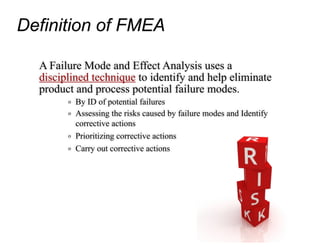
A Failure Mode and Effect Analysis uses a
disciplined technique to identify and help eliminate
product and process potential failure modes.
o By ID of potential failures
o Assessing the risks caused by failure modes and Identify
corrective actions
o Prioritizing corrective actions
o Carry out corrective actions
Most COMMON Types of FMEA's
Design (Potential) Failure Modes and
Effects Analysis-DFMEA
• Focus is on potential design- related failures
and their causes.
!
Process (Potential) Failures Modes and
Effects Analysis-PFMEA
• Focuses is on potential process failures and
their causes.
PFMEA's
!
● Focus is on potential process –related
failures and their causes.
▪Main drive is to understand the process through the
identification of as many potential failures as possible.
o e.g. Incorrect material used
● PFMEA typically assumes that the design
is sound.
● Development of Recommended Actions is
targeted at eliminating the Root Cause of
the potential failures.
PFMEA's benefits
•Identifies Process Functions
and Req’s!
•Identifies potential failure
modes!
•Assesses effect of failure!
•Identifies causes of failures!
•Identifies process controls!
•Identifies confirmed Critical
Characteristics!
•Provides an objective base for
action
PFMEA's outputs
PFMEA's - who
prepares it
•A team effort - including!
•Manufacturing/production!
•Engineering!
•Design !
•Quality!
•Test!
!
•However it is a moving feast
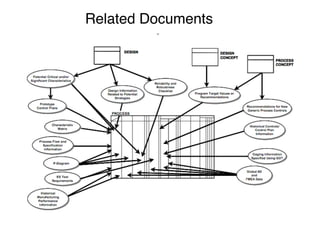
Related Documents
PFMEA
Three Parts:
● Process Flow Diagram (PFD)
● Process Failure Mode and Effects
Analysis (PFMEA)
● Process Control Plan (PCP)
Product Definition:
Key Product Characteristics, DFMEA
Process Definition:
Process Flow Diagram (PFD),
Failure Mode Analysis:
PFMEA
Control Strategy:
Control Plan,
Error proofing
Customer Requirements:
Manufacturing:
Work Instructions & Process Monitoring
Information Flow
SOR, Vehicle Tech Specs,
System Technical Specs
Product and Process Characteristics
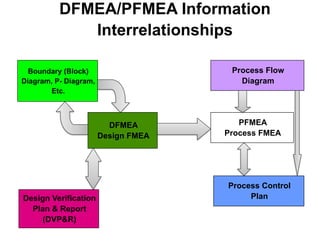
DFMEA/PFMEA Information
Interrelationships
DFMEA
Design FMEA
Process Flow
Diagram
PFMEA
Process FMEA
Boundary (Block)
Diagram, P- Diagram,
Etc.
Design Verification
Plan & Report
(DVP&R)
Process Control
Plan
Process Function/Requirements
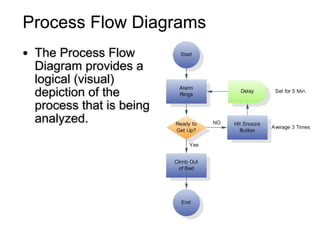
Process Flow Diagrams
● The Process Flow
Diagram provides a
logical (visual)
depiction of the
process that is being
analyzed.
12
● The SAE/AIAG PFMEA guidelines describe two
methods of defining process functions. 

Either or both may be used.
● Process Functions may be described in terms of:
▪ The product features/characteristics that are
created
or
▪ The process actions that are performed
● Process functions should be identified in detail
as necessary to provide information for the
PFMEA to develop effective Process Controls
Process Function / Requirement
13
● Consider a simple operation to drill a hole in a
metal part
● The product characteristics & requirements are:
▪ Hole size: 4.00 mm +/- 0.13
▪ Hole Location:

X = 28.0 mm +/- 0.2
Y = 15.0 mm +/- 0.2
▪ Perpendicular to surface, no burrs, etc.
● The process operation must create these
product characteristics and meet the
requirements
Process Function / Requirement
X
Y
4.00
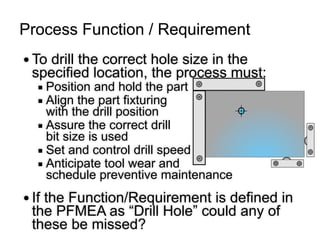
● To drill the correct hole size in the
specified location, the process must:
▪ Position and hold the part
▪ Align the part fixturing

with the drill position
▪ Assure the correct drill

bit size is used
▪ Set and control drill speed
▪ Anticipate tool wear and

schedule preventive maintenance
● If the Function/Requirement is defined in
the PFMEA as “Drill Hole” could any of
these be missed?
Process Function / Requirement
Process Flow Diagram (PFD)
● Process Flow Diagram is the foundation
▪ The process must be defined step by step, including
interfaces
▪ The PFD provides the structure to document what product
characteristics and requirements (OUTPUTS) are affected
by a given operation and how these characteristics and
sources of variation are controlled (INPUTS)
▪ PFD is a graphical representation of every possible path a
part can take through the anticipated manufacturing
process
▪ A well defined PFD establishes the foundation for the
PFMEA
● Helps in developing equipment specifications.
▪ How will the process control non-conforming material?
▪ How and when will inspections be performed, what is
required?
▪ How and when will parts be re-introduced into the
process?
PFD Example
PFD Feeds PFMEA

Identify the Function(s)
● Function is a description of what the
Process does to meet the requirements
➢Related to process specification and product
characteristics
➢Comes from the PFD operation description column
● Functions can be described as:
➢Do this operation…
➢To this part or material…
➢With this tooling or equipment…
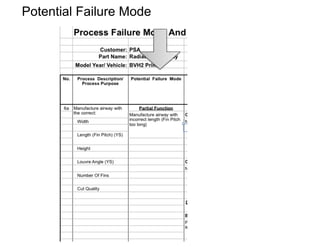
Potential Failure Mode
Potential Failure Modes
Often missed
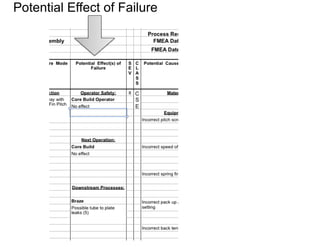
Potential Effect of Failure
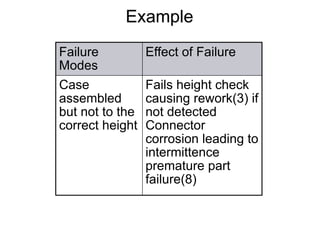
Example
Failure
Modes
Effect of Failure
Case
assembled
but not to the
correct height
Fails height check
causing rework(3) if
not detected
Connector
corrosion leading to
intermittence
premature part
failure(8)
Potential
Effects
of
Failure
Potential
Effects
of
Failure
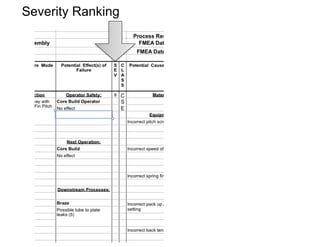
Severity Ranking
Severity
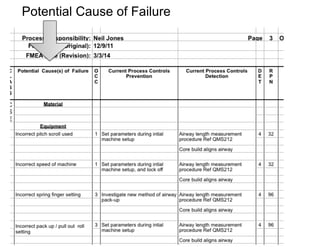
Potential Cause of Failure
Cause of Failure
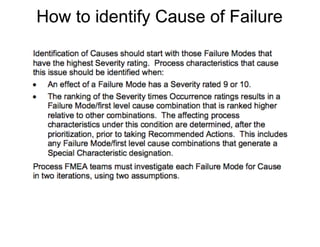
How to identify Cause of Failure
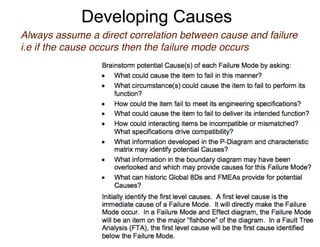
Developing Causes
Always assume a direct correlation between cause and failure
i.e if the cause occurs then the failure mode occurs
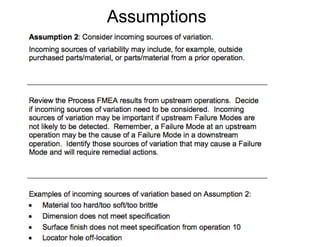
Assumptions
Assumptions
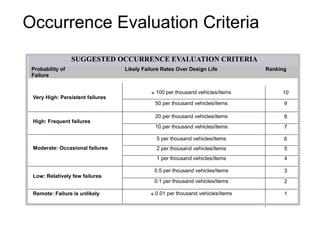
Occurrence
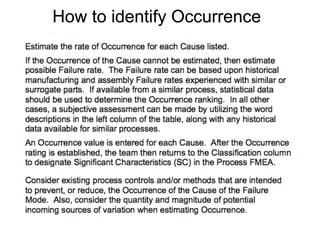
How to identify Occurrence
Occurrence Evaluation Criteria
Probability of Likely Failure Rates Over Design Life Ranking
Failure
SUGGESTED OCCURRENCE EVALUATION CRITERIA
Very High: Persistent failures
High: Frequent failures
Moderate: Occasional failures
Low: Relatively few failures
Remote: Failure is unlikely
≥ 100 per thousand vehicles/items
50 per thousand vehicles/items
20 per thousand vehicles/items
10 per thousand vehicles/items
5 per thousand vehicles/items
2 per thousand vehicles/items
1 per thousand vehicles/items
0.5 per thousand vehicles/items
0.1 per thousand vehicles/items
≤ 0.01 per thousand vehicles/items
10
9
8
7
6
5
4
3
2
1
Current controls
Current Controls
2 types of controls
Prevention
Prevent the Cause/mechanism or failure mode/effect from
occurring or reduce their rate of occurrence
!
Detection
Detect the cause/mechanism and lead to corrective action
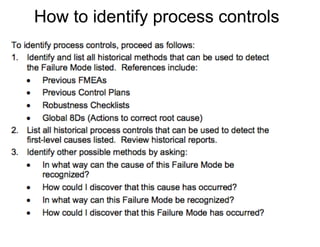
How to identify process controls
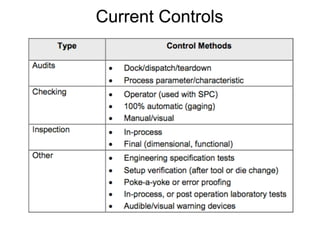
Current Controls
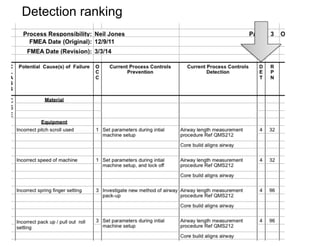
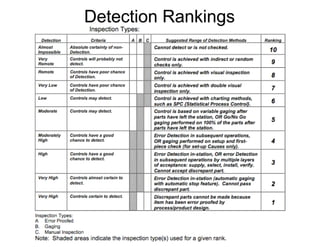
Detection ranking
Detection Rankings
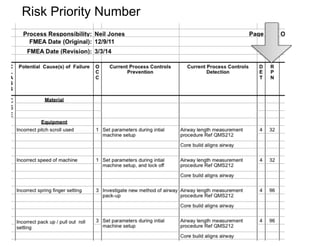
Risk Priority Number
Analysis Of Risk
▪ RPN / RISK PRIORITY NUMBER
▪ What Is Risk?
▪ Probability of danger
▪ Severity/Occurrence/Cause
Evaluation by RPN Only
▪ Case 1
o S=5 O=5 D=2 RPN = 50
▪ Case 2
o S=3 O=3 D=6 RPN = 54
▪ Case 3
o S=2 O=10, D=10 = 200
▪ Case 4
o S=9 O=2 D=3 = 54
WHICH ONE
IS WORSE?
Example
▪ Extreme Safety/Regulatory Risk
o =9 & 10 Severity
▪ High Risk to Customer Satisfaction
o Sev. > or = to 5 and Occ > or = 4
▪ Consider Detection only as a measure of Test
Capability.
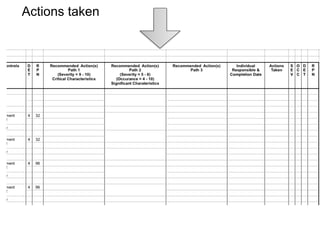
Actions taken
Actions
Re-rating RPN After Actions Have Occurred
Re-rating RPN After Actions Have
Occurred
▪ Severity typically stays the same.
▪ Occurrence is the primary item to reduce / focus on.
▪ Detection is reduced only as a last resort.
▪ Do not plan to REDUCE RPN with detection actions!!!
o 100% inspection is only 80% effective!
o Reducing RPN with detection does not eliminate failure mode,
or reduce probability of causes
o Detection of 10 is not bad if occurrence is 1
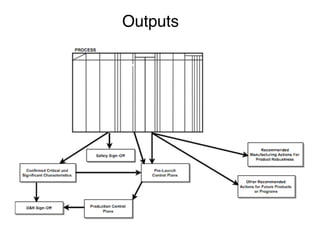
Outputs
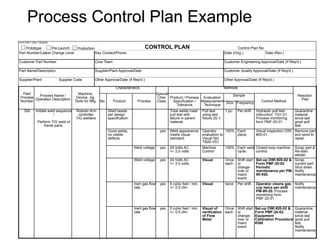
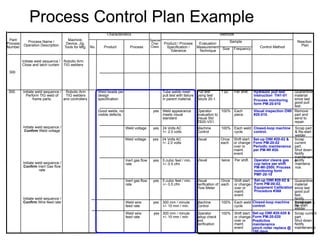
● PCP will be based on the previous
activities in PFD and PFMEA.
● Review the PFMEA information developed
& supplied and use to identify:
▪ Specific controls that may be needed due to the
information added
▪ Identify which controls are Product or Process
o Note any Special Characteristics
o Identify evaluation methods, frequency and Control
Methods
o Note Reaction Plans (particularly related to NC parts)
Process Control Plan
Process Control Plan Example
Part/
Process
Number
Process Name /

Operation Description
Machine,
Device, Jig,
Tools for Mfg.
Characteristics
Special
Char.
Class.
Methods
Reaction

Plan
No. Product Process
Product / Process
Specification /

Tolerance
Evaluation
Measurement

Technique
Sample
Control MethodSize Frequency
300 Initiate weld sequence
/


Perform TIG weld of
frame parts.
Robotic Arm
controller.

TIG welders.
Weld beads
per design
specification.
Tube welds meet
pull test with
failure in parent
material.

Pull test
using test
fixture 20-1.


1 pc. 


Per shift.


Hydraulic pull test
instruction TI21-01
Process monitoring
form PMF-20-01
Quarantine
material
since last
good pull
test.
Good welds,
no visible
defects.
yes Weld appearance
meets visual
standard.
Operator
evaluation to
Visual Std
TB20-VS1
100% Each
piece.
Visual inspection OWI
#20-01.
Remove part
and send to
repair.
Weld voltage
 yes 24 Volts AC

+/- 2.0 volts
Machine
Control
100% Each weld
cycle.
Closed-loop machine
control.
Scrap part &
Re-start
welder.
Weld voltage yes 24 Volts AC

+/- 2.0 volts
Visual Once
each
Shift start
or
change-
over or
maint.
event.
Set-up OWI #20-02 &
Form PMF-20-02
Periodic
maintenance per PM-
WI #20.
Scrap
current part. 

Shut down.

Notify
maintenance
.
Inert gas flow
rate
yes 5 cubic feet / min.

+/- 0.5 cfm
Visual twice Per shift.
 Operator cleans gas
cup twice per shift
PM-WI-20. Process
monitoring form
PMF-20-01
Notify
maintenance
.
Inert gas flow
rate
yes 5 cubic feet / min.

+/- 0.5 cfm
Visual of
verification
of Flow
Meter
Once
each
Shift start
or
change-
over or
maint.
event
Set-up OWI #20-02 &
Form PMF-20-02.
Equipment
Calibration Procedure
#368
Quarantine
material
since last
good pull
test.

Notify
maintenance
.
Form 818-1 (Rev 12Apr02)
CONTROL PLAN Control Plan No:
Part Number/Latest Change Level Key Contact/Phone Date (Orig.) Date (Rev.)
Customer Part Number Core Team Customer Engineering Approval/Date (If Req'd.)
Part Name/Description Supplier/Plant Approval/Date Customer Quality Approval/Date (If Req'd.)
Supplier/Plant Supplier Code Other Approval/Date (If Req'd.) Other Approval/Date (If Req'd.)
Prototype Pre-Launch Production
Process Control Plan Example
Initiate weld sequence /
Confirm Wire feed rate
Initiate weld sequence /
Confirm Weld voltage
Initiate weld sequence /

Perform TIG weld of
frame parts.
Initiate weld sequence /
Confirm Inert Gas flow
rate
Scrap part &
Re-start
welder
Closed-loop machine
control.
Each weld
cycle.
100%Machine
Control
300 mm / minute

+/- 10 mm / min.
yesWeld wire
feed rate
Scrap part
& Re-start
welder
Closed-loop machine
control.
Each weld
cycle.
100%Machine
Control
24 Volts AC

+/- 2.0 volts
yesWeld voltage

Notify
maintena
nce.
Operator cleans gas
cup twice per shift
PM-WI-2500. Process
monitoring form
PMF-20-10
Per shift.
twiceVisual5 cubic feet / min.

+/- 0.5 cfm
yesInert gas flow
rate
Remove
part and
send to
repair.
Visual inspection OWI
#20-010.
Each
piece.
100%Operator
evaluation to
Visual Std
TB20-VS1.
Weld appearance
meets visual
standard.
yesGood welds, no
visible defects.
Scrap current
part.

Shut down.

Notify
maintenance.
Set-up OWI #20-020 &
Form PM-20-020
Predictive
maintenance

pinch roller replace @
180 days.
Shift start
or change-
over or
maint.
event
100%Operator
setup check
and
verification
300 mm / minute

+/- 10 mm / min.
yesWeld wire
feed rate
Quarantine
material
since last
good pull
test.
Notify
maintenan
ce.
Set-up OWI #20-02 &
Form PM-00-02.
Equipment Calibration
Procedure #368
Shift start
or change-
over or
maint.
event
Once
each
Visual
verification of
Flow Meter
5 cubic feet / min.

+/- 0.5 cfm
yesInert gas flow
rate
Scrap
current
part. 

Shut down.

Notify
maintenanc
e.
Set-up OWI #20-02 &
Form PM-20-02
Periodic maintenance
per PM-WI #20.
Shift start
or change-
over or
maint.
event
Once
each
Visual24 Volts AC

+/- 2.0 volts
yesWeld voltage

Quarantine
material
since last
good pull
test.
Hydraulic pull test
instruction TI41-01
Process monitoring
form PM-20-010
Per shift.


1 pc. 


Pull test
using test
fixture 20-1.


Tube welds meet
pull test with failure
in parent material.

Weld beads per
design
specification.
Robotic Arm
TIG welders
and controllers.
300.
.!Robotic Arm
TIG welders
!Initiate weld sequence /
Close and latch curtain
300
FrequencySize
Reaction

PlanControl Method
Sample
Evaluation
Measurement

Technique
Product / Process
Specification /

Tolerance
ProcessProductNo.
Methods
Special
Char.
Class.
Characteristics
Machine,
Device, Jig,
Tools for Mfg.
Process Name /

Operation Description
Part/
Process
Number

Process fmea

  • 1.
  • 2.
  • 3.
    Origin Failure mode andeffect analysis (FMEA) was one of the first systematic techniques for failure analysis. It was developed by reliability engineers in the 1950s to study problems that might arise from malfunctions of military systems
  • 4.
    Definition of FMEA AFailure Mode and Effect Analysis uses a disciplined technique to identify and help eliminate product and process potential failure modes. o By ID of potential failures o Assessing the risks caused by failure modes and Identify corrective actions o Prioritizing corrective actions o Carry out corrective actions
  • 5.
    Most COMMON Typesof FMEA's Design (Potential) Failure Modes and Effects Analysis-DFMEA • Focus is on potential design- related failures and their causes. ! Process (Potential) Failures Modes and Effects Analysis-PFMEA • Focuses is on potential process failures and their causes.
  • 6.
    PFMEA's ! ● Focus ison potential process –related failures and their causes. ▪Main drive is to understand the process through the identification of as many potential failures as possible. o e.g. Incorrect material used ● PFMEA typically assumes that the design is sound. ● Development of Recommended Actions is targeted at eliminating the Root Cause of the potential failures.
  • 7.
    PFMEA's benefits •Identifies ProcessFunctions and Req’s! •Identifies potential failure modes! •Assesses effect of failure! •Identifies causes of failures! •Identifies process controls! •Identifies confirmed Critical Characteristics! •Provides an objective base for action
  • 8.
  • 9.
    PFMEA's - who preparesit •A team effort - including! •Manufacturing/production! •Engineering! •Design ! •Quality! •Test! ! •However it is a moving feast
  • 10.
  • 11.
    PFMEA Three Parts: ● ProcessFlow Diagram (PFD) ● Process Failure Mode and Effects Analysis (PFMEA) ● Process Control Plan (PCP)
  • 12.
    Product Definition: Key ProductCharacteristics, DFMEA Process Definition: Process Flow Diagram (PFD), Failure Mode Analysis: PFMEA Control Strategy: Control Plan, Error proofing Customer Requirements: Manufacturing: Work Instructions & Process Monitoring Information Flow SOR, Vehicle Tech Specs, System Technical Specs Product and Process Characteristics
  • 13.
    DFMEA/PFMEA Information Interrelationships DFMEA Design FMEA ProcessFlow Diagram PFMEA Process FMEA Boundary (Block) Diagram, P- Diagram, Etc. Design Verification Plan & Report (DVP&R) Process Control Plan
  • 14.
  • 15.
    Process Flow Diagrams ●The Process Flow Diagram provides a logical (visual) depiction of the process that is being analyzed.
  • 16.
    12 ● The SAE/AIAGPFMEA guidelines describe two methods of defining process functions. 
 Either or both may be used. ● Process Functions may be described in terms of: ▪ The product features/characteristics that are created or ▪ The process actions that are performed ● Process functions should be identified in detail as necessary to provide information for the PFMEA to develop effective Process Controls Process Function / Requirement
  • 17.
    13 ● Consider asimple operation to drill a hole in a metal part ● The product characteristics & requirements are: ▪ Hole size: 4.00 mm +/- 0.13 ▪ Hole Location:
 X = 28.0 mm +/- 0.2 Y = 15.0 mm +/- 0.2 ▪ Perpendicular to surface, no burrs, etc. ● The process operation must create these product characteristics and meet the requirements Process Function / Requirement X Y 4.00
  • 18.
    ● To drillthe correct hole size in the specified location, the process must: ▪ Position and hold the part ▪ Align the part fixturing
 with the drill position ▪ Assure the correct drill
 bit size is used ▪ Set and control drill speed ▪ Anticipate tool wear and
 schedule preventive maintenance ● If the Function/Requirement is defined in the PFMEA as “Drill Hole” could any of these be missed? Process Function / Requirement
  • 19.
    Process Flow Diagram(PFD) ● Process Flow Diagram is the foundation ▪ The process must be defined step by step, including interfaces ▪ The PFD provides the structure to document what product characteristics and requirements (OUTPUTS) are affected by a given operation and how these characteristics and sources of variation are controlled (INPUTS) ▪ PFD is a graphical representation of every possible path a part can take through the anticipated manufacturing process ▪ A well defined PFD establishes the foundation for the PFMEA ● Helps in developing equipment specifications. ▪ How will the process control non-conforming material? ▪ How and when will inspections be performed, what is required? ▪ How and when will parts be re-introduced into the process?
  • 20.
  • 21.
    PFD Feeds PFMEA
 Identifythe Function(s) ● Function is a description of what the Process does to meet the requirements ➢Related to process specification and product characteristics ➢Comes from the PFD operation description column ● Functions can be described as: ➢Do this operation… ➢To this part or material… ➢With this tooling or equipment…
  • 22.
  • 23.
  • 24.
  • 25.
    Example Failure Modes Effect of Failure Case assembled butnot to the correct height Fails height check causing rework(3) if not detected Connector corrosion leading to intermittence premature part failure(8)
  • 26.
  • 27.
  • 28.
  • 29.
  • 31.
  • 32.
  • 33.
    How to identifyCause of Failure
  • 34.
    Developing Causes Always assumea direct correlation between cause and failure i.e if the cause occurs then the failure mode occurs
  • 35.
  • 36.
  • 37.
  • 38.
    How to identifyOccurrence
  • 39.
    Occurrence Evaluation Criteria Probabilityof Likely Failure Rates Over Design Life Ranking Failure SUGGESTED OCCURRENCE EVALUATION CRITERIA Very High: Persistent failures High: Frequent failures Moderate: Occasional failures Low: Relatively few failures Remote: Failure is unlikely ≥ 100 per thousand vehicles/items 50 per thousand vehicles/items 20 per thousand vehicles/items 10 per thousand vehicles/items 5 per thousand vehicles/items 2 per thousand vehicles/items 1 per thousand vehicles/items 0.5 per thousand vehicles/items 0.1 per thousand vehicles/items ≤ 0.01 per thousand vehicles/items 10 9 8 7 6 5 4 3 2 1
  • 40.
  • 41.
    Current Controls 2 typesof controls Prevention Prevent the Cause/mechanism or failure mode/effect from occurring or reduce their rate of occurrence ! Detection Detect the cause/mechanism and lead to corrective action
  • 42.
    How to identifyprocess controls
  • 43.
  • 44.
  • 45.
  • 46.
  • 47.
    Analysis Of Risk ▪RPN / RISK PRIORITY NUMBER ▪ What Is Risk? ▪ Probability of danger ▪ Severity/Occurrence/Cause
  • 48.
    Evaluation by RPNOnly ▪ Case 1 o S=5 O=5 D=2 RPN = 50 ▪ Case 2 o S=3 O=3 D=6 RPN = 54 ▪ Case 3 o S=2 O=10, D=10 = 200 ▪ Case 4 o S=9 O=2 D=3 = 54 WHICH ONE IS WORSE?
  • 49.
    Example ▪ Extreme Safety/RegulatoryRisk o =9 & 10 Severity ▪ High Risk to Customer Satisfaction o Sev. > or = to 5 and Occ > or = 4 ▪ Consider Detection only as a measure of Test Capability.
  • 50.
  • 51.
  • 52.
    Re-rating RPN AfterActions Have Occurred
  • 53.
    Re-rating RPN AfterActions Have Occurred ▪ Severity typically stays the same. ▪ Occurrence is the primary item to reduce / focus on. ▪ Detection is reduced only as a last resort. ▪ Do not plan to REDUCE RPN with detection actions!!! o 100% inspection is only 80% effective! o Reducing RPN with detection does not eliminate failure mode, or reduce probability of causes o Detection of 10 is not bad if occurrence is 1
  • 54.
  • 55.
    ● PCP willbe based on the previous activities in PFD and PFMEA. ● Review the PFMEA information developed & supplied and use to identify: ▪ Specific controls that may be needed due to the information added ▪ Identify which controls are Product or Process o Note any Special Characteristics o Identify evaluation methods, frequency and Control Methods o Note Reaction Plans (particularly related to NC parts) Process Control Plan
  • 56.
    Process Control PlanExample Part/ Process Number Process Name /
 Operation Description Machine, Device, Jig, Tools for Mfg. Characteristics Special Char. Class. Methods Reaction
 Plan No. Product Process Product / Process Specification /
 Tolerance Evaluation Measurement
 Technique Sample Control MethodSize Frequency 300 Initiate weld sequence /
 
 Perform TIG weld of frame parts. Robotic Arm controller.
 TIG welders. Weld beads per design specification. Tube welds meet pull test with failure in parent material.
 Pull test using test fixture 20-1.
 
 1 pc. 
 
 Per shift.
 
 Hydraulic pull test instruction TI21-01 Process monitoring form PMF-20-01 Quarantine material since last good pull test. Good welds, no visible defects. yes Weld appearance meets visual standard. Operator evaluation to Visual Std TB20-VS1 100% Each piece. Visual inspection OWI #20-01. Remove part and send to repair. Weld voltage
 yes 24 Volts AC
 +/- 2.0 volts Machine Control 100% Each weld cycle. Closed-loop machine control. Scrap part & Re-start welder. Weld voltage yes 24 Volts AC
 +/- 2.0 volts Visual Once each Shift start or change- over or maint. event. Set-up OWI #20-02 & Form PMF-20-02 Periodic maintenance per PM- WI #20. Scrap current part. 
 Shut down.
 Notify maintenance . Inert gas flow rate yes 5 cubic feet / min.
 +/- 0.5 cfm Visual twice Per shift.
 Operator cleans gas cup twice per shift PM-WI-20. Process monitoring form PMF-20-01 Notify maintenance . Inert gas flow rate yes 5 cubic feet / min.
 +/- 0.5 cfm Visual of verification of Flow Meter Once each Shift start or change- over or maint. event Set-up OWI #20-02 & Form PMF-20-02. Equipment Calibration Procedure #368 Quarantine material since last good pull test.
 Notify maintenance . Form 818-1 (Rev 12Apr02) CONTROL PLAN Control Plan No: Part Number/Latest Change Level Key Contact/Phone Date (Orig.) Date (Rev.) Customer Part Number Core Team Customer Engineering Approval/Date (If Req'd.) Part Name/Description Supplier/Plant Approval/Date Customer Quality Approval/Date (If Req'd.) Supplier/Plant Supplier Code Other Approval/Date (If Req'd.) Other Approval/Date (If Req'd.) Prototype Pre-Launch Production
  • 57.
    Process Control PlanExample Initiate weld sequence / Confirm Wire feed rate Initiate weld sequence / Confirm Weld voltage Initiate weld sequence /
 Perform TIG weld of frame parts. Initiate weld sequence / Confirm Inert Gas flow rate Scrap part & Re-start welder Closed-loop machine control. Each weld cycle. 100%Machine Control 300 mm / minute
 +/- 10 mm / min. yesWeld wire feed rate Scrap part & Re-start welder Closed-loop machine control. Each weld cycle. 100%Machine Control 24 Volts AC
 +/- 2.0 volts yesWeld voltage
 Notify maintena nce. Operator cleans gas cup twice per shift PM-WI-2500. Process monitoring form PMF-20-10 Per shift.
twiceVisual5 cubic feet / min.
 +/- 0.5 cfm yesInert gas flow rate Remove part and send to repair. Visual inspection OWI #20-010. Each piece. 100%Operator evaluation to Visual Std TB20-VS1. Weld appearance meets visual standard. yesGood welds, no visible defects. Scrap current part.
 Shut down.
 Notify maintenance. Set-up OWI #20-020 & Form PM-20-020 Predictive maintenance
 pinch roller replace @ 180 days. Shift start or change- over or maint. event 100%Operator setup check and verification 300 mm / minute
 +/- 10 mm / min. yesWeld wire feed rate Quarantine material since last good pull test. Notify maintenan ce. Set-up OWI #20-02 & Form PM-00-02. Equipment Calibration Procedure #368 Shift start or change- over or maint. event Once each Visual verification of Flow Meter 5 cubic feet / min.
 +/- 0.5 cfm yesInert gas flow rate Scrap current part. 
 Shut down.
 Notify maintenanc e. Set-up OWI #20-02 & Form PM-20-02 Periodic maintenance per PM-WI #20. Shift start or change- over or maint. event Once each Visual24 Volts AC
 +/- 2.0 volts yesWeld voltage
 Quarantine material since last good pull test. Hydraulic pull test instruction TI41-01 Process monitoring form PM-20-010 Per shift.
 
 1 pc. 
 
 Pull test using test fixture 20-1.
 
 Tube welds meet pull test with failure in parent material.
 Weld beads per design specification. Robotic Arm TIG welders and controllers. 300. .!Robotic Arm TIG welders !Initiate weld sequence / Close and latch curtain 300 FrequencySize Reaction
 PlanControl Method Sample Evaluation Measurement
 Technique Product / Process Specification /
 Tolerance ProcessProductNo. Methods Special Char. Class. Characteristics Machine, Device, Jig, Tools for Mfg. Process Name /
 Operation Description Part/ Process Number