RANA Tech Solutions
Towards Customer Satisfaction
1PFMEA
Process Failure Modes and
Effects Analysis
(PFMEA)
RANA Tech Solutions
Towards Customer Satisfaction
2PFMEA
An FMEA is a systematic method for identifying,
analyzing, and documenting potential failure
modes and their effects on the system, the product
and process performance. The possible causes of
failure can then be prioritized.
RANA Tech Solutions
Towards Customer Satisfaction
3PFMEA
What We Will Learn …
1. As a Team, how to construct an FMEA
and associated Action Plan
2. How the FMEA process ties to
process mapping
3. The relationship between Failure
Mode, Cause and Effect
4. The different types of FMEAs
RANA Tech Solutions
Towards Customer Satisfaction
4PFMEA
Why Use FMEAs?
Identify ...
critical product characteristics and process variables
Prioritize ...
product and process deficiencies in support of downstream
improvement actions
Help focus ...
on prevention of product and process problems
RANA Tech Solutions
Towards Customer Satisfaction
5PFMEA
Benefits of FMEA’s
Improves the quality, reliability and safety of
products.
Helps increase customer satisfaction.
Reduces product development timing and cost.
Reduces the amount of rework, repair and
scrap.
Documents and tracks actions taken.
Prioritizes deficiencies to focus improvement
efforts.
RANA Tech Solutions
Towards Customer Satisfaction
6PFMEA
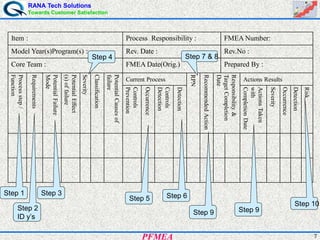
Process FMEA Steps
Prior to FMEA:
Charter Team
Develop and
Characterize
Process Map
1. Identify “Heavy Hitter” Process Step
2. Identify Associated y’s (Product
Parameters)
3. Failure Mode
4. Identify Failure Effects/Rate
Severity
5. Identify Causes/Rate Occurrence
6. Identify Controls (if any)/Rate
Detection
7. Calculate RPN
8. Prioritize by RPN Order
9. Determine Actions/Plan
10.Recalculate RPN Based on Plan
11.Take Action
RANA Tech Solutions
Towards Customer Satisfaction
7PFMEA
Item : Process Responsibility : FMEA Number:
Model Year(s)Program(s) : Rev. Date : Rev.No :
Core Team : FMEA Date(Orig.) Prepared By :
Processstep/
Function
Requirements
PotentialFailure
Mode
PotentialEffect
(s)offailure
Severity
Classification
PotentialCausesof
failure
Current Process
RPN
RecommendedAction
Responsibility&
TargetCompletion
Date
Actions Results
Controls
Prevention
Occurrence
Controls
Detection
Detection
ActionsTaken
with
CompletionDate
Severity
Occurrence
Detection
Risk
Step 1
Step 2
ID y’s
Step 3
Step 4
Step 5 Step 6
Step 7 & 8
Step 9
Step 10
Step 9
RANA Tech Solutions
Towards Customer Satisfaction
8PFMEA
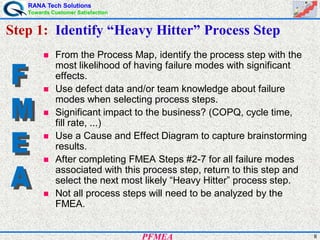
Step 1: Identify “Heavy Hitter” Process Step
From the Process Map, identify the process step with the
most likelihood of having failure modes with significant
effects.
Use defect data and/or team knowledge about failure
modes when selecting process steps.
Significant impact to the business? (COPQ, cycle time,
fill rate, ...)
Use a Cause and Effect Diagram to capture brainstorming
results.
After completing FMEA Steps #2-7 for all failure modes
associated with this process step, return to this step and
select the next most likely “Heavy Hitter” process step.
Not all process steps will need to be analyzed by the
FMEA.
RANA Tech Solutions
Towards Customer Satisfaction
9PFMEA
Step 2: Identify Associated y’s
From the Process Map, identify the y’s that are
associated with the process step being investigated.
As the y’s are the indications of a successful completion
of the process step, they are crucial as a basis for
determining failure modes.
RANA Tech Solutions
Towards Customer Satisfaction
10PFMEA
Step 3: Identify Failure Mode
Brainstorm failure modes for the selected process step
Identify the ways in which the process could fail to
generate each of the expected “y’s.”
Eliminate “duplicates” from brainstorm list.
Are the failure modes from the same level of the process?
Are the failure modes specific?
Are the failure modes the most likely?
Do the failure modes provide good coverage of the process
step?
Have all y’s been considered?
RANA Tech Solutions
Towards Customer Satisfaction
11PFMEA
Step 4: Identify Failure Effects/Rate Severity
Pick the most likely failure mode and brainstorm the most
important effects:
FAILURE EFFECTS are the outcome of the
occurrence of the failure mode in the process.
The impact on the customer is what the customer
experiences as a result of the Failure Mode.
Identify each effect as being “Attribute” or “Variable.”
Severity doesn’t change unless the design changes.
RANA Tech Solutions
Towards Customer Satisfaction
12PFMEA
Step 5: Identify Causes/Rate Occurrence
Identify the most likely causes for each failure mode using a
Cause and Effect Diagram :
– CAUSES are the conditions that bring about the Failure
Mode.
Transfer the resulting information to the FMEA form.
Assign an occurrence value (1-10) to the likelihood that
each particular cause will happen and result in the failure
mode.
The occurrence score for each cause should be related to
the likelihood of that cause resulting in the failure mode and
producing the specific associated effect.
RANA Tech Solutions
Towards Customer Satisfaction
13PFMEA
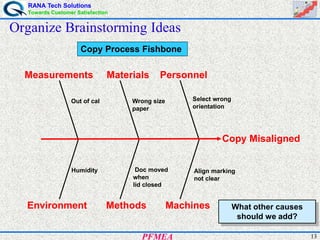
Organize Brainstorming Ideas
Copy Process Fishbone
What other causes
should we add?
Copy Misaligned
Out of cal Wrong size
paper
Select wrong
orientation
Humidity Doc moved
when
lid closed
Align marking
not clear
Environment Methods Machines
Measurements Materials Personnel
RANA Tech Solutions
Towards Customer Satisfaction
14PFMEA
Step 6: Identify Controls (if any)/Rate Detection
Identify the current mechanisms in place which prevent
the cause from occurring, or detect it before the product
reaches the customer. Some examples of controls are
SPC, training, maintenance, inspection, SOP etc.
Assign a detection value (1-10) based on an assessment
of the likelihood that the current control mechanisms will
detect the cause of the failure mode before it reaches the
customer.
Don’t agonize over detectability.
RANA Tech Solutions
Towards Customer Satisfaction
15PFMEA
Step 7: Calculate Risk Priority Number (RPN)
The product of the estimates of severity
occurrence and
detection.
The RPN provides a relative priority for taking action;
the bigger the RPN, the more important to address.
RPN = SEVERITY x OCCURRENCE x DETECTION
RANA Tech Solutions
Towards Customer Satisfaction
16PFMEA
Steps 8 & 9: Prioritize by RPN Order
& Determine Actions/Plan
STEP 8: Prioritize by RPN Order
Use the “Sort” command in Excel to order the
spreadsheet in descending order of Risk Priority
Number (RPN).
STEP 9: Determine Actions/Plan
Based on the causes found, determine actions that will
minimize the effect of each cause, in priority order.
RANA Tech Solutions
Towards Customer Satisfaction
17PFMEA
Steps 10 & 11: Recalculate RPN Based on Plan
& Take Action
STEP 10: Recalculate RPN Based on Plan
Assuming the actions are carried out successfully, reassign
severity, occurrence and detectability.
Place these new ratings in the “predicted” columns (ps, po
& pd).
Assign a rating from 1 to 5 for each action that will show the
“risk” associated with each action (5 being the greatest risk).
Place the rating in the “risk” column.
STEP 11: Take Action
Based on the risk mitigation column (Risk * rpn), take the
actions indicated or reassign actions.
Complete the actions indicated by the times stated!
RANA Tech Solutions
Towards Customer Satisfaction
18PFMEA
Helps analyze manufacturing and assembly processes to
reduce the occurrence and improve detection of defects.
Assists in the development of process control plans.
Establishes a priority for improvement activities.
Documents the rationale behind process changes and
helps guide future process improvement plans.
IS PROACTIVE! Should be started when new processes
are designed or when old processes are changed.
Process FMEA
RANA Tech Solutions
Towards Customer Satisfaction
19PFMEA
Design/Product FMEA
Helps to identify potential product failure modes early in
the product development cycle.
Increases the likelihood that all potential failure modes
and their effects on assemblies will be considered.
Assists in evaluating product design requirements and test
methods.
Establishes a priority for design improvement.
Documents the rationale behind design changes and
helps guide future development projects.
IS PROACTIVE! Should be done when new products are
designed or existing products are changed.
RANA Tech Solutions
Towards Customer Satisfaction
20PFMEA
Defect FMEA
Helps identify the root causes of defects.
Establishes a priority for improvement activities.
Documents plan of action.
Provides methodology to battle initial ground swell of
defects.
Focuses effort on defects with highest $ impact.
IS NOT PROACTIVE!
RANA Tech Solutions
Towards Customer Satisfaction
21PFMEA
When to Update an FMEA?
An FMEA should be updated whenever a change is being
considered to a product’s:
design
application
environment
material
product’s manufacturing or
assembly process
RANA Tech Solutions
Towards Customer Satisfaction
22PFMEA
Summary of Product/Process FMEA’s
What is the tool? - Spreadsheet
What will the tool identify/ show?
All product/process failure modes, related
effects, causes, & methods of control.
Risk Priority Number (RPN) for action
based on failure severity, probability of
occurrence and detection capability.
Actions/plans to reduce elements of RPN.
When to apply this tool?
When evaluating product for
robustness (functionality,
produceability, reliability).
During early stages of
defect reduction efforts to
identify causes.
When identifying key
process/product parameters
and evaluating methods for
control.
What results can you expect?
Learn to identify critical product/
process parameters.
Achieve consensus on solutions and
methods of implementation.
Detailed product/process understanding.
RANA Tech Solutions
Towards Customer Satisfaction
23PFMEA
Keys to Success
Identify purpose...BE SPECIFIC!
Understand effects...INVOLVE CUSTOMERS & SUPPLIERS!
Link to the process map.
Use to prioritize efforts, allocate resources.
Use as a risk assessment/prioritization tool based on predicted
impact.
Use to build consensus on prioritization.
Encourage creativity...TEAMWORK!
PLAN!
ASK QUESTIONS!
RANA Tech Solutions
Towards Customer Satisfaction
24PFMEA
Effect
Criteria: Severity of Effect on Product
(Customer Effect)
Rank Effect
Criteria: Severity of Effect on Process
(Manufacturing / Assembly Effect)
Failure to
meet Safety
and/or
Regulatory
Requirements
Potential failure mode affects safe vehicle
operation and/or involves noncompliance
with government regulation without warning
10
Failure to
meet Safety
and/or
Regulatory
Requirements
May endanger operation (machine or
assembly) without warning.
Potential failure mode affects safe vehicle
operation and/or involves noncompliance
with government regulation with warning
9
May endanger operation (machine or
assembly) with warning.
Loss or
Degradation of
Primary
Function
Loss of primary function (vehicle inoperable,
does not affect safe vehicle operation).
8
Major
Disruption
100% of product may have to be
scrapped. Line shutdown or stop ship.
Degradation of primary function (vehicle
operable ,but at reduced level of
performance).
7
Significant
Disruption
A portion of the production run may have
to be scrapped. Deviation from primary
process including decreased line speed
or added manpower.
Loss or
Degradation of
Secondary
Function
Loss of secondary function (vehicle
operable, but comfort/convenience functions
inoperable).
6
Moderate
Disruption
100% of production run may have to be
reworked offline and accepted.
Degradation of secondary function (vehicle
operable, but comfort/convenience functions
at reduced level of performance).
5
A portion of the production run may have
to be reworked offline and accepted.
Annoyance
Apperance or Audible Noise,vehicle
operable,item does not conform and noticed
by most customers (>75%).
4
Moderate
Disruption
100% of production run may have to be
reworked in station before it is
processed.
Apperance or Audible Noise,vehicle
operable,item does not conform and noticed
by many customers (50%).
3
A portion of the production run may have
to be reworked in station before it is
processed.
Apperance or Audible Noise,vehicle
operable,item does not conform and noticed
by discriminating customers (<25%).
2
Minor
Disruption
Slight inconvenience to
process,operation,or operator.
No Effect No discernible effect. 1 No Effect No discernible effect.
PFMEA Severity Table
RANA Tech Solutions
Towards Customer Satisfaction
25PFMEA
Likelihood of Failure
Criteria: Occurrence of Cause - PFMEA
(incidents per items / vehicles)
Rank
Very High
≥ 100 per thousand
≥ 1 in 10 10
High
50 per thousand
1 in 20 9
20 per thousand
1 in 50 8
10 per thousand
1 in 100 7
Moderate
2 per thousand
1 in 500 6
0.5 per thousand
1 in 2000 5
0.1 per thousand
1 in 10,000 4
Low
0.01 per thousand
1 in 100,000 3
≤0.001 per thousand
1 in 1000,000 2
Very Low Failure is elimated through preventive control 1
PFMEA Occurrence Table
RANA Tech Solutions
Towards Customer Satisfaction
26PFMEA
Opportunity for Detection Criteria: Likelihood of Detection by process control Rank
Likelihood of
Detection
No detection opportunity No current process control; Cannot detect or is not analyzed. 10
Almost
impossible
Not Likely to detect at any
stage
Failure Mode and/or Error (Cause) is not easily detected (e.g.,random
audits). 9 Very Remote
Problem Detection Post
Processing
Failure Mode detection post-processing by operator through
visual/tactile/audible means. 8 Remote
Problem Detection at
Source
Failure Mode detection in-station by operator through
visual/tactile/audible means or post-processing through use of attribute
gauging (go/no-go, manual torque check/clicker wrench,etc.)
7 Very Low
Problem Detection Post
Processing
Failure Mode detection post-processing by operator through use of
variable gauging or in-station by operator through use of attribute
gauging (go/no-go, manual torque check/clicker wrench,etc.)
6 Low
Problem Detection at
Source
Failure Mode or Error (Cause) detection in-station by operator through
variable gauging or by automated controls in-station will detect discrepant
part and notify operator (light,buzzer,etc.) Gauging performed on setup
and first piece check (for set-up causes only).
5 Moderate
Problem Detection Post
Processing
Failure Mode detection post-processing by automated controls that will
detect discrepant part and lock part to prevent further processing. 4 Moderately High
Problem Detection at
Source
Failure Mode detection in-station by automated controls that will detect
discrepant part and automatically lock part in station to prevent further
processing.
3 High
Error Detection and/or
Problem Prevention
Error ( Cause) detection in-station by automated controls that will detect
error and prevent discrepant part from being made. 2 Very High
Detection Not Applicable;
Error Prevention
Error (Cause) prevention as a result of fixture design, machine design or
part design. Discrepant parts cannot be made because item has been
error-proofed by product/process design.
1 Almost Certain
PFMEA Detection Table
RANA Tech Solutions
Towards Customer Satisfaction
27PFMEA
Item : Process Responsibility : FMEA Number:
Model Year(s)Program(s) : Rev. Date : Rev.No :
Core Team : FMEA Date(Orig.) Prepared By :
Processstep/Function
Requirements
PotentialFailureMode
PotentialEffect
(s)offailure
Severity
PotentialCausesof
failure Current Process
RPN
RecommendedAction
Responsibility&Target
CompletionDate
Actions Results
Controls
Prevention
Occurrence
Controls
Detection
Detection
Actions
CompletionDate
Severity
Occurrence
Detection
RPN
Risk
10/Receiptofraw-material
Correctquantityandconditionof
raw-material
Damagedbag
moistureingressinthematerial
duringhumidcondition(Blister)
8
Improperhandling
1.Storageofrawmaterialwillbein
metalliccontainerstoavoid
spillage,improperstackingandto
overcomesafetyrisk..
2.Forklift/Stackerisusedfor
materialhandling.
3.Shrinkwrapthematerial
immediatelywherebagsarein
damagedconditionduring
unloading
2
Visualcontrolbystoreincharge
andmonthlystorechecklist
(F/STR/06)andworkInstruction
formaterialhandling.
6 96
Shrinkwrappingbagstobe
checked100%visualinspection
IncomingInspector
10.05.19
10.05.19
8
2
4
64
1
PFMEA Example :
RANA Tech Solutions
Towards Customer Satisfaction
28
Any
Questions,
???
Thanks.

PFMEA

  • 1.
    RANA Tech Solutions TowardsCustomer Satisfaction 1PFMEA Process Failure Modes and Effects Analysis (PFMEA)
  • 2.
    RANA Tech Solutions TowardsCustomer Satisfaction 2PFMEA An FMEA is a systematic method for identifying, analyzing, and documenting potential failure modes and their effects on the system, the product and process performance. The possible causes of failure can then be prioritized.
  • 3.
    RANA Tech Solutions TowardsCustomer Satisfaction 3PFMEA What We Will Learn … 1. As a Team, how to construct an FMEA and associated Action Plan 2. How the FMEA process ties to process mapping 3. The relationship between Failure Mode, Cause and Effect 4. The different types of FMEAs
  • 4.
    RANA Tech Solutions TowardsCustomer Satisfaction 4PFMEA Why Use FMEAs? Identify ... critical product characteristics and process variables Prioritize ... product and process deficiencies in support of downstream improvement actions Help focus ... on prevention of product and process problems
  • 5.
    RANA Tech Solutions TowardsCustomer Satisfaction 5PFMEA Benefits of FMEA’s Improves the quality, reliability and safety of products. Helps increase customer satisfaction. Reduces product development timing and cost. Reduces the amount of rework, repair and scrap. Documents and tracks actions taken. Prioritizes deficiencies to focus improvement efforts.
  • 6.
    RANA Tech Solutions TowardsCustomer Satisfaction 6PFMEA Process FMEA Steps Prior to FMEA: Charter Team Develop and Characterize Process Map 1. Identify “Heavy Hitter” Process Step 2. Identify Associated y’s (Product Parameters) 3. Failure Mode 4. Identify Failure Effects/Rate Severity 5. Identify Causes/Rate Occurrence 6. Identify Controls (if any)/Rate Detection 7. Calculate RPN 8. Prioritize by RPN Order 9. Determine Actions/Plan 10.Recalculate RPN Based on Plan 11.Take Action
  • 7.
    RANA Tech Solutions TowardsCustomer Satisfaction 7PFMEA Item : Process Responsibility : FMEA Number: Model Year(s)Program(s) : Rev. Date : Rev.No : Core Team : FMEA Date(Orig.) Prepared By : Processstep/ Function Requirements PotentialFailure Mode PotentialEffect (s)offailure Severity Classification PotentialCausesof failure Current Process RPN RecommendedAction Responsibility& TargetCompletion Date Actions Results Controls Prevention Occurrence Controls Detection Detection ActionsTaken with CompletionDate Severity Occurrence Detection Risk Step 1 Step 2 ID y’s Step 3 Step 4 Step 5 Step 6 Step 7 & 8 Step 9 Step 10 Step 9
  • 8.
    RANA Tech Solutions TowardsCustomer Satisfaction 8PFMEA Step 1: Identify “Heavy Hitter” Process Step From the Process Map, identify the process step with the most likelihood of having failure modes with significant effects. Use defect data and/or team knowledge about failure modes when selecting process steps. Significant impact to the business? (COPQ, cycle time, fill rate, ...) Use a Cause and Effect Diagram to capture brainstorming results. After completing FMEA Steps #2-7 for all failure modes associated with this process step, return to this step and select the next most likely “Heavy Hitter” process step. Not all process steps will need to be analyzed by the FMEA.
  • 9.
    RANA Tech Solutions TowardsCustomer Satisfaction 9PFMEA Step 2: Identify Associated y’s From the Process Map, identify the y’s that are associated with the process step being investigated. As the y’s are the indications of a successful completion of the process step, they are crucial as a basis for determining failure modes.
  • 10.
    RANA Tech Solutions TowardsCustomer Satisfaction 10PFMEA Step 3: Identify Failure Mode Brainstorm failure modes for the selected process step Identify the ways in which the process could fail to generate each of the expected “y’s.” Eliminate “duplicates” from brainstorm list. Are the failure modes from the same level of the process? Are the failure modes specific? Are the failure modes the most likely? Do the failure modes provide good coverage of the process step? Have all y’s been considered?
  • 11.
    RANA Tech Solutions TowardsCustomer Satisfaction 11PFMEA Step 4: Identify Failure Effects/Rate Severity Pick the most likely failure mode and brainstorm the most important effects: FAILURE EFFECTS are the outcome of the occurrence of the failure mode in the process. The impact on the customer is what the customer experiences as a result of the Failure Mode. Identify each effect as being “Attribute” or “Variable.” Severity doesn’t change unless the design changes.
  • 12.
    RANA Tech Solutions TowardsCustomer Satisfaction 12PFMEA Step 5: Identify Causes/Rate Occurrence Identify the most likely causes for each failure mode using a Cause and Effect Diagram : – CAUSES are the conditions that bring about the Failure Mode. Transfer the resulting information to the FMEA form. Assign an occurrence value (1-10) to the likelihood that each particular cause will happen and result in the failure mode. The occurrence score for each cause should be related to the likelihood of that cause resulting in the failure mode and producing the specific associated effect.
  • 13.
    RANA Tech Solutions TowardsCustomer Satisfaction 13PFMEA Organize Brainstorming Ideas Copy Process Fishbone What other causes should we add? Copy Misaligned Out of cal Wrong size paper Select wrong orientation Humidity Doc moved when lid closed Align marking not clear Environment Methods Machines Measurements Materials Personnel
  • 14.
    RANA Tech Solutions TowardsCustomer Satisfaction 14PFMEA Step 6: Identify Controls (if any)/Rate Detection Identify the current mechanisms in place which prevent the cause from occurring, or detect it before the product reaches the customer. Some examples of controls are SPC, training, maintenance, inspection, SOP etc. Assign a detection value (1-10) based on an assessment of the likelihood that the current control mechanisms will detect the cause of the failure mode before it reaches the customer. Don’t agonize over detectability.
  • 15.
    RANA Tech Solutions TowardsCustomer Satisfaction 15PFMEA Step 7: Calculate Risk Priority Number (RPN) The product of the estimates of severity occurrence and detection. The RPN provides a relative priority for taking action; the bigger the RPN, the more important to address. RPN = SEVERITY x OCCURRENCE x DETECTION
  • 16.
    RANA Tech Solutions TowardsCustomer Satisfaction 16PFMEA Steps 8 & 9: Prioritize by RPN Order & Determine Actions/Plan STEP 8: Prioritize by RPN Order Use the “Sort” command in Excel to order the spreadsheet in descending order of Risk Priority Number (RPN). STEP 9: Determine Actions/Plan Based on the causes found, determine actions that will minimize the effect of each cause, in priority order.
  • 17.
    RANA Tech Solutions TowardsCustomer Satisfaction 17PFMEA Steps 10 & 11: Recalculate RPN Based on Plan & Take Action STEP 10: Recalculate RPN Based on Plan Assuming the actions are carried out successfully, reassign severity, occurrence and detectability. Place these new ratings in the “predicted” columns (ps, po & pd). Assign a rating from 1 to 5 for each action that will show the “risk” associated with each action (5 being the greatest risk). Place the rating in the “risk” column. STEP 11: Take Action Based on the risk mitigation column (Risk * rpn), take the actions indicated or reassign actions. Complete the actions indicated by the times stated!
  • 18.
    RANA Tech Solutions TowardsCustomer Satisfaction 18PFMEA Helps analyze manufacturing and assembly processes to reduce the occurrence and improve detection of defects. Assists in the development of process control plans. Establishes a priority for improvement activities. Documents the rationale behind process changes and helps guide future process improvement plans. IS PROACTIVE! Should be started when new processes are designed or when old processes are changed. Process FMEA
  • 19.
    RANA Tech Solutions TowardsCustomer Satisfaction 19PFMEA Design/Product FMEA Helps to identify potential product failure modes early in the product development cycle. Increases the likelihood that all potential failure modes and their effects on assemblies will be considered. Assists in evaluating product design requirements and test methods. Establishes a priority for design improvement. Documents the rationale behind design changes and helps guide future development projects. IS PROACTIVE! Should be done when new products are designed or existing products are changed.
  • 20.
    RANA Tech Solutions TowardsCustomer Satisfaction 20PFMEA Defect FMEA Helps identify the root causes of defects. Establishes a priority for improvement activities. Documents plan of action. Provides methodology to battle initial ground swell of defects. Focuses effort on defects with highest $ impact. IS NOT PROACTIVE!
  • 21.
    RANA Tech Solutions TowardsCustomer Satisfaction 21PFMEA When to Update an FMEA? An FMEA should be updated whenever a change is being considered to a product’s: design application environment material product’s manufacturing or assembly process
  • 22.
    RANA Tech Solutions TowardsCustomer Satisfaction 22PFMEA Summary of Product/Process FMEA’s What is the tool? - Spreadsheet What will the tool identify/ show? All product/process failure modes, related effects, causes, & methods of control. Risk Priority Number (RPN) for action based on failure severity, probability of occurrence and detection capability. Actions/plans to reduce elements of RPN. When to apply this tool? When evaluating product for robustness (functionality, produceability, reliability). During early stages of defect reduction efforts to identify causes. When identifying key process/product parameters and evaluating methods for control. What results can you expect? Learn to identify critical product/ process parameters. Achieve consensus on solutions and methods of implementation. Detailed product/process understanding.
  • 23.
    RANA Tech Solutions TowardsCustomer Satisfaction 23PFMEA Keys to Success Identify purpose...BE SPECIFIC! Understand effects...INVOLVE CUSTOMERS & SUPPLIERS! Link to the process map. Use to prioritize efforts, allocate resources. Use as a risk assessment/prioritization tool based on predicted impact. Use to build consensus on prioritization. Encourage creativity...TEAMWORK! PLAN! ASK QUESTIONS!
  • 24.
    RANA Tech Solutions TowardsCustomer Satisfaction 24PFMEA Effect Criteria: Severity of Effect on Product (Customer Effect) Rank Effect Criteria: Severity of Effect on Process (Manufacturing / Assembly Effect) Failure to meet Safety and/or Regulatory Requirements Potential failure mode affects safe vehicle operation and/or involves noncompliance with government regulation without warning 10 Failure to meet Safety and/or Regulatory Requirements May endanger operation (machine or assembly) without warning. Potential failure mode affects safe vehicle operation and/or involves noncompliance with government regulation with warning 9 May endanger operation (machine or assembly) with warning. Loss or Degradation of Primary Function Loss of primary function (vehicle inoperable, does not affect safe vehicle operation). 8 Major Disruption 100% of product may have to be scrapped. Line shutdown or stop ship. Degradation of primary function (vehicle operable ,but at reduced level of performance). 7 Significant Disruption A portion of the production run may have to be scrapped. Deviation from primary process including decreased line speed or added manpower. Loss or Degradation of Secondary Function Loss of secondary function (vehicle operable, but comfort/convenience functions inoperable). 6 Moderate Disruption 100% of production run may have to be reworked offline and accepted. Degradation of secondary function (vehicle operable, but comfort/convenience functions at reduced level of performance). 5 A portion of the production run may have to be reworked offline and accepted. Annoyance Apperance or Audible Noise,vehicle operable,item does not conform and noticed by most customers (>75%). 4 Moderate Disruption 100% of production run may have to be reworked in station before it is processed. Apperance or Audible Noise,vehicle operable,item does not conform and noticed by many customers (50%). 3 A portion of the production run may have to be reworked in station before it is processed. Apperance or Audible Noise,vehicle operable,item does not conform and noticed by discriminating customers (<25%). 2 Minor Disruption Slight inconvenience to process,operation,or operator. No Effect No discernible effect. 1 No Effect No discernible effect. PFMEA Severity Table
  • 25.
    RANA Tech Solutions TowardsCustomer Satisfaction 25PFMEA Likelihood of Failure Criteria: Occurrence of Cause - PFMEA (incidents per items / vehicles) Rank Very High ≥ 100 per thousand ≥ 1 in 10 10 High 50 per thousand 1 in 20 9 20 per thousand 1 in 50 8 10 per thousand 1 in 100 7 Moderate 2 per thousand 1 in 500 6 0.5 per thousand 1 in 2000 5 0.1 per thousand 1 in 10,000 4 Low 0.01 per thousand 1 in 100,000 3 ≤0.001 per thousand 1 in 1000,000 2 Very Low Failure is elimated through preventive control 1 PFMEA Occurrence Table
  • 26.
    RANA Tech Solutions TowardsCustomer Satisfaction 26PFMEA Opportunity for Detection Criteria: Likelihood of Detection by process control Rank Likelihood of Detection No detection opportunity No current process control; Cannot detect or is not analyzed. 10 Almost impossible Not Likely to detect at any stage Failure Mode and/or Error (Cause) is not easily detected (e.g.,random audits). 9 Very Remote Problem Detection Post Processing Failure Mode detection post-processing by operator through visual/tactile/audible means. 8 Remote Problem Detection at Source Failure Mode detection in-station by operator through visual/tactile/audible means or post-processing through use of attribute gauging (go/no-go, manual torque check/clicker wrench,etc.) 7 Very Low Problem Detection Post Processing Failure Mode detection post-processing by operator through use of variable gauging or in-station by operator through use of attribute gauging (go/no-go, manual torque check/clicker wrench,etc.) 6 Low Problem Detection at Source Failure Mode or Error (Cause) detection in-station by operator through variable gauging or by automated controls in-station will detect discrepant part and notify operator (light,buzzer,etc.) Gauging performed on setup and first piece check (for set-up causes only). 5 Moderate Problem Detection Post Processing Failure Mode detection post-processing by automated controls that will detect discrepant part and lock part to prevent further processing. 4 Moderately High Problem Detection at Source Failure Mode detection in-station by automated controls that will detect discrepant part and automatically lock part in station to prevent further processing. 3 High Error Detection and/or Problem Prevention Error ( Cause) detection in-station by automated controls that will detect error and prevent discrepant part from being made. 2 Very High Detection Not Applicable; Error Prevention Error (Cause) prevention as a result of fixture design, machine design or part design. Discrepant parts cannot be made because item has been error-proofed by product/process design. 1 Almost Certain PFMEA Detection Table
  • 27.
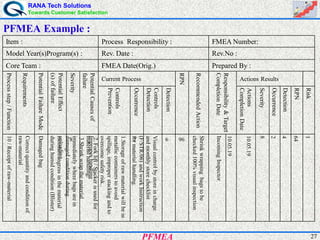
    RANA Tech Solutions TowardsCustomer Satisfaction 27PFMEA Item : Process Responsibility : FMEA Number: Model Year(s)Program(s) : Rev. Date : Rev.No : Core Team : FMEA Date(Orig.) Prepared By : Processstep/Function Requirements PotentialFailureMode PotentialEffect (s)offailure Severity PotentialCausesof failure Current Process RPN RecommendedAction Responsibility&Target CompletionDate Actions Results Controls Prevention Occurrence Controls Detection Detection Actions CompletionDate Severity Occurrence Detection RPN Risk 10/Receiptofraw-material Correctquantityandconditionof raw-material Damagedbag moistureingressinthematerial duringhumidcondition(Blister) 8 Improperhandling 1.Storageofrawmaterialwillbein metalliccontainerstoavoid spillage,improperstackingandto overcomesafetyrisk.. 2.Forklift/Stackerisusedfor materialhandling. 3.Shrinkwrapthematerial immediatelywherebagsarein damagedconditionduring unloading 2 Visualcontrolbystoreincharge andmonthlystorechecklist (F/STR/06)andworkInstruction formaterialhandling. 6 96 Shrinkwrappingbagstobe checked100%visualinspection IncomingInspector 10.05.19 10.05.19 8 2 4 64 1 PFMEA Example :
  • 28.
    RANA Tech Solutions TowardsCustomer Satisfaction 28 Any Questions, ??? Thanks.