The Digestive System Life Science 5 8/08
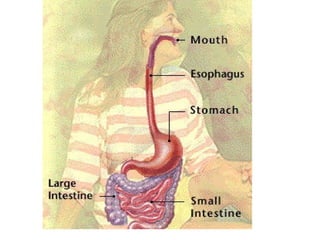
The  digestive system  is a group of organs that process the food we eat and takes out the nutrients our bodies need.
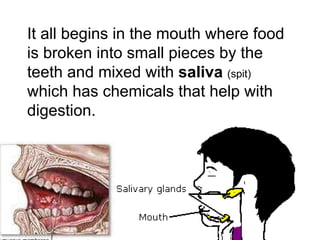
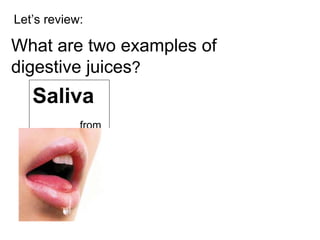
It all begins in the mouth where food is broken into small pieces by the teeth and mixed with  saliva  (spit)  which has chemicals that help with digestion.
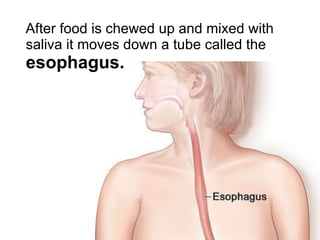
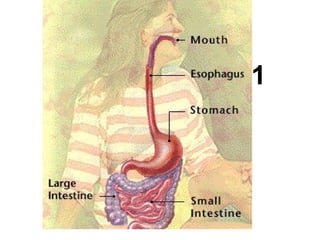
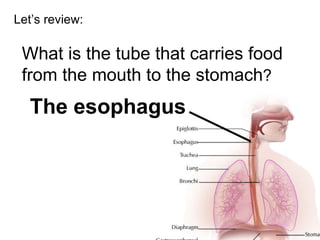
After food is chewed up and mixed with saliva it moves down a tube called the  esophagus.
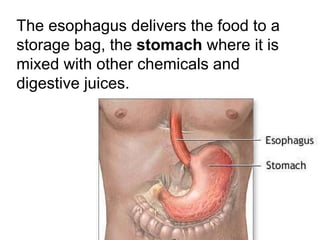
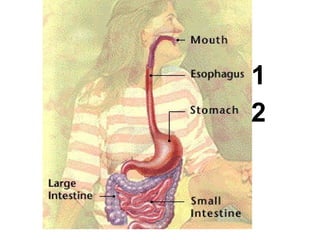
The esophagus delivers the food to a storage bag, the  stomach  where it is mixed with other chemicals and digestive juices.
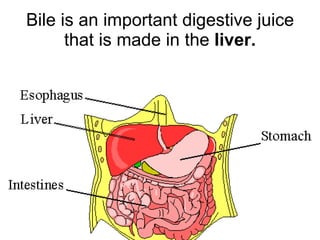
Bile is an important digestive juice that is made in the  liver.
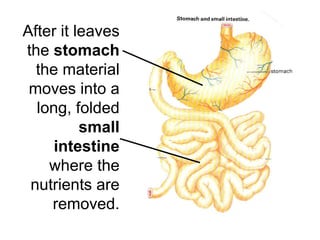
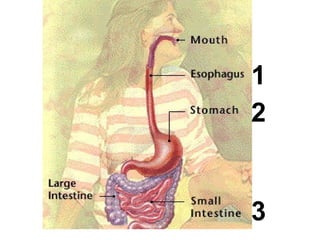
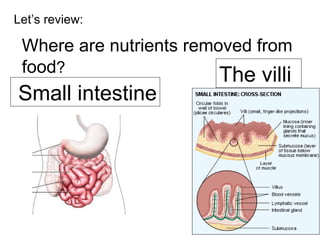
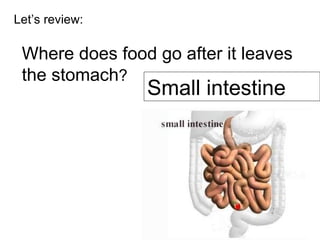
After it leaves the  stomach  the material moves into a long, folded  small intestine  where the nutrients are removed.
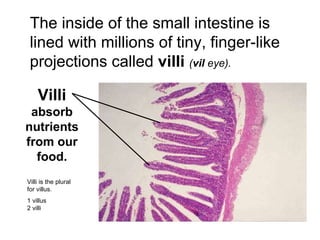
The inside of the small intestine is lined with millions of tiny, finger-like projections called  villi  ( vil  eye). Villi  absorb nutrients from our food. Villi is the plural for villus. 1 villus  2 villi
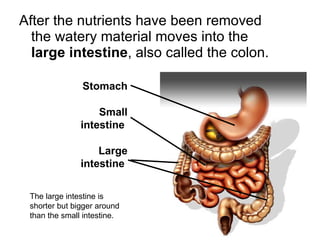
After the nutrients have been removed the watery material moves into the  large intestine , also called the colon. The large intestine is shorter but bigger around than the small intestine. Stomach Small intestine  Large intestine
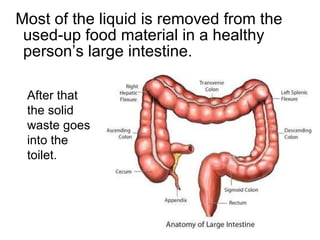
Most of the liquid is removed from the used-up food material in a healthy person’s large intestine.  After that the solid waste goes into the toilet.
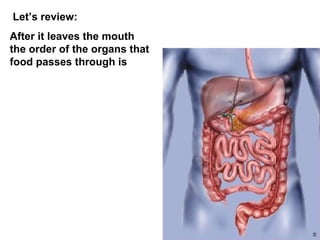
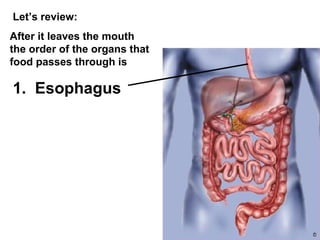
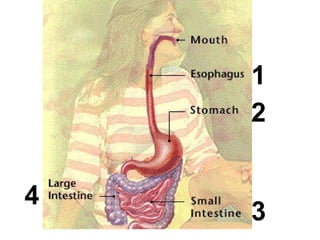
Let’s review: After it leaves the mouth the order of the organs that food passes through is
Let’s review: After it leaves the mouth the order of the organs that food passes through is 1.  Esophagus
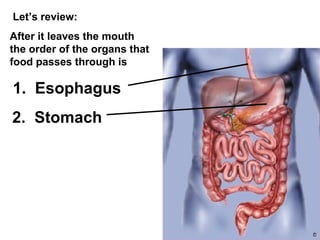
Let’s review: After it leaves the mouth the order of the organs that food passes through is 1.  Esophagus 2.  Stomach
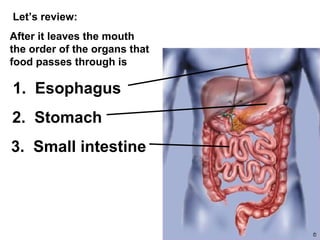
Let’s review: After it leaves the mouth the order of the organs that food passes through is 1.  Esophagus 2.  Stomach 3.  Small intestine
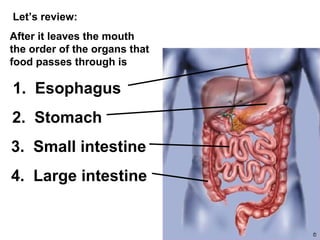
Let’s review: After it leaves the mouth the order of the organs that food passes through is 1.  Esophagus 2.  Stomach 3.  Small intestine 4.  Large intestine
 
1
1 2
1 2 3
1 2 3 4
 
Excretory system
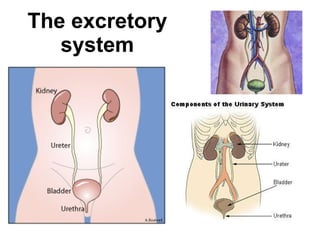
The excretory system removes cellular waste  from the blood.
The excretory system removes cellular waste  from the blood. It’s often called the  urinary system  because urine is how the waste leaves  the body.
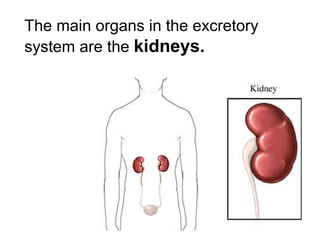
The main organs in the excretory system are the  kidneys.
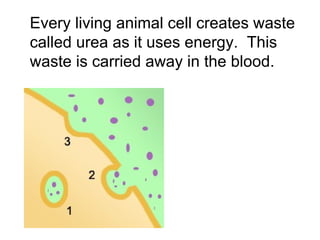
Every living animal cell creates waste called urea as it uses energy.  This waste is carried away in the blood.
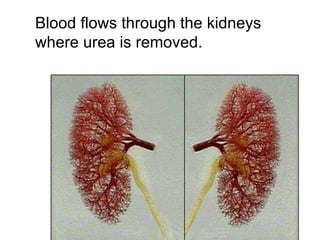
Blood flows through the kidneys where urea is removed.
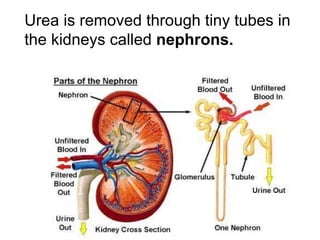
Urea is removed through tiny tubes in the kidneys called  nephrons.
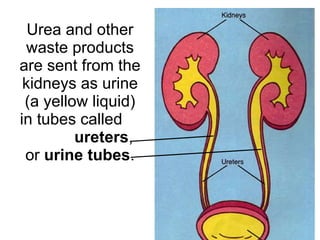
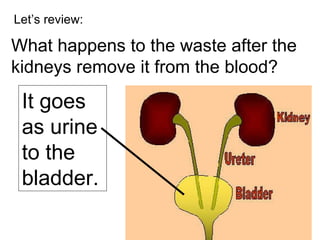
Urea and other waste products are sent from the kidneys as urine (a yellow liquid)  in tubes called  jjjjjjjjjjjj ureters ,  or  urine tubes .
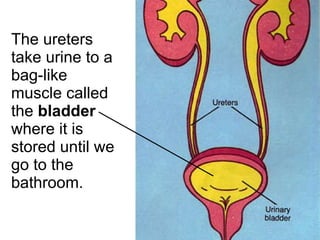
The ureters take urine to a bag-like muscle called the  bladder  where it is stored until we go to the bathroom.
The excretory system
Let’s review: What is the tube that carries food from the mouth to the stomach ?
Let’s review: What is the tube that carries food from the mouth to the stomach ? The esophagus
Let’s review: Where does food go after it leaves the stomach ?
Let’s review: Where does food go after it leaves the stomach ? Small intestine
Let’s review: Where is most water removed from food material before it leaves the body ?
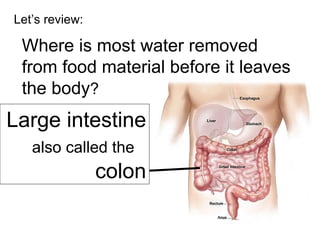
Let’s review: Where is most water removed from food material before it leaves the body ? Large intestine  also called the   colon
Let’s review: Where are nutrients removed from food ?
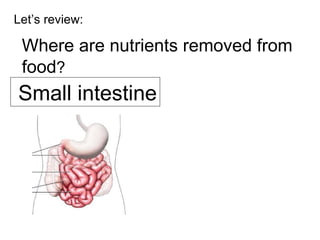
Let’s review: Where are nutrients removed from food ? Small intestine
Let’s review: Where are nutrients removed from food ? Small intestine The villi
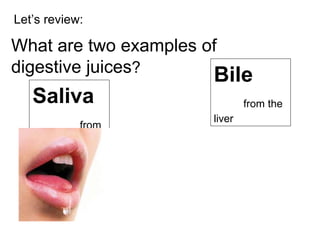
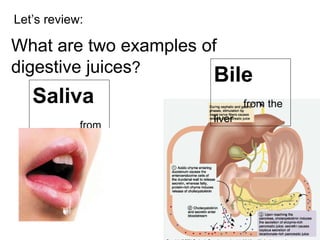
Let’s review: What are two examples of  digestive juices ?
Let’s review: What are two examples of  digestive juices ? Saliva   from the mouth
Let’s review: What are two examples of  digestive juices ? Saliva   from the mouth Bile   from the liver
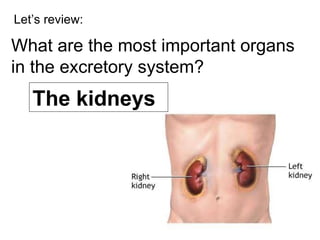
Let’s review: What are the most important organs in the excretory system?
Let’s review: What are the most important organs in the excretory system? The kidneys
Let’s review: What do the kidneys do?
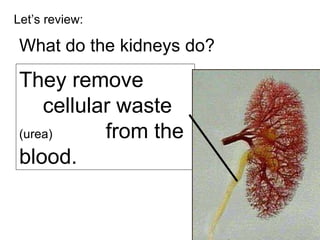
Let’s review: What do the kidneys do? They remove  cellular waste  (urea)   from the blood.
Let’s review: What happens to the waste after the kidneys remove it from the blood?
Let’s review: What happens to the waste after the kidneys remove it from the blood? It goes as urine to the bladder.
 

Digestive and excretory systems

  • 1.
    The Digestive SystemLife Science 5 8/08
  • 2.
    The digestivesystem is a group of organs that process the food we eat and takes out the nutrients our bodies need.
  • 3.
    It all beginsin the mouth where food is broken into small pieces by the teeth and mixed with saliva (spit) which has chemicals that help with digestion.
  • 4.
    After food ischewed up and mixed with saliva it moves down a tube called the esophagus.
  • 5.
    The esophagus deliversthe food to a storage bag, the stomach where it is mixed with other chemicals and digestive juices.
  • 6.
    Bile is animportant digestive juice that is made in the liver.
  • 7.
    After it leavesthe stomach the material moves into a long, folded small intestine where the nutrients are removed.
  • 8.
    The inside ofthe small intestine is lined with millions of tiny, finger-like projections called villi ( vil eye). Villi absorb nutrients from our food. Villi is the plural for villus. 1 villus 2 villi
  • 9.
    After the nutrientshave been removed the watery material moves into the large intestine , also called the colon. The large intestine is shorter but bigger around than the small intestine. Stomach Small intestine Large intestine
  • 10.
    Most of theliquid is removed from the used-up food material in a healthy person’s large intestine. After that the solid waste goes into the toilet.
  • 11.
    Let’s review: Afterit leaves the mouth the order of the organs that food passes through is
  • 12.
    Let’s review: Afterit leaves the mouth the order of the organs that food passes through is 1. Esophagus
  • 13.
    Let’s review: Afterit leaves the mouth the order of the organs that food passes through is 1. Esophagus 2. Stomach
  • 14.
    Let’s review: Afterit leaves the mouth the order of the organs that food passes through is 1. Esophagus 2. Stomach 3. Small intestine
  • 15.
    Let’s review: Afterit leaves the mouth the order of the organs that food passes through is 1. Esophagus 2. Stomach 3. Small intestine 4. Large intestine
  • 16.
  • 17.
  • 18.
  • 19.
  • 20.
  • 21.
  • 22.
  • 23.
    The excretory systemremoves cellular waste from the blood.
  • 24.
    The excretory systemremoves cellular waste from the blood. It’s often called the urinary system because urine is how the waste leaves the body.
  • 25.
    The main organsin the excretory system are the kidneys.
  • 26.
    Every living animalcell creates waste called urea as it uses energy. This waste is carried away in the blood.
  • 27.
    Blood flows throughthe kidneys where urea is removed.
  • 28.
    Urea is removedthrough tiny tubes in the kidneys called nephrons.
  • 29.
    Urea and otherwaste products are sent from the kidneys as urine (a yellow liquid) in tubes called jjjjjjjjjjjj ureters , or urine tubes .
  • 30.
    The ureters takeurine to a bag-like muscle called the bladder where it is stored until we go to the bathroom.
  • 31.
  • 32.
    Let’s review: Whatis the tube that carries food from the mouth to the stomach ?
  • 33.
    Let’s review: Whatis the tube that carries food from the mouth to the stomach ? The esophagus
  • 34.
    Let’s review: Whatis the tube that carries food from the mouth to the stomach ? The esophagus
  • 35.
    Let’s review: Wheredoes food go after it leaves the stomach ?
  • 36.
    Let’s review: Wheredoes food go after it leaves the stomach ? Small intestine
  • 37.
    Let’s review: Wheredoes food go after it leaves the stomach ? Small intestine
  • 38.
    Let’s review: Whereis most water removed from food material before it leaves the body ?
  • 39.
    Let’s review: Whereis most water removed from food material before it leaves the body ? Large intestine also called the colon
  • 40.
    Let’s review: Whereis most water removed from food material before it leaves the body ? Large intestine also called the colon
  • 41.
    Let’s review: Whereare nutrients removed from food ?
  • 42.
    Let’s review: Whereare nutrients removed from food ? Small intestine
  • 43.
    Let’s review: Whereare nutrients removed from food ? Small intestine The villi
  • 44.
    Let’s review: Whatare two examples of digestive juices ?
  • 45.
    Let’s review: Whatare two examples of digestive juices ? Saliva from the mouth
  • 46.
    Let’s review: Whatare two examples of digestive juices ? Saliva from the mouth
  • 47.
    Let’s review: Whatare two examples of digestive juices ? Saliva from the mouth Bile from the liver
  • 48.
    Let’s review: Whatare two examples of digestive juices ? Saliva from the mouth Bile from the liver
  • 49.
    Let’s review: Whatare the most important organs in the excretory system?
  • 50.
    Let’s review: Whatare the most important organs in the excretory system? The kidneys
  • 51.
    Let’s review: Whatare the most important organs in the excretory system? The kidneys
  • 52.
    Let’s review: Whatdo the kidneys do?
  • 53.
    Let’s review: Whatdo the kidneys do? They remove cellular waste (urea) from the blood.
  • 54.
    Let’s review: Whatdo the kidneys do? They remove cellular waste (urea) from the blood.
  • 55.
    Let’s review: Whathappens to the waste after the kidneys remove it from the blood?
  • 56.
    Let’s review: Whathappens to the waste after the kidneys remove it from the blood? It goes as urine to the bladder.
  • 57.
    Let’s review: Whathappens to the waste after the kidneys remove it from the blood? It goes as urine to the bladder.
  • 58.