


Pranabjyoti Das
Arunodoi Jr
INTRODUCTION
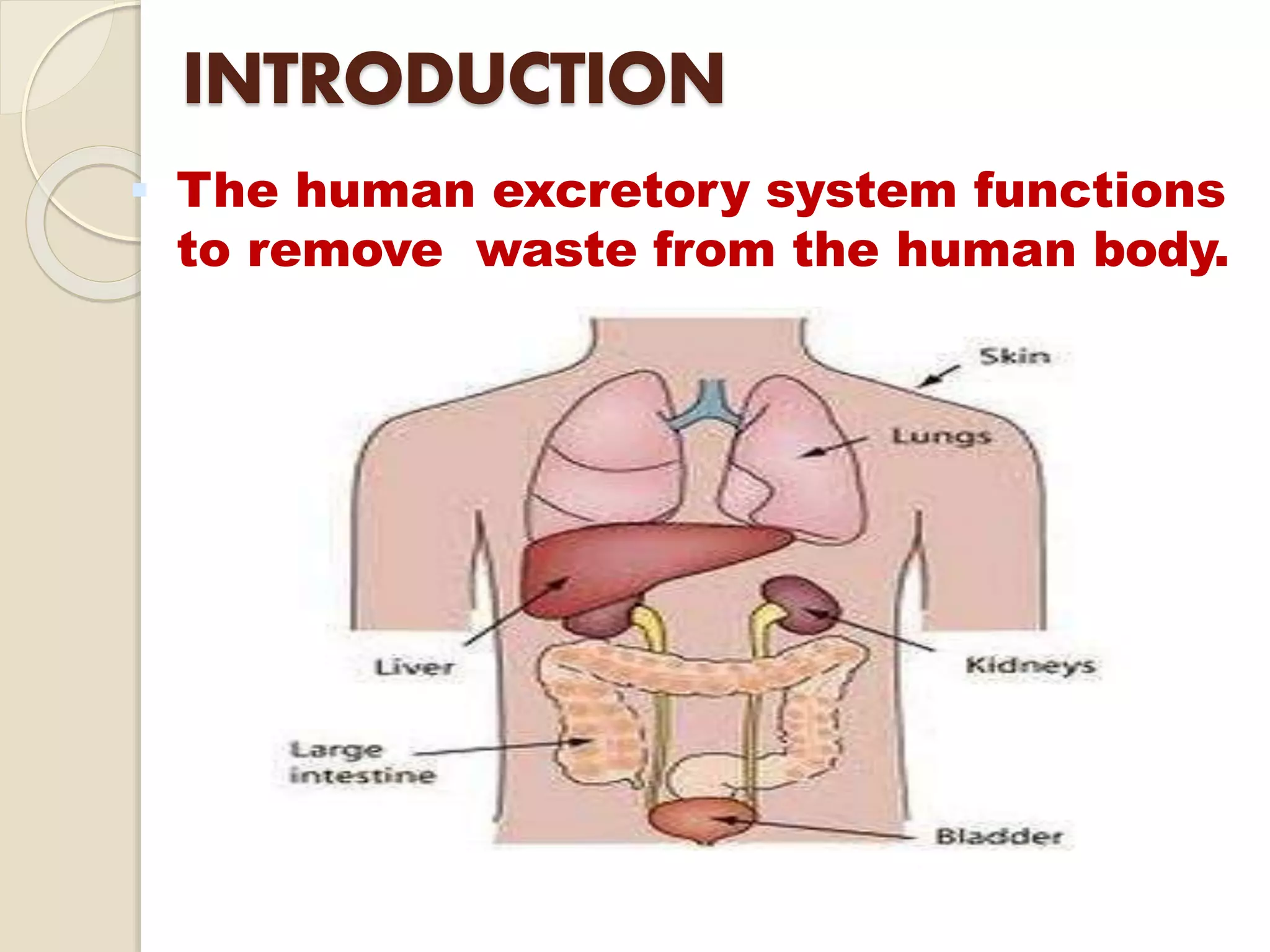
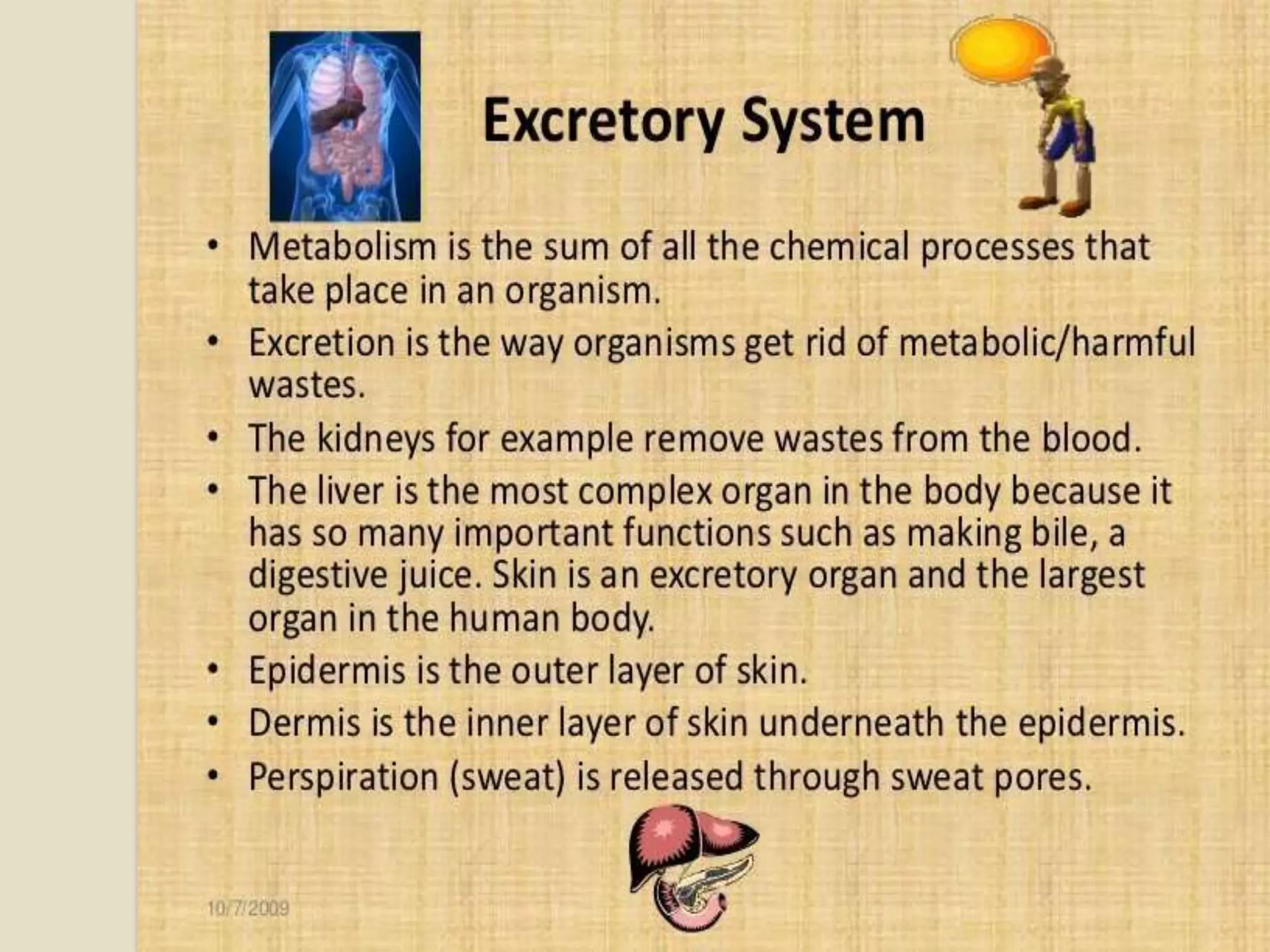
 The human excretory system functions
to remove waste from the human body.
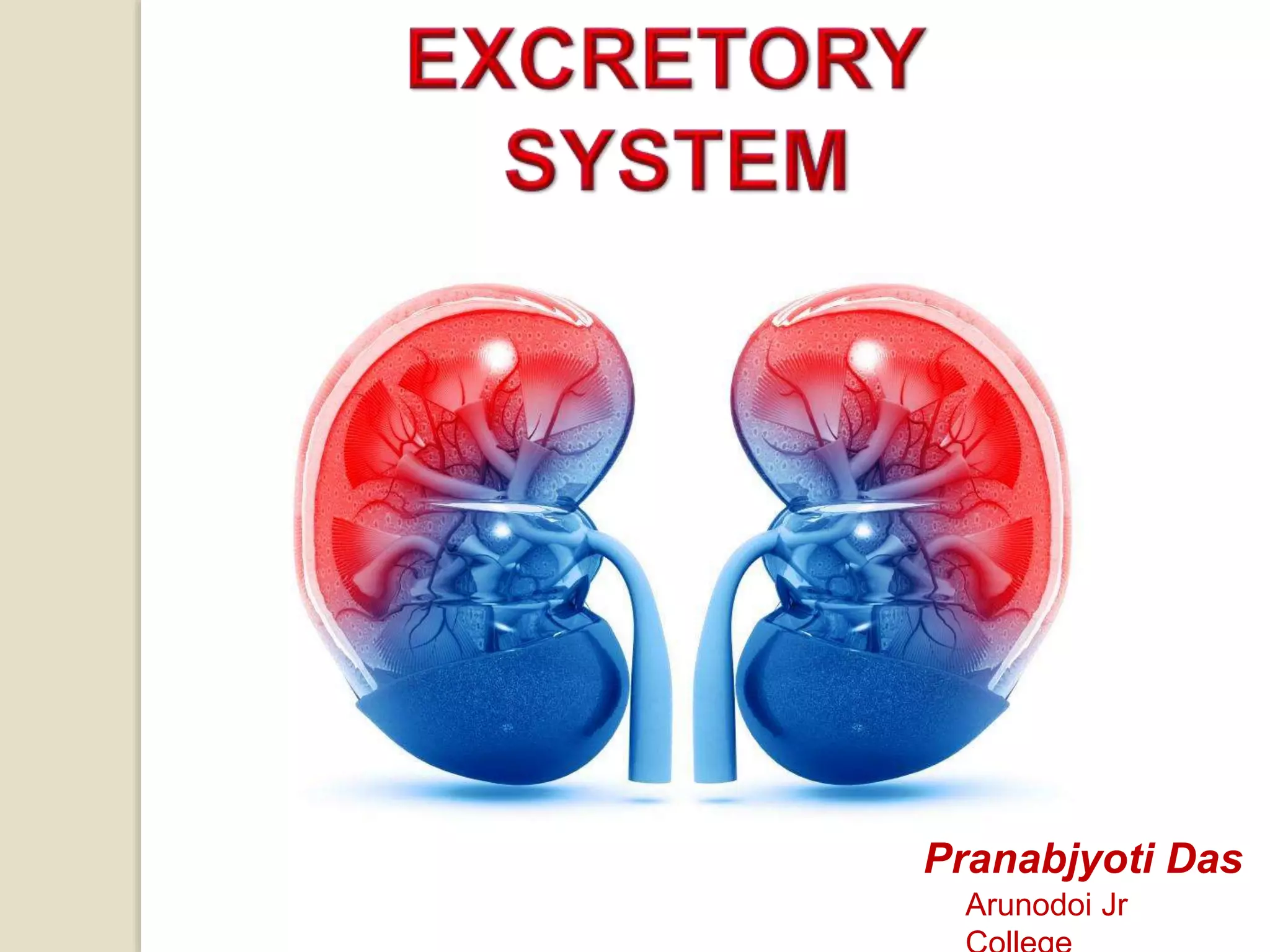
EXCRETORY SYSTEM
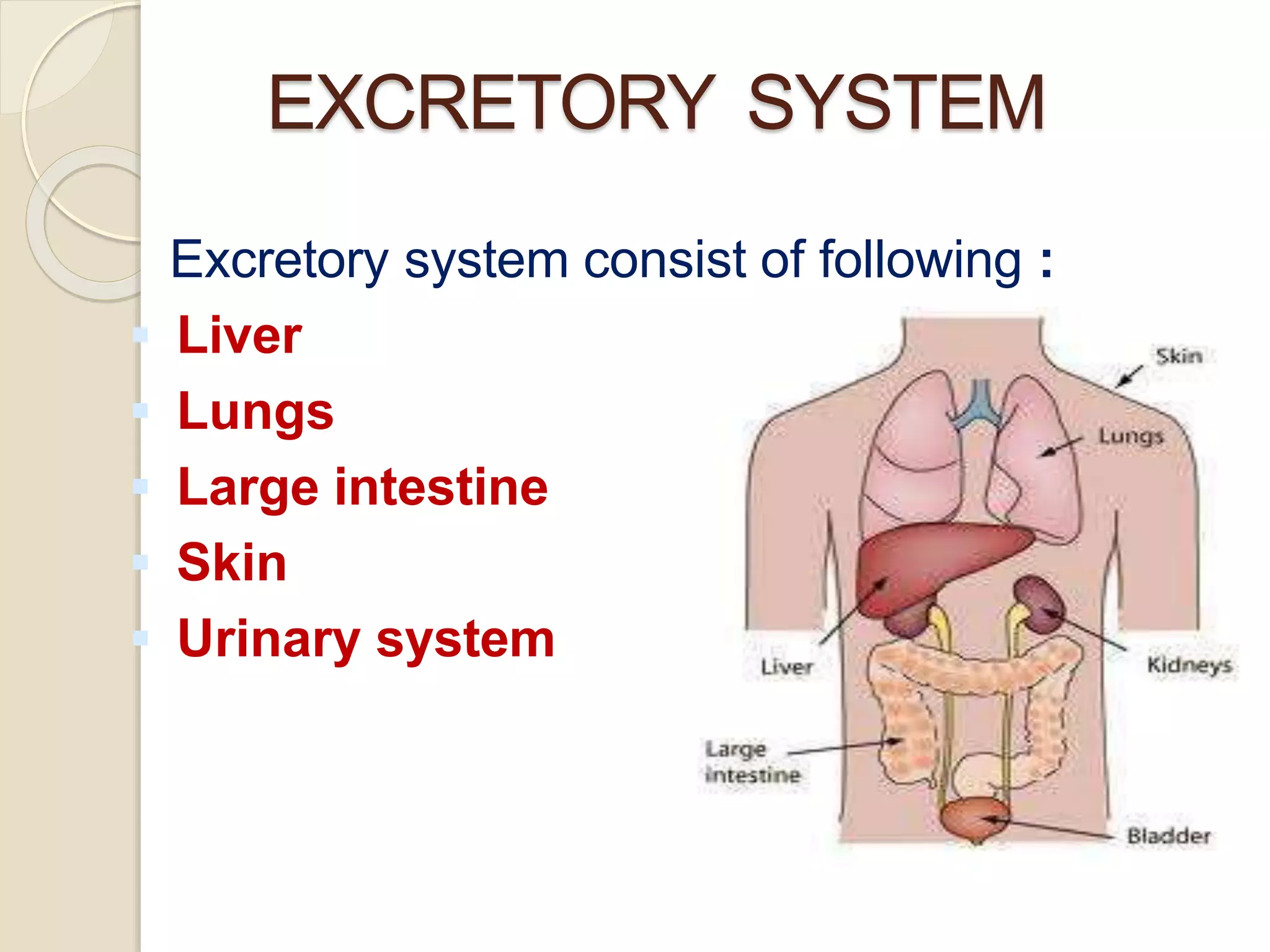
Excretory system consist of following :
 Liver
 Lungs
 Large intestine
 Skin
 Urinary system
LIVER
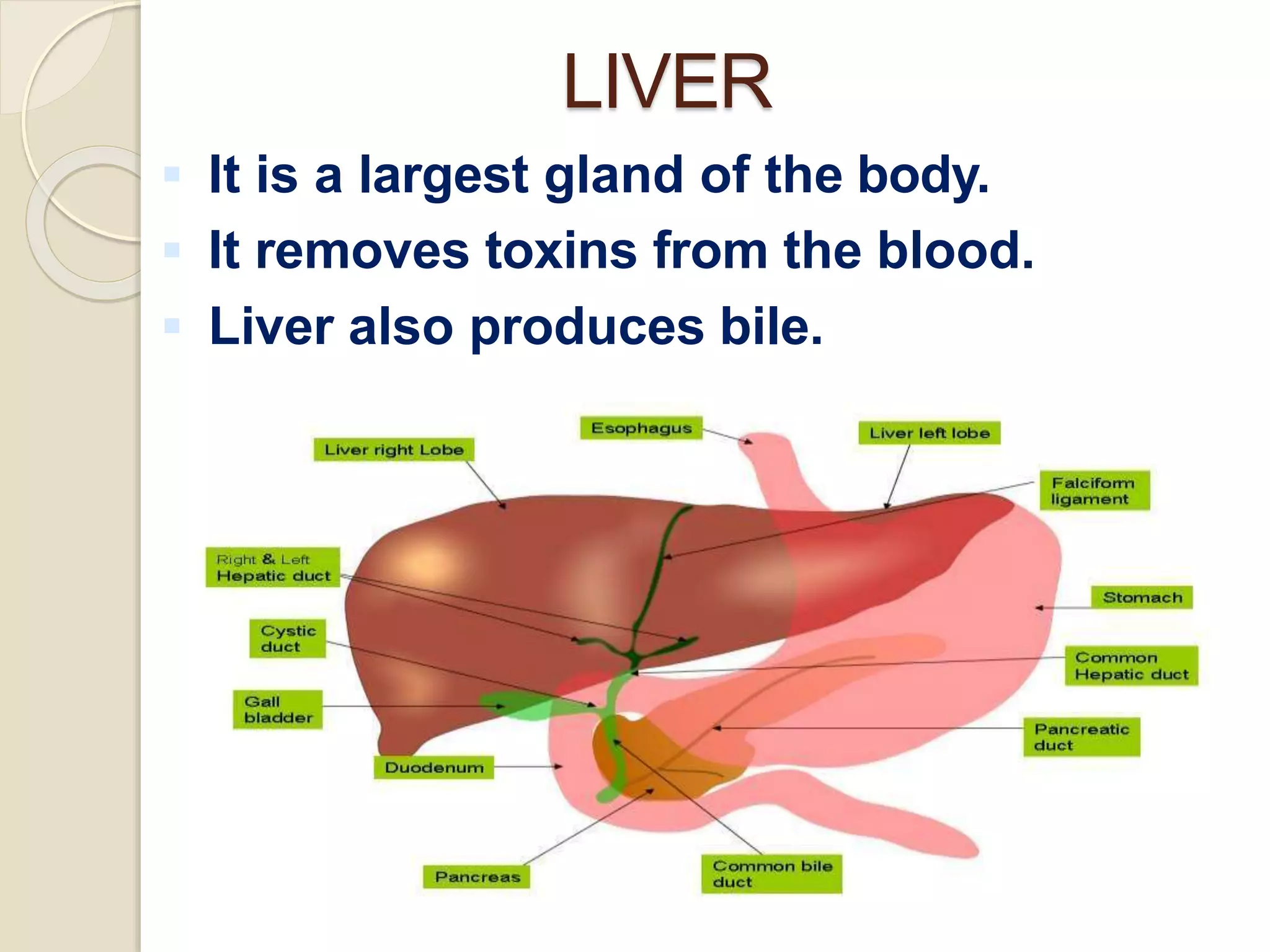
 It is a largest gland of the body.
 It removes toxins from the blood.
 Liver also produces bile.
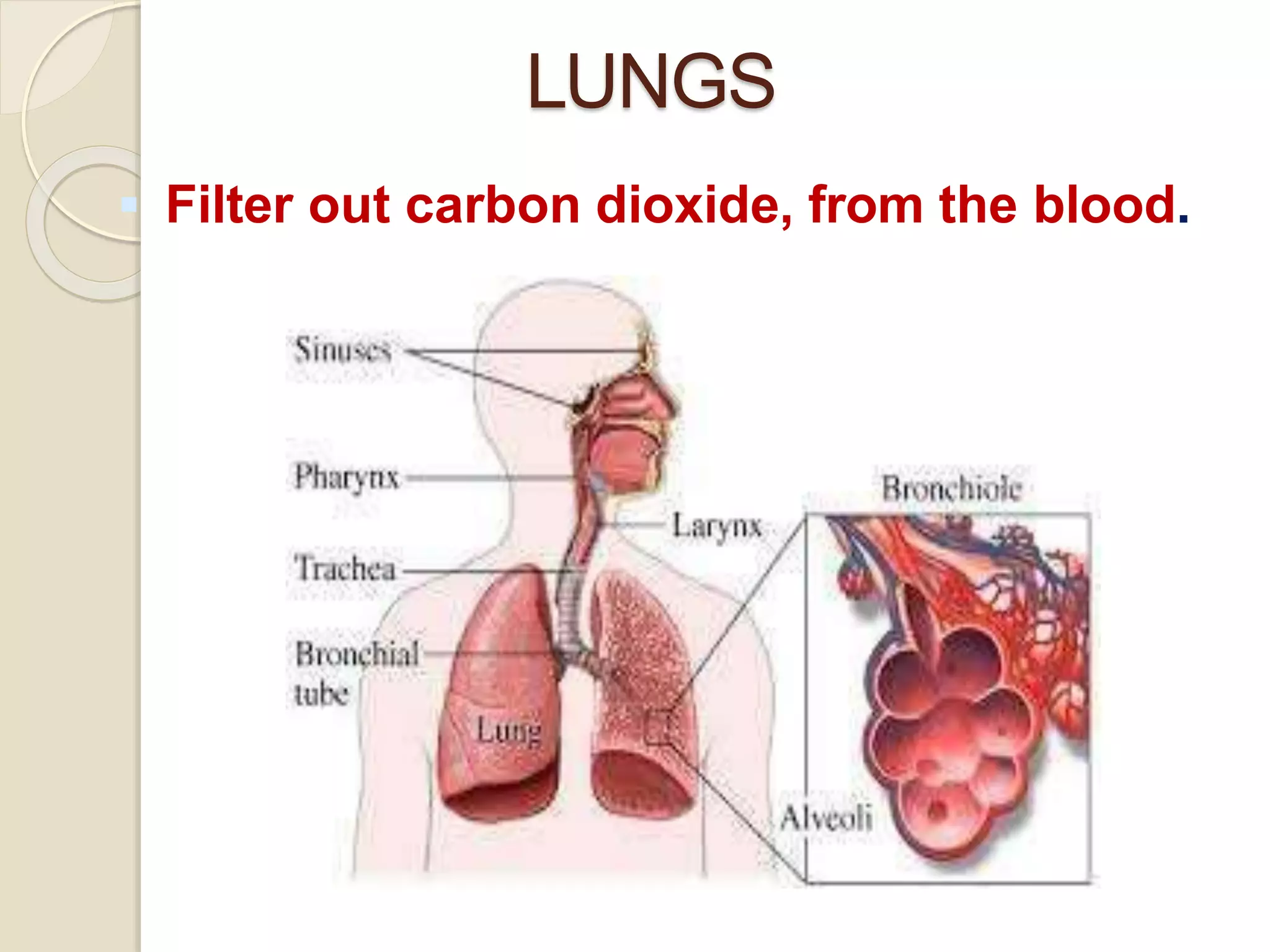
LUNGS
 Filter out carbon dioxide, from the blood.
Large Intestine
 It collects waste from throughout the body.
 Extracts any remaining usable water and then
 removes solidwaste.
SKIN
 Excretes sweat through sweat glands.
Helps to keep the body cool when it is warm.
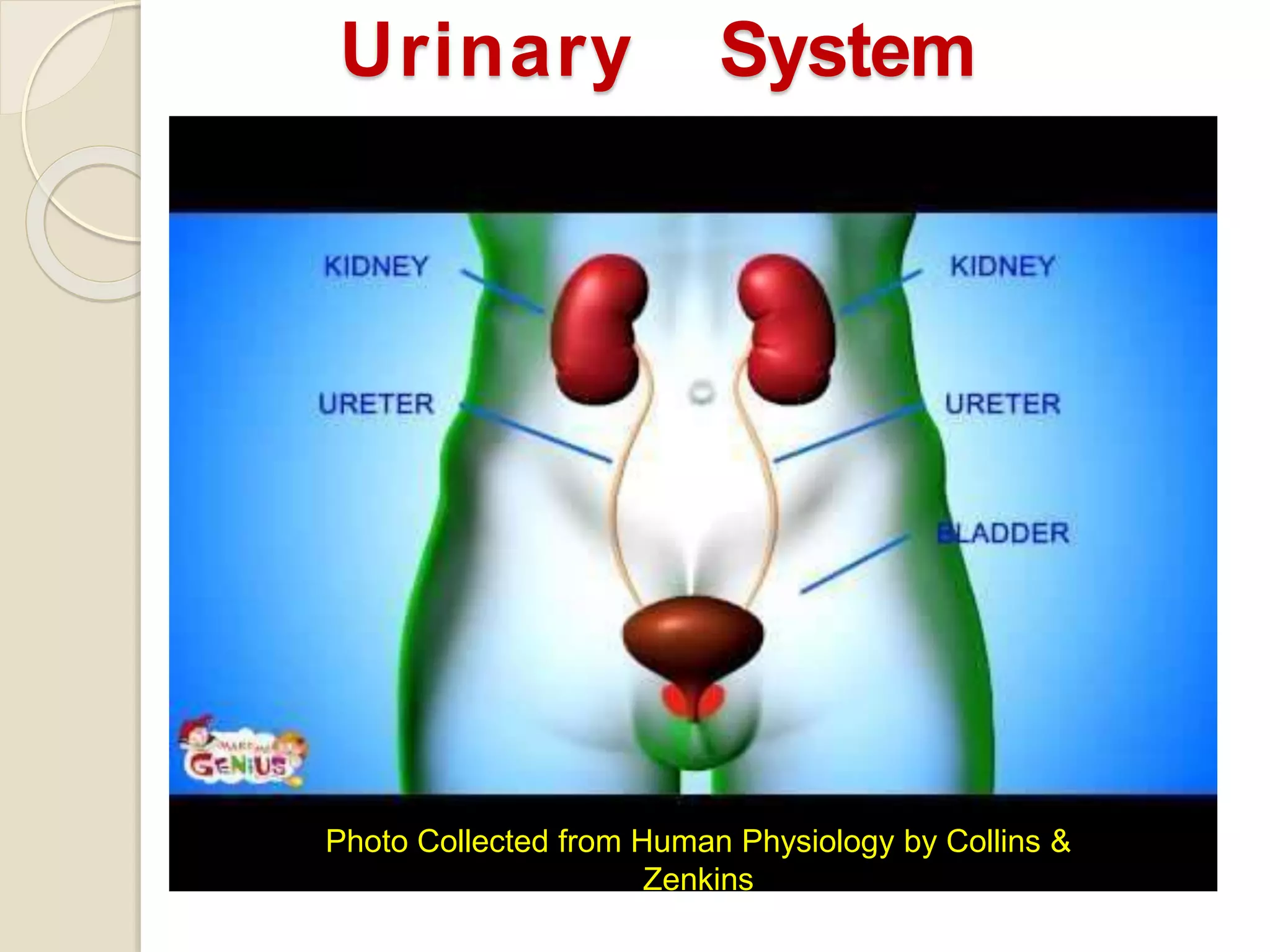
Urinary System
Photo Collected from Human Physiology by Collins &
Zenkins
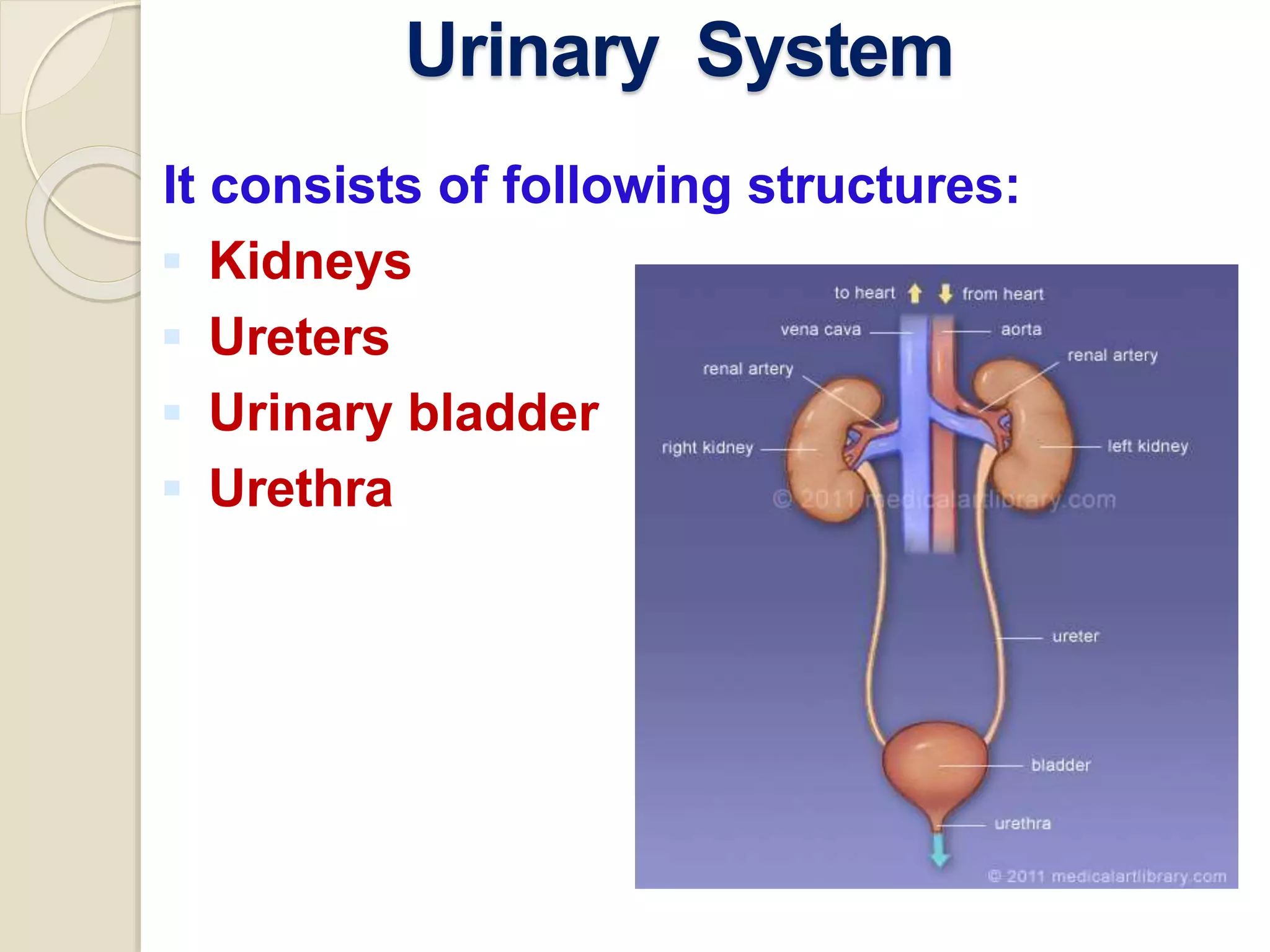
Urinary System
It consists of following structures:
 Kidneys
 Ureters
 Urinary bladder
 Urethra
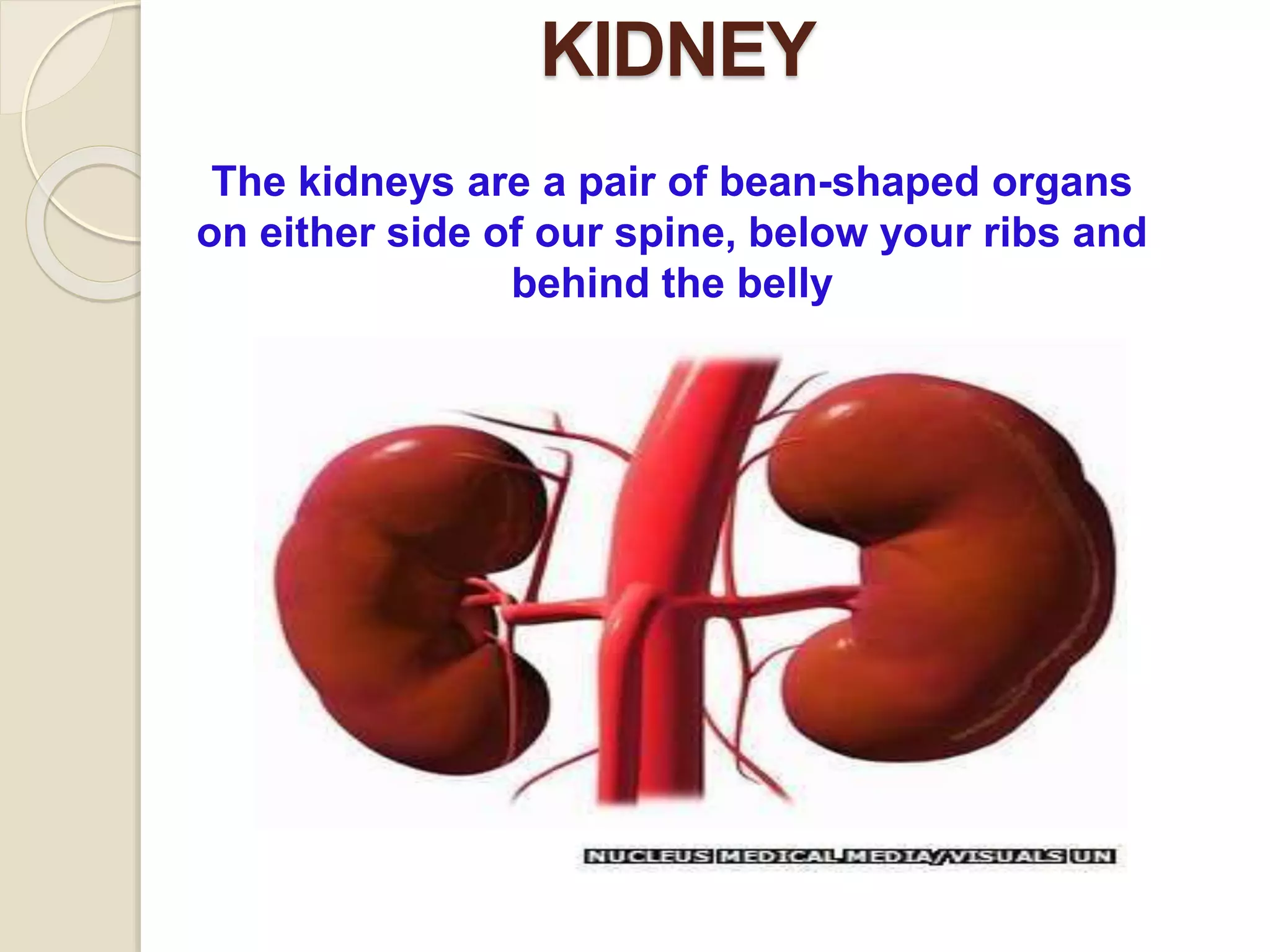
KIDNEY
The kidneys are a pair of bean-shaped organs
on either side of our spine, below your ribs and
behind the belly
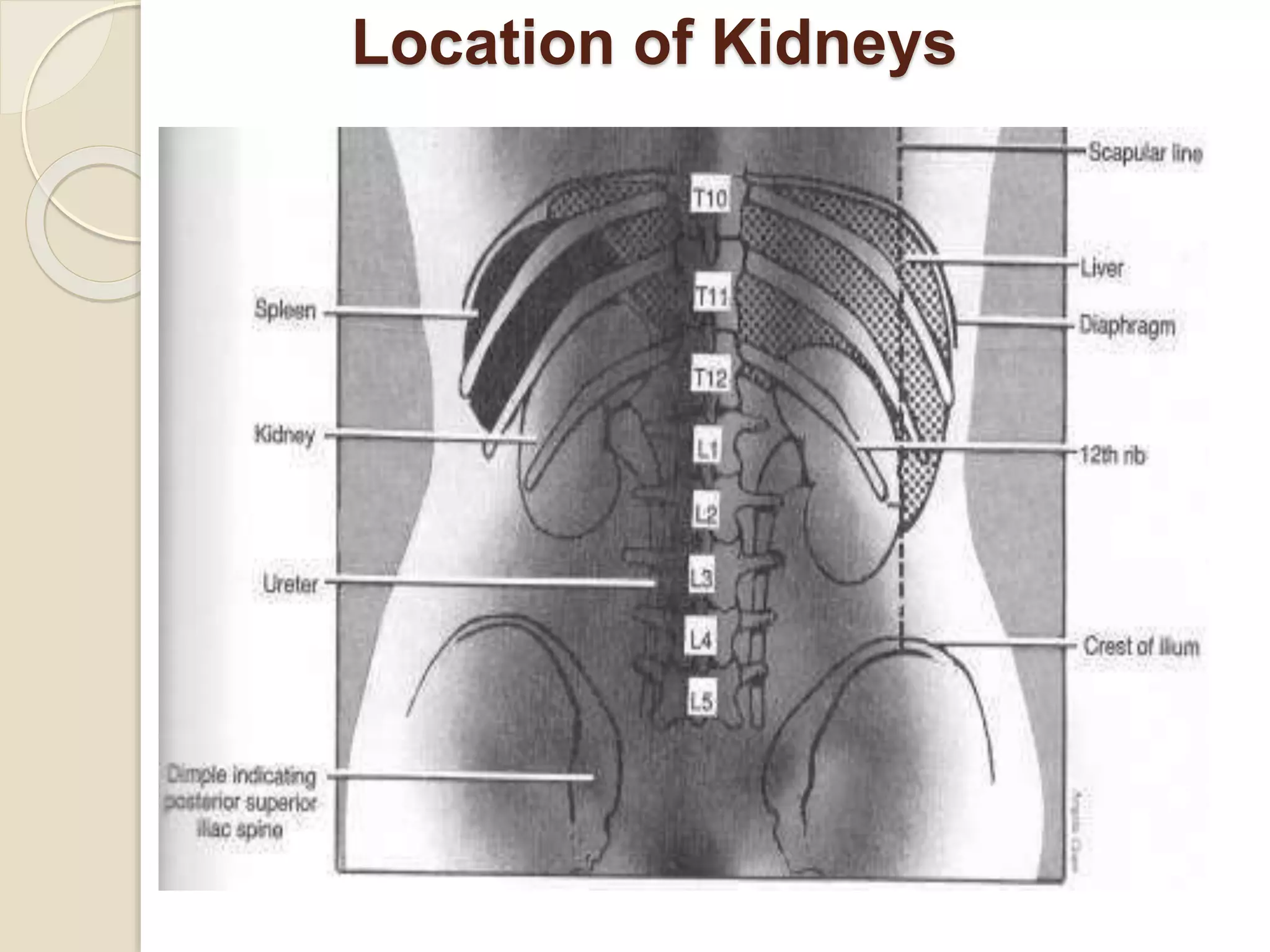
Location of Kidneys
KIDNEYS
 Kidneys lie in the abdominal cavity below the
diaphragm.
 Kidneys are present on each side of the
vertebral column.
 Kidneys extend from the level of 12th
thoracic vertebra to the 3rd lumbar vertebra.
 The right kidney is usually slightly lower in
position than the left.
 Each kidney is about 11 cm long, 6 cm wide,
 3 cm thick and weights about 125-170 gm.
Organs associated with the kidney
 LEFT KIDNEY
 Superiorly- the left adrenal gland.
 Anteriorly- the spleen, stomach, jejunumand
splenic flexure of the colon.
 Posteriorly - the diaphragm and muscles of the
posterior abdominalwall.
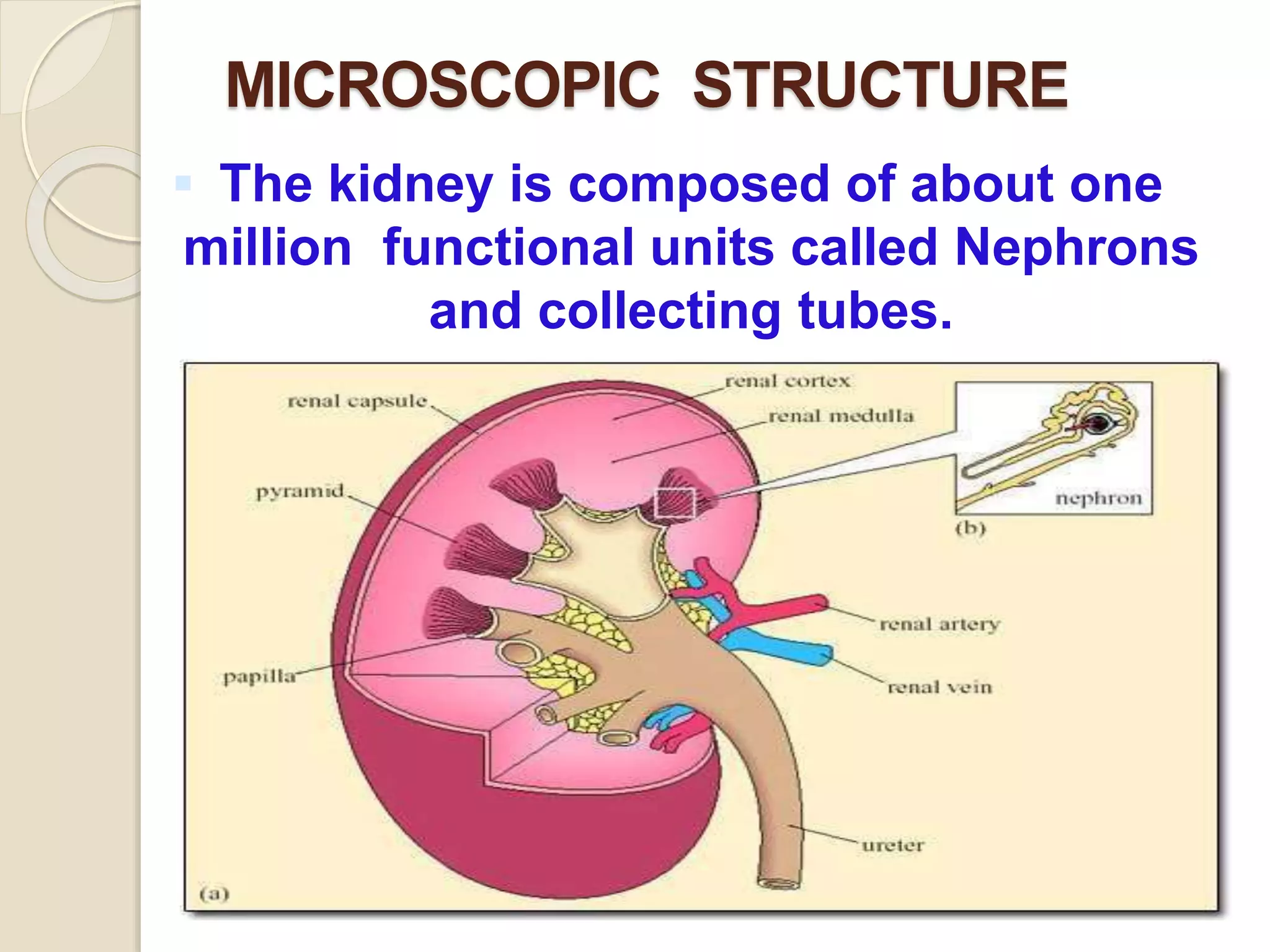
STRUCTURE OF THE KIDNEY
 Surrounding the kidney there is a
Fibrous capsule.
 A reddish brown layer of tissue is seen
in the kidney called as Cortex.
 The innermost layer consisting of pale
conical shaped striations is called renal
pyramids present in the Medulla.
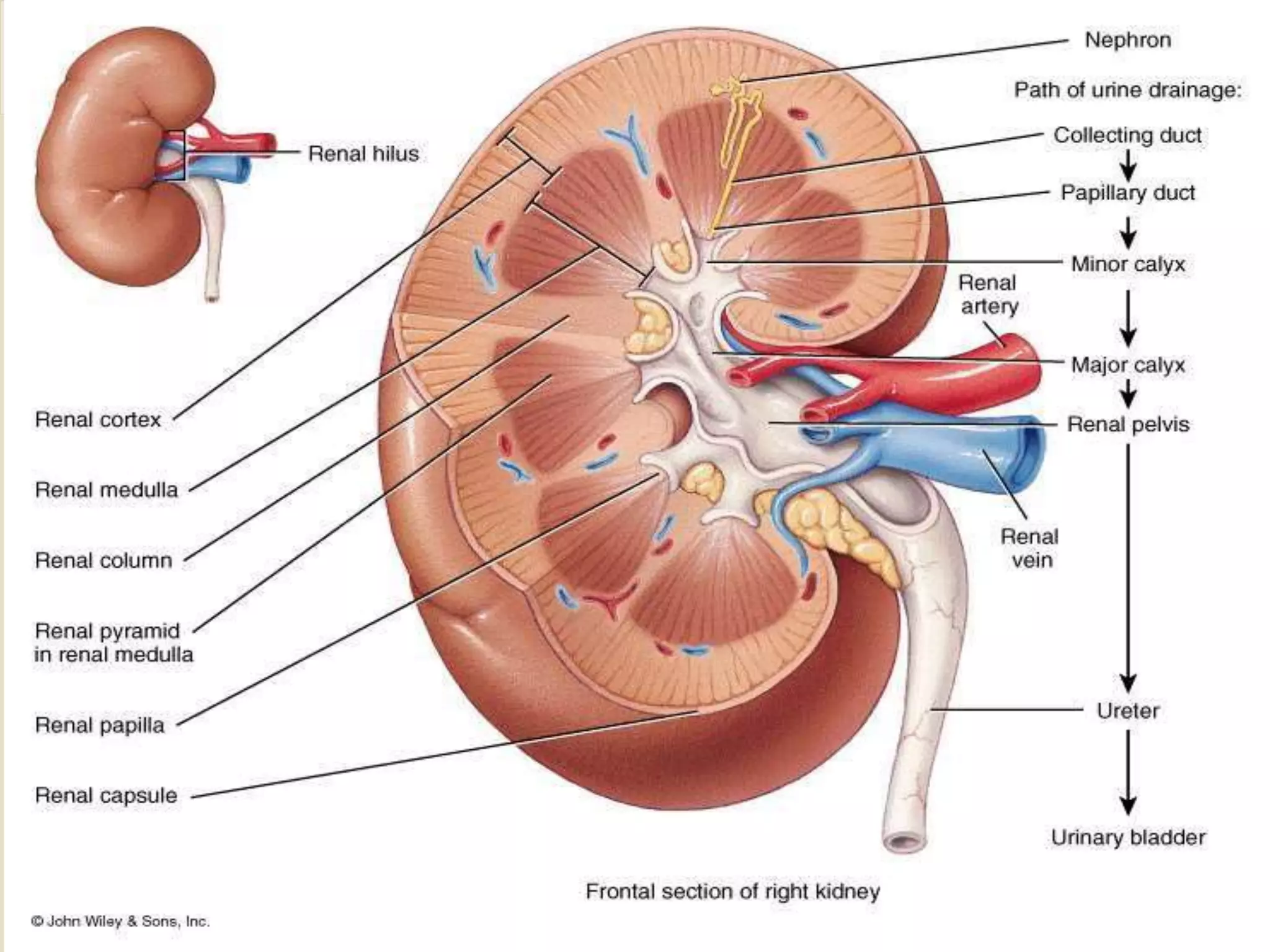
 Hilum: It is the concave medial
border of the kidney where the
renal blood and lymph vessels,
 the ureter and nerves enter.
It has a number of distal branches
called calyces. The calyces are of two
types. They are -
 Major calyx
 Minor calyx
MICROSCOPIC STRUCTURE
 The kidney is composed of about one
million functional units called Nephrons
and collecting tubes.
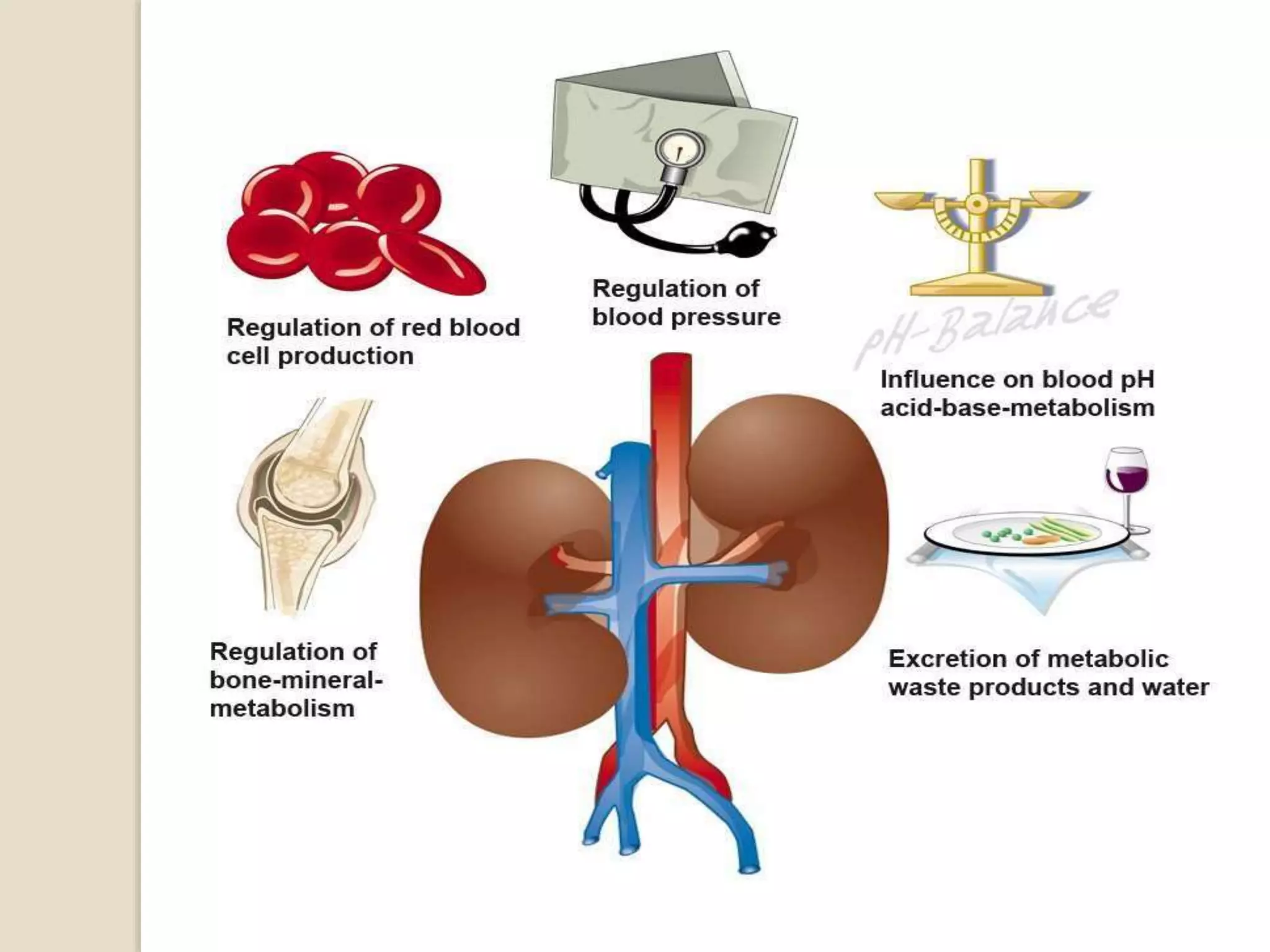
FUNCTIONS OF KIDNEY
 Formation of urine.
 Simple filtration.
 Selective reabsorption
 Secretion
 Water balance and urine output
 Electrolyte balance
BLOOD SUPPLY OF KIDNEY
 Kidney needs constant supply of blood in
order to control the composition of body
fluids.
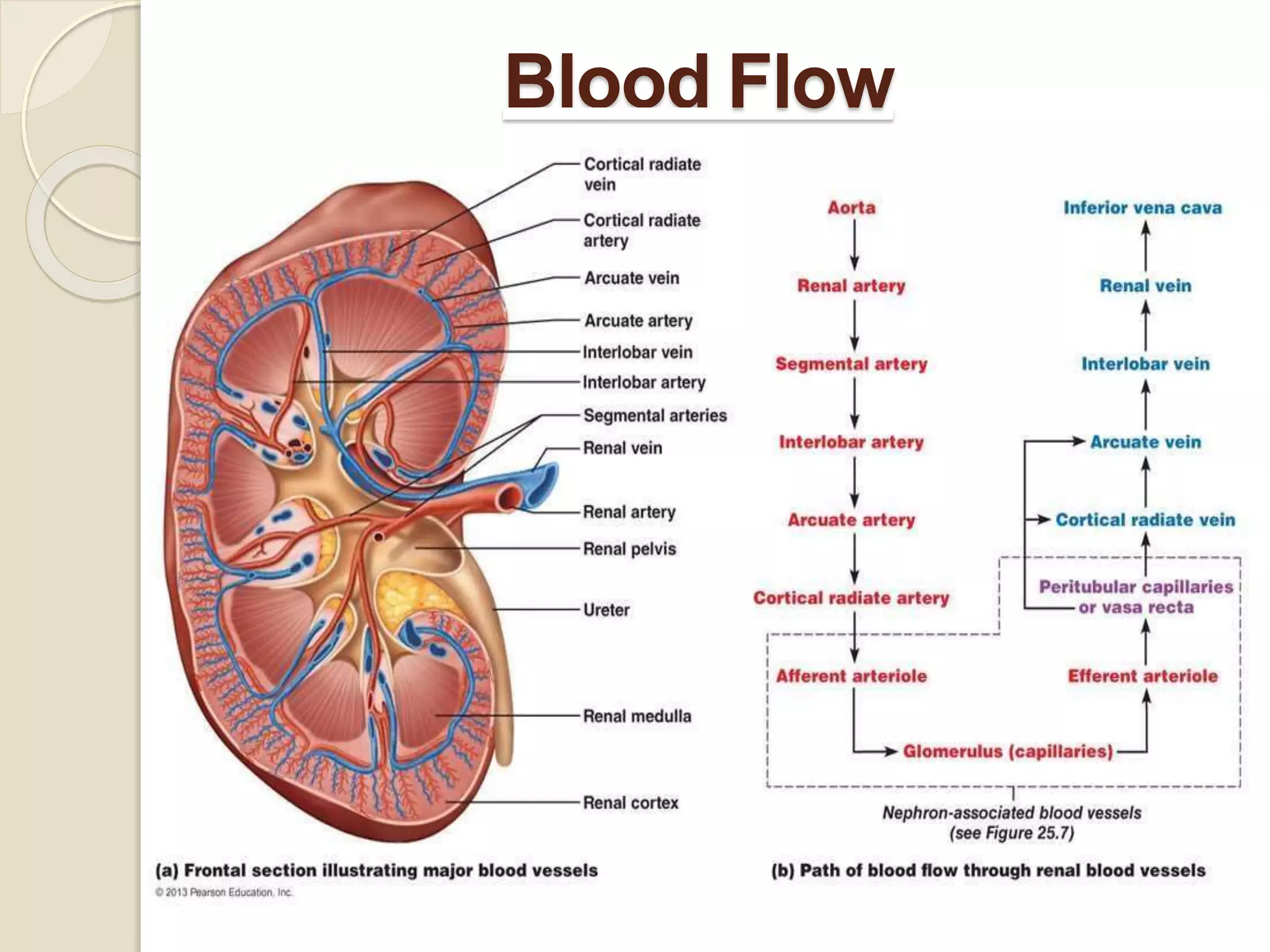
 Renal artery, a branch from aorta enters
the kidney at hilum.
 It supplies blood, rich in nitrogenous
waste, oxygen and nutrients.
 Renal vein carries deoxygenated blood to
the inferior vena cava and then to the
heart.
Blood Flow
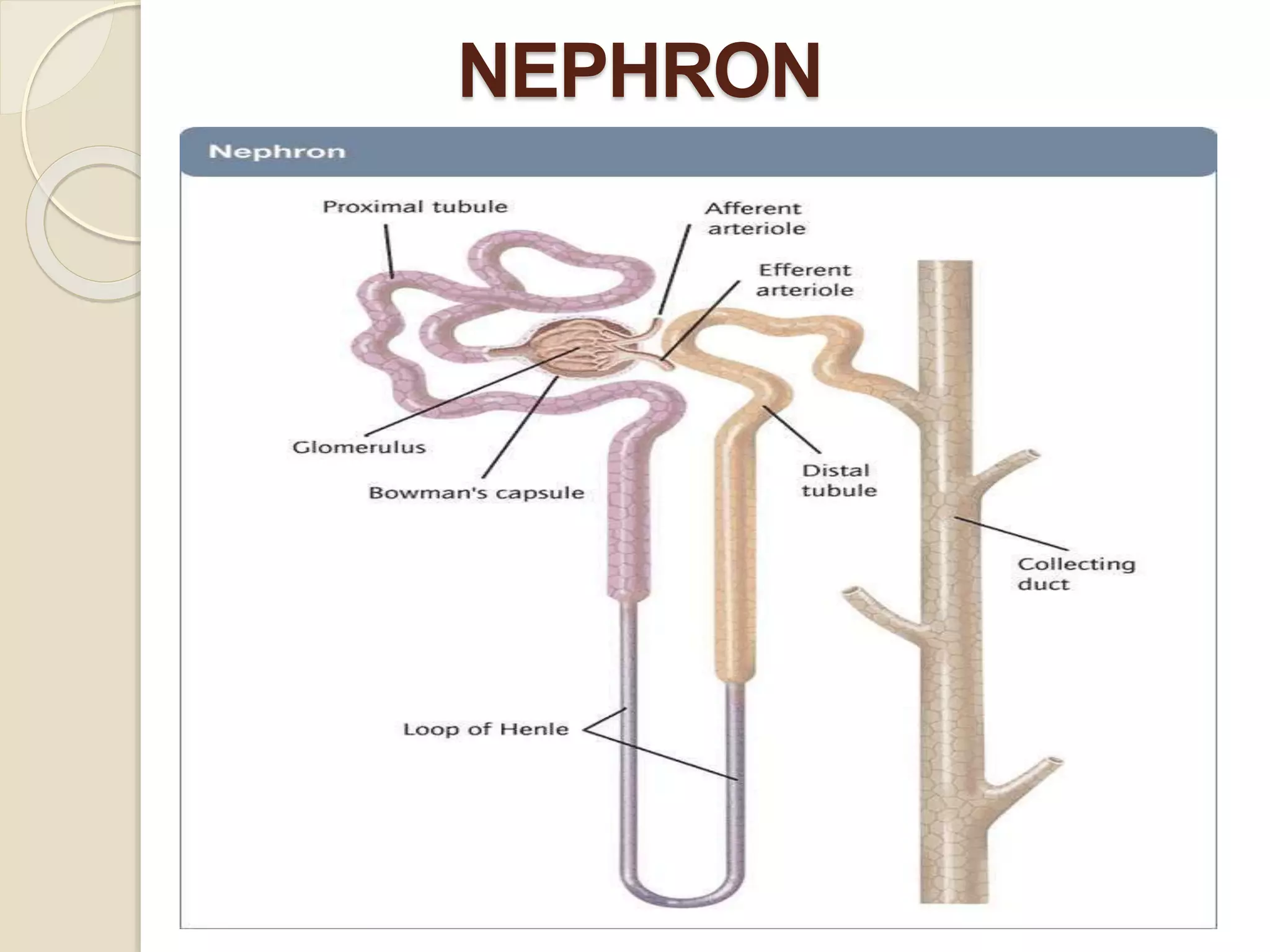
NEPHRON
NEPHRON
 Nephron Is the basic structural and
functional unit of the kidney.
Its chief functions are :-
 To regulate the concentration of water
and soluble substances
 Reabsorbing what is needed and
excreting the rest as urine
NEPHRON
I. It eliminates wastes from the body
II. It regulates blood volume and blood
pressure
III. It control levels of electrolytes and
metabolites
IV.It regulates blood pH.
NEPHRON
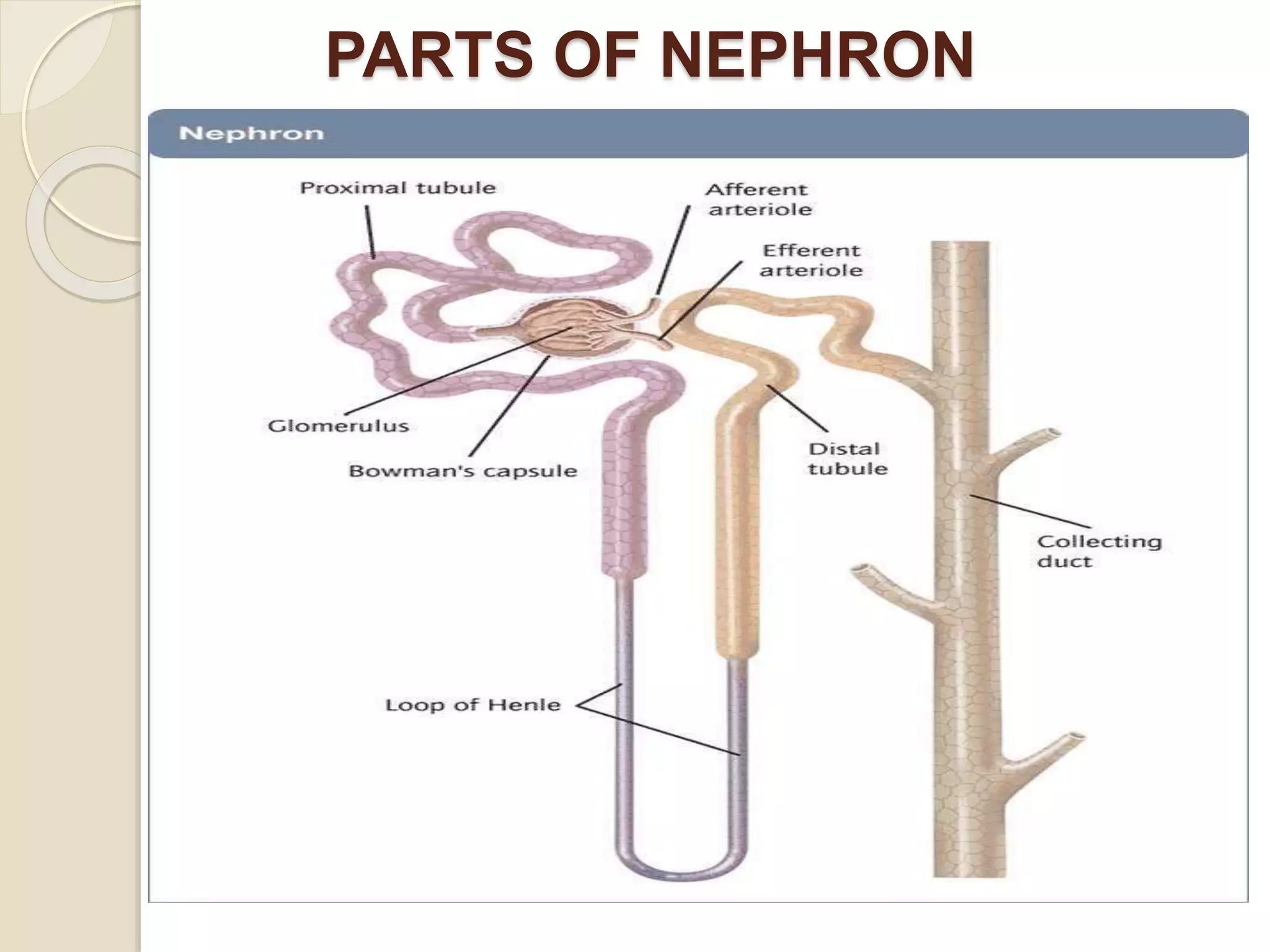
 Each nephron consists of the
following parts:
 Glomerulus
 Bowman’s capsule
 Proximal Convulated Tubule
 Loop of Henle
 Distal Convulated Tubule
 Collecting duct.
PARTS OF NEPHRON
 Loop of Henle: it consists of a descending
limb which continues into the thin segment
from which the thick ascending limb arises.
 Distal convoluted Tubule: Thick ascending
limb is continued with the distal convoluted
tubule.
 Collecting tubules: DCT joins to form
the collecting tubules.
PARTS OF NEPHRON
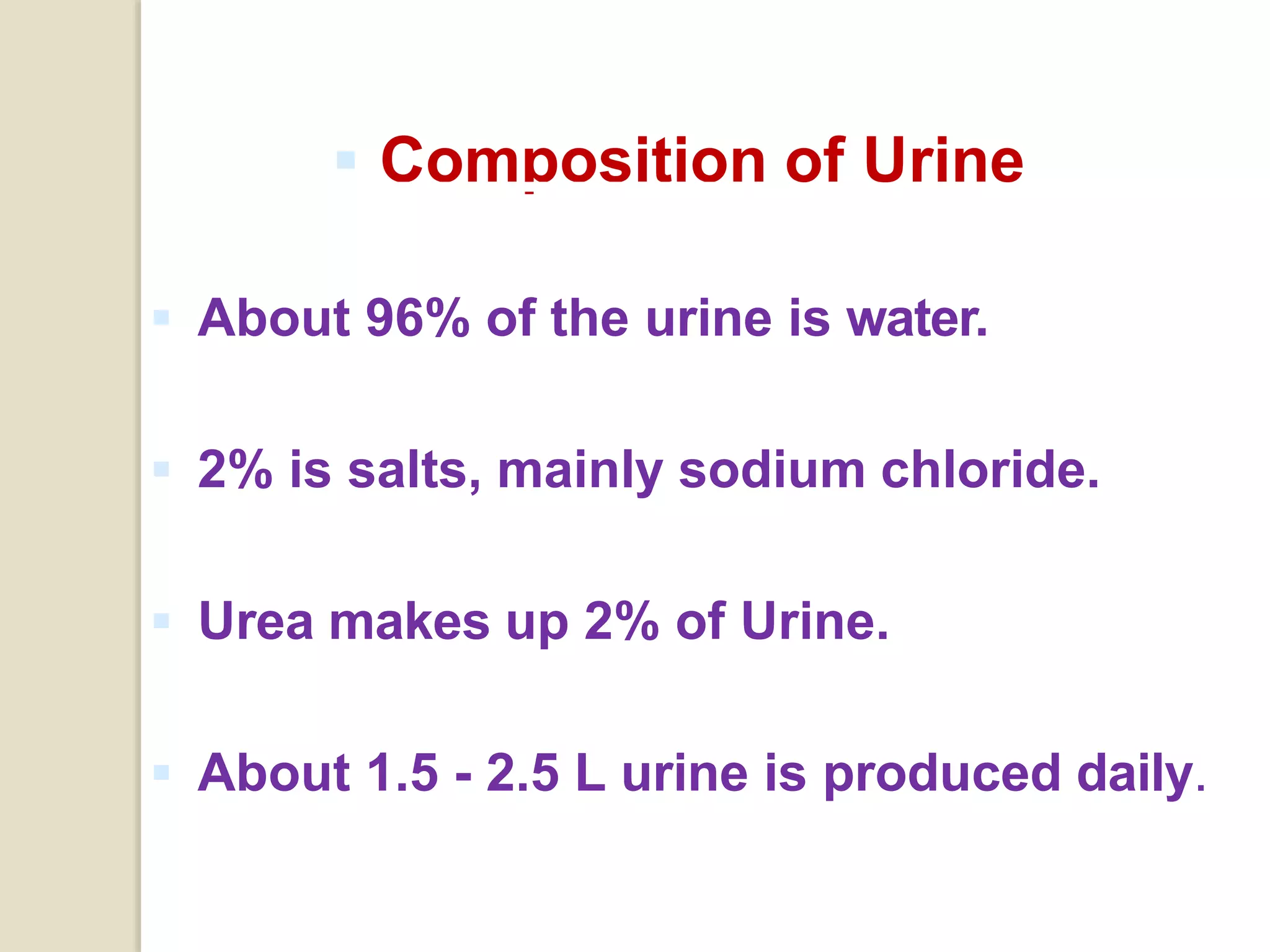
 Composition of Urine
 About 96% of the urine is water.
 2% is salts, mainly sodium chloride.
 Urea makes up 2% of Urine.
 About 1.5 - 2.5 L urine is produced daily.
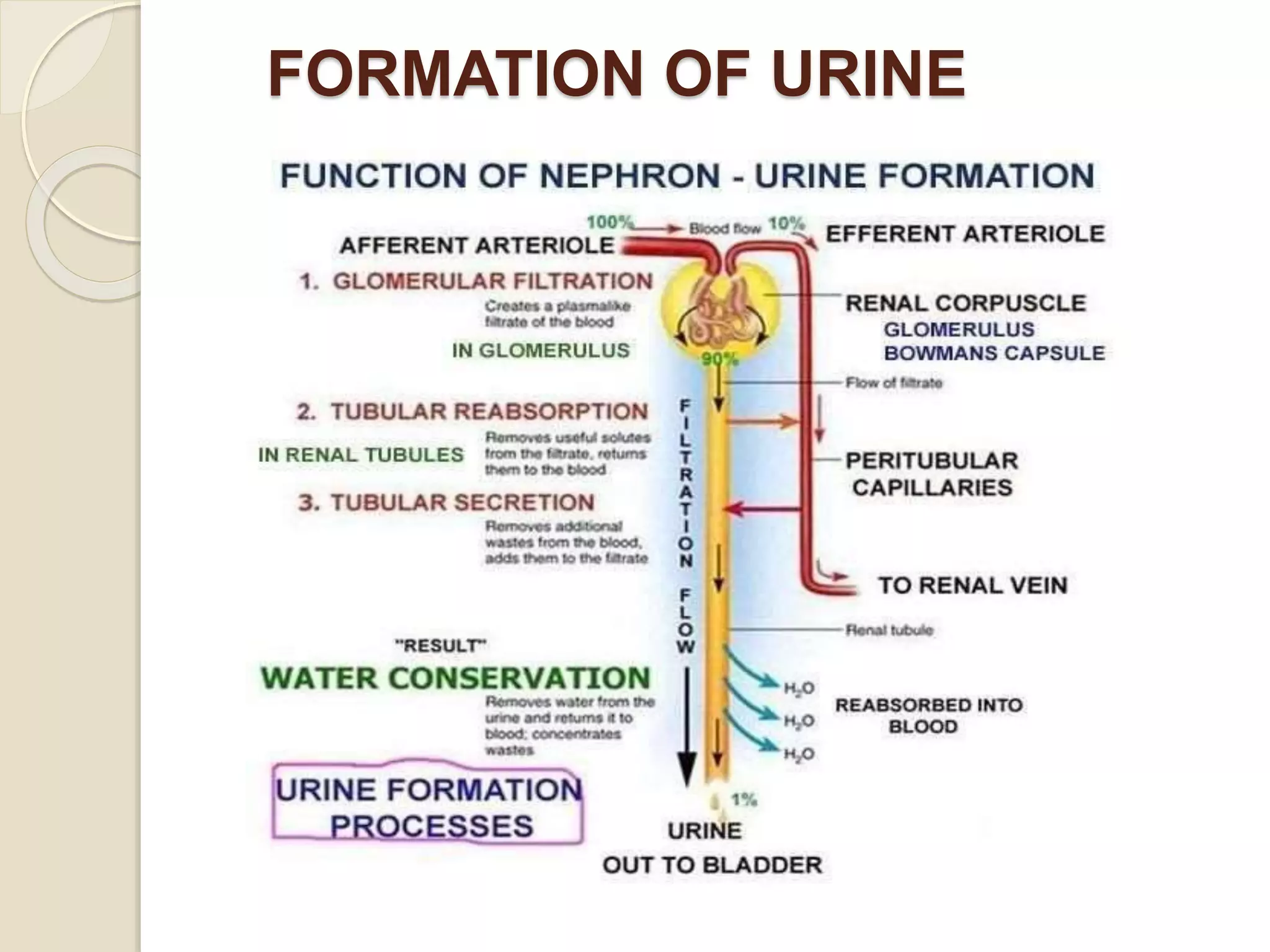
FORMATION OF URINE
FORMATION OF URINE
 The first step in urine formation is
filteration of blood in the kidneys.
 Nephron filter blood by regulating
concentration of water and soluble
substances like sodium salts.
 Reabsorbing is needed at the end
 before excreting the waste.
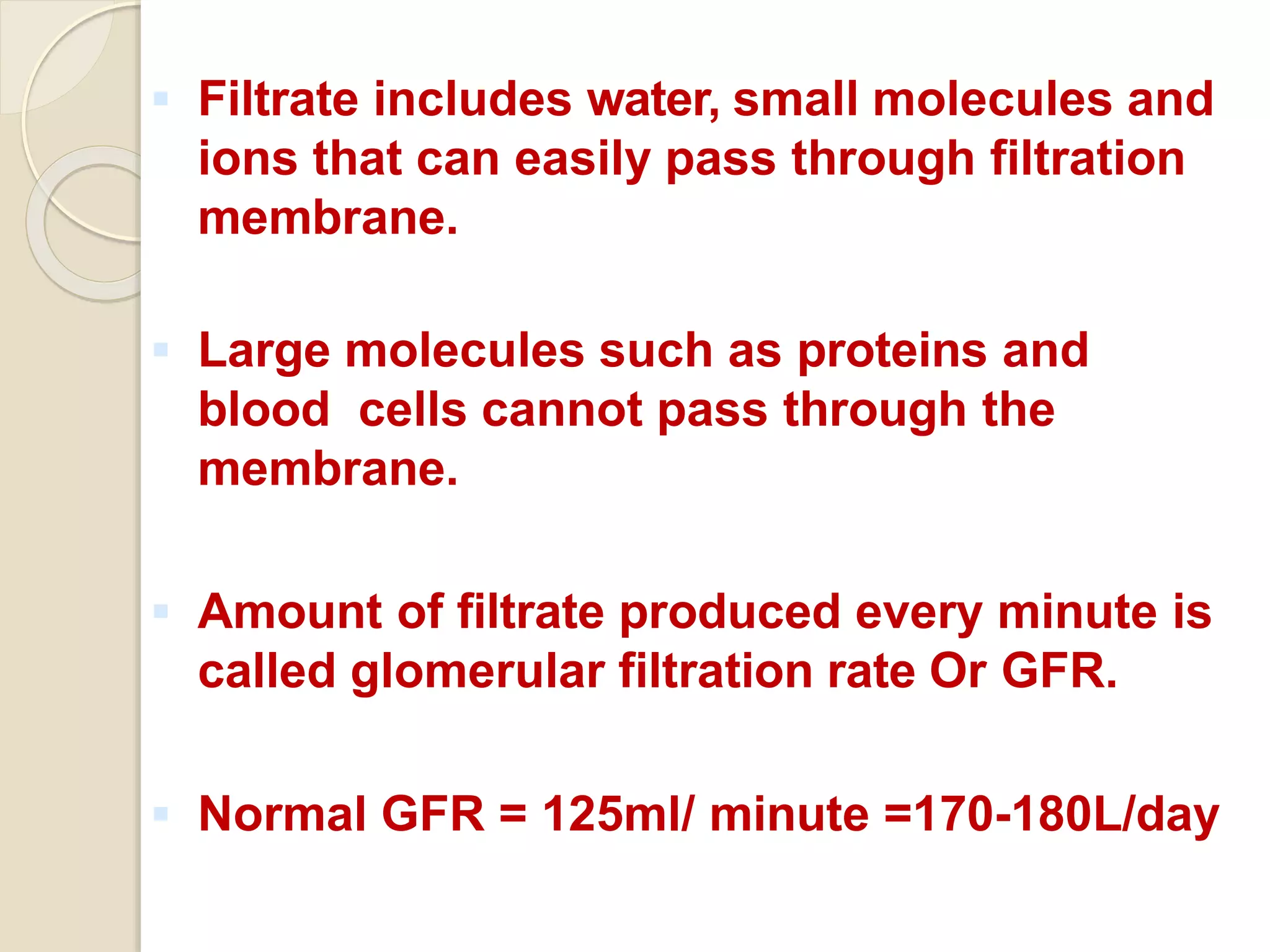
 Filtrate includes water, small molecules and
ions that can easily pass through filtration
membrane.
 Large molecules such as proteins and
blood cells cannot pass through the
membrane.
 Amount of filtrate produced every minute is
called glomerular filtration rate Or GFR.
 Normal GFR = 125ml/ minute =170-180L/day
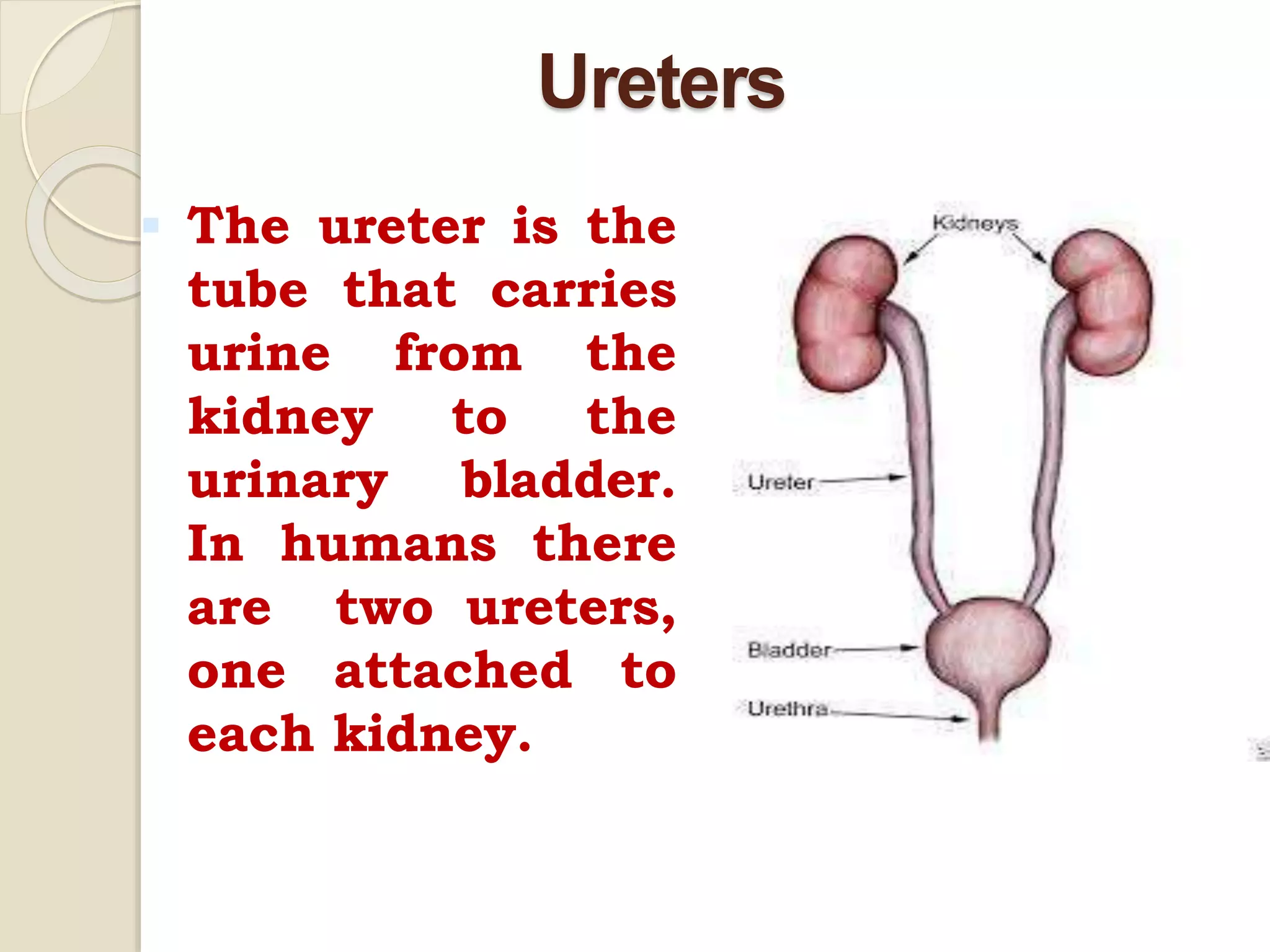
Ureters
 The ureter is the
tube that carries
urine from the
kidney to the
urinary bladder.
In humans there
are two ureters,
one attached to
each kidney.
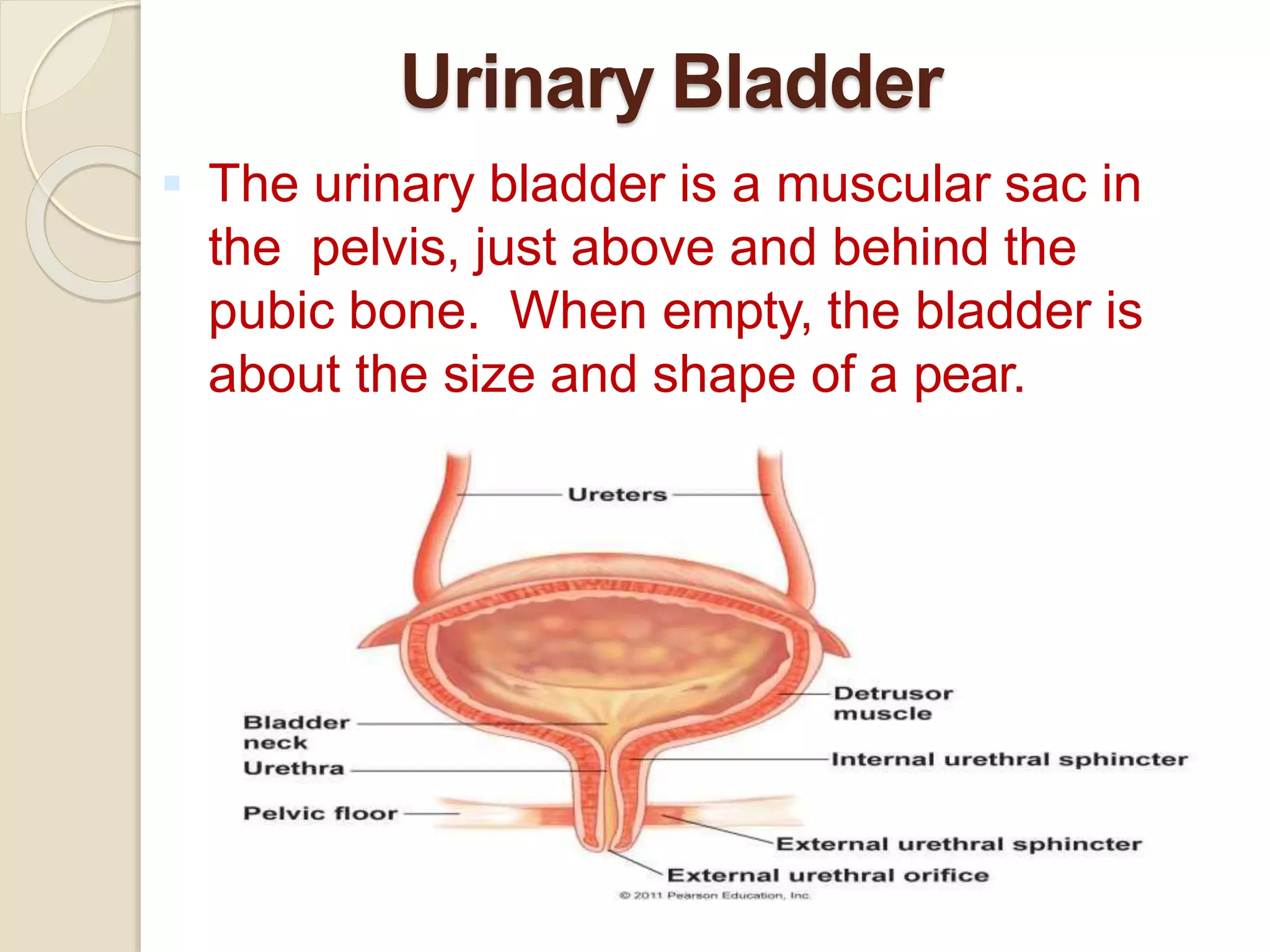
Urinary Bladder
 The urinary bladder is a muscular sac in
the pelvis, just above and behind the
pubic bone. When empty, the bladder is
about the size and shape of a pear.
Urinary Bladder
 Urine is made in the kidneys and travels
down through two tubes called ureters.
 Then the urine reaches the bladder.
 The bladder stores urine allowing
urination to be infrequent and voluntary.
 The normal capacity of the bladder is
400 to 600 ml.
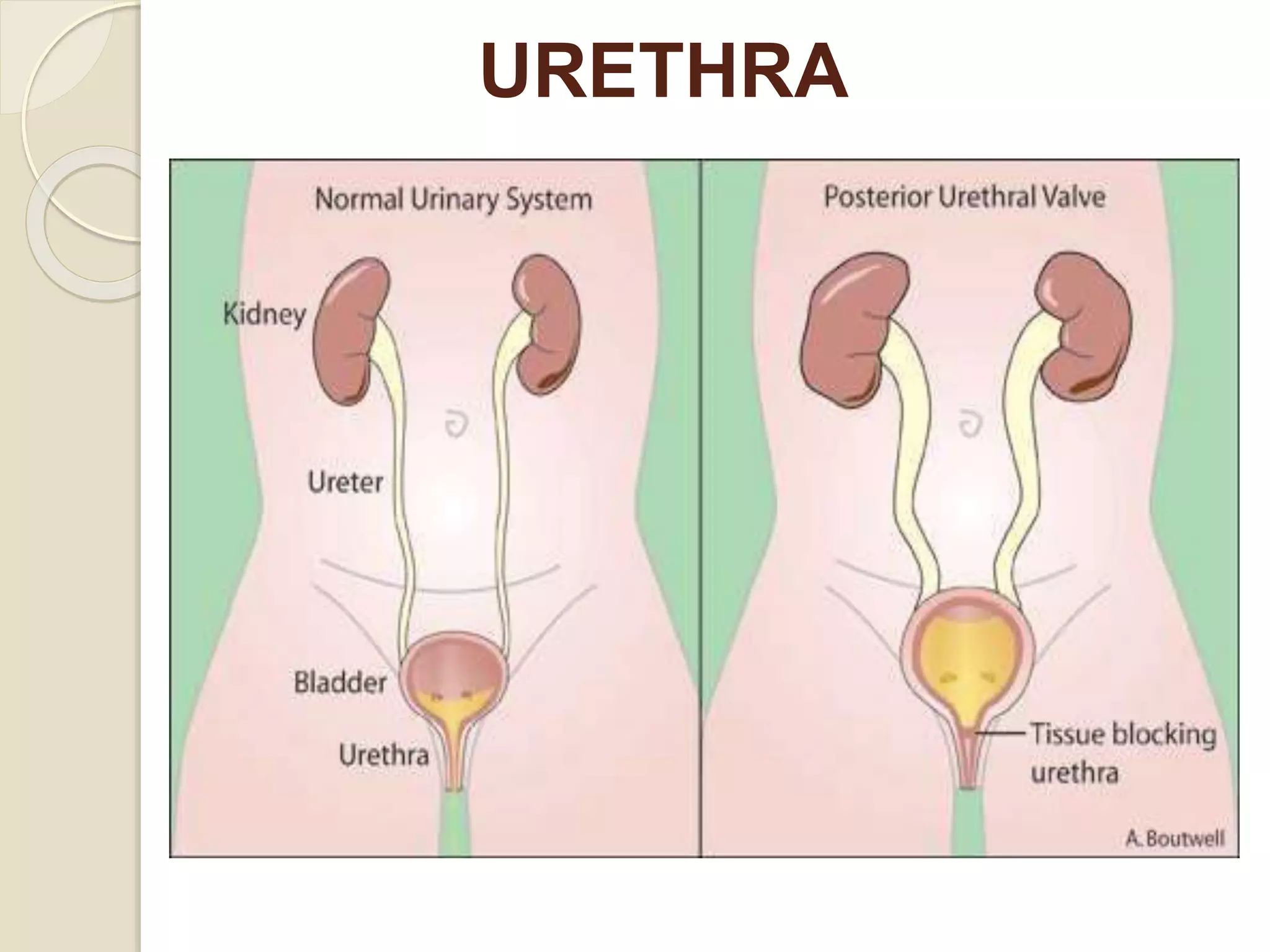
Urethra
 The bladder collects and stores urine until
when it is ready to be discharged through
the urethra.
 While the function remains the same for
both genders, slight differences exist due
to differences between male and female
genitals.
URETHRA
 Anuria: Absence of urine .
 Oliguria: Absence of urine output.
 Polyuria: Excess urine output.
 Bacteriuria: Bacteria in urine.
 Diuresis: Increased urine excretion.
 Dysuria: Painful or difficult urination.
Medical Terms Related To
Excretory System
Renal Failure
 Renal failure (also called as kidney
failure or renal insufficiency) is a
medical condition in which the
kidneys fail to filter waste products
adequately from the blood.
CONCLUSION
The excretory system is passive
biological system that removes
excess unnecessary wastes from an
organism, so as to help maintain
homeostasis within the organism and
prevent damage to the body.
It is responsible for the elimination of
waste product of metabolism as well
as other liquid and gaseous waste.
CONCLUSION
 The kidneys regulate the amount of water
, salts
and other substances in the blood.
 The kidneys are fist-sized, bean shaped
structures that remove nitrogenous wastes
(urine)and excess salts from the blood.
 The uretersare tubes that carryurine from the
pelvis of the kidneys to the urinary bladder.
Arunodoi Jr College
Tangla

Excretory system in Human (Class 10)

  • 1.
  • 2.
    INTRODUCTION  The humanexcretory system functions to remove waste from the human body.
  • 3.
    EXCRETORY SYSTEM Excretory systemconsist of following :  Liver  Lungs  Large intestine  Skin  Urinary system
  • 4.
    LIVER  It isa largest gland of the body.  It removes toxins from the blood.  Liver also produces bile.
  • 5.
    LUNGS  Filter outcarbon dioxide, from the blood.
  • 6.
    Large Intestine  Itcollects waste from throughout the body.  Extracts any remaining usable water and then  removes solidwaste.
  • 7.
    SKIN  Excretes sweatthrough sweat glands. Helps to keep the body cool when it is warm.
  • 8.
    Urinary System Photo Collectedfrom Human Physiology by Collins & Zenkins
  • 9.
    Urinary System It consistsof following structures:  Kidneys  Ureters  Urinary bladder  Urethra
  • 10.
    KIDNEY The kidneys area pair of bean-shaped organs on either side of our spine, below your ribs and behind the belly
  • 11.
  • 12.
    KIDNEYS  Kidneys liein the abdominal cavity below the diaphragm.  Kidneys are present on each side of the vertebral column.  Kidneys extend from the level of 12th thoracic vertebra to the 3rd lumbar vertebra.  The right kidney is usually slightly lower in position than the left.  Each kidney is about 11 cm long, 6 cm wide,  3 cm thick and weights about 125-170 gm.
  • 13.
    Organs associated withthe kidney  LEFT KIDNEY  Superiorly- the left adrenal gland.  Anteriorly- the spleen, stomach, jejunumand splenic flexure of the colon.  Posteriorly - the diaphragm and muscles of the posterior abdominalwall.
  • 14.
    STRUCTURE OF THEKIDNEY  Surrounding the kidney there is a Fibrous capsule.  A reddish brown layer of tissue is seen in the kidney called as Cortex.  The innermost layer consisting of pale conical shaped striations is called renal pyramids present in the Medulla.
  • 15.
     Hilum: Itis the concave medial border of the kidney where the renal blood and lymph vessels,  the ureter and nerves enter. It has a number of distal branches called calyces. The calyces are of two types. They are -  Major calyx  Minor calyx
  • 16.
    MICROSCOPIC STRUCTURE  Thekidney is composed of about one million functional units called Nephrons and collecting tubes.
  • 17.
    FUNCTIONS OF KIDNEY Formation of urine.  Simple filtration.  Selective reabsorption  Secretion  Water balance and urine output  Electrolyte balance
  • 19.
    BLOOD SUPPLY OFKIDNEY  Kidney needs constant supply of blood in order to control the composition of body fluids.  Renal artery, a branch from aorta enters the kidney at hilum.  It supplies blood, rich in nitrogenous waste, oxygen and nutrients.  Renal vein carries deoxygenated blood to the inferior vena cava and then to the heart.
  • 20.
  • 21.
  • 22.
    NEPHRON  Nephron Isthe basic structural and functional unit of the kidney. Its chief functions are :-  To regulate the concentration of water and soluble substances  Reabsorbing what is needed and excreting the rest as urine
  • 23.
    NEPHRON I. It eliminateswastes from the body II. It regulates blood volume and blood pressure III. It control levels of electrolytes and metabolites IV.It regulates blood pH.
  • 24.
    NEPHRON  Each nephronconsists of the following parts:  Glomerulus  Bowman’s capsule  Proximal Convulated Tubule  Loop of Henle  Distal Convulated Tubule  Collecting duct.
  • 25.
  • 26.
     Loop ofHenle: it consists of a descending limb which continues into the thin segment from which the thick ascending limb arises.  Distal convoluted Tubule: Thick ascending limb is continued with the distal convoluted tubule.  Collecting tubules: DCT joins to form the collecting tubules. PARTS OF NEPHRON
  • 27.
     Composition ofUrine  About 96% of the urine is water.  2% is salts, mainly sodium chloride.  Urea makes up 2% of Urine.  About 1.5 - 2.5 L urine is produced daily.
  • 28.
  • 29.
    FORMATION OF URINE The first step in urine formation is filteration of blood in the kidneys.  Nephron filter blood by regulating concentration of water and soluble substances like sodium salts.  Reabsorbing is needed at the end  before excreting the waste.
  • 30.
     Filtrate includeswater, small molecules and ions that can easily pass through filtration membrane.  Large molecules such as proteins and blood cells cannot pass through the membrane.  Amount of filtrate produced every minute is called glomerular filtration rate Or GFR.  Normal GFR = 125ml/ minute =170-180L/day
  • 31.
    Ureters  The ureteris the tube that carries urine from the kidney to the urinary bladder. In humans there are two ureters, one attached to each kidney.
  • 32.
    Urinary Bladder  Theurinary bladder is a muscular sac in the pelvis, just above and behind the pubic bone. When empty, the bladder is about the size and shape of a pear.
  • 33.
    Urinary Bladder  Urineis made in the kidneys and travels down through two tubes called ureters.  Then the urine reaches the bladder.  The bladder stores urine allowing urination to be infrequent and voluntary.  The normal capacity of the bladder is 400 to 600 ml.
  • 34.
    Urethra  The bladdercollects and stores urine until when it is ready to be discharged through the urethra.  While the function remains the same for both genders, slight differences exist due to differences between male and female genitals.
  • 35.
  • 36.
     Anuria: Absenceof urine .  Oliguria: Absence of urine output.  Polyuria: Excess urine output.  Bacteriuria: Bacteria in urine.  Diuresis: Increased urine excretion.  Dysuria: Painful or difficult urination. Medical Terms Related To Excretory System
  • 37.
    Renal Failure  Renalfailure (also called as kidney failure or renal insufficiency) is a medical condition in which the kidneys fail to filter waste products adequately from the blood.
  • 39.
    CONCLUSION The excretory systemis passive biological system that removes excess unnecessary wastes from an organism, so as to help maintain homeostasis within the organism and prevent damage to the body. It is responsible for the elimination of waste product of metabolism as well as other liquid and gaseous waste.
  • 40.
    CONCLUSION  The kidneysregulate the amount of water , salts and other substances in the blood.  The kidneys are fist-sized, bean shaped structures that remove nitrogenous wastes (urine)and excess salts from the blood.  The uretersare tubes that carryurine from the pelvis of the kidneys to the urinary bladder.
  • 41.